

North America Outage Management System Market Size & Forecast:
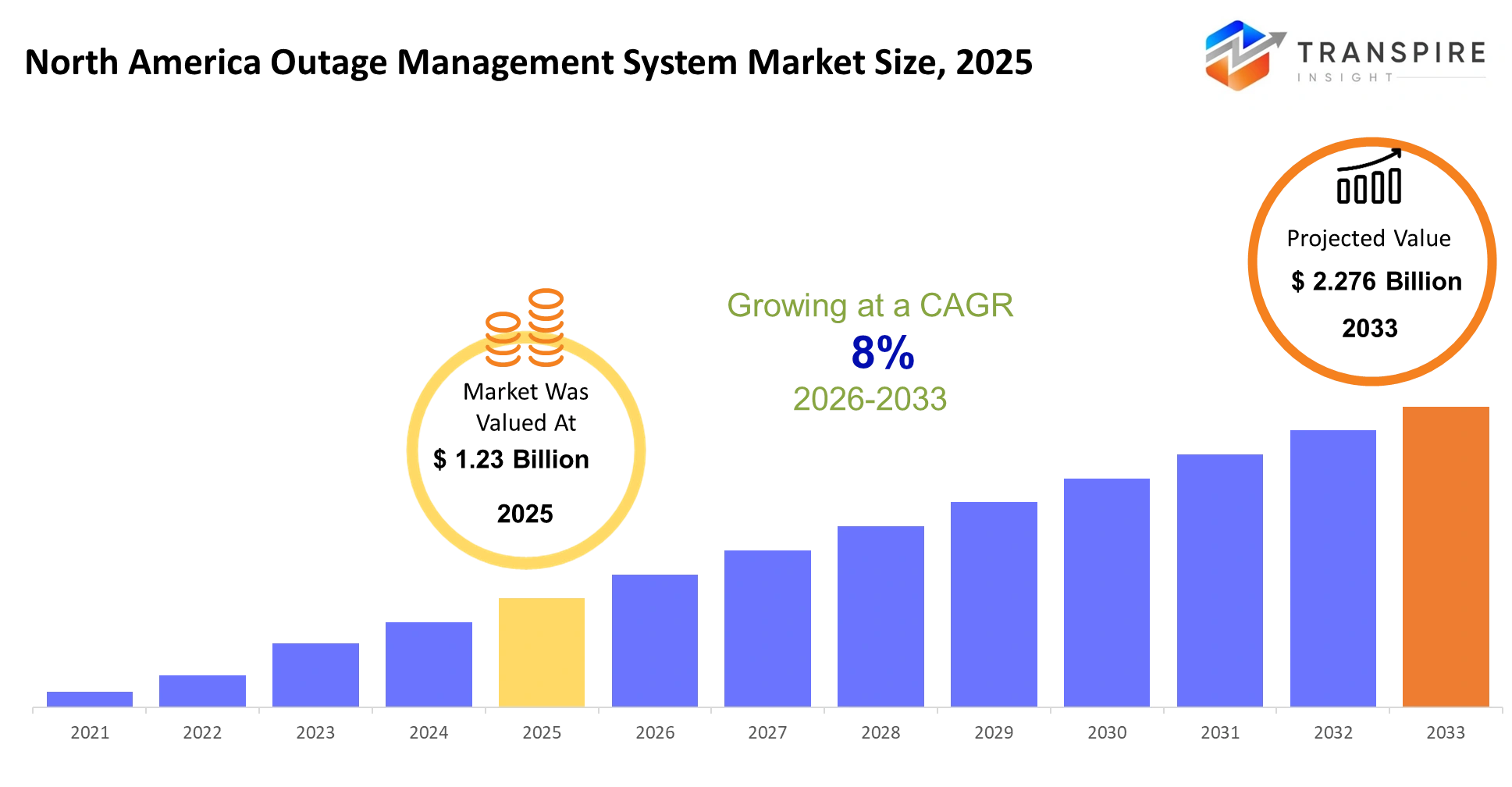
- North America Outage Management System Market Size 2025: USD 1.23 Billion
- North America Outage Management System Market Size 2033: USD 2.276 Billion
- North America Outage Management System Market CAGR: 8%
- North America Outage Management System Market Segments: By Component (Software, Hardware, Services, SCADA, Analytics, Others); By Deployment (Cloud, On-Premises, Hybrid, Utility-based, Edge, Others); By Application (Distribution Mgmt, Fault Detection, Restoration, Predictive Analytics, Others, Grid Mgmt); By End-User (Utilities, Energy, Govt, Industrial, Others, Smart Grid)
To learn more about this report,  Download Free Sample Report
North America Outage Management System Market Summary:
The North America Outage Management System Market size is estimated at USD 1.23 Billion in 2025 and is anticipated to reach USD 2.276 Billion by 2033, growing at a CAGR of 8% from 2026 to 2033.
The North America Outage Management System Market exists as a segment of the power and utilities sector which will develop better digital systems for managing electrical power networks. The United States and Canada utilities will use these systems to improve outage predictions and detection capabilities while providing customers with uninterrupted service.The need for faster service restoration and better service interruption information will push customers to require service providers to adopt systems that combine real-time data with mobile alerts and automated workflows.
The growing complexity of grid networks through renewable power and decentralized energy systems requires outage management tools to transition from traditional systems toward cloud-based analytics solutions. The regulatory authorities will demand increased reliability standards, which will require utilities to modernize their outdated operational systems. The integration of artificial intelligence with sensor network technologies will provide utilities with new capabilities to identify and address system faults, which will help them keep their services operational during emergencies.
What Has the Impact of Artificial Intelligence Been on the North America Outage Management System Market?
The North America outage management system market experiences rapid transformation through artificial intelligence which delivers advanced intelligence capabilities together with enhanced grid operational responsiveness. The North America outage management system market uses AI technology to enable utilities to manage large amounts of real-time information which they receive from smart meters and sensors and network devices, thus enhancing their ability to conduct market research and operational data examination.
Businesses can use machine learning together with predictive analytics to examine outage patterns while they evaluate risk factors and make faster decisions based on data. The market research shows that organizations currently move toward detecting outages before they occur and using automated systems to respond, which artificial intelligence systems in North America outage management system platforms, produce essential operational and reliability benefits.
The North America outage management system market benefits from smart automation integration which improves demand forecasting together with trend prediction.
The system predicts capacity requirements to decrease unscheduled downtime and service disruptions while enhancing operational efficiency throughout energy distribution systems. In addition, AI optimizes supply chain operations by improving inventory planning for spare parts and reducing operational costs through streamlined workforce deployment and automated workflows.
The new developments improve customer satisfaction levels while improving the strength and agility of the energy system. The North American outage management system market will experience rapid growth because artificial intelligence technology advances machine learning systems and sophisticated data analysis tools and because power systems require advanced technology to operate more efficiently.
Key Market Trends & Insights:
- The North American outage management system market will reach 38% market share in 2025 due to advanced grid systems and high utility investments.
- The United States leads regional demand because it adopted smart grid technology early and has many major utility technology providers operating in the country.
- Through 2030 Canada will experience the fastest growth because of its renewable energy projects and government-sponsored grid modernization programs.
- The North America outage management system market will reach 55% market share in 2025 because software solutions provide advanced analytics platforms that customers increasingly demand.
- The services segment controls the second-largest market share because utilities implementing digital transformation require integration and maintenance and consulting services.
- The fastest-growing segment of the market consists of cloud-based outage management systems which achieve a compound annual growth rate above 10percent because these systems offer advantages of scalability and cost efficiency and remote accessibility.
- Public utilities dominate applications with over 60% market share because these organizations expand their investments in smart grid reliability and outage response automation.
- Electric utility companies control approximately 65% of the North American outage management system market because they operate extensive infrastructure networks.
- The municipal and cooperative utility sector represents the most rapidly expanding user group because modernization funding together with digital adoption projects supports their growth.
- The main industry players comprise General Electric together with Schneider Electric, Siemens, Oracle and IBM.
North America Outage Management System Market Segmentation
By Component :
The North America Outage Management System Market demonstrates distinct operational components through its component classification system, which designates software as the primary element for processing data and monitoring outages and displaying information. The hardware components deliver essential support for communication networks and field devices which enables reliable data transmission throughout the grid system. The company provides three types of services which include system integration maintenance and consulting services to help utilities operate their systems efficiently without disrupting their business activities.
Supervisory Control and Data Acquisition systems enable electrical network real-time monitoring and control which increases outage response efficiency. Analytics adds value through its capacity to interpret data which produces pattern recognition and improved planning capabilities. The combined component interactions enable utilities to make decisions more quickly while bettering grid operational reliability and decreasing system downtime and inefficiencies throughout their service networks.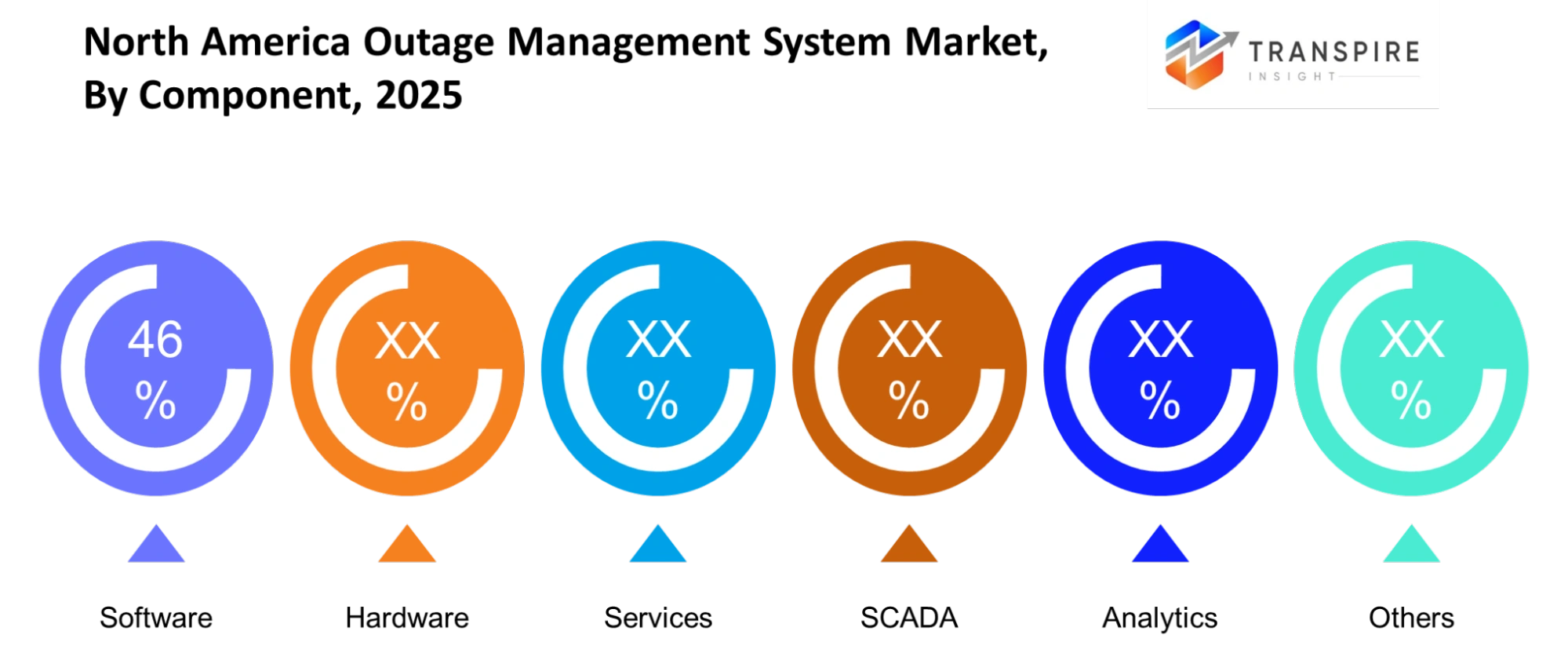
To learn more about this report, Download Free Sample Report
By Deployment :
The North America Outage Management System Market presents different deployment types that match the distinct operational requirements of their current infrastructure level. The cloud deployment model delivers better scalability through its remote access capabilities which enable rapid system updates while requiring lower initial costs. Organizations that need to comply with strict regulations and protect sensitive data choose on-premises systems because those systems give them complete control over their data.
The hybrid model combines the benefits of cloud computing and on-premises systems which enables organizations to transition their operations in a flexible manner. Utility-based deployment allows power distribution companies to match their grid requirements with customized operational capabilities. Edge deployment allows local data processing to occur at locations that are close to data sources which results in reduced latency times while enhancing grid outage handling in both remote areas and critical grid sites.
By Application :
North America Outage Management System Market deployment types reflect varying operational needs and infrastructure maturity.Cloud deployment enables organizations to expand their operations while accessing their systems from remote locations, which enables them to implement software updates more rapidly and to maintain lower initial costs. On-premises systems give organizations complete control over their sensitive information which makes them the preferred choice for organizations that must follow strict regulations and operate with outdated systems.
Hybrid models combine advantages of both cloud and on-premises setups, allowing gradual transition and flexibility. The utility-based deployment method delivers customized performance according to the specific needs of the grid system. Edge deployment enables faster local processing near data sources, reducing latency and improving outage response time, especially in remote or critical grid locations.
By End-User :
The North America Outage Management System market shows different adoption patterns among its end-user segments, which include organizations that depend on constant electricity supply. Utilities are the primary users who require systems that help them deliver continuous service while improving their ability to handle outages. The energy sector uses these systems to achieve better coordination between power generation and electricity distribution operations.
Government bodies adopt outage management solutions to strengthen public infrastructure and emergency response systems. Industrial users need electricity to flow without interruption because their production processes rely on continuous power supply which makes outage management crucial for their expense management. Smart grid technology combines cutting-edge innovations with automated systems that enable electricity networks to conduct real-time tracking and enhanced communication.
What are the Main Challenges for the North America Outage Management System Market Growth?
The North America outage management system market development faces multiple technical and operational difficulties which prevent it from reaching its complete potential. Utilities frequently encounter difficulties when they attempt to merge their existing grid systems with contemporary outage management systems, leading to separate data storage and operational inefficiencies. The system experiences operational difficulties because of two main problems: first, it cannot achieve system interoperability and second, it involves processing real-time information from several data sources.
The North America outage management system market faces commercialization difficulties which result from the high costs associated with system implementation and ongoing system maintenance. Organizations must spend substantial funds on software, hardware and security systems to implement advanced outage management systems.
The operational expenses and implementation timelines of grid security regulations, data protection rules and industry standards requirements create extra challenges for organizations. The North America outage management system market development faces market constraints which prevent smaller utilities from implementing new technologies because these organizations experience extended innovation cycles.
Adoption challenges also play a critical role in shaping the North America outage management system market. Many utilities, particularly smaller or municipal providers, lack the skilled workforce required to manage AI-driven and data-intensive systems. The adoption rate of digital technologies gets restricted because certain areas have limited digital infrastructure and budget constraints. The north america outage management system market experiences growth disparities because funding gaps and uneven modernization initiatives create differences between regions.
Country Insights
The electricity demand continues to increase while the grid system experiences more frequent power interruptions. The outage management systems which utilities in North America now use display better outage situations and speed up their response operations. Power infrastructure digital transformation enables system upgrades which help operators identify faults and create restoration plans without experiencing operational delays.
The company's growth demonstration shows that it now prioritizes both customer satisfaction and regulatory requirement compliance. The utility companies make more investments in sophisticated software systems because they want to minimize service interruptions while delivering precise information about power outages.The utility companies use smart grid technology and real-time data systems to enhance their operational capabilities which enables them to deliver uninterrupted service during emergency situations.
The region's development depends on technological progress because utility companies implement cloud solutions and analytics software. The combination of technology partners and energy businesses drives innovation forward whereas governmental policies promote modernization initiatives. The combination of these elements guarantees that North America will continue to expand its outage management systems which require implementation throughout the region.
Recent Development News
In April 2026, Oracle Corporation announced enhancements to its cloud-based utility outage management solutions. The update uses artificial intelligence analytics to enhance North American utility providers' ability to predict outages and restore power during outages.
Source https://www.oracle.com/
In March 2026, Siemens AG reported continued investment in digital grid and outage management technologies throughout North America. The company developed its outage management systems through artificial intelligence and automation technologies to help utilities which need to operate their increasingly complex and reliable grid systems. Source https://www.siemens.com/
|
Report Metrics |
Details |
|
Market size value in 2025 |
USD 1.23 Billion |
|
Market size value in 2026 |
USD 1.328 Billion |
|
Revenue forecast in 2033 |
USD 2.276 Billion |
|
Growth rate |
CAGR of 8% from 2026 to 2033 |
|
Base year |
2025 |
|
Historical data |
2021 - 2024 |
|
Forecast period |
2026 - 2033 |
|
Report coverage |
Revenue forecast, competitive landscape, growth factors, and trends |
|
Regional scope |
North America (Canada, The United States, and Mexico) |
|
Key company profiled |
Oracle, GE, Siemens, Schneider Electric, IBM, ABB, Eaton, Cisco, Microsoft, SAP, Hitachi, Honeywell, Itron, Landis+Gyr, Open Systems |
|
Customization scope |
Free report customization (country, regional & segment scope). Avail customized purchase options to meet your exact research needs. |
|
Report Segmentation |
By Component (Software, Hardware, Services, SCADA, Analytics, Others); By Deployment (Cloud, On-Premises, Hybrid, Utility-based, Edge, Others); By Application (Distribution Mgmt, Fault Detection, Restoration, Predictive Analytics, Others, Grid Mgmt); By End-User (Utilities, Energy, Govt, Industrial, Others, Smart Grid) |
How Can New Companies Establish a Strong Foothold in the North America Outage Management System Market?
New entrants to the North American outage management system market must define their target market segment and develop a unique value proposition. Businesses should focus their efforts on solving specific customer problems, which include outage management for smart cities and renewable energy grid reliability, and critical sector resilience methods used by healthcare and manufacturing industries.
Utilities require specialized scalable platforms that work with their existing systems which drives this industry trend. New players in the North American outage management system market can build their competitive advantage by targeting market segments with the greatest growth prospects.
The North American outage management system market depends on innovation as its primary driver for market entry. Startups that use advanced technologies like AI-based predictive analytics and cloud-native systems, and real-time data visualization tools can achieve better results in detecting outages and restoring service. Uptake Technologies demonstrates how predictive analytics improves asset performance while AutoGrid shows how artificial intelligence optimizes grid management. The innovation strategies assist companies in achieving better operational efficiency which results in cost reductions that improve their market competitiveness.
The north america outage management system market needs both strategic partnerships and ecosystem integration to achieve successful results. New companies can establish credibility and accelerate business growth by partnering with utilities, technology companies, and government agencies. The product value increases through its integration with smart grid platforms, IoT devices and cybersecurity frameworks, which also helps to establish permanent user adoption.
Key North America Outage Management System Market Company Insights
North America Outage Management System Market demonstrates constant development which results from growing need for dependable power distribution together with quick power restoration during grid outages. The need for utilities to reduce downtime while delivering better customer service drives increased adoption of modern outage management solutions. The market development and operational performance improvements throughout the region continue to progress through the integration of smart grid systems and real-time data analytics capabilities.
The demand for outage management systems will remain steady because of utilities focus on modernizing power grids and improving their digital systems. Utilities will spend money on systems that automatically identify faults and respond to them to decrease service interruptions. The increasing urban population together with rising energy needs will create more demand for effective solutions to manage power outages.
The adoption of cloud-based solutions will grow because these solutions offer both flexible operation and affordable costs. The advanced analytics, together with AI-driven insights, will enable utilities to forecast outages while enhancing their emergency response capabilities. The market will grow as regulatory policies that promote grid reliability create new business opportunities for solution providers working with utility companies.
Main businesses use their partnerships and product development, and their growth into new areas to increase their competitive advantage. Companies invest in advanced software platforms that offer real-time monitoring and predictive maintenance. The competitive environment maintains its active state because companies focus on improving system accuracy, reducing response time, and developing scalable solutions for utility needs.
Company List
- Oracle
- GE
- Siemens
- Schneider Electric
- IBM
- ABB
- Eaton
- Cisco
- Microsoft
- SAP
- Hitachi
- Honeywell
- Itron
- Landis+Gyr
- Open Systems
What are the Key Use-Cases Driving the Growth of North America Outage Management System Market?
The North America outage management system market is expanding rapidly because it enables utilities to increase grid reliability and operational efficiency. The utilities sector uses advanced analytics and smart sensors to detect outages in real-time and handle restoration through efficient crew deployment. The system decreases downtime which leads to better customer experiences hence it serves as the main reason customers adopt the North American outage management system.
Predictive maintenance and asset management represent an essential use case that drives the development of the North American outage management system market. The utilities sector applies machine learning models to predict equipment failures while they develop maintenance schedules which help them decrease unexpected outages and save operational expenses. The method becomes essential for renewable energy integration because solar and wind sources provide variable energy which needs real-time grid management.
The north america outage management system market is expanding in essential fields like healthcare and manufacturing which require continuous power supply for their operations. Hospitals use outage management systems to ensure their backup power systems remain operational while protecting patient safety. Manufacturing facilities use these systems to prevent costly production disruptions. The adoption of smart city projects is increasing as municipalities implement integrated platforms that enable them to monitor power grids in real time and respond quickly to power outages.
North America Outage Management System Market Report Segmentation
By Component
- Software
- Hardware
- Services
- SCADA
- Analytics
By Deployment
- Cloud
- On-Premises
- Hybrid
- Utility-based
- Edge
By Application
- Distribution Mgmt
- Fault Detection
- Restoration
- Predictive Analytics
- Grid Mgmt
By End-User
- Utilities
- Energy
- Govt
- Industrial
- Smart Grid
Frequently Asked Questions
Find quick answers to common questions.
The Approximate North America Outage Management System Market size for the Market will be USD 2.276 Billion in 2033.
Key Segments for the North America Outage Management System Market are By Component (Software, Hardware, Services, SCADA, Analytics, Others); By Deployment (Cloud, On-Premises, Hybrid, Utility-based, Edge, Others); By Application (Distribution Mgmt, Fault Detection, Restoration, Predictive Analytics, Others, Grid Mgmt); By End-User (Utilities, Energy, Govt, Industrial, Others, Smart Grid).
Major North America Outage Management System Market Players are Oracle, GE, Siemens, Schneider Electric, IBM, ABB, Eaton, Cisco, Microsoft, SAP, Hitachi, Honeywell, Itron, Landis+Gyr, Open Systems.
The Current North America Outage Management System Market size is USD 1.23 Billion in 2025.
The North America Outage Management System Market CAGR is 8%.
- Oracle
- GE
- Siemens
- Schneider Electric
- IBM
- ABB
- Eaton
- Cisco
- Microsoft
- SAP
- Hitachi
- Honeywell
- Itron
- Landis+Gyr
- Open Systems
Recently Published Reports
-
Apr 2026
3D Optical Profiler Market
3D Optical Profiler Market Size, Share & Analysis Report By Type (Desktop 3D Optical Profiler, and Portable 3D Optical Profiler), By Technology (Confocal Technology, and White Light Interference), By End-Use Industry (Manufacturing, Research Institutions, Automotive, Aerospace and Defense, Medical Devices, and Other), and Geography (North America, Europe, Asia-Pacific, Middle East and Africa, South and Central America), 2021 - 2031
-
Feb 2025
Depth Sensor Market
Depth Sensor Market Size, Share & Analysis Report By Type (Infrared Depth Sensors, Time-of-Flight (ToF) Sensors, Stereo Vision Sensors, Structured Light Sensors, Ultrasonic Depth Sensors), By Application (Automotive, Robotics, Gaming, Consumer Electronics, Industrial Automation, Healthcare, Security & Surveillance, Others), By End Users (Automotive Manufacturers, Consumer Electronics Companies, Healthcare Providers, Industrial Companies, Security Agencies, Gaming Companies, Robotics Companies, Others), and Geography (North America, Europe, Asia-Pacific, Middle East and Africa, South and Central America), 2021 – 2031
-
Feb 2025
Digital Manufacturing Market
Digital Manufacturing Market Size, Share & Analysis Report By Component (Hardware, Software, and Services), By Technology (Robotics, 3D Printing, Internet of Things (IoT), and Others), By Application (Automotive and Transportation, Aerospace and Defense, Consumer Electronics, Industrial Machinery, and Others), By Process Type (Computer-Based Designing, Computer-Based Simulation, Computer 3D Visualization, Analytics, and Others), and Geography (North America, Europe, Asia-Pacific, Middle East and Africa, South and Central America), 2021 – 2031
-
Feb 2025
Digital Visa Services Market
Digital Visa Services Market Size, Share & Analysis Report By Type (Individual Travelers, Group Travelers), By Application (Tourism, Business Travel, Others), and Geography (North America, Europe, Asia-Pacific, Middle East and Africa, South and Central America), 2021 – 2031