
North America Military Rotorcraft Market Size & Forecast:
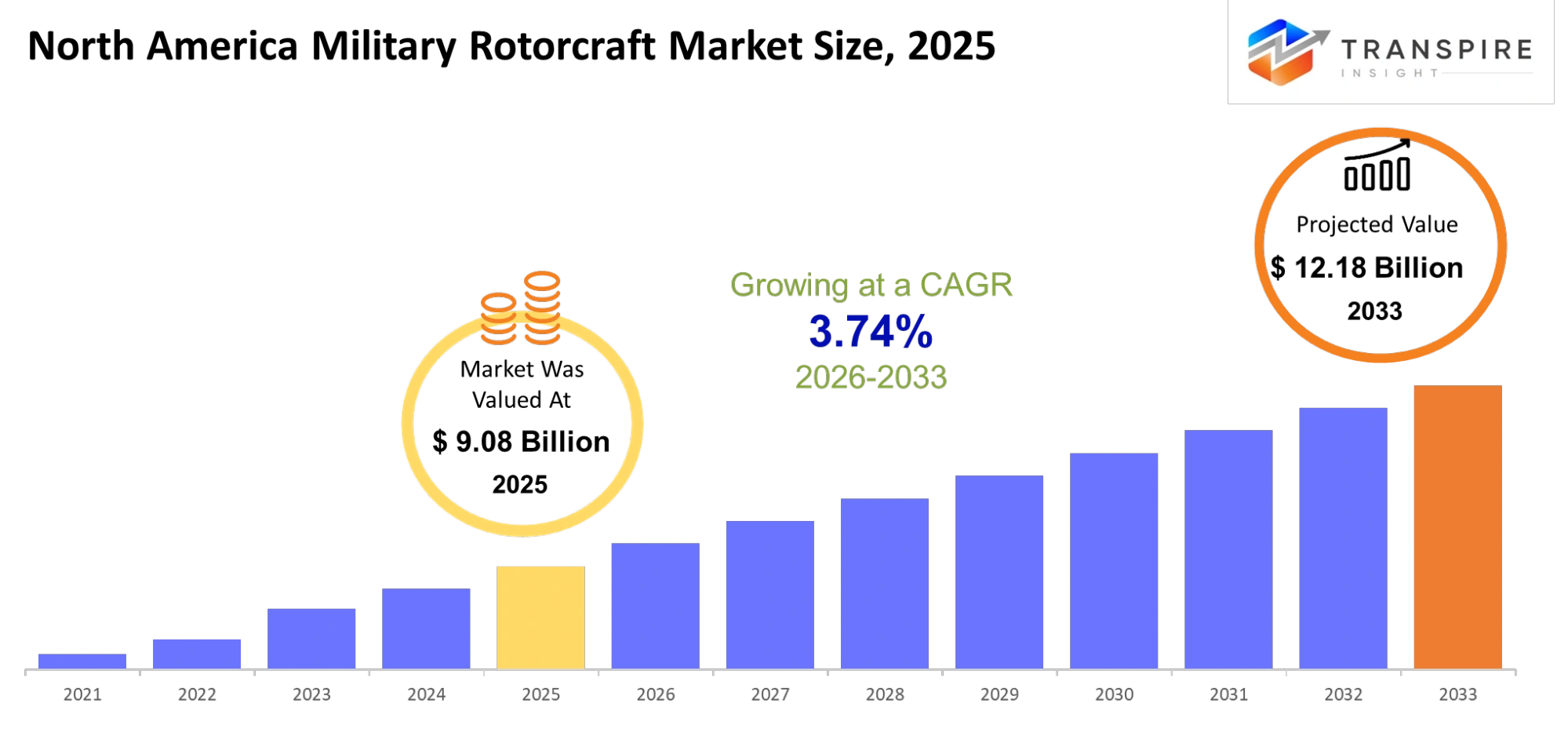
- North America Military Rotorcraft Market Size 2025: USD 9.08 Billion
- North America Military Rotorcraft Market Size 2033: USD 12.18 Billion
- North America Military Rotorcraft Market CAGR: 3.74%
- North America Military Rotorcraft Market Segments: By Type (Attack Helicopters, Transport Helicopters, Utility Helicopters, Others, Naval, Reconnaissance), By Application (Defense, Search & Rescue, Transport, Others, Combat, Surveillance), By Component (Engine, Avionics, Airframe, Others, Weapons, Systems), By End-User (Military, Navy, Air Force, Others, Defense Agencies, Govt).
To learn more about this report,  Download Free Sample Report
North America Military Rotorcraft Market Summary:
The North America Military Rotorcraft Market size is estimated at USD 9.08 Billion in 2025 and is anticipated to reach USD 12.18 Billion by 2033, growing at a CAGR of 3.74% from 2026 to 2033. The North America Military Rotorcraft Market is growing because defense budgets are increasing and military organizations require improved aerial combat and transportation capabilities.
The region's governments are making significant investments to upgrade their helicopter fleets through the implementation of modern technologies which include better avionics systems and stealth capabilities and increased payload capacities. The rotorcraft missions include troop transportation search and rescue operations and surveillance and tactical operations.
The demand for rotorcraft which can perform multiple operations has increased market growth because geopolitical conflicts are changing.
The North America Military Rotorcraft Market is experiencing growth because defense organizations now require helicopters which can perform multiple missions in various operational environments. The development of autonomous flight systems and advanced communication networks has resulted in increased operational efficiency and enhanced safety measures. The defense agencies and aerospace manufacturers have established partnerships which enable them to increase their research and development and manufacturing capabilities. The market maintains its active nature through modernization programs and strategic partnerships which create a competitive environment while meeting upcoming defense needs.
What Has the Impact of Artificial Intelligence Been on the North America Military Rotorcraft Market?
North American military rotorcraft operations experience total transformation through artificial intelligence which delivers precise data-based solutions for all decision-making processes and operations activities. The North American military rotorcraft market uses artificial intelligence to conduct market research through its advanced data evaluation capabilities which assist stakeholders in tracking market developments and mission requirements with improved precision.
Defense organizations can enhance their demand forecasting abilities through machine learning and predictive analytics while also forecasting procurement cycles and matching their spending plans with upcoming battlefield requirements. The North American military rotorcraft market increasingly adopts artificial intelligence technology which enhances strategic planning processes and enables defense operations to respond effectively to changing situations.
AI-powered automation solutions which use intelligent systems are creating new opportunities for improved production efficiency and better supply chain operations throughout the North American military rotorcraft sector. North American military rotorcraft manufacturers use artificial intelligence technology to improve their assembly operations by decreasing production delays and managing their resources more effectively which results in major cost savings.
The use of machine learning for predictive maintenance helps organizations decrease operational hazards while increasing rotorcraft lifespan performance. AI technologies drive progress in autonomous flight systems together with mission-specific flight system development which creates a powerful competitive edge for companies. The North American military rotorcraft market is evolving into a more resilient defense system which uses advanced technologies to support its next-generation defense capabilities.
Key Market Trends & Insights:
- The north america military rotorcraft market is experiencing substantial growth because both the U.S. and Canada are implementing modernization initiatives and increasing their defense budgets.
- The north america military rotorcraft market uses artificial intelligence to enable predictive maintenance which decreases operational downtime by 25% while enhancing fleet readiness.
- The demand for multi-role helicopters is increasing because 60% of new acquisitions between 2021 and 2026 will focus on helicopters that can perform various missions.
- Military rotorcraft systems are achieving better operational performance and mission accuracy through the use of intelligent automation systems together with advanced avionics technology.
- The growing demand for lightweight materials together with fuel-efficient engine technology enables better performance while decreasing product lifecycle expenses by 15 to 20 percent.
- The United States military rotorcraft market leads North America with 85 percent market share because of its substantial defense spending which will reach 2025.
- The fastest expanding region in Canada will experience a compound annual growth rate of more than 5 percent throughout the forecast period because of its ongoing fleet upgrades.
- Multi-role helicopters dominate with more than 55 percent market share because they provide operational flexibility for combat and transportation and reconnaissance activities.
- The second largest market segment consists of attack helicopters which hold approximately 25 percent market share because defense modernization efforts continue.
- The unmanned rotorcraft systems market will experience substantial growth between 2025 and 2032 because of increasing autonomous system capabilities.
- The military transport sector holds the largest share of applications with 40 percent because it meets both troop mobility and logistics needs.
- The intelligence, surveillance, and reconnaissance (ISR) application area is expanding most rapidly because there is a growing demand for immediate battlefield intel.
North America Military Rotorcraft Market Segmentation
By Type
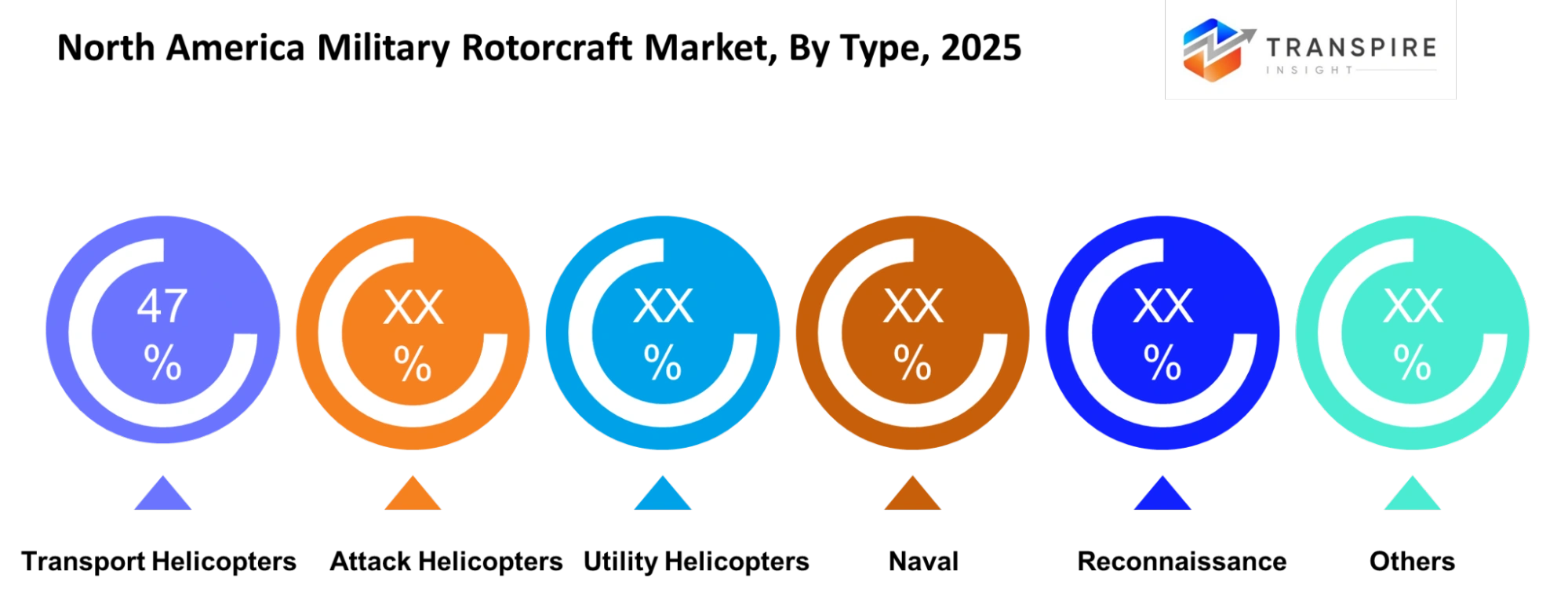
Attack helicopters use their advanced weaponry and targeting systems together with their durable armor to execute their combat missions. Transport helicopters enable troop movement and logistics operations while providing rapid deployment capabilities across all types of terrain with their ability to carry heavy loads. Utility helicopters use their flexible design to perform multiple missions which include medical evacuation and rescue operations and light transportation activities.
Naval and reconnaissance rotorcraft use their unique sensors and mission equipment to protect maritime areas and collect intelligence information. The need for multi-role capabilities will increase military operations that require utility and transport helicopters to handle various tasks. The naval variants will become more important because of the rising need for maritime security and coastal surveillance operations.
The development of advanced surveillance systems together with data collection technologies will enable the expansion of reconnaissance rotorcraft capabilities. The demand for various aircraft types will stay the same because military operations require both fleet upgrades and expanded missions.
To learn more about this report, Download Free Sample Report
By Application
The defense sector requires lead materials because ongoing national security investments and mission readiness efforts require these resources. The military uses rotorcraft during combat missions to execute precision strikes and provide close air support while enabling rapid conflict zone response. The military uses transport applications to move equipment and personnel between critical sites and remote locations.
Rotorcraft serve as essential tools for search and rescue operations because they deliver immediate assistance during disaster situations which occur in extreme environments. The need for real-time intelligence and border monitoring has led to increased interest in surveillance applications. The demand for combat and defense positions will persist because security threats continue to evolve.
The development of disaster management programs and emergency response plans will lead to more search and rescue operations being conducted. The transport industry will continue to expand because organizations require their personnel to transport equipment between different sites while keeping their emergency response capabilities operational.
By Component
Engines provide the necessary power to operate aviation systems while delivering optimal fuel consumption and enhanced operational capacity for extended flight durations. The digital technologies used in avionics systems provide advanced capabilities which enable better navigation and communication functions while improving mission execution accuracy.
Airframes provide structural strength and durability through their lightweight design which enhances fuel efficiency and allows better aircraft control. The combination of weapons systems and integrated systems enables military forces to achieve combat success through accurate targeting and advanced protective systems.
The operational efficiency of systems will see improvements through development of new avionics systems which also enhance safety standards. Engine upgrades will support better fuel consumption and longer operational range. Airframe innovations using lightweight materials will reduce maintenance costs and improve durability. The military organization will achieve mission success through continuous integration of advanced systems which will enhance both performance and mission dependability.
By End User
Military operations continue to use most of their resources because they require aerial vehicles for their combat and transport and surveillance missions. The Air Force depends on rotorcraft to provide quick deployment and logistical support and tactical assistance across different operational conditions. The naval military uses dedicated rotorcraft for missions that include maritime patrol and anti-submarine warfare and coastal security operations. Defense agencies and government bodies support additional roles such as disaster response and border monitoring.
Rising defense budgets will support increased procurement across military and air force segments. The naval sector will experience growth because countries will increase their efforts to protect maritime areas and maintain regional security. Government and defense agencies will expand usage for emergency response and homeland security needs. The current user requirements will stay constant because the organization continues to modernize its systems and increase its operational capabilities.
What are the Main Challenges for the North America Military Rotorcraft Market Growth?
The north america military rotorcraft market experiences multiple technical and operational obstacles which impede its growth progress. Advanced rotorcraft systems need precise engineering work, but their performance capabilities still deal with payload limits and fuel efficiency issues. The system requires multiple complex components which include avionics and AI systems and mission equipment to complete development through testing process.
Supply chain interruptions which affect vital parts like semiconductors and special alloys continue to create production obstacles which impede growth in the north american military rotorcraft industry. The north american military rotorcraft market faces manufacturing and commercialization obstacles which stem from excessive production expenses and mandatory compliance with detailed regulatory requirements.
Defense and safety regulations require defense contractors to spend additional time on development while increasing their testing and certification expenses. The limited number of dedicated manufacturing centers and expert workforce increases the difficulties involved in production operations. The existing market restrictions together with rising raw material prices and inflationary pressures create challenges for manufacturers who want to expand their operations while keeping their prices competitive.
The north american military rotorcraft market development process faces major obstacles because of challenges related to technology adoption. Maintenance and repair abilities represent a major infrastructure shortcoming which prevents deployment in remote areas and extreme weather conditions. The advanced rotorcraft systems require trained personnel to operate them which has emerged as a critical barrier to their widespread deployment. The defense sectors experience budget restrictions which result in funding deficiencies that create delays in defense procurement processes which in turn impede market growth.
Country Insights
The United States leads regional demand because of its high defense expenditures and superior aerospace development capabilities and ongoing aircraft fleet upgrades. Steady growth is maintained by the business's significant investment in developing next-generation rotorcraft
and its dedication to achieving combat readiness. The presence of leading manufacturers together with their continuous technological advancements will create enduring market stability throughout the entire area.
Canada demonstrates continuous development through its efforts to modernize outdated rotorcraft fleets and enhance operational performance. The defense modernization program together with joint program participation will receive government support which will result in gradual program expansion. The demand for services will remain stable because of operational needs which include surveillance activities and transport operations and rescue missions that take place in extensive remote areas.
Mexico exhibits minimal yet growing demand which security operations and border surveillance requirements are driving. Budget restrictions will delay extensive defense procurement activities, but the military will proceed with defense budget increases for infrastructure development. The combined efforts of regional partners to modernize their systems will drive progress throughout North America.
Recent Development News
In April 2026, Boeing Expands Chinook Production with Additional U.S. Army Order: Boeing confirmed a new order for CH-47F Block II Chinook helicopters, reinforcing production continuity and enhancing battlefield logistics capabilities. The contract supports long-term rotorcraft deployment plans.
Source: https://www.boeing.com
In April 2026, U.S. Army Plans Retirement of Older Helicopters to Fund New Aircraft Procurement: The U.S. Army announced plans to retire legacy rotorcraft models, including older Black Hawk variants, to redirect funding toward next-generation platforms. This strategic shift highlights modernization priorities in rotorcraft fleets.
Source: https://www.flightglobal.com
|
Report Metrics |
Details |
|
Market size value in 2025 |
USD 9.08 Billion |
|
Market size value in 2026 |
USD 9.42 Billion |
|
Revenue forecast in 2033 |
USD 12.18 Billion |
|
Growth rate |
CAGR of 3.74% from 2026 to 2033 |
|
Base year |
2025 |
|
Historical data |
2021 – 2024 |
|
Forecast period |
2026 – 2033 |
|
Report coverage |
Revenue forecast, competitive landscape, growth factors, and trends |
|
Country scope |
North America (Canada, The United States, and Mexico) |
|
Key company profiled |
Lockheed Martin, Boeing, Airbus, Leonardo, Bell Textron, Sikorsky, Northrop Grumman, BAE Systems, Honeywell, Safran, Rolls-Royce, General Electric, Elbit Systems, Rheinmetall, Thales |
|
Customization scope |
Free report customization (country, regional & segment scope). Avail customized purchase options to meet your exact research needs. |
|
Report Segmentation |
By Type (Attack Helicopters, Transport Helicopters, Utility Helicopters, Others, Naval, Reconnaissance), By Application (Defense, Search & Rescue, Transport, Others, Combat, Surveillance), By Component (Engine, Avionics, Airframe, Others, Weapons, Systems), By End-User (Military, Navy, Air Force, Others, Defense Agencies, Govt). |
How Can New Companies Establish a Strong Foothold in the North America Military Rotorcraft Market?
The north american military rotorcraft market needs new companies to establish their market position through specialized niche operations which address particular operational needs. The north american military rotorcraft market needs innovative lightweight materials and AI-enabled avionics and cost-effective manufacturing processes as essential elements for its entry strategies. The company should focus its business operations on unmanned rotorcraft support systems and predictive maintenance tools which enhance fleet operational efficiency according to their business model.
The company Shield AI develops autonomous flight technologies which decrease pilot requirements while increasing operational safety during missions. The defense sector needs our research work because it helps new organizations to build credibility in their operations during complex regulatory conditions.
The north american military rotorcraft market needs companies to establish partnerships with established aerospace and defense contractors to develop their business operations. The company Boeing and Lockheed Martin and Sikorsky provide testing facilities and certification pathways and supply chain networks which smaller firms can access through their partnership. The alliances between different organizations help companies in the north american military rotorcraft market to enter the market more easily while they accelerate the process of testing their products.
Defense technology companies can achieve rapid growth through the business model used by Anduril Industries which combines artificial intelligence with sensor technology and defense system integration capabilities. The military system requirements determine which technologies should be used in defense collaborations to increase their implementation possibility.
Technological innovation serves as the primary method which businesses use to compete in the north american military rotorcraft market. The companies that focus their resources on smart automation and machine learning technologies and advanced predictive analytics systems will achieve competitive superiority throughout their business operations.
Key North America Military Rotorcraft Market Company Insights
The north america military rotorcraft market displays intense rivalry because major defense contractors compete through their development of cutting-edge technologies and their procurement of extended government contracts. The leading companies allocate their resources to develop new technologies which will enhance their existing flight systems and their operational efficiency. Defense spending increases will create persistent competition which will drive technological advancements throughout the entire region.
The north america military rotorcraft market includes Boeing Lockheed Martin Sikorsky RTX Corporation Bell Textron Northrop Grumman and Leonardo as its main market participants. The companies develop advanced rotorcraft technology which enables better fuel efficiency and higher payload capacity and includes complete digital system integration. The companies will maintain their competitive edge through their strong government connections and their ability to establish long-term procurement agreements.
The north america military rotorcraft market experiences higher competition because more people want to use unmanned systems and artificial intelligence technologies. Organizations are directing their resources toward developing advanced technologies which encompass smart automation and predictive maintenance and next-generation avionics systems. The companies will use strategic partnerships and product enhancements and defense agreements to establish their competitive advantage and market presence for the future.
Company List
- Lockheed Martin
- Boeing
- Airbus
- Leonardo
- Bell Textron
- Sikorsky
- Northrop Grumman
- BAE Systems
- Honeywell
- Safran
- Rolls-Royce
- General Electric
- Elbit Systems
- Rheinmetall
- Thales
What are the Key Use-Cases Driving the Growth of the North America Military Rotorcraft Market?
The north america military rotorcraft market experiences strong growth because defense operations need flexible aerial platforms which can conduct multiple missions. The north america military rotorcraft market uses helicopters for troop transport because they enable rapid soldier deployment between difficult terrains and conflict zones. The rotorcrafts perform medical evacuation missions which enable emergency medical personnel to reach patients who need immediate treatment. The defense operations will adopt more mission-ready systems because increased mobility requirements will boost their demand.
The north america military rotorcraft market uses advanced rotorcraft which have sensors and imaging systems to conduct surveillance and intelligence operations. The defense agencies can make better decisions because these capabilities help with border security operations and maritime patrol missions and threat detection activities. The north america military rotorcraft market grows through combat operations which enable rotorcraft to conduct close air support missions while delivering precise targeting capabilities and tactical benefits in dangerous combat areas. Digital systems and AI-based analytics will allow operational functions to increase accuracy and improve efficiency.
The north america military rotorcraft market depends on search and rescue missions which find vital support during disaster response and remote area operations. Rotorcraft are used extensively for firefighting operations and emergency relief missions and evacuation activities during natural disasters because they provide rapid response capabilities in areas where ground access is restricted. The growing partnership between defense organizations and civil agencies has expanded rotorcraft capabilities for conducting humanitarian missions. The various applications which keep expanding will maintain their strong pressure on operational systems.
North America Military Rotorcraft Market Report Segmentation
By Type
- Attack Helicopters
- Transport Helicopters
- Utility Helicopters
- Others
- Naval
- Reconnaissance
By Application
- Defense
- Search & Rescue
- Transport
- Others
- Combat
- Surveillance
By Component
- Engine
- Avionics
- Airframe
- Others
- Weapons
- Systems
By End-User
- Military
- Navy
- Air Force
- Others
- Defense Agencies
- Govt
Frequently Asked Questions
Find quick answers to common questions.
The approximate North America Military Rotorcraft Market size for the market will be USD 12.18 Billion in 2033.
The key segments of the North America Military Rotorcraft Market are By Type (Attack Helicopters, Transport Helicopters, Utility Helicopters, Others, Naval, Reconnaissance), By Application (Defense, Search & Rescue, Transport, Others, Combat, Surveillance), By Component (Engine, Avionics, Airframe, Others, Weapons, Systems), By End-User (Military, Navy, Air Force, Others, Defense Agencies, Govt).
Major players in the North America Military Rotorcraft Market are Lockheed Martin, Boeing, Airbus, Leonardo, Bell Textron, Sikorsky, Northrop Grumman, BAE Systems, Honeywell, Safran, Rolls-Royce, General Electric, Elbit Systems, Rheinmetall, Thales.
The current market size of the North America Military Rotorcraft Market is USD 9.08 Billion in 2025.
The North America Military Rotorcraft Market CAGR is 3.74%.
- Lockheed Martin
- Boeing
- Airbus
- Leonardo
- Bell Textron
- Sikorsky
- Northrop Grumman
- BAE Systems
- Honeywell
- Safran
- Rolls-Royce
- General Electric
- Elbit Systems
- Rheinmetall
- Thales
Recently Published Reports
-
Apr 2026
Aerospace Fluoropolymers Market
Aerospace Fluoropolymers Market Size, Share & Analysis Report By Type (PTFE, FEP, PFA, ETFE, and Others), By Application (Electrical Insulation, Seals & Gaskets, Coatings, and Others), By End User (Commercial Aviation, Military Aviation, General Aviation, and Others), and Geography (North America, Europe, Asia-Pacific, Middle East and Africa, South and Central America), 2021 - 2031
-
Apr 2026
Airborne SATCOM System Market
Airborne SATCOM System Market Size, Share & Analysis Report By Type (SATCOM Terminals, Transceivers, Airborne Radio, Modems and Routers, SATCOM Radomes, and Other), By Application (Government and Defense and Commercial), and Geography (North America, Europe, Asia-Pacific, Middle East and Africa, South and Central America), 2021 – 2031
-
Apr 2026
Ship Leasing Market
Ship Leasing Market Size, Share & Analysis Report By Vessel Type (Container Ships, Bulk Carriers, Tankers, and Specialized Vessels), By Lease Duration (Short-Term Lease (Less than 1 year), Medium-Term Lease (1-5 years), and Long-Term Lease (More than 5 years)), By Lease Type (Bareboat Charter, Time Charter, Financial Lease, and Others), By End-User Industry (Oil and Gas, Manufacturing and Industrial, Automotive, Agriculture and Food, Retail and Consumer Goods, and Others), and Geography (North America, Europe, Asia-Pacific, Middle East and Africa, South and Central America), 2021 – 2031
-
Apr 2026
Thread Rolling Dies Market
Thread Rolling Dies Market Size, Share & Analysis Report By Type (Flat Thread Rolling Dies, Circular (Cylindrical) Dies, Tangential Thread Rolling Dies, Planetary Thread Rolling Dies, and Other Types), By Material Type (High-Speed Steel (HSS), Carbide, Tool Steel, Alloy Steel, and Other Specialized Alloys), By Distribution Channel (Direct Sales, Distributors and Dealers, and Online Platforms), By Application (Automotive Industry, Aerospace and Defense, Construction and Infrastructure, Industrial Machinery, Electronics and Electrical Components, Medical Devices, and Fastener Production), and Geography (North America, Europe, Asia-Pacific, Middle East and Africa, South and Central America), 2021 – 2031
Our Clients