

North America High Bandwidth Memory Market Size & Forecast:
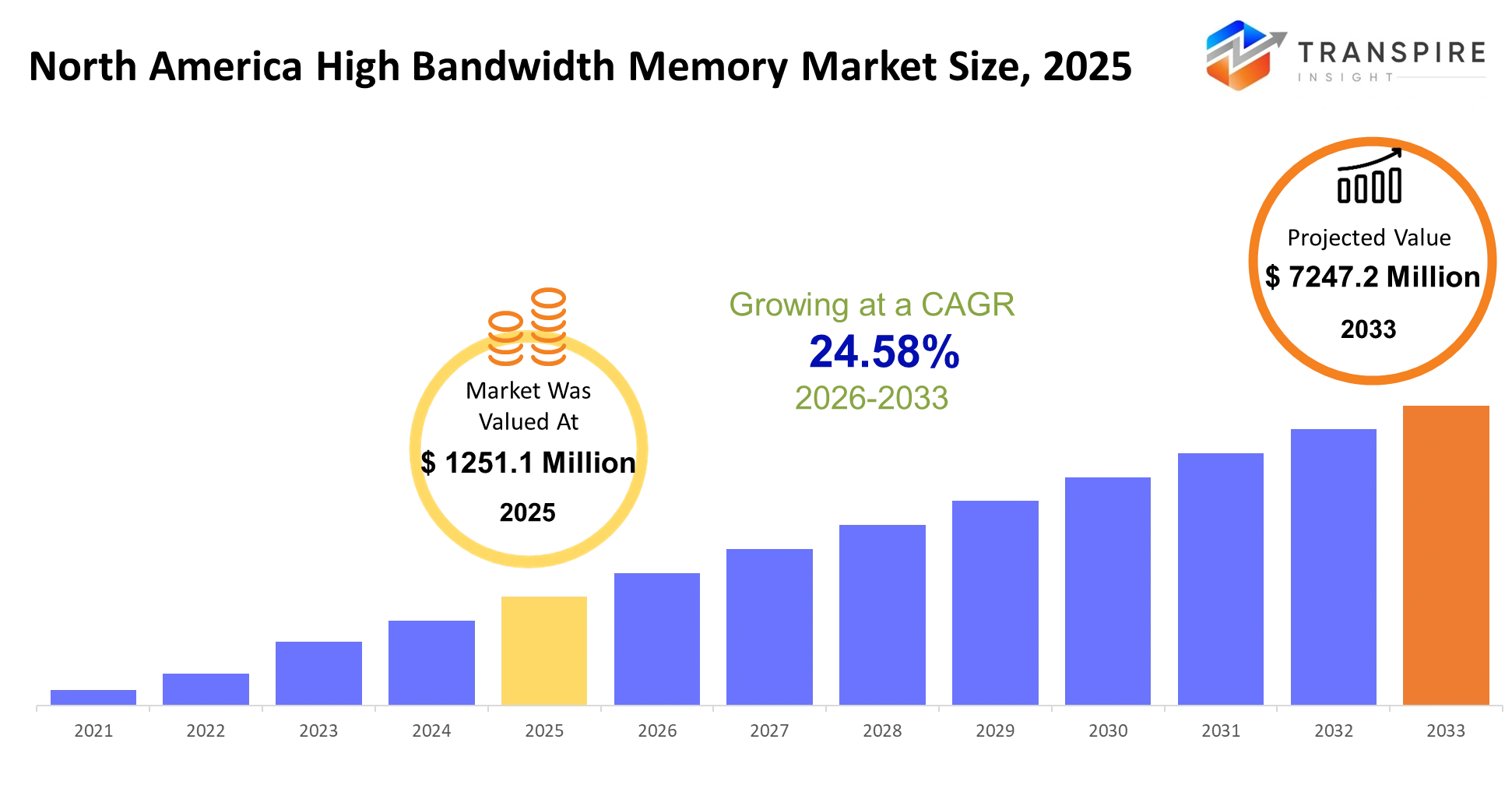
- North America High Bandwidth Memory Market Size 2025: USD 1251.1 Million
- North America High Bandwidth Memory Market Size 2033: USD 7247.2 Million
- North America High Bandwidth Memory Market CAGR: 24.58%
- North America High Bandwidth Memory Market Segments: By Type (HBM2, HBM2E, HBM3, HBM4), By Application (Graphics, AI, HPC, Data Centers), By End-User (Electronics Firms, Data Centers, AI Companies, OEMs)
To learn more about this report,  Download Free Sample Report
North America High Bandwidth Memory Market Summary:
The North America High Bandwidth Memory Market size is estimated at USD 1251.1 Million in 2025 and is anticipated to reach USD 7247.2 Million by 2033, growing at a CAGR of 24.58% from 2026 to 2033.
The South Korea Residential Water Purifier Market operates together with the North America High Bandwidth Memory Market in the research of residential water purifiers because consumer demand for safe home water systems has changed. The demand for advanced filtration systems together with intelligent monitoring capabilities and enhanced water safety standards will determine how products are developed and which products consumers choose to use in their homes.
The future will focus on developing compact purification systems that come with digital tracking features because urban households require both operational simplicity and product transparency. The upcoming years will see regulatory frameworks which will determine quality standards and installation processes in South Korean residential spaces to create uniform performance requirements.
What Has the Impact of Artificial Intelligence Been on the North America High Bandwidth Memory Market?
The North America High Bandwidth Memory Market experiences rapid changes because artificial intelligence technology implements improvements which boost operational efficiency and create new products and enable organizations to make choices based on data across their entire semiconductor supply chain. The North America High Bandwidth Memory Market experiences rising demand for high-performance computing which creates greater dependence on AI technologies that optimize design accuracy and improve workload performance and memory system efficiency.
The North America High Bandwidth Memory Market now uses AI-based analytics combined with machine learning technologies to help stakeholders understand market dynamics through better insights about industry trends and customer usage behavior. Predictive analytics in artificial intelligence systems for North America High Bandwidth Memory Market frameworks improves demand forecasting precision which enables manufacturers to synchronize their production processes with changing market needs.
The North America High Bandwidth Memory Market gains market strength through AI-driven supply chain optimization which reduces operational bottlenecks and enhances inventory control. The North America High Bandwidth Memory Market companies use AI technology to speed up their product development processes while improving performance for high-performance computing and artificial intelligence applications. The North America High Bandwidth Memory Market benefits from this combination of machine learning and predictive intelligence and smart automation because it delivers both competitive strength and sustainable market expansion.
Key Market Trends & Insights:
- The United States holds a dominant position in the North American High Bandwidth Memory Market because it will capture over 65% of the market in 2025 due to its robust semiconductor infrastructure and growing AI usage. north america high bandwidth memory market
- The fastest-growing area in Canada until 2030 will experience growth because of AI research centers and developing cloud computing infrastructures.
- The regional development process receives major assistance from both hyperscale data center construction projects and increasing requirements for AI-based semiconductor products.
- The North America High Bandwidth Memory Market identifies HBM3 and advanced stacked memory solutions as the dominant product category which accounts for approximately 40% market share. north america high bandwidth memory market
- The second-largest segment of HBM2E exists because GPU systems use it as a cost-effective solution which they already implement in their operations.
- The HBM3E and next-generation memory technologies will experience their most rapid growth period between 2026 and 2030.
- The North America High Bandwidth Memory Market is primarily controlled by AI accelerators and GPU computing which hold more than 45% market share because of rising generative AI requirements.
- The application segment of high-performance computing (HPC) experiences its most rapid growth because simulation and analytics workloads continue to increase.
- The North America High Bandwidth Memory Market has its main customer base of hyperscale cloud providers who control about 50% of the market.
- The North America High Bandwidth Memory Market receives its main development through the work of key companies which include SK hynix Samsung Electronics Micron Technology NVIDIA AMD and Intel.
North America High Bandwidth Memory Market Segmentation
By Type :
High Bandwidth Memory types show steady progression in performance and capacity. HBM2 and HBM2E support earlier GPU and computing workloads with balanced speed and efficiency. HBM3 and HBM4 support advanced AI processing, higher data transfer rates, and improved energy efficiency for modern computing systems.
HBM2 and HBM2E support legacy and mid-range computing demand. These types remain important for stable performance in existing systems. HBM3 and HBM4 focus on next-generation requirements with stronger bandwidth and faster processing capability. The demand for AI model training and advanced graphics workloads and high-performance computing systems continues to increase.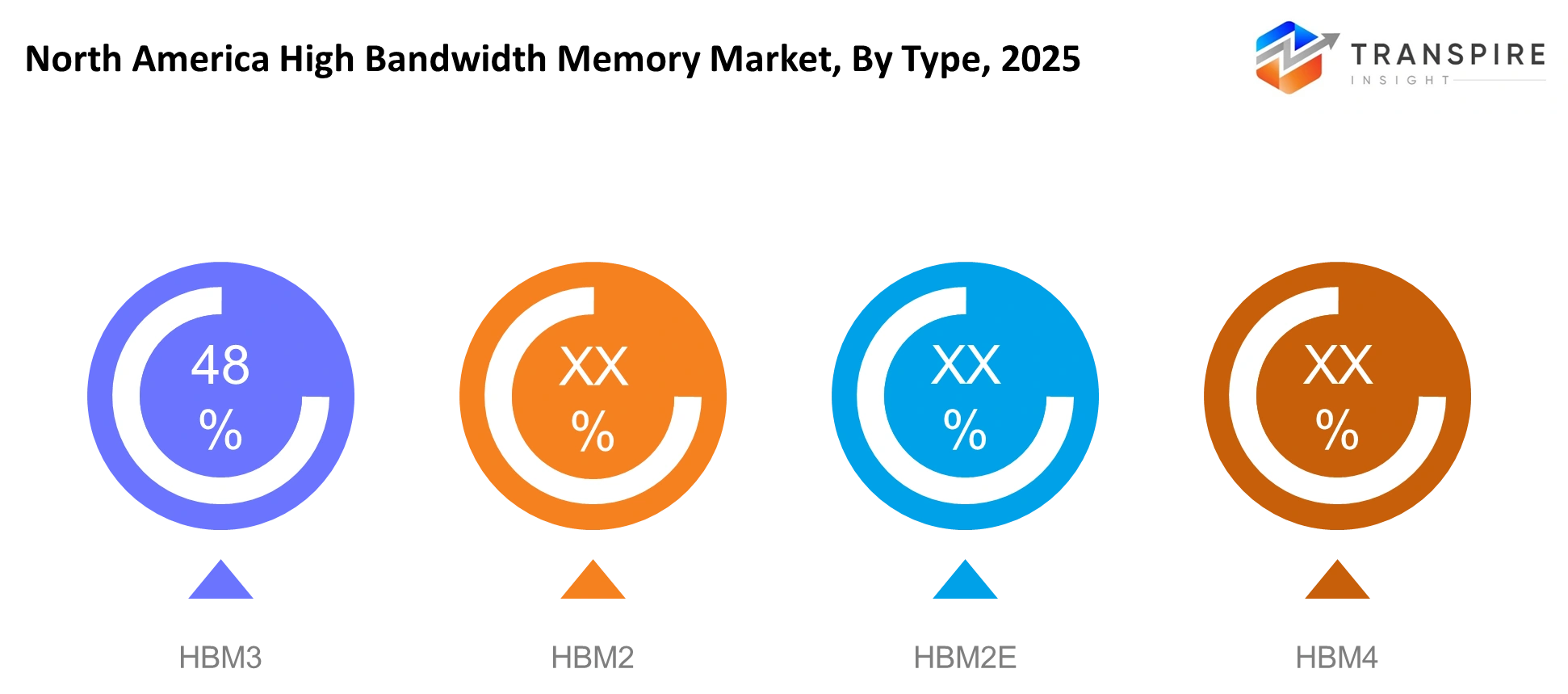
To learn more about this report, Download Free Sample Report
By Application :
High Bandwidth Memory usage extends to four sectors which include graphics processing, artificial intelligence, high-performance computing, and data center operations. Graphics applications require fast memory for rendering and visual processing. AI and HPC workloads depend on high-speed data movement. Data centers depend on memory efficiency to handle their extensive computing and storage requirements.
Graphics applications depend on fast frame rendering and smooth visual output. AI applications require rapid matrix processing and training efficiency. HPC systems need consistent high throughput for complex simulations. Data centers use high bandwidth memory to manage large datasets, reduce latency, and improve system performance under heavy workloads.
By End-User :
The requirements of end users include electronic manufacturing companies and data centers and artificial intelligence businesses and original equipment manufacturers. Electronics companies use high bandwidth memory technology to build their most advanced products. The data center industry uses the technology to create its expandable computational systems. Companies that develop artificial intelligence systems use the technology to train their models. Original equipment manufacturers use the technology to develop their upcoming hardware products.
Electronics companies develop their products to meet their customers' needs for high performance devices. The primary goal of data centers is to achieve optimal operational efficiency while minimizing system downtime. AI companies use high-speed memory to enhance their deep learning research capabilities. OEMs supply integrated systems with optimized performance. The growing demand from end users across North America creates a need for advanced memory solutions throughout the region.
What are the Main Challenges for the North America High Bandwidth Memory Market Growth?
The North America High Bandwidth Memory Market faces major difficulties through its technical and operational limitations which stem from the complex nature of 3D-stacked DRAM systems and their associated thermal management systems. The North America High Bandwidth Memory Market experiences performance issues when its systems must process AI workloads that require high bandwidth, which results in more complex management of signal quality and energy consumption.
The North America High Bandwidth Memory Market faces expansion limits because manufacturing and commercial production face challenges that require advanced semiconductor fabrication methods and precise equipment and expensive machinery. The North America High Bandwidth Memory Market operates under production challenges which result in expensive manufacturing and inconsistent product quality and extended product validation processes that hinder market entry. The need to meet strict semiconductor manufacturing requirements, along with supply chain dependencies, creates difficulties for businesses that want to grow their operations.
The North America High Bandwidth Memory Market encounters active deployment challenges because adoption problems and infrastructure deficiencies arise from the limited existence of skilled semiconductor engineers and advanced manufacturing facilities. The North America high bandwidth memory market faces adoption challenges because high entry costs prevent smaller companies from entering the market.
The North America High Bandwidth Memory Market faces permanent threats from two factors which include intense market competition and the development of new technological solutions. The market faces difficulties because high-speed memory alternatives drive pricing pressures and AI hardware products undergo rapid technological changes. North America High Bandwidth Memory Market companies need to invest in research and development because rising competition makes it essential for them to stay relevant and achieve their business growth objectives.
Country Insights
The United States experiences High Bandwidth Memory demand because of three factors which include semiconductor development and advanced computing systems and artificial intelligence infrastructure growth. Development of data centers together with high-performance computing systems receives backing from major technology companies and chip manufacturers. The region experiences continuous market development because companies maintain their investment in memory technology development and processing speed.
Research institutions and cloud computing growth together with advanced analytics system implementation drive High Bandwidth Memory activities in Canada. The government supports technology initiatives which drive technological development through partnerships between academic institutions and industrial organizations to develop memory solutions. The machine learning sector and simulation system market together with next-generation computing platforms which need fast data processing capacity create rising demand.
The demand for High Bandwidth Memory in Mexico develops through two main factors which include the growing electronics manufacturing sector and the rising use of advanced semiconductor components in industrial systems. The market presence of the industry benefits from two factors which include technology infrastructure development and growing adoption of automation solutions. The North American semiconductor networks establish supply chain connections which enable continuous delivery of high-performance memory solutions.
Recent Development News
In April 2026, Samsung Electronics reported an eightfold surge in quarterly operating profit driven by strong AI memory and HBM demand in North America. The company highlighted accelerating orders from U.S. hyperscale data center customers for next-generation HBM used in AI accelerators. Source https://www.barrons.com/
In April 2026, Micron Technology announced continued expansion of its HBM4 production roadmap for U.S. data center customers. The company emphasized increased shipments of high-bandwidth memory for AI GPU platforms, supported by rising North American cloud demand. Source https://www.barrons.com/
|
Report Metrics |
Details |
|
Market size value in 2025 |
USD 1251.1 Million |
|
Market size value in 2026 |
USD 1556.4 Million |
|
Revenue forecast in 2033 |
USD 7247.2 Million |
|
Growth rate |
CAGR of 24.58% from 2026 to 2033 |
|
Base year |
2025 |
|
Historical data |
2021 - 2024 |
|
Forecast period |
2026 - 2033 |
|
Report coverage |
Revenue forecast, competitive landscape, growth factors, and trends |
|
Regional scope |
North America (Canada, The United States, and Mexico) |
|
Key company profiled |
Samsung, SK Hynix, Micron, Intel, AMD, NVIDIA, TSMC, Broadcom, Marvell, Qualcomm, IBM, Fujitsu, Toshiba, MediaTek, TI |
|
Customization scope |
Free report customization (country, regional & segment scope). Avail customized purchase options to meet your exact research needs. |
|
Report Segmentation |
By Type (HBM2, HBM2E, HBM3, HBM4), By Application (Graphics, AI, HPC, Data Centers), By End-User (Electronics Firms, Data Centers, AI Companies, OEMs) |
How Can New Companies Establish a Strong Foothold in the North America High Bandwidth Memory Market?
New companies aiming to enter the North America High Bandwidth Memory Market need to use niche market strategies while delivering AI-powered unique value because demand for high-performance computing continues to grow. The North America High Bandwidth Memory Market develops through AI specialized workloads with edge computing and advanced analytics use cases. New companies can establish their presence in the market by targeting underserved markets which include healthcare imaging and smart city infrastructure.
The North America High Bandwidth Memory Market requires businesses to develop strategic partnerships and innovation ecosystems to achieve success because AI chip designers and hyperscale cloud providers represent essential collaborative partners. The North America High Bandwidth Memory Market benefits from startup companies such as Cerebras Systems and SambaNova Systems, which develop advanced AI hardware technology.
The North America High Bandwidth Memory Market provides major growth possibilities through industry-specific solutions that serve healthcare diagnostics needs and manufacturing automation requirements and smart city infrastructure demands. North America High Bandwidth Memory Market companies that develop performance optimization and energy efficiency and memory bandwidth technology innovations will achieve superior competitive advantage.
Key North America High Bandwidth Memory Market Company Insights
The North America High Bandwidth Memory Market will experience continuous growth because advanced computing systems require better performance and faster data processing solutions. The market will grow because artificial intelligence workloads and data centers and high-performance computing systems are increasing their use of the technology. The industry will see greater technology adoption as semiconductor companies increase their research activities. Competitive insights: Main companies in the industry will develop memory solutions that deliver both fast performance and low power consumption.
The North America High Bandwidth Memory Market will show a clear shift toward advanced packaging technologies and closer integration with processors. The demand for scalable memory solutions in AI accelerators and graphics processing units will experience an upward trend.
The North America High Bandwidth Memory Market will face challenges related to high production costs and complex manufacturing processes. The production process will experience delays because of restricted supply chain capacity and the need for advanced fabrication facilities. The industry will experience growth limitations because companies cannot achieve higher memory density without losing performance efficiency. Competitive insights: Companies will work on cost reduction strategies and improved yield rates to stay competitive.
The North America High Bandwidth Memory Market will stay competitive because global semiconductor companies will actively compete in the market. The research efforts will concentrate on developing better bandwidth solutions through energy saving methods and AI hardware compatibility advancements.
Company List
- Samsung
- SK Hynix
- Micron
- Intel
- AMD
- NVIDIA
- TSMC
- Broadcom
- Marvell
- Qualcomm
- IBM
- Fujitsu
- Toshiba
- MediaTek
- TI
What are the Key Use-Cases Driving the Growth of North America High Bandwidth Memory Market?
Organizations in the North America High Bandwidth Memory Market need high-performance computing with AI acceleration because their business operations need superfast data processing which handles complex workload demands. The North America High Bandwidth Memory Market receives advantages from generative AI models and large language model training and GPU-intensive computing activities. The applications increase bandwidth requirements while they decrease latency limitations which leads to greater adoption across industries that depend on data.
The North America High Bandwidth Memory Market shows strong potential in healthcare imaging and autonomous driving systems and advanced manufacturing applications. High-resolution medical imaging and diagnostic AI tools in healthcare require faster memory bandwidth to enable real-time analysis. In the North America High Bandwidth Memory Market automotive companies use HBM for sensor fusion and autonomous navigation while manufacturing firms apply predictive maintenance and digital twins to improve their production efficiency.
The North American High Bandwidth Memory Market is experiencing increased demand because enterprise cloud computing solutions and fintech analytics systems and edge AI deployments are expanding their usage. The data center industry needs memory systems that can scale according to their high workload requirements because these systems deliver better operational speed and energy consumption results. Companies that build artificial intelligence systems in North America drive the development of the North American high bandwidth memory market which provides digital systems with faster processing capabilities and greater system expansion and ongoing technological advancement.
North America High Bandwidth Memory Market Report Segmentation
By Type
- HBM2
- HBM2E
- HBM3
- HBM4
By Application
- Graphics
- AI
- HPC
- Data Centers
By End-User
- Electronics Firms
- Data Centers
- AI Companies
- OEMs
Frequently Asked Questions
Find quick answers to common questions.
The Approximate North America High Bandwidth Memory Market size for the Market will be USD 7247.2 Million in 2033.
Key Segments for the North America High Bandwidth Memory Market are By Type (HBM2, HBM2E, HBM3, HBM4), By Application (Graphics, AI, HPC, Data Centers), By End-User (Electronics Firms, Data Centers, AI Companies, OEMs).
Major North America High Bandwidth Memory Market Players are Samsung, SK Hynix, Micron, Intel, AMD, NVIDIA, TSMC, Broadcom, Marvell, Qualcomm, IBM, Fujitsu, Toshiba, MediaTek, TI.
The Current North America High Bandwidth Memory Market size is USD 1251.1 Million in 2025.
The North America High Bandwidth Memory Market CAGR is 24.58%.
- Samsung
- SK Hynix
- Micron
- Intel
- AMD
- NVIDIA
- TSMC
- Broadcom
- Marvell
- Qualcomm
- IBM
- Fujitsu
- Toshiba
- MediaTek
- TI
Recently Published Reports
-
Apr 2026
Fiber Optic Faceplates Market
Fiber Optic Faceplates Market Size, Share & Analysis Report By Type (< 300 mm2, 300-350 mm2, and > 350 mm2, By Application (Night Vision, Holographic Imaging, Medical, and Others), and Geography (North America, Europe, Asia-Pacific, Middle East and Africa, South and Central America), 2021 - 2031
-
Apr 2026
High Temperature Superconductors Market
High Temperature Superconductors Market Size, Share & Analysis Report By Type (1G HTS, and 2G HTS), By Application (Power Cable, Fault Current Limiter, and Transformer), and Geography (North America, Europe, Asia-Pacific, Middle East and Africa, South and Central America), 2021 - 2031
-
Apr 2026
Industrial Plugs and Socket Market
Industrial Plugs and Socket Market Size, Share & Analysis Report By Type (Industrial Plugs, Industrial Sockets), By Current (Up to 32 A, 32 to 125 A, Above 125 A), By Protection (Dustproof and Splash Proof, Waterproof, Explosion Proof), By End User (Heavy Industries, Oil and Gas, Chemicals and Pharmaceuticals, Power Generation, Others), and Geography (North America, Europe, Asia-Pacific, Middle East and Africa, South and Central America), 2021 - 2031
-
Apr 2026
InGaAs Avalanche Photodiodes Market
InGaAs Avalanche Photodiodes Market Size, Share & Analysis Report By Type (1100 - 1700 nm, and 1000 - 1600 nm), By Application (Missile Warning System, Muzzle Flash Detection, Wafer Defect Inspection, Laser Rangefinders, and Others), and Geography (North America, Europe, Asia-Pacific, Middle East and Africa, South and Central America), 2021 - 2031