

North America Game-Based Learning Market Size & Forecast:
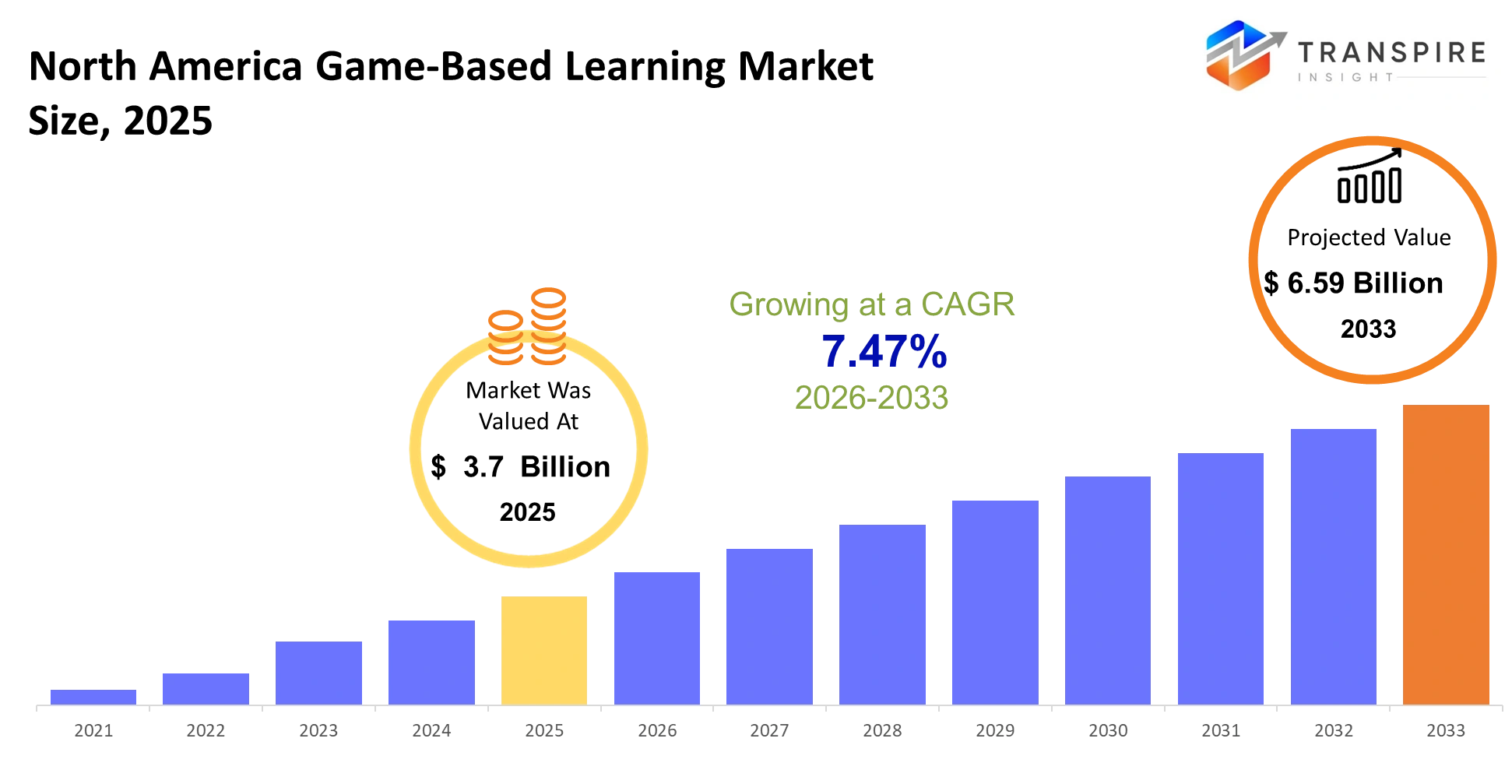
- North America Game-Based Learning Market Size 2025: USD 3.7 Billion
- North America Game-Based Learning Market Size 2033: USD 6.59 Billion
- North America Game-Based Learning Market CAGR: 7.47%
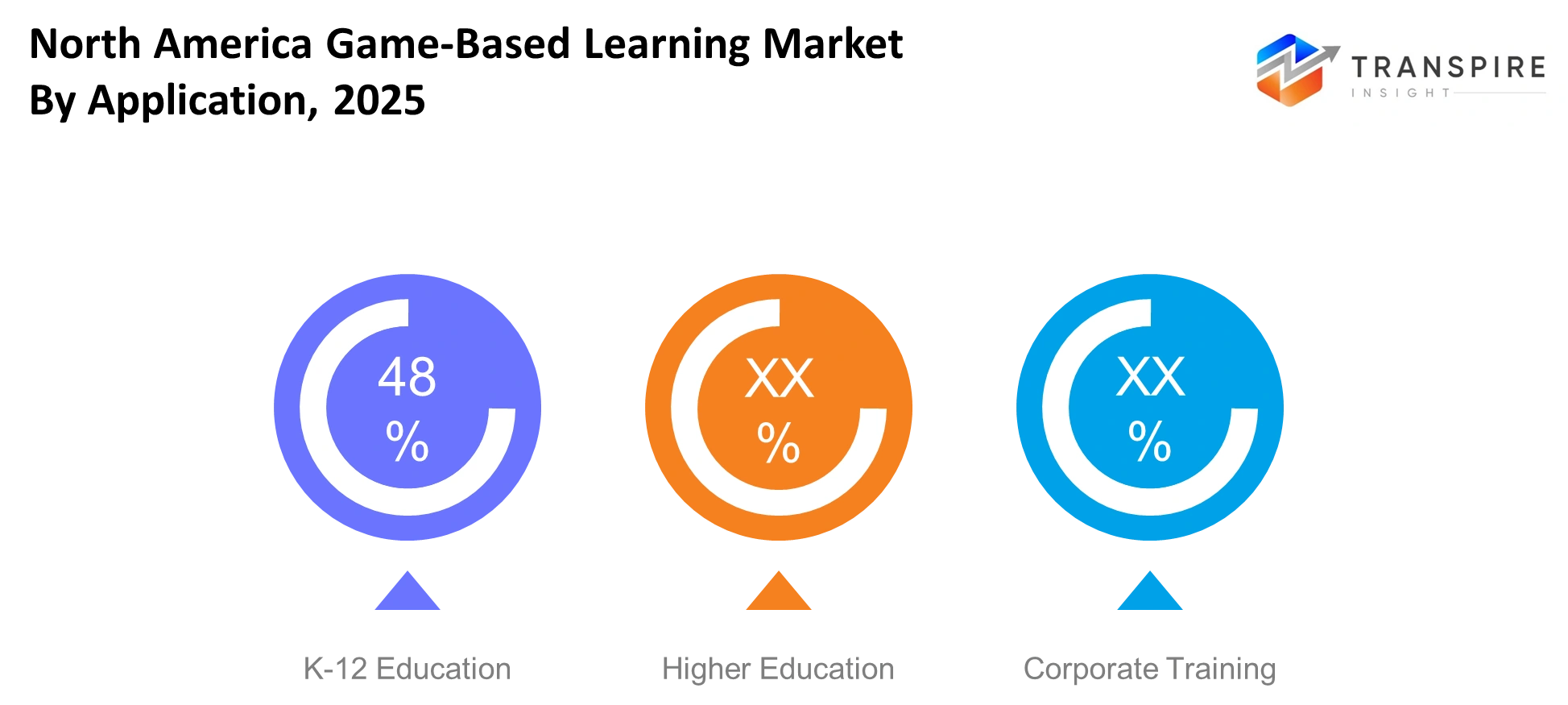
- North America Game-Based Learning Market Segments: By Component (Software, Services), By Application (K-12 Education, Higher Education, Corporate Training), By End-User (Educational Institutions, Enterprises).
To learn more about this report,  Download Free Sample Report
North America Game-Based Learning Market Summary:
The North America Game-Based Learning Market size is estimated at USD 3.7 Billion in 2025 and is anticipated to reach USD 6.59 Billion by 2033, growing at a CAGR of 7.47% from 2026 to 2033. The educational technology sector of North America which includes Canada and the United States and Mexico will develop its game-based learning market to create new methods for delivering educational content to students.Students will expect educational experiences that provide both entertainment value and measurable results which will lead developers to create learning systems that use artificial intelligence and current data processing technologies.Organizations will prioritize data protection measures and appropriate screen usage because these requirements will shape the development process of their products and the way educational institutions select their offerings.Educational institutions will increase their international partnerships through school and studio relationships which will become feasible through cloud technology that supports multiple educational settings. Content development will increasingly incorporate local cultural elements and multilingual requirements while producing training programs that focus on developing skills needed to meet changing demands of the workforce.
Key Market Trends & Insights:
The educational technology sector of North America which includes Canada and the United States and Mexico will develop its game-based learning market to create new methods for delivering educational content to students.Students will expect educational experiences that provide both entertainment value and measurable results which will lead developers to create learning systems that use artificial intelligence and current data processing technologies.Organizations will prioritize data protection measures and appropriate screen usage because these requirements will shape the development process of their products and the way educational institutions select their offerings.Educational institutions will increase their international partnerships through school and studio relationships which will become feasible through cloud technology that supports multiple educational settings. Content development will increasingly incorporate local cultural elements and multilingual requirements while producing training programs that focus on developing skills needed to meet changing demands of the workforce.
Educational institutions will establish deeper technology integration when they obtain affordable access to augmented reality and virtual reality educational tools. Students will use immersive simulations in classrooms to learn practical skills through the experience of real-life situations which include scientific research and professional development activities. The system will use cloud-based delivery to provide users with uninterrupted updates while they can access the platform from multiple devices to maintain a uniform user experience. Educational institutions will design their software systems to protect cybersecurity and student information because they must follow local digital security regulations.
The region will experience changes in content selection because consumer demands will determine which materials will be included and which will be omitted. Parents and educators will seek cultural content that includes local language and historical and social elements. Developers will create modular content which users can tailor according to the specific needs of different North American communities. The modules will focus on workforce development while interactive problem-solving exercises will help students develop essential skills which will prepare them for future job requirements.
North America Game-Based Learning Market Segmentation
By Component
Software- The software system will function as the main component which enables users to learn through interactive educational environments. The platform will develop customized learning experiences through its adaptive engines which modify content according to the actual performance of each user. The integration process between learning management systems and educational institutions will achieve better efficiency because it will provide institutions with tools to monitor their students' educational development and assessment results. Developers will create user-friendly designs which allow people to access their content across multiple devices while they build interactive game environments that motivate users to keep playing.
Services- The services will provide support for the implementation process of game-based learning solutions while also customizing these solutions and optimizing them throughout their entire lifetime. The consulting teams will assist both institutions and enterprises by helping them create educational content which meets their particular academic requirements and workforce development needs. The need for maintenance services and analytics interpretation and technical support will continue to grow because platforms are becoming more intricate. The organization needs to provide training for teachers and corporate trainers so they can use these resources effectively which will result in the technology producing measurable benefits instead of being underused.
By Application
K-12 Education- Game-based learning will transform classroom interactions in K-12 schools through its implementation of interactive storytelling and its system of reward-based learning. Younger learners will experience subject material through interactive challenges which foster their ability to think critically while maintaining their natural curiosity. Teachers will use performance data to identify learning gaps which they will address through the integration of these tools into their existing teaching methods. The content will showcase multiple cultural backgrounds because this approach enables students to comprehend the material while educational materials remain consistent with local curriculum standards.
Higher Education- Higher education institutions will utilize game-based learning to enable students to study advanced topics through virtual laboratories and interactive simulation-based learning environments. Students will acquire knowledge through hands-on learning experiences which replicate authentic professional environments, especially in engineering and healthcare and business fields. Universities will use these tools to increase student participation during both face-to-face classes and online courses. Academic evaluation systems will implement simulated environment assessment as a new method for measuring student performance.
Corporate Training- Organizations will use game-based training approaches because these methods help employees maintain strong focus and remember information better. Organizations will create interactive training modules which allow employees to experience workplace scenarios that teach them how to make decisions without facing real dangers. The tools will assist organizations with their onboarding process, compliance training, and skill development programs. Organizations will shift their focus toward learning programs which provide flexible and interactive educational experiences that lead to measurable results because workforce needs have changed.
To learn more about this report, Download Free Sample Report
By End-User
Educational Institutions- Educational institutions will become primary users of game-based learning which they will implement in their classrooms and digital platforms and hybrid teaching methods. Schools and universities will use these tools to address varying learning styles and improve student motivation. The administration will use analytics to track learning results which they will use to modify curriculum requirements. Investors now evaluate their investment decisions through an examination of long-term value which includes three factors: scalability, system integration requirements, and content customization capabilities for various student groups.
Enterprises- Enterprises will adopt game-based learning methods to develop flexible workforces who possess the necessary skills to meet changing organizational requirements. The training department will use interactive modules which promote active learning while minimizing the traditional program's boring elements. These solutions will support leadership development, technical skill building, and behavioral training. Data analysis will become a key focus for companies as they use performance metrics from these platforms to develop training programs which support their business objectives.
Regional Insights
The United States will lead adoption because its digital infrastructure enables immediate access to interactive tools which schools and businesses have already implemented. Schools will increasingly implement hybrid learning systems which use game-based modules in combination with standard teaching methods. Private edtech providers will continue shaping content innovation, while public institutions will focus on measurable learning outcomes. The demand for skill-oriented platforms will increase because these platforms enable educational institutions to teach practical competencies needed for future employment.
Canada will develop learning solutions which include all students and provide accessible educational resources through digital tools that serve both urban and rural areas. The government will fund programs that help public schools use interactive materials for their educational programs. Bilingual educators will choose educational resources which include bilingual content and materials that represent the diverse backgrounds of Canadian students. Educational institutions will implement systems which support teamwork and analytical reasoning while helping students track their academic progress according to national educational standards.
The digital capabilities of Mexican institutions will develop through their implementation of cost-effective educational solutions. The use of mobile-first platforms will become more common because students and professionals will have better access to them. The development of local content will increase because local content needs to represent regional languages and cultural elements of the area. Private companies and educational institutions will create partnerships that help schools adopt new teaching methods which will enable students to learn in ways that match the needs of their developing skills for future job markets.
Game-based learning development in this area will proceed through shared technological progress and international partnerships between countries. The development team will create flexible systems which will support different educational requirements and user needs. The organization will base its implementation plans on two main goals which focus on data security and ethical digital tool usage. Educational institutions need to find solutions which combine student participation with effective monitoring systems that evaluate how well interactive educational systems work when students change their academic and professional needs.
Recent Development News
United States: AI-Driven Content and Media Collaborations
Recent developments in the United States highlight a strong shift toward integrating media and education through interactive formats. A notable example includes the collaboration between business news content and gamified platforms, delivering short-form videos and quiz-based learning experiences for financial literacy. This approach will redefine how learners consume complex subjects, blending real-world knowledge with engaging formats. Institutions will increasingly adopt such models to make learning more relatable and practical.
Canada: Recognition of Gamified EdTech Tools in Classrooms
In Canada, recognition of high-performing digital learning tools will influence adoption trends across schools and higher education institutions. Awards and industry acknowledgments have highlighted platforms that combine adaptive learning with gamification, particularly in literacy and mathematics. These recognitions will guide educators toward proven solutions, encouraging wider implementation. As a result, classrooms will increasingly adopt tools that deliver both engagement and measurable academic improvement through interactive methods.
Mexico: Shift Toward Mobile and Cloud-Based Learning Platforms
Mexico is witnessing recent developments centered around mobile accessibility and cloud-based delivery of interactive learning solutions. With rising smartphone usage and improved connectivity, platforms are being designed to function efficiently on mobile devices, enabling broader reach among students and professionals. This transition will support flexible learning environments, allowing users to access gamified content anytime, while reducing dependence on expensive hardware infrastructure across institutions.
|
Report Metrics |
Details |
|
Market size value in 2025 |
USD 3.7 Billion |
|
Market size value in 2026 |
USD 3.98 Billion |
|
Revenue forecast in 2033 |
USD 6.59 Billion |
|
Growth rate |
CAGR of 7.47% from 2026 to 2033 |
|
Base year |
2025 |
|
Historical data |
2021 – 2024 |
|
Forecast period |
2026 – 2033 |
|
Report coverage |
Revenue forecast, competitive landscape, growth factors, and trends |
|
Country scope |
North America (Canada, The United States, and Mexico) |
|
Key company profiled |
Kahoot! ASA, Duolingo Inc., Minecraft Education (Microsoft), Roblox Corporation, Quizlet Inc., BrainPOP LLC, Classcraft Studios Inc., Prodigy Education Inc., Edmodo (NetDragon), Coursera Inc., Udemy Inc., Skillsoft Corporation, Houghton Mifflin Harcourt, Pearson plc, McGraw-Hill Education. |
|
Customization scope |
Free report customization (country, regional & segment scope). Avail customized purchase options to meet your exact research needs. |
|
Report Segmentation |
By Component (Software, Services), By Application (K-12 Education, Higher Education, Corporate Training), By End-User (Educational Institutions, Enterprises). |
Key North America Game-Based Learning Market Company Insights
The North America (Canada, the USA, and Mexico) game-based learning market would be affected by a combination of traditional education technology providers and new entrants who would specialize in engagement-centric learning design. Duolingo and Pearson and Skillsoft would work on creating adaptive content and curriculum-based content, whereas Kahoot! and Quizizz would work on improving interactive participation models. New entrants would introduce a unique positioning strategy with features such as user experience, analytics, content strategies that cater to the specific needs of different segments of learners by using simulations and AI-based personalization, and mobile-centric delivery models.
Company List
- Kahoot! ASA
- Duolingo Inc.
- Minecraft Education (Microsoft)
- Roblox Corporation
- Quizlet Inc.
- BrainPOP LLC
- Classcraft Studios Inc.
- Prodigy Education Inc.
- Edmodo (NetDragon)
- Coursera Inc.
- Udemy Inc.
- Skillsoft Corporation
- Houghton Mifflin Harcourt
- Pearson plc
- McGraw-Hill Education
North America Game-Based Learning Market Report Segmentation
By Component
- Software
- Services
By Application
- K-12 Education
- Higher Education
- Corporate Training
By End-User
- Educational Institutions
- Enterprises
Frequently Asked Questions
Find quick answers to common questions.
The approximate North America Game-Based Learning Market size for the market will be USD 6.59 Billion in 2033.
Key segments for the North America Game-Based Learning Market By Component (Software, Services), By Application (K-12 Education, Higher Education, Corporate Training), By End-User (Educational Institutions, Enterprises).
Major players in the North America Game-Based Learning Market are Kahoot! ASA, Duolingo Inc., Minecraft Education (Microsoft), Roblox Corporation, Quizlet Inc., BrainPOP LLC, Classcraft Studios Inc., Prodigy Education Inc., Edmodo (NetDragon), Coursera Inc., Udemy Inc., Skillsoft Corporation, Houghton Mifflin Harcourt, Pearson plc, McGraw-Hill Education.
The North America Game-Based Learning Market size is USD 3.7 Billion in 2025.
The North America Game-Based Learning Market CAGR is 7.47%.
- Kahoot! ASA
- Duolingo Inc.
- Minecraft Education (Microsoft)
- Roblox Corporation
- Quizlet Inc.
- BrainPOP LLC
- Classcraft Studios Inc.
- Prodigy Education Inc.
- Edmodo (NetDragon)
- Coursera Inc.
- Udemy Inc.
- Skillsoft Corporation
- Houghton Mifflin Harcourt
- Pearson plc
- McGraw-Hill Education
Recently Published Reports
-
Apr 2026
Bottled Water Market
Bottled Water Market Size, Share & Analysis Report By Product Type (Still Bottled Water, Carbonated Bottled Water, Functional Bottled Water, and Others), By Packaging (PET, Cans, and Others), By Sales Channel (Supermarkets/Hypermarkets, Convenience Stores/Drug Stores, Grocery Stores/Club Stores, Foodservice, and Others) and Geography (North America, Europe, Asia-Pacific, Middle East and Africa, South and Central America), 2021 - 2032
-
Apr 2026
Color Cosmetic Packaging Market
Color Cosmetic Packaging Market Size, Share & Analysis Report By Application (Mascara Packaging, Liquid Packaging, and Liquid Face), By Type (Tubes & Bottles, Pens & Markers, Compacts & Containers, and Droppers & Pumps), and Geography (North America, Europe, Asia-Pacific, Middle East and Africa, South and Central America), 2021 - 2031
-
Apr 2026
External Microphone For Camera Market
External Microphone For Camera Market Size, Share & Analysis Report By Type (Shotgun Microphone, Lavalier Microphone, and Others), By Application (Digital Camera, Professional Video Camera, and Others), and Geography (North America, Europe, Asia-Pacific, Middle East and Africa, South and Central America), 2021 - 2031
-
Apr 2026
Foot Orthotic Insoles Market
Foot Orthotic Insoles Market Size, Share & Analysis Report By Type (Pre-fabricated, and Custom-made), By Material (Thermoplastic, Composite Carbon Fiber, and Others), By Distribution Channel (Drug Stores, Hospitals & Clinics, and Others), and Geography (North America, Europe, Asia-Pacific, Middle East and Africa, South and Central America), 2021 - 2031