North America Automated Container Terminal Market Size & Forecast:
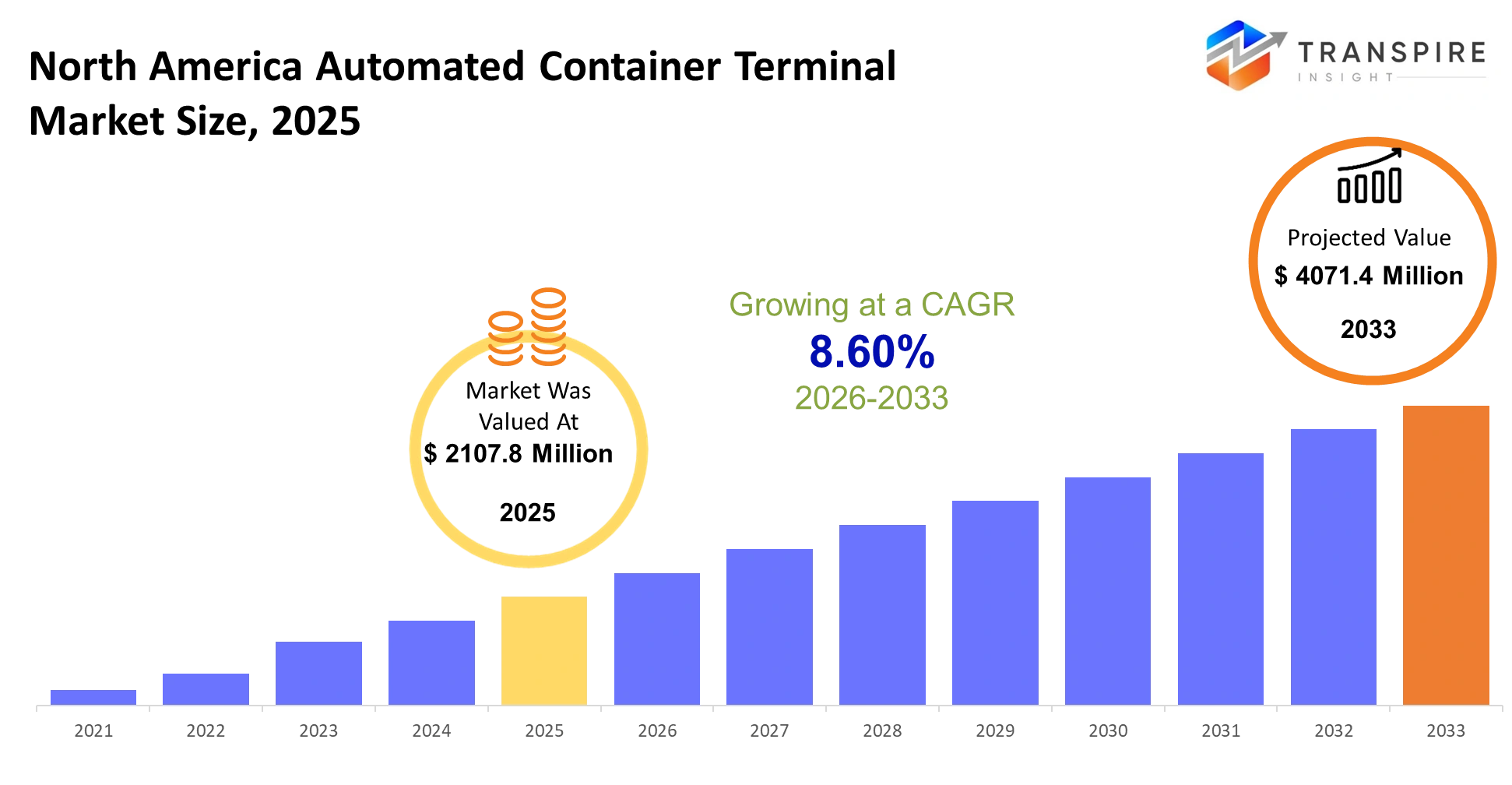
- North America Automated Container Terminal Market Size 2025: USD 2107.8 Million
- North America Automated Container Terminal Market Size 2033: USD 4071.4 Million
- North America Automated Container Terminal Market CAGR: 8.60%
- North America Automated Container Terminal Market Segments:By Type (Fully Auto, Semi, Remote, Hybrid, Smart, AI, IoT), By Equipment (AGV, ASC, STS, RTG, Robotics, Conveyor, Smart), By Application (Handling, Logistics, Port Ops, Shipping, Warehousing, Freight, Distribution), By Tech (AI, IoT, Robotics, Software, Sensors, Analytics, Digital Twin), By End-User (Ports, Logistics, Shipping, Govt, Operators, Warehouses, Freight).
To learn more about this report,  Download Free Sample Report
North America Automated Container Terminal Market Summary:
The North America Automated Container Terminal Market size is estimated at USD 2107.8 Million in 2025 and is anticipated to reach USD 4071.4 Million by 2033, growing at a CAGR of 8.60% from 2026 to 2033. The North America Automated Container Terminal Market is experiencing rapid growth because ports are now implementing automated systems which enable them to operate their facilities with greater efficiency. Terminal operators in the region are expanding their operations because of increasing trade activities and larger vessel sizes and the need to handle more cargo. Major ports are experiencing a transformation which improves safety standards while they optimize workforce utilization across their facilities.
The North America Automated Container Terminal Market is experiencing growth because digitalization trends which include IoT integration and real-time tracking and data analytics enable better cargo management. The government and port authorities are working together to modernize infrastructure which will increase supply chain resilience. Automated terminals currently serve as green solutions which help ports decrease their energy usage and carbon emissions while they serve as critical elements which drive North American ports' long-term competitive advantage.
What Has the Impact of Artificial Intelligence Been on the North America Automated Container Terminal Market?
The North America Automated Container Terminal Market experiences a transformative shift because of Artificial Intelligence which establishes new standards for both automated systems and data-based operational methods used in port facilities. The Automatic Container Terminal solutions which use AI technology provide North American businesses with their ability to conduct in-depth market studies and access current data while using predictive models to enhance their operational performance.
The North America Automated Container Terminal Market systems which utilize artificial intelligence technology enable operators to predict demand patterns accurately while they improve their vessel scheduling processes and boost their cargo handling effectiveness. The North America Automated Container Terminal Market experiences growth because intelligent automation systems decrease operational delays while they enhance resource distribution throughout the market.
The North America Automated Container Terminal Market benefits from AI-based systems because these systems increase production efficiency while they enhance supply chain management capabilities. The machine learning algorithms assist in detecting market patterns which help businesses identify their operational challenges thus enabling them to make quicker decisions while lowering their terminal operating expenses.
The North America Automated Container Terminal Market uses smart automation to boost equipment efficiency while decreasing operational interruptions and enabling organizations to implement predictive maintenance programs. The North America Automated Container Terminal Market develops a strong market edge because AI technology drives innovation and helps organizations build operational capabilities and achieve sustainable efficiency gains throughout their port networks.
Key Market Trends & Insights:
- The North America automated container terminal market is undergoing digital transformation which will result in automated systems controlling more than 35 percent of operational activities by 2028.
- The North America automated container terminal market ecosystem experiences efficiency improvements through the combined use of artificial intelligence, robotic systems, and predictive analytics technologies.
- Smart automation adoption is accelerating in North American ports, which enables leading terminals to achieve turnaround time improvements of 20 to 30 percent.
- The United States controls about 65 to 70 percent of the North America automated container terminal market which will reach its peak market share in 2025 because of substantial port upgrades.
- Canada will experience continuous growth between 2025 and 2032 because of its rising infrastructure investments.
- The North America automated container terminal market main segment comprises automated cranes and handling equipment, which holds the largest market share.
- The second largest market segment for terminal operating systems (TOS) exists because more organizations require digital coordination platforms.
- AI-driven logistics optimization software represents the most rapidly expanding market segment which will continue to develop until 2030.
- The North America automated container terminal market shows that cargo handling and container stacking operations represent the most significant application, which accounts for approximately 40 percent of the market share.
- Predictive maintenance and fleet optimization represent the most rapidly expanding application fields.
- Seaport authorities and terminal operators remain the leading end-users with the largest market share.
- The logistics and freight forwarding sector has become the most rapidly expanding customer base because global trade operations have grown increasingly complicated.
North America Automated Container Terminal Market Segmentation
By Type
The design of automated container terminals involves multiple active operating systems which enable different levels of digital control and human operations. The industry shows increasing interest in fully automated systems because these systems deliver higher operational efficiency while decreasing the need for manual cargo handling. Ports use semi-automated systems together with remote-controlled systems as transitional models which enable them to move toward complete automation.
The use of hybrid systems has become common because these systems enable manual operations to work together with advanced control systems for operational flexibility. The port industry is rapidly adopting smart systems which use artificial intelligence and Internet of Things technology to enable real-time monitoring and decision-making.
The Automated Container Terminal Market in North America experiences growth because businesses require faster cargo handling processes and shorter operational downtime. The United States and Canada currently have multiple ports which implement mixed-type automation systems to achieve operational efficiency while keeping costs under control. The implementation of AI and IoT-based systems in terminal operations helps improve visibility which leads to better scheduling accuracy and reduced congestion.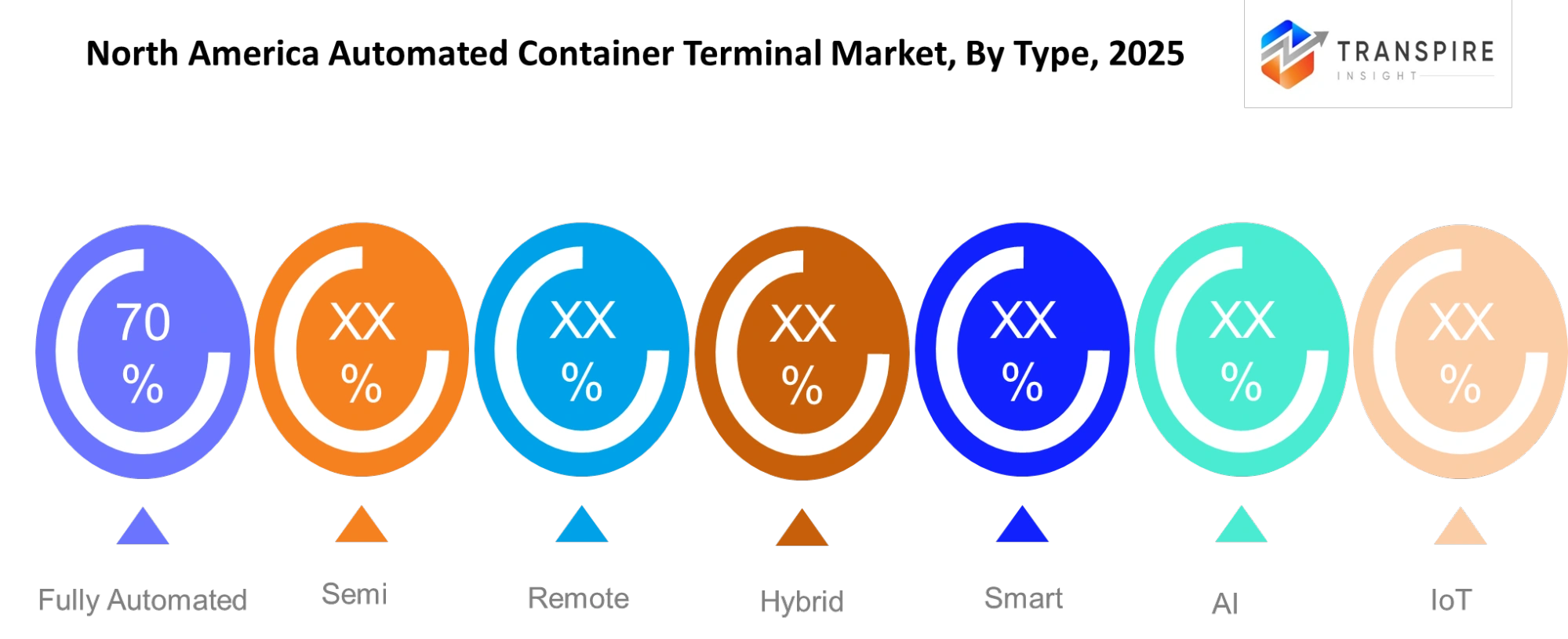
To learn more about this report, Download Free Sample Report
By Equipment
The equipment which operates automated terminals directly affects how quickly cargo operations progress and how accurately work tasks are executed. Automated Guided Vehicles (AGVs) enable container movement through terminals without needing human drivers. Automated Stacking Cranes (ASCs) operate as the standard equipment for facilities which need to store and retrieve containers at high storage densities.
The Ship-to-Shore (STS) cranes along with the Rubber Tyred Gantry (RTG) cranes utilize advanced automation technologies to perform their heavy lifting operations. Robotics together with conveyor systems now serve as essential components which enable ports to maintain constant material movement throughout their facilities. The combination of smart equipment with sensor technology and control systems enhances operational efficiency across various functions.
The North America Automated Container Terminal Market is seeing steady equipment upgrades as ports modernize infrastructure. The advanced machinery system decreases operational downtime while it enhances safety standards during high-volume processing operations. Terminals are increasing their demand for smart equipment which can connect to other systems because they want to enhance their predictive maintenance capabilities and their operational performance.
By Application
The development of automated container terminals has led to their implementation in different operational sectors which exist in port environments. The primary mission of the system centers on container operations which ensure rapid cargo loading and unloading activities. The logistics operations gain advantages through enhanced coordination which decreases delays during terminal operations.
The adoption of automation technologies enables port operations to achieve greater efficiency through improved scheduling and resource management processes. The shipping industry benefits from quicker ship turnaround times and enhanced container tracking technologies which lead to operational improvements. Automated storage and retrieval systems are providing better operational efficiency to both warehousing operations and freight distribution activities.
The North America Automated Container Terminal Market is supported by rising global trade and increasing cargo volumes. The automation of distribution and logistics networks enables better supply chain operations through enhanced reliability. All application areas at ports are now being equipped with advanced systems which help reduce congestion and enhance operational efficiency.
By Tech
The implementation of advanced digital systems at automated container terminals creates operational changes through technology adoption. The system uses artificial intelligence to make decisions because it processes current operational data. IoT systems enable equipment and terminal connections which result in enhanced visibility and better communication.
The use of robotics technology enables multiple physical tasks to be performed with greater accuracy because it decreases the need for human labor. Software platforms control terminal operations while they enable better system interaction throughout different operational functions. The sensors monitor two critical aspects which include equipment health and operational status. The combination of analytics and digital twin technology enables both simulation and performance enhancement processes.
These technologies are now dominant in the North America Automated Container Terminal Market because ports are implementing smarter operational systems. Predictive analytics helps organizations achieve two objectives which involve reducing equipment failures and increasing operational efficiency. Digital twin systems are also improving simulation-based decision-making for better terminal performance.
By End-User
The automated container terminal system provides direct access to its operational capabilities to multiple organizations which participate in cargo transportation and port facility management. The primary users of the system are port authorities who use the system to enhance their operational performance and increase their capacity. Logistics companies depend on automation to manage faster and more reliable cargo flow. Shipping firms benefit from reduced vessel waiting time and improved scheduling systems.
Government agencies use automation technology to boost their international trade capabilities while making their country more competitive. Terminal operators use sophisticated automation systems to control their daily terminal operations. The use of automated systems in warehouses and freight companies enables them to enhance their abilities to handle storage and distribution activities.
The North America Automated Container Terminal Market continues to grow because end-users focus on achieving operational efficiency while decreasing their expenses. The increase in trade activities together with modernization initiatives creates a demand for organizations to adopt new technologies which extends to all user groups. Automation helps supply chain networks by improving coordination together with decreasing operational delays throughout the entire network.
What are the Main Challenges for the North America Automated Container Terminal Market Growth?
The North America Automated Container Terminal Market encounters multiple technical and operational obstacles which impede the implementation of automated systems at scale. The north america automated container terminal market experiences performance efficiency problems because system complexity and digital platform integration difficulties and equipment interoperability restrictions create operational challenges. The ports experience scalability problems when they try to expand their automated systems to handle their busiest terminals which results in incomplete system optimization and inconsistent performance across their operational sites.
The North America Automated Container Terminal Market experiences manufacturing and commercialization difficulties because of its expensive production costs and its need to meet strict regulatory standards. The development of advanced automation systems requires precise engineering work combined with extensive safety testing and operational standard compliance which extends the duration needed to bring products to market.
The North America Automated Container Terminal Market experiences commercialization delays because cost pressures prevent operators from deploying systems and approval processes take extended periods while multiple port authorities and stakeholders go through their complicated procurement procedures.
The North America Automated Container Terminal Market growth faces restrictions because smaller ports and emerging logistics hubs lack proper adoption and infrastructure capabilities. The north america automated container terminal market requires substantial financial resources but faces two major obstacles: it needs skilled workers who possess technical expertise and it lacks sufficient digital systems. The lack of funding in many areas prevents organizations from modernizing their operations, which results in a delay for organisations that want to transition to fully automated terminal operations.
Country Insights
The automated container terminal market in North America sees the United States as its dominant force because major ports are undergoing substantial modernisation while international trade activity remains high. Ports invest in advanced automation systems to enhance their ability to process shipments while decreasing their operational downtime.
The North America Automated Container Terminal Market experiences consistent expansion because key coastal hubs maintain high container traffic and efficient logistics systems. The region will achieve better competitiveness because advanced infrastructure development and government assistance will continue to enhance its competitive position.
The North America Automated Container Terminal Market in Canada shows continuous advancement through increased financial backing of smart port systems and digital logistics technologies. Port authorities are focusing on upgrading terminal efficiency through semi-automated and hybrid solutions.
The North American automated container terminal market experiences permanent expansion because trade routes across the region expand while businesses need to expedite their cargo shipments. Canadian ports will achieve better operational capacity and efficiency through upcoming infrastructure enhancements and technology implementation.
Recent Development News
In April 2026, U.S. Port Terminal Modernisation Push Targets Automation Expansion : A major industry conference in Baltimore highlighted accelerating investments in automated container handling systems across U.S. ports. Terminal operators are focusing on smart cranes, AI-driven scheduling, and digital control systems to improve efficiency and reduce congestion in high-volume gateways.
Source: https://www.portandterminaltechnology.com
In April 2026, Kalmar Expands Hybrid Straddle Carrier Deployment in U.S.-Linked Terminal Projects: Kalmar announced new hybrid and electric straddle carrier orders supporting North American terminal sustainability upgrades. The initiative reflects growing demand for low-emission automation equipment in US-connected port infrastructure and long-term decarbonisation strategies.
Source: https://www.kalmarglobal.com
|
Report Metrics |
Details |
|
Market size value in 2025 |
USD 2107.8 Million |
|
Market size value in 2026 |
USD 2284.9 Million |
|
Revenue forecast in 2033 |
USD 4071.4 Million |
|
Growth rate |
CAGR of 8.60% from 2026 to 2033 |
|
Base year |
2025 |
|
Historical data |
2021 – 2024 |
|
Forecast period |
2026 – 2033 |
|
Report coverage |
Revenue forecast, competitive landscape, growth factors, and trends |
|
Regional scope |
North America (Canada, The United States, and Mexico) |
|
Key company profiled |
ABB, Siemens, Konecranes, Kalmar, Liebherr, ZPMC, Toyota Industries, Daifuku, BEUMER, Schneider, Emerson, Honeywell, Cisco, IBM, TMEIC |
|
Customization scope |
Free report customization (country, regional & segment scope). Avail customized purchase options to meet your exact research needs. |
|
Report Segmentation |
By Type (Fully Auto, Semi, Remote, Hybrid, Smart, AI, IoT), By Equipment (AGV, ASC, STS, RTG, Robotics, Conveyor, Smart), By Application (Handling, Logistics, Port Ops, Shipping, Warehousing, Freight, Distribution), By Tech (AI, IoT, Robotics, Software, Sensors, Analytics, Digital Twin), By End-User (Ports, Logistics, Shipping, Govt, Operators, Warehouses, Freight). |
How Can New Companies Establish a Strong Foothold in the North America Automated Container Terminal Market?
New companies can establish a strong foothold in the north america automated container terminal market by focusing on niche automation solutions that solve specific port efficiency problems. The use of smart automation systems together with predictive analytics and AI-based scheduling tools will result in reduced congestion and better cargo handling accuracy according to the entry strategies which the company developed.
The North America Automated Container Terminal Market shows emerging companies such as Twill and project44 which demonstrates how data-driven platforms enable better supply chain visibility and terminal coordination. New players will achieve their first success by focusing on mid-sized ports which their competitors have neglected while developing long-term contracts with customers.
The North America Automated Container Terminal Market requires companies to create strategic partnerships with port authorities and logistics operators and equipment manufacturers to achieve their growth objectives. The new market entrants can achieve differentiation through their modular automation systems which enable seamless integration with existing infrastructure, thereby reducing operational expenses and system downtime.
The strong industry trend shows that demand is growing for interoperable systems which provide better real-time tracking and operational efficiency throughout the north america automated container terminal market. Companies that provide scalable yet flexible deployment options will achieve a competitive edge during the initial adoption period.
Key North America Automated Container Terminal Market Company Insights
The North America Automated Container Terminal Market experiences intense competition because global automated systems companies and technology-based logistics firms work to improve port operations. The established companies in the market develop their smart automation systems and digital control platforms and AI-based terminal solutions to increase their market share. The North America Automated Container Terminal Market will experience rising competition because companies will invest heavily in robotics and predictive analytics and integrated port systems. Major ports will obtain contracts from companies that specialize in rapid deployment and cost reduction.
North America Automated Container Terminal Market companies compete for long-term infrastructure projects by using innovation-led strategies as their main method to create competitive advantages. The companies Kalmar Konecranes Siemens Logistics ABB and ZPMC are expanding their automation capabilities through modern crane technologies and intelligent terminal management systems. The companies develop their market position in the North America automated container terminal market through partnerships with port authorities to acquire modernization projects. The growing emphasis on sustainability and energy-efficient systems will determine how companies compete throughout the region.
Company List
- ABB
- Siemens
- Konecranes
- Kalmar
- Liebherr
- ZPMC
- Toyota Industries
- Daifuku
- BEUMER
- Schneider
- Emerson
- Honeywell
- Cisco
- IBM
- TMEIC
What are the Key Use-Cases Driving the Growth of the North America Automated Container Terminal Market?
The North America Automated Container Terminal Market is expanding because trade hubs need efficient cargo operations which can decrease their existing port traffic issues. High-volume seaports use automated container terminals to enhance their loading and unloading operations because these systems increase efficiency for worldwide supply chains which serve the automotive manufacturing and retail industries.
Smart automation systems in the North American automated container terminal market enable operators to enhance their operational performance through decreased human mistakes and improved ship turnaround times, which results in better international trade processes. Real-time cargo tracking and predictive logistics planning represent one of the primary applications for the North America Automated Container Terminal Market.
Automated terminals enable healthcare and pharmaceutical supply chains to maintain essential delivery schedules while manufacturing sectors use these systems for effective bulk material handling. The North American automated container terminal market uses AI-based systems for scheduling and container monitoring, which improves operational visibility and decreases operational interruptions, thus enhancing supply chain performance.
The system for warehouse integration, along with the inland distribution optimisation process, represents another key application. Automated terminals create a link between port operations and logistics centers, which enables quick transportation of products to retail and industrial centers. Companies that produce consumer goods experience better overall cost efficiency due to decreased product storage duration and optimised inventory movement. The integration from this system enables North American automated container terminal market operations to scale, which enhances their capability to handle changing customer demands.
North America Automated Container Terminal Market Report Segmentation
By Type
- Fully Auto
- Semi
- Remote
- Hybrid
- Smart
- AI
- IoT
By Equipment
- AGV
- ASC
- STS
- RTG
- Robotics
- Conveyor
- Smart
By Application
- Handling
- Logistics
- Port Ops
- Shipping
- Warehousing
- Freight
- Distribution
By Tech
- AI
- IoT
- Robotics
- Software
- Sensors
- Analytics
- Digital Twin
By End-User
- Ports
- Logistics
- Shipping
- Govt
- Operators
- Warehouses
- Freight
Frequently Asked Questions
Find quick answers to common questions.
The Approximate North America Automated Container Terminal Market size for the Market will be USD 4071.4 Million in 2033.
The key Segments of the North America Automated Container Terminal Market are By Type (Fully Auto, Semi, Remote, Hybrid, Smart, AI, IoT), By Equipment (AGV, ASC, STS, RTG, Robotics, Conveyor, Smart), By Application (Handling, Logistics, Port Ops, Shipping, Warehousing, Freight, Distribution), By Tech (AI, IoT, Robotics, Software, Sensors, Analytics, Digital Twin), By End-User (Ports, Logistics, Shipping, Govt, Operators, Warehouses, Freight).
Major Players in the North America Automated Container Terminal Market are ABB, Siemens, Konecranes, Kalmar, Liebherr, ZPMC, Toyota Industries, Daifuku, BEUMER, Schneider, Emerson, Honeywell, Cisco, IBM, TMEIC.
The Current Market size of the North America Automated Container Terminal Market is USD 2107.8 Million in 2025.
The North America Automated Container Terminal Market CAGR is 8.60%.
- ABB
- Siemens
- Konecranes
- Kalmar
- Liebherr
- ZPMC
- Toyota Industries
- Daifuku
- BEUMER
- Schneider
- Emerson
- Honeywell
- Cisco
- IBM
- TMEIC
Recently Published Reports
-
Dec 2024
ATV & UTV Market
ATV & UTV Market Size, Share & Analysis Report By Type (ATV, and UTV), By Variants (Less Than 400 CC, 400 CC To 800 CC, and More Than 800 CC), and Geography (North America, Europe, Asia-Pacific, Middle East and Africa, South and Central America), 2021 - 2031
-
Jan 2025
Automotive Central Gateway Module Market
Automotive Central Gateway Module Market Size, Share & Analysis Report By Type (Ethernet Central Gateway Module, CAN Central Gateway Module, LIN Central Gateway Module, and FlexRay), By Application (Powertrain Control, Body Control, Infotainment System, Advanced Driver Assistance Systems (ADAS), and Others), By End User (Passenger Vehicles, and Commercial Vehicles), and Geography (North America, Europe, Asia-Pacific, Middle East and Africa, South and Central America), 2021 - 2031
-
Jan 2025
Automotive Engine Oil Filter Market
Automotive Engine Oil Filter Market Size, Share & Analysis Report By Filter Type (Fuel Filter, Engine Oil Filter, Hydraulic Oil Filter, and Others), By Filter Media (Cellulose, Synthetic, and Micro), By Sales Channel (OEMs, and Aftermarket), By Vehicle Type (Passenger Cars, Light Commercial Vehicles, Heavy Duty Trucks, Buses and Coaches, and Off-road Vehicles), and Geography (North America, Europe, Asia-Pacific, Middle East and Africa, South and Central America), 2021 - 2031
-
Jan 2025
Automotive Parts Aluminium Die Casting Market
Automotive Parts Aluminium Die Casting Market Size, Share & Analysis Report By Production Process (Pressure Die Casting, Vacuum Die Casting, Squeeze Die Casting, Gravity Die Casting), By Application (Body Parts, Engine Parts, Transmission Parts, Battery And Related Components, Other Application Types), and Geography (North America, Europe, Asia-Pacific, Middle East and Africa, South and Central America), 2021 - 2031
Our Clients