

Middle East and Africa Television Advertising Market Size & Forecast:
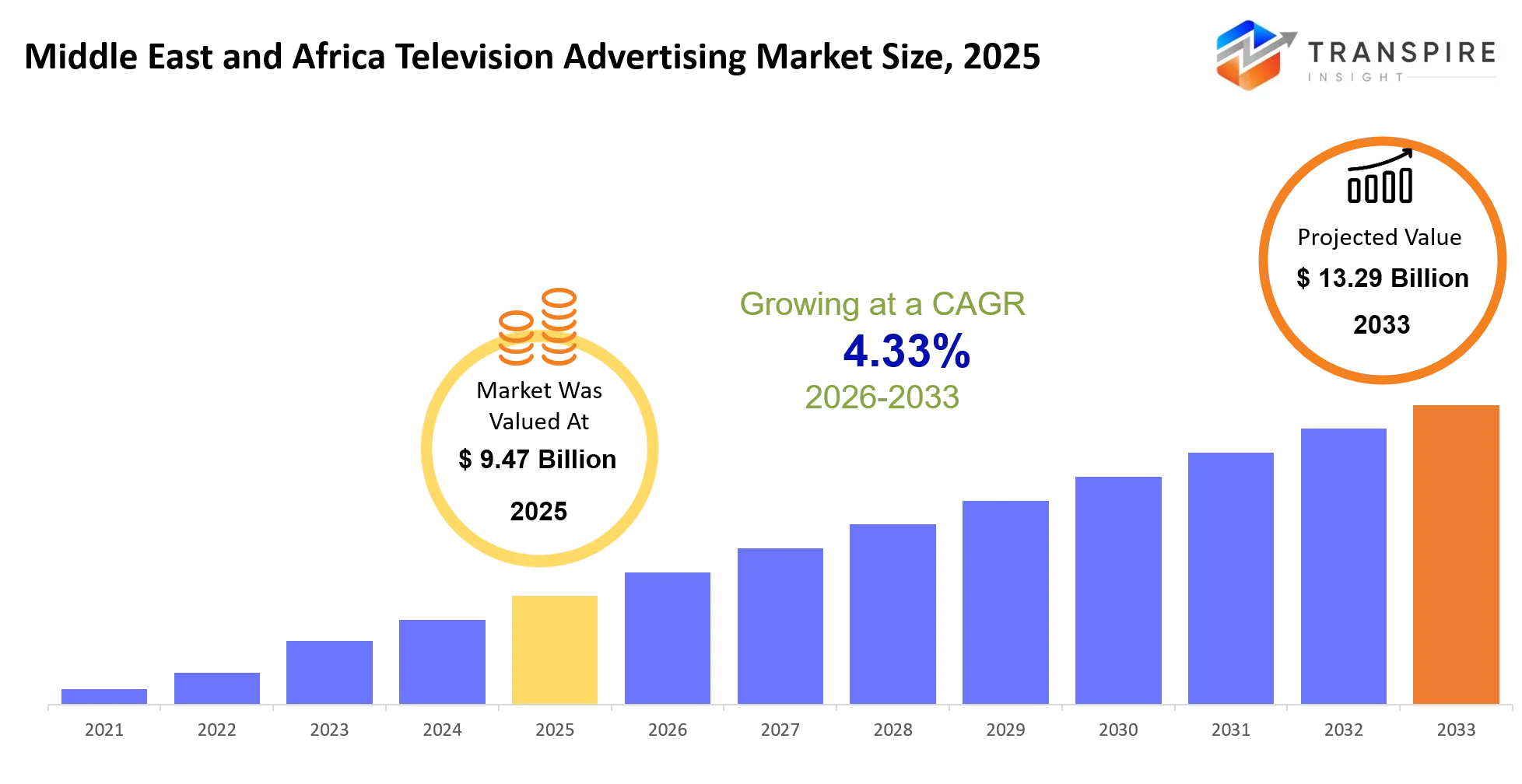
- Middle East and Africa Television Advertising Market Size 2025: USD 9.47 Billion
- Middle East and Africa Television Advertising Market Size 2033: USD 13.29 Million
- Middle East and Africa Television Advertising Market CAGR: 4.33%
- Middle East and Africa Television Advertising Market Segments: By Ad Type (National TV Ads, Regional TV Ads, Sponsorships, Infomercials, Others); By Industry (FMCG, Retail, Automotive, Telecom, Others); By End User (Large Enterprises, SMEs, Others)
To learn more about this report,  Download Free Sample Report
Middle East and Africa Television Advertising Market Summary
The Middle East and Africa Television Advertising Market was valued at USD 9.47 billion in 2025. It is forecast to reach USD 13.29 billion by 2033. That is a CAGR of 4.33% over the period.
The Middle East and Africa television advertising market helps brands reach huge audiences at scale, and yeah, it’s kind of a big deal, especially for product launches, retail promos, financial services marketing, telecom efforts, plus those government communication initiatives. TV still stays really useful in places where getting broad household coverage and keeping strong viewer engagement really matters, because it directly helps nudge consumer buying choices.
Over the last five years, the whole scene has shifted, in a more structural way, toward data-driven and cross-platform advertising strategies. Broadcasters are starting to weave TV spots together with digital measurement tools, so advertisers can basically view audience behaviour more clearly and dial in where the budget goes. One main trigger that sped this up was the COVID-19 pandemic; it boosted television viewership, while also making advertisers reconsider how effective media is, and how to target the right audiences. When economies started to recover, brands leaned into more advanced advertising approaches, mixing classic television reach with digital analytics. This change keeps growing the TV advertising value; it leads to larger campaign budgets, it strengthens advertiser confidence, and it opens up new revenue chances for broadcasters across the region.
Key Market Insights
- So, GCC countries kinda dominate the Middle East and Africa television advertising market, and you can say they’re making up nearly 45% of regional advertising spend in 2025, overall.
- Saudi Arabia and the UAE hold quite a big part, mostly because of hefty media investments, premium content production and also those large advertiser budgets, so in a way it becomes sort of inevitable that their share stays high.
- During the forecast period, Sub-Saharan Africa is turning into the fastest-growing region, largely pushed by expanding television access and also by growing consumer markets. In other words, it’s not just one factor but a sort of gradual momentum that’s building.
- Across Africa, digital broadcasting upgrades are getting better at expanding who can actually see the content, and they are, in a sort of reinforcing way, making the TV advertising market grow more. Audience reach is improving too, like steadily, not just once.
- Traditional television advertising is still kind of king with around 60% market share in 2025, propelled mainly by wide household reach.
- Prime-time commercial advertising still stays the second-largest segment kind of overall, because you get high audience engagement, plus the ad rates are premium too.
- Connected TV and addressable TV advertising seem like the fastest-moving part , going all the way through 2030 as marketers keep chasing more exact targeting abilities and that kind of smart placements.
- Cross-platform advertising solutions are getting some real traction across the regional television advertising industry; honestly, it’s becoming more noticeable lately, like you see them everywhere now and it’s not just one place.
- Consumer goods and retail promotion kind of dominate, with that application share staying in the lead and reaching almost 30% of the TV advertising spend.
- Telecom and financial services are still big contributors, mostly because there’s this really intense customer acquisition contest happening— it feels like it never really stops. Even when one round ends, another shows up right away, and everyone keeps circling around the next customer.
What are the Key Drivers, Restraints, and Opportunities in the Middle East and Africa Television Advertising Market?
The most powerful force pushing the Middle East and Africa television advertising market forward is the increasing integration of audience measurement instruments with connected TV platforms; it’s kind of a two-way relationship. Broadcasters and advertisers are more and more requesting provable campaign results, not only the usual classic reach figures. That change sort of began with the rapid growth of digital media consumption, and then, later, the push for more accountable ad spending after the pandemic phase, you know, when budgets turned tight. To answer that, television networks are introducing data-driven advertising arrangements that give sharper audience sorting and improved performance tracking. Those capabilities then help brands allocate more funding to television campaigns, which, in return, supports higher advertising revenues and a stronger presence in the market.
The biggest obstacle though, still comes from a fragmented media landscape across the region. The market is basically a patchwork of countries, each with its own television penetration rate, different degrees of advertising maturity, and separate regulatory rules, plus even distinct audience measurement approaches. This isn’t something you solve overnight, because it relies on long term investment in broadcast infrastructure, standardised measurement systems, and regulatory alignment that takes years to settle. Because of that fragmentation, cross border advertising efficiency remains limited, and advertisers struggle to run one coherent regional campaign. So, broadcasters often see reduced monetization upside, while advertisers face bigger campaign planning expenses.
One major future opportunity is the expansion of connected TV advertising across Gulf Cooperation Council countries and selected African
What Has the Impact of Artificial Intelligence Been on the Middle East and Africa Television Advertising Market?
Artificial intelligence and advanced digital technologies are, in a real way, nudging television advertising operations across the Middle East and Africa into a faster lane, so campaign execution audience targeting and performance measurement become more efficient even if it feels a bit uneven from market to market. Broadcasters and media agencies are using AI-powered platforms more and more, to handle advertisement scheduling audience segmentation content classification and inventory management with less manual effort. In practice, these systems cut down a lot of the day-to-day workload, and they let networks assign advertising slots based on viewer behaviour along with the actual campaign objectives
Machine learning models are also sharpening predictive strength inside the regional advertising ecosystem. Media companies examine historical viewership data, engagement patterns, and consumer demographics to forecast audience movements, and then tune where ads should land. Predictive analytics helps advertisers by surfacing the most effective time slots, estimating how far the campaign will travel, and improving return on advertising spend before launch. At the same time, programmatic television advertising platforms lean on real-time algorithms, which automate media buying decisions and also lift targeting precision
Taken together these technologies push higher advertising efficiency, better audience alignment, reduced campaign wastage, and stronger monetization of broadcasting assets. Many broadcasters say they notice improved inventory utilization and faster campaign deployment compared with older planning methods. Still, one key drawback stays, the uneven availability of high-quality audience data across multiple Middle Eastern and African markets is not easily fixed. I
Key Market Trends
- Since 2021, some major broadcasters, like MBC Group and MultiChoice, have kept expanding their digital advertising capabilities, to pair it with the old school television inventory. It s pretty much like adding a new channel, while still leaning on the usual screens too.
- Between 2022 and 2025, advertisers moved bigger chunks of their media budgets toward campaigns that mix television reach , with digital audience measurement sort of together, at least in practice.
- Connected TV adoption picked up speed across Gulf markets, which somehow let brands do more personalized ad campaigns and not be stuck only on demographic based targeting. In other words, less reliance on straight population segments, more room for tailored, nuanced messages.
- These days media buyers are leaning more and more on automated planning tools. They help shorten campaign deployment times, compared with the old fashioned television booking process, which was slower by far. In other words, it’s like a faster workflow, a sort of streamlined setup that replaces the usual manual method .
- Cross-platform advertising kind of emerged as a go-to strategy after advertisers started looking for unified performance measures across television, mobile, and streaming channels. It was all about getting that same kind of result tracking, not having different standards.
- Since 2020, broadcasters have invested pretty heavily in audience analytics platform, sort of to get better at advertiser accountability, and yes also to support premium advertising rates. It’s like the whole idea is, more insight, cleaner measurement and better justification for advertisers , so they’re more likely to pay those higher rates.
- Streaming services did increase competitive pressure on the old school television networks, so networks started to invest more in content quality and also in viewer retention initiatives, kinda like keep people around longer. At the same time the whole situation feels a bit more relentless, because platforms push so often, and traditional TV has to respond, without much delay.
- African broadcasters keep expanding their digital broadcasting infrastructure ,so the signal coverage is better all around and somehow it also opens new ad opportunities in areas that were underserved before, kind of unevenly.
- Telecom, e-commerce, and financial services brands seemed to bump up television ad activity, especially as customer acquisition costs were going up through those digital-only channels. It’s like they tried to compensate, or maybe hedge a bit, when the cost, per new buyer, got a little higher.
- Regional media firms started reinforcing their ties with advertising technology providers, to make the audience breakdowns more accurate and to get steadier campaign performance reporting. In other words, better segmentation and more reliable measurement, because the partners are working closer together ,and it’s all kind of smoother than before.
Middle East and Africa Television Advertising Market Segmentation
By Ad Type:
Traditional television advertising keeps a strong footing, largely because it still reaches a wide audience and matches the established viewing habits in many countries. Big consumer brands, telecom operators, and financial institutions remain willing to spend sizeable amounts on television campaigns, mostly for nationwide visibility. Premium placements during well liked entertainment programs, live sports, and prime time broadcasts, still feel like a sure bet for advertisers chasing mass exposure.
Connected TV and addressable advertising have really picked up steam, since broadcasters keep adding digital functions into their television platforms. Measurement tools are getting better , and the whole idea of data driven targeting has nudged advertisers to move some of their budgets toward more personalized campaigns. It’s also become more normal to run cross platform advertising strategies, so brands can link the television moment with online engagement and clearer performance tracking.
By Industry:
Consumer goods and retail, they take up a big chunk of advertising spending because promotions pop up a lot, and brands compete pretty hard. Television still works pretty well for introducing new products, backing seasonal sales, and generally boosting brand recognition with huge audiences. Retail chains keep turning to TV spots to support both their physical aisles, and the online shopping platforms , at the same time.
In the last few years telecommunications, financial services, healthcare, and e-commerce sectors have also been ramping up ad activity. And as competition grows for getting new customers, companies are putting more money into television campaigns that feel more trustworthy and reach a broad slice of the market. Plus, digital commerce has been expanding , which helps keep television advertising in the mix since businesses are aiming for stronger presence across different regional areas.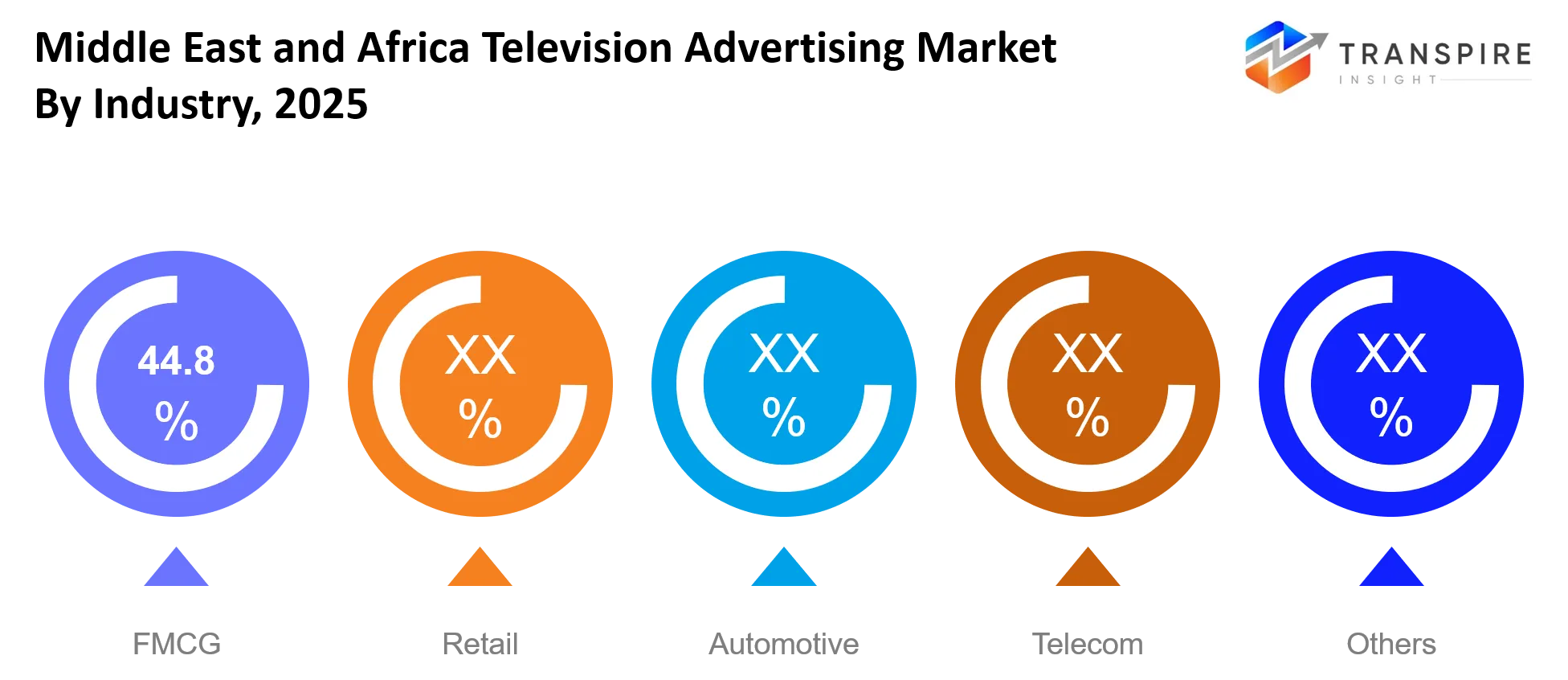
To learn more about this report, Download Free Sample Report
By End User:
Large enterprises show up as the main end user group, mostly because they’ve got big marketing budgets, and they really need steady brand visibility. Many multinational corporations, tend to lean on television advertising so they can stay visible in multiple countries across the same region. Also, the long-term advertising plan and those big, scale campaigns end up keeping spend coming from this segment, year after year.
Small and medium-sized businesses are slowly joining in more, since media buying options are becoming more flexible, and easier to access. Better audience analytics, plus more precise advertising solutions, are opening doors for regional brands and up-and-coming companies. Even startup businesses and expanding local firms are running tv campaigns now, to build recognition and reinforce their competitive stance in the most important consumer markets.
What are the Key Use Cases Driving the Middle East and Africa Television Advertising Market?
Television advertising is probably the most widely used thing for consumer-facing campaigns, the kind where you need broad audience reach pretty fast, within short period too. Retail brands, consumer goods companies, and telecommunications providers seem to depend on television to lift new products, seasonal offers, and also brand-building type initiatives. When households have strong penetration and viewers stay engaged, this area becomes a major source of advertising expenditure across the region.
And it’s not only the mass-market style anymore. Television advertising is also getting more traction in financial services and e-commerce, though people don’t always call it that way. Banks, insurance providers, and digital commerce platforms use television to build trust and to pull in customers, even when markets feel competitive. Government agencies likewise use television networks to push public service announcements, and to run national awareness programs, in a steady manner.
More emerging applications are showing up around connected TV and data-driven advertising formats, honestly it’s becoming a whole separate lane. Advertisers are starting to lean on audience analytics and addressable advertising tools, so they can deliver campaigns that feel more tailored. Streaming-supported television advertising and cross-platform media campaigns are opening up new opportunities as well, especially in Gulf countries and as African markets digitally advance and move forward.
|
Report Metrics |
Details |
|
Market size value in 2025 |
USD 9.47 Billion |
|
Market size value in 2026 |
USD 9.88 Billion |
|
Revenue forecast in 2033 |
USD 13.29 Billion |
|
Growth rate |
CAGR of 4.33% from 2026 to 2033 |
|
Base year |
2025 |
|
Historical data |
2021 - 2024 |
|
Forecast period |
2026 - 2033 |
|
Report coverage |
Revenue forecast, competitive landscape, growth factors, and trends |
|
Regional scope |
Middle East and Africa |
|
Key company profiled |
WPP, Omnicom, Publicis, Dentsu, IPG, Havas, MBC Group, beIN Media, Disney, Paramount, Comcast, ITV, RTL, Sky, Warner Bros Discovery |
|
Customization scope |
Free report customization (country, regional & segment scope). Avail customized purchase options to meet your exact research needs. |
|
Report Segmentation |
By Ad Type (National TV Ads, Regional TV Ads, Sponsorships, Infomercials, Others); By Industry (FMCG, Retail, Automotive, Telecom, Others); By End User (Large Enterprises, SMEs, Others) |
Which Regions are Driving the Middle East and Africa Television Advertising Market Growth?
In the Gulf Cooperation Council region, the market seems to be leading, mostly because high advertising expenditure keeps rolling, plus advanced broadcasting networks and steady investment in the media sector. Saudi Arabia and the United Arab Emirates take up a big share of the regional television advertising action, since big brands put very substantial budgets into mass reach campaigns. Also, supportive media policies, and continued investment in premium content production, help advertisers feel more confident. There’s a fairly mature ecosystem of broadcasters, media agencies , audience measurement providers, and advertising technology firms, and together they keep that leadership sort of locked in.
Meanwhile the broader Middle East still matters a lot, but the growth rhythm is a bit different than what we see in the Gulf markets. Revenue tends to come from more established television viewing habits, plus long standing relationships between advertisers and broadcasters. In several countries, economic diversification programs help keep advertising activity steady across banking, telecommunications , and consumer goods. That kind of stability makes the region a dependable source of market revenue even when budgets drop somewhere else.
Then there’s Sub-Saharan Africa, which looks like it’s emerging as the fastest growing region, as television access widens and broadcasting infrastructure gets upgraded. Recent investments in digital transmission networks and media modernization programs have expanded audience reach across a number of countries. With more people moving to cities, and consumer markets expanding too, brands are more willing to increase television advertising spending. If the momentum stays strong, it should open opportunities for broadcasters, advertising technology providers, and media investors looking for new revenue streams from 2026 to 2033.
Who are the Key Players in the Middle East and Africa Television Advertising Market and How Do They Compete?
Competition in the Middle East and Africa television advertising market is sort of moderately concentrated, with a small cluster of big broadcasters controlling a meaningful slice of premium advertising inventory while regional networks fight for local viewers. At the same time the market is getting gradually disrupted, thanks to streaming platforms, connected TV services, and also advertising technology providers that enable more precise audience targeting. So the rivalry is leaning more toward data capabilities, content strength , audience reach, and cross platform advertising solutions, rather than just pricing alone. Broadcasters that can blend mass-market visibility with measurable campaign outcomes are slowly getting a better standing with advertisers.
MBC Group kind of separates itself through wide Arabic-language programming, broad regional coverage, and ongoing investments in digital media platforms that help keep viewers engaged beyond traditional television. The company keeps pushing its advertising offering by bringing in audience analytics and also expanding digital distribution routes. beIN Media Group concentrates on premium sports and entertainment content, which lets advertisers tap into highly involved audiences during major live occasions. Exclusive broadcasting rights and well known brand recognition give it an edge that is hard for other players to copy.
MultiChoice Group relies on satellite broadcasting, local content creation , and digital services to stay visible across many African markets. It continues investing in streaming platforms and audience measurement capabilities, which in turn helps make more targeted advertising possibilities available. Dubai Media Incorporated uses its position in one of the region’s largest media hubs by offering multilingual content and integrating
Company List
- WPP
- Omnicom
- Publicis Groupe
- Dentsu
- Interpublic Group (IPG)
- Havas
- MBC Group
- beIN Media Group
- Disney
- Paramount Global
- Comcast Corporation
- ITV plc
- RTL Group
- Sky Group
- Warner Bros. Discovery
Recent Development News
In March 2026, MBC Group reported a 28.5% year-on-year increase in full-year 2025 revenue to SR 5.4 billion. The strong financial performance reflected continued investment in premium content, digital media platforms, and advertising inventory, strengthening the group's position in regional television advertising. [https://variety.com
In September 2025, beIN MEDIA GROUP renewed its strategic partnership with SMC Group through 2027. The agreement maintained SMC as the exclusive advertising sales representative across 23 Middle East and North Africa markets, supporting broader advertiser access to beIN's sports and entertainment channels. [https://www.beinmediagroup.com
In September 2025, Warner Bros. Discovery signed a new multi-year audience measurement and analytics agreement with Nielsen. The partnership expands advanced audience measurement capabilities across linear and streaming platforms from 2026, improving advertising targeting, campaign measurement, and media buying efficiency. [https://www.nielsen.com
What Strategic Insights Define the Future of the Middle East and Africa Television Advertising Market?
Over the next five to seven years, the Middle East and Africa television advertising market is expected to drift toward a more integrated media surroundings, where television streaming platforms, and digital advertising basically work like one connected ecosystem. The main push behind this shift is the increasing need for advertising outcomes that can actually be measured. Advertisers are putting more weight on audience data, campaign attribution, and cross platform results, and this will slowly redirect spending toward broadcasters and media companies that can deliver both reach and analytics, kind of in the same breath.
There’s also a quieter concern, market concentration. A rather small bunch of big broadcasters and media groups controls much of the premium advertising inventory in several markets. That kind of concentration may curb pricing flexibility for advertisers. It could also make the whole setup more fragile if viewers keep migrating to alternative platforms, faster than everyone is currently assuming.
At the same time there is a real opening, addressable television advertising in Gulf markets. Smart TV take up keeps growing there, and connectivity keeps improving, so the technical side is getting easier. Market players should probably put priority on audience measurement infrastructure, plus partnerships around data. The organizations that build solid analytics capabilities now will be better set to win those premium advertising budgets, once media buying becomes even more performance guided.
Middle East and Africa Television Advertising Market Report Segmentation
By Ad Type
- National TV Ads
- Regional TV Ads
- Sponsorships
- Infomercials
- Others
By Industry
- FMCG
- Retail
- Automotive
- Telecom
- Others
By End User
- Large Enterprises
- SMEs
- Others
Frequently Asked Questions
Find quick answers to common questions.
The Expected Middle East and Africa Television Advertising Market size for the Market will be USD 13.29 Billion in 2033.
Key Segments for the Middle East and Africa Television Advertising Market are By Ad Type (National TV Ads, Regional TV Ads, Sponsorships, Infomercials, Others); By Industry (FMCG, Retail, Automotive, Telecom, Others); By End User (Large Enterprises, SMEs, Others).
Major Middle East and Africa Television Advertising Market Players are WPP, Omnicom, Publicis, Dentsu, IPG, Havas, MBC Group, beIN Media, Disney, Paramount, Comcast, ITV, RTL, Sky, Warner Bros Discovery.
The Current Middle East and Africa Television Advertising Market size is USD 9.47 Million in 2025.
The Middle East and Africa Television Advertising Market CAGR is 4.33% from 2026 to 2033.
- WPP
- Omnicom
- Publicis Groupe
- Dentsu
- Interpublic Group (IPG)
- Havas
- MBC Group
- beIN Media Group
- Disney
- Paramount Global
- Comcast Corporation
- ITV plc
- RTL Group
- Sky Group
- Warner Bros. Discovery
About the Authors

Mayur Shinde
I am Mayur Shinde, a Senior Research Analyst at Transpire Insight, specializing in the Automotive & Transportation and Information & Communication Technology (ICT) Industry. My work focuses on analyzing emerging market trends, technological advancements, competitive landscapes, and industry developments to deliver accurate, data-driven insights. I am passionate about transforming complex market information into clear, actionable content that helps businesses, professionals, and decision-makers stay informed and make confident strategic decisions.

Chakradhar Khansole
Chakradhar serves as the Research Director at Transpire Insight, bringing over 8 years of experience in technology, innovation, and strategic market intelligence. He specializes in transforming complex market data into actionable business insights that enable organizations to make informed, growth-oriented decisions. Recognized for his strategic vision and analytical expertise, Chakradhar leads high-impact research initiatives, delivering comprehensive market assessments, competitive intelligence, and forward-looking industry analysis.
Recently Published Reports
-
Apr 2026
3D Optical Profiler Market
3D Optical Profiler Market Size, Share & Analysis Report By Type (Desktop 3D Optical Profiler, and Portable 3D Optical Profiler), By Technology (Confocal Technology, and White Light Interference), By End-Use Industry (Manufacturing, Research Institutions, Automotive, Aerospace and Defense, Medical Devices, and Other), and Geography (North America, Europe, Asia-Pacific, Middle East and Africa, South and Central America), 2021 - 2031
-
Apr 2026
Depth Sensor Market
Depth Sensor Market Size, Share & Analysis Report By Type (Infrared Depth Sensors, Time-of-Flight (ToF) Sensors, Stereo Vision Sensors, Structured Light Sensors, Ultrasonic Depth Sensors), By Application (Automotive, Robotics, Gaming, Consumer Electronics, Industrial Automation, Healthcare, Security & Surveillance, Others), By End Users (Automotive Manufacturers, Consumer Electronics Companies, Healthcare Providers, Industrial Companies, Security Agencies, Gaming Companies, Robotics Companies, Others), and Geography (North America, Europe, Asia-Pacific, Middle East and Africa, South and Central America), 2021 – 2031
-
Apr 2026
Digital Manufacturing Market
Digital Manufacturing Market Size, Share & Analysis Report By Component (Hardware, Software, and Services), By Technology (Robotics, 3D Printing, Internet of Things (IoT), and Others), By Application (Automotive and Transportation, Aerospace and Defense, Consumer Electronics, Industrial Machinery, and Others), By Process Type (Computer-Based Designing, Computer-Based Simulation, Computer 3D Visualization, Analytics, and Others), and Geography (North America, Europe, Asia-Pacific, Middle East and Africa, South and Central America), 2021 – 2031
-
Apr 2026
Digital Visa Services Market
Digital Visa Services Market Size, Share & Analysis Report By Type (Individual Travelers, Group Travelers), By Application (Tourism, Business Travel, Others), and Geography (North America, Europe, Asia-Pacific, Middle East and Africa, South and Central America), 2021 – 2031