
Middle East and Africa Gaskets and Seals Market Size & Forecast:
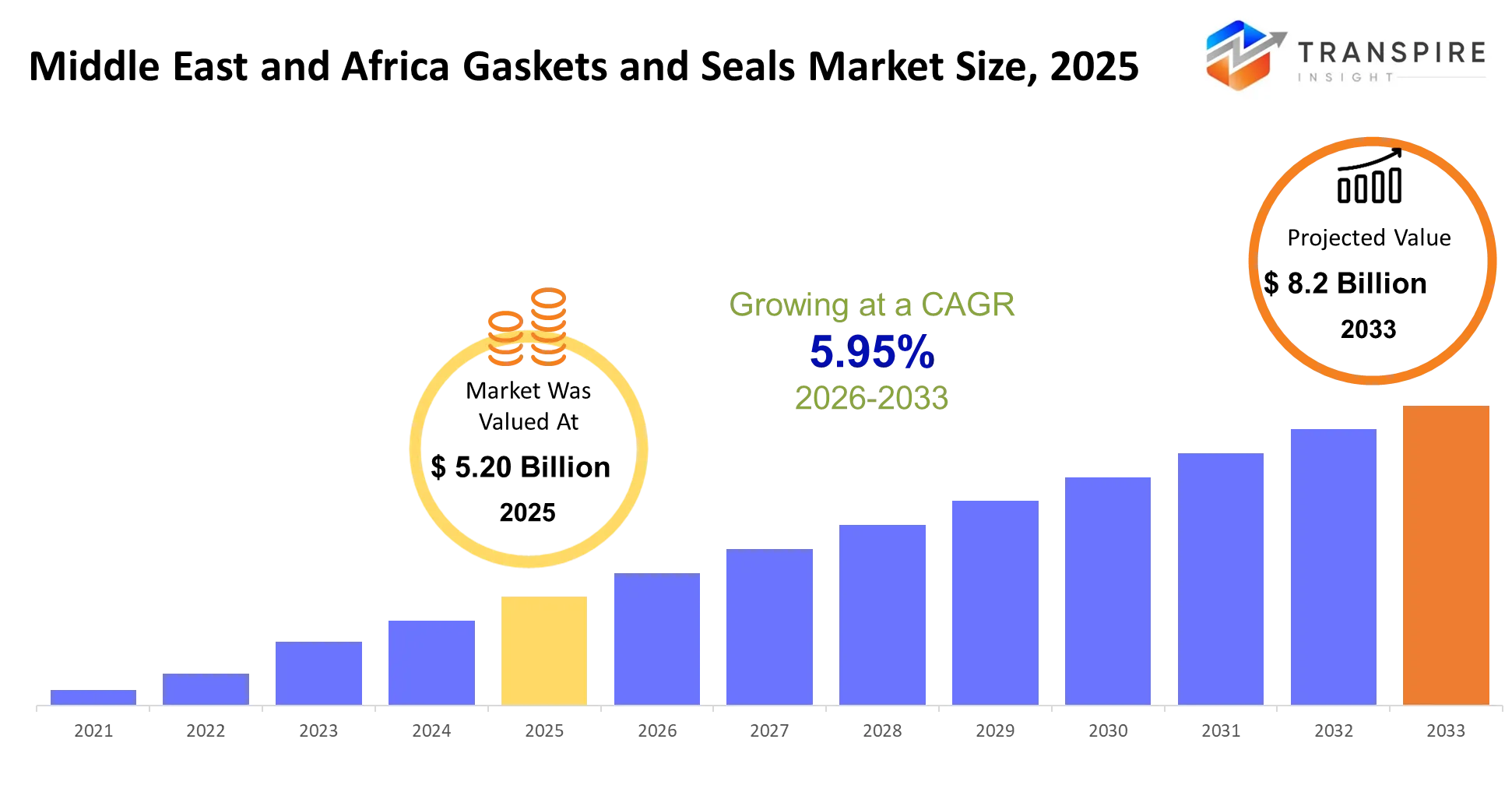
- Middle East and Africa Gaskets and Seals Market Size 2025: USD 5.20 Billion
- Middle East and Africa Gaskets and Seals Market Size 2033: USD 8.2 Billion
- Middle East and Africa Gaskets and Seals Market CAGR:5.95%
- Middle East and Africa Gaskets and Seals Market Segments: By Type (Metallic, Non-metallic, Semi-metallic, Others); By Application (Automotive, Oil & Gas, Industrial Machinery, Power Generation, Chemicals, Others); By End-User (Automotive Industry, Oil & Gas Companies, Industrial Firms, Power Plants, Chemical Industry, Others); By Material (Rubber, Metal, PTFE, Others)
To learn more about this report,  Download Free Sample Report
Middle East and Africa Gaskets and Seals Market Summary
The Middle East and Africa Gaskets and Seals Market was valued at USD 5.20 Billion in 2025. It is forecast to reach USD 8.2 Billion by 2033. That is a CAGR of 5.95% over the period.
The Middle East and Africa Gaskets and Seals Market kinda supports the physical integrity of industrial systems, by stopping fluid as well as gas leakage in pipelines, compressors, refineries, marine engines, and power equipment that are running under extreme pressure and temperature, you know. In real practice it helps keep operational safety and continuity across oil and gas production, petrochemical processing and energy transport infrastructure, because even a small seal failure can stop output and then cause expensive downtime.
Over the past 3–5 years the market has been shifting, structurally, toward higher specification sealing solutions as energy operators lean into hydrogen, LNG expansion, and carbon capture systems. These applications need tighter performance tolerances than conventional hydrocarbons, so the approach changes a bit. The pace of this transition was pushed by Saudi Arabia’s Vision 2030 industrial diversification and the UAE clean energy investments, which nudged EPC contractors to bring advanced materials earlier, into project design cycles. Also, supply chain disruptions during 2021–2022 highlighted how much the region depended on imported elastomers and fluoropolymers, so companies adjusted by moving into regional sourcing and doing supplier diversification.
So overall, that mix of technological transition and supply chain recalibration has increased the uptake of engineered seals and it also strengthened long term contract based procurement. As a result, revenue visibility for global and regional suppliers has gone up, pretty noticeably.
Key Market Insights
- The Middle East pretty much dominates the Middle East and Africa Gaskets and Seals Market, with around 55–60% share in 2025, and it is fueled by Saudi Arabia and UAE refinery plus LNG expansion programs, so a lot of the momentum stays there.
- Sub- Saharan Africa then comes in as the fastest-grow region through 2033 , backed by mining activity, power generation, and infrastructure investment inflows—really it just keeps showing up.
- Non-metallic seals take the lead across the Middle East and Africa Gaskets and Seals Market with more than 40% share, largely because they handle corrosion resistance in pipelines, and also in refining systems fairly well.
- Semi-metallic seals, meanwhile are growing the quickest in the 2024–2030 window, mostly tied to high-pressure industrial modernization efforts.
- For application side of things, oil and gas sit on top with close to 50% share, since upstream drilling and refining intensity never really slows down.
- Power generation also expands fast, especially as gas-fired plants grow and renewable integration projects scale across GCC and many African markets at the same time.
- When looking at end users , oil and gas companies stay the leading group, while industrial firms move faster, due to manufacturing expansion, and related industrial upgrades.
- In terms of competition, Parker Hannifin, Trelleborg, SKF, Freudenberg, and John Crane are the key players that show up most often.
- They tend to strengthen their market share using advanced material innovation in PTFE, elastomers, and high-pressure sealing technologies that fit tougher operating conditions.
- Finally, strategic partnerships with EPC contractors help accelerate early project integration across LNG, hydrogen, and petrochemical developments, even when timelines are tight.
What are the Key Drivers, Restraints, and Opportunities in the Middle East and Africa Gaskets and Seals Market?
The expansion of upstream oil, gas and petrochemical capacity across the Gulf Cooperation Council has, kind of, turned into the main growth engine for sealing systems, at least from what we see in procurement patterns. Big refinery upgrades in Saudi Arabia, plus new LNG linked infrastructure in Qatar and the UAE have kicked off a steady pull for high pressure and corrosion resistant sealing solutions. That momentum got even stronger after national energy diversification programs picked up pace, especially the hydrogen and carbon capture pilot efforts. Those initiatives need reliable sealing integrity in compressors, pipelines, and processing units, which is why the whole thing keeps moving. The direct impact shows up in the EPC driven specification demand, where sealing suppliers lock in long-term contracts during early project engineering stages, instead of only battling for aftermarket supply later.
There’s a structural constraint, because a lot of the critical input still relies on imported specialty materials like fluoropolymers and top tier elastomers. Supply chains are still pretty concentrated among a few global producers, so the sector is exposed to price swings and export restrictions. That, in turn, restricts how fast local manufacturing can scale, and it can delay adoption of advanced sealing technologies in cost sensitive markets across North and Sub Saharan Africa. So you end up with uneven technology diffusion, where high performance solutions stay mostly in marquee projects while broader industrial users keep leaning on lower spec alternatives, even if they’re not ideal.
Something like an opportunity is forming fast in hydrogen infrastructure, especially around Saudi Arabia’s NEOM hydrogen efforts and the UAE clean energy zones . Those places kind of demand sealing systems, next level, that can handle high-pressure electrolysis while also staying functional during cryogenic storage. And as capital keeps moving, into hydrogen corridors plus export-connected ammonia units, suppliers that manage early qualification with the EPC contractors will end up in better footing for the long haul, multi-decade supply options, and they can tap into a new high-margin demand layer.
What Has the Impact of Artificial Intelligence Been on the Middle East and Africa Gaskets and Seals Market?
Artificial intelligence is kind of reshaping scrubber performance systems and sealing intensive industrial equipment, by enabling real-time automation of monitoring and control functions, more or less. Operators are increasingly deploying AI enabled sensors across exhaust gas cleaning technology, to track pressure differentials, seal wear, and leakage risks in refinery units and also marine propulsion systems. At the same time, AI driven control systems optimize valve timing and fluid distribution, which helps lower mechanical strain on sealing components and makes operation feel more steady when load conditions keep changing.
Machine learning models are also boosting predictive maintenance across industrial sealing applications. In rotating equipment used in oil, gas, and power generation assets, the algorithms sift through vibration, temperature, and pressure signals, to anticipate seal degradation before a failure event actually happens. This shift has improved uptime in certain industrial operations by cutting down unplanned shutdown cycles and extending the intervals between maintenance work, while still enabling better emissions compliance through tighter system control. In marine emission control technology, predictive analytics let operators foresee scrubber fouling and adjust cleaning cycles, so efficiency stays up and fuel performance doesn’t drift as much.
That said, AI adoption is still somewhat constrained by limited high quality operational data from harsh environments like offshore platforms and long haul vessels. Connectivity gaps and inconsistent sensor calibration reduce model accuracy, especially across real world maritime conditions. So, deployment at full scale across sealing intensive systems tends to slow down.
Key Market Trends
- Refinery-driven sealing demand did decline in share, as hydrogen and carbon capture projects expanded across Gulf industrial diversification programs after 2023, though it wasnt a clean drop.
- EPC contractors started integrating sealing suppliers earlier in the project design phases by 2024, kinda shifting the whole competition more toward specification control than pure pricing.
- Also, non-metallic seal adoption moved up during 2025. Operators put more emphasis on corrosion resistance for aging pipeline runs and offshore infrastructure, all over the region.
- Hydrogen-compatible sealing technologies gained traction after 2024, pushed by pilot electrolyzer projects in Saudi Arabia and the UAE energy corridors, this part kept growing slowly.
- On the maintenance side, aftermarket demand strengthened in North Africa, because aging oil fields increased replacement cycles for industrial sealing components since 2023.
- PTFE based material usage rose sharply in chemical processing units after stricter safety compliance rules were expanded across industrial zones in 2025, and it felt immediate.
- Distribution-led sales models weakened a bit as direct OEM contracts grew, especially among global players like Parker Hannifin and Trelleborg.
- Meanwhile LNG and cryogenic applications expanded sealing requirements as export terminal capacity increased across Qatar-linked and East African infrastructure developments.
- Lastly, localized manufacturing partnerships increased after 2024, since companies reduced supply chain exposure to imported elastomer and fluoropolymer volatility.
Middle East and Africa Gaskets and Seals Market Segmentation
By Type
Non-metallic seals kind of hold the strongest position because they’re used a lot in pipelines , refineries and rotating equipment across most oil and gas infrastructure. Elastomers and polymer-based materials come up most often, since they offer corrosion resistance and flexibility when pressure keeps changing, which is common in regional upstream and midstream operations. Metallic seals still matter a great deal in high-pressure and very extreme-temperature settings, especially in LNG and petrochemical units, where the safety expectations are strict, like not negotiable.
Semi-metallic variants seem to gain interest when the job needs both resilience and structural strength, especially for compressors and heat exchangers. The growth factors don’t look the same across segments either. Non-metallic demand is tied to volume-driven maintenance cycles , while metallic uptake usually follows capital-heavy projects. Semi-metallic demand gets a boost when refineries and power plants upgrade and modernize equipment.
Looking ahead, the direction leans toward non-metallic and semi-metallic categories as infrastructure diversification keeps increasing, including across hydrogen and water treatment systems. Material innovation will shape how vendors stay competitive, particularly for suppliers working on hybrid composites. Buyers will push for durability and lifecycle cost efficiency rather than focusing only on the first purchase price, even if that initial number is tempting.
By Application
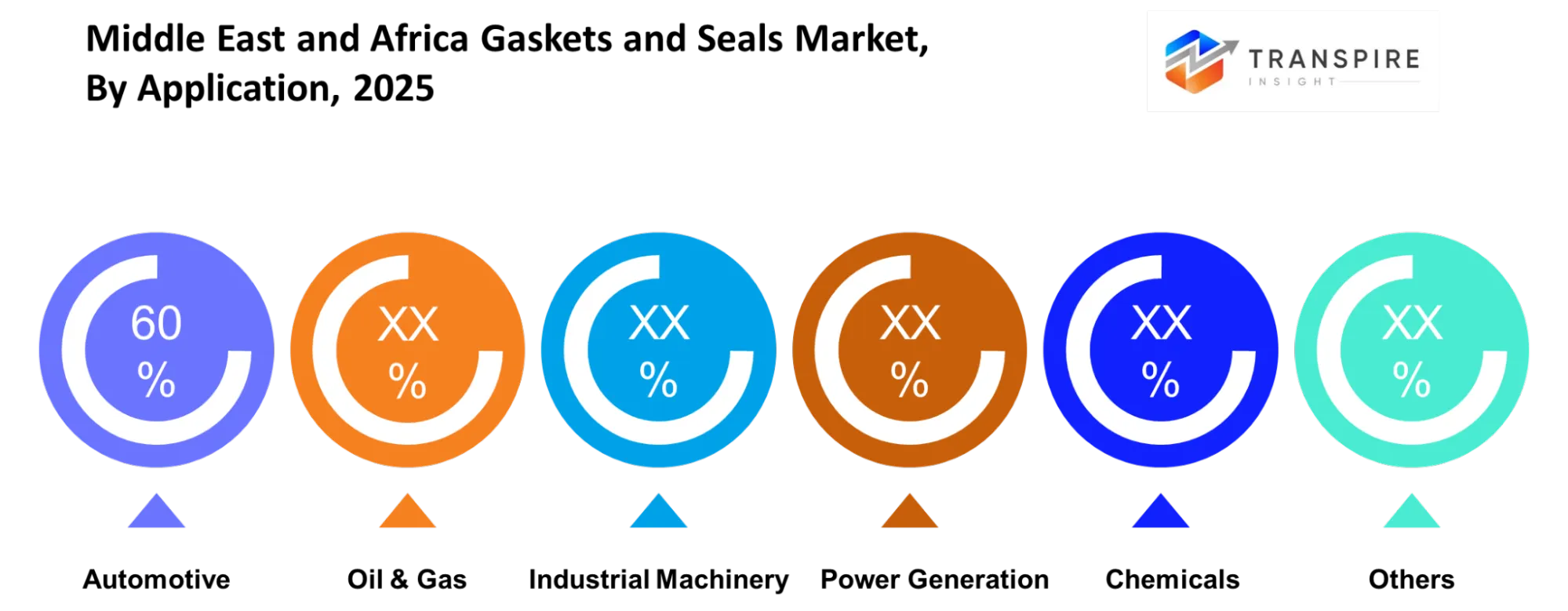
Oil and gas stands out as the dominant use-case due to the extensive extraction , refining, and transport network that needs reliable sealing integrity all the time under difficult operating conditions. Industrial machinery is the next big segment, and it’s mainly pulled by maintenance requirements for compressors , pumps and other rotating systems across manufacturing and processing industries .Chemical processing also keeps a steady kind of demand, largely because the media handling requirements stay pretty aggressive and strict, you know, it has to be continuous and monitored.
Power generation applications, though, show a more differentiated growth pattern, with expansion in gas-fired plants and some early-stage renewable integration, moving along in parallel. The automotive demand looks smaller overall but still stable, and it ties back to commercial fleets and aftermarket servicing more than advanced vehicle manufacturing. So each segment ends up behaving in its own way, not really like one uniform industrial demand line.
In the future, growth seems to concentrate in power generation and chemicals, as energy diversification ramps up across Gulf and African markets. Industrial machinery should benefit from rising automation, plus equipment replacement cycles that just keep coming around. Suppliers will need application-specific engineering ability , basically, to stay competitive under diverse operating conditions, even when the environments shift quickly.
To learn more about this report, Download Free Sample Report
By End-User
Oil and gas companies are the biggest end-user group, since they have that extensive upstream and downstream infrastructure which means continuous sealing maintenance, and not just occasional work. Industrial firms still add a lot of demand through machinery upkeep and plant-level operations in manufacturing hubs, plus logistics centers too. Power plants come next as stable consumers , supported by long operating lifecycles and strict safety compliance requirements that don’t really loosen.
For chemical industry end-users, there is a higher reliance on corrosion-resistant sealing systems, because exposure to aggressive processing environments is basically unavoidable. The automotive industry is more limited, mostly service networks and commercial transport fleets rather than a push toward manufacturing expansion. Other end-users, like water utilities and construction operators, create fragmented but steady demand, so it’s never one big uniform pool.
Future demand should keep getting stronger for power plants and industrial firms as energy, and manufacturing capacity starts expanding more and more. Oil and gas companies are still likely to dominate, however they will see a gradual diversification of demand sources. Suppliers will have to build solid service networks if they want to keep those long-term contracts across different end user categories, not just one segment.
By Material
Rubber materials are still leading, mostly because they’re used everywhere for sealing tasks across pipelines, pumps, and general industrial equipment, where flexibility matters and cost efficiency is a real priority. Metal materials keep a strong footing too, especially in high-pressure and high-temperature settings like refineries and LNG facilities. PTFE is getting more momentum in chemical and pharmaceutical-related use cases, mainly due to its resistance against aggressive media.
Other advanced materials, including composite blends, end up being useful for very specific needs in hydrogen systems and specialized industrial processes. The growth story is not identical for every option, with rubber pulled forward by volume replacement cycles, while PTFE and metal are more tied to high specification installations. Material choice is starting to mirror operational risk tolerance and also lifecycle performance requirements, which feels a bit more strict than before.
Looking ahead, demand may tilt further toward PTFE and advanced composites as hydrogen, and chemical processing expand. Rubber should stay dominant in maintenance-heavy scenarios, but it may gradually lose ground in higher-performance environments. Material innovation is likely to become a key competitive tool for suppliers trying to secure long-run contracts.
What are the Key Use Cases Driving the Middle East and Africa Gaskets and Seals Market?
Upstream oil and gas operations remain the dominant use case for gaskets and seals across the Middle East and Africa, driven by high-pressure drilling, refining, and pipeline systems that require continuous leak prevention under extreme temperature and corrosive conditions. This segment generates sustained demand because even minor seal failure can trigger costly shutdowns and regulatory non-compliance in critical energy infrastructure.
Beyond hydrocarbons, petrochemical processing and industrial manufacturing are expanding adoption, particularly in compressor systems, rotating equipment, and refinery maintenance cycles. Marine and LNG transport applications are also gaining traction as shipping fleets and export terminals require high-performance sealing solutions for cryogenic and high-vibration environments. These uses are strongly tied to large industrial operators and EPC contractors.
Emerging demand is building in hydrogen production systems and carbon capture infrastructure, where seals must withstand novel pressure and chemical exposure profiles. Water desalination and utility-scale renewable energy projects are also beginning to adopt advanced elastomeric sealing technologies as governments push infrastructure diversification.
|
Report Metrics |
Details |
|
Market size value in 2025 |
USD 5.20 Billion |
|
Market size value in 2026 |
USD 5.47 Billion |
|
Revenue forecast in 2033 |
USD 8.2 Billion |
|
Growth rate |
CAGR of 5.95% from 2026 to 2033 |
|
Base year |
2025 |
|
Historical data |
2021 - 2024 |
|
Forecast period |
2026 - 2033 |
|
Report coverage |
Revenue forecast, competitive landscape, growth factors, and trends |
|
Regional scope |
Middle East and Africa (Saudi Arabia, United Arab Emirates, South Africa, Rest of Middle East and Africa) |
|
Key company profiled |
Parker Hannifin, Trelleborg, SKF, Freudenberg, Garlock, Dana, John Crane, EagleBurgmann, Flowserve, NOK Corporation, Hutchinson, ElringKlinger, Flexitallic, James Walker, ERIKS |
|
Customization scope |
Free report customization (country, regional & segment scope). Avail customized purchase options to meet your exact research needs. |
|
Report Segmentation |
By Type (Metallic, Non-metallic, Semi-metallic, Others); By Application (Automotive, Oil & Gas, Industrial Machinery, Power Generation, Chemicals, Others); By End-User (Automotive Industry, Oil & Gas Companies, Industrial Firms, Power Plants, Chemical Industry, Others); By Material (Rubber, Metal, PTFE, Others) |
Which Regions are Driving the Middle East and Africa Gaskets and Seals Market Growth?
The Middle East Gulf Cooperation Council region kinda leads the MEA gaskets and seals market because of the dense concentration of upstream oil, gas, and petrochemical assets, you know. Saudi Arabia and the UAE keep demand steady via ongoing refinery expansions plus major hydrogen and carbon capture programs. With strong state-backed industrial policies and integrated EPC ecosystems, sealing suppliers can get involved early in megaproject design cycles, even before contracts fully lock. Then you add advanced port infrastructure and strict compliance rules for pressure performance and corrosion resistance, and well it really locks in the region’s lead.
North Africa comes next, and it feels structurally stable, not just “promising”. The drivers are more about domestic energy security and export logistics rather than a heavy push for industrial diversification. Algeria and Egypt, for instance, lean on mature oil and gas reservoirs together with steady refinery utilization, so that translates into consistent aftermarket demand for maintenance-grade sealing systems. The Suez Canal corridor also supports industrial work related to marine and transit-linked infrastructure servicing. Here, competition is less about cutting-edge material innovation and more about operational continuity and cost efficiency.
Sub-Saharan Africa is the fastest-growing area, mainly because infrastructure financing is accelerating and power generation plus mining activities are expanding quickly. More Chinese-backed industrial corridors, alongside renewable energy investments, has pushed demand for industrial sealing solutions across turbines, pipelines, and water systems. This change shows a shift away from resource extraction only, toward a wider industrial buildout backed by new ports and transport networks. For new entrants, that means a pretty long runway of demand growth from 2026 to 2033, but success will depend on local partnerships and flexible supply chain models.
Who are the Key Players in the Middle East and Africa Gaskets and Seals Market and How Do They Compete?
The Middle East and Africa gaskets and seals market still looks pretty moderately consolidated at the top, like, where a few major engineering firms go head to head for the high-spec kind of applications in oil and gas, petrochemicals, and the newer hydrogen infrastructure. But once you move downstream, the distribution and maintenance side feels way more split up. In that area, regional suppliers tend to push hard on availability and price. Honestly, competition is driven less by plain old cost leadership and more by material science know-how, certification for harsh pressure and temperature settings and the ability to land long-term service agreements with EPC contractors, and operators too.
Parker Hannifin tries to stand out via tech-led differentiation, using advanced sealing materials, and also expanding through acquisitions, which kinda helps it strengthen its position in hydrogen, and other high-pressure use cases that are getting more attention because of Gulf energy diversification efforts. Trelleborg leans into engineered polymer seals for offshore situations, and corrosive environments as well, they do this with application-specific customization, so they can fit into long-cycle industrial contracts that last. SKF instead links its seals with its bearings and condition monitoring systems, so it can chase predictive maintenance value, rather than competing like it’s just selling standalone components.
Freudenberg builds leverage by going deep with OEM partnerships across automotive and industrial equipment. It supplies elastomer sealing systems made for precision fit and lasting durability. John Crane emphasizes high-reliability mechanical seals, plus it backs them with broad global service networks , which then helps it keep recurring revenue steady through maintenance contracts. ERIKS takes a different route from a distribution and MRO mindset, leaning on regional inventory depth and quick turnaround logistics to win share in industrial operations that are maintenance-heavy.
Company List
- Parker Hannifin
- Trelleborg
- SKF
- Freudenberg
- Garlock
- Dana
- John Crane
- EagleBurgmann
- Flowserve
- NOK Corporation
- Hutchinson
- ElringKlinger
- Flexitallic
- James Walker
- ERIKS
Recent Development News
“In April 2026, Trelleborg Sealing Solutions announced the development of a new state-of-the-art manufacturing facility in Bengaluru as part of a greenfield investment to increase production capacity by 30%. The expansion strengthens localized supply chains for engineered seals and supports rising demand from oil, gas, and industrial customers serving Middle East-linked projects.https://www.automation.com
What Strategic Insights Define the Future of the Middle East and Africa Gaskets and Seals Market?
Over the next five to seven years, the Middle East and Africa gaskets and seals market is likely to start shifting, away from a cyclical oil-and-gas reliance toward something more structurally diversified in the industrial sense. That change is mostly nudged by large scale infrastructure spending, downstream petrochemical growth, and then a gradual merging with hydrogen readiness plus water-intensive desalination undertakings. What this really means is there is a steady baseline for high performance sealing solutions, not so much the kind of commoditized products that get squeezed on margin.
A quieter concern—so to speak— is the growing material dependency on specialized elastomers, and also fluoropolymers where the global supply concentration can end up turning into price shocks, and even export restrictions that hit suddenly. In parallel, hydrogen-ready sealing systems for electrolyzers and high pressure storage are appearing as a smaller niche, but one that is scaling fast. Market participants should therefore push for localization of advanced material making, and also secure early qualification with EPC contractors, so they can lock in long term supply agreements before the technology standards fully consolidate.
Middle East and Africa Gaskets and Seals Market Report Segmentation
By Type
- Metallic
- Non-metallic
- Semi-metallic
- Others
By Application
- Automotive
- Oil & Gas
- Industrial Machinery
- Power Generation
- Chemicals
- Others
By End-User
- Automotive Industry
- Oil & Gas Companies
- Industrial Firms
- Power Plants
- Chemical Industry
- Others
By Material
- Rubber
- Metal
- PTFE
- Others
Frequently Asked Questions
Find quick answers to common questions.
The Middle East and Africa Gaskets and Seals Market size is USD 8.2 Billion in 2033.
Key segments for the Middle East and Africa Gaskets and Seals Market are By Type (Metallic, Non-metallic, Semi-metallic, Others); By Application (Automotive, Oil & Gas, Industrial Machinery, Power Generation, Chemicals, Others); By End-User (Automotive Industry, Oil & Gas Companies, Industrial Firms, Power Plants, Chemical Industry, Others); By Material (Rubber, Metal, PTFE, Others).
Major Middle East and Africa Gaskets and Seals Market players are Parker Hannifin, Trelleborg, SKF, Freudenberg, Garlock, Dana, John Crane, EagleBurgmann, Flowserve, NOK Corporation, Hutchinson, ElringKlinger, Flexitallic, James Walker, ERIKS.
The Middle East and Africa Gaskets and Seals Market size is USD 5.20 Billion in 2025.
The Middle East and Africa Gaskets and Seals Market CAGR is 5.95% from 2026 to 2033.
- Parker Hannifin
- Trelleborg
- SKF
- Freudenberg
- Garlock
- Dana
- John Crane
- EagleBurgmann
- Flowserve
- NOK Corporation
- Hutchinson
- ElringKlinger
- Flexitallic
- James Walker
- ERIKS
Recently Published Reports
-
Apr 2026
Healthcare Polymer Packaging Market
Healthcare Polymer Packaging Market Size, Share & Analysis Report By Packaging Type (Syringes, IV Bottles and Pouches, Clamshells, Blisters, Bottles & Jars, Containers, Tubes, IV Parental Packaging, Others), By Type (Regulated, Non-regulated), By Polymer Type (LDPE (Low-Density Polyethylene), HDPE (High-Density Polyethylene), Homo-polymer (Homo), Random Copolymer (Random), Block Copolymer (Block), PET, Polystyrene, Polyvinyl Chloride, Polyamide/EVOH, Others), and Geography (North America, Europe, Asia-Pacific, Middle East and Africa, South and Central America), 2021 - 2031
-
Apr 2026
Hydrophilic Tape (Waterstop) Market
Hydrophilic Tape (Waterstop) Market Size, Share & Analysis Report By Type (Bentonite-Based Hydrophilic Tape, Rubber-Based Hydrophilic Tape), By Application (Residential Buildings, Commercial Buildings, Infrastructure Projects), and Geography (North America, Europe, Asia-Pacific, Middle East and Africa, South and Central America), 2021 - 2031
-
Apr 2026
Metalens Market
Metalens Market Size, Share & Analysis Report By Type (Visible Light Metalens, and Infrared Metalens), By Application (Consumer Electronics, Automotive Electronics, Industrial, Medical, and Others), and Geography (North America, Europe, Asia-Pacific, Middle East and Africa, South and Central America), 2021 - 2031
-
Apr 2026
PBT Resin Market
PBT Resin Market Size, Share & Analysis Report By Type (Reinforced PBT Resin, Unreinforced PBT Resin), By Processing Method (Injection Molding, Extrusion, Blow Molding, Others), By End-User (Automotive, Electrical & Electronics, Consumer Appliances, Industrial Machinery, Medical Devices, Packaging, Others), and Geography (North America, Europe, Asia-Pacific, Middle East and Africa, South and Central America), 2021 - 2031