

Middle East and Africa Europe Architectural Coating Market Summary
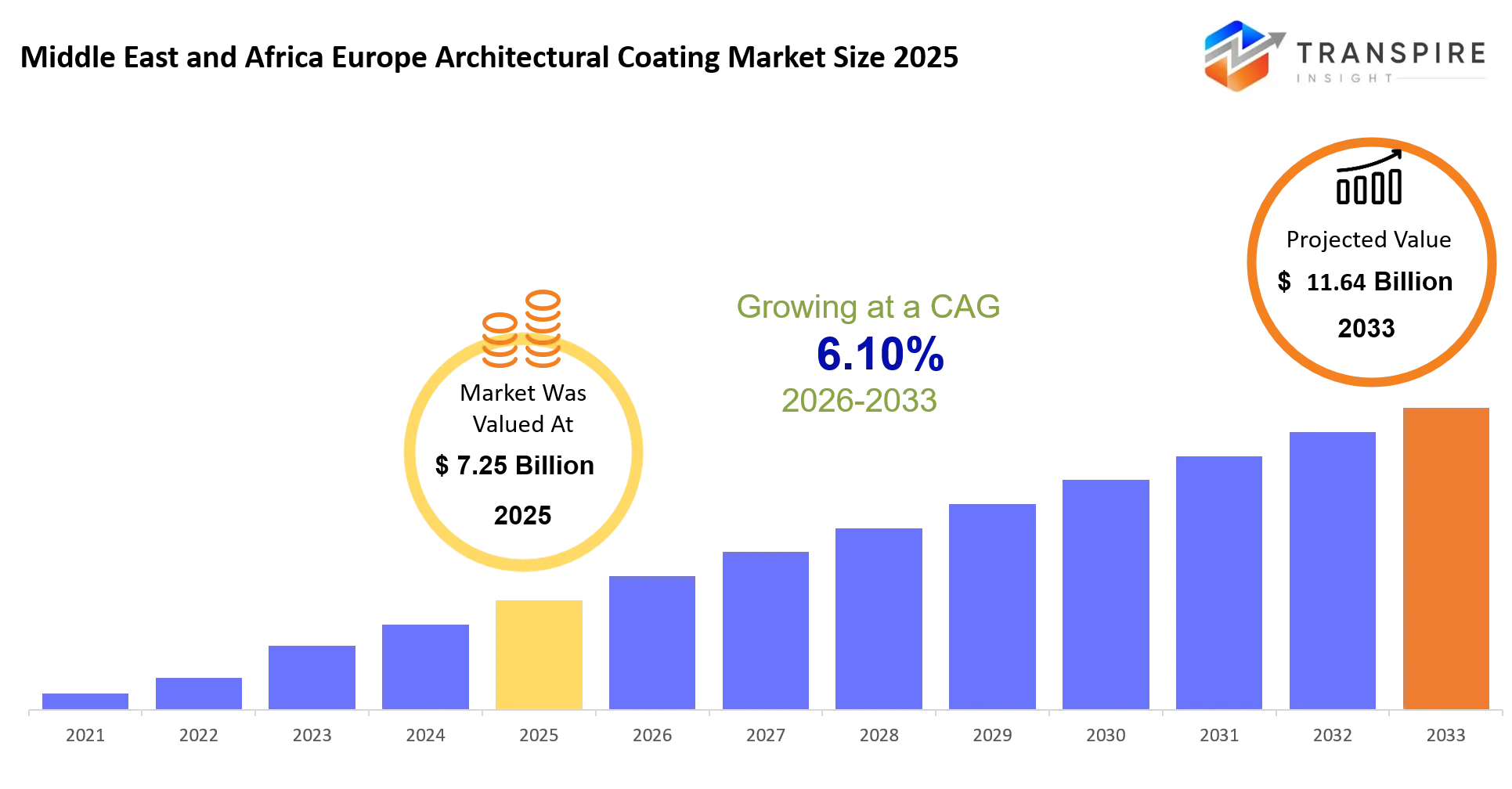
As per Transpire Insight Analysis the Middle East and Africa Europe Architectural Coating Market size is estimated at USD 7.25 Billion in 2025 and is anticipated to reach USD 11.64 Billion by 2033, growing at a CAGR of 6.10% from 2026 to 2033.
The Middle East and Africa Europe Architectural Coating Market, honestly it seems to do a lot for protecting residential commercial plus industrial structures from weathering, moisture, ultraviolet exposure, corrosion, and plain surface decay while also lifting visual charm and, in a kind of longer way, extending how long a building stays useful.In the last five years the market as a whole seems to have been drifting toward more water based coatings, low VOC solutions, and also higher performance formulations, at least a big part of it is because tougher European environmental rules plus the green building certification kind of re shaped how these products get developed. Then, after the Russia-Ukraine conflict, supply chains got disrupted and raw material prices started bouncing around, which meant manufacturers had to widen their sourcing, and push to speed up investments into regional production.
Because of all of that, a lot of producers rolled out premium mixes, with better staying power, an antimicrobial defense layer, and energy reflective capabilities, so it ends up feeling like everything is moving at once.. Meanwhile big urban redevelopment efforts across the Gulf countries, plus renovation work across Europe, kept increasing the need for specialized architectural coatings. So really, regulatory compliance along with infrastructure modernization and tech led product innovation is still pushing market revenues up and making the premium coating category catch on faster.
Middle East and Africa Europe Architectural Coating Market Size & Forecast:
- Middle East and Africa Europe Architectural Coating Market Size 2025: USD 7.25 Billion
- Expected Market Value 2033: USD 11.64 Billion
- Forecast CAGR: 6.10%
- Leading region in 2025:
- Fastest Growing region:
- Key Profile:
Key Market Insights
- Europe pretty much dominates the Middle East and Africa Europe Architectural Coating Market, with something like 74% of the market share in 2025. That’s mostly backed by renovation spend, and well, environmental regulations too , kind of pushing demand in a steady way.
- The Middle East on the other hand is moving fastest through 2033, as Saudi Arabia and the UAE speed up smart city plans and mega infrastructure investments, you know, the usual “more building, more coatings” story but accelerated.
- When it comes to technology , water-based coatings still lead, taking nearly 48% market share in 2025. This happens because VOC restrictions tighten up, and adoption gets broader across both commercial and residential construction, not just one side.
- Powder coatings stay in the second position, mainly due to better durability and lower lifecycle maintenance needs , so they remain popular even when budgets get cautious.
- UV-cured coatings are expected to grow the quickest through 2033. Rapid curing cycles are the key, plus improved production efficiency helps manufacturers scale faster, which then feeds the growth.
- On applications, residential construction brings in roughly 42% of total application revenue, driven by large-scale housing renovation and urban expansion projects that keep spreading outward.
- Commercial buildings are emerging as the fastest-growing application group too, since office modernization, and hospitality developments keep expanding across Gulf economies , fairly consistently.
- For end users , construction companies lead, with around 46% market share. Meanwhile, real estate developers are also expanding premium coating uptake for sustainable building certifications, which is where the demand gets even more specific.
- Big names like AkzoNobel, PPG Industries, Sherwin-Williams, Jotun, BASF Coatings, and Nippon Paint keep sharpening competition via low-carbon formulations, digital color platforms, and regional manufacturing expansions.
- Lastly, strategic partnerships, bio-based resin innovation, and investment in reflective coatings continue to separate suppliers while strengthening long-term market share across Europe and the Middle East.
What are the Key Drivers, Restraints, and Opportunities in the Middle East and Africa Europe Architectural Coating Market?
The strongest growth driver is, sort of, the tightening of building sustainability rules and energy-efficiency requirements across Europe, mixed with ambitious construction programs in the Gulf region. Regulations that limit volatile organic compound emissions have pushed manufacturers to shift away from conventional solvent-based products, toward advanced water-based and high-solid formulations. Meanwhile governments are pouring money into public infrastructure, residential developments and commercial real estate. These jobs need longer lasting protective coatings that cut back on how often maintenance happens and also lower lifecycle expenses, and that’s what basically creates steady revenue opportunities for premium coating suppliers.
Raw material volatility is still the market’s most stubborn structural problem. Important inputs like titanium dioxide, epoxy resins, acrylic polymers, and specialty additives keep seeing price swings, driven by energy costs, geopolitical disruptions and broad global supply constraints. Manufacturers, in practice, often can’t move all of those extra costs to customers, especially when construction markets are competitive. That situation constrains investment room, pushes procurement timelines out, and it suppresses adoption of premium coating systems in projects where buyers are very price sensitive.
The most compelling opportunity ahead is functional architectural coatings that deliver durability while also adding more building performance benefits. Solar-reflective coatings, antimicrobial coatings, self-cleaning technologies, and heat-reducing exterior paints are becoming more normal in commercial use across Europe and the Middle East.
What Has the Impact of Artificial Intelligence Been on the Middle East and Africa Europe Architectural Coating Market?
Artificial intelligence is kind of transforming architectural coating manufacturing, by pushing along production efficiency , better quality control and faster product development, sort of all at once. AI-powered manufacturing platforms keep a continuous eye on viscosity, pigment dispersion, temperature, plus the mixing conditions, so the system can auto-tune the process while it runs. That means batch variation drops and material waste becomes less, which is always a good thing. On top of that, machine learning models chew through production data to foresee equipment failures before they cause trouble, so manufacturing isn’t interrupted as often. The plant stays online more, and maintenance costs get lower, without all the usual surprises. Digital quality inspection systems, using computer vision, also flag coating defects, color inconsistencies, and surface imperfections quicker than manual checks.
AI also helps with predictive demand forecasting, basically by blending construction activity, seasonal rhythms, regional project pipelines, and past purchasing behaviors. With those signals manufacturers can adjust inventory levels, improve raw material procurement , and cut down delivery lead times. There’s also advanced simulation software, which lets researchers test coating durability, weather resistance, and chemical performance virtually first, before any real physical testing happens. That alone can shrink product development cycles a lot.
Even with all these benefits, widespread AI adoption is still held back, because integration can be expensive and the manufacturing infrastructure is often fragmented. A lot of regional coating producers still rely on older production equipment that doesn’t have compatible sensors, and the operational data isn’t standardized. This, in practice, reduces predictive model accuracy and slows down the rollout of fully autonomous manufacturing systems, especially for small and medium sized coating manufacturers.
Key Market Trends
- Water-based coating stuff managed to push their regional chunk up to almost 48% in 2025, mostly because European VOC rules sped up the swap away from solvent based choices.
- Saudi Arabia and the UAE also grew their premium coating purchasing, after big smart city and infrastructure spending, think multi billion dollars, from 2022 through 2025.
- Reflective roof coatings got more traction too, since commercial builders were aiming for something like 15–20% better building cooling efficiency when the climates stay extreme.
- After 2022, manufacturers started expanding local production capacity, to avoid raw material hiccups, and to keep deliveries more dependable.
- Digital color matching plus AI formulation platforms apparently cut product development timelines by roughly 20–30% across several major companies.
- For renovations, there’s been a stronger tilt toward antimicrobial and stain resistant interior coatings, mostly because commercial building upkeep standards basically became permanent.
- Companies like AkzoNobel, PPG Industries, Sherwin-Williams, Jotun, and Nippon Paint have been leaning into low-carbon product lines to keep their competitive stance, and stay visible in the market.
- Bio based resins, and recycled feedstocks, became more common in new premium coating releases as sustainability demands finally matured.
- Construction firms increasingly chose long life coating systems, which reduce repainting frequency, and then help lower total maintenance costs across the whole asset lifecycle.
- Overall, differentiation has kind of moved from pure pricing toward coating durability, digital color services, sustainability certifications, and more specialized performance traits for modern buildings.
Middle East and Africa Europe Architectural Coating Market Segmentation
By Resin Type
Acrylic coatings hold the biggest share, mostly because they are quite strong against the weather, their color stays steady and the whole process feels pretty straightforward across both residential and commercial builds. Epoxy coatings come in when the job is more demanding, like concrete floors, walls, and other structural faces that need very good chemical resistance plus a longer service life. Polyurethane products, on the other hand, give better abrasion resistance, keep the gloss longer, and still offer flexibility so they tend to be picked for premium exterior as well as interior finishing. Alkyd coatings are still used in more traditional construction settings, because cost efficiency matters, and the decorative results are dependable enough.
Polyester coatings, for their part, balance durability with good looking finishes on metal architectural elements used in modern buildings. Vinyl coatings provide moisture resistance and steady performance when the air is humid, while silicone coatings boost water repellence and thermal stability, especially on exterior structures. Other resin categories cover hybrid and specialty formulations that are tuned for particular environmental conditions, decorative applications, and stronger protective performance too. Product innovation keeps showing up across each resin category, so contractors, developers, and property owners get more choices, and it’s easier to match the coating to the real site requirements.
By Technology
Water-based coatings lead tech adoption ,because environmental rules push for lower volatile organic compound output, but still keep durability and a solid look. Solvent-based coatings keep showing up in jobs where adhesion and performance must stay strong, even when weather gets really demanding. Powder coatings deliver long-term safeguarding with little material waste, so the choice can be quite right for metal doors, window frames, and architectural fixtures. UV-cured coatings keep getting more traction, since curing happens fast ,which helps manufacturing speed up and makes project timelines shorter.
High-solid coatings lower the amount of solvent while still forming thicker protective layers, these help with better surface coverage and corrosion resistance too. Nano coatings bring more advanced surface properties, like scratch resistance, a self-cleaning approach, and stronger weather defense for premium buildings. Other technologies include specialty formulations that are tuned for very particular climates, decorative use cases, and customized requests from customers. Ongoing tech progress lets manufacturers sort out that sustainability–durability–production efficiency tradeoff, sort of in a balanced way.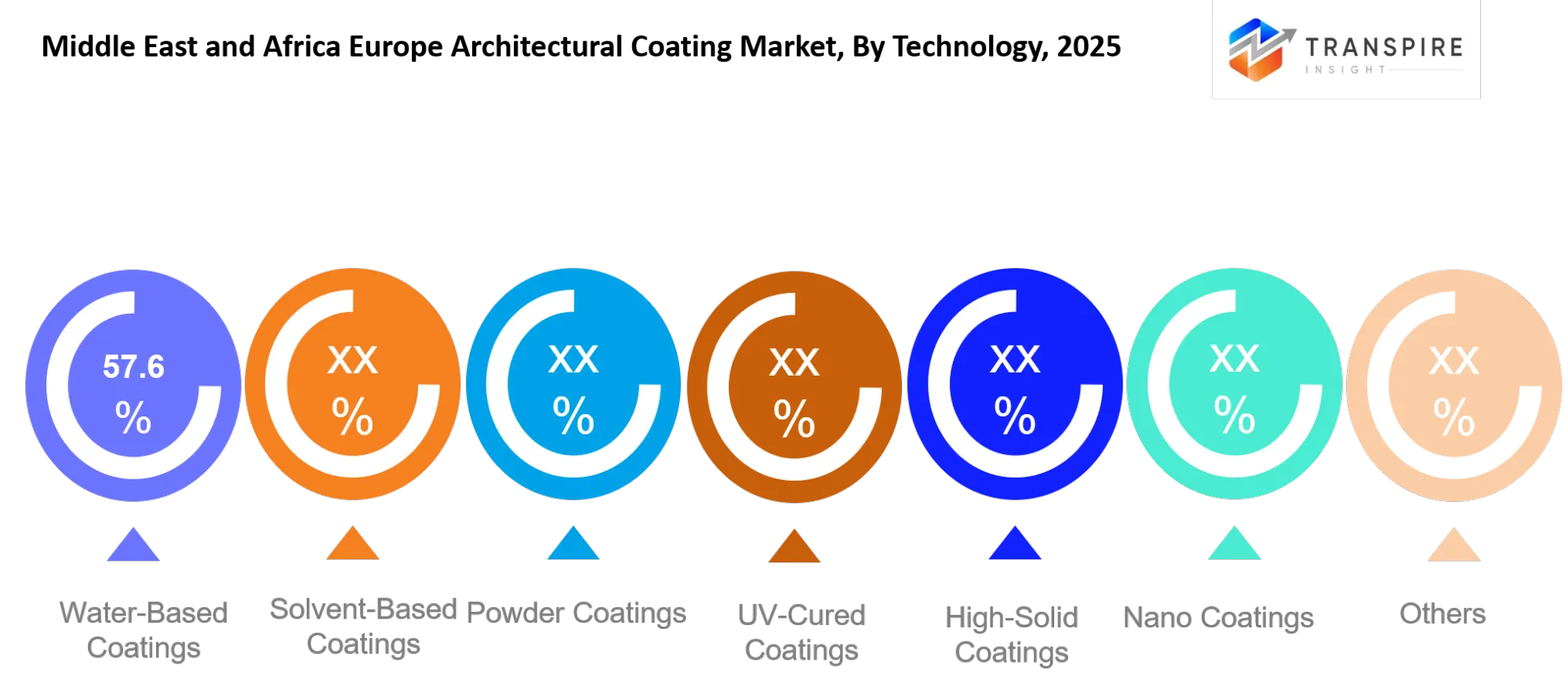
By Application
Residential Buildings tend to end up with the biggest volume, mostly because home construction and ongoing renovation still call for interior plus exterior coatings that offer decorative look and also longer term shielding, if you get what i mean. Commercial Buildings often lean on premium coating systems, not just for appearance but to keep things more durable and easier to maintain across offices, hotels, malls, and even educational facilities. Industrial Buildings are different, they need specialized coatings that can handle chemical exposure, moisture, and the sort of constant operational wear that normal coatings can not really survive. Infrastructure projects depend on protective coating systems for bridges, tunnels, airports and public transit areas that are hit with tough environmental stressors, day after day.
When Renovation Projects come up they can generate a lot of revenue too, since they extend the life of the building and improve structural appearance, without fully rebuilding everything. Decorative Finishes help deliver a higher end interior design vibe, using textured surfaces, tailored color options, and those more luxury visual effects. Protective Coatings do the practical work of shielding building materials from corrosion, UV radiation, moisture, and those temperature swings that quietly ruin surfaces over time. Other applications also show up in institutional buildings, recreational facilities, and specialized architectural structures, where the coating solution has to be adjusted, pretty much per project.
By End User
Construction Companies come out as the biggest end user category, mostly because big residential, commercial, and infrastructure projects need an steady coating supply while the work keeps moving forward. Real Estate Developers tend to go for premium coating solutions, it helps in raising property value, makes the building look better, and can improve long term upkeep efficiency. Government Projects bring a more stable procurement picture too, since money gets directed into schools, hospitals, transit facilities, plus public housing developments. Industrial Facilities usually choose specialized coating systems that shield production structures, warehouses, and processing plants from the tougher day to day operating conditions.
Residential Consumers buy decorative but also protective coatings for do it yourself home upgrades, remodeling, and general maintenance activities. Commercial Property Owners look for long lasting finishes, they want to cut maintenance expenses while keeping the building exteriors and interiors looking sharp. Other end users cover places like schools and universities, healthcare organizations, hospitality venues, and mixed use developments, all of them need coating products matched to their specific application. Having this broad end user mix, gives a more balanced revenue flow across multiple parts of the construction space.
By Distribution Channel
Direct Sales still stay kinda the go to distribution channel for big infrastructure developments and commercial construction, because the manufacturers often bring technical backup, customized approaches, and those longer-term supply agreements. Paint Dealers mostly cater to residential builders contractors, and renovation folks, using broad shelf presence plus local market insight. Specialty Stores pull in customers who want premium coating systems, decorative surfaces, and practical application guidance, especially when the construction needs are more specialized. Online Retail keeps growing too, since digital purchasing tools make comparisons easier, and they improve access across a much broader geography.
Wholesale Distributors help reinforce regional supply chains by holding inventory and moving goods quickly to contractors, retailers, and construction companies. Home Improvement Stores back renovation work with convenient product availability for homeowners and smaller contractors. There are also Other distribution channels like regional suppliers, authorized dealers, and project-based procurement partners which target more niche construction markets. Overall, expanding the distribution network boosts product availability while also supporting a faster project rollout.
What are the Key Use Cases Driving the Middle East and Africa Europe Architectural Coating Market?
Residential construction is still, like, the main thing because new housing developments and the big renovation programs need strong interior and outside coating systems, yes. Premium wall finishes plus weather resistant exterior paints and moisture protective coatings all help keep the building around longer, while also cutting down on the amount of upkeep required.
Commercial buildings and public infrastructure are also getting bigger attention. Things like office complexes, hospitals, airports hotels, and schools are using more advanced coating solutions nowadays, especially those with stain resistance, antimicrobial performance and reflective properties, which can help day to day operations and match newer building requirements.
More emerging use cases show up too, for example smart buildings and energy efficient developments that lean into heat reflective coatings and self cleaning exterior finishes. And then there are net zero construction projects, along with sustainable urban growth across Gulf countries, which are basically opening doors for architectural coatings that do more in terms of thermal behavior and they last longer in real life.
|
Report Metrics |
Details |
|
Market size value in 2025 |
USD 7.25 Billion |
|
Market size value in 2026 |
USD 7.69 Billion |
|
Revenue forecast in 2033 |
USD 11.64 Billion |
|
Growth rate |
CAGR of 6.10% from 2026 to 2033 |
|
Base year |
2025 |
|
Historical data |
2021 - 2024 |
|
Forecast period |
2026 - 2033 |
|
Report coverage |
Revenue forecast, competitive landscape, growth factors, and trends |
|
Regional scope |
Middle East and Africa (Saudi Arabia, United Arab Emirates, South Africa, Rest of Middle East and Africa) |
|
Key company profiled |
AkzoNobel, PPG Industries, Sherwin-Williams, Jotun, Nippon Paint, Kansai Paint, BASF Coatings, Axalta, Hempel, Asian Paints, Berger Paints, Teknos, DAW SE, Benjamin Moore, Masco Corporation |
|
Customization scope |
Free report customization (country, regional & segment scope). Avail customized purchase options to meet your exact research needs. |
|
Report Segmentation |
By Resin Type (Acrylic, Epoxy, Polyurethane, Alkyd, Polyester, Vinyl, Silicone, Others); By Technology (Water-Based Coatings, Solvent-Based Coatings, Powder Coatings, UV-Cured Coatings, High-Solid Coatings, Nano Coatings, Others); By Application (Residential Buildings, Commercial Buildings, Industrial Buildings, Infrastructure, Renovation Projects, Decorative Finishes, Protective Coatings, Others); By End User (Construction Companies, Real Estate Developers, Government Projects, Industrial Facilities, Residential Consumers, Commercial Property Owners, Others); By Distribution Channel (Direct Sales, Paint Dealers, Specialty Stores, Online Retail, Wholesale Distributors, Home Improvement Stores, Others) |
Which Regions are Driving the Middle East and Africa Europe Architectural Coating Market Growth?
Europe takes the biggest chunk of market revenue, really, mainly because environmental rules nudge everyone to keep switching toward low-VOC, water borne, and high performance architectural coatings, it’s sorta continuous by design. On top of that, building energy standards being enforced , plus circular economy policies and renovation programs they all act together and keep demand pretty steady across residential work, commercial sites, and public infrastructure. There is also a mature manufacturing base, advanced raw material suppliers, certified applicator networks, and established research centers that back ongoing product innovation. And honestly, long term backing for sustainable construction and refurbishment keeps Europe right in the middle of premium coating consumption.
The Middle East stays in the second spot, though the “why” isn’t the same as Europe. Instead of demand being pulled by renovation cycles, big urban growth, tourism oriented projects, and government supported construction plans generate a more consistent buying pattern across Saudi Arabia, the United Arab Emirates, and Qatar. With stable public spending, diversified economic programs and careful long term infrastructure schedules, the market sees less swings in demand while still pushing adoption of premium exterior coatings made for high temperatures and ultraviolet exposure. International coating manufacturers also show up in force, which strengthens local supply chains and improves technical support ability.
Africa is forecast to be the fastest growing regional market from 2026 to 2033, since infrastructure spending, affordable housing initiatives, and industrial development are speeding up construction momentum. More recent public funding for transport corridors, commercial facilities, and urban renewal has opened extra doors for decorative as well as protective coating suppliers.
Who are the Key Players in the Middle East and Africa Europe Architectural Coating Market and How Do They Compete?
Competition is still pretty well consolidated, but big manufacturers stay in the game by leaning on technology, sustainability results, product quality, and what they can actually do regionally in manufacturing, not just because they’re cheaper. The older, established names keep trying to lock in their positions using higher end coating technologies, smarter digital color management, plus localized production. Meanwhile, the more regional players tend to push harder with broader distribution and tighter customer relationships. In the end, innovation, regulatory adherence, and having specific, specialized product lines are the real gap makers.
AkzoNobel is concentrating on sustainable architectural coatings, bio based feedstocks, and coating systems that use less energy which help green building initiatives. Their work with BASF and Arkema, to come up with lower-carbon architectural powder coatings, kind of reinforces the environmental story, and also helps separate the premium offerings. PPG Industries, in turn, leans on advanced coating chemistry, digital color tools, and ongoing product development, backed by large manufacturing operations and technical service networks. Jotun instead differentiates with products that are built for harsh climates, which helps them get deeper penetration across Middle Eastern construction markets where durability plus weather resistance are still the kind of things buyers look at first.
Sherwin-Williams is extending reach via local distribution, contractor support programs, and premium coating systems aimed at both commercial and residential projects. Nippon Paint, for its part, improves its position through innovation in low-emission decorative coatings, while also expanding regional manufacturing and building strategic partnerships across fast growing construction markets.
Company List
• AkzoNobel
• PPG Industries
• Sherwin-Williams
• Jotun
• Nippon Paint
• Kansai Paint
• BASF Coatings
• Axalta
• Hempel
• Asian Paints
• Berger Paints
• Teknos
• DAW SE
• Benjamin Moore
• Masco Corporation
Recent Development News
In September 2025, AkzoNobel, BASF, and Arkema entered a strategic partnership to develop lower-carbon architectural powder coatings. The collaboration reduced the product carbon footprint of Interpon architectural powder coatings by up to 40%, supporting sustainable building construction.https://www.basf.com
In May 2025, AkzoNobel launched a radiative cooling coating system in China. The new architectural coating helps reduce building temperatures and improve energy efficiency, expanding advanced solutions for sustainable construction.https://www.paint.org
In April 2025, AkzoNobel announced a strategic partnership with IPG Photonics to introduce laser curing technology for powder coatings. The collaboration aims to improve curing speed, reduce energy consumption, and support more sustainable coating production.https://www.akzonobel.com
What Strategic Insights Define the Future of the Middle East and Africa Europe Architectural Coating Market?
The market is kinda moving toward high-performance, low-carbon coating systems, they kinda combine durability energy efficiency, and also digital manufacturing capabilities. Regulatory pressure on building emissions, plus those more strict sustainability requirements, keep nudging investment toward premium coating technologies, not so much the usual decorative stuff. One less obvious risk is that there is still heavy reliance on imported specialty resins, pigments, and performance additives, and that leaves manufacturers kinda exposed to geopolitical problems and raw material price swings.
At the same time there’s an opportunity showing up, like advanced functional coatings— radiative cooling, self-cleaning, and heat-reflective approaches—these can support net-zero buildings and smart city developments across Europe and also the Gulf region. If companies expand local manufacturing, diversify their raw material sourcing, and put money into functional coating innovation, they’ll likely build better supply resilience while also landing more premium construction projects over the next five to seven years.
Middle East and Africa Europe Architectural Coating Market Report Segmentation
By Resin Type
• Acrylic
• Epoxy
• Polyurethane
• Alkyd
• Polyester
• Vinyl
• Silicone
• Others
By Technology
• Water-Based Coatings
• Solvent-Based Coatings
• Powder Coatings
• UV-Cured Coatings
• High-Solid Coatings
• Nano Coatings
• Others
By Application
• Residential Buildings
• Commercial Buildings
• Industrial Buildings
• Infrastructure
• Renovation Projects
• Decorative Finishes
• Protective Coatings
• Others
By End User
• Construction Companies
• Real Estate Developers
• Government Projects
• Industrial Facilities
• Residential Consumers
• Commercial Property Owners
• Others
By Distribution Channel
• Direct Sales
• Paint Dealers
• Specialty Stores
• Online Retail
• Wholesale Distributors
• Home Improvement Stores
• Others
Frequently Asked Questions
Find quick answers to common questions.
The Expected Middle East and Africa Europe Architectural Coating Market size for the Market will be USD 11.64 Billion in 2033.
Key Segments for the Middle East and Africa Europe Architectural Coating Market are By Resin Type (Acrylic, Epoxy, Polyurethane, Alkyd, Polyester, Vinyl, Silicone, Others); By Technology (Water-Based Coatings, Solvent-Based Coatings, Powder Coatings, UV-Cured Coatings, High-Solid Coatings, Nano Coatings, Others); By Application (Residential Buildings, Commercial Buildings, Industrial Buildings, Infrastructure, Renovation Projects, Decorative Finishes, Protective Coatings, Others); By End User (Construction Companies, Real Estate Developers, Government Projects, Industrial Facilities, Residential Consumers, Commercial Property Owners, Others); By Distribution Channel (Direct Sales, Paint Dealers, Specialty Stores, Online Retail, Wholesale Distributors, Home Improvement Stores, Others).
Major Middle East and Africa Europe Architectural Coating Market Players are AkzoNobel, PPG Industries, Sherwin-Williams, Jotun, Nippon Paint, Kansai Paint, BASF Coatings, Axalta, Hempel, Asian Paints, Berger Paints, Teknos, DAW SE, Benjamin Moore, Masco Corporation.
The Current Middle East and Africa Europe Architectural Coating Market size is USD 7.25 Billion in 2025.
The Middle East and Africa Europe Architectural Coating Market CAGR is 6.10% from 2026 to 2033.
• AkzoNobel
• PPG Industries
• Sherwin-Williams
• Jotun
• Nippon Paint
• Kansai Paint
• BASF Coatings
• Axalta
• Hempel
• Asian Paints
• Berger Paints
• Teknos
• DAW SE
• Benjamin Moore
• Masco Corporation
About the Authors

Pankaj Ghogare Patil
I am Pankaj Ghogare Patil, a Senior Research Analyst at Transpire Insight, specializing in the Pharmaceutical, Chemicals & Materials, Healthcare IT, and Biotechnology industry. My expertise lies in conducting comprehensive market research, analyzing industry trends, evaluating competitive landscapes, and translating complex data into actionable insights. At Transpire Insight, I closely follow emerging technologies, regulatory developments, and market innovations to create accurate, well-researched, and informative content that helps businesses and professionals make informed decisions. I am committed to producing credible, evidence-based articles that reflect industry best practices while making technical topics accessible and valuable for a broad audience.

Chakradhar Khansole
Chakradhar serves as the Research Director at Transpire Insight, bringing over 8 years of experience in technology, innovation, and strategic market intelligence. He specializes in transforming complex market data into actionable business insights that enable organizations to make informed, growth-oriented decisions. Recognized for his strategic vision and analytical expertise, Chakradhar leads high-impact research initiatives, delivering comprehensive market assessments, competitive intelligence, and forward-looking industry analysis.
Recently Published Reports
-
May 2026
Healthcare Polymer Packaging Market
Healthcare Polymer Packaging Market Size, Share & Analysis Report By Packaging Type (Syringes, IV Bottles and Pouches, Clamshells, Blisters, Bottles & Jars, Containers, Tubes, IV Parental Packaging, Others), By Type (Regulated, Non-regulated), By Polymer Type (LDPE (Low-Density Polyethylene), HDPE (High-Density Polyethylene), Homo-polymer (Homo), Random Copolymer (Random), Block Copolymer (Block), PET, Polystyrene, Polyvinyl Chloride, Polyamide/EVOH, Others), and Geography (North America, Europe, Asia-Pacific, Middle East and Africa, South and Central America), 2021 - 2031
-
Apr 2026
Hydrophilic Tape (Waterstop) Market
Hydrophilic Tape (Waterstop) Market Size, Share & Analysis Report By Type (Bentonite-Based Hydrophilic Tape, Rubber-Based Hydrophilic Tape), By Application (Residential Buildings, Commercial Buildings, Infrastructure Projects), and Geography (North America, Europe, Asia-Pacific, Middle East and Africa, South and Central America), 2021 - 2031
-
Apr 2026
Metalens Market
Metalens Market Size, Share & Analysis Report By Type (Visible Light Metalens, and Infrared Metalens), By Application (Consumer Electronics, Automotive Electronics, Industrial, Medical, and Others), and Geography (North America, Europe, Asia-Pacific, Middle East and Africa, South and Central America), 2021 - 2031
-
Apr 2026
PBT Resin Market
PBT Resin Market Size, Share & Analysis Report By Type (Reinforced PBT Resin, Unreinforced PBT Resin), By Processing Method (Injection Molding, Extrusion, Blow Molding, Others), By End-User (Automotive, Electrical & Electronics, Consumer Appliances, Industrial Machinery, Medical Devices, Packaging, Others), and Geography (North America, Europe, Asia-Pacific, Middle East and Africa, South and Central America), 2021 - 2031