
Middle East and Africa Drone UAV Detection Market Summary
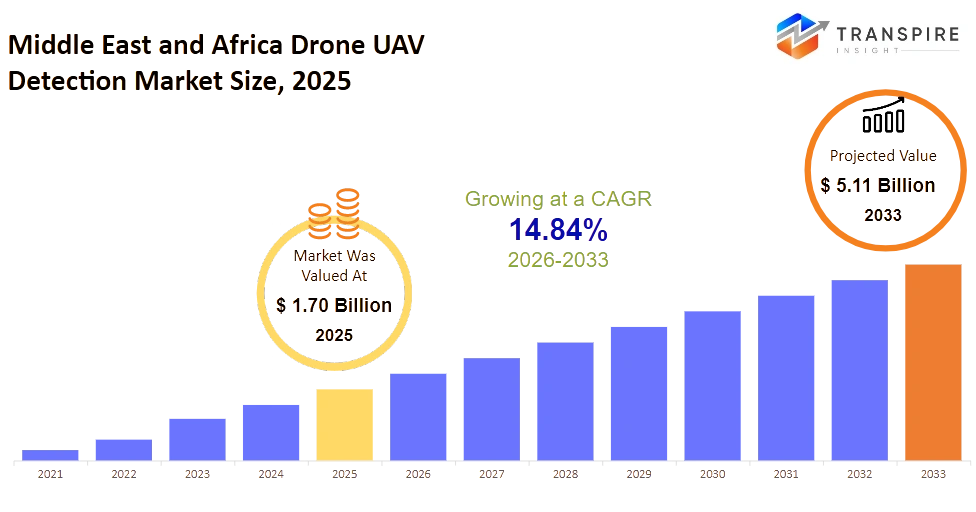
As per Transpire Insight Analysis the Middle East and Africa Drone UAV Detection Market size is estimated at USD 1.70 Billion in 2025 and is anticipated to reach USD 5.11 Billion by 2033, growing at a CAGR of 14.84% from 2026 to 2033.
The Middle East and Africa Drone UAV Detection Market, honestly, plays a major part in safeguarding airports , military bases, oil and gas facilities, border areas and even public infrastructure from unauthorized or aggressive drones. In practice, detection systems mix radar plus radio frequency sensors, electro optical cameras, acoustic sensors as well, and then add artificial intelligence, so they can spot, follow, and evaluate airborne threats before these things mess up daily operations or start weakening security. In the last few years, the market moved away from using just one kind of detection gear , and it leaned more toward joined multi sensor counter UAV platforms, which tend to give faster, and also more dependable, threat assessments.
At the same time, regional security anxieties, cross border drone incidents, and attacks aimed at important energy installations have pushed investments toward stronger airspace surveillance technologies. Because of that, governments and operators of critical infrastructure have been updating older security setups with smarter detection features, sort of “upgrade the brain” approach. As deployment keeps spreading across defense and civilian settings, vendors are still finding ways to earn higher revenues via long term system integration work, software improvements, maintenance agreements, and richer analytics services.
Middle East and Africa Drone UAV Detection Market Size & Forecast:
- Middle East and Africa Drone UAV Detection Market Size 2025: USD 1.70 Billion
- Expected Market Value 2033: USD 5.11 Billion
- Forecast CAGR: 14.84%
- Leading region in 2025:Saudi Arabia
- Fastest Growing region:Africa
- Key Profile: Dedrone, DroneShield, RTX, Lockheed Martin, Thales, Leonardo, Saab, Israel Aerospace Industries, HENSOLDT, Elbit Systems, Rohde & Schwarz, QinetiQ, Fortem Technologies, Blighter Surveillance Systems, Aaronia AG
Key Market Insights
- The Middle East and Africa Drone UAV Detection Market is growing more and more ,as governments keep upping protection levels for airports ,military sites, and energy backbones against low altitude drone problems.
- In the region, Saudi Arabia kind of led the way in 2025 with around 32% market share, this is largely tied to defense modernization efforts and programs meant for safeguarding critical infrastructure.
- Meanwhile the United Arab Emirates is expected to post the quickest expansion through 2033, driven by smart city investments and more airspace security push’s.
- When it comes to what’s doing the heavy lifting, radar based detection stayed the top technology in 2025, pulling in almost 30% of industry revenue thanks to long range surveillance reach.
- AI based detection is projected to deliver the strongest growth rate over the forecast window because automated threat sorting helps cut down on those annoying false alarms.
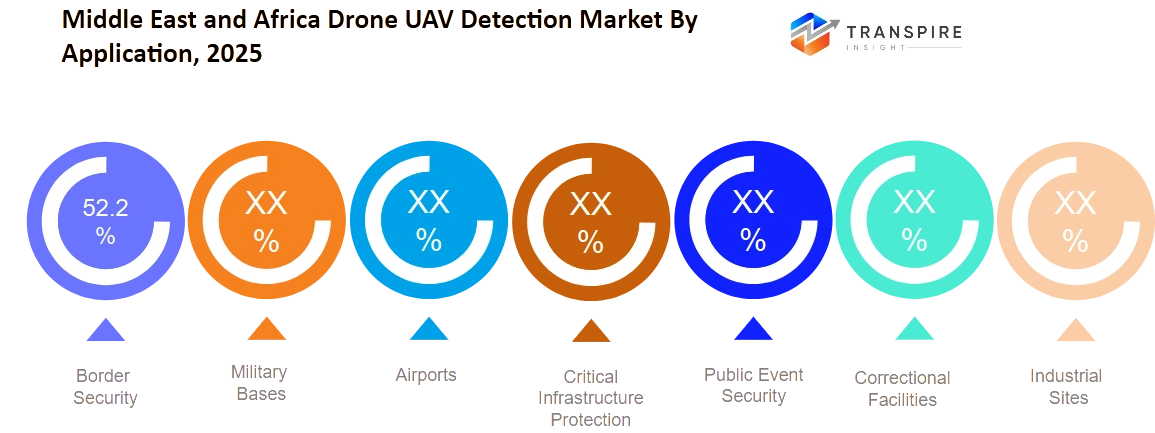
- Looking at use cases, military base protection held the biggest application slice at roughly 35% market share, mainly due to ongoing border monitoring needs. Critical infrastructure protection is also ramping up fast as oil ,gas, utilities ,and transport companies keep building out their drone defense systems.
- On the end user side, defense organizations grabbed the largest share, but government agencies keep widening procurement too, especially for national security and border observation.
- Key players like Dedrone, DroneShield, Thales, Leonardo, RTX, and HENSOLDT are focusing on AI powered sensor fusion, collaborative partnerships, and integrated command and control platforms, so they can stay competitive.
- Overall ,technology suppliers are increasingly stitching together radar, RF sensing, electro optical imaging, and AI analytics into one detection system, which helps speed up response and boosts operational dependability ,even during busy real world conditions.
What are the Key Drivers, Restraints, and Opportunities in the Middle East and Africa Drone UAV Detection Market?
The main engine behind market growth is kind of the quick rise in unauthorized drone activity that keeps showing up near military installations, airports, oil terminals and even at national borders. Lots of governments throughout the Middle East have answered this by pushing larger defense, and homeland security budgets aimed at these low-altitude aerial risks. Newer radar setups, RF sensors, and AI enabled analytics lets security teams spot and sort drones much quicker than old school surveillance. With that, it becomes easier to justify buying integrated detection networks, which in turn drives higher revenues for equipment vendors, software developers, and also for the long term maintenance providers.
On the other hand the biggest drag is the expensive side of rolling out integrated counter UAV solutions across wide regions. To get real coverage you need several sensors, a command and control layer, communication infrastructure, plus ongoing system tuning. Then there are regulatory constraints tied to radio-frequency monitoring and drone interception, and those rules are not exactly the same everywhere. So scaling up becomes more complicated and, frankly it can slow down procurement plans. These “behind the scenes” hurdles stretch the project schedule and end up squeezing the short run revenue chances for suppliers.
A big opening shows up in how critical infrastructure can be protected beyond pure military uses. Oil refineries, power generation plants, ports, mining sites, and smart cities are starting to adopt advanced drone detection approaches to limit day to day operational exposure. AI powered multi sensor platforms that work alongside existing security arrangements are a straightforward route for commercial and public operators who want continuous airspace observation, while also lowering operating costs because threat detection becomes more automatic.
What Has the Impact of Artificial Intelligence Been on the Middle East and Africa Drone UAV Detection Market?
Artificial intelligence has pretty much pushed forward drone detection systems in a way that makes the whole process quicker at spotting, sorting, and keeping track of low altitude aerial threats, you know. A lot of modern counter-UAV setups mix radar, radio frequency sensors, electro optical cameras, infrared imaging, plus acoustic sensing with AI methods that automatically separate drones from birds, regular aircraft, and all that confusing environmental noise. Because of this automation, less people have to watch everything all the time, response can be faster, and day to day operations get more efficient at airports, military bases, border crossings , and also at critical power facilities. Security operators can look at many sensor streams from a single command setup , while the AI orders likely risks by looking at flight behavior and the overall risk level
On top of that, machine learning models help with predictive abilities by reading historical flight patterns, checking sensor performance, and taking in environmental conditions. In practice, those models can tune sensor placement, make target tracking steadier, reduce false alarms, and keep the system available longer through predictive maintenance on radar and surveillance equipment. Continuous learning then helps the platform adjust to new drone signatures and shifting operating conditions. That strengthens airspace defense overall, and at the same time it helps lower maintenance spending while improving surveillance uptime
Still, even with all these benefits, AI adoption comes with limits that matter. Bringing advanced analytics into existing defense infrastructure takes a lot of investment, and good regional training data is not always easy to get, especially for certain drone categories or specific operating scenarios.
Key Market Trends
- Since 2023, AI-enabled sensor fusion is kinda the go-to thing now, it improves drone classification accuracy too, and also helps cut down false alarms in those complicated environments where everything’s happening at once, and not always cleanly.
- More and more military organizations are buying integrated radar, RF, electro-optical, and infrared detection platforms instead of just taking standalone surveillance systems, so they can better cover low-altitude airspace protection.
- For oil and gas facilities, protection efforts have really broadened lately, after attacks on regional energy infrastructure. That situation is pushing long-term investment into advanced counter-UAV capabilities , not only short-term fixes.
- In the Middle East, airports keep upgrading drone surveillance systems to meet tighter aviation safety requirements, while also trying to reduce disruption to commercial flights, as much as possible.
- Defense suppliers have been moving toward modular detection platforms that let customers extend their capabilities via software upgrades, instead of going through full hardware replacement every time.
- AI-powered command-and-control software is now kind of a differentiator, it supports automated threat prioritization and faster decision-making by operators during those drone incidents.
- Border security agencies are also leaning more on mobile and vehicle-mounted detection systems, because that makes it easier to cover remote desert zones and tough terrain, without major gaps.
- International defense companies and regional governments seem to be collaborating more as well, through technology partnerships, local manufacturing, and broader system integration programs.
- And finally, software-defined radio technology is gradually replacing the conventional RF monitoring approach, which improves the ability to detect newer, changing commercial and custom-built drone communication signals, even when they’re more tricky or less predictable.
Middle East and Africa Drone UAV Detection Market Segmentation
By Detection Technology
Radar Based Detection still seems to stay on top, mostly due to that long-range watch capability and the dependable results even when weather is kinda changing. RF detection keeps getting used a lot for spotting communication signals between drones and their controllers, while Acoustic Detection helps out in situations where radar coverage has limitations or just struggles. Then Electro-Optical/Infrared Detection brings in that visual confirmation, which makes it easier for security teams to categorize airborne objects with a bit more confidence. Multi Sensor Detection, instead, mashes several technologies together so you can push accuracy up and also reduce false alarms in those messy environments.
AI Based Detection is also growing, because stronger algorithms help with object recognition and even threat classification ,with much less operator involvement. Hybrid Detection Systems fold radar, RF, optical sensors, and artificial intelligence into one platform, so the monitoring stays continuous and the response time tends to get faster. Other detection technologies still get picked for specialized uses where custom surveillance needs, terrain realities, or the operational budget end up steering procurement decisions. Overall, ongoing technology integration should improve detection performance across defense, aviation, and critical infrastructure security, without too much fuss.
By Deployment
Fixed Systems account for a pretty big share, because permanent installations provide uninterrupted surveillance for airports, military facilities,and energy infrastructure. Mobile Systems, meanwhile, give operational flexibility—security teams can relocate equipment when threat conditions start changing. Portable Systems also come in handy for temporary deployments at public events, emergency operations, and tactical missions, where quick setup really matters. Vehicle-Mounted Systems help patrol forces move more easily, especially when they operate along large borders, or in remote places.
Border Surveillance Systems are still gaining importance as governments push stronger monitoring across sensitive crossing points and remote desert regions. Critical Infrastructure Systems are the kind of protection for oil fields, refineries, power stations, ports, and communication facilities—mostly against unauthorized drone activity, using continuous airspace monitoring. There are other deployment models too, aimed at specialized operational requirements where standard installations cannot really give full coverage. Flexible deployment options should let organizations align security investments with mission-specific needs, without so much mismatch.
By Application
Military Bases are, kind of, the biggest use case overall, because defense groups need ongoing protection from surveillance drones and likely aerial attacks. Airports stay a close second, since aviation agencies keep pushing runway safety, and they try to keep commercial flights safe from drones that are unauthorized. Critical Infrastructure Protection keeps stretching outward across oil and gas facilities, utility grids, transport corridors, and government buildings, because uninterrupted performance is kind of non negotiable. Border Security fits in too, helping with longer range observation, and improving situational awareness in delicate regions.
Public Event Security is getting more focus now, as officials deploy temporary counter-drone setups during international sporting events, political meetings and cultural festivals, sometimes even right before the crowds arrive. Correctional Facilities are also adopting detection measures more often, mainly to stop contraband deliveries that come in via unmanned aircraft. Industrial Sites meanwhile are using drone surveillance for guarding manufacturing plants , mining operations , and logistics centers against unwarranted aerial approach. There will be additional applications too, because more commercial organizations are realizing the practical value of persistent, low altitude airspace monitoring.
By End User
Defense Organizations generate the biggest revenue or at least that’s what the market often says, because national security programs need advanced counter-UAV abilities across military installations and operational zones. Government Agencies keeps funding drone detection systems for border management, law enforcement and homeland security initiatives. Airports also upgrade surveillance infrastructure so safe flight operations stay reliable, while Oil and Gas Companies reinforce refineries, pipelines, offshore facilities,and storage terminals against aerial threats. Utilities furthermore expand their deployment to guard electricity generation and transmission assets.
Private Security Companies are more and more folding drone detection technologies into their commercial security services, for industrial facilities, business parks and public venues. Critical Infrastructure Operators keep improving their surveillance systems to protect transportation networks, ports, communication facilities, and water treatment plants. Other end users adopt tailored solutions based on operational risks, regulatory needs,and infrastructure priorities. Wider commercial adoption should diversify revenue streams beyond the usual defense procurement contracts.
By Solution
Detection Only solutions are still appropriate for orgs that need constant monitoring, but do not really have active response, the kind where you intervene on the spot. Detection & Tracking setups give real time location updates and flight route analysis , so the security folks can judge risk early before making any operational call. Detection & Neutralization options bring in electronic counter measures or interception technologies for places where you need a fast counter action and not later on. Counter-UAV Systems usually bundle several hardware and software bits into one security platform, which helps teams coordinate more cleanly during operations.
Integrated Air Defense Systems keep growing, as governments link drone detection tools into wider national defense networks for better situational visibility. There are also other approaches that target specialized needs via custom software, sensor placement and integration, or command-and-control style functions built for particular industries. Ongoing funding for these integrated platforms should boost interoperability, cut down the response window, and reinforce protection across both military and civilian security activities.
What are the Key Use Cases Driving the Middle East and Africa Drone UAV Detection Market?
Protection of military bases still stays like the biggest use case, because defense orgs need ongoing observation against surveillance drones, unwanted airborne entry, and possible hostile attacks. Put together radar plus RF sensing along with electro-optical gear gives that early threat visibility, so security teams can react before the drones ever get close to sensitive facilities. In practice this kind of application keeps bringing solid procurement benefits as governments modernize their national defense setup.
Then there’s airport security and critical infrastructure protection, which are growing fast across the region. Civil aviation authorities use improved detection platforms to stop flight disruptions triggered by unauthorized drones, while oil gas firms, utilities and industrial operators guard refineries, pipelines power plants, and transport nodes from aerial intrusion. Border security agencies additionally depend on mobile detection systems to tighten surveillance across remote desert stretches and strategic crossing points, with less downtime and more coverage.
New and more niche use cases are starting to show up too—correctional facilities, smart city surveillance, and big public gatherings where temporary counter-drone systems help keep public safety steady. Mining sites, seaports, and logistics centers are also assessing AI-enabled detection platforms, aiming to safeguard high-value assets and boost operational endurance. Overall, these directions should open up additional commercial chances during the forecast period.
|
Report Metrics |
Details |
|
Market size value in 2025 |
USD 1.70 Billion |
|
Market size value in 2026 |
USD 1.94 Billion |
|
Revenue forecast in 2033 |
USD 5.11 Billion |
|
Growth rate |
CAGR of 14.84% from 2026 to 2033 |
|
Base year |
2025 |
|
Historical data |
2021 - 2024 |
|
Forecast period |
2026 - 2033 |
|
Report coverage |
Revenue forecast, competitive landscape, growth factors, and trends |
|
Regional scope |
Middle East and Africa (Saudi Arabia, United Arab Emirates, South Africa, Rest of Middle East and Africa) |
|
Key company profiled |
Dedrone, DroneShield, RTX, Lockheed Martin, Thales, Leonardo, Saab, Israel Aerospace Industries, HENSOLDT, Elbit Systems, Rohde & Schwarz, QinetiQ, Fortem Technologies, Blighter Surveillance Systems, Aaronia AG |
|
Customization scope |
Free report customization (country, regional & segment scope). Avail customized purchase options to meet your exact research needs. |
|
Report Segmentation |
By Detection Technology (Radar-Based Detection, RF Detection, Acoustic Detection, Electro-Optical/Infrared Detection, Multi-Sensor Detection, AI-Based Detection, Hybrid Detection Systems, Others); By Deployment (Fixed Systems, Mobile Systems, Portable Systems, Vehicle-Mounted Systems, Border Surveillance Systems, Critical Infrastructure Systems, Others); By Application (Military Bases, Airports, Critical Infrastructure Protection, Border Security, Public Event Security, Correctional Facilities, Industrial Sites, Others); By End User (Defense Organizations, Government Agencies, Airports, Oil & Gas Companies, Utilities, Private Security Companies, Critical Infrastructure Operators, Others); By Solution (Detection Only, Detection & Tracking, Detection & Neutralization, Counter-UAV Systems, Integrated Air Defense Systems, Others) |
Which Regions are Driving the Middle East and Africa Drone UAV Detection Market Growth?
The Middle East takes the lead on the regional market really because of heavy defense spending, a lot of oil and gas infrastructure, and ongoing national security investment, you know, the usual chain. In that space, Saudi Arabia along with the United Arab Emirates put noticeable focus into integrated air defense, border observation , and also the protection of critical infrastructure. Bigger international airports, energy sites and military bases keep needing advanced counter-UAV systems that can spot threats that are, frankly, getting more sophisticated every year. And then there’s the strong cooperation with global defense technology providers which helps a lot, especially with long term procurement plans.
Israel is also a major piece of the picture, mainly due to its advanced defense technology ecosystem and steady spending on counter-drone developments. While some neighboring markets emphasize more “just” infrastructure protection, Israel tends to lean much harder into research, product development and on-the-ground deployment of next generation detection tools. Local manufacturers work side by side with defense organizations to build AI enabled surveillance platforms plus integrated air defense capabilities. Also, the continued exports of these technologies end up boosting regional revenues, and that, in turn, encourages more new innovation.
Africa is expected to grow the quickest through the forecast period because governments keep strengthening border management and trying to shield critical infrastructure from new aerial risks. Recent funding for airport upgrades, mining security, energy projects, and public safety has opened more doors for drone detection solutions that are more advanced. Nations like South Africa, Egypt and Morocco are slowly increasing their surveillance capacity via defense modernization, and infrastructure development programs too.
Who are the Key Players in the Middle East and Africa Drone UAV Detection Market and How Do They Compete?
Competition is still fairly concentrated, in the sense that the big defense technology players go head to head mostly by using advanced sensor integration, AI, system dependability, and regional partnerships , not only by price. In most procurements, the decision makers look at everyday performance, compatibility with the already installed defense infrastructure and then, also long-term service backing. The more established manufacturers keep nudging their edge forward by growing their software feature set , refining detection accuracy and delivering scalable counter-UAV packages for both military , and civilian buyers.
Dedrone sort of stands out because of its AI-driven sensor fusion software, which pulls together radar, RF sensors, and cameras into one consolidated airspace monitoring platform. They keep moving ahead via deliberate partnerships with airports, government bodies, and operators of critical infrastructure. DroneShield meanwhile is more centered on modular counter-drone technology that merges RF detection, electronic countermeasures and command software , so users can tune the setup to match their actual operational needs. Ongoing product refinement helps it stay relevant across defense programs and homeland security efforts.
Thales leans into integrated air defense approaches, tying drone detection into wider surveillance frameworks and command networks, which makes their solutions appealing for national security initiatives. Leonardo uses its background in radar, and defense electronics , to deliver multi-sensor detection systems for military and airport contexts. Israel Aerospace Industries combines advanced radar, intelligence capabilities, and field-tested operational know-how, aiming to provide very integrated counter-UAV solutions that work in complicated security situations.
Company List
• Dedrone
• DroneShield
• RTX
• Lockheed Martin
• Thales
• Leonardo
• Saab
• Israel Aerospace Industries
• HENSOLDT
• Elbit Systems
• Rohde & Schwarz
• QinetiQ
• Fortem Technologies
• Blighter Surveillance Systems
• Aaronia AG
Recent Development News
In October 2025, DroneShield launched DroneSentry-C2 Enterprise, a strategic command-and-control software platform for national-scale counter-drone operations. The platform enables centralized management of multiple counter-UAS sites, strengthening security for military installations, airports, and critical infrastructure while expanding DroneShield's software-driven business model. Source:https://www.droneshield.com
In March 2026, DroneShield established a European manufacturing footprint for counter-UAS systems through a collaboration with an experienced manufacturing partner. The expansion supports sovereign European production, shortens delivery timelines, and positions the company to compete more effectively for regional defense procurement opportunities. Source:https://www.droneshield.com
In May 2026, DroneShield and Terma signed a strategic Memorandum of Understanding (MoU) to develop layered counter-UAS capabilities. The partnership combines AI-enabled drone detection, electronic warfare technologies, and command-and-control software to deliver interoperable air defense solutions for military and critical infrastructure customers, including those in the Middle East. Source:https://www.droneshield.com
What Strategic Insights Define the Future of the Middle East and Africa Drone UAV Detection Market?
The market is drifting toward fully integrated, AI enabled airspace security ecosystems that sorta mash together radar, radio frequency sensing, electro optical imaging, and command and control software into one unified platform. This shift is being pushed by the rising sophistication of autonomous drones, the fact that protection requirements for strategic infrastructure keep getting higher, and also the steady government funding in layered air defense programs. In the next five to seven years, software defined detection capabilities and multi sensor fusion are expected to turn into standard procurement requirements, more or less, not just premium add ons.
A less obvious sort of risk is the quick evolution of drone technologies that can quietly reduce how well traditional detection methods work—mainly via autonomous navigation, encrypted communications ,or simply lower radar signatures. If teams do not keep up with continuous software upgrades and ongoing sensor improvements then existing systems can end up with shorter technology lifecycles. In that case modernization costs also start creeping up, sometimes faster than expected.
There’s also a pretty meaningful opportunity here in AI driven mobile counter UAV platforms meant for border surveillance, energy infrastructure, and smart city safety. This is especially true across emerging African economies that are putting money into national security modernization. Firms that can deliver interoperable, scalable solutions that fit with existing defense networks, and that can build regional partnerships or local manufacturing know how, will likely sit in the better position for long term contracts and a stronger competitive stance across the full forecast horizon.
Middle East and Africa Drone UAV Detection Market Report Segmentation
By Detection Technology
• Radar-Based Detection
• RF Detection
• Acoustic Detection
• Electro-Optical/Infrared Detection
• Multi-Sensor Detection
• AI-Based Detection
• Hybrid Detection Systems
• Others
By Deployment
• Fixed Systems
• Mobile Systems
• Portable Systems
• Vehicle-Mounted Systems
• Border Surveillance Systems
• Critical Infrastructure Systems
• Others
By Application
• Military Bases
• Airports
• Critical Infrastructure Protection
• Border Security
• Public Event Security
• Correctional Facilities
• Industrial Sites
• Others
By End User
• Defense Organizations
• Government Agencies
• Airports
• Oil & Gas Companies
• Utilities
• Private Security Companies
• Critical Infrastructure Operators
• Others
By Solution
• Detection Only
• Detection & Tracking
• Detection & Neutralization
• Counter-UAV Systems
• Integrated Air Defense Systems
• Others
Frequently Asked Questions
Find quick answers to common questions.
The expected Middle East and Africa Drone UAV Detection Market size for the market will be USD 5.11 Billion in 2033.
Key segments for the Middle East and Africa Drone UAV Detection Market are By Detection Technology (Radar-Based Detection, RF Detection, Acoustic Detection, Electro-Optical/Infrared Detection, Multi-Sensor Detection, AI-Based Detection, Hybrid Detection Systems, Others); By Deployment (Fixed Systems, Mobile Systems, Portable Systems, Vehicle-Mounted Systems, Border Surveillance Systems, Critical Infrastructure Systems, Others); By Application (Military Bases, Airports, Critical Infrastructure Protection, Border Security, Public Event Security, Correctional Facilities, Industrial Sites, Others); By End User (Defense Organizations, Government Agencies, Airports, Oil & Gas Companies, Utilities, Private Security Companies, Critical Infrastructure Operators, Others); By Solution (Detection Only, Detection & Tracking, Detection & Neutralization, Counter-UAV Systems, Integrated Air Defense Systems, Others).
Major Middle East and Africa Drone UAV Detection Market players are Dedrone, DroneShield, RTX, Lockheed Martin, Thales, Leonardo, Saab, Israel Aerospace Industries, HENSOLDT, Elbit Systems, Rohde & Schwarz, QinetiQ, Fortem Technologies, Blighter Surveillance Systems, Aaronia AG.
The Middle East and Africa Drone UAV Detection Market size is USD 1.70 Billion in 2025.
The Middle East and Africa Drone UAV Detection Market CAGR is 14.84% from 2026 to 2033.
• Dedrone
• DroneShield
• RTX
• Lockheed Martin
• Thales
• Leonardo
• Saab
• Israel Aerospace Industries
• HENSOLDT
• Elbit Systems
• Rohde & Schwarz
• QinetiQ
• Fortem Technologies
• Blighter Surveillance Systems
• Aaronia AG
About the Authors

Tejashri Dhatrak
I am Tejashri Dhatrak, a Senior Research Analyst at Transpire Insight, specializing in the Aerospace and Defence sector. My work focuses on analyzing industry trends, defence technologies, market developments, and emerging innovations that shape the global aerospace and security landscape. At Transpire Insight, I research complex topics, evaluate credible sources, and transform technical insights into accurate, well-structured, and easy-to-understand content for industry professionals and decision-makers. My goal is to provide reliable, research-backed information that helps readers stay informed about defence capabilities, aerospace advancements, strategic developments, and the evolving dynamics of the global defence ecosystem.

Chakradhar Khansole
Chakradhar serves as the Research Director at Transpire Insight, bringing over 8 years of experience in technology, innovation, and strategic market intelligence. He specializes in transforming complex market data into actionable business insights that enable organizations to make informed, growth-oriented decisions. Recognized for his strategic vision and analytical expertise, Chakradhar leads high-impact research initiatives, delivering comprehensive market assessments, competitive intelligence, and forward-looking industry analysis.
Recently Published Reports
-
Apr 2026
Aerospace Fluoropolymers Market
Aerospace Fluoropolymers Market Size, Share & Analysis Report By Type (PTFE, FEP, PFA, ETFE, and Others), By Application (Electrical Insulation, Seals & Gaskets, Coatings, and Others), By End User (Commercial Aviation, Military Aviation, General Aviation, and Others), and Geography (North America, Europe, Asia-Pacific, Middle East and Africa, South and Central America), 2021 - 2031
-
Apr 2026
Airborne SATCOM System Market
Airborne SATCOM System Market Size, Share & Analysis Report By Type (SATCOM Terminals, Transceivers, Airborne Radio, Modems and Routers, SATCOM Radomes, and Other), By Application (Government and Defense and Commercial), and Geography (North America, Europe, Asia-Pacific, Middle East and Africa, South and Central America), 2021 – 2031
-
Apr 2026
Ship Leasing Market
Ship Leasing Market Size, Share & Analysis Report By Vessel Type (Container Ships, Bulk Carriers, Tankers, and Specialized Vessels), By Lease Duration (Short-Term Lease (Less than 1 year), Medium-Term Lease (1-5 years), and Long-Term Lease (More than 5 years)), By Lease Type (Bareboat Charter, Time Charter, Financial Lease, and Others), By End-User Industry (Oil and Gas, Manufacturing and Industrial, Automotive, Agriculture and Food, Retail and Consumer Goods, and Others), and Geography (North America, Europe, Asia-Pacific, Middle East and Africa, South and Central America), 2021 – 2031
-
Apr 2026
Thread Rolling Dies Market
Thread Rolling Dies Market Size, Share & Analysis Report By Type (Flat Thread Rolling Dies, Circular (Cylindrical) Dies, Tangential Thread Rolling Dies, Planetary Thread Rolling Dies, and Other Types), By Material Type (High-Speed Steel (HSS), Carbide, Tool Steel, Alloy Steel, and Other Specialized Alloys), By Distribution Channel (Direct Sales, Distributors and Dealers, and Online Platforms), By Application (Automotive Industry, Aerospace and Defense, Construction and Infrastructure, Industrial Machinery, Electronics and Electrical Components, Medical Devices, and Fastener Production), and Geography (North America, Europe, Asia-Pacific, Middle East and Africa, South and Central America), 2021 – 2031
Our Clients





