
Middle East and Africa Business Travel Market Size & Forecast:
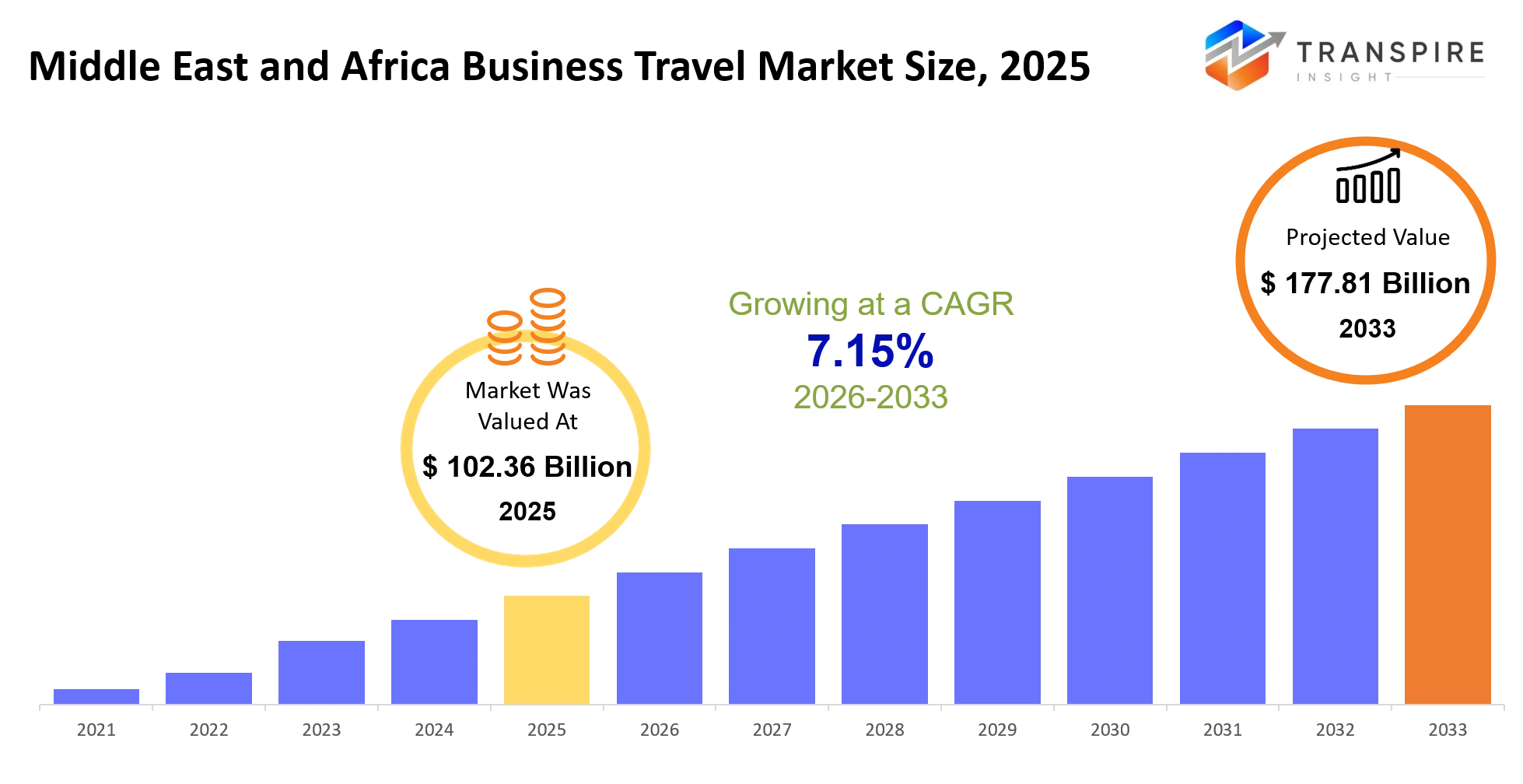
- Middle East and Africa Business Travel Market Size 2025: USD 102.36 Billion
- Middle East and Africa Business Travel Market Size 2033: USD 177.81 Billion
- Middle East and Africa Business Travel Market CAGR: 7.15%
- Middle East and Africa Business Travel Market Segments: By Travel Type (Domestic, International, MICE, Corporate Events, Others); By Booking Channel (Online, Travel Agencies, Direct Booking, Others); By End User (SMEs, Large Enterprises, Government, Others).
To learn more about this report,  Download Free Sample Report
Middle East and Africa Business Travel Market Summary
The Middle East and Africa Business Travel Market was valued at USD 102.36 Billion in 2025. It is forecast to reach USD 177.81 Billion by 2033. That is a CAGR of 7.15% over the period.
The Middle East and Africa Business Travel Market has become kind of a crucial moving piece for corporate decision-making , project execution, client engagement, and cross-border growth across sectors like energy construction, finance, logistics, and technology. It basically helps in getting executives and technical specialists, along with sales groups and project managers, to do what they need face to face, you know, to negotiate contracts, keep an eye on operations, and manage regional investments without delays.
In the last five years, the market has also seen a big change in how travel gets run, more companies now lean toward digitally managed travel programs. That means they adopt a linked booking approach, expense handling, and traveler risk systems— all to tighten cost control and stay aligned with rules. The comeback of international mobility after the COVID-19 pandemic , was a major kick off point that reshaped travel behavior. At the same time, big efforts toward economic diversification and continuous infrastructure rollouts across Gulf countries, pushed corporate trips even faster, like, there s no real pause. Multinationals are widening their regional footprint and the governments are courting foreign investment, so overall business travel volumes keep rising. Because of that, demand grows for higher-end mobility services, better lodging, and more robust corporate travel management solutions, which then turns into wider revenue avenues across the entire business travel ecosystem.
Key Market Insights
- The Gulf Cooperation Council , or GCC region, basically dominates the Middle East and Africa Business Travel Market, with a market share over 55% in 2025.
- Saudi Arabia and the United Arab Emirates seem to be leading the charge on regional revenue, mostly because large business gatherings and foreign investment programs, kind of keep fueling everything.
- Meanwhile, Sub-Saharan Africa is showing the quickest growth over the forecast window, which is largely linked to the broader trade flow and those ongoing infrastructure buildouts.
- At the same time, cross-border business activity along with a wider economic alignment inside the region continues to lift the overall business travel demand across Africa.
- Corporate travel management services stay at the front here, and in 2025 they hold around 40% of the total market share .
- Accommodation and lodging services sit as the second-largest segment, helped along by rising executive travel numbers.
- Digital booking and expense management platforms are the fastest-growing segment, mostly fueled by enterprise digital modernization initiatives through 2030.
- Integrated travel technology solutions are getting better at improving compliance , traveler well-being, and cost control for organizations.
- Client meetings, contract discussions, and business development work make up more than 45% of the overall business travel demand.
- Conferences, exhibitions, and corporate events are the fastest-growing application category across the forecast period, even if people sometimes lump them together.
- Regional governments keep investing in international trade fairs and business forums, and that creates a newer , emerging need for corporate travel services.
- Energy, construction, and financial services still remain major drivers of travel-related spending.
- In the Middle East and Africa business travel market, large enterprises are basically taking the lead, they contribute to nearly 60% of the overall business travel spend, so yeah the total expenditure is largely coming from them
What are the Key Drivers, Restraints, and Opportunities in the Middle East and Africa Business Travel Market?
Driver
- One of the strongest pushes behind the growth of the Middle East and Africa Business Travel Market is the regions broad economic diversification and all those infrastructure investment programs. Things like Saudi Arabia’s Vision 2030 , along with large-scale development work happening throughout the United Arab Emirates , have pulled in multinational corporations, investors, consultants, and even technology providers. Because of that, projects rarely run on calls alone , they often require this ongoing face to face rhythm, plus site walk throughs, contract talks, and active oversight of the entire project too. So when governments push billions of dollars toward tourism, logistics, manufacturing and renewable energy, business travel activity tends to expand alongside it , almost in tandem. In practice, that arrangement boosts spend on air tickets, lodging , travel management services, and corporate gatherings, which then keeps revenue growth moving across the whole travel ecosystem.
Restraint
- A major constraint stems from the uneven transport and business infrastructure across many African economies. Yes, several major commercial hubs deliver solid connectivity, but secondary cities can end up with a thinner flight web, shaky local transport arrangements , and visa processes that feel unusually complicated. This is basically a structural issue since upgrading infrastructure means major capital spending, plus long implementation schedules. Because of that, many firms end up keeping travel concentrated in the well-known business centers. That choice limits market reach, and it can also slow down the introduction of corporate travel services into regions that are otherwise high potential, sort of where demand could be growing.
Opportunity
- A big future opening sits inside the adoption of AI powered travel management platforms. Companies are more and more looking for solutions that basically automate booking, handle expense reporting, keep policy compliance in check, and also support traveler risk management, in a smoother way. Places like the UAE and Saudi Arabia are pushing hard to expand their digital business ecosystems, so the situation becomes pretty favorable for these kinds of tools. And because organizations keep chasing efficiency plus decisions grounded in data, travel management that is enabled by technology is kind of set to open up the next phase of overall market growth, sooner rather than later.
What Has the Impact of Artificial Intelligence Been on the Middle East and Africa Business Travel Market?
Artificial intelligence and advanced digital tech are reshaping marine emission control systems , mostly by boosting operational efficiency, meeting regulatory demands , and even raising overall asset performance . In newer scrubber performance setups , companies are putting in AI-enabled sensors and automation platforms that track things nonstop like exhaust gas makeup, washwater condition , pressure readings, and the real equipment status. The whole point is that these systems tweak operating parameters on the fly, so there is less manual fiddling, and vessel operators can stay aligned with international emission standards .
Machine learning is also giving exhaust gas cleaning technology better “look ahead” ability . When the models digest historical operating information , things such as engine load profiles, fuel usage trends and local environmental conditions, they can spot early clues of pump wear, nozzle blockages , or even corrosion starting to creep in. That way predictive maintenance becomes more practical, which in turn cuts down on surprise shutdowns and helps stretch equipment life. A few operators even rely on emissions forecasting tools to foresee compliance trouble, then fine tune scrubber settings before they reach regulated waters.
Overall these solutions bring tangible operational upsides. Better monitoring accuracy generally means more uptime , lower maintenance spending, and improved fuel efficiency , because equipment tends to run closer to its best behavior. Digital compliance tracking also makes reporting feel simpler, and it can reduce the likelihood of regulatory penalties.
Still, take-up is not as fast as it could be, since integration costs are high , and the supply of clean, high-quality operational data can be limited. Many older vessels simply don’t have the digital backbone needed for stronger analytics, so wide deployment becomes more difficult than expected.
Key Market Trends
- Since 2021, corporations have, kind of swapped the scattered booking approaches with more integrated travel platforms , and this has helped with policy compliance along with real-time expense visibility, like it’s more obvious now.
- In Saudi Arabia , Vision 2030 initiatives seem to have nudged executive travel numbers upward, so consulting , engineering and technology teams are doing more frequent site visits basically, you know, face to face.
- Business travelers now more often choose premium economy, plus flexible ticket options which hints that schedule reliability matters more than it did in the pre 2020 rhythm of travel .
- After 2022 AI driven travel management solutions really started getting traction, because automated itinerary planning risk monitoring and expense reconciliation are bundled together, in a way that feels smoother and more “ hands off ”.
- Between 2022 and 2025, regional airlines added more direct international routes, which cut down on reliance on transit and improved connectivity for corporate travellers as well, generally.
- Corporate events also bounced back hard, with big exhibitions in Dubai and Riyadh pulling in notably higher international attendance, compared to the earlier downturn.
- Travel managers have leaned into procurement strategies that use dynamic pricing models. This gives organizations a better chance to handle the ups and downs in airfare and accommodation costs.
- Multinational companies are increasingly pairing business meetings with regional market assessments. It shows a wider investment push happening across several emerging African economies.
- Firms like American Express Global Business Travel, BCD Travel, and CWT expanded their digital service offerings, aiming to reinforce customer retention without too much friction.
- And sustainability reporting requirements have pushed larger enterprises , starting in 2023, to monitor travel-linked emissions and fine tune employee travel policies.
Middle East and Africa Business Travel Market Segmentation
By Travel Type
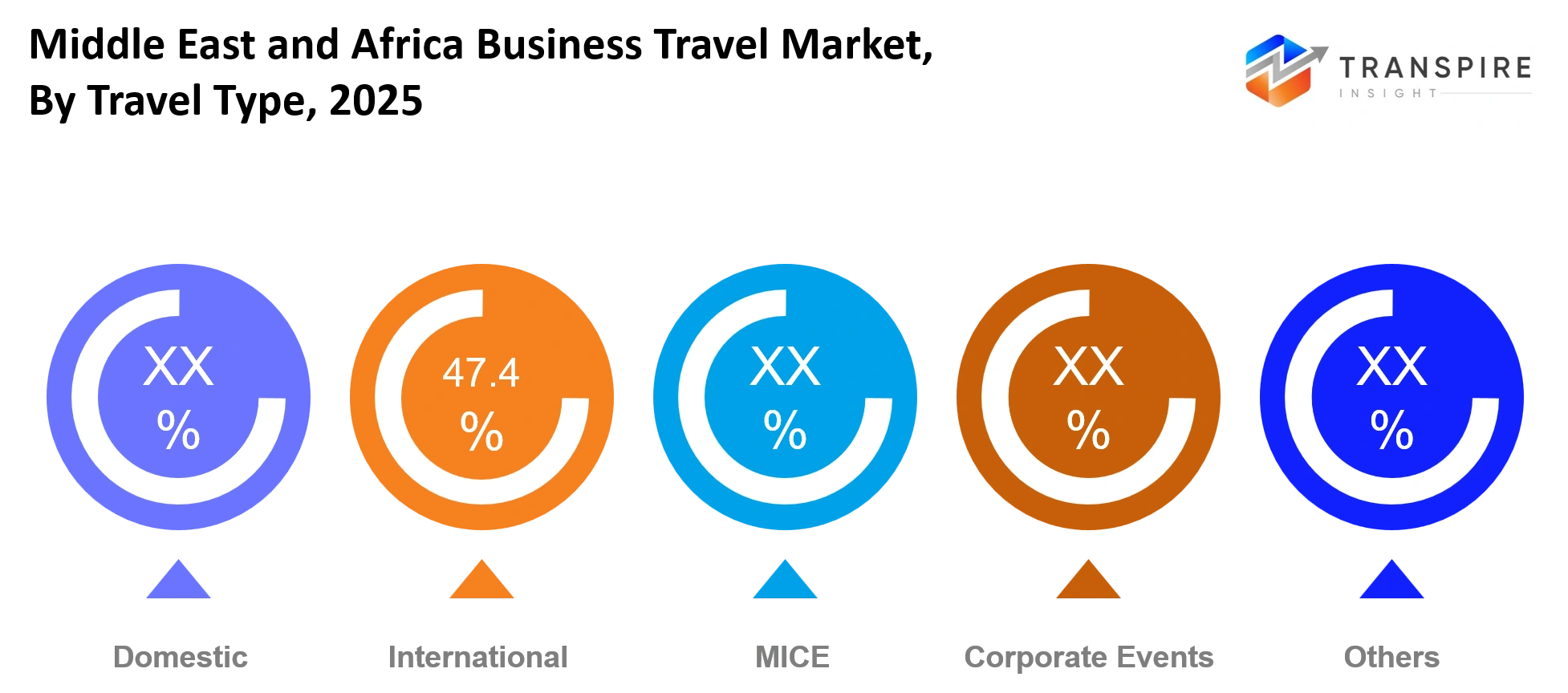
Domestic travel keeps backing up day to day business operations in the main economic centers. Regular meetings, project checks, training sessions and a bunch of regional business actions keep generating a steady stream, mostly inside national borders. With reduced travel costs and shorter travel time, domestic trips stay a big part of corporate mobility plans, honestly.
International travel still has a strong place too, mainly because foreign investment is rising, trade partnerships keep expanding, and cross border business growth keeps happening. MICE travel is getting more traction as governments and private entities take part in conferences, exhibitions, and sector gatherings. Corporate events add even more motion via leadership meetings, product unveilings, networking sessions, and stakeholder involvement programs. Other travel categories also chip in, through specialized business needs that connect to consulting, technical services, and role specific assignments, sometimes, linked to a certain industry.
To learn more about this report, Download Free Sample Report
By Booking type
As for booking channel, it looks like the online booking channels are taking up a growing portion of business travel transactions. Companies are chasing, yes, more convenience, more transparency, and also clearer cost control. On these digital platforms, reservations can be done much faster, and expenses are tracked more centrally too. That, in turn, makes policy management feel easier, or at least smoother. On top of that, advanced travel management systems help with real-time itinerary updates and travel risk monitoring, so nothing feels totally static.
Still, travel agencies don’t really vanish. They stay useful when the itinerary is complicated, when international travel needs coordination, and when premium corporate services are on the table. Then there are direct booking channels, which usually appeal to organizations that want tighter relationships with airlines, hotels, and lodging providers. Other methods keep showing up for business cases that are more specific, especially when customized travel arrangements are required, or when certain specialized service demands need attention. Overall, continuous digital adoption will keep nudging how people book within corporate travel programs.
By End User
Large enterprises take up a substantial slice of business travel spendin g because multinational operations, tend to mean frequent employee movement between various locations. In practice business expansion, client engagement, project oversight, and regional coordination create a steady kind of travel appetite. When companies put structured travel rules in place plus dedicated travel budgets, that also tends to make volume rise even more across this segment.
SMEs are getting more involved in business travel too, as market expansion, partnership building, and customer acquisition tasks start mattering more. Government organizations also add demand through diplomatic engagements, trade missions, policy talks, and public sector collaborations, often in a pretty continuous way. Other end users include educational
institutions, industry associations, and non-profit organizations that require travel for conferences, knowledge exchange programs, and professional development initiatives. Continued economic development across the region will support broader participation from all end-user categories.
What are the Key Use Cases Driving the Middle East and Africa Business Travel Market?
Corporate meetings , client negotiations, and those ongoing project management tasks really are the core reason people end up traveling for business across the region. In practice, energy, construction, finance, and technology firms keep leaning on face to face conversations , to handle contracts, keep an eye on projects, and reinforce commercial ties. That whole pattern sort of turns into travel that stays pretty consistent year round
At the same time, conference attendance and industry exhibitions are gaining a lot more weight, especially when big enterprises, and government organizations are involved. Trade events across Saudi Arabia, the United Arab Emirates, and South Africa are now drawing executives, investors, and sector specialists who really want to line up collaborations, find investment opportunities, and drive market expansion, so it’s not just one-off visits anymore.
You can also notice newer use cases coming through , such as travel tied to innovation hubs, startup ecosystems, and renewable energy initiatives. Cross border cooperation in things like green hydrogen, digital infrastructure, and advanced manufacturing is generating fresh mobility needs, and it should continue to rise steadily during the forecast period.
|
Report Metrics |
Details |
|
Market size value in 2025 |
USD 102.36 Billion |
|
Market size value in 2026 |
USD 109.68 Billion |
|
Revenue forecast in 2033 |
USD 177.81 Billion |
|
Growth rate |
CAGR of 7.15% from 2026 to 2033 |
|
Base year |
2025 |
|
Historical data |
2021 - 2024 |
|
Forecast period |
2026 - 2033 |
|
Report coverage |
Revenue forecast, competitive landscape, growth factors, and trends |
|
Regional scope |
Middle East and Africa (Saudi Arabia, United Arab Emirates, South Africa, Rest of Middle East and Africa) |
|
Key company profiled |
American Express GBT, BCD Travel, CWT, FCM Travel, Expedia, Booking.com, Travelport, SAP Concur, TripActions, Emirates, Qatar Airways, Marriott, Hilton, Accor, Turkish Airlines. |
|
Customization scope |
Free report customization (country, regional & segment scope). Avail customized purchase options to meet your exact research needs. |
|
Report Segmentation |
By Travel Type (Domestic, International, MICE, Corporate Events, Others); By Booking Channel (Online, Travel Agencies, Direct Booking, Others); By End User (SMEs, Large Enterprises, Government, Others). |
Which Regions are Driving the Middle East and Africa Business Travel Market Growth?
The Gulf region leads the market, supported by ambitious economic diversification programs, strong aviation connectivity, and large-scale investment projects. Countries such as Saudi Arabia and the United Arab Emirates attract multinational corporations, consultants, and investors through business-friendly policies and major development initiatives. Global business hubs including Dubai, Riyadh, and Abu Dhabi host a high concentration of conferences, trade exhibitions, and corporate headquarters. A well-developed ecosystem of airlines, hotels, event venues, and travel management providers helps sustain regional leadership.
South Africa represents the second-largest contributor and differs from the Gulf region through its focus on established commercial activity rather than large state-led investment programs. Financial services, mining, manufacturing, and professional services sectors generate consistent corporate travel demand throughout the year. Stable business networks and mature corporate travel practices support steady market performance even during periods of economic uncertainty. Continued investment from domestic companies and multinational firms makes South Africa a reliable source of business travel revenue.
Sub-Saharan Africa is emerging as the fastest-growing region due to expanding trade corridors, infrastructure development, and foreign direct investment. Several countries have increased spending on transport networks, industrial zones, and digital infrastructure, creating new opportunities for corporate mobility. Business travel linked to energy, telecommunications, logistics, and technology projects has accelerated as regional economies become more interconnected. This growth creates attractive opportunities for travel service providers, airlines, and technology platforms seeking expansion between 2026 and 2033.
Who are the Key Players in the Middle East and Africa Business Travel Market and How Do They Compete?
Competition in the Middle East and Africa business travel sector remains moderately consolidated, with a mix of global travel management companies and technology-focused providers competing for corporate accounts. Competition increasingly centers on digital capabilities, traveler risk management, expense visibility, and the ability to support multinational clients across multiple countries. Established providers continue to defend market share through integrated service offerings, while newer technology-driven firms challenge traditional models with more flexible booking and management platforms. Service quality, data analytics, and regional coverage have become more important differentiators than price alone.
American Express Global Business Travel focuses on integrated corporate travel management supported by advanced booking, expense, and reporting tools. Strong relationships with airlines, hotels, and corporate customers allow the company to negotiate favorable travel programs and deliver broad global coverage. BCD Travel differentiates itself through data-driven travel optimization and traveler compliance solutions that help organizations control costs while improving policy adherence. Continued investment in digital platforms and analytics capabilities strengthens customer retention and operational efficiency.
CWT emphasizes travel technology, traveler safety, and real-time trip management through mobile-enabled platforms. A strong focus on risk management creates value for organizations operating across diverse business environments. FCM Travel differentiates through highly personalized service models supported by proprietary technology and local market expertise. TravelPerk expands through a technology-first strategy that combines automated booking, flexible travel options, and simplified expense management, attracting companies seeking modern alternatives to traditional travel management services.
Company List
- American Express GBT
- BCD Travel
- CWT
- FCM Travel
- Expedia
- Booking.com
- Travelport
- SAP Concur
- TripActions
- Emirates
- Qatar Airways
- Marriott
- Hilton
- Accor
- Turkish Airlines
Recent Development News
"In March 2026, American Express Global Business Travel launched 'Complete,' a next-generation travel and expense solution developed in partnership with SAP Concur. The platform integrates travel booking, expense management, and payments into a unified workflow, strengthening digital transformation across corporate travel programs.
Source: https://investors.amexglobalbusinesstravel.com
"In September 2025, American Express Global Business Travel completed the acquisition of CWT following regulatory approvals. The transaction expanded customer reach, increased transaction volumes, and accelerated consolidation within the global corporate travel management sector.
Source: https://investors.amexglobalbusinesstravel.com
"In July 2025, BCD Travel expanded its partnership with Oversee to deploy agentic AI technology across its operational environment. The initiative automates traveler service requests and enhances operational efficiency, supporting faster response times and scalable corporate travel services.
Source: https://news.bcdtravel.com
"In June 2025, BCD Travel strengthened its strategic partnership with Conferma to expand virtual payment and hotel integration capabilities. The collaboration improves payment automation, invoice reconciliation, and financial visibility for corporate travel customers.
Source: https://news.bcdtravel.com
What Strategic Insights Define the Future of the Middle East and Africa Business Travel Market?
The Middle East and Africa Business Travel Market is moving toward a more technology-driven and strategically managed model over the next five to seven years. Growth will be supported less by simple travel volume expansion and more by corporate investment in digital travel ecosystems, traveler risk management, and data-driven decision-making. As governments continue attracting foreign investment and multinational companies expand regional operations, business travel will become increasingly integrated with broader economic development strategies.
A less visible risk lies in market concentration. Large corporations and major economic hubs account for a significant share of travel spending, creating exposure to shifts in investment cycles, project delays, or geopolitical uncertainty. Any slowdown in major business centers could have a disproportionate impact on regional travel activity.
An emerging opportunity is the development of AI-enabled travel intelligence platforms that combine booking, compliance, expense management, and predictive analytics. Market participants should prioritize partnerships with technology providers and build scalable digital service capabilities now, as future competitive advantage will increasingly depend on data integration, automation, and personalized traveler experiences rather than traditional travel management alone.
Middle East and Africa Business Travel Market Report Segmentation
By Travel Type
- Domestic
- International
- MICE (Meetings, Incentives, Conferences, and Exhibitions)
- Corporate Events
- Others
By Booking Channel
- Online
- Travel Agencies
- Direct Booking
- Others
By End User
- SMEs
- Large Enterprises
- Government
- Others
Frequently Asked Questions
Find quick answers to common questions.
The expected Middle East and Africa Business Travel Market size for the market will be USD 177.81 Billion in 2033.
Key segments for the Middle East and Africa Business Travel Market are By Travel Type (Domestic, International, MICE, Corporate Events, Others); By Booking Channel (Online, Travel Agencies, Direct Booking, Others); By End User (SMEs, Large Enterprises, Government, Others).
Major Middle East and Africa Business Travel Market players are American Express GBT, BCD Travel, CWT, FCM Travel, Expedia, Booking.com, Travelport, SAP Concur, TripActions, Emirates, Qatar Airways, Marriott, Hilton, Accor, Turkish Airlines.
The Middle East and Africa Business Travel Market size is USD 102.36 Billion in 2025.
The Middle East and Africa Business Travel Market CAGR is 7.15% from 2026 to 2033.
- American Express GBT
- BCD Travel
- CWT
- FCM Travel
- Expedia
- Booking.com
- Travelport
- SAP Concur
- TripActions
- Emirates
- Qatar Airways
- Marriott
- Hilton
- Accor
- Turkish Airlines
About the Authors

Chetan Dhatrak
I’m Chetan Dhatrak, a Senior Research Analyst at Transpire Insight, specializing in the Consumer Goods, Foods and Beverages industry. I focus on analyzing market trends, consumer behavior, competitive landscapes, and industry developments to deliver accurate, data-driven insights. My research at Transpire Insight is built on credible sources and in-depth analysis, helping businesses and readers better understand market dynamics, emerging opportunities, and evolving consumer preferences. I’m committed to creating reliable, well-researched content that supports informed decision-making and reflects the latest developments in the consumer goods and food & beverage sectors.

Chakradhar Khansole
Chakradhar serves as the Research Director at Transpire Insight, bringing over 8 years of experience in technology, innovation, and strategic market intelligence. He specializes in transforming complex market data into actionable business insights that enable organizations to make informed, growth-oriented decisions. Recognized for his strategic vision and analytical expertise, Chakradhar leads high-impact research initiatives, delivering comprehensive market assessments, competitive intelligence, and forward-looking industry analysis.
Recently Published Reports
-
Apr 2026
Bottled Water Market
Bottled Water Market Size, Share & Analysis Report By Product Type (Still Bottled Water, Carbonated Bottled Water, Functional Bottled Water, and Others), By Packaging (PET, Cans, and Others), By Sales Channel (Supermarkets/Hypermarkets, Convenience Stores/Drug Stores, Grocery Stores/Club Stores, Foodservice, and Others) and Geography (North America, Europe, Asia-Pacific, Middle East and Africa, South and Central America), 2021 - 2032
-
Apr 2026
Color Cosmetic Packaging Market
Color Cosmetic Packaging Market Size, Share & Analysis Report By Application (Mascara Packaging, Liquid Packaging, and Liquid Face), By Type (Tubes & Bottles, Pens & Markers, Compacts & Containers, and Droppers & Pumps), and Geography (North America, Europe, Asia-Pacific, Middle East and Africa, South and Central America), 2021 - 2031
-
Apr 2026
External Microphone For Camera Market
External Microphone For Camera Market Size, Share & Analysis Report By Type (Shotgun Microphone, Lavalier Microphone, and Others), By Application (Digital Camera, Professional Video Camera, and Others), and Geography (North America, Europe, Asia-Pacific, Middle East and Africa, South and Central America), 2021 - 2031
-
Apr 2026
Foot Orthotic Insoles Market
Foot Orthotic Insoles Market Size, Share & Analysis Report By Type (Pre-fabricated, and Custom-made), By Material (Thermoplastic, Composite Carbon Fiber, and Others), By Distribution Channel (Drug Stores, Hospitals & Clinics, and Others), and Geography (North America, Europe, Asia-Pacific, Middle East and Africa, South and Central America), 2021 - 2031