Middle East and Africa Automotive Safety System Market Size & Forecast:
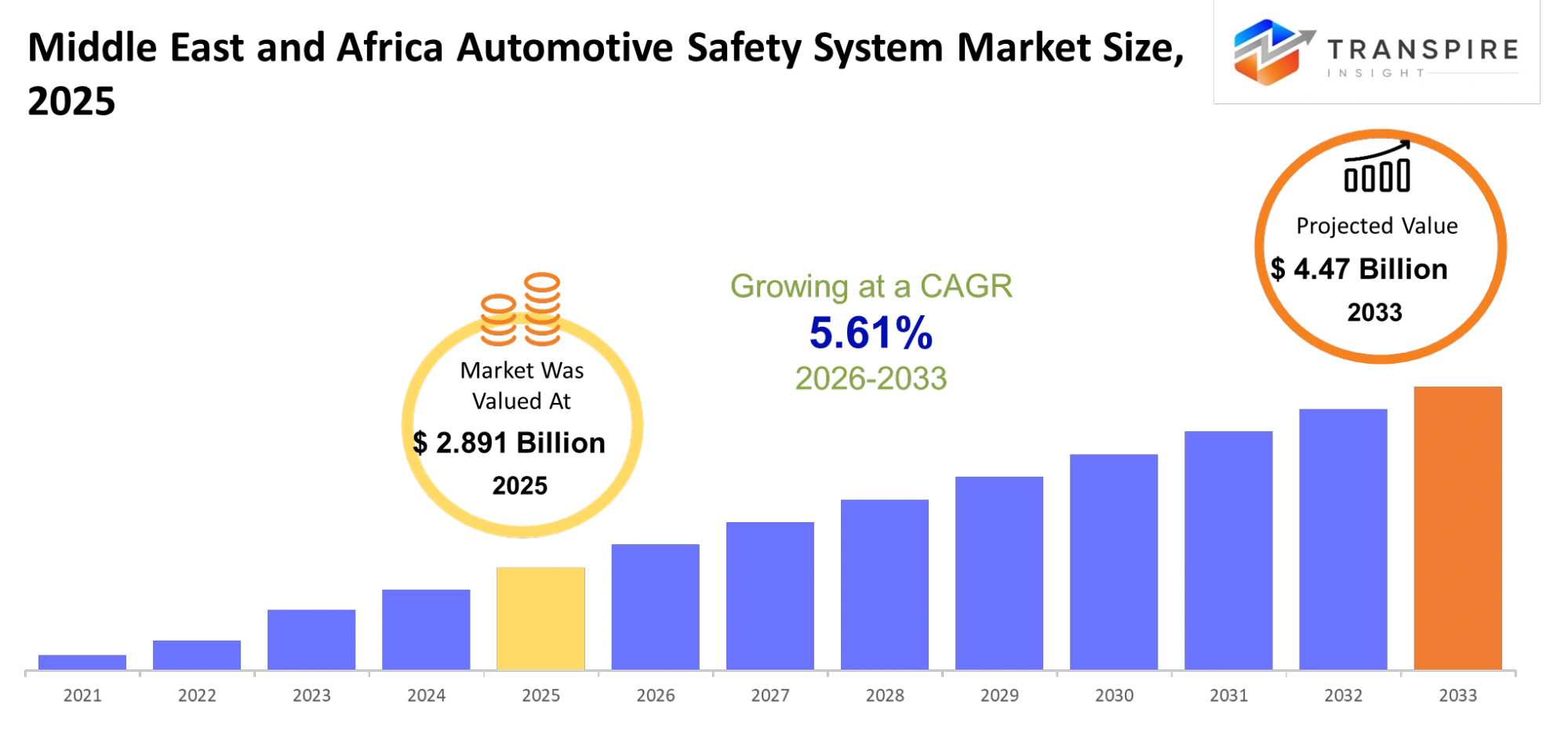
- Middle East and Africa Automotive Safety System Market Size 2025: USD 2.891 Billion
- Middle East and Africa Automotive Safety System Market Size 2033: USD 4.47 Billion
- Middle East and Africa Automotive Safety System Market CAGR: 5.61%
- Middle East and Africa Automotive Safety System Market Segments: By Type (Active, Passive, ADAS), By Component (Airbags, Sensors, ECUs, Cameras), By End-User (OEMs, Automotive Manufacturers, Fleet Operators, Suppliers)
To learn more about this report,  Download Free Sample Report
Middle East and Africa Automotive Safety System Market Summary:
The Middle East and Africa Automotive Safety System Market size is estimated at USD 2.891 Billion in 2025 and is anticipated to reach USD 4.47 Billion by 2033, growing at a CAGR of 5.61% from 2026 to 2033. The Middle East and Africa (Saudi Arabia, United Arab Emirates, South Africa, Rest of Middle East and Africa) Automotive Safety System Market sits within the broader automotive technology industry and will continue to reflect how mobility priorities are shifting across these regions. Vehicle buyers will expect their vehicles to prevent accidents which must be implemented before they occur. The governments of Saudi Arabia and the UAE will introduce stricter safety regulations which will require vehicle manufacturers to include driver assistance systems as standard equipment. Safety system design will evolve through urban development and increased traffic which will make advanced sensors and immediate warning systems become standard features. In South Africa, affordability will shape adoption, encouraging scalable safety solutions. The region will see growing adoption of global vehicle standards which will change all aspects of vehicle protection requirements.
What Has the Impact of Artificial Intelligence Been on the Middle East and Africa Automotive Safety System Market?
The automotive safety system market in the Middle East and Africa experiences transformation through artificial intelligence which uses data to improve safety technology development, testing, and implementation processes. The Middle East and Africa automotive safety system market will benefit from AI technology because it enables researchers to analyze extensive datasets which include vehicle sensor information, traffic data, and accident records to produce more precise market insights. The application of artificial intelligence in Middle East and Africa automotive safety system market research will enhance predictive analytics, which enables businesses to forecast demand for advanced driver assistance systems and collision avoidance technologies with improved accuracy.
The Middle East and Africa automotive safety system market will achieve better production performance through smart automation and machine learning which enhance manufacturing efficiency by streamlining production processes and decreasing safety component defects. Artificial intelligence systems will optimize supply chain management by using real-time tracking and smart inventory control to decrease delivery times and cut down operational expenses. The Middle East and Africa automotive safety system market will benefit from artificial intelligence solutions as they enable manufacturers to create customized safety systems which match the developing trends of connected and autonomous transportation.
The Middle East and Africa automotive safety systems market will gain competitive advantages through AI integration because companies will use intelligent systems to improve product reliability and meet upcoming safety requirements. The market will gain the ability to handle changing consumer demands and new regulatory requirements through this development which will establish its permanent technological path.
Key Market Trends & Insights:
- The automotive safety system market in the Middle East and Africa will be led by Saudi Arabia and UAE which will capture more than 35% of the market share in 2024 through increased demand for premium vehicles.
- The automotive safety regulations in South Africa will create a growth rate that exceeds 8% CAGR until 2030.
- The market for advanced driver assistance systems (ADAS) will reach nearly 40% market share in 2024 because of high demand for technologies that prevent collisions.
- The second largest market share belongs to airbags and passive safety systems which receive support from mandatory safety regulations that exist in multiple nations.
- The period from 2025 to 2030 will see autonomous emergency braking systems and AI-integrated safety systems experience the highest growth rate as smart automation trends become more common.
- The market for automotive safety systems in the Middle East and Africa operates with passenger vehicles holding a market share of about 65% because of increasing safety requirements from customers.
- The commercial vehicle market will experience its most rapid expansion because of new safety requirements for fleet operations and the growth of the logistics industry.
- Safety system demand in the automotive industry shows that OEMs drive more than 70% of total demand because automakers implement these systems during their vehicle production process.
- The market for aftermarket solutions will experience rapid expansion between 2025 and 2030 because of increasing demand for retrofitting services on existing vehicle fleets.
Middle East and Africa Automotive Safety System Market Segmentation
By Type
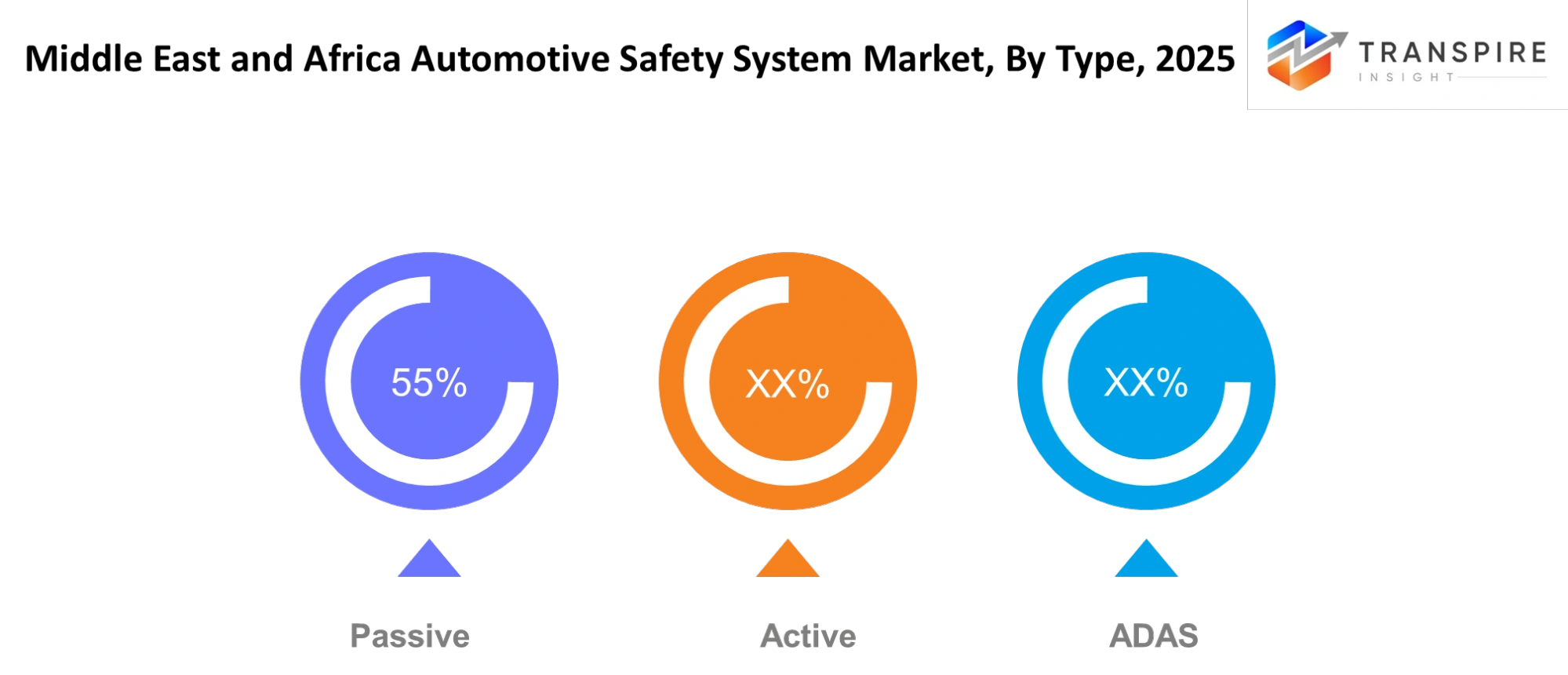
Active safety systems will use braking support and stability control together with real-time monitoring systems to stop accidents from happening until the moment of impact. Passive safety systems will remain essential because they use structural design and restraint systems to minimize injury during crashes. ADAS will continue to bridge both areas through its use of sensors and cameras which work with software to deliver critical driving assistance during emergencies. The growing adoption of these technologies will occur across regional markets because of increasing road congestion and upcoming safety regulations.
Rising awareness among buyers will lead to higher demand for vehicles equipped with active and ADAS features, especially in urban centers. The active protection systems of the present day will remain essential because regulatory standards require their implementation as basic protection measures. The commercial adoption of ADAS technology will increase during the next years because system prices will decrease and technology will become widely available. The automotive safety system market in the middle east and africa region will achieve its balance between accident prevention methods and safety protection measures in upcoming vehicle models.
To learn more about this report, Download Free Sample Report
By Component
Airbags will remain a core component because both regulatory requirements and their proven effectiveness in decreasing fatalities demand their presence. The increasing importance of sensors will enable collection of real-time data which supports advanced safety capabilities. The control units of ECUs will process input data from multiple sources to create appropriate system responses. Cameras will enable visual detection systems to enhance lane monitoring and object recognition and driver assistance functions.
Technological progress will make sensors and cameras more accurate and cost-efficient, increasing integration across vehicle segments. ECUs will evolve into advanced systems which can execute sophisticated algorithms while enabling vehicle connectivity. Airbag technology will also improve with better deployment timing and multi-stage inflation systems. The middle east and africa automotive safety system market will experience rising demand for integrated component systems which operate together without issues.
By End-User
OEMs will dominate demand because they embed safety systems during vehicle production. Automotive manufacturers will develop products which comply with safety standards while achieving cost efficiency. Fleet operators will start using safety technologies because these technologies help them decrease accident risks and enhance their operational efficiency. Suppliers will deliver essential components which enable them to support all innovative activities that occur throughout the entire value chain.
The increasing market competition will force OEMs to create unique product differentiation through superior safety capabilities and advanced technological integration. Fleet operators will select systems which decrease operational expenses by minimizing equipment failure time and decreasing insurance costs. Suppliers will allocate funds towards research initiatives and strategic partnerships to adapt to the evolving requirements of the industry. The automotive safety system market in the middle east and africa will undergo development through collaborative efforts between various end-user groups.
What are the Main Challenges for the Middle East and Africa Automotive Safety System Market Growth?
The automotive safety system market in the Middle East and Africa faces ongoing difficulties because of technical and operational problems which create obstacles to its development. The system reliability and calibration processes become compromised due to the different testing standards which exist together with the various road conditions and extreme weather conditions. Vehicle manufacturers encounter problems because their vehicles need to integrate multiple technologies which include sensors and cameras and control units. The Middle East and Africa automotive safety system market experiences deployment delays because supply chain disruptions affect semiconductor and electronic component availability which restricts market growth.
The manufacturing and commercialization barriers create fundamental obstacles which prevent business expansion. The high production costs of advanced safety technologies result in higher vehicle prices which prevents price-sensitive markets from adopting these technologies. The manufacturers face greater operational expenses and increased time requirements because they must comply with changing safety regulations and certification standards. The Middle East and Africa automotive safety system market experiences system rollout delays because local production capabilities remain incomplete and organizations depend on imports for their needs.
The existing adoption challenges stay unsolved because both infrastructure shortcomings and public knowledge deficits continue to exist. The present road systems in many areas do not provide the necessary infrastructure needed to operate advanced driver assistance systems at their full potential. The system installation process together with system optimization and system maintenance tasks suffers from technician and engineering staff shortages. Middle eastern and African automotive safety system markets face market restrictions because funding gaps and limited automotive technology investments slow down system adoption.
The existence of low-cost alternatives together with basic safety features creates competitive pressure which affects consumer buying behavior. The combination of technological advancements and regulatory updates generates investment risks because they create unpredictable conditions. The future dangers and development obstacles which affect the Middle East and Africa automotive safety system market result from these factors.
Regional Insights
The stronger purchasing power of Saudi Arabia and the UAE will create high demand for advanced vehicle features which customers will prefer to purchase. The combination of urban growth and premium vehicle market expansion will create demand for safety system integration. The increasing regulatory requirements will force manufacturers to implement stricter safety standards which they must meet across all their operating markets.
The South African market will experience steady development through gradual market acceptance which will be supported by growing public awareness and government backing. The rest of the region will rely on imported goods and international standards to determine its market development. The combination of infrastructure deficiencies and budget constraints will determine how quickly people adopt new technologies which will result in different speeds of development across various nations.
Recent Development News
In April 2026, Robert Bosch GmbH announced the acquisition of Bosch Chassis Systems India to strengthen its active safety and braking technology portfolio. The move will support integrated safety platforms and faster development of next-generation vehicle motion systems.https://thebrakereport.com/
In February 2026, ZF Friedrichshafen AG unveiled AI-driven diagnostic and safety solutions, including a multi-brand diagnostics platform and 360-degree video safety system for fleet operators. These innovations aim to enhance vehicle safety monitoring and real-time risk detection.https://www.autocarpro.in/
|
Report Metrics |
Details |
|
Market size value in 2025 |
USD 2.891 Billion |
|
Market size value in 2026 |
USD 3.05 Billion |
|
Revenue forecast in 2033 |
USD 4.47 Billion |
|
Growth rate |
CAGR of 5.61% from 2026 to 2033 |
|
Base year |
2025 |
|
Historical data |
2021 - 2024 |
|
Forecast period |
2026 - 2033 |
|
Report coverage |
Revenue forecast, competitive landscape, growth factors, and trends |
|
Regional scope |
Middle East and Africa (Saudi Arabia, United Arab Emirates, South Africa, Rest of Middle East and Africa) |
|
Key company profiled |
Bosch, Continental, Denso, ZF Friedrichshafen, Aptiv, Valeo, Hyundai Mobis, Autoliv, Magna, Hella, Infineon, NXP, Texas Instruments, Veoneer, AISIN |
|
Customization scope |
Free report customization (country, regional & segment scope). Avail customized purchase options to meet your exact research needs. |
|
Report Segmentation |
By Type (Active, Passive, ADAS), By Component (Airbags, Sensors, ECUs, Cameras), By End-User (OEMs, Automotive Manufacturers, Fleet Operators, Suppliers) |
How Can New Companies Establish a Strong Foothold in the Middle East and Africa Automotive Safety System Market?
New market entrants in the Middle East and Africa automotive safety system sector can develop strong market positions by searching for operational deficiencies which need to be solved through affordable safety products that meet regional performance standards. The region requires systems which can withstand severe weather conditions and rough road surfaces because many vehicles operate in those types of environments. Companies that design products which can withstand high temperatures and manage dust and handle mixed traffic situations will establish their market presence. The new players will create their market presence through two methods which include targeting niche segments entry-level ADAS and fleet safety technology.
The automotive safety system market in the Middle East and Africa will use innovation strategies to create distinctive product offerings. Startups that build safety systems with artificial intelligence and predictive analytics together with smart automation will achieve superior accuracy and real-time system responsiveness. The company can achieve faster market entry through partnerships with local original equipment manufacturers while the partnerships will decrease business operational risks. Smart city project collaborations create new opportunities to develop use cases which will support connected vehicle safety and traffic monitoring systems.
Foresight Autonomous Holdings and Mobileye demonstrate how technology-based approaches generate innovative safety solutions through their vision systems and AI detection technology. The innovation-based models of their business will enable new companies to find solutions that address their most critical operational challenges. The combination of local solutions and strategic partnerships and ongoing product development will enable businesses to establish their presence in the Middle East and Africa automotive safety system market while developing lasting trust.
Key Middle East and Africa Automotive Safety System Market Company Insights
Global players will maintain strong market positions through their advanced safety technologies and their existing supply networks. Bosch Continental and Denso will direct their efforts toward developing new products and creating integrated systems and meeting regulatory standards. The company will develop its research capabilities and its local manufacturing capacity to enhance its ability to meet specific local market needs.
New entrants will compete by delivering affordable solutions which can be modified to meet specific local requirements. The company will establish partnerships with original equipment manufacturers and fleet operators to accelerate its market entry process and achieve faster market penetration. Smaller companies will achieve market visibility through their unique technology especially their AI-based safety systems which will help them develop sustainable competitive advantages in the changing automotive safety market.
Company List
- Bosch
- Continental
- Denso
- ZF Friedrichshafen
- Aptiv
- Valeo
- Hyundai Mobis
- Autoliv
- Magna
- Hella
- Infineon
- NXP
- Texas Instruments
- Veoneer
- AISIN
What are the Key Use-Cases Driving the Growth of the Middle East and Africa Automotive Safety System Market?
Middle East and Africa automotive safety system market expansion occurs because real-world applications drive adoption of passenger vehicle safety systems. Urban drivers now use advanced driver assistance systems, including lane departure warnings and automatic braking, to reduce their likelihood of accidents. The market experiences continuous growth because these features address two current challenges: rising traffic volume and increasing safety awareness.
The Middle East and Africa automotive safety system market is growing, driven by fleet management as a significant application. Logistics and transport companies are adopting safety technologies to monitor driver behavior, prevent collisions, and reduce insurance costs. Fleet operators use AI-enabled systems which monitor fatigue, speed and road conditions to enhance their operational efficiency while meeting safety standards.
Connected infrastructure investments drive smart city projects which lead to increased adoption of smart city initiatives. Real-time data exchange between vehicle safety systems and traffic monitoring systems enables better road safety results. Construction and mining industries benefit from heavy vehicles that use sensors and cameras to improve safety standards and decrease operational hazards.
The future growth of our organization depends on developing artificial intelligence and predictive analytics and connected mobility solutions. The automotive safety system market for Middle East and Africa will grow because technology becomes more accessible across both premium and mid-range vehicle segments.
Middle East and Africa Automotive Safety System Market Report Segmentation
By Type
- Active
- Passive
- ADAS
By Component
- Airbags
- Sensors
- ECUs
- Cameras
By End-User
- OEMs
- Automotive Manufacturers
- Fleet Operators
- Suppliers
Frequently Asked Questions
Find quick answers to common questions.
The approximate Middle East and Africa Automotive Safety System Market size for the market will be USD 4.47 Billion in 2033.
Key segments for the Middle East and Africa Automotive Safety System Market are By Type (Active, Passive, ADAS), By Component (Airbags, Sensors, ECUs, Cameras), By End-User (OEMs, Automotive Manufacturers, Fleet Operators, Suppliers).
Major Middle East and Africa Automotive Safety System Market players are Bosch, Continental, Denso, ZF Friedrichshafen, Aptiv, Valeo, Hyundai Mobis, Autoliv, Magna, Hella, Infineon, NXP, Texas Instruments, Veoneer, AISIN.
The Middle East and Africa Automotive Safety System Market size is USD 2.891 Billion in 2025.
The Middle East and Africa Automotive Safety System Market CAGR is 5.61%.
- Bosch
- Continental
- Denso
- ZF Friedrichshafen
- Aptiv
- Valeo
- Hyundai Mobis
- Autoliv
- Magna
- Hella
- Infineon
- NXP
- Texas Instruments
- Veoneer
- AISIN
Recently Published Reports
-
Dec 2024
ATV & UTV Market
ATV & UTV Market Size, Share & Analysis Report By Type (ATV, and UTV), By Variants (Less Than 400 CC, 400 CC To 800 CC, and More Than 800 CC), and Geography (North America, Europe, Asia-Pacific, Middle East and Africa, South and Central America), 2021 - 2031
-
Jan 2025
Automotive Central Gateway Module Market
Automotive Central Gateway Module Market Size, Share & Analysis Report By Type (Ethernet Central Gateway Module, CAN Central Gateway Module, LIN Central Gateway Module, and FlexRay), By Application (Powertrain Control, Body Control, Infotainment System, Advanced Driver Assistance Systems (ADAS), and Others), By End User (Passenger Vehicles, and Commercial Vehicles), and Geography (North America, Europe, Asia-Pacific, Middle East and Africa, South and Central America), 2021 - 2031
-
Jan 2025
Automotive Engine Oil Filter Market
Automotive Engine Oil Filter Market Size, Share & Analysis Report By Filter Type (Fuel Filter, Engine Oil Filter, Hydraulic Oil Filter, and Others), By Filter Media (Cellulose, Synthetic, and Micro), By Sales Channel (OEMs, and Aftermarket), By Vehicle Type (Passenger Cars, Light Commercial Vehicles, Heavy Duty Trucks, Buses and Coaches, and Off-road Vehicles), and Geography (North America, Europe, Asia-Pacific, Middle East and Africa, South and Central America), 2021 - 2031
-
Jan 2025
Automotive Parts Aluminium Die Casting Market
Automotive Parts Aluminium Die Casting Market Size, Share & Analysis Report By Production Process (Pressure Die Casting, Vacuum Die Casting, Squeeze Die Casting, Gravity Die Casting), By Application (Body Parts, Engine Parts, Transmission Parts, Battery And Related Components, Other Application Types), and Geography (North America, Europe, Asia-Pacific, Middle East and Africa, South and Central America), 2021 - 2031
Our Clients