
Middle East and Africa Artificial Intelligence in Supply Chain Market Size & Forecast:
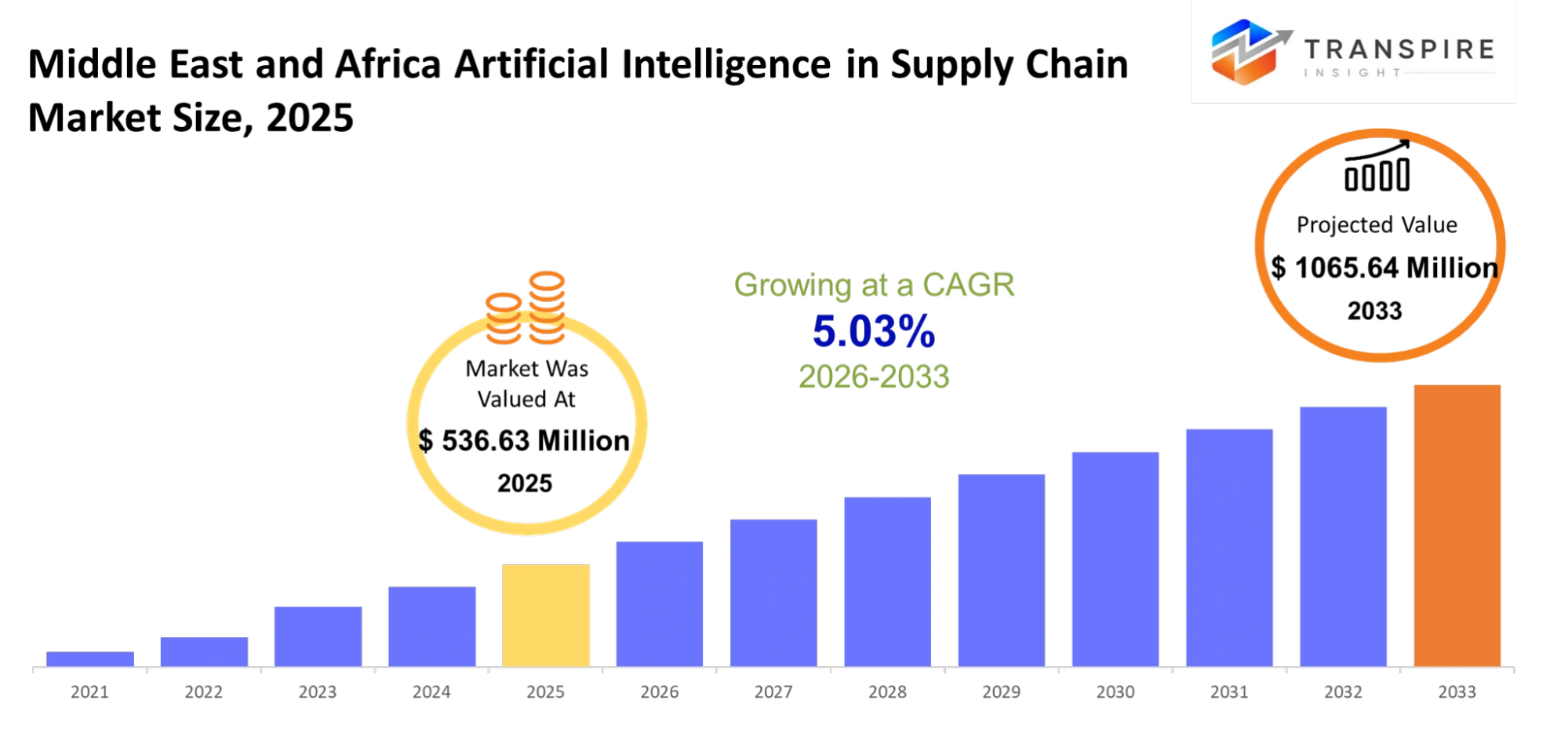
- Middle East and Africa Artificial Intelligence in Supply Chain Market Size 2025: USD 536.63 Million
- Middle East and Africa Artificial Intelligence in Supply Chain Market Size 2033: USD 1065.64 Million
- Middle East and Africa Artificial Intelligence in Supply Chain Market CAGR: 5.03%
- Middle East and Africa Artificial Intelligence in Supply Chain Market Segments: By Component (Software, Services, Platforms), By Technology (ML, NLP, Computer Vision), By Application (Forecasting, Inventory, Logistics, Procurement), By End-User (Retail, Manufacturing, Logistics Firms, E-commerce)
To learn more about this report,  Download Free Sample Report
Middle East and Africa Artificial Intelligence in Supply Chain Market Summary:
The Middle East and Africa Artificial Intelligence in Supply Chain Market size is estimated at USD 536.63 Million in 2025 and is anticipated to reach USD 1065.64 Million by 2033, growing at a CAGR of 5.03% from 2026 to 2033. The Artificial Intelligence in Supply Chain Market which operates in the Middle East and Africa region will include Saudi Arabia, United Arab Emirates, South Africa and the rest of Middle East and Africa. The logistics industry together with digital technology will determine market competition because their organizations will use operational efficiency and predictive decision-making to gain advantages. Companies in Gulf countries and African nations will change their supply networks to meet new delivery demands and customer demand for delivery visibility. Digital transformation programs will become mandatory for governments because they want to establish data-driven systems for international trade. The procurement and distribution systems will undergo transformation through machine learning and real-time tracking and automation improvements while companies will develop flexible supply chains based on upcoming requirements through regional infrastructure development and changing regulations.
Key Market Trends & Insights:
Digital procurement platforms will gain traction across Saudi Arabia and the United Arab Emirates as enterprises move toward predictive sourcing. Artificial intelligence will be used by companies to predict supplier risks and price changes which will be especially useful for industries that face international trade disruptions. The transition will lead to stronger connections between suppliers who will share their information. South Africa will use similar tools to assist its import-dependent industries which will enable companies to decrease their reliance on unpredictable supply chains and enhance their operational planning.
Warehouse automation will expand steadily throughout the industry but it will grow most quickly in main logistics centers such as Dubai and Johannesburg. Operators will use robotics and intelligent forecasting systems to manage changing order volumes without raising their labor expenses. Businesses will develop new storage approaches which will be based on demand information that their advanced analytics systems create. The region will see smaller markets implement semi-automated systems which will help them achieve better efficiency while reducing inventory handling errors although they face financial constraints.
The demand from consumers who want their purchases delivered more swiftly will require companies to improve their last-mile delivery systems through the use of current data insights. The use of artificial intelligence will create better delivery routes through demand patterning which enables faster service in highly populated urban territories. Retailers will increasingly create digital platforms which they will combine with their logistics partners to ensure they deliver consistent service to customers. The tools will assist businesses that operate in developing African markets to reach their target markets which remain unserved because of existing infrastructure limitations.
The national digital strategies together with regulatory frameworks will determine how organizations implement advanced technologies throughout their supply chain operations. The Middle Eastern governments will back smart logistics projects while African nations will work to create better systems for managing data and facilitating international commerce. The secure data infrastructure projects will receive additional funding because of these developments. The growing compliance requirements will lead businesses to implement systems which provide complete visibility and tracking of their operations while meeting local laws and international trade regulations.
Middle East and Africa Artificial Intelligence in Supply Chain Market Segmentation
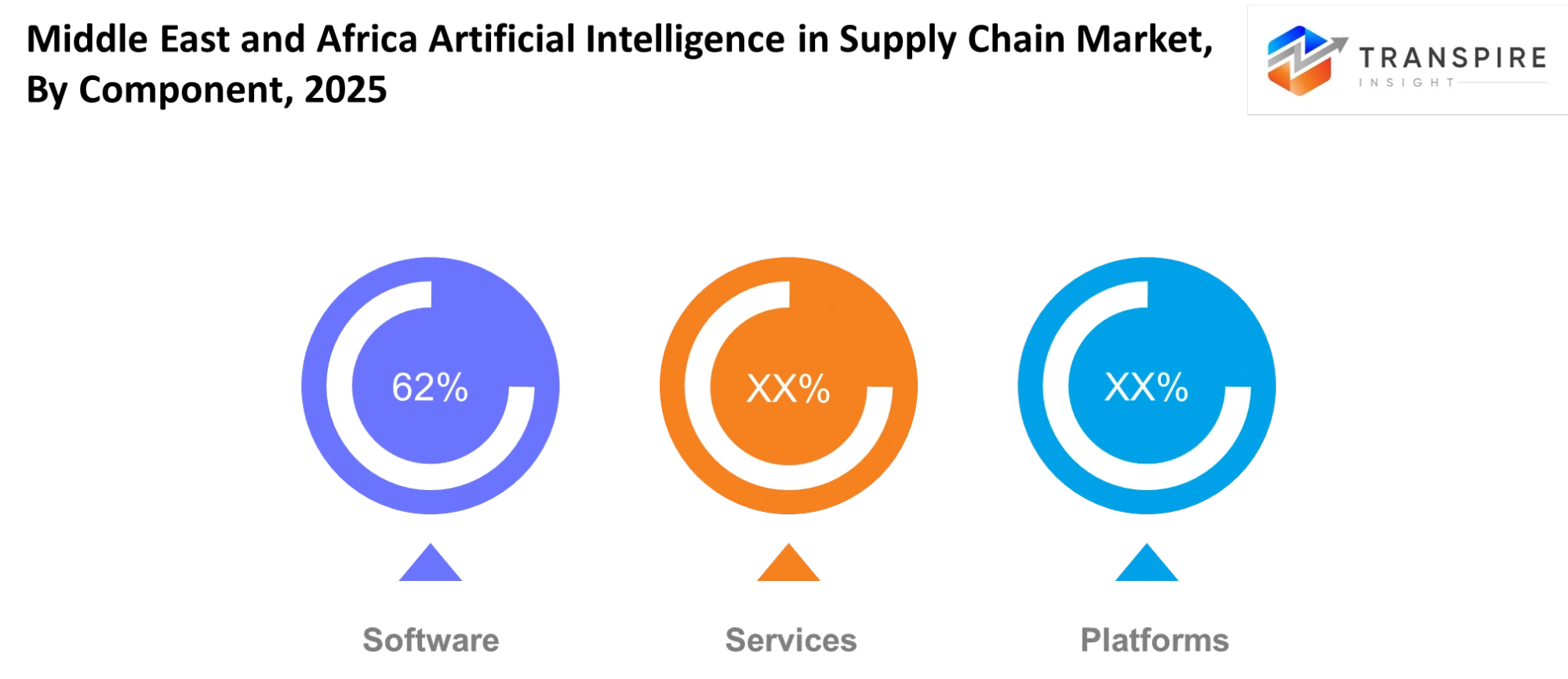
By Component
Software- The analytical framework for supply chains will be established through software solutions which enable organizations to analyze operational data. The systems will use predictive models to support demand sensing and route planning and supplier evaluation. Companies will spend more on software that can be built to fit their current enterprise systems because it helps them work better while decreasing their need for manual work and it improves their decision-making process across procurement and warehousing and distribution operations.
Services- Organizations will rely on services to help them implement their systems and improve their operations. Businesses will require consulting and system integration and maintenance support to implement complex technological solutions in their actual business needs. Many firms will rely on external expertise to train teams and manage transitions, especially in regions where technical skills are still developing. Ongoing service support will ensure that deployed solutions continue to meet market standards and business objectives.
Platforms- Integrated platforms will create a single digital system which connects various functions to enable suppliers and distributors and retailers to work together. Supply chain partners will benefit from real-time visibility provided by the platforms, thus fostering greater cooperation between them and reducing delays in the process. More and more companies will choose international data exchange platforms which prove most useful for their export trade operations. The enterprises can achieve process optimization through this approach while they keep their ability to adapt to upcoming changes.
To learn more about this report, Download Free Sample Report
By Technology
ML- Machine learning will transform how organizations anticipate demand and manage risks. The systems analyze historical data together with real-time data to detect patterns which human planners cannot see. Companies will use machine learning to refine forecasting accuracy and optimize inventory levels and detect anomalies in operations. The continuous learning capabilities will enable systems to adapt to new conditions which will make supply chains more efficient and resilient throughout different regional markets.
NLP- Natural language processing will enhance supply chain communication and data interpretation processes. Businesses will use it to process unstructured data such as supplier emails and contracts and customer feedback. The capability will enhance procurement decisions and customer service by extracting significant insights from text-based information. Organizations will depend on NLP to handle their standard interactions as its usage increases because it will shorten response durations while enhancing their operational transparency.
Computer Vision- Computer vision will enable systems to analyze visual information which will help automate warehouse operations and logistics activities. The system will help with inventory tracking and quality inspection and shipment verification. Companies will use cameras and intelligent recognition tools to monitor goods movement with higher accuracy. The technology will decrease human mistakes while enhancing productivity in environments with high work volume where manual inspections take extended periods and show unreliable results.
By Application
Forecasting- The implementation of advanced analytics will enhance forecasting accuracy for organizations through their planning processes. The tools will use market trends and seasonal patterns together with external disruptions to produce precise demand forecasts. Companies will utilize forecasting systems to synchronize their production timelines with their distribution approaches. The enhanced precision of forecasting systems will assist businesses in maintaining their equilibrium between product supply and demand during competitive market conditions.
Inventory- The future of inventory management will implement dynamic control systems which automatically adjust stock levels according to actual demand requirements. Intelligent systems will help companies track stock movements while they calculate when to restock their products. The method will lower inventory expenses while providing customers access to all products. Distribution networks that operate in multiple regions will use these systems to help their operations run smoothly while they reduce financial losses from excessive inventory and slow restocking processes.
Logistics- Logistics applications will develop solutions which enhance delivery efficiency while creating optimal transport routes. The advanced systems will evaluate traffic patterns together with fuel expenses and delivery timelines in order to determine the most efficient routes. The businesses will utilize the information to decrease their shipping durations and overall operational costs. The tools enable organizations across different geographic areas to achieve operational efficiency improvements through their capability to manage multiple transportation methods which results in better customer outcomes.
Procurement- Data driven insights implementation will be allow organizations to develop enhanced and more strategic procurement programs. Organizations will apply intelligent systems to assess supplier performance while forecasting price fluctuations and determining possible risks. The process will enable organizations to achieve better outcomes through their negotiations and sourcing activities. The increasing interconnection of supply networks will result in more collaborative procurement processes between supply chain partners.
By End-User
Retail- To satisfy increasing customer demands for quick delivery and product access retail enterprises will implement sophisticated supply chain technologies. The systems will enable retailers to handle changes in customer demand while they maintain appropriate store stock levels and their delivery operations become more efficient. Retailers will improve customer satisfaction because of their ability to use data insights which also decrease their business operational costs. The competitive nature of urban markets makes this aspect vital because businesses need to maintain high service standards to keep their customers.
Manufacturing- Manufacturers will use intelligent supply chain solutions to align their production processes with actual market demand. The systems will provide assistance through three main functions which include raw material planning and production scheduling and distribution coordination. Manufacturers can achieve their operational goals through better visibility which enables them to decrease downtime and waste material. Organizations in areas that have complicated supply networks will use these tools to sustain their production processes while they manage unexpected changes in market demand and supply chain interruptions.
Logistics Firms- Logistics operations will benefit from advanced technologies which enable companies to boost their operational productivity and provide dependable services. The tools will provide organizations with capabilities to enhance their fleet operations and optimize delivery routes and monitor their shipments in real time. Companies will use data insights to improve their coordination efforts throughout their entire transportation network. The logistics industry will experience heightened competition as providers work to create quicker more dependable services while optimizing expenses through enhanced operational methods.
E-commerce- It is necessary to have intelligent supply chains in place since e-commerce companies require effective management of their orders and rapid deliveries. These platforms will offer solutions in terms of order processing, inventory management, and optimizing last mile deliveries. E-commerce companies will make use of data to provide their customers with a smooth experience. Effective management of the supply chain will be required for the growth and success of the online retail industry.
Regional Insights
The Saudi Arabian government will enhance its international status through efforts to modernize supply chains while meeting its national digital transformation requirements. The establishment of smart logistics zones together with data infrastructure investments will motivate organizations to implement intelligent planning systems. Retail and manufacturing sectors will push for faster fulfillment cycles, driven by changing consumer expectations. Digital trade regulatory initiatives will promote operational adoption while local businesses will implement advanced technologies to enhance their productivity and operational reliability.
The United Arab Emirates will maintain its position as a central logistics center because of its developed infrastructure and its governmental support for research and development. Businesses will use intelligent systems to improve their international trade operations which will include real-time tracking capabilities. Urban centers will require last-mile delivery services because of their need for quick shipping. Companies will also develop methods to connect their digital platforms with their worldwide partners, which will enable them to work together efficiently while providing excellent services in competitive markets.
South Africa will experience steady adoption as companies seek to overcome infrastructure challenges and improve supply reliability. The companies in the industry will use predictive software tools to monitor their stock levels while they try to minimize disruptions which happen because of transportation delays. The retail and industrial sectors will lead implementation, focusing on cost control and operational visibility. The deployment strategies will be determined by local regulations which govern data handling and trade operations, while businesses will choose solutions which provide both efficiency and cost-effectiveness.
The rest of the Middle East and Africa will show varied progress, influenced by economic diversity and infrastructure readiness. Intelligent supply solutions will be gradually adopted by emerging markets, which will use these solutions to improve their trade efficiency while decreasing their need for manual operations. Governments will establish digital frameworks to enable international business activities between countries. The companies operating in these areas will develop systems which provide both scalable capacity and flexible functionality to help their business overcome changing customer needs and shipping challenges.
Recent Development News
In January 2026, the United Arab Emirates strengthened its strategic position by joining a United States-led program which focused on securing artificial intelligence and semiconductor supply chains. The move will enhance cross-border technology transfer processes and data protection measures by establishing stronger international security partnerships. The initiative will create more robust supply chain networks which will operate throughout the Gulf region. Companies which operate in the area will begin to base their supply chain operations on international standards.
In April 2026, the ongoing geopolitical conflicts have caused a complete transformation of international trade routes because shipping operations now bypass established shipping routes. The new system will determine the ways supply chains will operate throughout the Middle East and Africa. Companies will increase their use of adaptive planning systems which help them cope with unpredictable situations while ensuring their operations remain intact. The new system will drive investments toward developing new logistics routes and implementing digital tracking systems which will enhance operational efficiency.
|
Report Metrics |
Details |
|
Market size value in 2025 |
USD 536.63 Million |
|
Market size value in 2026 |
USD 755.59 Million |
|
Revenue forecast in 2033 |
USD 1065.64 Million |
|
Growth rate |
CAGR of 5.03% from 2026 to 2033 |
|
Base year |
2025 |
|
Historical data |
2021 – 2024 |
|
Forecast period |
2026 – 2033 |
|
Report coverage |
Revenue forecast, competitive landscape, growth factors, and trends |
|
Country scope |
Middle East and Africa (Saudi Arabia, United Arab Emirates, South Africa, Rest of Middle East and Africa) |
|
Key company profiled |
IBM, Microsoft, Google, Amazon, SAP, Oracle, Blue Yonder, Infor, Accenture, TCS, Infosys, Wipro, Capgemini, Cognizant, SAS |
|
Customization scope |
Free report customization (country, regional & segment scope). Avail customized purchase options to meet your exact research needs. |
|
Report Segmentation |
By Component (Software, Services, Platforms), By Technology (ML, NLP, Computer Vision), By Application (Forecasting, Inventory, Logistics, Procurement), By End-User (Retail, Manufacturing, Logistics Firms, E-commerce) |
Key Middle East and Africa Artificial Intelligence in Supply Chain Market Company Insights
The Artificial Intelligence in Supply Chain Market for Middle East and Africa which includes Saudi Arabia, United Arab Emirates, South Africa, and other Middle Eastern and African countries will show a mix of established international technology companies and new local technology startups. The combination of cloud-based analytics solutions and automation tools will allow IBM, SAP, Oracle, Microsoft, and Amazon Web Services to create enterprise-level deployments that will shape their business operations. Regional companies such as Lumitech, Singula, and Warp Development will develop their own local solutions while Humain and other Saudi Arabian projects will build up their AI infrastructure and data capabilities.
Company List
- IBM
- Microsoft
- Amazon
- SAP
- Oracle
- Blue Yonder
- Infor
- Accenture
- TCS
- Infosys
- Wipro
- Capgemini
- Cognizant
- SAS
Middle East and Africa Artificial Intelligence in Supply Chain Market Report Segmentation
By Component
- Software
- Services
- Platforms
By Technology
- ML
- NLP
- Computer Vision
By Application
- Forecasting
- Inventory
- Logistics
- Procurement
By End-User
- Retail
- Manufacturing
- Logistics Firms
- E-commerce
Frequently Asked Questions
Find quick answers to common questions.
The approximate Middle East and Africa Artificial Intelligence in Supply Chain Market size for the market will be USD 1065.64 Million in 2033.
Key segments for the Middle East and Africa Artificial Intelligence in Supply Chain Market By Component (Software, Services, Platforms), By Technology (ML, NLP, Computer Vision), By Application (Forecasting, Inventory, Logistics, Procurement), By End-User (Retail, Manufacturing, Logistics Firms, E-commerce).
Major players in the Middle East and Africa Artificial Intelligence in Supply Chain Market are IBM, Microsoft, Google, Amazon, SAP, Oracle, Blue Yonder, Infor, Accenture, TCS, Infosys, Wipro, Capgemini, Cognizant, SAS.
The Middle East and Africa Artificial Intelligence in Supply Chain Market size is USD 536.63 Million in 2025.
The Middle East and Africa Artificial Intelligence in Supply Chain Market CAGR is 5.03%.
- IBM
- Microsoft
- Amazon
- SAP
- Oracle
- Blue Yonder
- Infor
- Accenture
- TCS
- Infosys
- Wipro
- Capgemini
- Cognizant
- SAS
Recently Published Reports
-
Apr 2026
3D Optical Profiler Market
3D Optical Profiler Market Size, Share & Analysis Report By Type (Desktop 3D Optical Profiler, and Portable 3D Optical Profiler), By Technology (Confocal Technology, and White Light Interference), By End-Use Industry (Manufacturing, Research Institutions, Automotive, Aerospace and Defense, Medical Devices, and Other), and Geography (North America, Europe, Asia-Pacific, Middle East and Africa, South and Central America), 2021 - 2031
-
Apr 2026
Depth Sensor Market
Depth Sensor Market Size, Share & Analysis Report By Type (Infrared Depth Sensors, Time-of-Flight (ToF) Sensors, Stereo Vision Sensors, Structured Light Sensors, Ultrasonic Depth Sensors), By Application (Automotive, Robotics, Gaming, Consumer Electronics, Industrial Automation, Healthcare, Security & Surveillance, Others), By End Users (Automotive Manufacturers, Consumer Electronics Companies, Healthcare Providers, Industrial Companies, Security Agencies, Gaming Companies, Robotics Companies, Others), and Geography (North America, Europe, Asia-Pacific, Middle East and Africa, South and Central America), 2021 – 2031
-
Apr 2026
Digital Manufacturing Market
Digital Manufacturing Market Size, Share & Analysis Report By Component (Hardware, Software, and Services), By Technology (Robotics, 3D Printing, Internet of Things (IoT), and Others), By Application (Automotive and Transportation, Aerospace and Defense, Consumer Electronics, Industrial Machinery, and Others), By Process Type (Computer-Based Designing, Computer-Based Simulation, Computer 3D Visualization, Analytics, and Others), and Geography (North America, Europe, Asia-Pacific, Middle East and Africa, South and Central America), 2021 – 2031
-
Apr 2026
Digital Visa Services Market
Digital Visa Services Market Size, Share & Analysis Report By Type (Individual Travelers, Group Travelers), By Application (Tourism, Business Travel, Others), and Geography (North America, Europe, Asia-Pacific, Middle East and Africa, South and Central America), 2021 – 2031