
Middle East and Africa AI Meeting Assistants Market Size & Forecast:
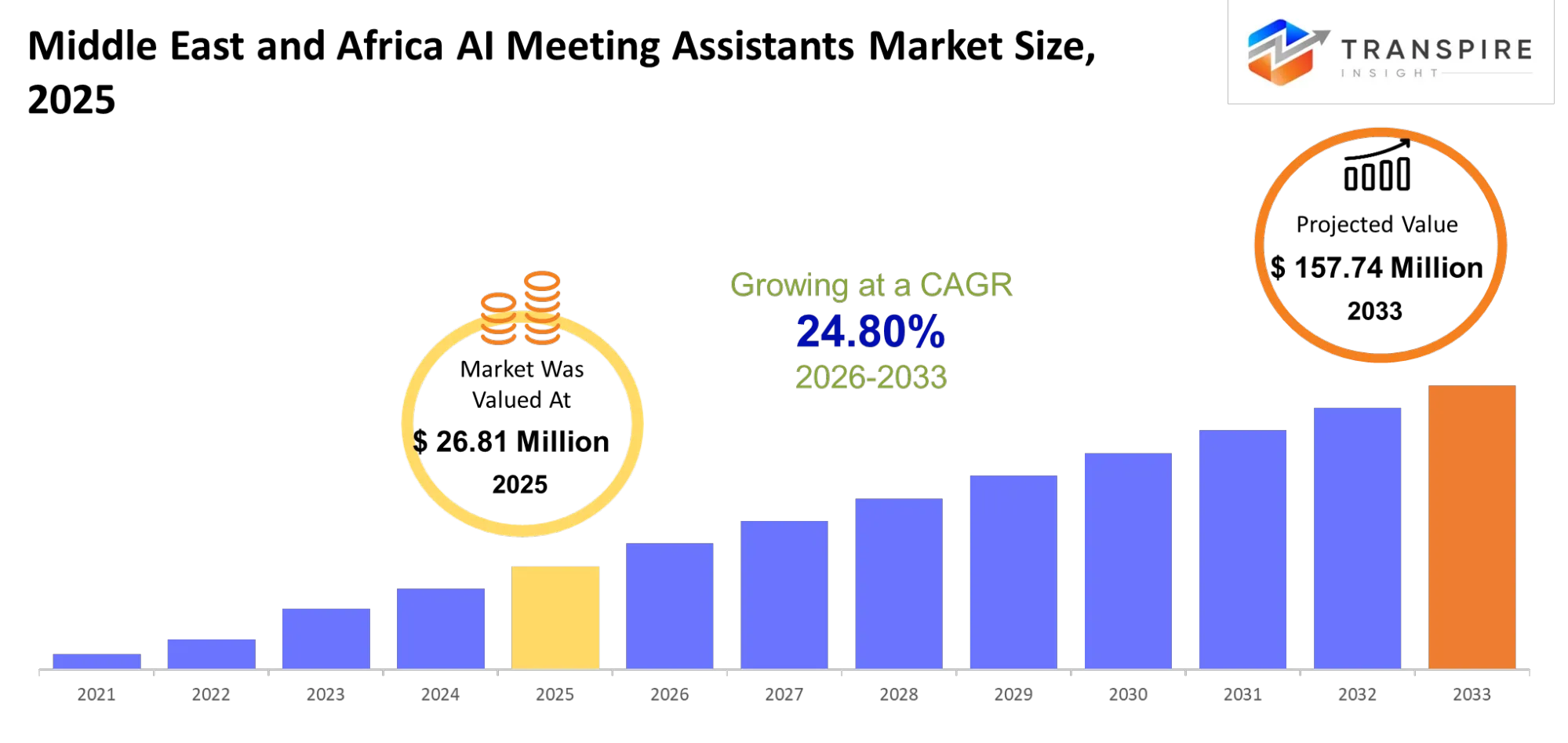
- Middle East and Africa AI Meeting Assistants Market Size 2025: USD 26.81 Million
- Middle East and Africa AI Meeting Assistants Market Size 2033: USD 157.74 Million
- Middle East and Africa AI Meeting Assistants Market CAGR: 24.80%
- Middle East and Africa AI Meeting Assistants Market Segments: By Type (Voice Assistants, Chat Assistants, Transcription Tools, Analytics Tools, Scheduling Assistants, Others); By Application (Meeting Transcription, Scheduling, Collaboration, Decision Support, Productivity Enhancement, Workflow Automation, Others); By End-User (Enterprises, SMEs, Remote Teams, IT Companies, Corporate Users, Consultants, Others); By Deployment (Cloud, On-premise, Hybrid, Others)
To learn more about this report,  Download Free Sample Report
Middle East and Africa AI Meeting Assistants Market Summary
The Middle East and Africa AI Meeting Assistants Market was valued at USD 26.81 Million in 2025. It is forecast to reach USD 157.74 Million by 2033. That is a CAGR of 24.80% over the period.
Companies in the Middle East and Africa use AI meeting assistants to conduct discussions which they then transcribe and systematize across their remote teams who work in energy and construction and logistics and public services so that they can easily access meeting decisions which will guide their daily work tasks. The market has progressed during the last five years from fundamental audio recording systems to contemporary cloud-based collaboration tools which contain generative AI that automatically creates summaries and categorizes content while assigning tasks within business operational processes.
Organizations in the Middle East and Africa have increased their use of digital meeting intelligence because they require remote work solutions which combine with pandemic requirements and current geopolitical tensions and supply chain problems which have occurred in the region. Businesses adopt these tools because they help decrease miscommunication problems while they need to make decisions faster and build better accountability systems to manage their projects which leads to improved execution speed and operational efficiency.
Key Market Insights
- The Middle East and Africa AI Meeting Assistants Market will reach its 2025 peak when the Middle East retains 45% market share because companies will increase their digital transformation efforts.
- The African region experiences its highest growth rate until 2030 because businesses adopt cloud technology and build startup ecosystems while digital infrastructure development improves.
- The Middle East and Africa AI Meeting Assistants Market is dominated by cloud-based AI meeting assistants which control approximately 60% market share because they provide scalable solutions at affordable implementation costs.
- Enterprises prefer subscription-based collaboration tools which make software-as-a-service platforms the second-largest market share holder.
- Enterprise collaboration remains the dominant application which accounts for almost 50% of market share in the Middle East and Africa AI Meeting Assistants Market.
- Enterprises drive efficiency transformation in their business operations through project management and automated workflow documentation which emerge as their most rapidly expanding applications.
- Large enterprises lead with around 55% share because they currently need centralized meeting intelligence systems.
- The end-user group of SMEs experiences the highest growth rate because affordable AI tools now become available through cloud platforms.
- Zoom Video Communications grows its market share by using AI Companion meeting intelligence features.
- International Business Machines develops enterprise AI analytics solutions which provide meeting insights and automated processes.
What are the Key Drivers, Restraints, and Opportunities in the Middle East and Africa AI Meeting Assistants Market?
The main force behind this development stems from how businesses now implement generative AI technology into their internal teamwork platforms. Organizations in sectors such as energy, logistics, and government have moved beyond manual note-taking to AI systems that transcribe, summarize, and assign action points in real time. The current situation developed because businesses began using hybrid work models after the COVID-19 pandemic while economic pressures forced organizations to decrease their administrative expenses. As a result, Microsoft and Zoom Video Communications now provide AI copilots as part of their meeting systems, which helps them develop their subscription business model.
The key restraint remains uneven digital infrastructure and data governance maturity across parts of Africa and smaller Middle Eastern enterprises. Many organizations continue to depend on unreliable internet connections and disjointed information technology systems, which creates problems for processing AI data in real time and causes delays in their product development process. The existing structural deficit prevents organizations from launching their products while it also restricts their ability to earn revenue in the immediate future especially within mid-market business operations.
The Gulf Cooperation Council region will experience significant growth potential through investments in sovereign cloud systems and the establishment of regional AI research centers. The UAE and Saudi Arabia governments finance the development of localized data centers and enterprise AI systems, which allow safe implementation of meeting intelligence technologies. The system establishes a framework that enables organizations to implement AI technologies at scale, especially in government organizations and large companies, which previously faced AI implementation difficulties because of data residency regulations.
What Has the Impact of Artificial Intelligence Been on the Middle East and Africa AI Meeting Assistants Market?
The maritime operations of the Middle East and Africa use AI-driven scrubber performance systems to automate their emissions monitoring and control systems which operate on both their ships and their port fleets. The systems use continuous sensor inputs from exhaust gas cleaning technology to monitor sulfur emissions in real time while achieving international maritime emission standards. The AI-enabled compliance dashboards function as reporting data instruments which help fleet operators to decrease their manual verification work and establish better audit readiness for their multiple vessel operations.
Machine learning models use historical data about engine load patterns and fuel quality changes and weather conditions to increase their ability to forecast maintenance needs and emissions patterns. The system enables organizations to create maintenance schedules which decrease unexpected equipment failures by 15% and enhance fuel efficiency in their optimized fleets between 8 and 12%. Advanced optimization algorithms enable operators to adjust their voyage plans, which helps them decrease fuel usage while they maintain their operational reliability and delivery time commitments.
The adoption process faces obstacles because satellite connectivity remains limited and real-time data transmission experiences problems throughout open sea routes, which leads to decreased accuracy in analytics models and slower delivery of decision-making insights. The high costs associated with integrating new technology into existing vessel systems create obstacles for mid-tier operators who want to implement large-scale system upgrades.
Key Market Trends
- Manual meeting note taking transformed into AI-generated summaries during the 2020 to 2021 period, which resulted in more efficient administrative operations throughout organizations in the Middle East and Africa region.
- The market progressed from standalone transcription software to complete system solutions, which Microsoft Copilot and Google Workspace AI tools brought into the world since 2023.
- Zoom and Cisco turned their video services into AI-driven collaboration platforms, which included features for tracking real-time activities and analyzing meeting content.
- Public institutions in UAE and Saudi Arabia accelerated their adoption of enterprise-grade AI meeting assistant through government digital transformation programs which began in 2022.
- Organizations replaced isolated communication systems with unified AI collaboration platforms which resulted in almost 30 percent better operational efficiency between different teams.
- Enterprises shifted their procurement policies because security requirements now demanded AI systems that comply with rules about local data storage and controlled access to cloud services.
- After 2021, hybrid work became standard which led buyers to expect real-time transcription accuracy and multilingual support for their remote MEA teams.
- The AI analytics integration to IBM and enterprise SaaS providers expanded, which created the ability to generate post-meeting insights and execute automated task distribution throughout various workflows.
Middle East and Africa AI Meeting Assistants Market Segmentation
By Type :
Voice assistants enable users to control meetings through spoken commands which allow them to handle tasks and take notes and ask questions. Chat assistants enable users to interact through text because they need immediate answers and directional assistance. Transcription tools transform spoken conversations into written documents which serve both documentation purposes and review needs.
Analytics tools extract important information from meeting data by showing detection of patterns and decision-making processes and the extent of participant involvement. Scheduling assistants streamline meeting time arrangements through their ability to send reminders and handle calendar operations among all users. Hybrid tools function as another category of tools which merge different capabilities to enhance both meeting management processes and business communication efficiency.
By Application :
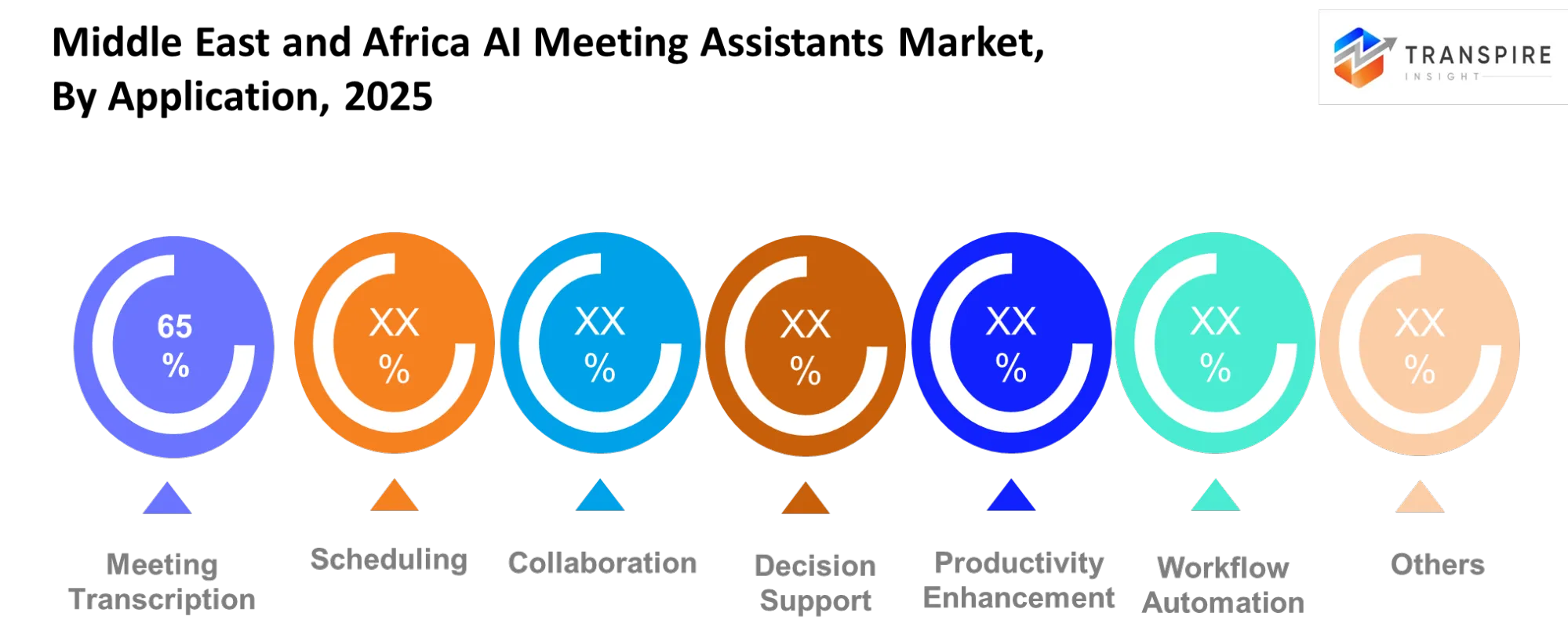
The meeting transcription application specializes in transforming spoken dialogue into precise written transcripts which serve both record-keeping and compliance requirements. The scheduling application enables teams and departments to eliminate conflicts through automatic meeting time coordination which decreases manual work requirements for planning activities. The collaboration application enables users to communicate in real time while working together during meetings.
The decision support application extracts insights from discussions to assist businesses in making operational decisions. Productivity enhancement leads to increased meeting effectiveness while decreasing time spent on nonproductive activities. The workflow automation system links meeting results with operational tasks and systems to maintain continuous business operations.
To learn more about this report, Download Free Sample Report
By End-User :
Companies use AI meeting assistants to handle their complete communication needs while creating organized meeting operations which different teams can use. SMEs adopt these tools to reduce operational effort and improve meeting efficiency with limited resources and staff availability. Remote teams use AI meeting assistants to enable their work across various geographic locations and different time zones.
IT companies use these solutions for their technical discussions and their documentation process. Corporate users apply them for routine business meetings, while consultants use them for client discussions, reporting, and structured analysis of meeting outcomes.
By Deployment :
Cloud deployment enables users to access AI meeting assistants through online platforms which support remote operations and provide simple updates that need no extensive system resources. On-premise deployment allows organizations to maintain full control over data and system security within internal servers. Hybrid deployment enables organizations to use cloud resources while keeping their on-premise systems under full control.
The model enables organizations to achieve their objectives of expanding operations while protecting their sensitive data. The choice of deployment method for organizations in the Middle East and Africa market depends on their security requirements and budget needs and their operational structure.
What are the Key Use Cases Driving the Middle East and Africa AI Meeting Assistants Market?
The main application of AI Meeting Assistants in the Middle East and Africa pertains to enterprise meeting transcription and real-time summarization because businesses in the energy and construction sectors together with governmental bodies need to document their extensive strategic meetings using structured formats. The organization requires this solution because it needs to decrease reporting mistakes which occur during manual work while it needs to speed up its decision-making process across all remote teams.
The system now supports automated task allocation and different languages translation which helps multinational companies and public sector organizations that work with Arabic and English and French-speaking teams. The project-based industries which include oil and gas services together with infrastructure development now utilize these tools to achieve coordination between their field operations and their head office planning activities.
The current use cases focus on two main applications which use AI systems to analyze communication patterns for predictive meeting analytics and compliance tracking purposes. The maritime logistics operators and large government procurement bodies newly test these capabilities which will become integrated into their main operational processes.
|
Report Metrics |
Details |
|
Market size value in 2025 |
USD 26.81 Million |
|
Market size value in 2026 |
USD 33.46 Million |
|
Revenue forecast in 2033 |
USD 157.74 Million |
|
Growth rate |
CAGR of 24.80% from 2026 to 2033 |
|
Base year |
2025 |
|
Historical data |
2021 - 2024 |
|
Forecast period |
2026 - 2033 |
|
Report coverage |
Revenue forecast, competitive landscape, growth factors, and trends |
|
Regional scope |
Middle East and Africa (Saudi Arabia, United Arab Emirates, South Africa, Rest of Middle East and Africa) |
|
Key company profiled |
Microsoft, Google, Zoom, Cisco, Otter.ai, Fireflies.ai, Avoma, Notion, Slack, Amazon, IBM, ClickUp, Zoho, RingCentral, Chorus.ai |
|
Customization scope |
Free report customization (country, regional & segment scope). Avail customized purchase options to meet your exact research needs. |
|
Report Segmentation |
By Type (Voice Assistants, Chat Assistants, Transcription Tools, Analytics Tools, Scheduling Assistants, Others); By Application (Meeting Transcription, Scheduling, Collaboration, Decision Support, Productivity Enhancement, Workflow Automation, Others); By End-User (Enterprises, SMEs, Remote Teams, IT Companies, Corporate Users, Consultants, Others); By Deployment (Cloud, On-premise, Hybrid, Others) |
Which Regions are Driving the Middle East and Africa AI Meeting Assistants Market Growth?
The Middle East leads all regional areas because it requires digital transformation and its businesses adopt AI-based collaboration systems at high rates. The UAE and Saudi Arabia use AI technology for public service and their major energy operations which helps them to implement AI across their business processes. The combination of advanced cloud systems and national data protection regulations enables companies in controlled sectors to safely use AI meeting assistants. The system enables organizations to grow their operations more quickly which particularly benefits government-linked organizations and multinational companies with regional headquarters.
Africa shows continuous and organized technology adoption which is backed by better business internet access and the growth of its digital service networks. In this region growth happens because of business needs which banks, telecom companies and resource industries require whereas the Middle East depends on government policies. Organizations choose affordable cloud-based collaboration solutions to support their teams who work from different locations in multiple countries. The pattern of adoption shows steady progress which helps international solution providers maintain constant income flow.
The Gulf region shows the highest development rate through its digital innovation centers which expand through Saudi Arabia's Vision 2030 program and the UAE's AI-first government strategy. The deployment of AI in 2023 today shows better results because of recent funding dedicated to developing smart city systems and enterprise cloud infrastructure. The current transition has established a suitable atmosphere which supports the development of sophisticated meeting intelligence systems that work with both public and private operational processes. The current market situation provides investors and new companies with advantages which will help them expand their businesses until the year 2026 through 2033.
Who are the Key Players in the Middle East and Africa AI Meeting Assistants Market and How Do They Compete?
The market for Artificial Intelligence meeting assistants in the Middle East and Africa region remains partially consolidated because global productivity ecosystems dominate the market while niche startups develop specialized transcription products. The competition among businesses depends on three factors which include their ability to integrate systems, the strength of their data protection methods and their proficiency in handling multiple languages. Enterprises prefer embedded tools within existing collaboration suites, reducing willingness to adopt standalone applications. Organizations that possess established control over workplace communication systems benefit from competitive advantage because they can implement artificial intelligence functions throughout their business operations.
The company Microsoft promotes product usage through its Copilot system which integrates with business communication systems to provide automatic summary creation and task monitoring functions in Office applications. Google uses its Workspace AI tools which deliver real-time language translation services and cloud-based collaboration capabilities to establish its unique market position. Zoom Video Communications develops its platform into an AI-based system which uses automatic meeting documentation and situational awareness functions. The companies develop their businesses through enterprise bundling methods which establish stronger connections with workplace systems, resulting in increased user retention and steady subscription income.
Cisco Systems uses its Webex platform with secure enterprise networks to provide services for regulated industries and government organizations that need compliance-based service delivery. International Business Machines develops AI analytics solutions which businesses need to customize their complex operational systems for their larger organizational needs. The two companies expand their operations through partnerships with telecom companies and cloud-based services in the Middle East and Africa while emphasizing security and operational control and custom enterprise integration solutions instead of providing standard collaboration tools.
Company List
- Microsoft
- Zoom
- Cisco
- Otter.ai
- Fireflies.ai
- Avoma
- Notion
- Slack
- Amazon
- IBM
- ClickUp
- Zoho
- RingCentral
- Chorus.ai
Recent Development News
In February 2026, Harmonic Innovation Group announced the activation of the Harmonic Fund’s venture platform with an initial €50 million investment alongside its AI Hub expansion across Africa. The initiative supports AI startups building enterprise automation tools, including AI-powered coordination and productivity assistants used for meeting and workflow management across healthcare, agriculture, and public services.
Source https://www.undp.org/kenya/
In November 2025 (reported into 2026 planning cycles), The United Arab Emirates dedicated $1 billion to its "AI for Development" program which will build artificial intelligence infrastructure and services throughout Africa and develop enterprise AI solutions that automate administrative tasks and create smart AI meeting assistant systems. The funding targets education, healthcare, and governance digitization, which will speed up the implementation of AI-based productivity systems throughout the Middle East and Africa region. Source https://www.reuters.com/
What Strategic Insights Define the Future of the Middle East and Africa AI Meeting Assistants Market?
The Middle East and Africa AI Meeting Assistants Market is structurally moving toward deeply embedded, workflow-native intelligence systems rather than standalone productivity tools. The demand for unified AI ecosystems which link meetings to project execution and compliance tracking and enterprise analytics will drive adoption during the next 5 to 7 years. The expansion of sovereign cloud services in the Gulf region together with the growing digital transformation of African financial and telecom industries supports this transformation.
The risk becomes less noticeable because platform concentration increases when a few ecosystem providers maintain control over both communication networks and artificial intelligence components. Enterprises face dependency risks which might hinder innovation because bundled productivity suites will restrict access and raise costs for users.
A new business opportunity exists in developing localized multilingual AI models which Arabic, French, and Swahili speakers use for enterprise communication. This trend is supported by national AI strategies which both UAE and Saudi Arabia have established.
Market participants should prioritize modular API-driven architectures which enable seamless integration with primary enterprise systems while providing organizations the ability to customize their operations under different regulatory conditions and linguistic requirements.
Middle East and Africa AI Meeting Assistants Market Report Segmentation
By Type
- Voice Assistants
- Chat Assistants
- Transcription Tools
- Analytics Tools
- Scheduling Assistants
By Application
- Meeting Transcription
- Scheduling
- Collaboration
- Decision Support
- Productivity Enhancement
- Workflow Automation
By End-User
- Enterprises
- SMEs
- Remote Teams
- IT Companies
- Corporate Users
- Consultants
By Deployment
- Cloud
- On-premise
- Hybrid
Frequently Asked Questions
Find quick answers to common questions.
The Middle East and Africa AI Meeting Assistants Market size is USD 157.74 Million in 2033.
Key segments for the Middle East and Africa AI Meeting Assistants Market are By Type (Voice Assistants, Chat Assistants, Transcription Tools, Analytics Tools, Scheduling Assistants, Others); By Application (Meeting Transcription, Scheduling, Collaboration, Decision Support, Productivity Enhancement, Workflow Automation, Others); By End-User (Enterprises, SMEs, Remote Teams, IT Companies, Corporate Users, Consultants, Others); By Deployment (Cloud, On-premise, Hybrid, Others).
Major Middle East and Africa AI Meeting Assistants Market players are Microsoft, Google, Zoom, Cisco, Otter.ai, Fireflies.ai, Avoma, Notion, Slack, Amazon, IBM, ClickUp, Zoho, RingCentral, Chorus.ai.
The Middle East and Africa AI Meeting Assistants Market size is USD 26.81 Million in 2025.
The Middle East and Africa AI Meeting Assistants Market CAGR is 24.80% from 2026 to 2033.
- Microsoft
- Zoom
- Cisco
- Otter.ai
- Fireflies.ai
- Avoma
- Notion
- Slack
- Amazon
- IBM
- ClickUp
- Zoho
- RingCentral
- Chorus.ai
Recently Published Reports
-
Apr 2026
3D Optical Profiler Market
3D Optical Profiler Market Size, Share & Analysis Report By Type (Desktop 3D Optical Profiler, and Portable 3D Optical Profiler), By Technology (Confocal Technology, and White Light Interference), By End-Use Industry (Manufacturing, Research Institutions, Automotive, Aerospace and Defense, Medical Devices, and Other), and Geography (North America, Europe, Asia-Pacific, Middle East and Africa, South and Central America), 2021 - 2031
-
Apr 2026
Depth Sensor Market
Depth Sensor Market Size, Share & Analysis Report By Type (Infrared Depth Sensors, Time-of-Flight (ToF) Sensors, Stereo Vision Sensors, Structured Light Sensors, Ultrasonic Depth Sensors), By Application (Automotive, Robotics, Gaming, Consumer Electronics, Industrial Automation, Healthcare, Security & Surveillance, Others), By End Users (Automotive Manufacturers, Consumer Electronics Companies, Healthcare Providers, Industrial Companies, Security Agencies, Gaming Companies, Robotics Companies, Others), and Geography (North America, Europe, Asia-Pacific, Middle East and Africa, South and Central America), 2021 – 2031
-
Apr 2026
Digital Manufacturing Market
Digital Manufacturing Market Size, Share & Analysis Report By Component (Hardware, Software, and Services), By Technology (Robotics, 3D Printing, Internet of Things (IoT), and Others), By Application (Automotive and Transportation, Aerospace and Defense, Consumer Electronics, Industrial Machinery, and Others), By Process Type (Computer-Based Designing, Computer-Based Simulation, Computer 3D Visualization, Analytics, and Others), and Geography (North America, Europe, Asia-Pacific, Middle East and Africa, South and Central America), 2021 – 2031
-
Apr 2026
Digital Visa Services Market
Digital Visa Services Market Size, Share & Analysis Report By Type (Individual Travelers, Group Travelers), By Application (Tourism, Business Travel, Others), and Geography (North America, Europe, Asia-Pacific, Middle East and Africa, South and Central America), 2021 – 2031