
Middle East and Africa AdTech Market Size & Forecast:
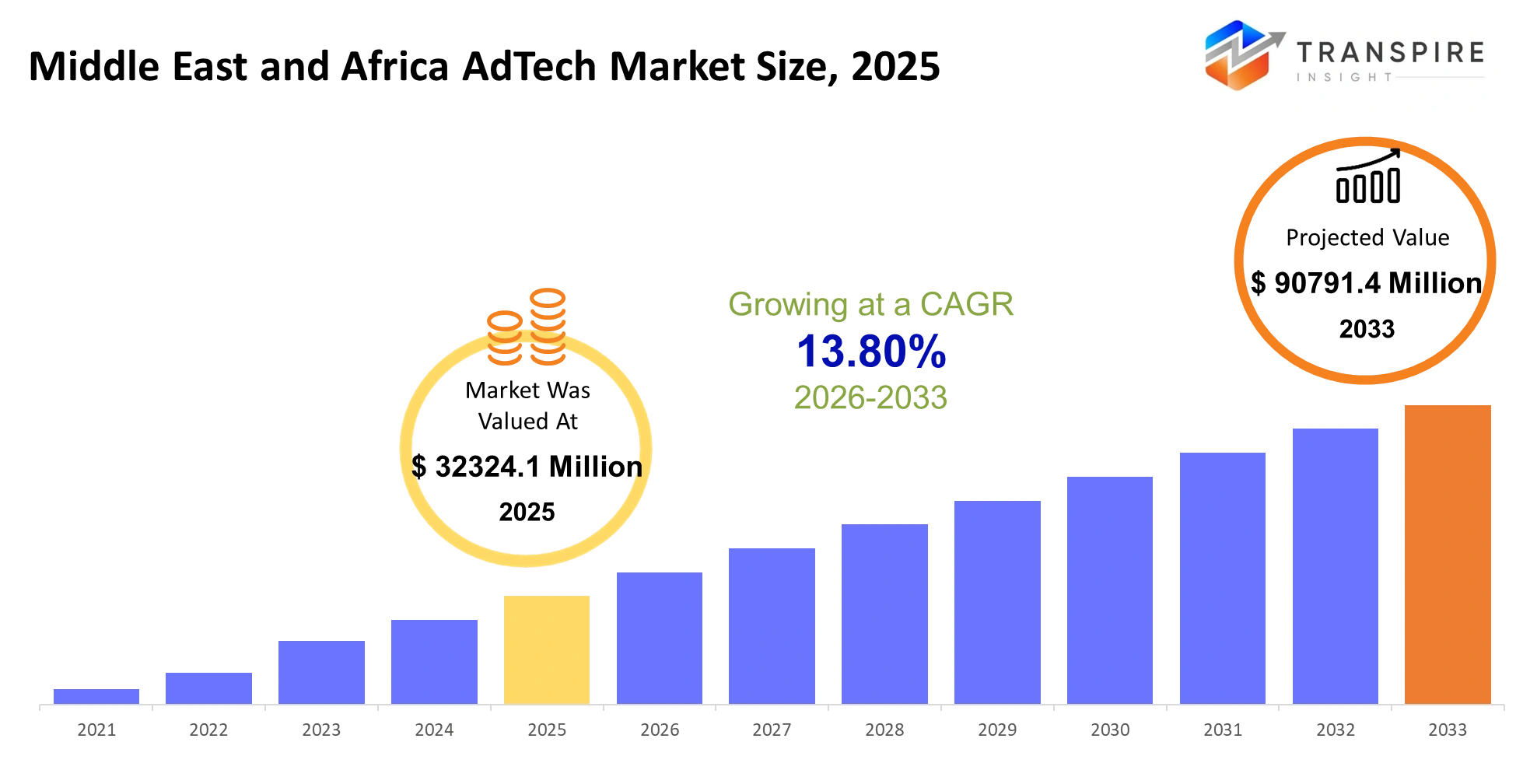
- Middle East and Africa AdTech Market Size 2025: USD 32324.1 Million
- Middle East and Africa AdTech Market Size 2033: USD 90791.4 Million
- Middle East and Africa AdTech Market CAGR: 13.80%
- Middle East and Africa AdTech Market Segments: By Type (Programmatic, Display, Video, Native), By Platform (Mobile, Desktop, CTV, OTT), By End-User (Retail, BFSI, Media, E-commerce).
To learn more about this report,  Download Free Sample Report
Middle East and Africa AdTech Market Summary:
The Middle East and Africa AdTech Market size is estimated at USD 32324.1 Million in 2025 and is anticipated to reach USD 90791.4 Million by 2033, growing at a CAGR of 13.80% from 2026 to 2033. The digital advertising industry shows changing trends in its Middle East and Africa AdTech Market which includes Saudi Arabia, United Arab Emirates, South Africa, and Rest of Middle East and Africa due to mobile-first audience behavior and multilingual content consumption and platform-based media usage. Brands will depend on data signals which are obtained from various business areas where social commerce and video streaming and retail media platforms will meet. The targeting process in Saudi Arabia and the UAE will undergo changes because privacy-focused regulations will be implemented while South African local publishers will increase their use of programmatic advertising. Consumers will expect businesses to deliver messaging that matches their cultural background while providing personalized content at a quick pace. The development of technology will focus on AI-driven campaign management systems while regional regulations will create new standards for responsible data management practices.
Key Market Trends & Insights:
- Mobile behaviors will dictate advertising execution for the whole region, whereby short-form video and in-app engagement will be used in campaign execution. The advertisers within the countries such as Saudi Arabia and the UAE will create ads that cater to the needs of the Arabic speaking population as well as English communication for their expatriate audience.
- There will also be a rise in the use of retail media networks as regional e-commerce sites as well as supermarkets start sharing their ecosystem data to advertisers. This trend provides brand advertisers an opportunity to understand the intention to purchase through their promotions in urban cities where online shopping of groceries is anticipated to be high.
- Artificial intelligence will transform how campaigns work because it will handle three tasks which include media buying and audience segmentation and creative testing.
- Privacy regulations will shape data collection and activation methods across Gulf countries because their privacy regulations keep getting stricter.
Middle East and Africa AdTech Market Segmentation
By Type
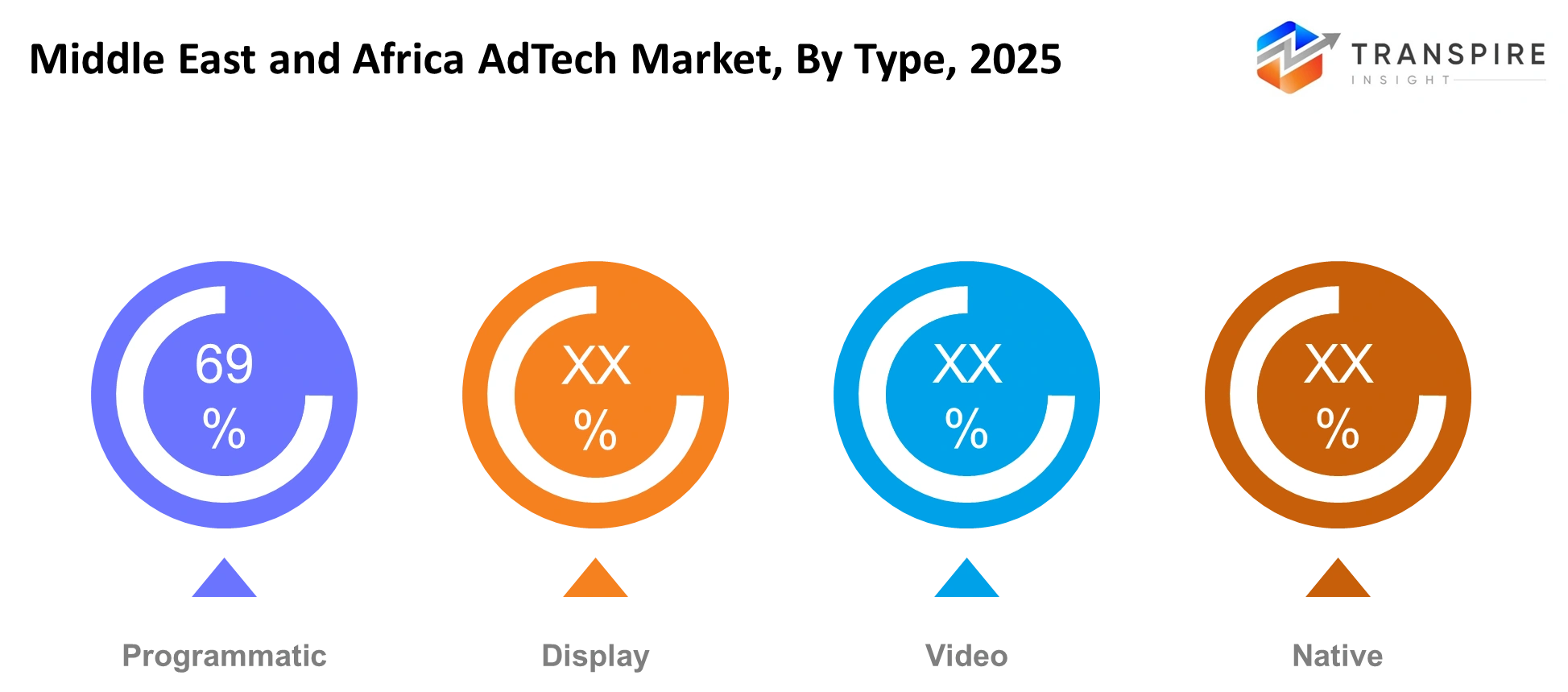
Programmatic- advertising continues to change the process of media inventory buying and selling throughout the entire region. Advertisers will use automated bidding systems to access real-time audience data because digital consumption increases in urban areas. Agencies in the UAE and Saudi Arabia will need advanced demand-side platforms because their clients require exact advertising targets. African markets will start using basic programmatic systems which provide cost-effective solutions but need better infrastructure.
Display- Display advertising will maintain its role as a reliable advertising channel which helps brands build awareness and conduct retargeting operations. The advertising industry will develop new static and rich media formats which meet current demand for faster website loading times and mobile-first browsing patterns. Advertisers choose visual content which connects with local cultural elements and language use. Display formats which use less data will become more essential in areas with different internet speeds because they provide reliable content delivery while maintaining user experience on fast and slow networks.
Video- Video advertising will be the primary method for audience engagement because people choose to watch videos through social media and streaming video services. Short-form video will capture immediate attention, while longer formats will support brand narratives. High smartphone usage in the Middle East will drive premium video viewing, while Africa will require adaptive streaming technology. Advertisers create culturally relevant advertisements which use influencers to establish trust and expand their audience among young people.
Native- The future growth of native advertising is tied to brands looking for smooth integration into content. There will be a reduction in ad fatigue since this type of ad format will merge marketing elements with content that consumers are interested in. Content creators in the area will come up with an approach for creating stories that allow them to incorporate sponsored content in their unique storytelling manner. Marketers will partner with local producers in coming up with effective marketing campaigns.
To learn more about this report, Download Free Sample Report
By Platform
Mobile- The mobile platform will maintain its position as the main platform because people use smartphones for app-based activities. Mobile devices will remain the primary choice for consumers in the Middle East and Africa when they shop, watch entertainment, and communicate with others. Advertisers will create their campaigns to work specifically with vertical screens which will enable fast and interactive local content delivery. The need for data-efficient formats will force brands to improve their performance while creating content in regions where users face high expenses for connectivity.
Desktop- Professional and research environments will continue to use desktop advertising because it remains valuable for professionals who work in finance and B2B service industries. Users will engage with desktop computers more than mobile devices because desktops provide better access to detailed content and users who need to make important decisions. Advertisers will use this platform for in-depth storytelling, product comparisons, and lead generation campaigns. Business hubs which operate in urban areas will use desktop interactions as a key part of their marketing efforts to reach specific audiences.
CTV- Connected TV will become more popular because households are starting to adopt smart televisions and Internet-enabled viewing devices. Advertisers will use CTV as a solution that connects traditional television with digital targeting capabilities which permit advertisement delivery in a high-quality viewing experience. High-speed internet in affluent markets such as the UAE will enable users to watch content without interruptions while other areas will create opportunities for early brand establishment through their progressive internet adoption.
OTT- OTT Services will revolutionize how content is consumed because of the capability of providing instant movie, television series, news, and locally relevant content to consumers. Advertisers will utilize the OTT platform to reach out to customers who do not tune into conventional broadcast TV. The industry will come up with various approaches for branding based on the dual nature of the OTT platform. The audience retention process will be dependent on content from localized libraries, thus forcing advertisers to create ads that fit culture-based narratives.
By End-User
Retail- Retail advertisers will use digital channels to drive their target audience towards making purchases through both online and physical shopping methods. The advertising campaigns will center around three main elements which include local market reach and special offers and seasonal customer demand patterns. Urban areas will see organized retail growth which will lead brands to combine their digital advertising with in-store interactive experiences that use QR codes and location-based messages. The focus of the system will be to deliver a complete customer journey which starts from product discovery and ends at purchase through the use of current data information.
BFSI- Digital advertising will become a tool for the banking and financial services and insurance sector to establish consumer trust while educating them about financial products. The advertising campaigns will showcase three main elements which include security features and transparent operations and personalized product solutions. Advertisers will utilize data-driven insights to identify specific customer segments for their marketing efforts because digital banking adoption continues to grow in the Middle East region. The financial inclusion initiatives in Africa will promote awareness campaigns which will educate people about mobile banking and financial services that are easy to access.
Media- Media firms will utilize advertising technologies to make money through their content while keeping their audiences hooked. Publishers will engage in programmatic sales and subscriptions, in addition to brand content partnerships, because conventional income generation methods cannot sustain them anymore. They will have to balance advertisement frequency with the audience's experience in order to keep them loyal. Media firms based in different regions will further use data analysis to understand the behavior of the audience and create advertisements that cater to them.
E-commerce- E-commerce sites will be at the heart of any digital advertising strategy since they offer a platform for reaching consumers exhibiting buying intentions directly. Firms will leverage sponsored products and ads, recommendations, and performance-based advertising campaigns to convert their leads. The advertising capabilities in the region will grow due to the increase in the number of consumers preferring online shopping. Firms will get accurate audience targeting as a result of using logistic data and browsing behaviors.
Regional Insights
The synergy between the introduction of digital technology by Saudi Arabia and the youth population of this region that uses digital gadgets would shape the future evolution of the region. Advertisers will run campaigns based on Arabic-first content while using globally accepted formats appealing to people who have mixed viewing experiences. Digital transformation initiatives supported by governments will allow local advertising platforms to strengthen their capacity for advertisements. Brands will require to find ways of reaching consumers by creating new messaging strategies as consumers expect personalized advertisements.
In this way, the United Arab Emirates will become a testbed for innovative advertising solutions as well as premium advertising formats. The presence of Internet connectivity and expatriates from different countries would make it necessary to develop advertising campaigns in several languages and target audience segments. Brands would start applying data-enabled storytelling techniques together with interactive video and other formats of engaging content. Advertisers would apply audience insights in line with privacy data regulations that would make it possible for them to strike the right balance between precision targeting and proper data handling.
South Africa will present a distinct environment shaped by economic diversity and varied access to digital infrastructure. Advertisers will create new strategies which will help them reach both high-speed urban users and users who access data at lower speeds in remote areas. Campaign planning will require cost efficiency as the primary factor even though mobile-first engagement will become the main focus of the campaign. Advertisers will find new ways to reach their target audience because local publishers will boost their digital services through trusted content networks which operate in specific regional areas.
The rest of the Middle East and Africa will display a mix of emerging opportunities and uneven digital maturity. The markets of Kenya Nigeria and Egypt will see increased online activity because affordable smartphones and better internet access become more accessible. Advertisers need to develop flexible advertising strategies which will help them solve both infrastructure problems and cultural differences in different regions. Brands need to establish local platform and creator partnerships to build market trust and deliver authentic brand messages in each target market.
Recent Development News
In December 2025, Influencer and Video Advertising Surge Across MENA. Influencer-led campaigns will continue to dominate regional strategies, with spending projected to reach $703 million in 2025, driven largely by Saudi Arabia and the UAE. Video advertising will also expand significantly, expected to hit $2.8 billion, supported by mobile-first consumption. Social media advertising expenditure will rise to $4.26 billion, reflecting strong engagement on platforms like TikTok and YouTube, where short-form content will shape advertiser priorities.
In April 2026, the expansion of Digital Agency Ecosystems in the Middle East. The Middle East advertising landscape is witnessing structural shifts with the launch of a regional alliance of independent agencies, starting with 25 founding members. The broader agency market was valued at $8.18 billion in 2025 and is projected to reach $10.76 billion by 2031. Digital-first agencies already account for nearly half of total revenues, signaling a strong transition toward data-driven and technology-enabled advertising models across the region.
|
Report Metrics |
Details |
|
Market size value in 2025 |
USD 32324.1 Million |
|
Market size value in 2026 |
USD 36721.7 Million |
|
Revenue forecast in 2033 |
USD 90791.4 Million |
|
Growth rate |
CAGR of 13.80% from 2026 to 2033 |
|
Base year |
2025 |
|
Historical data |
2021 – 2024 |
|
Forecast period |
2026 – 2033 |
|
Report coverage |
Revenue forecast, competitive landscape, growth factors, and trends |
|
Country scope |
Middle East and Africa (Saudi Arabia, United Arab Emirates, South Africa, Rest of Middle East and Africa) |
|
Key company profiled |
Google, Meta, Amazon, Adobe, Oracle, Salesforce, The Trade Desk, PubMatic, Criteo, AppNexus, Magnite, MediaMath, Verizon Media, Taboola, Outbrain. |
|
Customization scope |
Free report customization (country, regional & segment scope). Avail customized purchase options to meet your exact research needs. |
|
Report Segmentation |
By Type (Programmatic, Display, Video, Native), By Platform (Mobile, Desktop, CTV, OTT), By End-User (Retail, BFSI, Media, E-commerce). |
Key Middle East and Africa AdTech Market Company Insights
The AdTech Market in the Middle East and Africa which includes Saudi Arabia United Arab Emirates South Africa and the Rest of Middle East and Africa market consists of global technology companies and new local businesses that will change digital advertising operations. The companies Alphabet Amazon Adobe and The Trade Desk will maintain their market leadership through their AI-based targeting systems and unified product offerings while TA Telecom and Zamakan will develop their services based on local data and community-specific marketing strategies. The growth of programmatic ecosystems will increase the significance of companies that provide analytics and attribution and automation services because advertisers are now using first-party data methods. The advertising market will benefit from global platforms working with local agencies because this partnership allows efficient advertising methods that suit specific regional needs in various markets.
Company List
- Meta
- Amazon
- Adobe
- Oracle
- Salesforce
- The Trade Desk
- PubMatic
- Criteo
- AppNexus
- Magnite
- MediaMath
- Verizon Media
- Taboola
- Outbrain
Middle East and Africa AdTech Market Report Segmentation
By Type
- Programmatic
- Display
- Video
- Native
By Platform
- Mobile
- Desktop
- CTV
- OTT)
By End-User
- Retail
- BFSI
- Media
- E-commerce
Frequently Asked Questions
Find quick answers to common questions.
The approximate Middle East and Africa AdTech Market size for the market will be USD 90791.4 Million in 2033.
Key segments for the Middle East and Africa AdTech Market By Type (Programmatic, Display, Video, Native), By Platform (Mobile, Desktop, CTV, OTT), By End-User (Retail, BFSI, Media, E-commerce).
Major players in the Middle East and Africa AdTech Market are Google, Meta, Amazon, Adobe, Oracle, Salesforce, The Trade Desk, PubMatic, Criteo, AppNexus, Magnite, MediaMath, Verizon Media, Taboola, Outbrain.
The Middle East and Africa AdTech Market size is USD 32324.1 Million in 2025.
The Middle East and Africa AdTech Market CAGR is 13.80%.
- Meta
- Amazon
- Adobe
- Oracle
- Salesforce
- The Trade Desk
- PubMatic
- Criteo
- AppNexus
- Magnite
- MediaMath
- Verizon Media
- Taboola
- Outbrain
Recently Published Reports
-
Dec 2024
3D Optical Profiler Market
3D Optical Profiler Market Size, Share & Analysis Report By Type (Desktop 3D Optical Profiler, and Portable 3D Optical Profiler), By Technology (Confocal Technology, and White Light Interference), By End-Use Industry (Manufacturing, Research Institutions, Automotive, Aerospace and Defense, Medical Devices, and Other), and Geography (North America, Europe, Asia-Pacific, Middle East and Africa, South and Central America), 2021 - 2031
-
Feb 2025
Depth Sensor Market
Depth Sensor Market Size, Share & Analysis Report By Type (Infrared Depth Sensors, Time-of-Flight (ToF) Sensors, Stereo Vision Sensors, Structured Light Sensors, Ultrasonic Depth Sensors), By Application (Automotive, Robotics, Gaming, Consumer Electronics, Industrial Automation, Healthcare, Security & Surveillance, Others), By End Users (Automotive Manufacturers, Consumer Electronics Companies, Healthcare Providers, Industrial Companies, Security Agencies, Gaming Companies, Robotics Companies, Others), and Geography (North America, Europe, Asia-Pacific, Middle East and Africa, South and Central America), 2021 – 2031
-
Feb 2025
Digital Manufacturing Market
Digital Manufacturing Market Size, Share & Analysis Report By Component (Hardware, Software, and Services), By Technology (Robotics, 3D Printing, Internet of Things (IoT), and Others), By Application (Automotive and Transportation, Aerospace and Defense, Consumer Electronics, Industrial Machinery, and Others), By Process Type (Computer-Based Designing, Computer-Based Simulation, Computer 3D Visualization, Analytics, and Others), and Geography (North America, Europe, Asia-Pacific, Middle East and Africa, South and Central America), 2021 – 2031
-
Feb 2025
Digital Visa Services Market
Digital Visa Services Market Size, Share & Analysis Report By Type (Individual Travelers, Group Travelers), By Application (Tourism, Business Travel, Others), and Geography (North America, Europe, Asia-Pacific, Middle East and Africa, South and Central America), 2021 – 2031