

Methyl Methacrylate Adhesives (MMA) Market Summary:
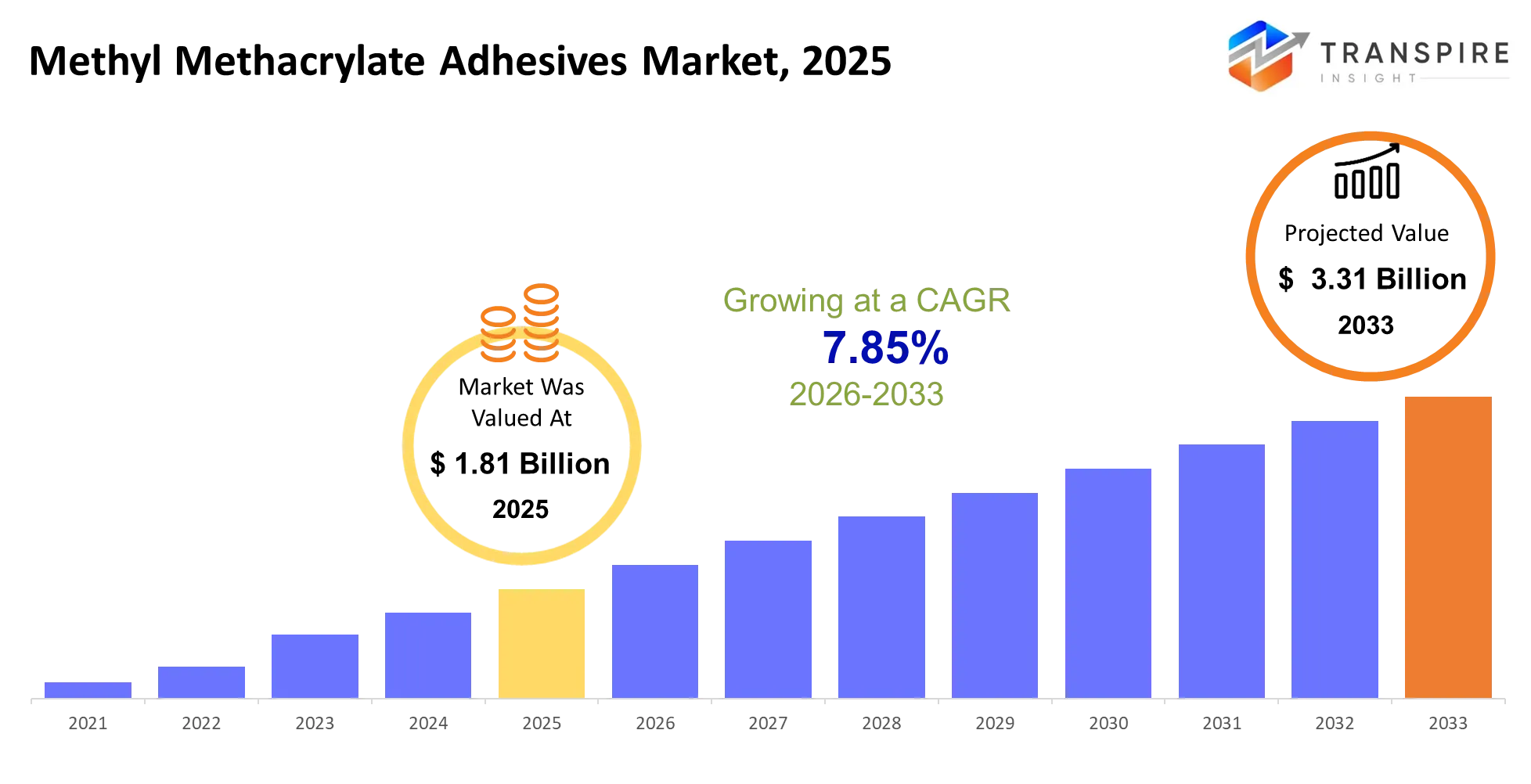
As per Transpire Insight Analysis, the Methyl Methacrylate Adhesives (MMA) Market size is estimated at USD 1.81 billion in 2025 and is anticipated to reach USD 3.31 billion by 2033, growing at a CAGR of 7.85% from 2026 to 2033.
The methyl methacrylate adhesives (MMA) market is changing fast. People in vehicles, composites, construction and industrial assembly want stronger bonding. In the next three to five years, more and more companies have moved away from old mechanical fasteners like bolts and rivets. Instead, they’re using adhesives. These adhesives can stick materials together, like metal and plastic, without needing a lot of prep work on the surfaces. A big reason for this shift is the growing use of composites and plastics. These materials are especially popular in transportation and wind energy parts. They help reduce weight and improve efficiency. At the same time, factories are getting more automated. Assembly lines are moving quicker. So adhesives that cure at room temperature and get strong fast are more valuable. They don’t need heat or long wait times. One key reason for the rise in MMA adhesives is the increase in manufacturing that uses a lot of composites. In those cases, welding or riveting can add weight and steps. That slows things down. MMA adhesives solve that problem. They bond parts quickly and securely. This helps cut down assembly time. Also, since MMA adhesives stick to metals, plastics and composites, parts can be glued together instead of being fastened. That’s helping the market grow.
Methyl Methacrylate Adhesives (MMA) Market Size & Forecast:
- Market Size 2025: USD 1.81 Billion
- Expected Market Value (2033): USD 3.31 Billion
- Forecast CAGR (2026-2033): 7.85%
- Leading Region in 2025: North America
- Fastest Growing Region: Asia Pacific
- Key Company Profiles: 3M, Arkema, LORD Corporation, Scott Bader, Henkel, Sika, H.B. Fuller, ITW, Permabond, Parson Adhesives, Plexus, Huntsman, Dow, Bostik, Uniseal
Key Market Insights:
The market is moving forward with lightweight manufacturing, faster assembly and greater structural bonding. MMA two-part is the largest market segment, but wind energy and composite bonding are presenting new growth possibilities.
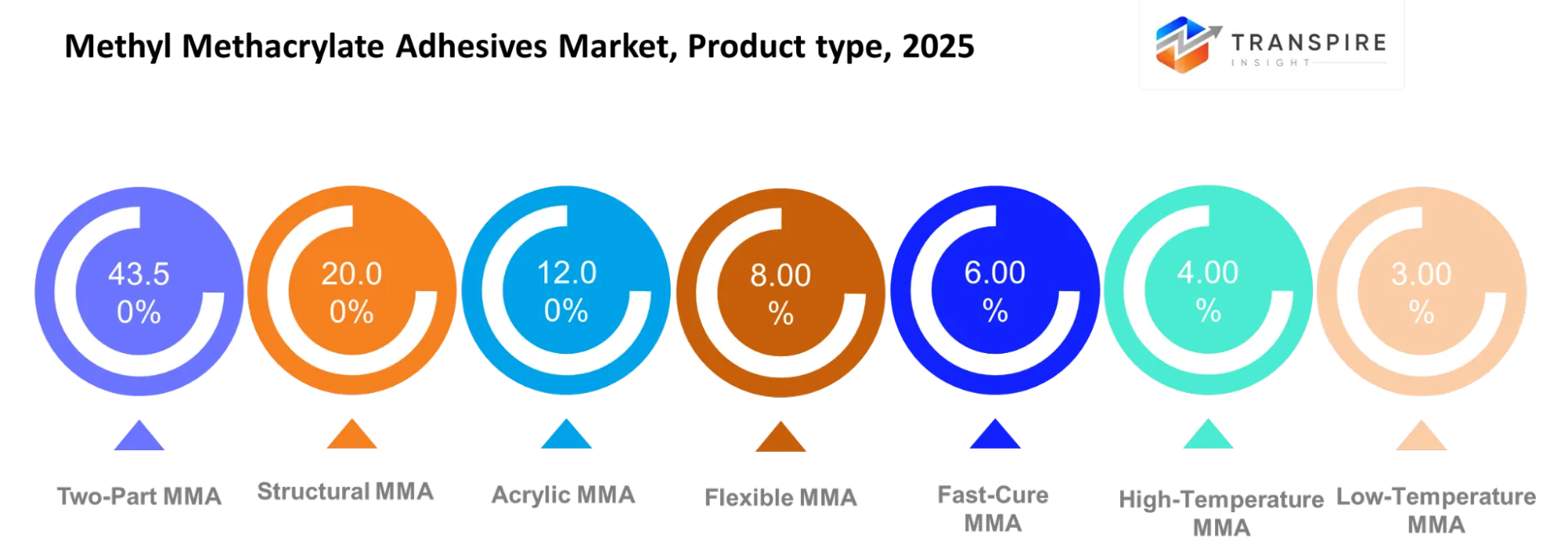
- The Two-Part MMA category accounted for 43.50% of the market, backed by the efforts of manufacturers like Sika in developing two-part MMA systems offering fast strength and adhesion development on different substrates.
- The structural MMA category comprised 20.00%, driven by the trend of adhesive bonding in transportation and industrial assemblies where manufacturers were looking for alternatives to welding and riveting.
- Acrylic MMA accounted for 12.00%, while manufacturers like ITW Performance Polymers were concentrating on the broad substrate compatibility and reduced odour, along with ease of processing, in their Plexus adhesives range.
- Flexible MMA was 8.00%, meeting the rising demand for adhesives suitable for vibration, impact, and movement resistance in composite and transportation assemblies.
- The Fast-Cure MMA accounted for 6.00%, gaining from the behaviour of manufacturers favouring short fixture time and high production throughput.
- The ITW's Plexus adhesives range concentrated on fast room-temperature curing and production efficiency.
- The high-temperature MMA category consisted of 4.00%, leaving space for high-temperature and longer life cycle resistant formulations.
What are the Key Drivers, Restraints, and Opportunities in the Methyl Methacrylate Adhesives (MMA) Market?
Drivers
The development of growth is fueled by the trend towards lightweight composite assemblies in transport applications, wind energy products and industrial applications. MMA adhesives will bond different materials together without the need to drill holes, use rivets or perform extensive surface treatment. This will help save assembly time and increase production capacity. This is most applicable in cases where structural bonding replaces mechanical fastening.
Restraints
The costs, odour, handling, and the necessity to manage mixing ratios restraints the acceptance of MMA in some uses. This is because advanced MMA solutions need an exact chemistry formula, precision dispensing equipment, and proper working conditions. Small companies are thus likely to put off adopting the technology if their current fastening techniques work well within their manufacturing processes.
Opportunities
There is an opportunity to produce application-specific formulations of MMA for composites, electric vehicle parts, wind power components, and assembly lines. Research and development efforts are geared towards ease of dispensing, reduced odour, quick fixture time, and substrate flexibility. Development time can be cut down through digital formulation solutions and localised application engineering centres to tailor products according to regional requirements. This means that suppliers will produce more valuable formulations, a wider product range, and more options to address assembly-specific needs of new manufacturing centres around the world.
What Has the Impact of Artificial Intelligence Been on the Methyl Methacrylate Adhesives (MMA) Market?
Artificial intelligence is increasingly starting to affect the methyl methacrylate adhesives industry by means of formulation development, material simulation, and process optimisation, and not by means of the chemical composition of the adhesive. Manufacturers can build digital models based on datasets to compare the properties of formulations and estimate their performance, thereby reducing the number of physical tests needed in developing the product. The other benefit is that AI-enabled analysis can help to identify the proper materials and optimise the dispensing parameters while predicting potential performance issues before going into production. The advantage is a faster design-validation process and more efficient usage of the lab resources. However, there are factors such as the availability of quality data, data integration with the existing CAE systems, and the expenses involved in building the digital model that affect adoption.
Instance
In April 2026, the company Henkel introduced LOCTITE SOLVE, an AI-based platform that simulates digital models of adhesive formulations and their properties such as strength and thermal properties. The technology reduces physical testing and speeds up the process of formulating adhesives.https://www.henkel.com/press-and-media/press-releases-and-kits/2026-04-15-henkel-launches-loctite-solve-to-enable-fast-flexible-and-ai-assisted-simulation-of-adhesive-performance-2148956
Key Market Trends:
The market for adhesives in the MMA industry will move away from general-purpose bonding applications toward more specialized applications designed for speed, toughness, and multicomponent assemblies.
- Product development trends towards faster fixture times as manufacturers strive to increase production volume without necessitating extra assembly steps.
- The transport industry is turning to adhesive bonding in addition to or even instead of mechanical fastening due to the increasing prevalence of lightweight materials
- Composite manufacturing is leading to greater application of MMA in structures since adhesives can spread out stresses on bonded parts instead of concentrating it around mechanical fasteners.
- Adhesive manufacturers are focusing more on odour-free and easy-to-handle formulations due to workplace and manufacturing considerations.
- Application engineering is becoming increasingly significant as more customers demand formulation assistance in selecting substrates and joint types for their manufacturing operations.
Methyl Methacrylate Adhesives (MMA) Market Segmentation
By product type
Two-Part MMA has the largest market share, accounting for 43.50%, followed by Structural MMA with 20.00%, Acrylic MMA at 12.00%, Flexible MMA at 8.00%, Fast Cure MMA at 6.00%, High Temperature MMA at 4.00%, Low Temperature MMA at 3.00% and Other MMA products at 3.50%. The prominence of two-part systems is due to their capability to offer structural bonding while having a convenient manufacturing process. Structural and fast-curing systems will probably receive more interest from manufacturers due to efficiency and mixed material usage.
By Application
the market includes applications in automotive, transport, construction, marine, wind energy, electronics, industrial equipment and sports equipment segments. The applications in automotive and transport sectors derive advantages from the use of MMA adhesives as it helps in bonding metals, plastics, and composites besides being suitable for lightweight constructions. The application segment that represents the fastest-growing segment among the provided data is that of wind energy and composites at a CAGR of 8.20%.
by Substrate
MMA adhesives find applications in metals, plastics, composites, glass, rubber, wood, and ceramics. Metals and composites are still significant as they help in designing systems for bonding different materials without depending solely on mechanical fastening. Plastics and composites provide scope for growth in the future as there is increased usage of light and composite materials in the manufacturing process.
By curing type
The market contains room temperature, heat cure, UV assisted, fast cure, low temperature, moisture assisted and hybrid cure types. Room temperature and fast cure types are especially applicable for production processes where manufacturers aim to decrease waiting time between bonding and the next assembly step. Hybrid and other special curing technologies can solve cases when traditional curing conditions are hard to provide.
By end user
the market provides services to automotive OEMs, construction firms, industrial manufacturers, marine manufacturers, aerospace companies, electronic manufacturers and wind turbine manufacturers. Automotive and industrial manufacturers need a combination of high strength, fast curing and the ability to bond with different substrates. Growth potential lies in the work of wind turbine manufacturers, which need reliable bonding for composite-intensive parts. The growth of lightweight transportation and renewable energy machinery should create special demands.
By distribution
MMA adhesives are available to customers through direct selling, distributors, speciality dealers, online platforms, OEMs, and industrial distributors. Direct selling and OEMs are crucial when customers need technical advice and assistance, product verification, and customised product formulations. The distributors and speciality dealers offer wider market access, especially for small-scale industrial customers. Online platforms may help with product discovery, while OEMs may help adhesive companies be involved in the design of the components.
What are the Key Use Cases Driving the Methyl Methacrylate Adhesives (MMA) Market?
MMA two-part adhesives are a key use case, as they provide robust bonding for composite substrates in automotive, construction and general industry assembly applications. The fact that these materials cure at room temperature also enables rapid manufacturing without complex heat treatment processes. Areas of increasing application include the wind energy industry and composite bonding, which allows for joining large composite structures by distributing loads in the joint. Structural adhesives are also used in transportation manufacturing to reduce the need for welding, riveting and other fastening methods. Potential future uses will include lightweight electric vehicle parts, electronics assembly and marine and sports equipment. These applications necessitate formulations that feature fast cure, flexibility, shock resistance and adhesion to plastic and composite substrates.
|
Report Metrics |
Details |
|
Market size value in 2025 |
USD 1.81 Billion |
|
Market size value in 2026 |
USD 1.95 Billion |
|
Revenue forecast in 2033 |
USD 3.31 Billion |
|
Growth rate |
CAGR of 7.85% from 2026 to 2033 |
|
Base year |
2025 |
|
Historical data |
2021 - 2024 |
|
Forecast period |
2026 - 2033 |
|
Report coverage |
Revenue forecast, competitive landscape, growth factors, and trends |
|
Regional scope |
United States; Canada; Mexico; United Kingdom; Germany; France; Italy; Spain; Denmark; Sweden; Norway; China; Japan; India; Australia; South Korea; Thailand; Brazil; Argentina; South Africa; Saudi Arabia; United Arab Emirates |
|
Key company profiled |
3M, Arkema, LORD Corporation, Scott Bader, Henkel, Sika, H.B. Fuller, ITW, Permabond, Parson Adhesives, Plexus, Huntsman, Dow, Bostik, Uniseal |
|
Customization scope |
Free report customization (country, regional & segment scope). Avail customized purchase options to meet your exact research needs. |
|
Report Segmentation |
Product Type (Two-Part MMA, Structural MMA, Acrylic MMA, Flexible MMA, Fast-Cure MMA, High-Temperature MMA, Low-Temperature MMA); Application (Automotive, Transportation, Construction, Marine, Wind Energy, Electronics, General Industrial, Sports Equipment); Substrate (Metals, Plastics, Composites, Glass, Rubber, Wood, Ceramics); Curing Type (Room Temperature, Heat Cure, UV-Assisted, Fast Cure, Low-Temperature Cure, Moisture-Assisted, Hybrid Cure); End User (Automotive OEMs, Construction Companies, Industrial Manufacturers, Marine Manufacturers, Aerospace Companies, Electronics Manufacturers, Wind Turbine Manufacturers); Distribution (Direct Sales, Distributors, Specialty Dealers, Online Channels, OEM Partnerships, Industrial Suppliers) |
Which Regions are Driving the Methyl Methacrylate Adhesives (MMA) Market Growth?
North America
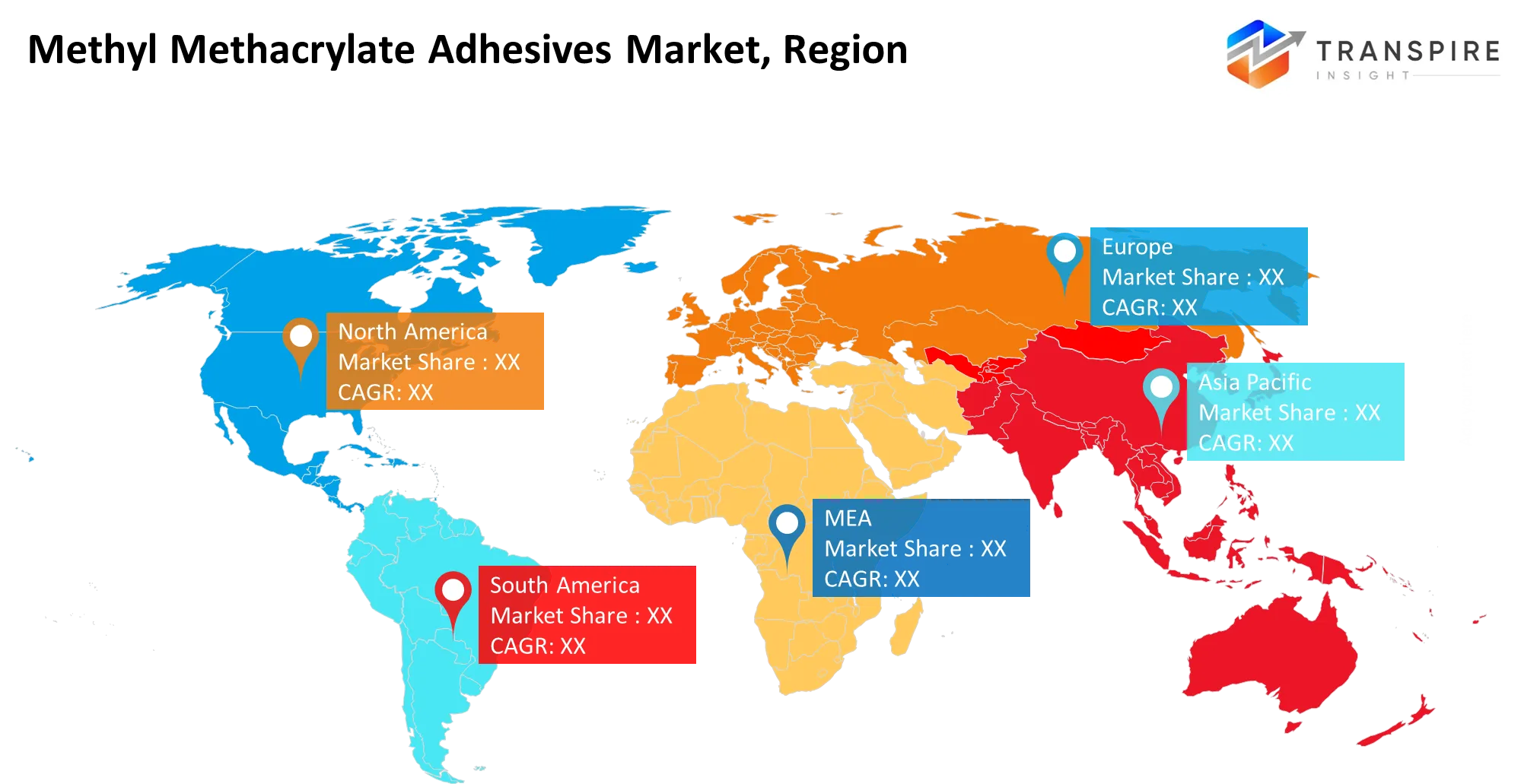
The North American region holds the largest market share of 35.70%. This is because the region already has existing capabilities for automotive, transport, industrial, and composites manufacturing. The region also has an existing ecosystem of adhesive suppliers and OEM customers that will enable the uptake of structural bonding technology. The demand for lightweight assembly and efficient joining systems will drive the use of MMA adhesives.
In March 2026, IMCD extended its distribution collaboration with Evonik in supplying VISIOMER speciality methacrylates in the United States. These methacrylates are useful in the manufacture of adhesives and sealants, thereby expanding access to methacrylate resins for downstream applications in the North American market.https://www.ascouncil.org/news/imcd-expands-distribution-of-evonik-methacrylates-in-the-us
Europe
The European region accounts for 29.00% of the total market. This is because the region has an existing capability in automotive, aerospace, marine, and industrial manufacturing. As compared to the North American region, the European region's market has close ties with engineering, lightweight vehicles, and sustainable manufacturing. The existing industrial base in the region will provide stability for the adoption of structural adhesives.
In March 2026, Integra Adhesives announced the Horizon™ two-part methacrylate adhesive product line that will serve the purpose of interior and exterior surface fabrication applications in Europe. This highlights the launch of new methacrylate adhesives with superior performance in tough environmental conditions in the European region.https://integra-adhesives.co.uk/news/category/news/
Asia Pacific
Asia Pacific constitutes 25.00% of the region and is referred to as the fastest-growing regional market with a CAGR of 7.90%. New uses of structural adhesives arise due to the expansion of automotive, electronics, renewable energy production, and manufacturing industries in Asia Pacific. Localisation of adhesive technology and application engineering has made it easier for suppliers to reach their clients in the regional market.
In March 2026, Henkel inaugurated a new customer application centre in Bengaluru, India, dedicated to the development of next-generation adhesive solutions for electronics production. Applications include 5G technology infrastructure, data centres, EV systems, industrial automation, and medical electronics, highlighting growing demand for adhesives in the Asia-Pacific region.https://www.henkel.com/press-and-media/press-releases-and-kits/2026-03-24-henkel-launches-advanced-customer-application-center-for-electronics-solutions-in-india-2135888
Who are the Key Players in the Methyl Methacrylate Adhesives (MMA) Market and how do they compete?
In the world MMA adhesives market, competition exists on product formulation, applicability to certain substrates, cure rates, support and ability to provide for huge industrial customers. Increasingly, companies differentiate themselves through application engineering, customisation, and solutions that lower assembly time but do not engage in pricing of products. Henkel offers a wide portfolio of adhesives and also digital engineering together with regional application engineering support. Its strategy includes AI-supported simulation, development of technical capacity in Asia Pacific and development of mobility, electronics and industrial solutions. Thus, the company distinguishes itself by early design support and local engineering capacities.ITW Performance Polymers, with the help of the Plexus brand, competes with high-performance MMA systems in terms of composites, metals and thermoplastics. Its distinguishing factors are fast cure, universal substrate compatibility, and special product formulations for easier application. The company offers the Plexus brand line of structural adhesives for composite and transportation applications.
Methyl Methacrylate Adhesives (MMA) Market companies
- 3M
- Arkema
- LORD Corporation
- Scott Bader
- Henkel
- Sika
- H.B. Fuller
- ITW
- Permabond
- Parson Adhesives
- Plexus
- Huntsman
- Dow
- Bostik
- Uniseal
Recent Development News
In February 2026, Sika announced the signing of a deal to buy Akkim, an adhesives and sealants producer in Turkey. The move is meant to increase Sika's geographical footprint and production capacity in adhesives and sealants.https://www.sika.com/en/media/media-releases/2026/sika-to-acquire-akkim.html
In March 2025, Henkel announced a new Application Engineering Centre in Chennai and also plans to set up an adhesive-materials manufacturing plant near Pune, India, for the electronics industry.https://www.henkel.com/press-and-media/press-releases-and-kits/2025-02-27-henkel-strengthens-its-electronics-footprint-in-india-2041890
What Strategic Insights Define the Future of the Methyl Methacrylate Adhesives (MMA) Market?
The international MMA adhesive market is shifting towards high-performance, lightweight, and application-oriented bonding materials, especially since automobile, transport, composite, construction, and renewable energy industries are incorporating mixed material designs. Quick-curing, durable, low-odour, and low-emission MMA adhesives could be expected in future product development. Fortune Business Insights. A hidden threat would be the instability in raw materials and the supply chain that can increase production costs and pose uncertainty to adhesive manufacturers and consumers. S&P . An emerging opportunity would be in the field of advanced composite bonding, where MMA adhesives can help create lightweight structures without depending on mechanical bonding. Mordor Intelligence. From a strategic point of view, manufacturers should focus on low-emission, reliable raw materials, quick-curing technologies, application-oriented adhesives, and partnerships with OEMs to guarantee long-term demand. Fortune Business Insights
Product Type
- Two-Part MMA
- Structural MMA
- Acrylic MMA
- Flexible MMA
- Fast-Cure MMA
- High-Temperature MMA
- Low-Temperature MMA
Application
- Automotive
- Transportation
- Construction
- Marine
- Wind Energy
- Electronics
- General Industrial
- Sports Equipment
Substrate
- Metals
- Plastics
- Composites
- Glass
- Rubber
- Wood
- Ceramics
Curing Type
- Room Temperature
- Heat Cure
- UV-Assisted
- Fast Cure
- Low-Temperature Cure
- Moisture-Assisted
- Hybrid Cure
End User
- Automotive OEMs
- Construction Companies
- Industrial Manufacturers
- Marine Manufacturers
- Aerospace Companies
- Electronics Manufacturers
- Wind Turbine Manufacturers
Distribution
- Direct Sales
- Distributors
- Specialty Dealers
- Online Channels
- OEM Partnerships
- Industrial Suppliers
By Regional Analysis
North America
- US
- Canada
- Mexico
Europe
- Germany
- UK
- France
- Italy
- Spain
- Russia
- Rest of Europe
Asia Pacific
- China
- Japan
- India
- South Korea
- Australia
- Rest of Asia Pacific
South America
- Brazil
- Argentina
- Rest of South America
Middle East & Africa
- UAE
- Saudi Arabia
- Qatar
- South Africa
- Rest of the Middle East & Africa
Frequently Asked Questions
Find quick answers to common questions.
The methyl methacrylate adhesives (MMA) market size was valued at USD 1.81 billion in 2025 and is poised to reach USD 3.31 billion by 2033, expanding at a 7.85% CAGR.
Key segments for the methyl methacrylate adhesives (MMA) market are Product Type (Two-Part MMA, Structural MMA, Acrylic MMA, Flexible MMA, Fast-Cure MMA, High-Temperature MMA, Low-Temperature MMA); Application (Automotive, Transportation, Construction, Marine, Wind Energy, Electronics, General Industrial, Sports Equipment); Substrate (Metals, Plastics, Composites, Glass, Rubber, Wood, Ceramics); Curing Type (Room Temperature, Heat Cure, UV-Assisted, Fast Cure, Low-Temperature Cure, Moisture-Assisted, Hybrid Cure); End User (Automotive OEMs, Construction Companies, Industrial Manufacturers, Marine Manufacturers, Aerospace Companies, Electronics Manufacturers, Wind Turbine Manufacturers); Distribution (Direct Sales, Distributors, Specialty Dealers, Online Channels, OEM Partnerships, Industrial Suppliers)
Growth is primarily driven by increased usage of strong and light bonding, increased use of MMA-based adhesives in automobiles and transportation industry, increased construction and wind energy activities and requirement of fast curing and durable adhesive.
The market is led by major manufacturers including 3M, Arkema, LORD Corporation, Scott Bader, Henkel, Sika, H.B. Fuller, ITW, Permabond, Parson Adhesives, Plexus, Huntsman, Dow, Bostik, and Uniseal
North America has a market share of 35.70% of the worldwide market for methyl methacrylate (MMA) adhesives. This is due to high demand for the adhesive in the automotive, construction, transportation, marine, and industrial segments owing to sophisticated manufacturing processes and innovations in adhesive technology.
The commercial opportunities of the MMA adhesives market in the world comprise increased usage of MMA adhesives in automotive applications, increasing usage of MMA adhesives in the wind energy and construction sector, growing adoption of lightweight composites, and the introduction of fast-curing and high-performance MMA adhesives.
- 3M
- Arkema
- LORD Corporation
- Scott Bader
- Henkel
- Sika
- H.B. Fuller
- ITW
- Permabond
- Parson Adhesives
- Plexus
- Huntsman
- Dow
- Bostik
- Uniseal
About the Authors

Pankaj Ghogare Patil
I am Pankaj Ghogare Patil, a Senior Research Analyst at Transpire Insight, specializing in the Pharmaceutical, Chemicals & Materials, Healthcare IT, and Biotechnology industry. My expertise lies in conducting comprehensive market research, analyzing industry trends, evaluating competitive landscapes, and translating complex data into actionable insights. At Transpire Insight, I closely follow emerging technologies, regulatory developments, and market innovations to create accurate, well-researched, and informative content that helps businesses and professionals make informed decisions. I am committed to producing credible, evidence-based articles that reflect industry best practices while making technical topics accessible and valuable for a broad audience.

Chakradhar Khansole
Chakradhar serves as the Research Director at Transpire Insight, bringing over 8 years of experience in technology, innovation, and strategic market intelligence. He specializes in transforming complex market data into actionable business insights that enable organizations to make informed, growth-oriented decisions. Recognized for his strategic vision and analytical expertise, Chakradhar leads high-impact research initiatives, delivering comprehensive market assessments, competitive intelligence, and forward-looking industry analysis.
Recently Published Reports
-
May 2026
Healthcare Polymer Packaging Market
Healthcare Polymer Packaging Market Size, Share & Analysis Report By Packaging Type (Syringes, IV Bottles and Pouches, Clamshells, Blisters, Bottles & Jars, Containers, Tubes, IV Parental Packaging, Others), By Type (Regulated, Non-regulated), By Polymer Type (LDPE (Low-Density Polyethylene), HDPE (High-Density Polyethylene), Homo-polymer (Homo), Random Copolymer (Random), Block Copolymer (Block), PET, Polystyrene, Polyvinyl Chloride, Polyamide/EVOH, Others), and Geography (North America, Europe, Asia-Pacific, Middle East and Africa, South and Central America), 2021 - 2031
-
Apr 2026
Hydrophilic Tape (Waterstop) Market
Hydrophilic Tape (Waterstop) Market Size, Share & Analysis Report By Type (Bentonite-Based Hydrophilic Tape, Rubber-Based Hydrophilic Tape), By Application (Residential Buildings, Commercial Buildings, Infrastructure Projects), and Geography (North America, Europe, Asia-Pacific, Middle East and Africa, South and Central America), 2021 - 2031
-
Apr 2026
Metalens Market
Metalens Market Size, Share & Analysis Report By Type (Visible Light Metalens, and Infrared Metalens), By Application (Consumer Electronics, Automotive Electronics, Industrial, Medical, and Others), and Geography (North America, Europe, Asia-Pacific, Middle East and Africa, South and Central America), 2021 - 2031
-
Apr 2026
PBT Resin Market
PBT Resin Market Size, Share & Analysis Report By Type (Reinforced PBT Resin, Unreinforced PBT Resin), By Processing Method (Injection Molding, Extrusion, Blow Molding, Others), By End-User (Automotive, Electrical & Electronics, Consumer Appliances, Industrial Machinery, Medical Devices, Packaging, Others), and Geography (North America, Europe, Asia-Pacific, Middle East and Africa, South and Central America), 2021 - 2031