

Managed Information Services Market Summary:
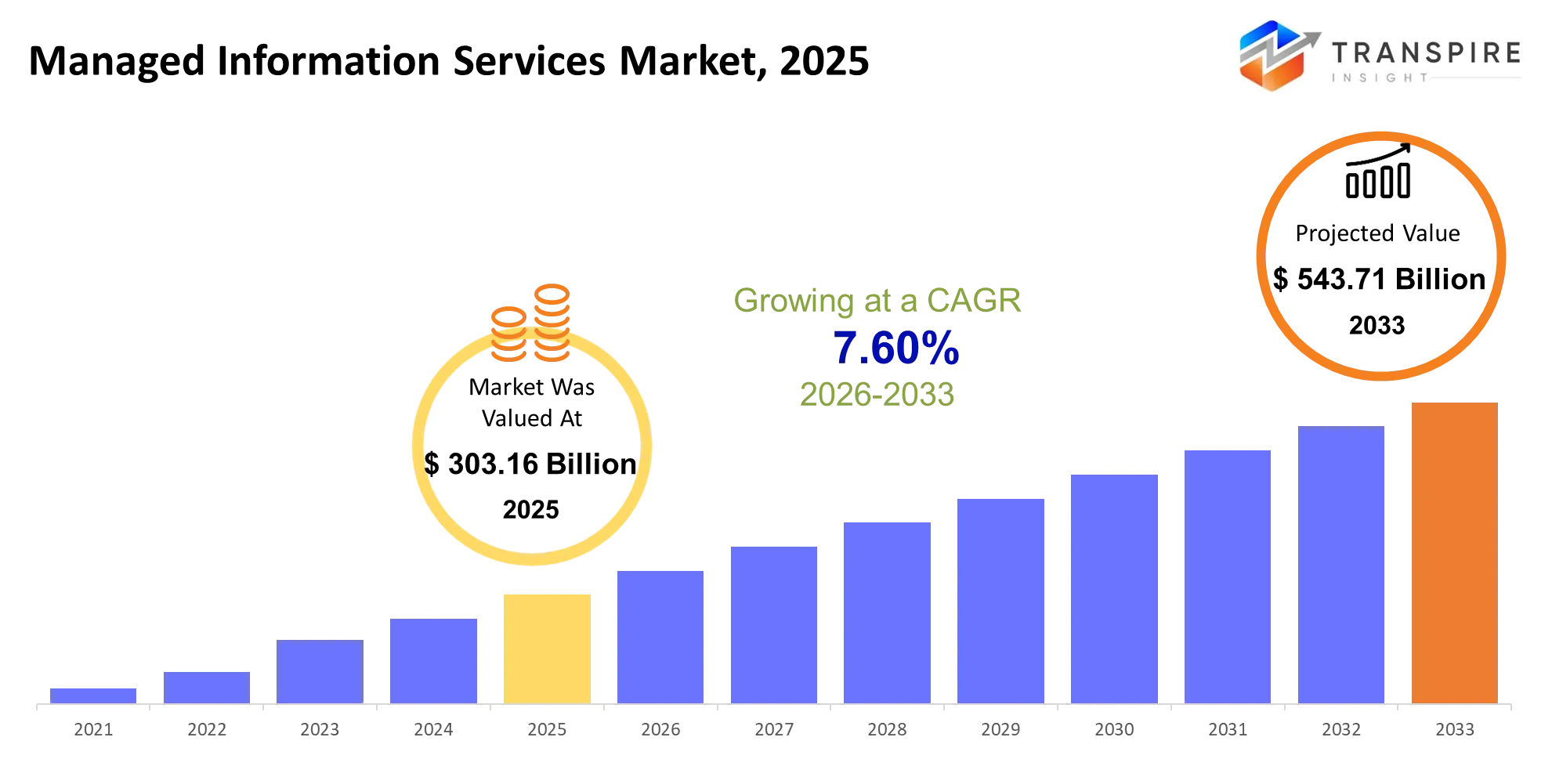
As per Transpire Insight, The Managed Information Services Market size is estimated at USD 303.16 billion in 2025 and is anticipated to reach USD 543.71 billion by 2033, growing at a CAGR of 7.60% from 2026 to 2033.
The managed-information services providers are now increasingly also managing the operation of enterprise information technology. They manage infrastructure, network, applications, data, security, and the workplace, providing cloud, edge, and on-premises environments. In the past three to five years, the model has migrated from a cost-out outsourcing to a continuous day-to-day operation of a technology ecosystem - including cloud migration, zero-trust security, and automation - embedded within service agreements. The structural change is to a hybrid and multi-cloud operating model that requires a single provider to orchestrate the disjointed environments. The business-driven catalyst for this shift has been the re-platforming of modern enterprise workloads and the impact of cyber threats, which drives organisations to improve monitoring and resilience. Management of this opens a direct growth curve: as technology complexity increases, the quantity of systems to oversee grows, while skills shortages and public accountability for security make externally administered expertise more cost-effective.
Managed Information Services Market Size & Forecast:
- Market Size 2025: USD 303.16 Billion
- Expected Market Value (2033): USD 543.71 Billion
- Forecast CAGR (2026-2033): 7.60%
- Leading Region in 2025: North America
- Fastest Growing Region: Asia-Pacific
- Key Company Profiles: IBM, Accenture, Cisco, Microsoft, Fujitsu, HPE, Dell Technologies, TCS, NTT DATA, Capgemini, Wipro, Infosys, Cognizant, DXC Technology, Orange Business.
Key Managed Information Services Market Insights:
Managed Information Services (MIS) is evolving from traditional outsourced services to AI-driven, security-focused, and results-driven operations. The greatest commercial momentum is being generated by those who offer an integrated approach to managed infrastructure and cybersecurity, cloud orchestration, automation, and measurable operational resilience.
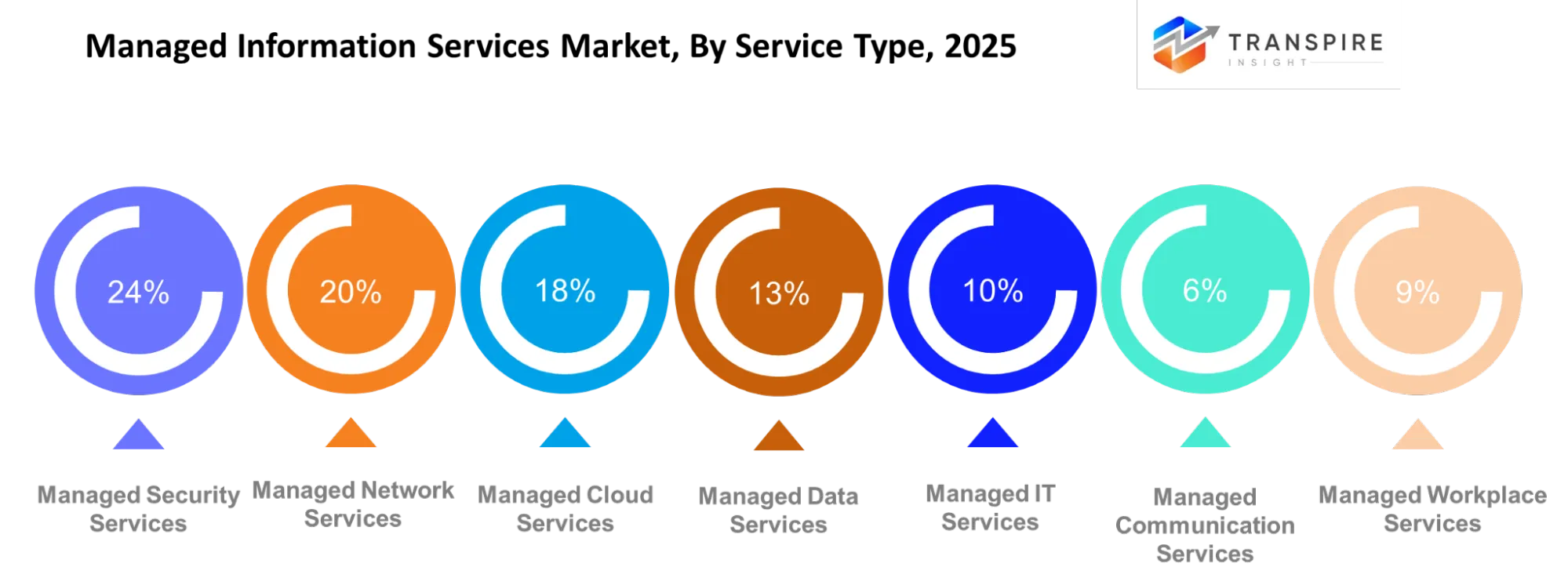
- Managed IT Services account for 31.20%, while IBM is growing its AI-hybrid cloud business as clients rationalise their scattered IT infrastructure management.
- Managed Security Services account for 24.00%, and Microsoft is joined by Accenture on generative-AI cyber services to speed up threat response.
- Managed Network Services make up 20.00%, as Cisco pushes its secure networking platforms, while zero-trust connectivity takes the place of perimeter-based security.
- Managed Cloud Services account for 18.00%, with HPE and Dell Technologies helping customers with workload portability in the growing multi-cloud cost-governance challenge.
- Managed Data Services account for 13.00% of the pie, and Infosys is bolstering data and AI operations as enterprises look for governed analytics instead of standalone datasets.
- The 10.00% subsegment of Managed IT Services stems from the growth of TCS and Wipro's automation-driven service desks, which are designed to handle increased ticket volume.
- Managed Communication Services account for 6.00%, with Orange Business Services combining cloud communications with secure hybrid-work collaboration solutions.
- Managed Workplace Services account for 5.00%, and DXC Technology is a leader in digital employee experience as endpoint diversity grows.
- Managed Application Services account for 4.00%, whereas Cognizant's Secure AI Services is a manifestation of the need for governing enterprise agentic-AI environments.
What are the Key Drivers, Restraints, and Opportunities in the Managed Information Services Market?
Driver:
Growth is being propelled by the operational complexity created when enterprises combine public cloud, private systems, SaaS applications, remote endpoints, and connected assets. The rapid rise in ransomware, cloud misconfigurations, and compliance scrutiny has triggered board-level investment in continuous monitoring, managed detection and response, identity controls, and audit-ready reporting. This shifts spending from irregular project work to subscription-based contracts covering 24/7 service delivery. In regulated sectors such as BFSI, healthcare, and government, outsourced expertise shortens the time needed to deploy controls while reducing the cost of building internal security operations centres.
Restraint:
Vendor lock-in, fragmented legacy architecture, and uncertainty over data ownership constrain adoption. Many organisations retain mission-critical applications on older platforms, while their cloud, security, and network tools generate incompatible data formats. Moving responsibility to one provider can therefore require costly integration, contract redesign, and governance changes. Data-residency obligations also limit cross-border service delivery, particularly where sensitive customer, health, or financial data is involved.
Opportunity:
AI-enabled managed operations can shift contracts from labour-intensive monitoring toward predictive, outcome-based services. AI can correlate infrastructure, security, and application signals to identify anomalies before disruption, while automated remediation reduces repetitive intervention. Europe adds opportunity because NIS2 covers managed service and managed security service providers, increasing the commercial value of documented controls, incident handling, and supply-chain security capabilities. Providers that combine compliance evidence with automation can expand into regulated customers and convert project work into recurring managed engagements.
What Has the Impact of Artificial Intelligence Been on the Managed Information Services Market?
AI is enabling AI-driven managed information services, which will switch from reactive ticket-based activities to predictive activities. Observability with AI will outperform fire-hose monitoring, correlating logs, network events, application performance, and user experiences to more quickly identify outlier behaviours. In cybersecurity, machine-learning models will learn to triage alerts, spot malicious outliers, and run automatic containment activities, allowing analysts to focus on high-value cyber incidents.
In infrastructure, predictive analytics will predict capacity pinch points, hardware failures, and outlier service events for proactive response, not incident-driven response. In the service desk, generative AI will improve the productivity of service-desk agents in fulfilling ticket requests, coding resolutions, generating knowledge articles, and automating end-user request workflows. Available managed-service offerings are increasingly combining AI with human Validation or Approval. For example, the Infosys AI-led managed-services deal was extended to include application, data, infrastructure, and service-desk operations. The primary concern is integration and accuracy. AI has to function across diverse, partially modernised legacy environments, and wrong decisions may create operational or security issues, so high-impact operational decisions require human validation at scale.
In September 2026, Shield Technology Partners acquired the Florida-based managed services provider Nerds Support. This acquisition accelerates the deployment of Shield's AI-infused "Forge" IT services automation platform, enabling small and midsize managed service providers to automate level-one support tickets and shift operations from reactive troubleshooting to proactive remediation.
Key Managed Information Services Market Trends:
Managed services move away from labour outsourcing to AI-powered, continually optimised processes, where resilience, security, and measurable results are more significant than simply staffing. The market is moving from support to a coordinating function for hybrid infrastructure, cyber risk, AI workloads, and compliance.
- The service desk is no longer about tickets, but about AI-driven triage, knowledge, and automated remediation.
- The role of providers has changed from single-platform administration to orchestration and observability across environments, as a result of the transition to hybrid-cloud adoption.
- The shift from periodic monitoring to continuous exposure management, faster detection, and automated response is part of the evolution of cybersecurity operations.
- Buyers are increasingly requiring providers to provide evidence of controls and third-party risk, which is a greater level of regulatory scrutiny of ICT operations.
- Managed contracts are changing from a fixed task-based delivery to outcome-based contracts based on uptime, resilience, security, user experience and more.
- As the number of AI workloads continues to grow, infrastructure providers are increasingly being challenged to provide specialised capacity monitoring, performance optimisation and governance services for these applications.
- As organisations move toward deploying analytics and AI over increasingly dispersed data over time, data management is increasingly becoming real-time, with quality, lineage and access controls.
- The shift to remote working has introduced a new focus on endpoint security, identity controls, digital experience monitoring and automated support for distributed teams for workplace management.
Managed Information Services Market Segmentation
Service Type:
Managed IT services comprise 31.20%, with proven vendor players gaining market share owing to management of infrastructure, technical support, and operational management. Managed security services comprise 24.00%, with a CAGR of 14.18%, indicating a move towards security breach detection, compliance, and cyber resilience. Managed network services comprise 20.00%, with key players enabling secure connectivity in multi-site distributed and hybrid cloud environments. Managed cloud services comprise 18.00%, with top players managing workload optimisation and multi-cloud environment governance. Managed data services comprise 13.00%, with leading vendors offering data management and data availability. Managed communication services, managed workplace services, and managed application services comprise 6.00%, 5.00%, and 4.00%, respectively, providing core operational services.
Deployment:
On-Premise remains important for organisations requiring control, low latency, and compatibility with legacy systems. Public Cloud supports scalable workloads and flexible capacity, while Private Cloud addresses security and governance requirements. Hybrid Cloud is gaining strategic relevance as enterprises connect existing infrastructure with cloud platforms, creating demand for unified management. Multi-Cloud improves workload flexibility but increases governance complexity. Edge extends processing closer to users and devices, while Colocation supports infrastructure consolidation. Hosted environments appeal to organisations seeking outsourced operations without complete cloud migration.
Organization Size:
Large Enterprises represent a substantial opportunity because complex technology estates require specialised infrastructure, security and application management. SMEs increasingly use managed services to access advanced capabilities without maintaining large internal IT teams. Startups benefit from scalable infrastructure and predictable technology costs during expansion. Government organisations prioritise continuity, security and accountability across critical systems, while Education requires reliable digital platforms and distributed access. Healthcare places greater emphasis on availability and information protection. Nonprofits favour flexible managed models that control technology overhead while maintaining essential services.
End User:
BFSI requires continuous availability, cybersecurity, and operational resilience across highly regulated environments. IT & Telecom demand scalable infrastructure management and network performance to support high-volume digital services. Healthcare requires secure, reliable systems supporting sensitive information and connected applications, while Government emphasises continuity, compliance and resilient public infrastructure. Retail increasingly depends on real-time digital platforms, connected stores and customer analytics. Manufacturing uses managed services to support connected production environments and operational technology. Media & Entertainment and Education require dependable platforms supporting distributed users, digital content and remote access.
Management Type:
Fully Managed services support organisations seeking complete operational accountability, covering infrastructure, security and applications. Co-Managed models allow internal teams to retain strategic control while providers handle specialised functions, whereas Remote Managed services support distributed environments efficiently. On-Site Managed models remain relevant where physical intervention is essential, while Hybrid Managed combines remote expertise with local support. Outcome-Based contracts increasingly connect provider compensation to measurable performance, while Subscription-Based models improve budget predictability. Project-Based engagements support targeted modernisation, migration and transformation requirements.
Delivery Channel:
Managed Service Providers and System Integrators coordinate complex technology environments by combining infrastructure, applications, security and cloud expertise. Direct Providers deliver specialised capabilities, while Telecom Operators extend managed connectivity and network services. Cloud Providers integrate infrastructure management with cloud platforms and optimisation tools. VARs broaden access by combining products with implementation and support, while Consultants contribute strategic planning, transformation and governance expertise. Resellers expand market reach through packaged technology offerings. Future contracts are likely to favour integrated channels combining automation, security and measurable service outcomes.
What are the Key Use Cases Driving the Managed Information Services Market?
The main use case is ongoing enterprise IT operations, reflecting the position of Managed IT Services at 31.20%. Providers provide monitoring, patching, backup, service desks, and applications, removing the need for internal resources to focus on transformation in hybrid clouds and hybrid IT.
On expanding applications, the focus is on cybersecurity, cloud governance and network resilience. Managed Security Services helps detect threats and comply, and Managed Network Services provides secure distributed connectivity. Managed Cloud Services helps optimise workloads, manage costs and enforce policies.
Potential use cases are AI-enabled monitoring and prescriptive management. Analytics of telemetry are performed to identify anomalies, capacity expectations, and automatic remediation of lower-risk issues. AI governance is more detailed, with model access, data management, and auditability, especially for regulated industries.
|
Report Metrics |
Details |
|
Market size value in 2025 |
USD 303.16 Billion |
|
Market size value in 2026 |
USD 325.65 Billion |
|
Revenue forecast in 2033 |
USD 543.71 Billion |
|
Growth rate |
CAGR of 7.60% from 2026 to 2033 |
|
Base year |
2025 |
|
Historical data |
2021 - 2024 |
|
Forecast period |
2026 - 2033 |
|
Report coverage |
Revenue forecast, competitive landscape, growth factors, and trends |
|
Regional scope |
United States; Canada; Mexico; United Kingdom; Germany; France; Italy; Spain; Denmark; Sweden; Norway; China; Japan; India; Australia; South Korea; Thailand; Brazil; Argentina; South Africa; Saudi Arabia; United Arab Emirates |
|
Key companies profiled |
IBM, Accenture, Cisco, Microsoft, Fujitsu, HPE, Dell Technologies, TCS, NTT DATA, Capgemini, Wipro, Infosys, Cognizant, DXC Technology, Orange Business |
|
Customization scope |
Free report customisation (country, regional & segment scope). Avail customised purchase options to meet your exact research needs. |
|
Report Segmentation |
Service Type (Managed Security Services, Managed Network Services, Managed Cloud Services, Managed Data Services, Managed IT Services, Managed Communication Services, Managed Workplace Services, Managed Application Services); Deployment (On-Premise, Public Cloud, Private Cloud, Hybrid Cloud, Multi-Cloud, Edge, Colocation, Hosted); Organization Size (Large Enterprises, SMEs, Startups, Government, Education, Healthcare, Nonprofits, Others); End User (BFSI, IT & Telecom, Healthcare, Retail, Manufacturing, Government, Media & Entertainment, Education); Management Type (Fully Managed, Co-Managed, Remote Managed, On-Site Managed, Hybrid Managed, Outcome-Based, Subscription-Based, Project-Based); Delivery Channel (Direct Providers, Managed Service Providers, System Integrators, Telecom Operators, Cloud Providers, VARs, Consultants, Resellers) |
Which Regions are Driving the Managed Information Services Market Growth?
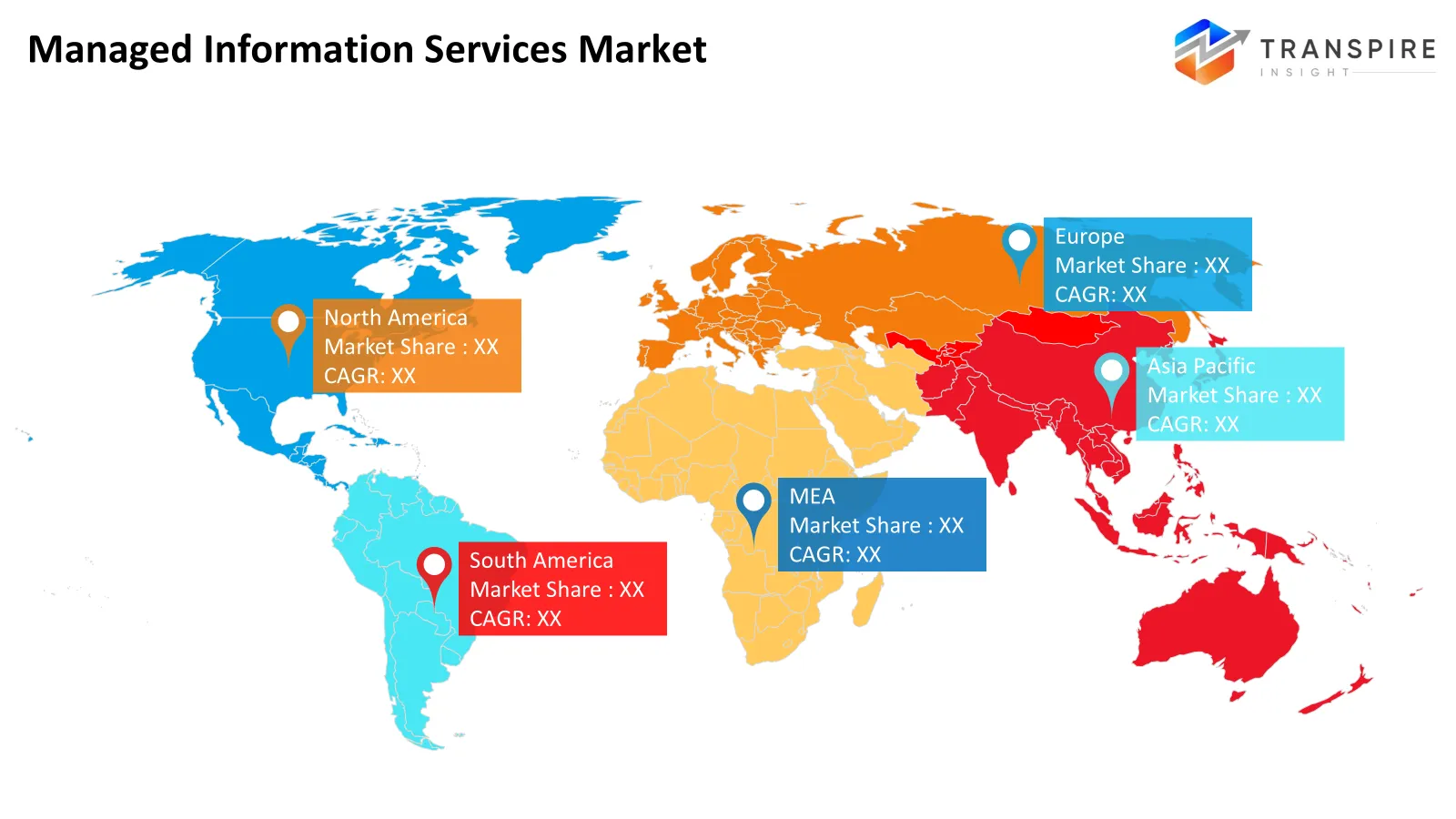
North America leads the market with a 34.87% share, driven by high enterprise technology spend, leading cloud architectures, and the presence of more than 10,000 service providers. The demand here is high among BFSI, healthcare, government, technology, and retail; cyber resilience, uptime, and auditability are vital business drivers. Ransomware threats, as well as the spend on in-house specialists, have resulted in a shift to a contracted delivery model for security operations, cloud optimisation, and networking. The presence of hyperscale cloud expertise, startups in the cybersecurity space, artificial intelligence platforms, and private capital enables rapid innovation in services.
In September 2026, AMD finalized an agreement to acquire World Labs for $8.2 billion in an all-stock transaction. This strategic move allows the semiconductor giant to absorb advanced spatial-intelligence models and 3D simulation capabilities into its portfolio.
Europe represents 27.00% of provider scale and has a regulator-led purchasing environment. The GDPR, NIS2, and DORA mention 'data governance', 'control of third-party providers', 'audit rights', and 'operational resilience' as procurement criteria. With DORA now effective, a demand for onshore managed providers that can provide evidence of ICT risk controls and strong, aligned support for financial-sector resilience obligations is swelling. Sovereign cloud needs are one of the few reliable near-term sources of demand for regionally located, near-term compliant, and increasingly towards-focused managed services.
In September 2026, Pistachio acquired the intellectual property of Hugin.io to expand its focus from human risk management into cybersecurity compliance. The integration of Hugin's posture-assessment and compliance management tools enhances small and medium-sized enterprises' ability to address evolving regulatory frameworks.
Asia Pacific accounts for 23.00% of market share and is the most dynamic region, with a CAGR of 12.45%. Rapid digitalisation across industries such as manufacturing, banking, healthcare, telecom, and retail has led to increased cloud and distributed operations security requirements. Growing cloud infrastructure, increasing cyber threats, and persistent technology skills shortage have compelled companies to opt for specialist providers rather than grow internally. The region is expected to witness growth in managed detection and response, Local language support, Delivery of sovereign cloud, and Edge management for manufacturing operations.
In August 2026, Indian provider Island Computing launched the country’s first fully managed sovereign cloud platform. This product launch systematically retains all underlying hardware, identity networks, and distributed planes entirely inside India. It gives data-sensitive sectors like banking and government bodies a strictly compliant, lower-cost digital operational alternative to standard foreign hyperscalers.
Who are the Key Players in the Managed Information Services Market, and how do they compete?
The scale of infrastructure will no longer be the differentiator; rather, it will be the ability to run hybrid estates securely and automate service delivery with risk mitigation. IBM, Accenture, Cisco, Microsoft, Fujitsu, HPE, Dell Technologies, TCS, NTT DATA, Capgemini, Wipro, Infosys, Cognizant, DXC Technology, and Orange Business Services compete through platform ecosystems, industry expertise, delivery scale, and regional compliance capabilities. IBM differentiates itself in hybrid-cloud and artificial intelligence; Microsoft pursues its recurring platform-aligned service cloud, identity, security, and productivity stack.
Accenture combines consulting-led transformation with managed cyber operations; its increased collaboration with Microsoft centres on generative AI-powered cyber solutions and platform-controlled tooling. Cisco has a compelling focus on secure networking and integrated threat workflows, including AI-security integration with ServiceNow. TCS, Infosys, Wipro, Cognizant, Capgemini, and NTT DATA leverage scale, automation, and sector-centric capability to compete in large-scale operations and modernisation programs. Fujitsu, HPE, Dell Technologies, and DXC aim at enterprise infrastructure, edge, and workplace, as well as hybrid-platform management. Orange Business Services leverages its telecom assets to compete in secure mobility, multinational network management, and communications-enabled cloud.
Key Players are:
- IBM
- Accenture
- Cisco
- Microsoft
- Fujitsu
- HPE
- Dell Technologies
- TCS
- NTT DATA
- Capgemini
- Wipro
- Infosys
- Cognizant
- DXC Technology
- Orange Business
Recent Development News
- In August 2026, KPMG in India partnered with Zoho to deliver integrated digital transformation and ongoing managed services, combining advisory capabilities with Zoho’s cloud applications to support enterprise automation, governance, and scalable technology operations. https://kpmg.com/in/en/media/press-releases/2026/08/kpmg-in-india-and-zoho-announce-strategic-alliance-to-support-enterprise-digital-transformation.html
- In September 2026, Fujitsu Limited launched an advanced managed security infrastructure service to bolster active cyber defences across enterprise organisations. This continuous information management service seamlessly unifies threat hunting, attack surface management, and dark web monitoring under a proactive ecosystem. The operational launch equips enterprises with immediate, real-time data visibility. https://global.fujitsu/en-global/pr/news/2026/09/25-01
- In April 2026, Colligo partnered with Carahsoft Technology to distribute its Email Manager for Microsoft 365 to the North American public sector, expanding access to compliant email records-management services through government procurement channels. https://www.carahsoft.com/news/colligo-and-carahsoft-partner-to-deliver-compliant-email-manager-software-to-the-public-sector-2026
What Strategic Insights Define the Future of the Managed Information Services Market?
The market is already shifting towards AI-led managed operations, with providers managing infrastructure, security, applications, and data using a set of workflows that are increasingly autonomous, rather than service desks driven by labour. The most significant risk here is the bundling of this responsibility-if the managed-service provider is bad, it will increase supply-chain cyber risks, especially when patching, testing, and access controls aren't maintained consistently. The European Union Agency for Cybersecurity (ENISA) notes in a new report that 43% of respondents in a survey of ICT service-management organisations didn't perform cybersecurity testing last year. The new opportunity lies in co-joining managed services with AI governance, predictive security, and evidence-based compliance-particularly in regulated industries and hybrid-cloud cases. ENISA's recommended managed-security certification framework would also help standardize trust requirements across Europe. Providers should focus on AI-enabled automation, zero-trust controls, measurable resilience outcomes, and industry-specific compliance, rather than just reducing service labour costs.
Key Segmentations are:
Service Type
- Managed Security Services
- Managed Network Services
- Managed Cloud Services
- Managed Data Services
- Managed IT Services
- Managed Communication Services
- Managed Workplace Services
- Managed Application Services
Deployment
- On-Premise
- Public Cloud
- Private Cloud
- Hybrid Cloud
- Multi-Cloud
- Edge
- Colocation
- Hosted
Organization Size
- Large Enterprises
- SMEs
- Startups
- Government
- Education
- Healthcare
- Nonprofits
- Others
End User
- BFSI
- IT & Telecom
- Healthcare
- Retail
- Manufacturing
- Government
- Media & Entertainment
- Education
Management Type
- Fully Managed
- Co-Managed
- Remote Managed
- On-Site Managed
- Hybrid Managed
- Outcome-Based
- Subscription-Based
- Project-Based
Delivery Channel
- Direct Providers
- Managed Service Providers
- System Integrators
- Telecom Operators
- Cloud Providers
- VARs
- Consultants
- Resellers
By Regional Analysis
North America
- US
- Canada
- Mexico
Europe
- Germany
- UK
- France
- Italy
- Spain
- Russia
- Rest of Europe
Asia Pacific
- China
- Japan
- India
- South Korea
- Australia
- Rest of Asia Pacific
South America
- Brazil
- Argentina
- Rest of South America
Middle East & Africa
- UAE
- Saudi Arabia
- Qatar
- South Africa
- Rest of the Middle East & Africa
Frequently Asked Questions
Find quick answers to common questions.
The managed information services market size was valued at USD 303.16 billion in 2025 and is poised to reach USD 543.71 billion by 2033, expanding at a 7.60% CAGR.
Key segments for the managed information services market are Service Type (Managed Security Services, Managed Network Services, Managed Cloud Services, Managed Data Services, Managed IT Services, Managed Communication Services, Managed Workplace Services, Managed Application Services); Deployment (On-Premise, Public Cloud, Private Cloud, Hybrid Cloud, Multi-Cloud, Edge, Colocation, Hosted); Organization Size (Large Enterprises, SMEs, Startups, Government, Education, Healthcare, Nonprofits, Others); End User (BFSI, IT & Telecom, Healthcare, Retail, Manufacturing, Government, Media & Entertainment, Education); Management Type (Fully Managed, Co-Managed, Remote Managed, On-Site Managed, Hybrid Managed, Outcome-Based, Subscription-Based, Project-Based); Delivery Channel (Direct Providers, Managed Service Providers, System Integrators, Telecom Operators, Cloud Providers, VARs, Consultants, Resellers).
Growth is primarily driven by hybrid-cloud adoption, rising cybersecurity requirements, AI-enabled IT operations, increasing infrastructure complexity, regulatory compliance, and enterprise demand for specialised 24/7 technology management.
The managed information services market is led by major manufacturers including IBM, Accenture, Cisco, Microsoft, Fujitsu, HPE, Dell Technologies, TCS, NTT DATA, Capgemini, Wipro, Infosys, Cognizant, DXC Technology, and Orange Business.
North America holds 34.87% of the market, supported by mature cloud infrastructure, strong cybersecurity investment, advanced data-centre ecosystems, AI adoption, and established enterprise outsourcing capabilities.
Key opportunities include AI-driven predictive operations, managed cybersecurity, hybrid-cloud governance, AI governance, regulatory compliance services, and outcome-based managed-service contracts.
- IBM
- Accenture
- Cisco
- Microsoft
- Fujitsu
- HPE
- Dell Technologies
- TCS
- NTT DATA
- Capgemini
- Wipro
- Infosys
- Cognizant
- DXC Technology
- Orange Business
About the Authors

Mayur Shinde
I am Mayur Shinde, a Senior Research Analyst at Transpire Insight, specializing in the Automotive & Transportation and Information & Communication Technology (ICT) Industry. My work focuses on analyzing emerging market trends, technological advancements, competitive landscapes, and industry developments to deliver accurate, data-driven insights. I am passionate about transforming complex market information into clear, actionable content that helps businesses, professionals, and decision-makers stay informed and make confident strategic decisions.

Chakradhar Khansole
Chakradhar serves as the Research Director at Transpire Insight, bringing over 8 years of experience in technology, innovation, and strategic market intelligence. He specializes in transforming complex market data into actionable business insights that enable organizations to make informed, growth-oriented decisions. Recognized for his strategic vision and analytical expertise, Chakradhar leads high-impact research initiatives, delivering comprehensive market assessments, competitive intelligence, and forward-looking industry analysis.
Recently Published Reports
-
Apr 2026
3D Optical Profiler Market
3D Optical Profiler Market Size, Share & Analysis Report By Type (Desktop 3D Optical Profiler, and Portable 3D Optical Profiler), By Technology (Confocal Technology, and White Light Interference), By End-Use Industry (Manufacturing, Research Institutions, Automotive, Aerospace and Defense, Medical Devices, and Other), and Geography (North America, Europe, Asia-Pacific, Middle East and Africa, South and Central America), 2021 - 2031
-
Apr 2026
Depth Sensor Market
Depth Sensor Market Size, Share & Analysis Report By Type (Infrared Depth Sensors, Time-of-Flight (ToF) Sensors, Stereo Vision Sensors, Structured Light Sensors, Ultrasonic Depth Sensors), By Application (Automotive, Robotics, Gaming, Consumer Electronics, Industrial Automation, Healthcare, Security & Surveillance, Others), By End Users (Automotive Manufacturers, Consumer Electronics Companies, Healthcare Providers, Industrial Companies, Security Agencies, Gaming Companies, Robotics Companies, Others), and Geography (North America, Europe, Asia-Pacific, Middle East and Africa, South and Central America), 2021 – 2031
-
Apr 2026
Digital Manufacturing Market
Digital Manufacturing Market Size, Share & Analysis Report By Component (Hardware, Software, and Services), By Technology (Robotics, 3D Printing, Internet of Things (IoT), and Others), By Application (Automotive and Transportation, Aerospace and Defense, Consumer Electronics, Industrial Machinery, and Others), By Process Type (Computer-Based Designing, Computer-Based Simulation, Computer 3D Visualization, Analytics, and Others), and Geography (North America, Europe, Asia-Pacific, Middle East and Africa, South and Central America), 2021 – 2031
-
Apr 2026
Digital Visa Services Market
Digital Visa Services Market Size, Share & Analysis Report By Type (Individual Travelers, Group Travelers), By Application (Tourism, Business Travel, Others), and Geography (North America, Europe, Asia-Pacific, Middle East and Africa, South and Central America), 2021 – 2031