

Japan Xylose Market Size & Forecast:
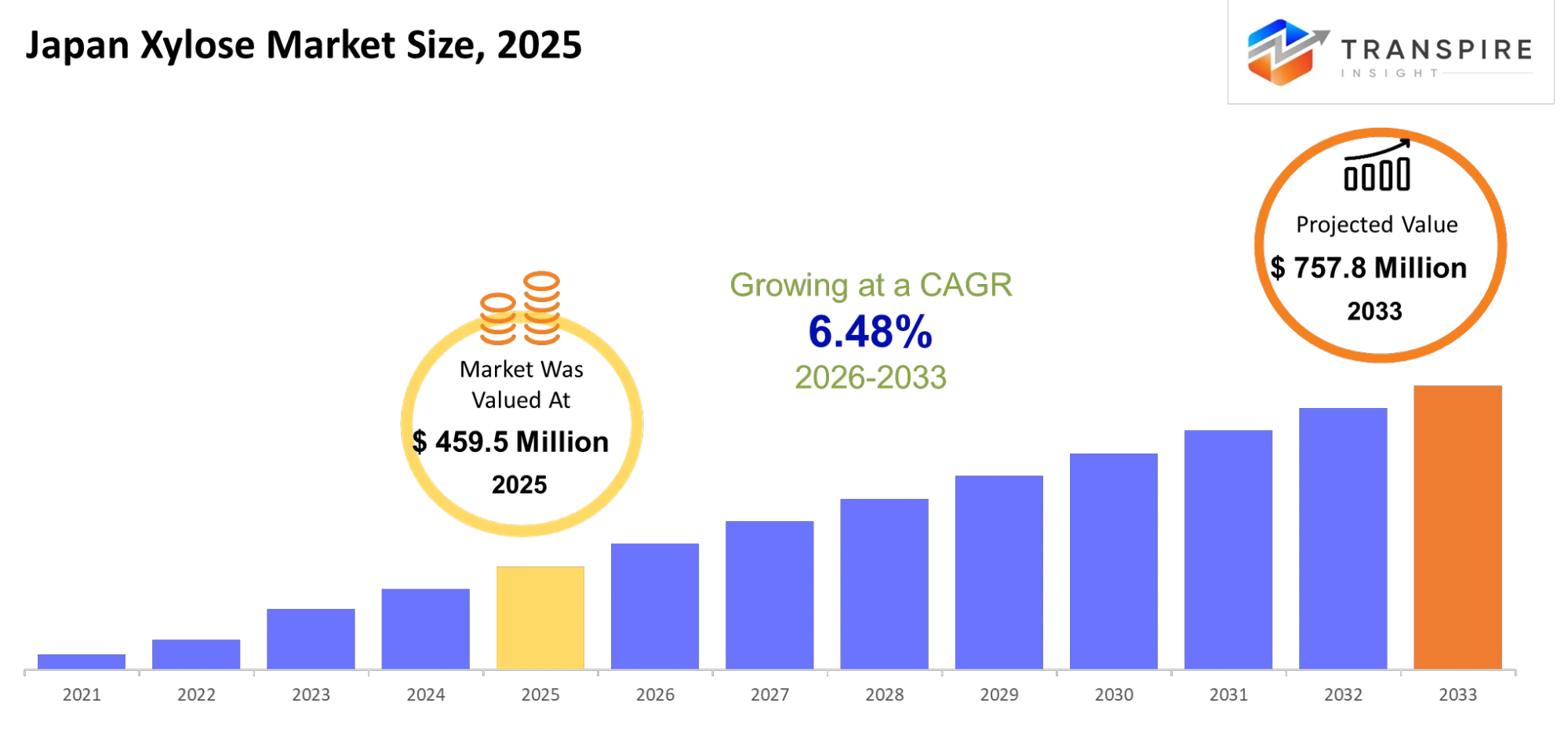
- Japan Xylose Market Size 2025: USD 459.5 Million
- Japan Xylose Market Size 2033: USD 757.8 Million
- Japan Xylose Market CAGR: 6.48%
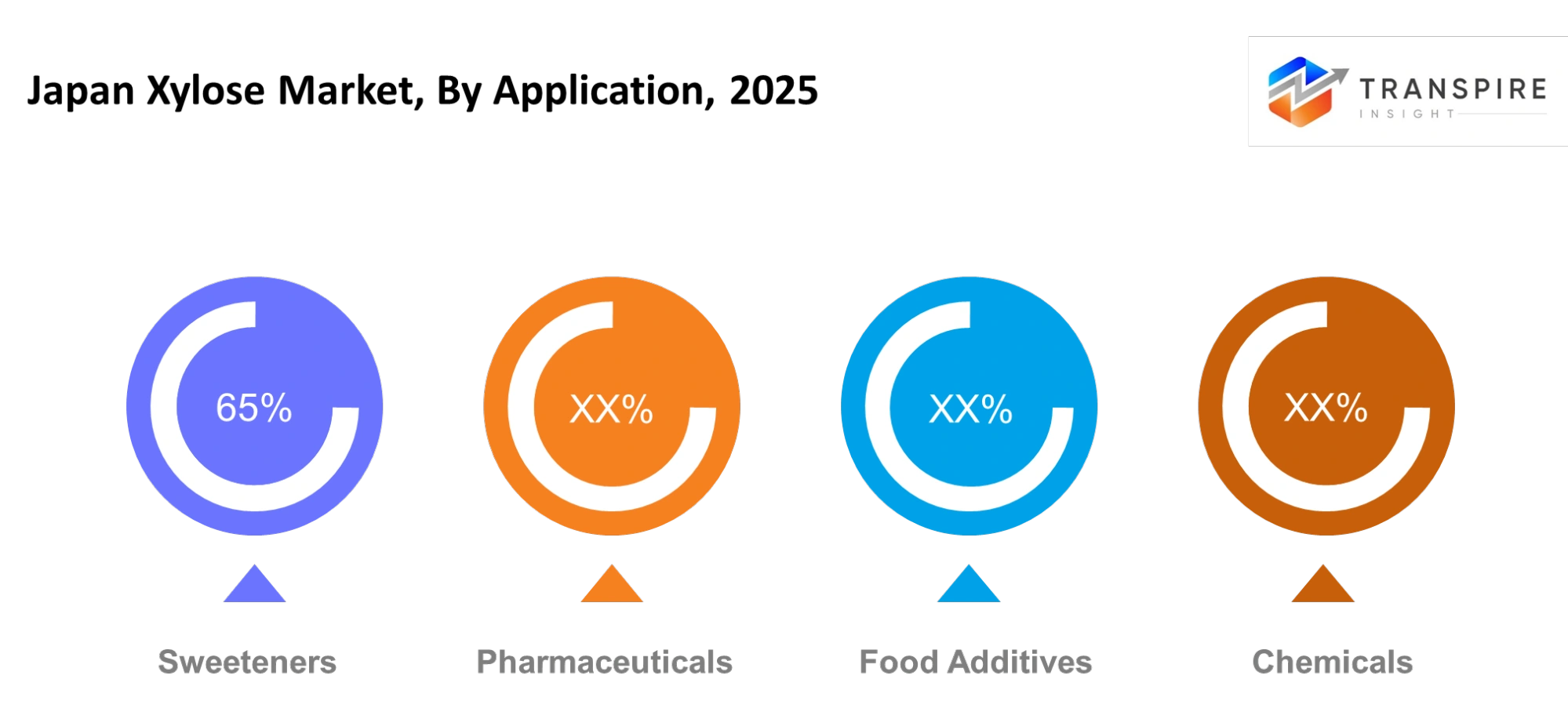
- Japan Xylose Market Segments: By Type (Food Grade, Pharma Grade, Industrial Grade, Technical Grade), By Application (Sweeteners, Pharmaceuticals, Food Additives, Chemicals), By End-User (Food Companies, Pharma Firms, Chemical Companies, Research Labs)
To learn more about this report,  Download Free Sample Report
Japan Xylose Market Summary:
The Japan Xylose Market size is estimated at USD 459.5 Million in 2025 and is anticipated to reach USD 757.8 Million by 2033, growing at a CAGR of 6.48% from 2026 to 2033.
The food and biochemical industry in Japan now shows an ongoing transition toward plant-based sugar substitutes which processors and formulators use in their work. The xylose market in Japan will develop through two main factors which include consumer demand for cleaner products and the development of new processing methods.
The ongoing development of fermentation and purification technology will enhance product quality while Japanese regulations will determine the permitted use of ingredients in different product categories. The Japanese xylose market will adapt to changing dietary habits and heightened packaging requirements which will emerge throughout upcoming product developments in the food and pharmaceutical sectors.
What Has the Impact of Artificial Intelligence Been on the Japan Xylose Market?
Artificial Intelligence is rapidly changing the Japan xylose market because it enables stakeholders to study both demand trends and operational processes. The Japanese xylose market gained advantages from AI because it allows businesses to use machine learning models and predictive analytics for better planning and forecasting. The Japan xylose market uses artificial intelligence to create better business visibility through digital transformation which helps companies quickly adapt to market changes and customer needs.
AI tools in the Japan xylose market provide better market research and data analysis capabilities because they can analyze extensive data sets instantly. Smart automation improves production processes by decreasing the need for human work and maintaining consistent product quality. Manufacturers use predictive analytics to forecast demand which helps them adjust production levels according to changing requirements while minimizing excess materials. Artificial intelligence in the Japanese xylose market helps supply chain optimization and cost reduction by finding operational weaknesses and optimizing asset distribution throughout logistics and purchasing processes.
The Japan xylose market currently experiences a transformation toward data-driven decision-making in which artificial intelligence technology enables businesses to create new products and gain market advantage. Companies use advanced market trends analysis with intelligent systems to improve their ability to predict disruptions and create proactive solutions. The digital transformation process establishes permanent environmental efficiency practices which allow the Japan xylose market to achieve consistent growth in a world that depends more on technological advancements.
Key Market Trends & Insights:
- The artificial intelligence system that operates in the Japan xylose market demonstrates approximately 30% improvement in demand prediction accuracy which results in enhanced production scheduling and better inventory management.
- The market demonstrates increasing acceptance of smart automation technologies which help production facilities achieve cost reductions between 15% and 20% across their processing operations.
- The Japan xylose market experiences strong growth through predictive analytics which companies use to find materials and improve their supply chain operations.
- The Kanto region controls 38% of the Japan xylose market in 2025 because its industrial and food processing facilities create strong market demand.
- The Kansai region will experience its fastest market growth between 2024 and 2030 because biotech companies increase their investments in the area.
- Japan's xylose market shows its main segment through xylose-based sweeteners which control 45% of the market because of their extensive use in the food industry.
- The growing need for sugar alternatives drives food and beverage applications which control almost half of the Japanese xylose market.
- The food processing industry leads the japan xylose market with around 48% share driven by functional ingredient demand.
- Pharmaceutical companies represent the fastest-growing end-user segment because they continuously expand their use of medical formulations and their research applications.
- DuPont Cargill Mitsubishi Chemical Tate & Lyle and Roquette Frères operate as the primary companies which control the Japan xylose market.
Japan Xylose Market Segmentation
By Type :
Food Grade xylose serves food processing applications because it provides both sweet taste and low calorie content. The demand for products will increase because more people are starting to look for sugar substitutes. Pharma Grade xylose enables manufacturers to create specific medicinal products through controlled formulation processes. The chemical industry uses Industrial Grade for large chemical operations while Technical Grade serves research needs and specialized manufacturing requirements.
Food Grade serves as an essential component in bakery and beverage products because it enables the creation of healthier product recipes. Pharma Grade ensures stability in medicinal compounds. Industrial Grade supports bulk production in chemical synthesis. Technical Grade is used where precision and controlled quality are required in laboratory and development activities across multiple sectors.
By Application :
The growing worldwide need for low-calorie sugar alternatives results in greater use of xylose as a sweetening ingredient. Xylose functions as a base ingredient which improves the stability of pharmaceutical formulations. The Food Additives segment strengthens texture and taste in processed items while Chemical applications support synthesis processes in different industrial production lines.
The Sweeteners segment enables people to consume less sugar, which promotes healthier eating habits. The Pharmaceutical application of formulations enables drug production with controlled results. Food Additives improve consistency and preservation in packaged foods. Chemical usage supports production efficiency in industrial processes, which results in improved output for material and compound development activities.
To learn more about this report, Download Free Sample Report
By End-User :
Companies in the food industry use xylose to create products with less sugar and healthier packaged products. Pharma Firms apply xylose in drug formulation processes. Chemical Companies use it in production systems that need sugar-based materials. Research organizations test and develop and create new industrial applications through their work.
Food Companies prioritize xylose for healthier product innovation. Pharmaceutical companies use it to achieve precise medicine formulation and maintain drug stability. Chemical Companies use it for efficient processing and production enhancement. Research Labs enable experimentation and product development while they create new applications that improve efficiency across various fields.
What are the Main Challenges for the Japan Xylose Market Growth?
The industrial development of the Japan xylose sector faces multiple technical and operational difficulties which obstruct its ability to expand into new industrial markets. The Japan xylose market experiences its main challenge from product stability issues which arise during processing and storage because xylose needs specific environmental conditions to sustain its quality and functional characteristics.
The production process becomes more challenging because of complicated extraction methods and purification methods while the supply chain problems for raw material acquisition lead to product quality variations. The combination of these elements creates obstacles for manufacturers who need to achieve efficient production processes together with cost savings during production for the Japan xylose market.
The Japan xylose market faces manufacturing and commercialization obstacles because it requires expensive production processes together with strict compliance to GMP and food-grade regulations. The regulations protect product safety but they create delays in product market introduction which results in higher business costs.
The small and mid-sized producers face profitability challenges because their operational capabilities do not permit them to achieve sufficient market demand. The Japanese xylose industry requires companies to invest in advanced processing technologies and quality control systems for them to compete in a market that values cost efficiency.
The japan xylose market faces two major growth obstacles which stem from adoption challenges and current infrastructure limitations. The end-use industries demonstrate low adoption rates because of two main factors which include limited understanding of xylose applications and lack of proper integration into their existing production processes.
The market expansion process faces obstacles because the bioprocessing and industrial biotechnology fields suffer from a shortage of qualified workers. The R&D funding gap and pilot-scale project funding gap create a funding shortfall which delays innovation processes and affects the entire development progress of the japan xylose market.
Country Insights
The production situation of Japan Xylose Market shows permanent integration of biotechnology-based methods together with agricultural feedstock processing. The manufacturers focus on developing methods that enable efficient extraction while maintaining consistent quality through all production runs. The research initiatives which study carbohydrate processing methods improve the dependability of their research outcomes. The industrial facilities operate their quality control systems at high standards which enable them to provide food-grade and pharmaceutical-grade xylose products for both domestic markets and international distribution.
The demand pattern in Japan Xylose Market shows rising demand for low-calorie sweeteners which food and beverage manufacturers use in their products. The health-conscious consumption patterns drive the development of diabetic-friendly products and functional food items. The pharmaceutical industry uses the product which helps to maintain a constant demand. Industrial buyers require dependable product delivery which maintains taste quality and meets food safety regulations for different product applications.
The Japan Xylose Market operates under a trade and regulatory system that enforces strict food safety rules and regulations on food additives. All import and export activities must adhere to established quality standards which guarantee product safety. The regulatory system establishes requirements for product labeling which includes all component materials. International trade partnerships enable stable raw material flow while domestic policies promote environmentally friendly production methods and ethical material sourcing throughout supply chains.
Recent Development News
In March 2026, Ajinomoto Co., Inc. increased its research development activities for functional oligosaccharides and xylose-based ingredients which will be used in food products and pharmaceutical products throughout Japan. The organization developed its bioprocessing innovation program to improve production processes for xylose-derived sweeteners and excipients used in products with low calories and gut health benefits.Source https://www.ajinomoto.com/
In April 2026, With its improved xylose-to-xylitol conversion process, Hayashibara Co. Ltd. established a stronger biotechnology portfolio that focuses on carbohydrate-based research. The development aims to support rising demand for sugar alternatives in Japan’s food and pharmaceutical sectors.Source https://group.nagase.com/
|
Report Metrics |
Details |
|
Market size value in 2025 |
USD 459.5 Million |
|
Market size value in 2026 |
USD 488.3 Million |
|
Revenue forecast in 2033 |
USD 757.8 Million |
|
Growth rate |
CAGR of 6.48% from 2026 to 2033 |
|
Base year |
2025 |
|
Historical data |
2021 - 2024 |
|
Forecast period |
2026 - 2033 |
|
Report coverage |
Revenue forecast, competitive landscape, growth factors, and trends |
|
Country scope |
Japan |
|
Key company profiled |
Danisco, Roquette, ADM, Cargill, Ingredion, Mitsubishi Chemical, Ajinomoto, Nippon Starch, Showa Sangyo, Meiji, Tate & Lyle, COFCO, Shandong Futaste, Gulshan Polyols, Zuchem |
|
Customization scope |
Free report customization (country, regional & segment scope). Avail customized purchase options to meet your exact research needs. |
|
Report Segmentation |
By Type (Food Grade, Pharma Grade, Industrial Grade, Technical Grade), By Application (Sweeteners, Pharmaceuticals, Food Additives, Chemicals), By End-User (Food Companies, Pharma Firms, Chemical Companies, Research Labs) |
How Can New Companies Establish a Strong Foothold in the Japan Xylose Market?
New entrants can create strong market positions during their initial entry into the Japan xylose market because specific application segments show developing demand while existing competition remains weak. The Japan xylose market receives its main drive from functional food and pharmaceutical and bio-based chemical production which enables business opportunities for companies that provide their specialized and affordable solutions. New players who use industry trend development and their solutions for unmet demands in low-calorie sweeteners and fermentation inputs will achieve early success in the Japan xylose market.
Businesses need to use innovation-driven methods for their Japan xylose market operations because advanced enzymatic conversion methods and AI-based production optimization will lead to their enduring success. The companies BioSugar Labs Japan and XyloNext Innovations use machine learning to enhance yield efficiency while decreasing production expenses which gives them a competitive advantage. Through partnerships with food manufacturers and biotech companies and academic research institutes, businesses create stronger paths to market entry while they fast-track product distribution throughout the Japan xylose sector.
Companies need to combine smart automation technologies with digital supply chain solutions to establish operational efficiency in their Japan xylose operations. Environmental compliance has become a top priority for industry players which has led to increased interest in sustainable production methods and circular bioeconomy models by startups. New entrants in the Japanese xylose market can establish their long-term presence by combining their technology advantages with their regional partner networks and their ability to develop marketable innovations.
Key Japan Xylose Market Company Insights
The Japanese xylose market will experience continuous growth because food processing and pharmaceutical and chemical industries will increase their need for xylose. Demand for sugar substitutes and fermentation products will drive market expansion. Manufacturers will concentrate their efforts on creating reliable product availability through their development of better extraction techniques. Industrial applications will grow steadily as all major business sectors begin to adopt these technologies.
The industry competition will maintain its focus on three main areas which include production efficiency and cost control together with product purity maintenance. Companies will work on strengthening supply chains and improving raw material sourcing. Market participants will also focus on research activities to enhance yield and quality. The market will maintain moderate competition because businesses focus on establishing long-term contracts and satisfying ongoing customer needs.
Company List
- Danisco
- Roquette
- ADM
- Cargill
- Ingredion
- Mitsubishi Chemical
- Ajinomoto
- Nippon Starch
- Showa Sangyo
- Meiji
- Tate & Lyle
- COFCO
- Shandong Futaste
- Gulshan Polyols
- Zuchem
What are the Key Use-Cases Driving the Growth of Japan Xylose Market?
The Japan xylose market demonstrates consistent growth because industries throughout the food and pharmaceutical and bio-based chemical sectors require more extensive industrial applications. The Japan xylose market experiences growth because consumers increasingly recognize health benefits of low-calorie sweeteners and functional sugar alternatives which they consider safe for their dietary needs. The combination of artificial intelligence with advanced processing technologies creates production efficiency improvements which businesses use to expand their operational reach among different sectors.
The Japan xylose market is expanding in the food and beverage industry through its application in sugar-free and diabetic-friendly products which use it as a natural sweetening agent. Xylose has gained commercial importance in healthcare and pharmaceuticals because it now serves as a diagnostic tool and component for drug development. The Japan xylose market receives advantages from biofuel production applications because xylose functions as an essential feedstock for fermentation-based ethanol production which helps Japan achieve its renewable energy objectives.
The Japanese xylose market sees increased development because manufacturing sectors use xylose to produce bio-based chemicals which decrease their need for petroleum-based materials. The development of smart fermentation systems and AI-based bioprocess optimization presents modern trends that enable better scalability and cost-effective operations. The developments create fresh possibilities for innovation which enhance Japan's industrial development throughout the entire value chain of the xylose market.
Japan Xylose Market Report Segmentation
By Type
- Food Grade
- Pharma Grade
- Industrial Grade
- Technical Grade
By Application
- Sweeteners
- Pharmaceuticals
- Food Additives
- Chemicals
By End-User
- Food Companies
- Pharma Firms
- Chemical Companies
- Research Labs
Frequently Asked Questions
Find quick answers to common questions.
The approximate Japan Xylose Market size for the market will be USD 757.8 Million in 2033.
Key segments for the Japan Xylose Market are By Type (Food Grade, Pharma Grade, Industrial Grade, Technical Grade), By Application (Sweeteners, Pharmaceuticals, Food Additives, Chemicals), By End-User (Food Companies, Pharma Firms, Chemical Companies, Research Labs).
Major Japan Xylose Market players are Danisco, Roquette, ADM, Cargill, Ingredion, Mitsubishi Chemical, Ajinomoto, Nippon Starch, Showa Sangyo, Meiji, Tate & Lyle, COFCO, Shandong Futaste, Gulshan Polyols, Zuchem.
The Japan Xylose Market size is USD 459.5 Million in 2025.
The Japan Xylose Market CAGR is 6.48%.
- Danisco
- Roquette
- ADM
- Cargill
- Ingredion
- Mitsubishi Chemical
- Ajinomoto
- Nippon Starch
- Showa Sangyo
- Meiji
- Tate & Lyle
- COFCO
- Shandong Futaste
- Gulshan Polyols
- Zuchem
Recently Published Reports
-
Apr 2026
Baby Infant Formula Market
Baby Infant Formula Market Size, Share & Analysis Report By ype (Infant Milk, Follow On Milk, Specialty Baby Milk, Growing-Up Milk), By Ingredient (Carbohydrate, Fat, Protein, Minerals, Vitamins, and Others), By Product Form (Powder, Liquid, and Ready-to-feed), By Distribution Channels (Supermarket/Hypermarket, Specialty Store, Pharmacies, Online Retail, and Others), and Geography (North America, Europe, Asia-Pacific, Middle East and Africa, South and Central America), 2021 - 2031
-
Apr 2026
Edible Insects for Animal Feed Market
Edible Insects for Animal Feed Market Size, Share & Analysis Report By Type (Insect Powder, Insect Meal, Insect Bar, Insect Paste, Insect Oil, and Others), By Insect Type (Beetles, Cricket, Caterpillar, Hymenoptera, Orthoptera, Tree Bugs, and Others), By Application (Livestock, Pet Food, and Aquaculture), By Livestock Type (Poultry, Swine, and Others), and Geography (North America, Europe, Asia-Pacific, Middle East and Africa, South and Central America), 2021 - 2031
-
Apr 2026
Food Industry Disinfection and Bacterial Control Market
Food Industry Disinfection and Bacterial Control Market Size, Share & Analysis Report By Type (Chemical Disinfectants, Physical Disinfectants, and Biocides and Antimicrobials), By Application (Food Processing Equipment Surface Disinfection, Food Preparation Areas Surface Disinfection, Storage Areas Surface Disinfection, Anti-microbial Coatings Food Preservation, and Preservative Solutions Food Preservation), By End User (Meat and Poultry Processing, Dairy Processing, Seafood Processing, Bakery and Confectionery, Restaurants and Commercial Kitchens, and Food Service Providers), By Sales Channel (Online, Offline), and Geography (North America, Europe, Asia-Pacific, Middle East and Africa, South and Central America), 2021 - 2031
-
Apr 2026
Freeze Dried Food Market
Freeze Dried Food Market Size, Share & Analysis Report By Product Type (Fruits, Vegetables, Freeze-Dried Dairy Products, Freeze-Dried Meat and Seafood, Freeze-Dried Pet Food, and Prepared Meal), By Nature (Organic, and Conventional), By Form (Powdered, Granules, and Diced), By End Use (Breakfast Cereals, Dairy Products, Bakery & Confectionery, Nutritional Bars & Supplements, Powdered Beverages, Snacks, and Retail (Household)), and Geography (North America, Europe, Asia-Pacific, Middle East and Africa, South and Central America), 2021 - 2031