

Japan Wood Pellets Market Size & Forecast:
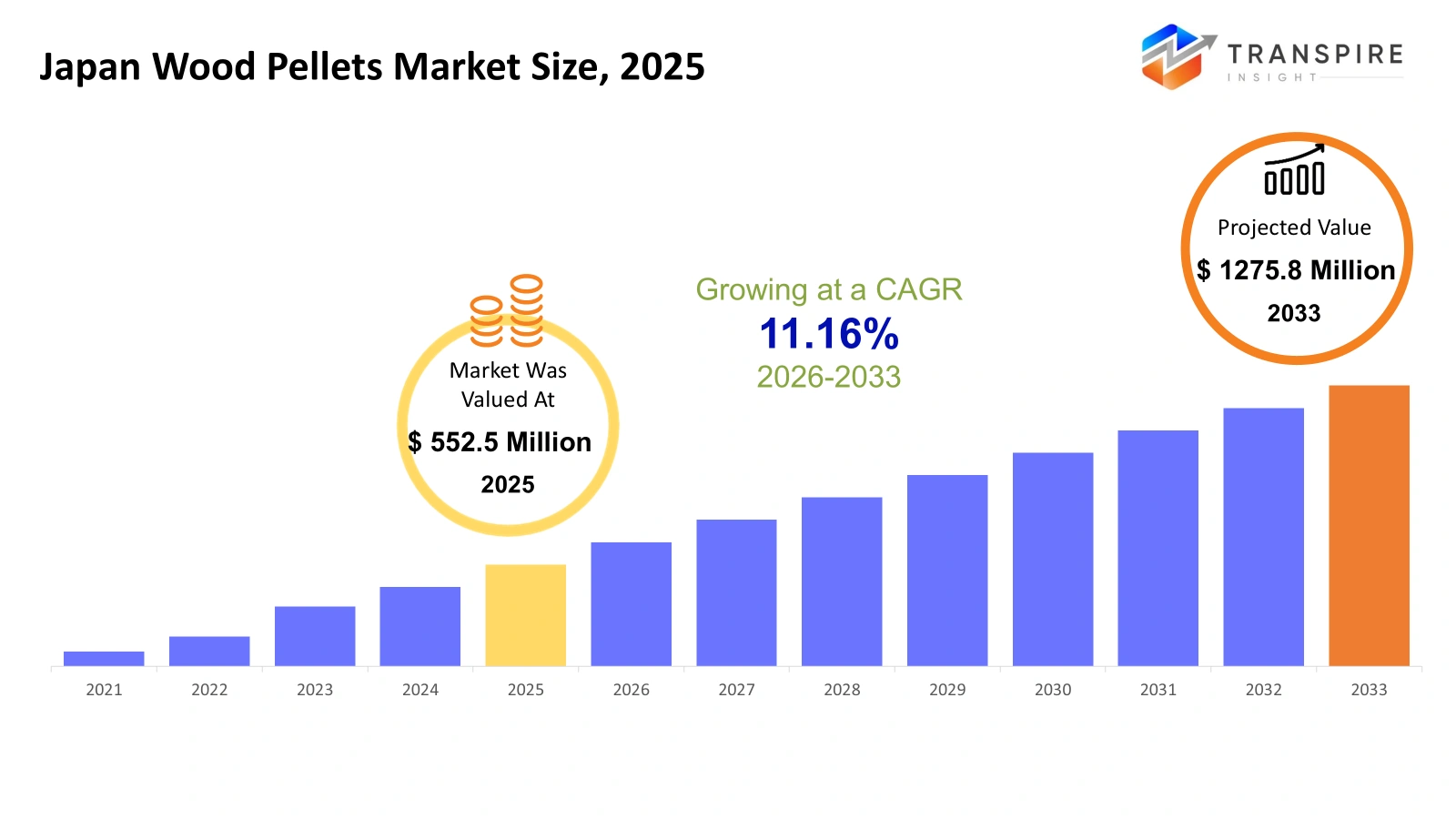
- Japan Wood Pellets Market Size 2025: USD 552.5 Million
- Japan Wood Pellets Market Size 2033: USD 1275.8 Million
- Japan Wood Pellets Market CAGR: 11.16%
- Japan Wood Pellets Market Segments:By Application (Power Generation, Residential Heating, Industrial Heating), By Source (Forest Residues, Agricultural Residues, Wood Waste).
To learn more about this report,  Download Free Sample Report
Japan Wood Pellets Market Summary:
The Japan Wood Pellets Market size is estimated at USD 552.5 Million in 2025 and is anticipated to reach USD 1275.8 Million by 2033, growing at a CAGR of 11.16% from 2026 to 2033. Japan's wood pellet market shows continuous growth because the country implements cleaner sustainable energy solutions. The government backing and increasing biomass power generation demand have made wood pellets essential for Japan's renewable energy system. Utilities and energy companies are increasingly investing in biomass plants and long-term pellet supply agreements. Japan depends on imports because of its restricted domestic resources, which establishes strong international trade ties while enabling the country to achieve its carbon emissions reduction and energy security objectives.
Key Market Trends & Insights:
- Japan uses biomass energy as a solution to create a diverse energy system which reduces its reliance on fossil fuels. Biomass power plants in Japan use wood pellets as their main fuel source to establish a transition path toward cleaner electricity production.
- The government supports renewable energy through its initiatives, which create financial incentives and establish climate change mitigation goals. The policies enable power utilities and private companies to increase their utilisation of wood pellets.
- Japan imports wood pellets from Canada, Vietnam and the United States because it has insufficient domestic forestry resources. The biomass industry has developed stronger international supply chains because of this pattern.
- Japanese energy companies are building new biomass power facilities while transforming existing coal plants into dual-fuel systems that use wood pellets. This approach enables power companies to operate their energy systems more efficiently because it decreases carbon emissions through existing power station systems.
- The market has made sustainability its main business focus, which leads companies to choose certified and responsible pellet products as their main market offering. Companies need to establish environmental standards and traceability systems to keep their supply agreements active.
- Japanese utilities use long-term contracts with global pellet vendors to maintain stable fuel procurement operations. The agreements provide consistent product quality and pricing, which enables biomass power projects to expand their operations.
Japan Wood Pellets Market Segmentation
By Application
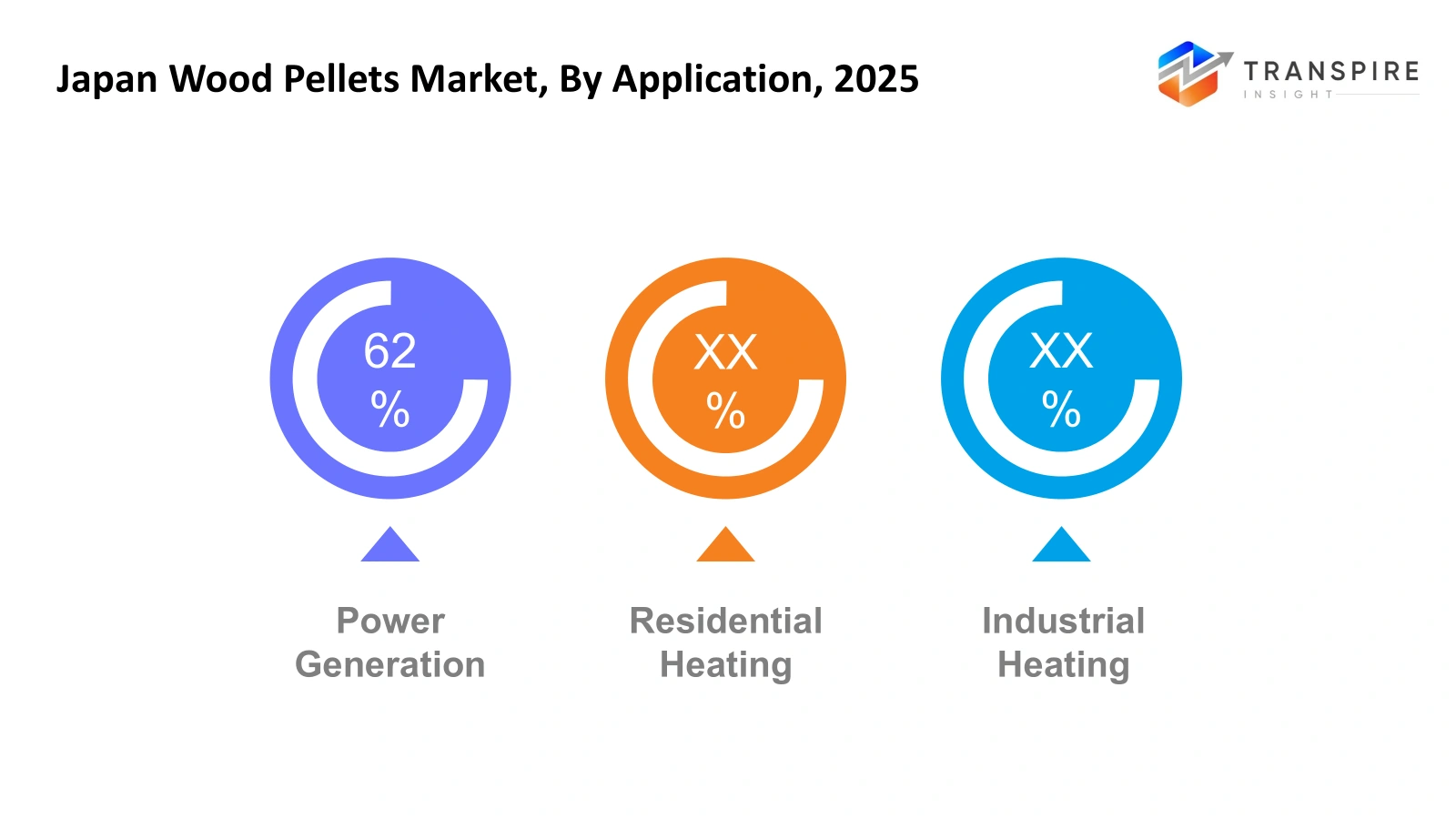
- Power Generation: The wood pellet market in Japan reaches its highest volume through power generation, which serves as its primary industrial use. Biomass power plants increasingly rely on wood pellets as a cleaner fuel alternative to coal. Utilities are also adopting co-firing technologies, which enable them to blend pellets with traditional fuels to generate electricity while reducing emissions.
- Residential Heating: The residential heating market in Japan comprises a small segment that is currently growing slowly. Cold regions of Japan are seeing increased interest in wood pellet stoves and boilers as households seek efficient, environmentally friendly heating solutions. Homeowners are beginning to adopt renewable energy technologies because they have become more environmentally conscious about different energy options.
- Industrial Heating: Wood pellets serve as an environmentally friendly fuel source that industrial facilities use to power their boilers and heating systems. Businesses investigate biomass fuel sources because they help reduce greenhouse gas emissions while decreasing their operating expenses. The development has become especially apparent in industries that adopt sustainable environmental practices and face stricter environmental regulations.
To learn more about this report, Download Free Sample Report
By Source
- Forest Residues: Forest residues, together with branches and bark and other logging by-products, serve as the primary raw material for wood pellet manufacturing. The use of these materials reduces waste, supporting environmentally friendly forestry methods. Pellet production in Japan uses both domestic forestry residues and imported materials.
- Agricultural Residues: Agricultural residues, including straw, husks, and other crop by-products, are now being studied as new materials for pellet production. These residues, which are present in smaller quantities than in wood-based materials, enable energy production through the utilisation of agricultural waste and the creation of new renewable biomass resources.
- Wood Waste: Wood waste from sawmills, furniture production and construction activities serves as a vital material for wood pellet production. The process of recycling this waste into biomass fuel results in better resource utilisation. The process converts discarded wood materials into renewable energy sources, which supports Japan’s circular economy system.
Country Insights
The wood pellet market in Japan exists because the country remains dedicated to developing renewable energy sources while decreasing its carbon emissions. Japan functions as a major wood pellet importer, which enables the country to exert substantial influence over the international biomass energy market. The demand exists because biomass power plants require pellets as their primary fuel, or use them alongside coal to generate electricity in an environmentally friendly way.
The government supports renewable energy development through its carbon neutrality policies, which create financial incentives for power companies to pursue biomass energy plants. The organisations established permanent supply contracts with North American and Southeast Asian pellet manufacturers through these programmes.
The domestic pellet production capacity in Japan remains restricted because the country only has a small amount of forest resources. The country now works to expand its capacity to process forest waste and wood materials. There is indeed room for further market expansion as Japan continues to emphasize sustainable development and moves towards meeting its energy security objectives.
Recent Development News
Japan Opens 112 MW Biomass Power Plant in Aichi to Boost Renewable Energy Capacity.
Japanese Firms Sign Deal to Import 640,000 Tonnes of Biomass Including Wood Pellets from Indonesia.
|
Report Metrics |
Details |
|
Market size value in 2025 |
USD 552.5 Million |
|
Market size value in 2026 |
USD 608.2 Million |
|
Revenue forecast in 2033 |
USD 1275.8 Million |
|
Growth rate |
CAGR of 11.16% from 2026 to 2033 |
|
Base year |
2025 |
|
Historical data |
2021 – 2024 |
|
Forecast period |
2026 – 2033 |
|
Report coverage |
Revenue forecast, competitive landscape, growth factors, and trends |
|
Country scope |
Japan |
|
Key company profiled |
Enviva Inc., Pinnacle Renewable Energy, Drax Group PLC, RWE AG, Vattenfall AB, Mitsubishi Corporation, Sumitomo Corporation, Pacific BioEnergy, Graanul Invest Group, Fram Renewable Fuels, Georgia Biomass LLC, Canfor Corporation, Viridis Energy, Energex Corporation, Pfeifer Group. |
|
Customization scope |
Free report customization (country, regional & segment scope). Avail customized purchase options to meet your exact research needs. |
|
Report Segmentation |
By Application (Power Generation, Residential Heating, Industrial Heating), By Source (Forest Residues, Agricultural Residues, Wood Waste). |
Key Japan Wood Pellets Company Insights
The Japan wood pellet market is supported by a mix of domestic energy companies and international biomass suppliers who work together to supply the growing renewable energy needs of the country. Major utilities and trading firms are actually investing in both biomass power plants and long-term pellet supply agreements to secure their fuel resources. Many companies are now dedicated to achieving environmental compliance through their sustainable sourcing and certified pellet production methods. Global production partnerships enable organisations to create stronger supply networks, while their technological progress and effective logistics systems enhance pellet storage, handling, and energy production operations.
Company List
- Enviva Inc.
- Pinnacle Renewable Energy
- Drax Group PLC
- RWE AG
- Vattenfall AB
- Mitsubishi Corporation
- Sumitomo Corporation
- Pacific BioEnergy
- Graanul Invest Group
- Fram Renewable Fuels
- Georgia Biomass LLC
- Canfor Corporation
- Viridis Energy
- Energex Corporation
- Pfeifer Group.
Japan Wood Pellets Market Report Segmentation
By Application
- Power Generation
- Residential Heating
- Industrial Heating
By Source
- Forest Residues
- Agricultural Residues
- Wood Waste
Frequently Asked Questions
Find quick answers to common questions.
The approximate Japan Wood Pellets Market size will be USD 1275.8 million in 2033.
The key segments of the Japan Wood Pellets Market are By Application (Power Generation, Residential Heating, Industrial Heating), By Source (Forest Residues, Agricultural Residues, Wood Waste).
Major players in the Japan Wood Pellets Market are Enviva Inc., Pinnacle Renewable Energy, Drax Group PLC, RWE AG, Vattenfall AB, Mitsubishi Corporation, Sumitomo Corporation, Pacific BioEnergy, Graanul Invest Group, Fram Renewable Fuels, Georgia Biomass LLC, Canfor Corporation, Viridis Energy, Energex Corporation, Pfeifer Group.
The current market size of the Japan Wood Pellets Market is USD 552.5 Million in 2025.
The Japan Wood Pellets Market CAGR is 11.16%.
- Enviva Inc.
- Pinnacle Renewable Energy
- Drax Group PLC
- RWE AG
- Vattenfall AB
- Mitsubishi Corporation
- Sumitomo Corporation
- Pacific BioEnergy
- Graanul Invest Group
- Fram Renewable Fuels
- Georgia Biomass LLC
- Canfor Corporation
- Viridis Energy
- Energex Corporation
- Pfeifer Group.
Recently Published Reports
-
Apr 2026
Healthcare Polymer Packaging Market
Healthcare Polymer Packaging Market Size, Share & Analysis Report By Packaging Type (Syringes, IV Bottles and Pouches, Clamshells, Blisters, Bottles & Jars, Containers, Tubes, IV Parental Packaging, Others), By Type (Regulated, Non-regulated), By Polymer Type (LDPE (Low-Density Polyethylene), HDPE (High-Density Polyethylene), Homo-polymer (Homo), Random Copolymer (Random), Block Copolymer (Block), PET, Polystyrene, Polyvinyl Chloride, Polyamide/EVOH, Others), and Geography (North America, Europe, Asia-Pacific, Middle East and Africa, South and Central America), 2021 - 2031
-
Apr 2026
Hydrophilic Tape (Waterstop) Market
Hydrophilic Tape (Waterstop) Market Size, Share & Analysis Report By Type (Bentonite-Based Hydrophilic Tape, Rubber-Based Hydrophilic Tape), By Application (Residential Buildings, Commercial Buildings, Infrastructure Projects), and Geography (North America, Europe, Asia-Pacific, Middle East and Africa, South and Central America), 2021 - 2031
-
Apr 2026
Metalens Market
Metalens Market Size, Share & Analysis Report By Type (Visible Light Metalens, and Infrared Metalens), By Application (Consumer Electronics, Automotive Electronics, Industrial, Medical, and Others), and Geography (North America, Europe, Asia-Pacific, Middle East and Africa, South and Central America), 2021 - 2031
-
Apr 2026
PBT Resin Market
PBT Resin Market Size, Share & Analysis Report By Type (Reinforced PBT Resin, Unreinforced PBT Resin), By Processing Method (Injection Molding, Extrusion, Blow Molding, Others), By End-User (Automotive, Electrical & Electronics, Consumer Appliances, Industrial Machinery, Medical Devices, Packaging, Others), and Geography (North America, Europe, Asia-Pacific, Middle East and Africa, South and Central America), 2021 - 2031