

Japan Variable Air Volume Systems Market Size & Forecast:
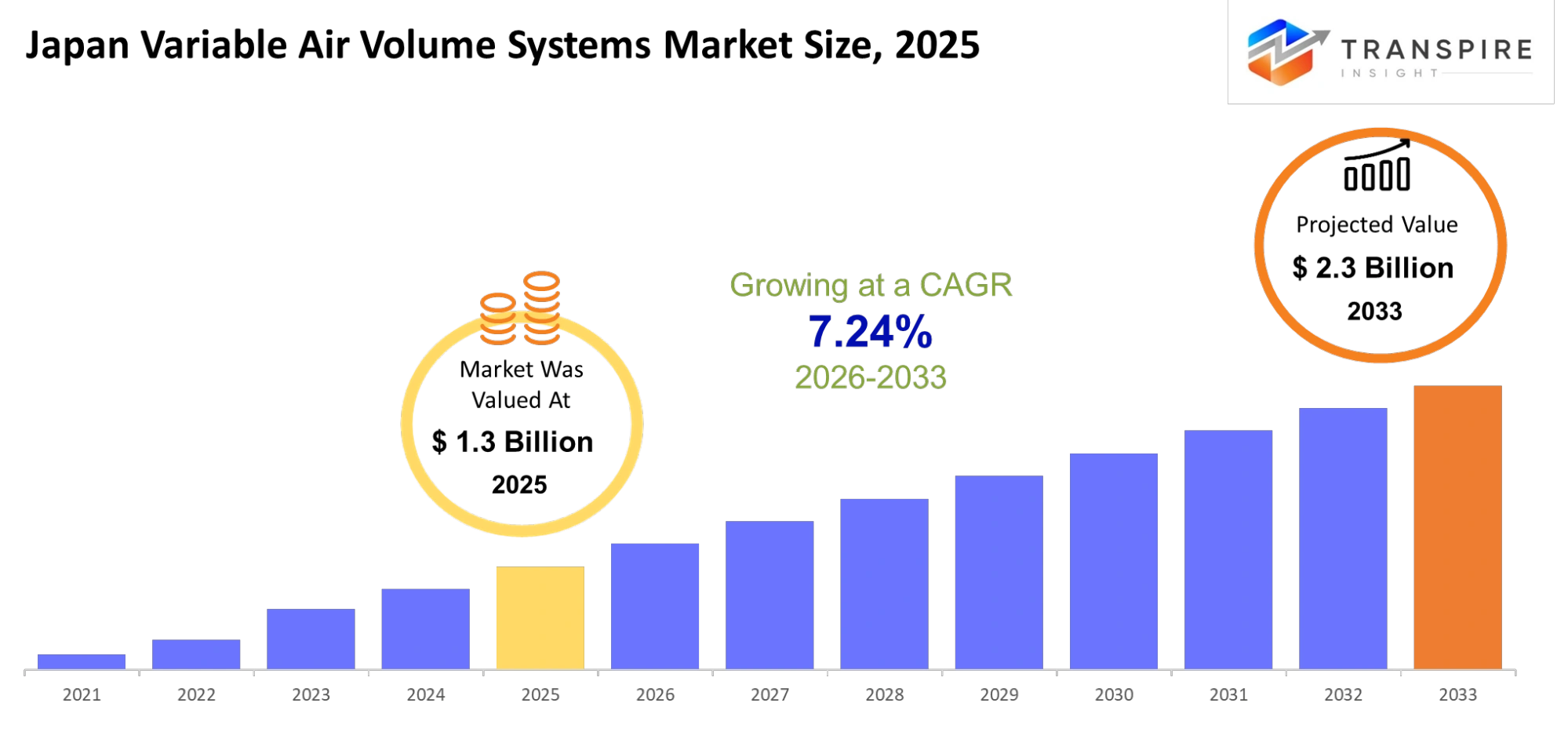
- Japan Variable Air Volume Systems Market Size 2025: USD 1.3 Billion
- Japan Variable Air Volume Systems Market Size 2033: USD 2.3 Billion
- Japan Variable Air Volume Systems Market CAGR: 7.24%
- Japan Variable Air Volume Systems Market Segments: By Type (Single Duct VAV, Dual Duct VAV, Fan Powered VAV, Pressure Independent), By Application (Commercial Buildings, Industrial Facilities, Residential Complexes, Hospitals), By End-User (HVAC Companies, Construction Firms, Building Owners, Facility Managers)
To learn more about this report,  Download Free Sample Report
Japan Variable Air Volume Systems Market Summary:
The Japan Variable Air Volume Systems Market size is estimated at USD 1.3 Billion in 2025 and is anticipated to reach USD 2.3 Billion by 2033, growing at a CAGR of 7.24% from 2026 to 2033. The Japan Variable Air Volume Systems Market in the HVAC industry is shaped by shifting building design priorities in commercial spaces and stricter environmental expectations. The demand for quieter airflow control systems which use less energy has increased because office spaces and mixed-use developments now require different types of airflow control systems. The development of sensor-based airflow modulation systems together with digital building management systems has established new standards for system installation.
The current deployment of systems across urban infrastructure has been changed by new regulations which focus on reducing carbon emissions.Future installations will increasingly align with smart building platforms, where automated airflow balancing and real-time monitoring will support occupant comfort while maintaining stricter energy performance expectations across Japan's urban facilities systems.
What Has the Impact of Artificial Intelligence Been on the Japan Variable Air Volume Systems Market?
Artificial Intelligence is changing how building climate control systems operate in the Japan Variable Air Volume Systems Market because it enables organizations to use more advanced climate control systems and better data-driven decision-making methods.
The implementation of smart automation technology leads to better operational workflows, which results in increased production efficiency and improved system performance across all organizational facilities. The Japan Variable Air Volume Systems Market uses AI-driven technologies to decrease energy consumption and cut operational expenses while providing real-time airflow control which improves indoor environmental conditions.
The Japan Variable Air Volume Systems Market is also benefiting from artificial intelligence in Japan Variable Air Volume Systems Market applications that support supply chain optimization and enable more resilient inventory planning. The Japanese Variable Air Volume Systems Market will benefit from AI implementation because manufacturers will gain market advantage through advanced building management systems and their ability to quickly adapt to new market requirements that emerge from sustainability and energy efficiency initiatives.
Key Market Trends & Insights:
- The Japan Variable Air Volume Systems Market forecast shows Kanto region will maintain its market lead with 38% share in 2025 because of its extensive commercial facilities and ongoing smart city developments.
- The Japan Variable Air Volume Systems Market will experience its strongest growth between 2025 and 2030 because the Kansai region will implement industrial modernization and green building initiatives.
- The Japan Variable Air Volume Systems Market designates Terminal VAV boxes as its main product category which holds a market share of approximately 42% because most HVAC systems undergo retrofit modifications.
- VAV controllers create a major market presence in the Japan Variable Air Volume Systems Market through their compatibility with commercial building automation system upgrades.
- The Japan Variable Air Volume Systems Market will see rapid growth until 2030 through the adoption of smart sensor VAV systems which use AI technology for building automation.
- Commercial buildings control approximately 55% of the Japan Variable Air Volume Systems Market because office spaces need better energy efficiency solutions.
- The Japan Variable Air Volume Systems Market experiences its highest growth from data centers which need accurate cooling solutions for their AI processing operations.
- The Japan Variable Air Volume Systems Market identifies office buildings as its main user category because of ongoing renovation and upgrade work.
- The Japan Variable Air Volume Systems Market experiences increased adoption from healthcare facilities because they must comply with strict air quality and energy efficiency regulations.
Japan Variable Air Volume Systems Market Segmentation
By Type :
Japanese Variable Air Volume systems will operate differently based on their design types to meet various building airflow control requirements. The single duct VAV system will control air flow through a single duct which makes it easy to operate and perfect for common building areas. The systems will find common applications in locations that need continuous air flow throughout their spaces.
The dual duct VAV system will operate with two air streams which include one warm air stream and one cool air stream to deliver air based on the requirements of different rooms. The fan powered VAV system will use built-in fans to create steady air flow throughout all operation levels including times of reduced system capacity. The pressure independent VAV system will automatically change its air flow settings which enables the system to maintain steady operation when system pressure variations occur.
By Application :
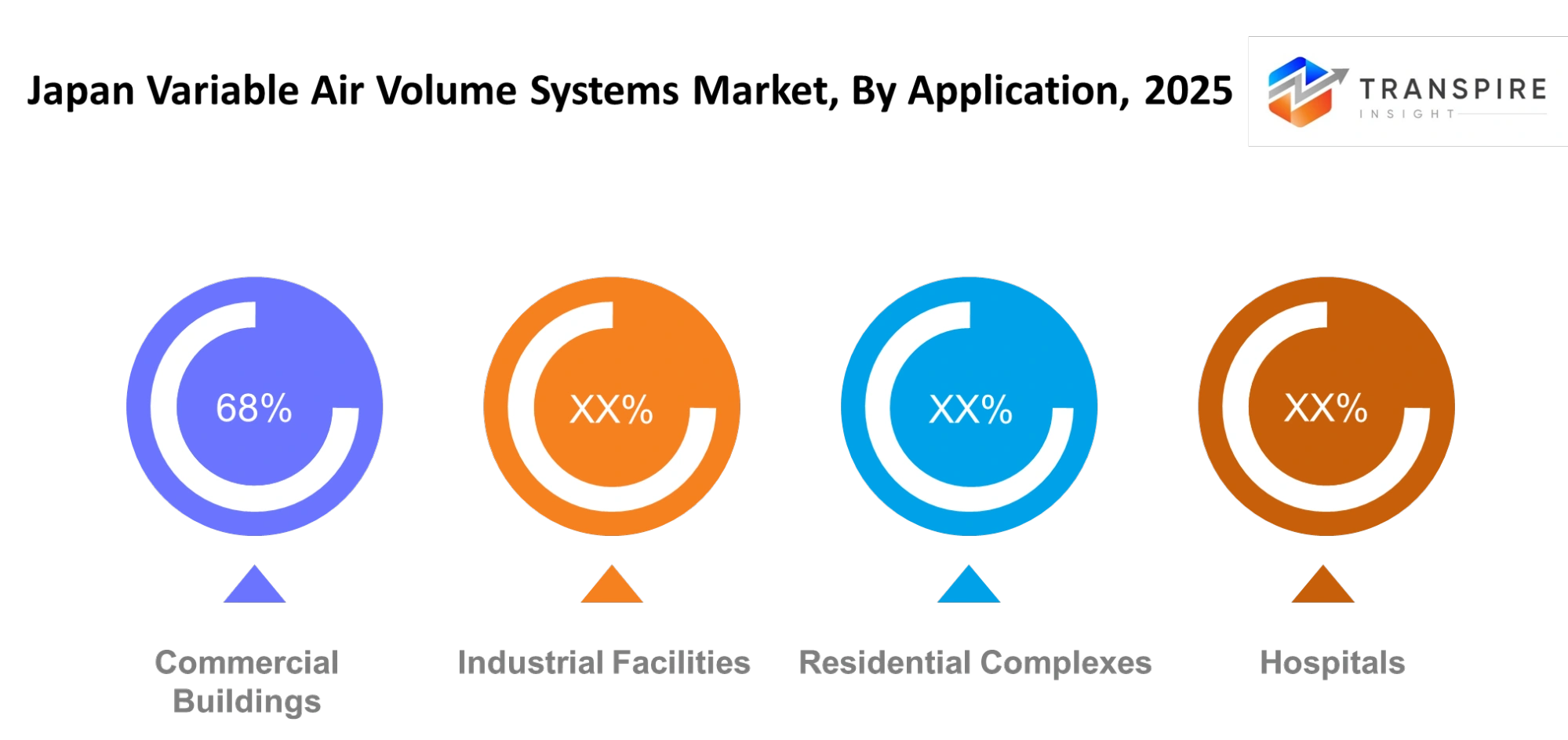
Variable Air Volume systems in Japan will see strong use across commercial buildings which require effective energy management and balanced comfort solutions. The offices and retail spaces require flexible airflow control systems which help maintain indoor comfort during times of low occupancy while decreasing energy consumption.
Industrial facilities will use these systems to manage air quality and temperature in work environments which experience different heating requirements. Residential complexes will use smaller VAV systems to create better indoor comfort and operational efficiency. Hospitals will need accurate air control systems to achieve hygienic conditions and stable temperature control and restricted air movement in their critical zones.
To learn more about this report, Download Free Sample Report
By End-User :
The HVAC companies in Japan will provide complete design and installation services for Variable Air Volume systems which they will customize according to project requirements and building dimensions. The companies will evaluate system performance and installation standards while providing ongoing maintenance services for various types of buildings.
The construction firms will implement VAV systems into their new building projects to achieve current energy standards. Building owners will invest in these systems to decrease their operational expenses while enhancing their occupants' comfort. Facility managers will supervise daily operations by maintaining correct airflow distribution and conducting system upkeep to guarantee continuous functionality.
What are the Main Challenges for the Japan Variable Air Volume Systems Market Growth?
The Japan market for variable air volume systems encounters operational and technical difficulties because its systems must be integrated with modern HVAC automation systems yet their performance relies on unpredictable load conditions. The Japan variable air volume systems market faces operational obstacles because both supply chain disruptions and scalability challenges prevent efficient system implementation in major commercial building projects. The limited ability to work with existing systems from the past makes it difficult for organizations to achieve optimization which results in diminished operational efficiency.
The Japan variable air volume systems market faces production and business development obstacles because manufacturing costs remain high while companies must meet strict regulatory standards and certification processes take an extended period to complete. These challenges in japan variable air volume systems market often delay product launches and increase overall operational expenditure. The process of maintaining quality standards that comply with GMP requirements becomes more challenging for manufacturers because they need to control energy efficiency standards.
The growth of the Japan variable air volume systems market gets hindered by both adoption issues and infrastructure limitations which specifically affect small and mid-sized facilities that face financial problems and lack skilled workers. The Japan variable air volume systems market experiences additional challenges because there is a shortage of trained HVAC technicians and digital infrastructure development happens at different rates throughout the country. The market for energy-efficient climate control systems faces increased pricing pressure because of competing technologies which also create enduring risks for the industry.
Country Insights
The Japan Variable Air Volume Systems Market experiences consistent demand growth which results from increased demand for energy-efficient climate control systems used in commercial buildings. The requirement to decrease electricity consumption in buildings creates a need for greater adoption of this technology. The development of new office spaces combined with the upgrade of HVAC systems creates stronger market presence which extends throughout urban and industrial areas.
The ongoing construction activities throughout Japan especially in commercial complexes and healthcare facilities and educational institutions lead to increased installation rates for variable air volume systems. The combination of smart building initiatives and old infrastructure upgrades creates a greater need for system replacements. The structured urban planning of Japan together with its advanced construction standards creates advantages for the Variable Air Volume Systems Market.
Japan's strict environmental regulations together with its national energy conservation goals drive the market development for airflow control systems. Variable air volume technology enables buildings to achieve lower carbon emissions while gaining better operational efficiency. The Japan Variable Air Volume Systems Market experiences growth due to government-supported sustainability programs and the rising demand for sustainable energy solutions.
Recent Development News
In April 2026, Johnson Controls International announced an upgrade to its Metasys building management platform deployed in Japan. The enhancement improves AI-driven VAV system coordination for large-scale commercial infrastructure, enabling more precise airflow and energy optimization. Source https://www.johnsoncontrols.com/
In March 2026, Mitsubishi Electric Corporation launched an advanced HVAC control module designed to improve variable air volume performance in high-rise buildings across Japan. The system integrates IoT-based occupancy sensing to dynamically regulate airflow and reduce energy consumption.Source https://www.mitsubishielectric.com/
|
Report Metrics |
Details |
|
Market size value in 2025 |
USD 1.3 Billion |
|
Market size value in 2026 |
USD 1.41 Billion |
|
Revenue forecast in 2033 |
USD 2.3 Billion |
|
Growth rate |
CAGR of 7.24% from 2026 to 2033 |
|
Base year |
2025 |
|
Historical data |
2021 - 2024 |
|
Forecast period |
2026 - 2033 |
|
Report coverage |
Revenue forecast, competitive landscape, growth factors, and trends |
|
Country scope |
Japan |
|
Key company profiled |
Daikin, Johnson Controls, Siemens, Honeywell, Carrier, Trane, Mitsubishi Electric, LG Electronics, Panasonic, Schneider Electric, ABB, Lennox, Hitachi, Fujitsu, Toshiba |
|
Customization scope |
Free report customization (country, regional & segment scope). Avail customized purchase options to meet your exact research needs. |
|
Report Segmentation |
By Type (Single Duct VAV, Dual Duct VAV, Fan Powered VAV, Pressure Independent), By Application (Commercial Buildings, Industrial Facilities, Residential Complexes, Hospitals), By End-User (HVAC Companies, Construction Firms, Building Owners, Facility Managers) |
How Can New Companies Establish a Strong Foothold in the Japan Variable Air Volume Systems Market?
New entrants can establish a strong position in the japan variable air volume systems market by focusing on smart, energy-efficient HVAC solutions tailored for Japan’s dense urban infrastructure.
The entry strategy for the japan variable air volume systems market requires businesses to focus on specific high-demand industries which include healthcare facilities and semiconductor manufacturing plants and smart city projects. The japan variable air volume systems market allows companies to establish unique market positions through predictive analytics-based airflow control and real-time monitoring. This technology resembles the market innovations developed by BrainBox AI which uses machine learning to optimize HVAC energy consumption.
The japan variable air volume systems market requires companies to establish distribution networks and gain market credibility through partnerships with local contractors and engineering firms and facility management providers. The japan variable air volume systems market enables emerging players to implement localization strategies while complying with Japan's rigorous energy efficiency standards to build trust and increase market adoption.
Key Japan Variable Air Volume Systems Market Company Insights
The Japanese commercial building sector will experience increased demand because energy efficient climate control systems provide lower operational expenses. The implementation of smart HVAC systems through new construction and retrofit projects in office buildings, hospitals, and retail stores will lead to uniform system installation throughout urban areas of the country.
Japanese HVAC manufacturers will develop their advanced variable air volume systems through enhanced sensor technology and automation capabilities that improve energy efficiency for commercial buildings. The establishment of strategic alliances with construction companies and facility management organizations will enable broader product market reach while product development efforts will enhance business presence in major city areas.
Company List
- Daikin
- Johnson Controls
- Siemens
- Honeywell
- Carrier
- Trane
- Mitsubishi Electric
- LG Electronics
- Panasonic
- Schneider Electric
- ABB
- Lennox
- Hitachi
- Fujitsu
- Toshiba
What are the Key Use-Cases Driving the Growth of Japan Variable Air Volume Systems Market?
Healthcare facilities and smart hospitals which require precise airflow control for patient safety and energy efficiency are driving strong adoption of variable air volume systems in Japan. The Japan variable air volume systems market operates through advanced VAV systems which data centers and research laboratories use to maintain constant thermal conditions needed for high-performance computing and sensitive equipment operations.
The Japan variable air volume systems market operates in manufacturing and automotive plants because production environments need consistent indoor air quality and proper ventilation for their operations. Smart VAV systems are being implemented by enterprise offices and commercial complexes to improve energy efficiency and reduce operational expenses through integration with IoT-based building management systems.
The Japan variable air volume systems market is expanding because building operators in retail infrastructure airports and smart city projects require climate control solutions which can be easily scaled and adapted to different situations. Advanced automation and predictive control technologies are driving long-term efficiency improvements which help the Japan variable air volume systems market through these two use-cases.
Japan Variable Air Volume Systems Market Report Segmentation
By Type
- Single Duct VAV
- Dual Duct VAV
- Fan Powered VAV
- Pressure Independent
By Application
- Commercial Buildings
- Industrial Facilities
- Residential Complexes
- Hospitals
By End-User
- HVAC Companies
- Construction Firms
- Building Owners
- Facility Managers
Frequently Asked Questions
Find quick answers to common questions.
The approximate Japan Variable Air Volume Systems Market size for the market will be USD 2.3 Billion in 2033.
Key segments for the Japan Variable Air Volume Systems Market are By Type (Single Duct VAV, Dual Duct VAV, Fan Powered VAV, Pressure Independent), By Application (Commercial Buildings, Industrial Facilities, Residential Complexes, Hospitals), By End-User (HVAC Companies, Construction Firms, Building Owners, Facility Managers).
Major Japan Variable Air Volume Systems Market players are Daikin, Johnson Controls, Siemens, Honeywell, Carrier, Trane, Mitsubishi Electric, LG Electronics, Panasonic, Schneider Electric, ABB, Lennox, Hitachi, Fujitsu, Toshiba.
The Japan Variable Air Volume Systems Market size is USD 1.3 Billion in 2025.
The Japan Variable Air Volume Systems Market CAGR is 7.24%.
- Daikin
- Johnson Controls
- Siemens
- Honeywell
- Carrier
- Trane
- Mitsubishi Electric
- LG Electronics
- Panasonic
- Schneider Electric
- ABB
- Lennox
- Hitachi
- Fujitsu
- Toshiba
Recently Published Reports
-
Apr 2026
Handling and Lifting Equipment Market
Handling and Lifting Equipment Market Size, Share & Analysis Report By Product (Cranes and Hoists, Forklifts, Conveyor Systems, Aerial Work Platforms, Others), By Application (E-Commerce, Automotive and Railway, Food and Beverages, Aviation, Others), and Geography (North America, Europe, Asia-Pacific, Middle East and Africa, South and Central America), 2021 - 2031
-
Apr 2026
HVAC Equipment Market
HVAC Equipment Market Size, Share & Analysis Report By Heating Equipment Type (Boilers and Furnaces, Heat Pumps, and Unitary Heaters), By Ventilation Equipment (Air Handling Units, Humidifiers and Dehumidifiers, Air Filters, and Fan Coiling Units), By Air Conditioning Equipment (Unitary Air Conditioners, Room Air Conditioners, Packaged Terminal Air Conditioners, and Chillers), By End User (Commercial, Residential, Industrial, and others), and Geography (North America, Europe, Asia-Pacific, Middle East and Africa, South and Central America), 2021 – 2031
-
Apr 2026
Refrigeration Valves Market
Refrigeration Valves Market Size, Share & Analysis Report By Type (Solenoid Valves, Expansion Valves, Check Valves, Service Valves, Others), By Application (Commercial Refrigeration, Industrial Refrigeration, Transport Refrigeration, Residential Refrigeration, Air Conditioning Systems), By End User (Food and Beverage Industry, Pharmaceutical Industry, HVAC Industry, Chemical Industry, Others), and Geography (North America, Europe, Asia-Pacific, Middle East and Africa, South and Central America), 2021 – 2031
-
Apr 2026
E-Commerce Packaging Materials Market
E-Commerce Packaging Materials Market By Material Type (Corrugated Boxes, Paper & Paperboard, Foam & Cushioning Materials, Plastic Packaging, Flexible Packaging, Protective Packaging, Others), By Product(Primary Packaging, Secondary Packaging, Tertiary Packaging), By Packaging Function (Protective Packaging, Branding & Presentation Packaging, Transit & Logistic Packaging, Sustainable Packaging, Tamper Evidence Packaging), By End-User (Retail & Consumer Goods, Electronic Appliances, Food & Beverages, Healthcare & Pharmaceutical, Fashion & Apparel, Home & Furnishing, Others); By Industry Analysis, Size, Share, Growth, Trends, and Forecasts 2021-2033