

Japan Textile Market Size & Forecast:
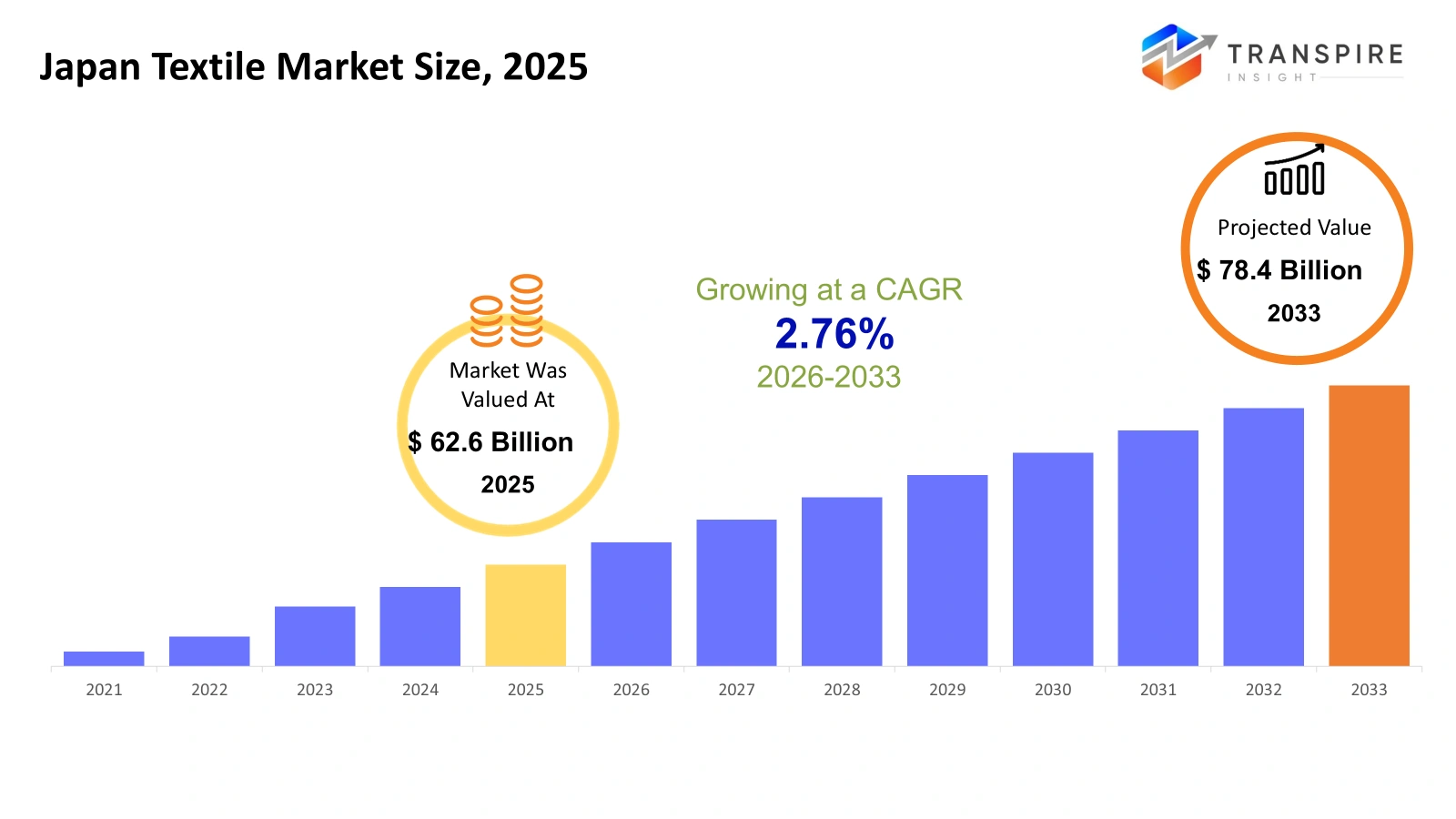
- Japan Textile Market Size 2025: USD 62.6 Billion
- Japan Textile Market Size 2033: USD 78.4 Billion
- Japan Textile Market CAGR: 2.76%
- Japan Textile Market Segments:By Product Type (Natural Fibers, Synthetic Fibers, Blended Fibers), By Application (Apparel, Home Textiles, Industrial Textiles).
To learn more about this report,  Download Free Sample Report
Japan Textile Market Summary:
The Japan Textile Market size is estimated at USD 62.6 Billion in 2025 and is anticipated to reach USD 78.4 Billion by 2033, growing at a CAGR of 2.76% from 2026 to 2033. The Japanese textile industry exists as a dynamic combination of its traditional roots and its contemporary technological advancements, which showcase centuries of crafting skills. The sector produces high-quality fabrics, which include silk, cotton and synthetic blends, to serve both domestic fashion needs and international market demands. Japanese companies adopt sustainable practices through their use of environmentally friendly materials and processes, which help decrease their ecological footprint. Japan’s textile market maintains its successful operation through its dedication to design and durability and innovative solutions while it preserves traditional practices and current fashion trends.
Key Market Trends & Insights:
- Japanese textile companies are implementing sustainable fashion practices through their use of environmentally friendly materials and energy-saving production methods, which meet worldwide demand for sustainable fashions while decreasing their environmental footprint.
- The market for smart textiles and wearable fabrics is growing as new technologies enable fabrics to provide moisture control and temperature management and bacteria elimination.
- Japan has established itself as a global textile market through its increasing fabric exports, which have expanded to fashion centres in Europe and North America.
- The luxury market niche sector experiences growth because customers now prefer premium textiles, which include silk and high-quality cotton, for their exclusive designs and expert craftsmanship.
- E-commerce platforms and virtual textile showrooms provide brands with the ability to reach a larger customer base while creating customised shopping experiences.
Japan Textile Market Segmentation
By Product Type
- Natural Fibers: The Japanese textile industry keeps its traditional practice of using natural fibers because they provide comfort and durability and maintain their historical value. The traditional weaving methods are used by artisans and modern manufacturers, who create designs that attract fashion customers and luxury markets which prefer sustainable, high-quality materials.
- Synthetic Fibers: People choose synthetic fibers, which include polyester, nylon and rayon, because these materials offer multiple uses, low costs and good performance characteristics. Japanese manufacturers create innovative lightweight fabrics which provide moisture-wicking properties and wrinkle resistance to meet rising demand in sportswear and uniforms and functional fashion markets while maintaining energy-efficient production methods.
- Blended Fibers: Blended fabrics create a combination of natural and synthetic fibers which provides people with two advantages: they can wear comfortable and durable materials that also save them money. Japan’s textile sector uses these fabric blends to produce apparel and industrial materials which maintain their visual appeal while improving their strength and elastic properties and simple upkeep.
By Application
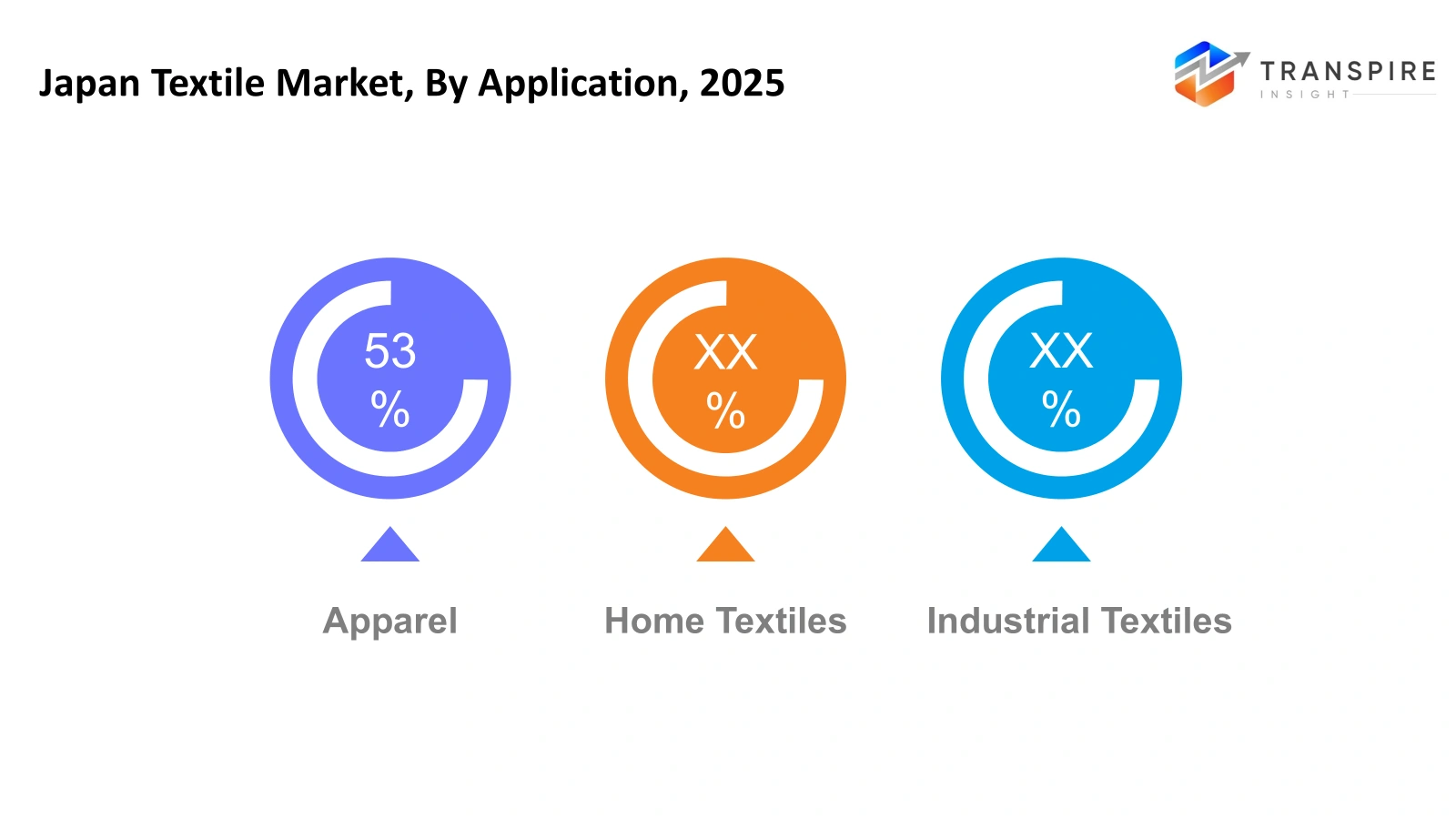
- Apparel: The biggest market segment continues to be apparel because it attracts consumers through its combination of fashion trends and functional clothing and luxurious products. The Japanese textile industry produces highly valued fabrics which combine comfort and stylish design and advanced textile technology to meet the needs of local and overseas customers.
- Home Textiles: The market derives its value from home textiles, which include bedding, curtains, carpets and upholstery. Japanese manufacturers use natural fibers and sustainable processes to create home textiles which combine durability and comfort with elegant designs that suit modern household needs.
- Industrial Textiles: Japanese industrial textiles support automotive and medical and protective and construction needs. The Japanese textile industry demonstrates its ability to create high-performance fabrics which deliver strength and fire resistance and specialised features through its precision manufacturing methods and technical textile research.
To learn more about this report, Download Free Sample Report
Country Insights
Japan's textile industry combines its heritage craftsmanship with contemporary technological innovations. The country is globally recognised for its high-quality fabrics, which include luxurious silk and fine cotton and technologically advanced synthetic and blended textiles. Japanese manufacturers design their products to achieve exact specifications through expert craftsmanship, which results in durable items that consumers want to purchase throughout the world. Sustainability has become a key focus which companies use to meet the increasing demand for responsible fashion through their adoption of eco-friendly materials and energy-efficient production methods.
Japan operates as an international centre for technical textiles because the country produces fabrics that serve automotive, medical and industrial needs while demonstrating its research and innovation capabilities. The market achieves success through fashion-forward products which integrate traditional indigo dyeing and kimono weaving methods with contemporary fashion trends to attract customers from all over the world. Japan’s textile industry demonstrates its exceptional capabilities through its ability to create high-quality products and develop innovative solutions while maintaining its traditional Japanese heritage.
Recent Development News
Japan to draw up action plan to reduce clothing waste: Authorities are working on structured policies to manage increasing clothing waste and improve recycling systems nationwide.
Japan to cut apparel waste by 25% with recycling push: Japan is encouraging reuse, repair, and recycling through collaboration between businesses, households, and local governments.
|
Report Metrics |
Details |
|
Market size value in 2025 |
USD 62.6 Billion |
|
Market size value in 2026 |
USD 64.8 Billion |
|
Revenue forecast in 2033 |
USD 78.4 Billion |
|
Growth rate |
CAGR of 2.76% from 2026 to 2033 |
|
Base year |
2025 |
|
Historical data |
2021 – 2024 |
|
Forecast period |
2026 – 2033 |
|
Report coverage |
Revenue forecast, competitive landscape, growth factors, and trends |
|
Country scope |
Japan |
|
Key company profiled |
Toray Industries Inc., Teijin Limited, Mitsubishi Chemical Group, Kuraray Co. Ltd., Asahi Kasei Corporation, Toyobo Co. Ltd., Nisshinbo Holdings Inc., Unitika Ltd., Lenzing AG, Indorama Ventures PCL, Reliance Industries Limited, Hyosung Corporation, Far Eastern New Century Corporation, Kolon Industries Inc., Shandong Ruyi Technology Group. |
|
Customization scope |
Free report customization (country, regional & segment scope). Avail customized purchase options to meet your exact research needs. |
|
Report Segmentation |
By Product Type (Natural Fibers, Synthetic Fibers, Blended Fibers), By Application (Apparel, Home Textiles, Industrial Textiles) . |
Key Japan Textile Company Insights
Japan's textile industry combines traditional methods with modern technology to create high-quality fabrics which they sell in domestic and international markets. The main manufacturers of the industry emphasise three core values, which include producing precise products that maintain their quality throughout time while using environmentally sustainable methods to manufacture their items. The companies study smart textiles and technical textiles to create clothing and medical and industrial solutions, which shows their dedication to research and development. Japanese textile companies establish worldwide standards for product quality and creative design through their combination of traditional silk weaving and indigo dyeing methods with contemporary design elements.
Company List
- Toray Industries Inc.
- Teijin Limited
- Mitsubishi Chemical Group
- Kuraray Co. Ltd.
- Asahi Kasei Corporation
- Toyobo Co. Ltd.
- Nisshinbo Holdings Inc.
- Unitika Ltd.
- Lenzing AG
- Indorama Ventures PCL
- Reliance Industries Limited
- Hyosung Corporation
- Far Eastern New Century Corporation
- Kolon Industries Inc.
- Shandong Ruyi Technology Group
Japan Textile Market Report Segmentation
By Product Type
- Natural Fibers
- Synthetic Fibers
- Blended Fibers
By Application
- Apparel
- Home Textiles
- Industrial Textiles
Frequently Asked Questions
Find quick answers to common questions.
The approximate Japan Textile Market size for the market will be USD 78.4 Billion in 2033.
The key segments of the Japan Textile Market are By Product Type (Natural Fibers, Synthetic Fibers, Blended Fibers), By Application (Apparel, Home Textiles, Industrial Textiles) .
Major players in the Japan Textile Market are Toray Industries Inc., Teijin Limited, Mitsubishi Chemical Group, Kuraray Co. Ltd., Asahi Kasei Corporation, Toyobo Co. Ltd., Nisshinbo Holdings Inc., Unitika Ltd., Lenzing AG, Indorama Ventures PCL, Reliance Industries Limited, Hyosung Corporation, Far Eastern New Century Corporation, Kolon Industries Inc., Shandong Ruyi Technology Group.
The current market size of the Japan Textile Market is USD 62.6 Billion in 2025.
The Japan Textile Market CAGR is 2.76%.
- Toray Industries Inc.
- Teijin Limited
- Mitsubishi Chemical Group
- Kuraray Co. Ltd.
- Asahi Kasei Corporation
- Toyobo Co. Ltd.
- Nisshinbo Holdings Inc.
- Unitika Ltd.
- Lenzing AG
- Indorama Ventures PCL
- Reliance Industries Limited
- Hyosung Corporation
- Far Eastern New Century Corporation
- Kolon Industries Inc.
- Shandong Ruyi Technology Group
Recently Published Reports
-
Apr 2026
Bottled Water Market
Bottled Water Market Size, Share & Analysis Report By Product Type (Still Bottled Water, Carbonated Bottled Water, Functional Bottled Water, and Others), By Packaging (PET, Cans, and Others), By Sales Channel (Supermarkets/Hypermarkets, Convenience Stores/Drug Stores, Grocery Stores/Club Stores, Foodservice, and Others) and Geography (North America, Europe, Asia-Pacific, Middle East and Africa, South and Central America), 2021 - 2032
-
Apr 2026
Color Cosmetic Packaging Market
Color Cosmetic Packaging Market Size, Share & Analysis Report By Application (Mascara Packaging, Liquid Packaging, and Liquid Face), By Type (Tubes & Bottles, Pens & Markers, Compacts & Containers, and Droppers & Pumps), and Geography (North America, Europe, Asia-Pacific, Middle East and Africa, South and Central America), 2021 - 2031
-
Apr 2026
External Microphone For Camera Market
External Microphone For Camera Market Size, Share & Analysis Report By Type (Shotgun Microphone, Lavalier Microphone, and Others), By Application (Digital Camera, Professional Video Camera, and Others), and Geography (North America, Europe, Asia-Pacific, Middle East and Africa, South and Central America), 2021 - 2031
-
Apr 2026
Foot Orthotic Insoles Market
Foot Orthotic Insoles Market Size, Share & Analysis Report By Type (Pre-fabricated, and Custom-made), By Material (Thermoplastic, Composite Carbon Fiber, and Others), By Distribution Channel (Drug Stores, Hospitals & Clinics, and Others), and Geography (North America, Europe, Asia-Pacific, Middle East and Africa, South and Central America), 2021 - 2031