

Japan Monoterpenes Market Size & Forecast:
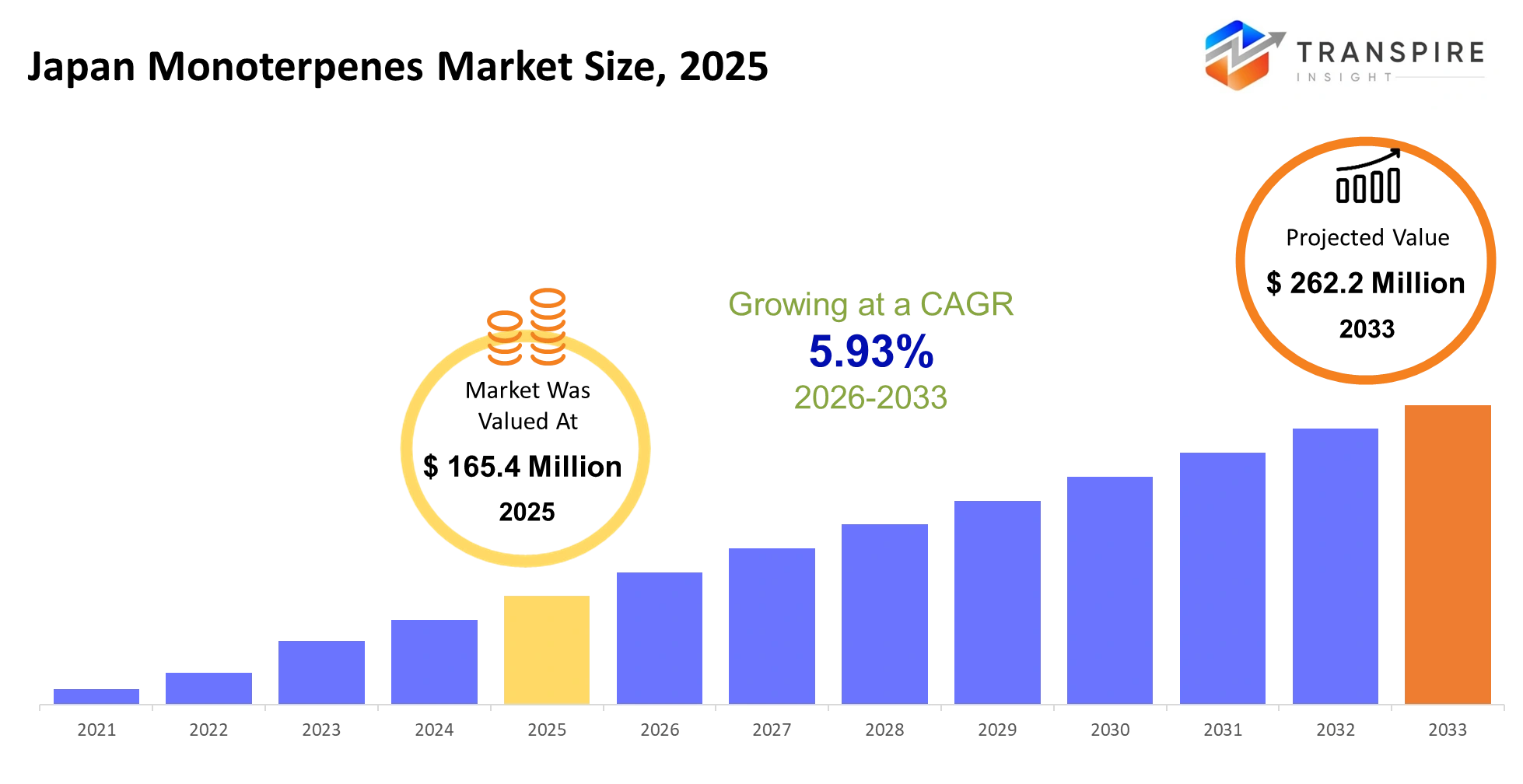
- Japan Monoterpenes Market Size 2025: USD 165.4 Million
- Japan Monoterpenes Market Size 2033: USD 262.2 Million
- Japan Monoterpenes Market CAGR: 5.93%
- Japan Monoterpenes Market Segments: By Type (Acyclic Monoterpenes, Monocyclic Monoterpenes, Bicyclic Monoterpenes, Oxygenated Monoterpenes, Synthetic Monoterpenes, Others); By Application (Fragrances, Pharmaceuticals, Food & Beverages, Cosmetics, Agrochemicals, Industrial Chemicals, Others); By End-User (FMCG Companies, Pharma Companies, Cosmetic Industry, Food Industry, Chemical Industry, Research Institutes, Others); By Form (Liquid, Powder, Crystals, Essential Oils, Others).
To learn more about this report,  Download Free Sample Report
Japan Monoterpenes Market Summary
The Japan Monoterpenes Market was valued at USD 165.4 Million in 2025. It is forecast to reach USD 262.2 Million by 2033. That is a CAGR of 5.93% over the period.
The Japan monoterpenes market operates in multiple industries by providing natural components which enhance product development and increase product lifespan and enable environmentally friendly chemical manufacturing. The compounds hold particular value for producers who need to replace fossil fuel materials while delivering functional results in taste and scent and medicinal uses.
The market has developed a new structure since the last three to five years because companies now use bio-based methods for extraction and their advanced methods of precise purification. The chemical safety regulations became more strict together with Japan's initiative to achieve sustainable industrial resource use. The worldwide supply chains broke down during the pandemic period in addition to its aftermath, which caused Japan to realize its dependence on imported raw terpene feedstocks. This situation forced domestic producers to improve their local sourcing and processing capabilities.
The market growth has followed this particular path. The monoterpene market has expanded because companies now use these components as necessary elements for their products, which comply with both cleaner-label standards and upcoming regulatory demands. This development has created stronger market demand, which provides suppliers with consistent income for the long term.
Key Market Insights
- The Japan Monoterpenes Market is controlled by the Kanto region which secures 38% of the market share in 2025 through its active perfume and cosmetic and pharmaceutical production facilities.
- Kansai holds a significant share at 27% which results from its advanced chemical processing facilities and its network of specialty ingredient suppliers.
- Chubu develops into the fastest-expanding regional market which will experience strong growth until 2030 because of industrial diversification and local production development.
- Limonene leads the Japan Monoterpenes Market with approximately 34% industry size share in 2025 due to wide solvent and flavoring applications.
- Pinene holds the second position in the market with a 26% share which it maintains through its use in resin production and fragrance intermediate manufacturing.
- The Myrcene market segment shows the highest growth rate because its development will continue until 2026 until 2030 due to increasing demand from pharmaceutical and nutraceutical companies.
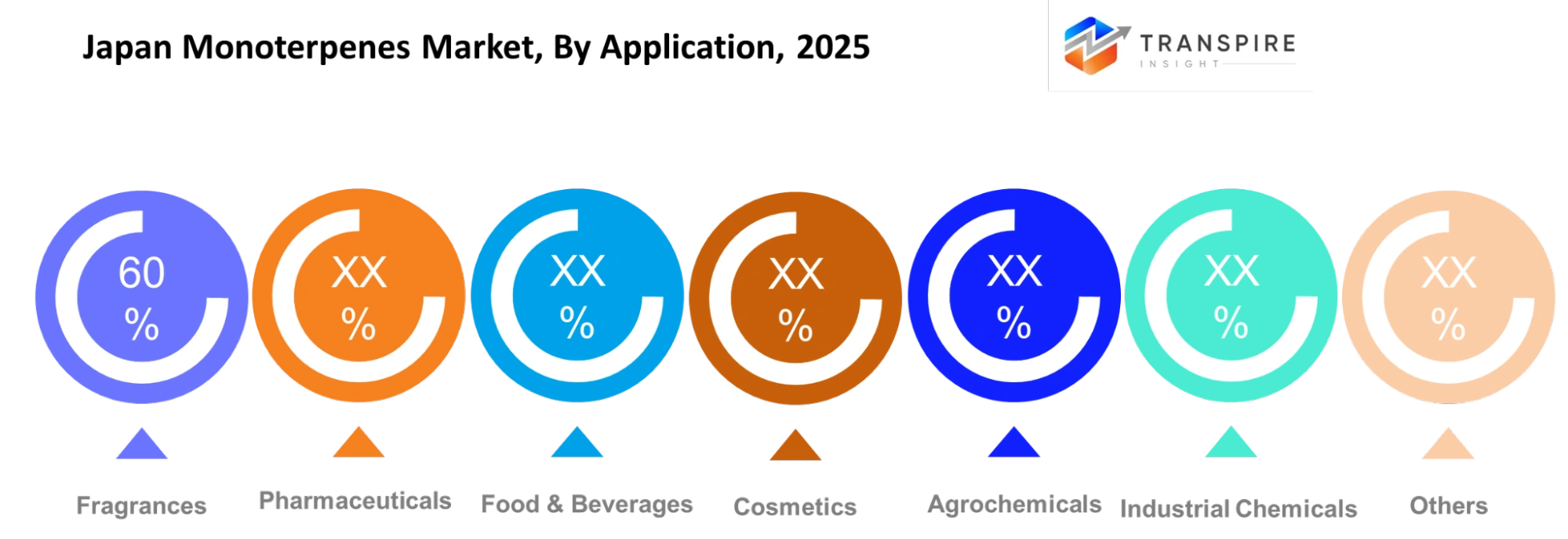
- Japan reaches its highest market ownership through fragrance and flavor applications which control 41% of the market because of its strong premium personal care and processed food industries.
- The cosmetics and personal care industry drives demand in Japan Monoterpenes Market which will generate approximately 36% of its revenue during 2025.
- The food and beverage processing industry uses natural flavors to create its second most important user segment which follows the first user segment.
- The pharmaceutical industry shows new demand which will increase at a high rate until 2030 according to market forecasts.
What are the Key Drivers, Restraints, and Opportunities in the Japan Monoterpenes Market?
The Japan Monoterpenes Market experiences its strongest growth through the ongoing reformulation process which affects cosmetics and food flavoring and pharmaceutical production after the implementation of stricter chemical safety regulations and ingredient disclosure requirements that have been enforced since recent years. Japanese manufacturers have responded by replacing synthetic aromatic intermediates with monoterpene-based compounds that offer traceable sourcing and lower residual toxicity profiles.
The company increased its purchases of high-purity limonene and pinene derivatives, which allowed suppliers to control prices and generated higher revenue for domestic specialty chemical processors. The market’s most significant barrier is Japan’s structural dependence on imported citrus peel extracts, pine-derived feedstocks, and other terpene-rich raw materials.
The situation requires a lengthy period because domestic agriculture lacks sufficient capacity to produce industrial-grade output while establishing local refining facilities demands extended time for financial investments and governmental permissions. The manufacturing process experiences increased procurement unpredictability because of production delays which create financial difficulties that hinder mid-sized manufacturers from expanding their operations.
Pharmaceuticals and functional wellness applications show the most significant growth potential through their advanced terpene encapsulation technologies. The current research funding for microencapsulation systems enables controlled release of monoterpenes which scientists use to create therapeutic and nutraceutical products. Japan's increasing elderly population drives healthcare innovation which enables businesses that develop precision delivery systems and clinical-grade terpene processing to access new market growth opportunities.
What Has the Impact of Artificial Intelligence Been on the Japan Monoterpenes Market?
The monoterpenes sector of Japan is undergoing transformation through artificial intelligence and advanced digital technologies which enhance extraction efficiency and production consistency and supply chain responsiveness throughout specialty chemical manufacturing. The producers use AI-enabled process control systems to automate distillation temperature adjustments and track terpene purity levels and maximize solvent recovery cycles. The systems decrease the need for manual work while they assist in achieving more consistent batch production which pharmaceutical and fragrance-grade compounds require to meet industry standards.
Extraction and purification equipment now uses machine learning models for their predictive maintenance needs. The systems detect equipment wear through their ability to analyze vibration patterns and pressure fluctuations and thermal deviations which lead to failures. The processors report directional improvements through their ability to decrease unplanned downtime and separate processes which consume less energy and achieve more consistent production yields. AI-based forecasting tools enable manufacturers to estimate raw material availability and price fluctuations which enables procurement teams to modify their sourcing plans before production disruptions occur.
The technology improves regulatory compliance because it automates documentation processes which establish traceability and verify product purity. The system delivers cost savings for administrative work while it improves the organizationW?s capability to prepare for international shipments. The system faces its main challenge through excessive costs which make it difficult for mid-sized processors who use older refining systems to implement the system. The existing historical process data restrictions cause model accuracy losses because they cannot capture seasonal feedstock changes, which prevents digital technology adoption across Japan's specialized terpene processing industry.
Key Market Trends
- The Japanese processors since 2022 achieved an 18% increase in their domestic refinement capacity which decreased their need for Southeast Asian citrus extract imports that existed during the pandemic.
- The ingredient traceability requirements which companies needed to follow between 2021 and 2024 required Takasago International Corporation to develop blockchain-based systems for verifying their sourcing processes.
- The period from 2023 through 2025 saw pharmaceutical buyers increasing their procurement of high-purity limonene which resulted from intensified therapeutic formulation research across Japan's clinical ingredient supply chain.
- The manufacturers after 2024 started using AI-powered distillation controls which resulted in reduced batch variability and better terpene purity maintenance throughout their fragrance and nutraceutical manufacturing processes.
- The importers since 2022 reduced their spot-market buying activities by approximately 22% because they preferred long-term supplier contracts which protected their profit margins from fluctuations in citrus feedstock prices.
- The collaboration between domestic refiners and Givaudan as a global partner resulted in faster technology transfer of advanced terpene purification methods.
- Since 2023, food formulators have moved away from synthetic aroma compounds because the new ingredient labeling standards changed their purchasing practices in the processed beverage industry.
- Japanese specialty chemical producers who export their products have shifted their business focus away from volume-based sales to specialized production of premium clinical-grade terpenes.
- Manufacturers upgraded their solvent recovery systems because sustainability audits established after 2024 which reduced waste during processing and enhanced operational performance in their terpene extraction plants.
Japan Monoterpenes Market Segmentation
By Type :
The Japanese market for monoterpenes relies on consumers who use acyclic monoterpenes and monocyclic monoterpenes for their fragrance needs and their ability to enhance flavors and their requirement for food formulation. The products show high adoption rates in personal care items and food products which require pleasant scents and clean smells.
Bicyclic monoterpenes and oxygenated monoterpenes and synthetic monoterpenes and other variants support pharmaceuticals and agrochemicals and industrial chemicals. These types improve drug formulation systems and crop protection products and industrial processing applications through enhanced stability and chemical strength and aroma balance.
By Application :
The Japan monoterpenes market derives its demand from fragrance and cosmetics applications which use monoterpenes for creating scents and formulating personal care products and enhancing their premium offerings. The sector shows high demand for skincare products and perfumes and grooming items because customers consider fragrance quality to be essential.
The Japanese market uses monoterpenes for various applications which include pharmaceuticals and food and beverages and agrochemicals and industrial chemicals. The functional roles for healthcare and agriculture and manufacturing industries include flavor improvement as well as preservation support and chemical synthesis and formulation stability.
To learn more about this report, Download Free Sample Report
By End-User :
FMCG companies, the cosmetic industry, and the food industry create a major demand base for Japan's monoterpenes market through their extensive production and packaging and product development activities. The manufacturing cycles of consumer products create strong requirements which businesses need to fulfill.
Pharma companies and the chemical industry and research institutes in Japan drive both innovation and practical applications of monoterpenes. The applications of this research extend to drug formulation studies and chemical development work and experimental research which supports industrial advancement and product improvement.
By Form :
The Japanese monoterpenes market exists through liquid and essential oil forms which enable easy mixing together with their ability to dissolve everything and their broad application in producing fragrances and cosmetics and food flavors. These forms support smooth blending in multiple product lines.
Powder and crystal forms support controlled release, storage stability, and efficient handling in pharmaceutical, food, and chemical applications. These formats assist industrial processing, precise formulation, and long-term material stability across manufacturing systems.
What are the Key Use Cases Driving the Japan Monoterpenes Market?
The primary factor that drives adoption of monoterpenes in premium fragrance and cosmetic manufacturing for monoterpenes handles dual functions as both fundamental aromatic components and essential components for perfume and skincare and personal care product development. Japanese cosmetic producers depend on these compounds because they produce stable fragrance results which meet their needs for product safety and ingredient tracking procedures.
The use of this technology has increased in both processed food and pharmaceutical production facilities. Food processors increasingly apply terpene derivatives to natural flavor reformulation as labeling standards tighten while pharmaceutical companies integrate purified compounds into excipients and therapeutic delivery systems for precision formulation performance. New functional wellness products and advanced agrochemical products are developing new applications.
Nutraceutical developers are exploring encapsulated terpene delivery for controlled-release supplements while agricultural input manufacturers are testing bioactive terpene blends for plant protection solutions. The current applications of this technology exist in their beginning phase, yet commercial potential exists because formulation technology will continue to develop throughout the forecast period.
|
Report Metrics |
Details |
|
Market size value in 2025 |
USD 165.4 Million |
|
Market size value in 2026 |
USD 175.2 Million |
|
Revenue forecast in 2033 |
USD 262.2 Million |
|
Growth rate |
CAGR of 5.93% from 2026 to 2033 |
|
Base year |
2025 |
|
Historical data |
2021 - 2024 |
|
Forecast period |
2026 - 2033 |
|
Report coverage |
Revenue forecast, competitive landscape, growth factors, and trends |
|
Country scope |
Japan |
|
Key company profiled |
BASF, Symrise, Givaudan, Firmenich, Takasago, Mane, Sensient, Robertet, IFF, Kao, DSM, Evonik, Solvay, Merck, Dow. |
|
Customization scope |
Free report customization (country, regional & segment scope). Avail customized purchase options to meet your exact research needs. |
|
Report Segmentation |
By Type (Acyclic Monoterpenes, Monocyclic Monoterpenes, Bicyclic Monoterpenes, Oxygenated Monoterpenes, Synthetic Monoterpenes, Others); By Application (Fragrances, Pharmaceuticals, Food & Beverages, Cosmetics, Agrochemicals, Industrial Chemicals, Others); By End-User (FMCG Companies, Pharma Companies, Cosmetic Industry, Food Industry, Chemical Industry, Research Institutes, Others); By Form (Liquid, Powder, Crystals, Essential Oils, Others). |
Which Regions are Driving the Japan Monoterpenes Market Growth?
The Kanto region leads Japan's monoterpenes industry because it combines the country's largest specialty chemical manufacturing base with strong regulatory oversight and direct access to advanced research infrastructure. Tokyo and Yokohama house significant fragrance and pharmaceutical and high-value chemical manufacturing companies which need permanent access to pure terpene materials for their extensive product development work. The system enables dependable material transfer because it allows companies to transport assets through their interconnected port facilities and distribution centers.
Manufacturers and research institutions and technology providers create a regional advantage by working together to develop new products which they bring to market. The Kansai region holds the second-largest position, but growth logic differs from Kanto because stability comes from established industrial specialization rather than concentration of corporate headquarters. Chemical processing centers in Osaka and Kobe have operated for many years because they rely on established supplier networks and they complete procurement activities for food and cosmetic and industrial needs. The region benefits from resilient mid-sized manufacturers that maintain consistent production even during external feedstock disruptions. Kansai operation provides trustworthy national revenue through its steady growth which results from careful capital spending and constant demand from end users.
The Chubu region exhibits its fastest growth rate because of industrial diversification and manufacturing modernization programs which started in 2024. Regional producers have expanded their specialty chemical processing capacity while they implemented digital process optimization systems which boost extraction efficiency and product quality. Increased investment in pharmaceutical ingredient production has generated additional demand for high-purity terpene derivatives. The acceleration process establishes appealing investment opportunities for investors and technology providers between 2026 and 2033 especially in the fields of precision processing equipment and advanced purification solutions.
Who are the Key Players in the Japan Monoterpenes Market and How Do They Compete?
The Japanese monoterpenes market exhibits moderate competition because most high-value supply is controlled by a few specialty chemical and fragrance ingredient makers while smaller companies target lower-purity industrial markets. The main competition between companies has moved from raw material access and pricing to purification technology and traceability systems and formulation-specific customization. Existing companies conduct share protection activities through their support of advanced processing technologies while selected international companies pursue premium pharmaceutical and cosmetic markets which require technical expertise more than production cost advantages.
Takasago International Corporation competes through its exact formulation capabilities which work together with Japanese cosmetic and fragrance companies. The company builds its strength through creating unique aromatic compounds as it works together with Japanese personal care companies to develop products at a faster rate than its bigger multinational competitors. The company keeps growing by creating research partnerships that develop natural ingredient processes and sensory technology for upcoming products.
Kuraray Co., Ltd. establishes its market position through its advanced chemical synthesis capabilities and its process engineering expertise which enable the company to produce high-purity terpene derivatives used in industrial applications and pharmaceutical products. Givaudan operates its business by developing high-quality natural ingredients which it sources from its international network of suppliers to ensure consistent availability of production materials. Symrise AG expands its business operations by establishing regional technical support centers and conducting application-specific co-development projects which assist customers in speeding up their product reformulation processes while building long-term supply partnerships.
Company List
Recent Development News
In April 2026, BASF announced the start of commercial production of menthol and linalool at its expanded aroma ingredients facilities, strengthening global terpene-derived fragrance supply chains that directly support downstream Japanese monoterpene applications in flavors and fragrances. The expansion improves supply reliability for monoterpene-based aroma chemicals used by Asian manufacturers, including Japanese formulators.
Source: https://www.basf.com/
In April 2026, Mitsui Chemicals, Idemitsu Kosan, and Sumitomo Chemical received Japan Fair Trade Commission clearance for their integration of polypropylene and polyethylene businesses under Prime Polymer, strengthening Japan’s polyolefin and specialty chemical production base that supports downstream terpene-derived additives and industrial solvent applications. The integration is expected to improve domestic feedstock efficiency for specialty chemical value chains.
Source: https://jp.mitsuichemicals.com/
What Strategic Insights Define the Future of the Japan Monoterpenes Market?
The Japan monoterpenes market will transition from its current state to pharmaceutical-grade production operations while developing precision-engineered terpene derivatives between 2023 and 2028. The market shift exists because healthcare and nutraceutical and premium personal care sectors now require tighter formulation standards which make buyers value molecular consistency and traceability and functional performance more than they value cost efficiency. The suppliers who possess advanced purification technology and develop tailored solutions for specific applications will generate the most business value in the market.
The business faces a hidden danger because it relies on a small number of essential raw materials. The processors who depend heavily on imported citrus and pine-derived feedstocks face operational risks because agricultural climate changes and trade restrictions will result in decreased profit margins during times of high product demand.
The development of controlled-release terpene delivery systems enables product delivery for therapeutic and functional wellness applications. The Japanese government plans to increase funding for healthcare technology development to address the needs of its aging population. Market participants should move now to secure partnerships with pharmaceutical formulation developers and invest in encapsulation technology platforms, as early positioning in this niche could define competitive advantage during the next phase of market expansion.
Japan Monoterpenes Market Report Segmentation
By Type
- Acyclic Monoterpenes
- Monocyclic Monoterpenes
- Bicyclic Monoterpenes
- Oxygenated Monoterpenes
- Synthetic Monoterpenes
By Application
- Fragrances
- Pharmaceuticals
- Food & Beverages
- Cosmetics
- Agrochemicals
- Industrial Chemicals
By End-User
- FMCG Companies
- Pharma Companies
- Cosmetic Industry
- Food Industry
- Chemical Industry
- Research Institutes
By Form
- Liquid
- Powder
- Crystals
- Essential Oils
Frequently Asked Questions
Find quick answers to common questions.
The Japan Monoterpenes Market size is USD 262.2 Million in 2033.
Key segments for the Japan Monoterpenes Market are By Type (Acyclic Monoterpenes, Monocyclic Monoterpenes, Bicyclic Monoterpenes, Oxygenated Monoterpenes, Synthetic Monoterpenes, Others); By Application (Fragrances, Pharmaceuticals, Food & Beverages, Cosmetics, Agrochemicals, Industrial Chemicals, Others); By End-User (FMCG Companies, Pharma Companies, Cosmetic Industry, Food Industry, Chemical Industry, Research Institutes, Others); By Form (Liquid, Powder, Crystals, Essential Oils, Others).
Major Japan Monoterpenes Market players are BASF, Symrise, Givaudan, Firmenich, Takasago, Mane, Sensient, Robertet, IFF, Kao, DSM, Evonik, Solvay, Merck, Dow.
The Japan Monoterpenes Market size is USD 165.4 Million in 2025.
The Japan Monoterpenes Market CAGR is 5.93% from 2026 to 2033.
- BASF
- Symrise
- Givaudan
- Firmenich
- Takasago
- Mane
- Sensient
- Robertet
- IFF
- Kao
- DSM
- Evonik
- Solvay
- Merck
- Dow
Recently Published Reports
-
Apr 2026
Healthcare Polymer Packaging Market
Healthcare Polymer Packaging Market Size, Share & Analysis Report By Packaging Type (Syringes, IV Bottles and Pouches, Clamshells, Blisters, Bottles & Jars, Containers, Tubes, IV Parental Packaging, Others), By Type (Regulated, Non-regulated), By Polymer Type (LDPE (Low-Density Polyethylene), HDPE (High-Density Polyethylene), Homo-polymer (Homo), Random Copolymer (Random), Block Copolymer (Block), PET, Polystyrene, Polyvinyl Chloride, Polyamide/EVOH, Others), and Geography (North America, Europe, Asia-Pacific, Middle East and Africa, South and Central America), 2021 - 2031
-
Apr 2026
Hydrophilic Tape (Waterstop) Market
Hydrophilic Tape (Waterstop) Market Size, Share & Analysis Report By Type (Bentonite-Based Hydrophilic Tape, Rubber-Based Hydrophilic Tape), By Application (Residential Buildings, Commercial Buildings, Infrastructure Projects), and Geography (North America, Europe, Asia-Pacific, Middle East and Africa, South and Central America), 2021 - 2031
-
Apr 2026
Metalens Market
Metalens Market Size, Share & Analysis Report By Type (Visible Light Metalens, and Infrared Metalens), By Application (Consumer Electronics, Automotive Electronics, Industrial, Medical, and Others), and Geography (North America, Europe, Asia-Pacific, Middle East and Africa, South and Central America), 2021 - 2031
-
Apr 2026
PBT Resin Market
PBT Resin Market Size, Share & Analysis Report By Type (Reinforced PBT Resin, Unreinforced PBT Resin), By Processing Method (Injection Molding, Extrusion, Blow Molding, Others), By End-User (Automotive, Electrical & Electronics, Consumer Appliances, Industrial Machinery, Medical Devices, Packaging, Others), and Geography (North America, Europe, Asia-Pacific, Middle East and Africa, South and Central America), 2021 - 2031