
Japan Marine Fin Stabilizer Market Size & Forecast:
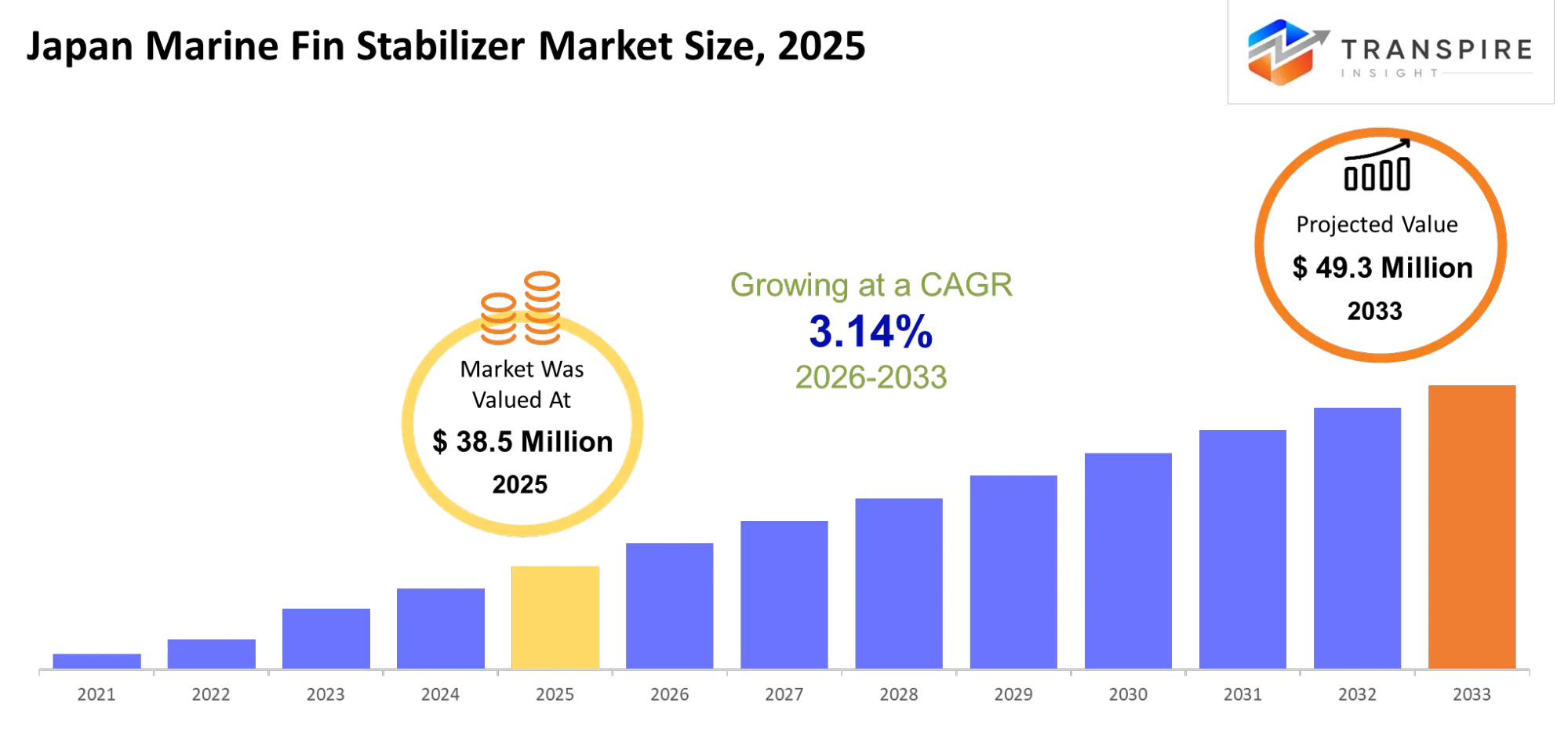
- Japan Marine Fin Stabilizer Market Size 2025: USD 38.5 Million
- Japan Marine Fin Stabilizer Market Size 2033: USD 49.3 Million
- Japan Marine Fin Stabilizer Market CAGR: 3.14%
- Japan Marine Fin Stabilizer Market Segments: By Type (Retractable Stabilizers, Fixed Stabilizers, Others); By Application (Commercial Ships, Yachts, Naval Vessels, Others); By End-User (Shipbuilders, Defense Sector, Commercial Operators, Others); By Technology (Hydraulic Systems, Electric Systems, Others)
To learn more about this report,  Download Free Sample Report
Japan Marine Fin Stabilizer Market Summary:
The Japan Marine Fin Stabilizer Market size is estimated at USD 38.5 Million in 2025 and is anticipated to reach USD 49.3 Million by 2033, growing at a CAGR of 3.14% from 2026 to 2033.
The japan marine fin stabilizer market stands as an important segment within Japan’s advanced maritime equipment industry, which has developed through the country's dedication to ship design and its quest to improve offshore shipping capabilities and create high-quality marine equipment. Shipowners and fleet operators now show different demand patterns because they want their ships to provide better onboard comfort and optimized fuel efficiency with improved smooth sailing abilities used in both commercial and private marine operations.
Passenger vessels and luxury yachts and specialized research ships will continue to seek stabilization systems that can deliver better roll reduction without adding significant operational complexity. Japanese buyers have started to choose products more carefully because they prefer systems which provide digital capabilities and require less maintenance and have smaller physical dimensions. Manufacturers have responded to this demand by designing products which use lighter composite materials and advanced hydrodynamic systems and multiple control mechanisms which will enable them to adapt to different sea conditions more effectively.
Japanese shipyards now experience market changes because of stricter environmental regulations and the implementation of vessel modernization initiatives. Suppliers have responded to regulatory demands for energy-efficient marine operations by creating solutions which reduce drag while stabilizing products. Product development strategies have transformed because automation improvements and smart vessel monitoring developments. Connected stabilizer platforms will experience stronger market adoption according to industry experts.
Operators now require systems which will execute integration with their complete onboard diagnostic systems and their entire network of predictive maintenance systems to achieve earlier fault detection and better operational scheduling. The industry has adopted new technological innovations because customers now demand different services which include quieter operations and better passenger experiences in coastal tourism and premium charter services.
What Has the Impact of Artificial Intelligence Been on the Japan Marine Fin Stabilizer Market?
The japan marine fin stabilizer market experiences major changes because artificial intelligence enables manufacturers, suppliers, and marine technology providers to assess market opportunities while they adapt to new industry demands. Marine fin stabilizer market operations in Japan experience major market research improvements because artificial intelligence enables companies to track vessel demand patterns and installation patterns in different regions and change customer needs with more accuracy.
The analysis of market trends in Japanese marine fin stabilizers uses artificial intelligence to help businesses identify new trends which they can use to make investment decisions based on data while they build their competitive advantage in the specialized marine equipment industry. The production efficiency of the japan marine fin stabilizer market improves through machine learning and smart automation technologies.
AI systems enable manufacturers to enhance design simulations while they automate precision engineering tasks and boost quality control for fin stabilizer components. The system decreases operational mistakes while it decreases production time and manufacturing expenses. AI-driven supply chain optimization helps Japanese marine fin stabilizer market businesses to enhance their inventory management, shortage prediction, and procurement processes which results in faster delivery and cost savings.
Key Market Trends & Insights:
- The Kanto region controls almost 38% of the Japanese marine fin stabilizer market, which major shipbuilding and marine engineering sectors support.
- The fastest-growing region in Kansai projects a 6.4% CAGR expansion from 2025 until 2031 because of its planned strategic development of marine infrastructure.
- The coastal industrial zones experience rising demand, which comes from two main sources: commercial vessel retrofitting and defense fleet modernization projects.
- The market for retractable fin stabilizers reaches 46% in 2025 because these systems provide better efficiency and operational adaptability.
- The second-largest market share belongs to fixed fin stabilizers, which shipping companies prefer for their commercial operations because of their minimal upkeep needs.
- The segment of AI-integrated active stabilizers currently shows the highest growth rate because it will continue to expand until 2031 due to increasing adoption of smart vessel technology.
- The Japan marine fin stabilizer market will reach its highest demand in 2025 because luxury yachts account for almost 42% of all applications.
- The naval and defense vessel sector shows the fastest expansion because increasing maritime security investments drive the development of stabilization technologies.
- The shipbuilding industry controls 48% of the end-user market share because original equipment manufacturers (OEMs) show high demand for their products.
- The marine retrofit service industry experiences rapid growth because fleet modernization projects increase throughout Japan.
- The main industry participants consist of Mitsubishi Heavy Industries, Kawasaki Heavy Industries, NAKASHIMA, Rolls-Royce Marine, SKF Marine, and DNV Marine Systems.
Japan Marine Fin Stabilizer Market Segmentation
By Type :
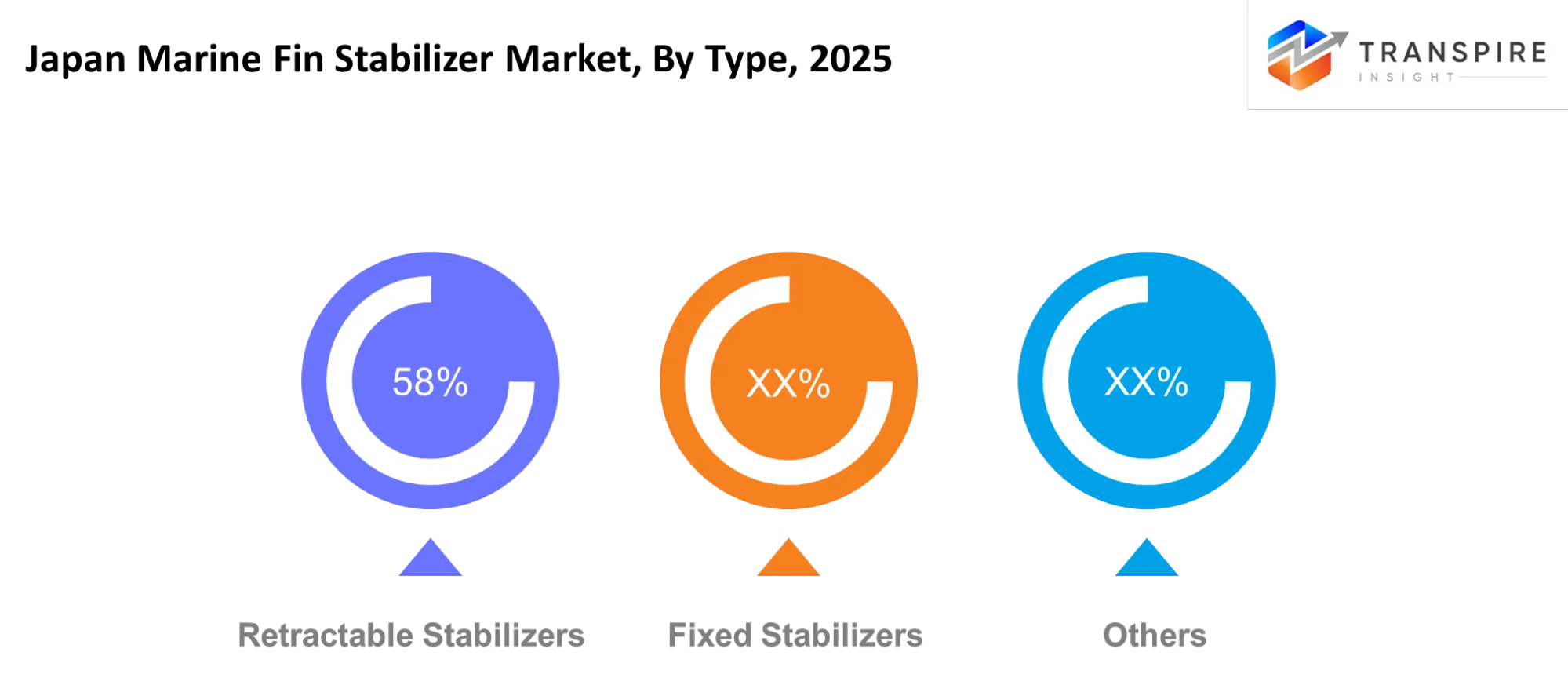
The Japan Marine Fin Stabilizer Market shows clear variation across stabilizer types because vessel design, operational flexibility, and maintenance preferences shape buying decisions. The market demands retractable stabilizers because they enable users to store their equipment in compact spaces while their devices work effectively during different ocean conditions. Operators of luxury vessels choose these systems because they deliver better fuel efficiency through reduced drag during periods when the vessel is not active.
The commercial market demands fixed stabilizers because their constant performance capabilities provide better value than their ability to retract. Equipment with stable construction and reduced mechanical parts enables better performance for extended operational periods. The "Others" segment contains hybrid and customized stabilizing systems which major Japanese shipbuilding companies use to develop technical upgrades and vessel-specific engineering solutions for their specialized marine projects.
To learn more about this report, Download Free Sample Report
By Application :
Commercial ships form a major application area in the Japan Marine Fin Stabilizer Market because cargo movement requires operational stability for safer transport and improved onboard equipment protection. The demand for passenger ferries and cruise vessels exists because better travel conditions enable higher service quality and increased passenger satisfaction during extended routes.
Yachts represent another active area as premium marine leisure services expand across coastal tourism zones. Naval vessels create steady market movement through defense modernization and performance-focused upgrades. The "Others" category includes research ships and offshore service vessels and marine survey operations which use vibration control and balance support to maintain technical precision during challenging offshore conditions.
By End-User :
The Japanese Marine Fin Stabilizer Market depends on shipbuilders because their stabilizer systems are now used during the initial construction of ships. Japanese shipyards use their strong engineering abilities to assist their customers with installation planning which enables them to develop better structural designs that will enhance operational performance throughout their deployment phase.
The defense sector creates stable opportunities through marine fleet enhancement programs and vessel performance improvement projects. Commercial operators use stabilizers to enhance their customer experience while decreasing the maintenance burden that arises from excessive ship movements. The “Others” category includes retrofit specialists, vessel maintenance contractors, and private marine service providers who take part in aftermarket automotive upgrades and replacement projects.
By Technology :
Hydraulic systems maintain a dominant position in the Japan Marine Fin Stabilizer Market because they provide established operational reliability together with their ability to generate strong forces and their excellent performance in demanding marine conditions. The military and commercial sectors prefer this technology because it has been used successfully for many years and provides reliable performance during extended use times.
Electric systems receive increasing interest from the industry because their combination of clean energy usage and digital control capabilities matches the contemporary efficiency requirements of maritime vessels. Modern vessel manufacturers prefer our product because it offers both a compact design and easy maintenance features. Continuous technical development across automation and smart monitoring functions strengthens future opportunities for advanced electric stabilization solutions in Japan's marine equipment industry.
What are the Main Challenges for the Japan Marine Fin Stabilizer Market Growth?
The expansion of the Japan marine fin stabilizer market faces multiple technical and operational challenges which continue to determine its development path. The main barrier which prevents Japan marine fin stabilizer market growth exists because operators need to understand how various vessel sizes and sea conditions affect stabilization performance. Operational capabilities are restricted because of three factors which include hydrodynamic efficiency variations and onboard navigation system integration issues and maintenance-related performance declines. Production schedules face additional challenges because specialized electronic sensors and hydraulic components and advanced control systems experience supply chain interruptions.
The Japan marine fin stabilizer market faces major growth impediments because of manufacturing and commercialization obstacles which exist within the industry. High-precision stabilizer systems require advanced engineering expertise combined with strict quality standards and substantial capital investment for their production. The need to comply with marine safety regulations and environmental standards results in longer approval processes which subsequently delay product launches. The Japan marine fin stabilizer market faces increased cost pressures because of rising raw material expenses and changing steel and semiconductor prices.
Adoption challenges remain another critical market limitation. Smaller ship operators often hesitate to invest due to high installation and retrofit costs, while dockyard infrastructure restrictions which limit advanced stabilizer installation capabilities create deployment delays. The Japanese marine fin stabilizer market suffers from two problems because there are not enough qualified marine automation technicians to maintain systems and ensure their long-term operational stability.
Country Insights
Japan Marine Fin Stabilizer Market shows strong development because advanced vessel manufacturing and constant commercial fleet operations support all major coastal areas. Domestic shipbuilding centers continue focusing on motion-control systems for passenger comfort and fuel balance and operational stability. The market will keep developing because engineers will implement continuous improvements while manufacturers maintain their exact production procedures.
The Japan Marine Fin Stabilizer Market experiences changes because defense vessel enhancement programs and increasing passenger transport needs establish new market requirements. Demand remains linked with improved onboard stability, smoother navigation, and better operational efficiency during rough-water movement. Strong technical standards across marine construction facilities will encourage wider installation across newly developed vessels.
The Japan Marine Fin Stabilizer Market potential receives continuous growth from marine infrastructure expansion and marine technology development that emphasizes automation. Research-driven engineering practices support advanced stabilizer design suited for varied vessel categories. The domestic maritime industry will experience continuous growth because organizations increasingly prioritize energy-efficient marine systems and performance dependability and extended maintenance value.
Recent Development News
In April 2026, Mitsubishi Heavy Industries announced progress in its next-generation frigate program (New FFM), advancing construction plans for vessels scheduled from 2026 onward. The program reflects rising demand for advanced onboard stabilization and motion-control systems in naval fleets, supporting suppliers of fin stabilizer technologies.
Source https://www.navalnews.com/
In March 2026, Kawasaki Heavy Industries remained under the impact of a temporary Japanese Ministry of Defense suspension (lasting until March 2026) following prior engine data compliance issues. The development affected its defense-related marine systems business, potentially influencing supplier dynamics and procurement decisions in naval stabilization technologies.Source https://www.digitimes.com/
|
Report Metrics |
Details |
|
Market size value in 2025 |
USD 38.5 Million |
|
Market size value in 2026 |
USD 39.7 Million |
|
Revenue forecast in 2033 |
USD 49.3 Million |
|
Growth rate |
CAGR of 3.14% from 2026 to 2033 |
|
Base year |
2025 |
|
Historical data |
2021 - 2024 |
|
Forecast period |
2026 - 2033 |
|
Report coverage |
Revenue forecast, competitive landscape, growth factors, and trends |
|
Country scope |
Japan |
|
Key company profiled |
Rolls-Royce, Wärtsilä, Naiad Dynamics, SKF, Mitsubishi Heavy Industries, Kawasaki Heavy Industries, Quantum Marine, Humphree, DMS Holland, ABT-TRAC, Veem, Sleipner, Seakeeper, Fincantieri, Damen |
|
Customization scope |
Free report customization (country, regional & segment scope). Avail customized purchase options to meet your exact research needs. |
|
Report Segmentation |
By Type (Retractable Stabilizers, Fixed Stabilizers, Others); By Application (Commercial Ships, Yachts, Naval Vessels, Others); By End-User (Shipbuilders, Defense Sector, Commercial Operators, Others); By Technology (Hydraulic Systems, Electric Systems, Others) |
How Can New Companies Establish a Strong Foothold in the Japan Marine Fin Stabilizer Market?
New entrants seeking to build a strong presence in the japan marine fin stabilizer market must focus on specialized innovation and targeted positioning rather than competing directly on scale. The market entry strategy should target the existing unmet demand for compact stabilization systems which are needed by mid-sized recreational vessels and hybrid-electric yachts and coastal patrol craft. Through smart marine technology adoption market growth will accelerate while companies that develop products which match upcoming industry trends will achieve rapid success in the japan marine fin stabilizer market.
Technology differentiation forms a second critical path which organizations must pursue. The Japan marine fin stabilizer market requires startups to invest in AI-enabled control systems and predictive maintenance software and lightweight composite fin materials which will enable energy-efficient operation. Organizations can build strong competitive advantages by solving their most important operational problems which include high retrofit costs and maintenance challenges and they need to enhance onboard system integration. The adaptive stabilization software and modular retrofit-ready systems developed by SmartShip Dynamics and OceanMotion Technologies showcase emerging players who use these innovation strategies to gain market attention.
The Japan marine fin stabilizer market requires both strategic partnerships and market entry partnerships to establish credible market presence. The product validation process and commercial deployment process will move faster through partnerships with Japanese shipyards and marine engineering firms and vessel automation providers. The companies which offer customized solutions to Japanese luxury marine and defense markets together with their localized service support and advanced automation technologies will achieve long-term market growth potential while establishing competitive advantages in the Japanese marine fin stabilizer market.
Key Japan Marine Fin Stabilizer Market Company Insights
The Japan Marine Fin Stabilizer Market operates with active competition because marine technology advancements and ship performance needs and fuel-efficient stabilization solutions create ongoing demand. Major manufacturers concentrate their efforts on developing precision engineering technologies and creating compact products and building advanced control mechanisms which enhance ship stability for both commercial and private marine users. The market presence of a company depends on three factors which include the product's trustworthiness and its technical assistance and the ability to maintain it for an extended period.
The company maintains its competitive position through product development and it establishes stronger connections with shipbuilders and its investments in intelligent stabilization technologies which adapt to maritime weather changes. Domestic companies maintain their competitive position through established industrial networks while international businesses expand their market reach through distribution partnerships and their unique product offerings. The Japanese marine equipment market uses pricing methods and after-sales service quality assessments and system longevity evaluations to determine its market position.
Company List
- Rolls-Royce
- Wärtsilä
- Naiad Dynamics
- SKF
- Mitsubishi Heavy Industries
- Kawasaki Heavy Industries
- Quantum Marine
- Humphree
- DMS Holland
- ABT-TRAC
- Veem
- Sleipner
- Seakeeper
- Fincantieri
- Damen
What are the Key Use-Cases Driving the Growth of Japan Marine Fin Stabilizer Market?
The japan marine fin stabilizer market is experiencing growth because its application in luxury yachts and recreational vessels has increased, which increases passenger comfort and onboard stability. High-net-worth vessel owners and charter operators increasingly rely on advanced fin stabilizer systems to reduce roll motion and improve navigation comfort during both transit and anchorage. The use-case continues to strengthen demand in the japan marine fin stabilizer market because marine tourism and premium yacht customization trends increase throughout Japan's coastal areas.
The japan marine fin stabilizer market experiences growth because commercial shipping stands as one of its main applications. Stabilizer systems are being adopted by cargo vessels ferries and offshore service ships because these systems enable improved operational efficiency while decreasing cargo movement risks and protecting crew members during challenging sea conditions. The adoption of AI-enabled stabilization controls supports customer adoption because these controls deliver predictive performance adjustments and fuel-efficient operation which helps maritime industry goals for sustainability.
The japan marine fin stabilizer market has developed a valuable growth sector which includes defense and surveillance vessels. Naval fleets use modern stabilization systems to achieve their needs for precise navigation and equipment reliability and efficient operations during their extended missions.
Research vessels and oceanographic survey ships now rely on stabilization technologies to achieve their data accuracy needs and to operate their equipment with greater ease. The market for japan marine fin stabilizers will see long-term growth because new use cases will drive research development in intelligent automation and lightweight composite fin systems and scalable retrofit solutions.
Japan Marine Fin Stabilizer Market Report Segmentation
By Type
- Retractable Stabilizers
- Fixed Stabilizers
By Application
- Commercial Ships
- Yachts
- Naval Vessels
By End-User
- Shipbuilders
- Defense Sector
- Commercial Operators
By Technology
- Hydraulic Systems
- Electric Systems
Frequently Asked Questions
Find quick answers to common questions.
The approximate Japan Marine Fin Stabilizer Market size for the market will be USD 49.3 Million in 2033.
Key segments for the Japan Marine Fin Stabilizer Market are By Type (Retractable Stabilizers, Fixed Stabilizers, Others); By Application (Commercial Ships, Yachts, Naval Vessels, Others); By End-User (Shipbuilders, Defense Sector, Commercial Operators, Others); By Technology (Hydraulic Systems, Electric Systems, Others).
Major Japan Marine Fin Stabilizer Market players are Rolls-Royce, Wärtsilä, Naiad Dynamics, SKF, Mitsubishi Heavy Industries, Kawasaki Heavy Industries, Quantum Marine, Humphree, DMS Holland, ABT-TRAC, Veem, Sleipner, Seakeeper, Fincantieri, Damen.
The Japan Marine Fin Stabilizer Market size is USD 38.5 Million in 2025.
The Japan Marine Fin Stabilizer Market CAGR is 3.14%.
- Rolls-Royce
- Wärtsilä
- Naiad Dynamics
- SKF
- Mitsubishi Heavy Industries
- Kawasaki Heavy Industries
- Quantum Marine
- Humphree
- DMS Holland
- ABT-TRAC
- Veem
- Sleipner
- Seakeeper
- Fincantieri
- Damen
Recently Published Reports
-
Apr 2026
ATV & UTV Market
ATV & UTV Market Size, Share & Analysis Report By Type (ATV, and UTV), By Variants (Less Than 400 CC, 400 CC To 800 CC, and More Than 800 CC), and Geography (North America, Europe, Asia-Pacific, Middle East and Africa, South and Central America), 2021 - 2031
-
Apr 2026
Automotive Central Gateway Module Market
Automotive Central Gateway Module Market Size, Share & Analysis Report By Type (Ethernet Central Gateway Module, CAN Central Gateway Module, LIN Central Gateway Module, and FlexRay), By Application (Powertrain Control, Body Control, Infotainment System, Advanced Driver Assistance Systems (ADAS), and Others), By End User (Passenger Vehicles, and Commercial Vehicles), and Geography (North America, Europe, Asia-Pacific, Middle East and Africa, South and Central America), 2021 - 2031
-
Apr 2026
Automotive Engine Oil Filter Market
Automotive Engine Oil Filter Market Size, Share & Analysis Report By Filter Type (Fuel Filter, Engine Oil Filter, Hydraulic Oil Filter, and Others), By Filter Media (Cellulose, Synthetic, and Micro), By Sales Channel (OEMs, and Aftermarket), By Vehicle Type (Passenger Cars, Light Commercial Vehicles, Heavy Duty Trucks, Buses and Coaches, and Off-road Vehicles), and Geography (North America, Europe, Asia-Pacific, Middle East and Africa, South and Central America), 2021 - 2031
-
Apr 2026
Automotive Parts Aluminium Die Casting Market
Automotive Parts Aluminium Die Casting Market Size, Share & Analysis Report By Production Process (Pressure Die Casting, Vacuum Die Casting, Squeeze Die Casting, Gravity Die Casting), By Application (Body Parts, Engine Parts, Transmission Parts, Battery And Related Components, Other Application Types), and Geography (North America, Europe, Asia-Pacific, Middle East and Africa, South and Central America), 2021 - 2031
Our Clients