Japan Internet Of Things In Healthcare Market Size & Forecast:
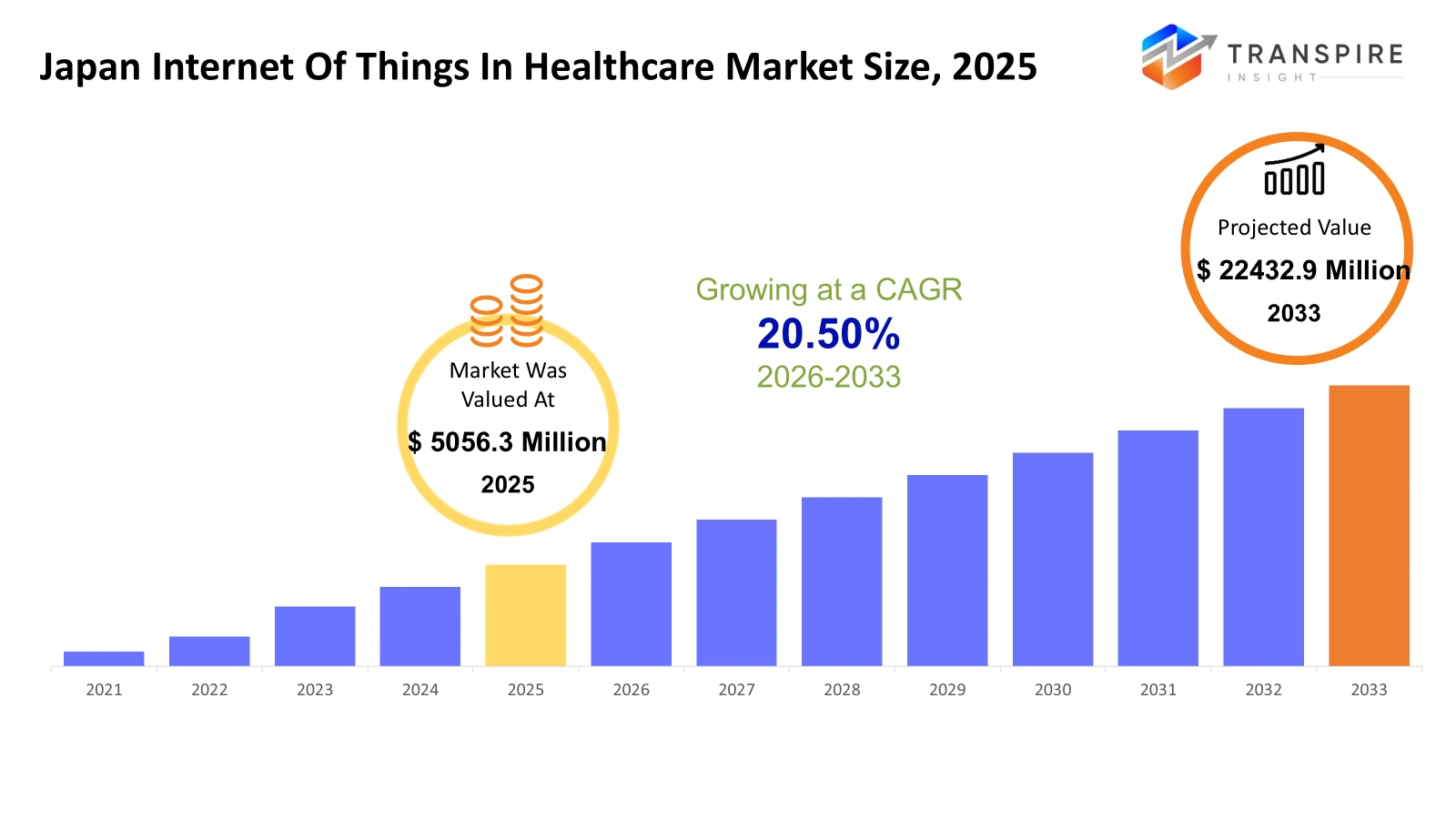
- Japan Internet Of Things In Healthcare Market Size 2025: USD 5056.3 Million
- Japan Internet Of Things In Healthcare Market Size 2033: USD 22432.9 Million
- Japan Internet Of Things In Healthcare Market CAGR: 20.50%
- Japan Internet Of Things In Healthcare Market Segments:By Component (Devices, Software, Services), By Application (Remote Patient Monitoring, Clinical Operations, Medication Management, Connected Imaging), By End User (Hospitals, Clinics, Research Institutes).
To learn more about this report,  Download Free Sample Report
Japan Internet Of Things In Healthcare Market Summary:
The Japan Internet of Things In Healthcare Market size is estimated at USD 5056.3 Million in 2025 and is anticipated to reach USD 22432.9 Million by 2033, growing at a CAGR of 20.50% from 2026 to 2033. The Japan Internet of Things (IoT) in Healthcare Market sees increasing growth because hospitals and healthcare facilities adopt connected technologies to enhance patient treatment and operational performance. Doctors use IoT-enabled devices, which include remote monitoring systems and smart wearables and connected medical equipment, to observe patient health throughout the day. The Japanese population, which continues to age, creates demand for advanced digital healthcare solutions. The market will experience continuous growth through upcoming years because investments in smart hospitals and data-driven healthcare management systems will increase.
Key Market Trends & Insights:
- The situation leads to higher hospital admission rates because doctors require immediate access to patient health information to improve patient treatment.
- Japanese consumers now prefer wearable technologies that include smart health tracking bands and connected sensors. The devices enable users to track their daily health indicators, which include heart rate and sleep patterns and physical activity levels.
- Healthcare organizations use IoT systems together with data analytics platforms to develop valuable health information. The patient data analysis process enables healthcare organizations to reach clinical decisions more quickly while their treatment results show improvement.
- Japanese hospitals are purchasing advanced medical equipment that connects to their digital networks. IoT technology enables hospitals to run their operations smoothly because it provides asset tracking systems that enhance patient management and staff connection.
- The aging Japanese population drives the increasing demand for home medical treatment equipment. The Internet of Things devices enable permanent health monitoring for elderly patients who stay at home. This system detects health problems at an early stage, which leads to decreased demand for medical services.
- Healthcare organisations adopt IoT solutions because government programmes that support digital health transformation promote this technology. The market experiences consistent growth because policies that support telemedicine and health data management and smart healthcare infrastructure development exist.
Japan Internet Of Things In Healthcare Market Segmentation
By Component
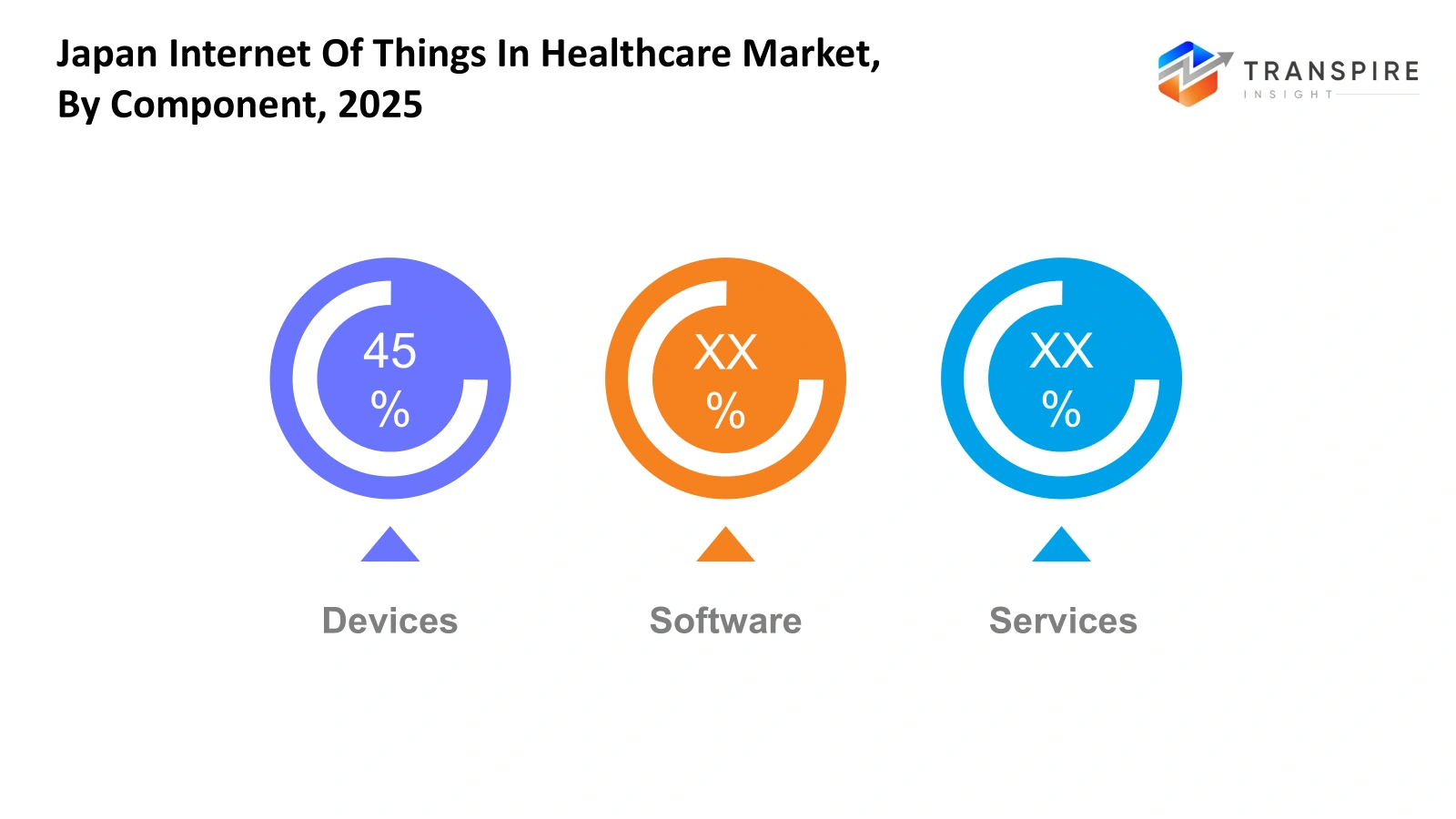
- Devices: Japan's healthcare systems depend on IoT devices, which function as their primary networking elements. The system uses wearable monitors and smart sensors together with connected medical equipment to capture patient data throughout the entire day. The devices enable hospitals and home care providers to track patients' health status, which assists doctors in making timely and accurate medical choices.
- Software: The IoT device software platforms serve two essential functions which involve data management and data analysis. The Japanese healthcare system uses these solutions to create patient databases while providing remote monitoring capabilities and enabling predictive analysis features. Healthcare workers can use the system to analyse massive data sets, which enhances their capacity to develop patient treatment strategies.
- Services: The services provided by the company consist of system integration maintenance and consulting services together with technical support for IoT healthcare solutions. The service providers assist healthcare facilities in implementing new technologies through their expertise in both installation procedures and operational support. Japanese hospitals increasingly require these services because they need dependable partners to handle their intricate IoT system operations.
To learn more about this report, Download Free Sample Report
By Application
- Remote Patient Monitoring: Remote patient monitoring technology has become essential for Japan because it enables doctors to treat patients with chronic illnesses and senior citizens. Healthcare providers can use Internet of Things (IoT) devices to monitor their patients' vital signs through remote access. Doctors can use this method to monitor their patients' health, while patients benefit from improved convenience.
- Clinical Operations: Hospitals improve their operational efficiency through IoT technology, which creates connections between their medical devices and their asset tracking and workflow monitoring systems. Japanese healthcare facilities implement these systems to achieve operational efficiency while decreasing their patient treatment wait times. Staff members use connected technologies to enhance their resource management capabilities, which leads to more efficient clinical operations.
- Medication Management: Healthcare providers use IoT solutions to maintain proper control over medication distribution and usage. Smart devices together with connected systems provide patients with medicine consumption alerts while notifying caregivers about any missed doses. Japanese healthcare facilities utilize such technologies to enhance treatment compliance while decreasing the number of medication errors that occur.
- Connected Imaging: Connected imaging systems create a network link between diagnostic equipment and digital networks, which enables medical professionals to share and analyse their medical imaging data at higher speeds. Japanese hospitals apply Internet of Things technology to enhance their imaging processes, which results in decreased patient waiting times and improved diagnostic accuracy through enhanced access to imaging information.
By End User
- Hospitals: The healthcare sector in Japan sees hospitals as its main users of Internet of Things technology. The hospitals implement linked systems to control their patient observation equipment, their medical instruments and their entire hospital facilities. The implementation of IoT solutions enables hospitals to achieve better operational results and better patient results and to use data for their daily medical operations.
- Clinics: Clinics are gradually adopting IoT technologies, which enable them to offer more personalised and efficient healthcare services. The connected monitoring devices, together with digital systems, enable clinics to handle patient records while monitoring health conditions and conducting remote consultations. The smaller healthcare facilities in Japan can now deliver better patient care because of this technology, which requires minimal operational resources.
- Research Institutes: The Japanese research institutes utilise Internet of Things technologies to gather and study health data, which they use for medical research and technological advancements. The connected devices deliver essential real-time information, which assists in both clinical trials and scientific research. The technologies enable researchers to investigate new treatment options while enhancing their comprehension of different medical disorders.
Country Insights
Digital technologies enter the Japanese healthcare system while the Japan Internet of Things market in healthcare maintains its steady growth. Japan utilises IoT-based solutions to enhance patient monitoring, improve hospital operations and develop home healthcare solutions for its rapidly growing elderly population. Medical professionals use connected devices and smart wearables and remote monitoring systems to track patient condition in real time and deliver necessary medical assistance.
Japanese hospitals and clinics are implementing intelligent healthcare systems which combine Internet of Things technology with data analytics and cloud solutions to enhance their patient data management capabilities. The government uses its resources to develop digital healthcare systems and telemedicine platforms which create demand for connected technologies. The country's strong technological capabilities together with its high healthcare standards create an environment that supports IoT-based innovation. IoT technology will become a vital component that transforms Japanese healthcare delivery methods.
Recent Development News
AI and Digital Health Investments Accelerate Healthcare Innovation in Japan.
Generative AI Healthcare Agent Introduced to Assist Doctors and Patients in Japan.
|
Report Metrics |
Details |
|
Market size value in 2025 |
USD 5056.3 Million |
|
Market size value in 2026 |
USD 6082.6 Million |
|
Revenue forecast in 2033 |
USD 22432.9 Million |
|
Growth rate |
CAGR of 20.50% from 2026 to 2033 |
|
Base year |
2025 |
|
Historical data |
2021 – 2024 |
|
Forecast period |
2026 – 2033 |
|
Report coverage |
Revenue forecast, competitive landscape, growth factors, and trends |
|
Country scope |
Japan |
|
Key company profiled |
Siemens Healthineers, GE Healthcare, Philips Healthcare, IBM Corporation, Microsoft Corporation, Cisco Systems Inc., Medtronic PLC, Honeywell International Inc., SAP SE, Oracle Corporation, Qualcomm Technologies Inc., Intel Corporation, Amazon Web Services, Bosch Healthcare Solutions, Fujitsu Limited. |
|
Customization scope |
Free report customization (country, regional & segment scope). Avail customized purchase options to meet your exact research needs. |
|
Report Segmentation |
By Component (Devices, Software, Services), By Application (Remote Patient Monitoring, Clinical Operations, Medication Management, Connected Imaging), By End User (Hospitals, Clinics, Research Institutes). |
Key Japan Internet Of Things In Healthcare Company Insights
The Japan Internet of Things in Healthcare Market experiences ongoing development through its technological advancements and healthcare system innovations. The companies that operate in this market focus on creating new medical devices that connect to digital networks and create intelligent monitoring systems and data-based healthcare solutions for hospitals and medical facilities. Organizations are directing their financial resources toward research initiatives and digital infrastructure development to improve their capabilities in remote patient monitoring and predictive analytics and connected hospital systems. Healthcare institutions and technology partners are forming strategic partnerships to achieve their business objectives. The market demand for efficient patient-centered healthcare services has prompted companies to develop IoT solutions that ensure system reliability and protect data security and which can expand their market presence.
Company List
- Siemens Healthineers
- GE Healthcare
- Philips Healthcare
- IBM Corporation
- Microsoft Corporation
- Cisco Systems Inc.
- Medtronic PLC
- Honeywell International Inc.
- SAP SE
- Oracle Corporation
- Qualcomm Technologies Inc.
- Intel Corporation
- Amazon Web Services
- Bosch Healthcare Solutions
- Fujitsu Limited.
Japan Internet Of Things In Healthcare Market Report Segmentation
By Component
- Devices
- Software
- Services
By Application
- Remote Patient Monitoring
- Clinical Operations
- Medication Management
- Connected Imaging
By End User
- Hospitals
- Clinics
- Research Institutes
Frequently Asked Questions
Find quick answers to common questions.
The Approximate Japan Internet Of Things In Healthcare Market size for the Market will be USD 22432.9 Million in 2033.
The key Segments of the Japan Internet Of Things In Healthcare Market are By Component (Devices, Software, Services), By Application (Remote Patient Monitoring, Clinical Operations, Medication Management, Connected Imaging), By End User (Hospitals, Clinics, Research Institutes).
Major Players in the Japan Internet Of Things In Healthcare market are Siemens Healthineers, GE Healthcare, Philips Healthcare, IBM Corporation, Microsoft Corporation, Cisco Systems Inc., Medtronic PLC, Honeywell International Inc., SAP SE, Oracle Corporation, Qualcomm Technologies Inc., Intel Corporation, Amazon Web Services, Bosch Healthcare Solutions, Fujitsu Limited.
The Current Market size of the Japan Internet Of Things In Healthcare Market is USD 5056.3 Million in 2025.
The Japan Internet Of Things In Healthcare Market CAGR is 20.50%.
- Siemens Healthineers
- GE Healthcare
- Philips Healthcare
- IBM Corporation
- Microsoft Corporation
- Cisco Systems Inc.
- Medtronic PLC
- Honeywell International Inc.
- SAP SE
- Oracle Corporation
- Qualcomm Technologies Inc.
- Intel Corporation
- Amazon Web Services
- Bosch Healthcare Solutions
- Fujitsu Limited.
Recently Published Reports
-
Dec 2024
AI in Diabetic Retinopathy Market
AI in Diabetic Retinopathy Market Size, Share & Analysis Report By Type (Screening AI Systems, Diagnostic AI Systems, and Predictive AI Models), By Application Segment (Hospitals, Ophthalmology Clinics, Diagnostic Centers, and Research and Development), and Geography (North America, Europe, Asia-Pacific, Middle East and Africa, South and Central America), 2021 - 2031
-
Feb 2025
Psychometric Tests Market
Psychometric Tests Market Size, Share & Analysis Report By Type (Personality Tests, Ability/Aptitude Tests, Skill/Knowledge Tests, and Others), By Application (Talent Acquisition and Talent Management), and Geography (North America, Europe, Asia-Pacific, Middle East and Africa, South and Central America), 2021 – 2031
-
Feb 2025
Rare Biological Sample Collection Market
Rare Biological Sample Collection Market Size, Share & Analysis Report By Type (Isolation Kits & Reagent, Blood Collection Tubes, and Others), By Application (Oncology, Transcriptomics, Pharmacogenomics, and Others), and Geography (North America, Europe, Asia-Pacific, Middle East and Africa, South and Central America), 2021 – 2031
-
Dec 2025
Patient Lift Pendant Market
Patient Lift Pendant Market By Product Type (Wired Pendants, Wireless, Programmable), By Operation Type(Manual, Electric), By End-Users (Healthcare Professionals, Patients), By Application (Hospitals, Homecare, Rehabilitation Centers, Others), By Industry Analysis, Size, Share, Growth, Trends, and Forecasts 2021-2033
Our Clients
.jpg)