

Japan Ilmenite Market Size & Forecast:
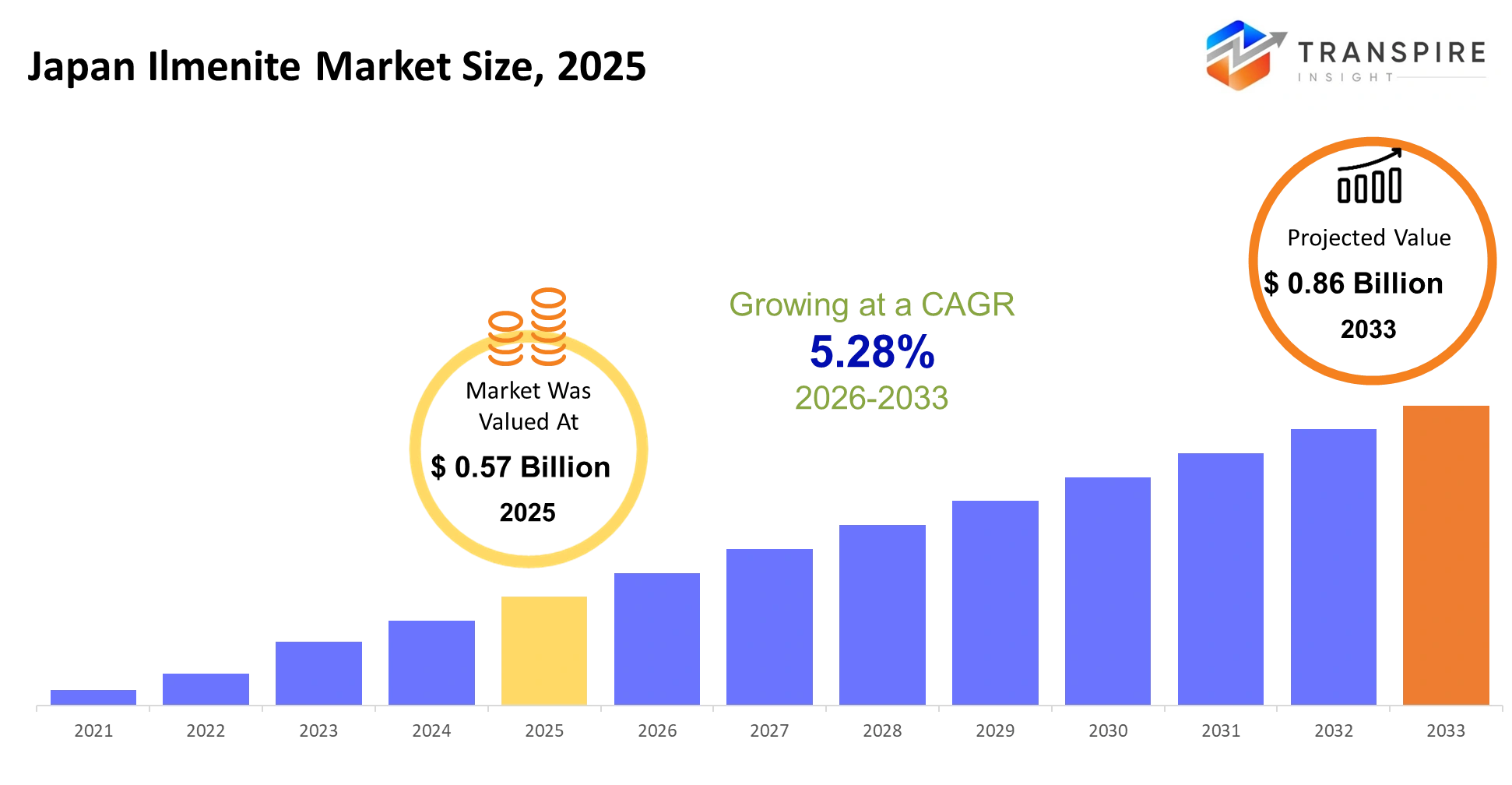
- Japan Ilmenite Market Size 2025: USD 0.57 Billion
- Japan Ilmenite Market Size 2033: USD 0.86 Billion
- Japan Ilmenite Market CAGR: 5.28%
- Japan Ilmenite Market Segments: By Type (Sulfate Ilmenite, Chloride Ilmenite, Synthetic Rutile, Others); By Application (Titanium Dioxide Production, Welding Electrodes, Pigments, Coatings, Aerospace Materials, Others); By End-User (Paint Industry, Chemical Industry, Construction Industry, Aerospace Industry, Automotive Industry, Others); By Form (Sand, Powder, Slag, Others)
To learn more about this report,  Download Free Sample Report
Japan Ilmenite Market Summary
The Japan Ilmenite Market was valued at USD 0.57 Billion in 2025. It is forecast to reach USD 0.86 Billion by 2033. That is a CAGR of 5.28% over the period.
The Japan ilmenite market serves two main functions because it provides essential feedstock that creates titanium dioxide which various industries use in their production of coatings plastics , automotive finishes and construction materials. The process supplies essential resources which aerospace manufacturers and advanced industrial manufacturers use to create titanium metal products, making it an essential component of Japanese material supply chains. The market provides industrial solutions because it delivers essential mineral resources which manufacturers need to create products that resist corrosion and perform at high levels.
The market has experienced fundamental changes which began three years ago because Japanese processors now choose different sources of supply instead of depending on specific territories that produce concentrated materials. After the Russia-Ukraine conflict triggered raw material price fluctuations and global logistics disruptions, organizations discovered their procurement weaknesses which led to procurement system changes. To enhance their ore extraction performance, manufacturers established long-term supply contracts and dedicated resources to process improvement projects.
The market expansion receives direct assistance from this development. The implementation of stable sourcing systems enables producers to achieve consistent production outcomes, while the implementation of efficiency enhancements decreases processing expenses, which results in improved profit margins and increased use of products throughout the entire downstream manufacturing operations.
Key Market Insights
- The Kanto region controls the Japan Ilmenite Market because it holds 38% of the market share which results from its specialized pigment processing and its advanced manufacturing facilities.
- Kansai holds a significant share at approximately 27% which its developed chemical production facilities and its titanium feedstock processing capabilities support.
- Chubu will experience the fastest growth among all regions until 2030 because of its industrial expansion plans and increasing demand from the downstream coatings manufacturing sector.
- The sulfate-grade ilmenite market dominates Japan because it accounts for approximately 46% of the total ilmenite industry in 2025 which results from its extensive use in titanium dioxide pigment manufacturing.
- The chloride-grade ilmenite market holds second place in the market because it controls about 31% of market share while high-purity applications become more common in industrial use.
- The synthetic upgraded ilmenite market shows strong growth during the forecast period because of its superior processing capabilities and reduced contamination levels.
- Titanium dioxide pigment production leads, contributing nearly 61% of total Japan Ilmenite Market demand in 2025.
- Chemical and pigment manufacturers control approximately 52% of the market because they need to maintain their continuous feedstock supply.
- The automotive and infrastructure maintenance requirements drive industrial coatings producers to become the second largest end-user sector.
- The advanced materials manufacturers sector will experience the fastest growth until 2030 because Japan develops its production of high-performance titanium-based components.
What are the Key Drivers, Restraints, and Opportunities in the Japan Ilmenite Market?
The Japan ilmenite market experiences its most powerful growth because domestic titanium dioxide pigment production continues to increase which automotive coatings and industrial paints and advanced plastics manufacturing need to satisfy their stricter performance standards. The shift toward domestic production started to grow after supply chain disruptions which occurred after the pandemic showed industry leaders that their businesses had become too dependent on imported finished titanium dioxide products. Japanese manufacturers responded by strengthening local processing capacity and securing greater volumes of ilmenite feedstock through long-term procurement agreements. The mineral processors who provide titanium-bearing raw materials have seen their plant utilization rates increase and their revenue streams grow because of this development.
The most important structural obstacle to market development exists because Japan depends on imported ilmenite which becomes necessary for the country that lacks economically exploitable domestic mineral resources. The solution to this problem requires years to establish because alternative supply channels demand years for contract negotiations and logistics infrastructure improvements and technical ore quality testing for processing suitability. The global supply chain concentrates its resources in Australia and South Africa and Mozambique which leads to increased pricing instability. Processors experience revenue losses because they need to purchase materials at inflated prices while their production schedules face delays which prevent them from growing their operations.
The adoption of upgraded synthetic ilmenite and advanced beneficiation technologies, which show potential for future growth, represents a significant business opportunity. The implementation of impurity reduction systems together with feedstock upgrading systems will lead to improved titanium recovery efficiency and decreased processing waste. Japanese specialty material producers are increasingly exploring these technologies to support aerospace-grade titanium applications, creating a pathway for higher-value market growth over the next decade.
What Has the Impact of Artificial Intelligence Been on the Japan Ilmenite Market?
The supply chain of ilmenite in Japan experiences transformation through artificial intelligence and advanced digital systems that enhance operational efficiency in three areas which include mineral handling and bulk transport logistics and emissions-heavy processing operations. The integration of AI-based monitoring systems into scrubber performance systems at bulk cargo terminals and processing facilities enables automated particulate control which monitors exhaust gas treatment efficiency while fulfilling real-time regulatory standards. Digital fleet compliance tracking in maritime transport enables operators to track fuel consumption patterns while they select optimal vessel routes for ilmenite imports which results in reduced idle time and decreased costs associated with freight operations.
The implementation of machine learning models enhances predictive capabilities for mineral processing facilities. The systems enable operators to identify rotary kiln and separator and beneficiation circuit equipment wear patterns which support predictive maintenance planning to avoid mechanical failures that would hinder production. Facilities that use sensor-based maintenance planning systems have achieved directional uptime improvements between 8% and 12% while AI-powered combustion optimization has decreased energy usage through enhanced furnace efficiency and processing temperature stabilization.
The titanium feedstock producers experience direct benefits from these gains because they achieve reduced processing expenses and improved production reliability. High integration expenses and scattered operational information represent the main obstacle which AI systems must overcome in order to achieve successful implementation. The existing processing systems from the past do not possess enough sensors and historical data to develop accurate models, which delays the implementation process throughout Japan's outdated industrial systems.
Key Market Trends
- The Japanese processors reduced their need for spot-market buying by almost 18% from 2022 while they established multi-year supply agreements with Iluka Resources and Rio Tinto.
- The 2021 logistics disruptions prompted procurement teams to search for suppliers outside Australia while they started importing mineral sands from African producers.
- Processors adopted new synthetic ilmenite materials between 2023 and 2025 because they needed to decrease impurity levels which would help them achieve better titanium dioxide conversion rates.
- Japanese pigment manufacturers accelerated furnace modernization after 2022, with digital process controls improving ore utilization rates by an estimated 8 to 10 percent.
- Environmental compliance standards introduced stricter emissions oversight in 2023, which required refiners to develop cleaner beneficiation processes and waste heat recovery systems.
- Buyers increasingly prioritize feedstock consistency over lowest-cost sourcing, which shows that procurement strategies have changed because of raw material price fluctuations.
- The year 2024 saw domestic processors working together with global suppliers to establish common technical validation programs that decreased the time needed to qualify new ore grades.
- The demand for titanium used in aerospace applications increased after 2023, which led Toho Titanium and other specialty producers to search for more premium mineral resources.
- The market rivalry changed because suppliers developed value-added processing capabilities, which enabled them to establish contracts that used recovery rates as a pricing method instead of standard ore weight.
Japan Ilmenite Market Segmentation
By Type:
The Japan Ilmenite Market maintains stable demand for sulfate ilmenite because the material serves as essential feedstock in titanium dioxide production. Existing production facilities depend on this material which will keep its industrial consumption level stable. The segment maintains its significance for long-term operational planning because it provides continuous supply and processing capabilities which operate at high reliability.
Japanese manufacturers now recognize chloride ilmenite as a cleaner processing method which offers manufacturing advantages that have become increasingly important. Synthetic rutile enables industrial production to meet high-purity requirements which apply to advanced industrial production processes that need refined output. The other category includes specialized mineral blends that serve limited but necessary industrial uses, helping manufacturers meet exact processing standards.
By Application:
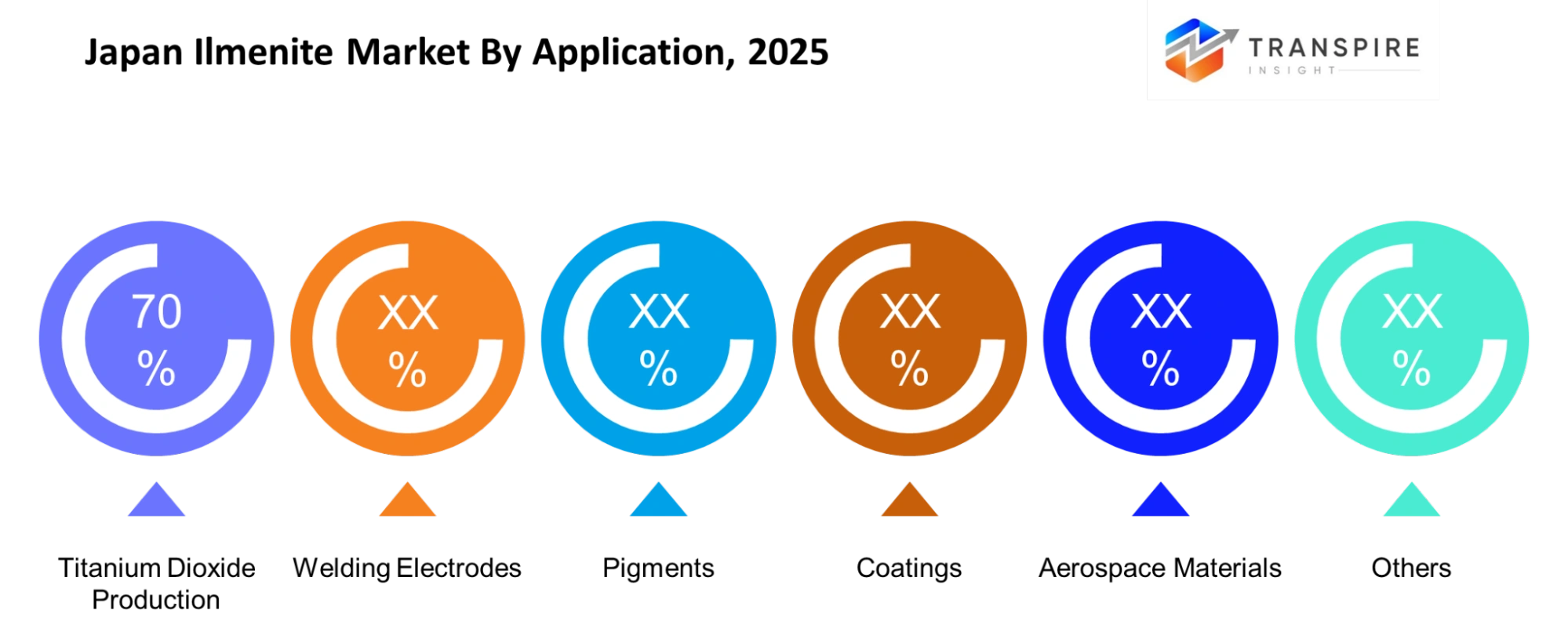
The Japan Ilmenite Market shows its biggest demand for titanium dioxide production because this process creates essential materials for multiple industrial sectors which include paints and coatings and plastics. The need for infrastructure development together with ongoing manufacturing operations will create steady demand. Industrial processors depend on consistent ilmenite supply to ensure smooth production and meet quality expectations.
Welding electrodes also represent a solid application due to steady industrial fabrication requirements. Pigments and coatings continue expanding as product finishing standards rise across manufacturing. Aerospace materials are becoming more relevant as lightweight and heat-resistant material demand grows, while the other category includes technical applications where ilmenite supports precision-focused industrial processes.
To learn more about this report, Download Free Sample Report
By End-User:
The paint industry needs titanium dioxide which comes from ilmenite because this material provides essential color quality and opacity and durability. The ongoing construction work and industrial coating operations will maintain active operations in this market segment. The urban development activities in Japan create continuous demand for both residential and commercial building projects.
The chemical industry relies on ilmenite to extract minerals which produce various chemical derivatives. The aerospace and automotive industries need lightweight and durable materials because these materials help them achieve their efficiency requirements. The construction industry generates constant demand through its activities while industrial users obtain mineral-based materials for their specific manufacturing needs.
By Form:
Sand-form ilmenite has received widespread industrial adoption because its direct suitability matches multiple processing techniques. The market for this segment exists because the product enables easy handling and transportation while it works well with existing systems. Processing facilities depend on this product because it helps them move materials efficiently while minimizing their preparation work.
The powder-form ilmenite product meets industrial needs which require small particles to create specific processing conditions. Slag exists because it contains high titanium levels which help to increase processing efficiency during advanced industrial operations. The other product forms enable production systems to customize materials according to specific technical requirements that exist in various operational settings.
What are the Key Use Cases Driving the Japan Ilmenite Market?
The primary application of ilmenite in Japan exists to produce titanium dioxide pigment which manufacturers use for industrial coatings and automotive finishes and construction materials. The highest demand for this application exists because manufacturers need feedstock with high purity to create pigments that have permanent durability and superior opacity and corrosion resistance.
The aerospace industry now uses titanium metal processing while developing new applications for chemical processing equipment. Japanese specialty manufacturers are increasing ilmenite-derived feedstock use to support lightweight structural materials and corrosion-resistant systems used in precision engineering and industrial fabrication.
Advanced battery materials and additive manufacturing powders are currently developing as new use cases. Research-driven industrial programs are exploring titanium-based compounds for next-generation energy storage systems, while metal powder production for 3D printing is gaining attention as Japan strengthens domestic capabilities in high-value advanced manufacturing.
|
Report Metrics |
Details |
|
Market size value in 2025 |
USD 0.57 Billion |
|
Market size value in 2026 |
USD 0.6 Billion |
|
Revenue forecast in 2033 |
USD 0.86 Billion |
|
Growth rate |
CAGR of 5.28% from 2026 to 2033 |
|
Base year |
2025 |
|
Historical data |
2021 - 2024 |
|
Forecast period |
2026 - 2033 |
|
Report coverage |
Revenue forecast, competitive landscape, growth factors, and trends |
|
Country scope |
Japan |
|
Key company profiled |
Rio Tinto, Iluka Resources, Tronox, Kenmare Resources, VV Minerals, Trimex Sands, Base Resources, Eramet, Indian Rare Earths, Sierra Rutile, QIT Madagascar Minerals, RBM, CMOC, Vedanta, Kronos Worldwide |
|
Customization scope |
Free report customization (country, regional & segment scope). Avail customized purchase options to meet your exact research needs. |
|
Report Segmentation |
By Type (Sulfate Ilmenite, Chloride Ilmenite, Synthetic Rutile, Others); By Application (Titanium Dioxide Production, Welding Electrodes, Pigments, Coatings, Aerospace Materials, Others); By End-User (Paint Industry, Chemical Industry, Construction Industry, Aerospace Industry, Automotive Industry, Others); By Form (Sand, Powder, Slag, Others) |
Which Regions are Driving the Japan Ilmenite Market Growth?
The Kanto region controls Japan's ilmenite market because it has deep-water port access and extensive chemical processing facilities and it is near pigment production and advanced materials manufacturing operations. The major ports of Yokohama and Chiba enable efficient bulk mineral handling which supports continuous import operations from Australia and Africa. The region also benefits from concentrated industrial demand from coatings, plastics, and specialty materials producers that require reliable titanium feedstock. The integrated system of logistics operators and processors and end-use manufacturers enables Kanto to maintain its market leadership while quickly responding to changes in worldwide supply patterns.
Kansai holds the second-largest position, but its strength comes from industrial stability rather than sheer processing scale. Kansai relies on its established manufacturing hub in Osaka and Kobe which produces specialty chemicals and industrial components, while Kanto needs export-centered logistics systems to operate. The region has maintained consistent investment in process optimization and feedstock efficiency improvements, allowing operators to manage raw material cost fluctuations more effectively. Kansai maintains operational stability which enables the region to generate national market revenue at all times, including during international supply disruptions.
The Chubu region is currently experiencing rapid development because of its industrial modernization progress and rising investments in advanced manufacturing facilities. The recent increase in demand for automotive materials and precision engineering products has created a need for titanium dioxide pigments and titanium-based materials in the region. The port infrastructure improvements at Nagoya have enabled increased bulk cargo handling capacity which eliminates the import restrictions that had previously prevented operational growth. The period from 2026 to 2033 will provide abundant chances for suppliers and investors who want to access the emerging advanced manufacturing supply chain of Japan.
Who are the Key Players in the Japan Ilmenite Market and How Do They Compete?
The Japan ilmenite market shows moderate competition because few international mineral sands companies control most of the available feedstock while Japanese processors use different approaches for material acquisition and processing operations. New companies are unable to enter the market because they need to spend large amounts of money and take extended periods for product testing while they must comply with rigorous standards for ore matching. The main competitive factors for businesses include their ability to deliver products on time and their capacity to maintain consistent ore quality together with their ability to provide technical assistance for improving downstream production processes.
Companies that exist in the market maintain their market share through long-term contract agreements and improved feedstock products which minimize processing losses that result from impurities. Rio Tinto uses its large scale operations and strong supply chain capabilities to compete in the Japanese market by using its various mining sites which help decrease shipment dangers. The company provides processors with predictable production output through its consistent ilmenite grade deliveries. Iluka Resources develops a competitive edge through its high-quality feedstock and its technical partnerships with processors which help them achieve better titanium recovery results.
The system creates value for applications which need precise impurity management to enhance production output. Tronox Holdings uses vertical integration to create a business model which combines its mining operations with its processing activities to deliver customized material specifications. Kenmare Resources expands its market presence by using supply diversification methods which attract Japanese buyers who want to use different supply options instead of relying on single sourcing methods. Toho Titanium creates a competitive advantage through its capability to acquire feedstock materials which directly supports its operations in manufacturing aerospace components and specialty alloy products.
Company List
- Rio Tinto
- Iluka Resources
- Tronox
- Kenmare Resources
- VV Minerals
- Trimex Sands
- Base Resources
- Eramet
- Indian Rare Earths
- Sierra Rutile
- QIT Madagascar Minerals
- RBM
- CMOC
- Vedanta
- Kronos Worldwide
Recent Development News
In January 2026, Osaka Titanium Technologies announced the expansion of its aerospace-grade titanium production capacity and signed a comprehensive Green Transformation agreement to support carbon-neutral operations by 2050. The investment strengthens Japan’s downstream titanium processing ecosystem, increasing demand visibility for imported ilmenite-derived feedstocks used in titanium sponge production and reinforcing supply chain resilience for the domestic market. Source https://news.metal.com/
In December 2025, Sumitomo Corporation deepened its long-standing strategic partnership with OSAKA Titanium technologies Co., Ltd. through renewed commercial coordination focused on titanium supply chain expansion for aerospace applications. The collaboration is expected to improve procurement and distribution efficiency for titanium raw materials in Japan, indirectly supporting stronger ilmenite import demand as titanium sponge output scales.
Source https://www.sumitomocorp.com/
What Strategic Insights Define the Future of the Japan Ilmenite Market?
The Japan ilmenite market is undergoing structural changes during the next five to seven years because it will establish a specialized supply system which operates with efficient processes that use high-grade feedstock materials and connects directly to advanced manufacturing operations. The main reason for this transformation, which shows Japan's dedication to producing titanium products through domestic manufacturing, now affects all industries that depend on titanium for aerospace and specialty chemical and precision industrial material production. Processing operations will generate greater output through effective raw material processing when they implement better technologies and improve their operational methods.
The pigment manufacturing sector faces hidden dangers because of its reliance on new technologies which can replace existing systems. The titanium market will experience declining demand for ilmenite because new titanium feedstocks and recycling systems will reach commercial viability before the market expects. The Chubu region presents an opportunity which will develop through investments in additive manufacturing and titanium powder production because these developments will establish a new market for premium-grade feedstock materials.
For market participants, the most effective strategy is to invest now in ore beneficiation capabilities and regional technical partnerships. Companies that establish adaptable sourcing methods while developing valuable downstream products will achieve better chances to increase their profit margins.
Japan Ilmenite Market Report Segmentation
By Type
- Sulfate Ilmenite
- Chloride Ilmenite
- Synthetic Rutile
By Application
- Titanium Dioxide Production
- Welding Electrodes
- Pigments
- Coatings
- Aerospace Materials
By End-User
- Paint Industry
- Chemical Industry
- Construction Industry
- Aerospace Industry
- Automotive Industry
By Form
- Sand
- Powder
- Slag
Frequently Asked Questions
Find quick answers to common questions.
The Japan Ilmenite Market size is USD 0.86 Billion in 2033.
Key segments for the Japan Ilmenite Market are By Type (Sulfate Ilmenite, Chloride Ilmenite, Synthetic Rutile, Others); By Application (Titanium Dioxide Production, Welding Electrodes, Pigments, Coatings, Aerospace Materials, Others); By End-User (Paint Industry, Chemical Industry, Construction Industry, Aerospace Industry, Automotive Industry, Others); By Form (Sand, Powder, Slag, Others).
Major Japan Ilmenite Market players are Rio Tinto, Iluka Resources, Tronox, Kenmare Resources, VV Minerals, Trimex Sands, Base Resources, Eramet, Indian Rare Earths, Sierra Rutile, QIT Madagascar Minerals, RBM, CMOC, Vedanta, Kronos Worldwide.
The Japan Ilmenite Market size is USD 0.57 Billion in 2025.
The Japan Ilmenite Market CAGR is 5.28% from 2026 to 2033.
- Rio Tinto
- Iluka Resources
- Tronox
- Kenmare Resources
- VV Minerals
- Trimex Sands
- Base Resources
- Eramet
- Indian Rare Earths
- Sierra Rutile
- QIT Madagascar Minerals
- RBM
- CMOC
- Vedanta
- Kronos Worldwide
Recently Published Reports
-
Apr 2026
Healthcare Polymer Packaging Market
Healthcare Polymer Packaging Market Size, Share & Analysis Report By Packaging Type (Syringes, IV Bottles and Pouches, Clamshells, Blisters, Bottles & Jars, Containers, Tubes, IV Parental Packaging, Others), By Type (Regulated, Non-regulated), By Polymer Type (LDPE (Low-Density Polyethylene), HDPE (High-Density Polyethylene), Homo-polymer (Homo), Random Copolymer (Random), Block Copolymer (Block), PET, Polystyrene, Polyvinyl Chloride, Polyamide/EVOH, Others), and Geography (North America, Europe, Asia-Pacific, Middle East and Africa, South and Central America), 2021 - 2031
-
Apr 2026
Hydrophilic Tape (Waterstop) Market
Hydrophilic Tape (Waterstop) Market Size, Share & Analysis Report By Type (Bentonite-Based Hydrophilic Tape, Rubber-Based Hydrophilic Tape), By Application (Residential Buildings, Commercial Buildings, Infrastructure Projects), and Geography (North America, Europe, Asia-Pacific, Middle East and Africa, South and Central America), 2021 - 2031
-
Apr 2026
Metalens Market
Metalens Market Size, Share & Analysis Report By Type (Visible Light Metalens, and Infrared Metalens), By Application (Consumer Electronics, Automotive Electronics, Industrial, Medical, and Others), and Geography (North America, Europe, Asia-Pacific, Middle East and Africa, South and Central America), 2021 - 2031
-
Apr 2026
PBT Resin Market
PBT Resin Market Size, Share & Analysis Report By Type (Reinforced PBT Resin, Unreinforced PBT Resin), By Processing Method (Injection Molding, Extrusion, Blow Molding, Others), By End-User (Automotive, Electrical & Electronics, Consumer Appliances, Industrial Machinery, Medical Devices, Packaging, Others), and Geography (North America, Europe, Asia-Pacific, Middle East and Africa, South and Central America), 2021 - 2031