

Japan Ferroelectric Random Access Memory (FRAM) Market Size & Forecast:
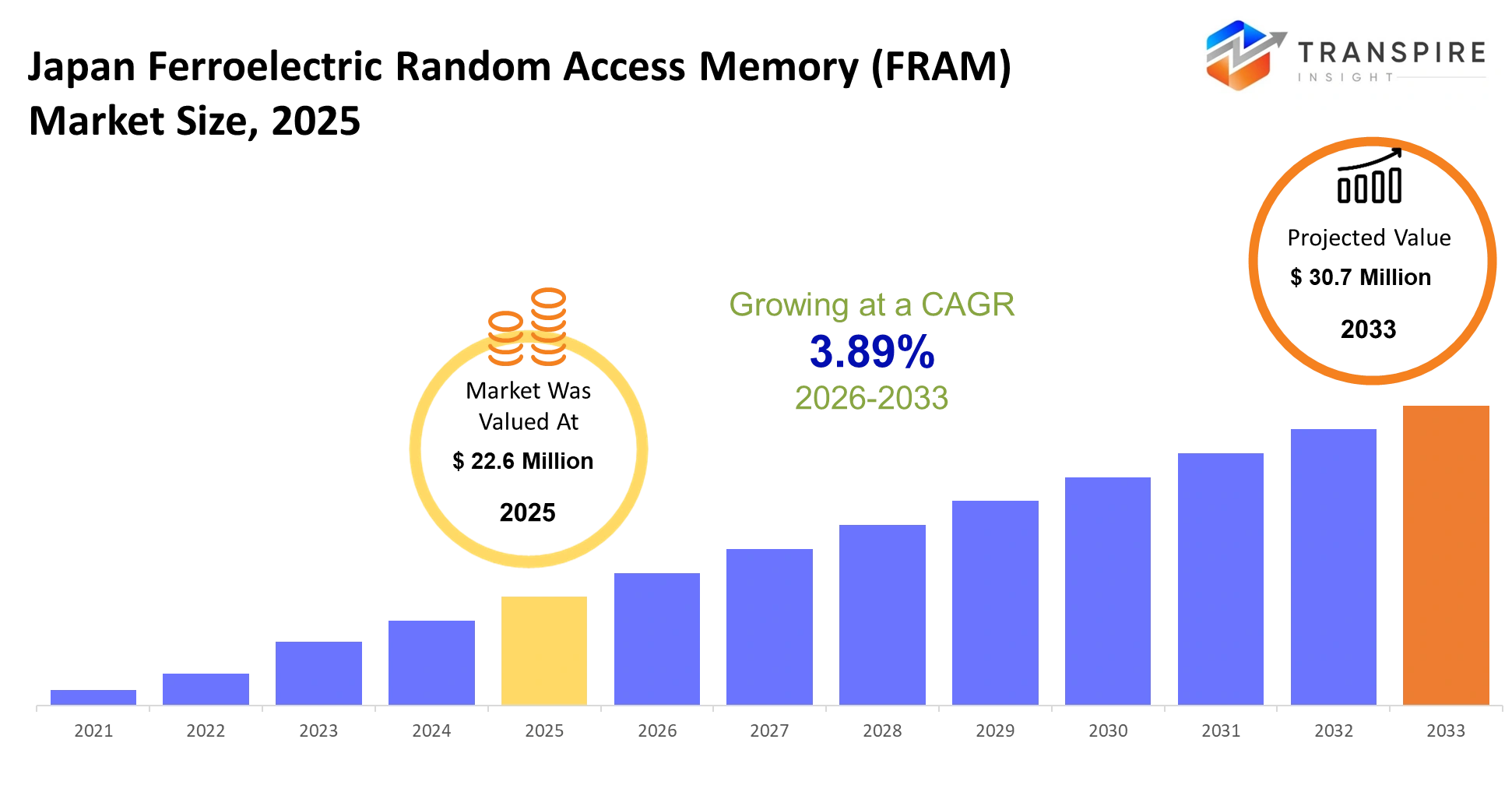
- Japan Ferroelectric Random Access Memory (FRAM) Market Size 2025: USD 22.6 Million
- Japan Ferroelectric Random Access Memory (FRAM) Market Size 2033: USD 30.7 Million
- Japan Ferroelectric Random Access Memory (FRAM) Market CAGR: 3.89%
- Japan Ferroelectric Random Access Memory (FRAM) Market Segments: By Type (Standalone, Embedded, Serial, Parallel), By Application (Smart Cards, IoT, Automotive, Industrial), By End-User (Electronics Manufacturers, OEMs, Semiconductor Firms, Industrial Users)
To learn more about this report,  Download Free Sample Report
Japan Ferroelectric Random Access Memory (FRAM) Market Summary:
The Japan Ferroelectric Random Access Memory (FRAM) Market size is estimated at USD 22.6 Million in 2025 and is anticipated to reach USD 30.7 Million by 2033, growing at a CAGR of 3.89% from 2026 to 2033. The Japan Ferroelectric Random Access Memory (FRAM) market is growing at a constant rate because different industries including automotive and consumer electronics and industrial automation require low-power and fast and permanent memory solutions. FRAM technology provides multiple benefits which exceed the capabilities of standard memory systems because it enables quicker data writing and it delivers longer operational life and it requires less power consumption. The advanced electronics manufacturing capabilities of Japan together with its strong semiconductor industry drive the development of FRAM technology in new applications.
The growing automotive electronics sector especially for electric and autonomous vehicles has increased the need for dependable memory solutions such as FRAM. The area promotes development because major electronics and semiconductor companies operate there while they conduct research and development work. The government is backing digital transformation initiatives together with smart infrastructure projects which help develop the market. The Japan FRAM market will continue to grow during the next few years because businesses are focusing on two aspects which include energy efficiency and data reliability.
Key Market Trends & Insights:
- Rising Demand for Low-Power Memory Solutions FRAM technology gains market traction because its power requirements are lower than those of existing memory systems. This technology enables battery-powered devices and Internet of Things sensors and wearable devices to operate with extended energy efficiency which is essential for their performance needs.
- Growing Adoption in Automotive Electronics The rising adoption of electric vehicles and autonomous driving technology in Japan has increased the need for FRAM components which are used in event data recorders and advanced driver-assistance systems and infotainment systems. The product's tough automotive design enables it to endure extreme conditions while operating at high writing speeds which makes it suitable for automotive applications.
- Increasing Integration in Industrial IoT (IIoT) Industrial automation and smart manufacturing systems now use FRAM technology because it provides fast write capabilities and long-lasting performance. The system enables real-time data logging and predictive maintenance and machine-to-machine communication which helps Japan achieve its Industry 4.0 and smart factory goals.
- Technological Advancements and Miniaturization Research and development initiatives currently aim to enhance FRAM memory technology by increasing its storage capacity and microcontroller compatibility and system distribution capabilities. Japanese semiconductor companies are working on new memory solutions which will deliver improved performance and smaller memory solutions for next-generation electronic devices.
- Strong Domestic Semiconductor Ecosystem Support Japan's established semiconductor industry benefits from government initiatives which support digital transformation and this combination drives FRAM market expansion. Research institutions and companies are working together to speed up product development and create new uses for their technology in different industries.
Japan Ferroelectric Random Access Memory (FRAM) Market Segmentation
By Type
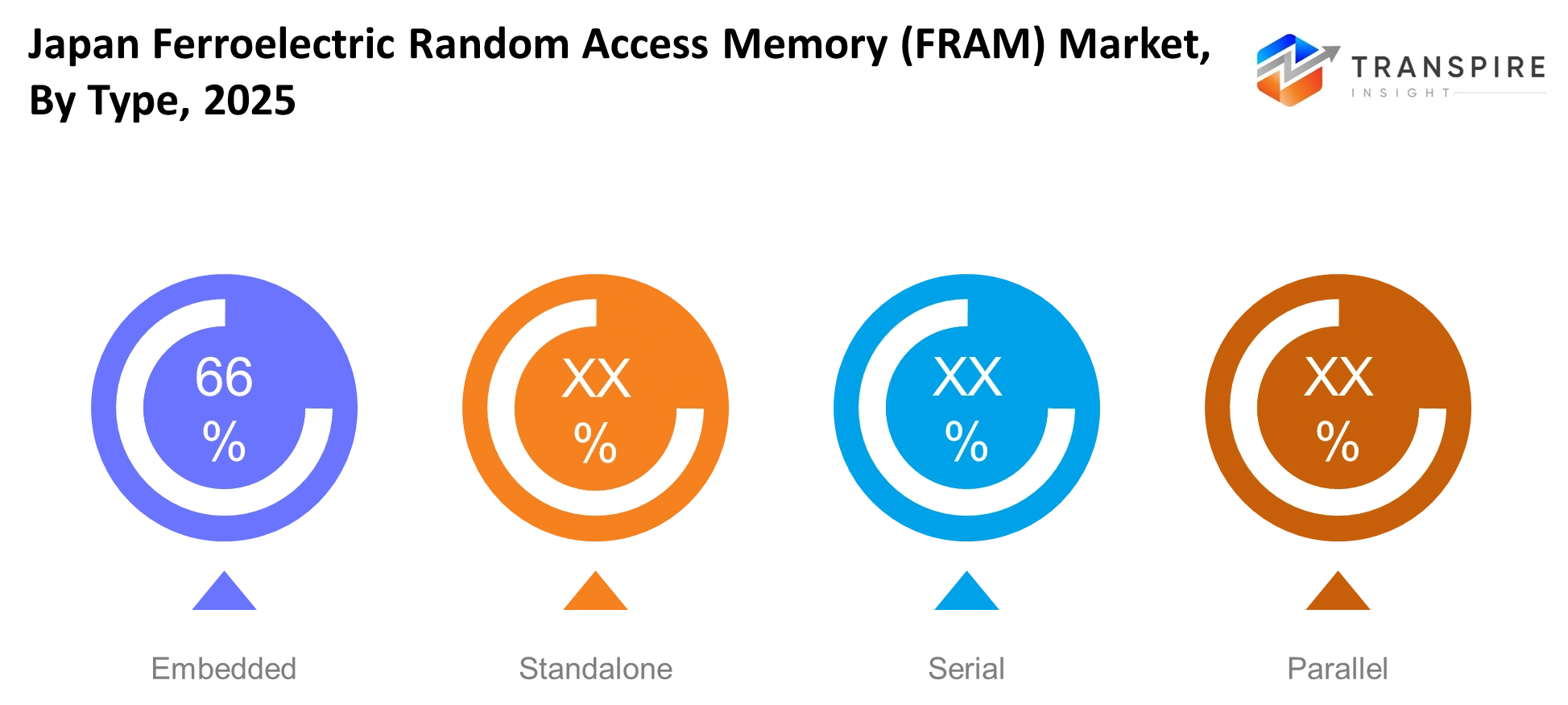
- Standalone: Standalone FRAM devices function as independent memory components which can be integrated into different types of electronic systems. The technology functions as essential non-volatile memory which maintains data during power outages while providing high durability, making it suitable for use in data logging devices and industrial equipment applications.
- Embedded: Embedded FRAM exists as a built-in component of microcontrollers and system-on-chip SoC systems. The product has become increasingly popular because it delivers compact dimensions and efficient performance, which makes it suitable for use in IoT devices and smart sensors and portable electronic devices.
- Serial: Serial FRAM operates through SPI or I2C interfaces which allow for easier circuit connections and reduced requirement for connector pins. The technology functions as an essential component in small electronic devices and consumer electronic products that need to conserve space while providing easy installation.
- Parallel: Parallel FRAM achieves enhanced data transmission speeds through its multiple data pathways, which enables its use in demanding performance scenarios. The technology functions as an essential component in industrial systems and automotive electronics which require instantaneous data processing and high-speed operation.
To learn more about this report, Download Free Sample Report
By Application
- Smart Cards: Smart cards use FRAM to achieve secure data storage and fast transaction processing capabilities. The technology proves suitable for banking identification and access control system applications because of its ability to endure multiple write cycles and maintain operational integrity.
- IoT: FRAM enables IoT devices to operate with low power while they perform continuous data writing tasks. The technology enables sensors and wearables and connected devices to operate their memory needs for ongoing data collection and transmission activities.
- Automotive: The automotive sector uses FRAM in applications such as event data recorders, advanced driver-assistance systems (ADAS), and infotainment systems. The product achieves high reliability through its ability to withstand extreme conditions and maintain operational performance.
- Industrial: Industrial applications extend to automation systems and robotics and smart manufacturing. FRAM enables systems to perform real-time data logging and monitoring functions which allow for predictive maintenance and optimal system performance in extreme operating condition
By End-User
- Electronics Manufacturers: These companies use FRAM technology to create products which include consumer electronics and wearable devices and smart home equipment. Memory solutions must be developed as compact products which consume less energy while delivering superior performance to meet the current market needs.
- OEMs (Original Equipment Manufacturers): OEMs use FRAM technology to create customized solutions which they provide to customers in the automotive and healthcare and industrial fields. The system functions effectively because of its flexible design which provides dependable performance in specialized work environments.
- Semiconductor Firms: Semiconductor companies create and distribute FRAM chips which come with built-in systems. The Japanese industry needs continuous research and development work from these companies to drive its FRAM technology development forward.
- Industrial Users: Industrial organizations use FRAM technology in their operations which include manufacturing equipment and automated systems and work processes that require extensive data processing. The system functions effectively because of its flexible design which provides dependable performance in specialized work environments.
Country Insights
Japan's advanced semiconductor manufacturing ecosystem and its historical development of electronic technology create strong support for the country's FRAM market. The country is home to key players such as Fujitsu and Panasonic which have been instrumental in the development and commercialization of FRAM technology. Japanese manufacturers create high-quality electronic components which match the benefits of FRAM technology that includes reliable operation and low energy usage and rapid data writing capabilities. The country establishes itself as a global automotive electronics leader which drives industrial automation to increase the use of FRAM technology in essential business functions.
Government programs that support digital transformation and smart manufacturing and next-generation mobility development work to increase the need for advanced memory solutions which include FRAM technology. Japan's push toward Industry 4.0 and the expansion of IoT infrastructure are creating new opportunities for embedded FRAM in smart devices and connected systems. Research institutions and semiconductor companies engage in strong collaborative partnerships which lead to ongoing technological progress while electric vehicle development and smart infrastructure investments will drive long-term market expansion.
Recent Development News
- Japan's FRAM market is currently experiencing new technological developments that include next-generation solutions based on FeFET technology which enhances memory performance through increased scalability and faster operation with lower power consumption.
- The development of advanced ferroelectric materials which include hafnium oxide helps to establish better compatibility with contemporary semiconductor production processes.
|
Report Metrics |
Details |
|
Market size value in 2025 |
USD 22.6 Million |
|
Market size value in 2026 |
USD 23.5 Million |
|
Revenue forecast in 2033 |
USD 30.7 Million |
|
Growth rate |
CAGR of 3.89% from 2026 to 2033 |
|
Base year |
2025 |
|
Historical data |
2021 – 2024 |
|
Forecast period |
2026 – 2033 |
|
Report coverage |
Revenue forecast, competitive landscape, growth factors, and trends |
|
Country scope |
Japan |
|
Key company profiled |
Fujitsu, Cypress, Texas Instruments, Infineon, ROHM, Renesas, STMicroelectronics, Samsung, Toshiba, NXP, Microchip, Panasonic, Sony, SK Hynix, Intel |
|
Customization scope |
Free report customization (country, regional & segment scope). Avail customized purchase options to meet your exact research needs. |
|
Report Segmentation |
By Type (Standalone, Embedded, Serial, Parallel), By Application (Smart Cards, IoT, Automotive, Industrial), By End-User (Electronics Manufacturers, OEMs, Semiconductor Firms, Industrial Users) |
Key Japan Ferroelectric Random Access Memory (FRAM) Market Company Insights
The Japan Ferroelectric Random Access Memory (FRAM) market shows intense competition because both international semiconductor companies and powerful domestic firms compete in this market. Fujitsu and Panasonic have provided essential support for the initial stages of FRAM technology development and its market introduction through their work in embedded and low-power product development. International firms such as Texas Instruments, Infineon, and STMicroelectronics are building their business operations by providing advanced FRAM products that combine with microcontrollers to support automotive and industrial and IoT market solutions.
Japanese companies Renesas and ROHM and Toshiba work to build up the domestic market by developing new technologies and forming strategic partnerships. The major technology companies Samsung, SK Hynix, and Intel are making investments in emerging memory technologies which either work together with FRAM or act as competitors to it. The companies NXP Microchip Cypress and Sony work on specialized product development which helps Japanese markets to expand through their innovative work on embedded memory products.
Company List
- Fujitsu
- Cypress
- Texas Instruments
- Infineon
- ROHM
- Renesas
- STMicroelectronics
- Samsung
- Toshiba
- NXP
- Microchip
- Panasonic
- Sony
- SK Hynix
- Intel
Japan Ferroelectric Random Access Memory (FRAM) Market Report Segmentation
By Type
- Standalone
- Embedded
- Serial
- Parallel
By Application
- Smart Cards
- IoT
- Automotive
- Industrial
By End-User
- Electronics Manufacturers
- OEMs
- Semiconductor Firms
- Industrial Users
Frequently Asked Questions
Find quick answers to common questions.
The Approximate Japan Ferroelectric Random Access Memory (FRAM) Market size for the Market will be USD 30.7 Million in 2033.
Key Segments for the Japan Ferroelectric Random Access Memory (FRAM) Market are By Type (Standalone, Embedded, Serial, Parallel), By Application (Smart Cards, IoT, Automotive, Industrial), By End-User (Electronics Manufacturers, OEMs, Semiconductor Firms, Industrial Users).
Major Japan Ferroelectric Random Access Memory (FRAM) Market Players are Fujitsu, Cypress, Texas Instruments, Infineon, ROHM, Renesas, STMicroelectronics, Samsung, Toshiba, NXP, Microchip, Panasonic, Sony, SK Hynix, Intel.
The Current Japan Ferroelectric Random Access Memory (FRAM) Market size is USD 22.6 Million in 2025.
The Japan Ferroelectric Random Access Memory (FRAM) Market CAGR is 3.89%.
- Fujitsu
- Cypress
- Texas Instruments
- Infineon
- ROHM
- Renesas
- STMicroelectronics
- Samsung
- Toshiba
- NXP
- Microchip
- Panasonic
- Sony
- SK Hynix
- Intel
Recently Published Reports
-
Apr 2026
Fiber Optic Faceplates Market
Fiber Optic Faceplates Market Size, Share & Analysis Report By Type (< 300 mm2, 300-350 mm2, and > 350 mm2, By Application (Night Vision, Holographic Imaging, Medical, and Others), and Geography (North America, Europe, Asia-Pacific, Middle East and Africa, South and Central America), 2021 - 2031
-
Apr 2026
High Temperature Superconductors Market
High Temperature Superconductors Market Size, Share & Analysis Report By Type (1G HTS, and 2G HTS), By Application (Power Cable, Fault Current Limiter, and Transformer), and Geography (North America, Europe, Asia-Pacific, Middle East and Africa, South and Central America), 2021 - 2031
-
Apr 2026
Industrial Plugs and Socket Market
Industrial Plugs and Socket Market Size, Share & Analysis Report By Type (Industrial Plugs, Industrial Sockets), By Current (Up to 32 A, 32 to 125 A, Above 125 A), By Protection (Dustproof and Splash Proof, Waterproof, Explosion Proof), By End User (Heavy Industries, Oil and Gas, Chemicals and Pharmaceuticals, Power Generation, Others), and Geography (North America, Europe, Asia-Pacific, Middle East and Africa, South and Central America), 2021 - 2031
-
Apr 2026
InGaAs Avalanche Photodiodes Market
InGaAs Avalanche Photodiodes Market Size, Share & Analysis Report By Type (1100 - 1700 nm, and 1000 - 1600 nm), By Application (Missile Warning System, Muzzle Flash Detection, Wafer Defect Inspection, Laser Rangefinders, and Others), and Geography (North America, Europe, Asia-Pacific, Middle East and Africa, South and Central America), 2021 - 2031