
Japan Eye Tracking Market Size & Forecast:
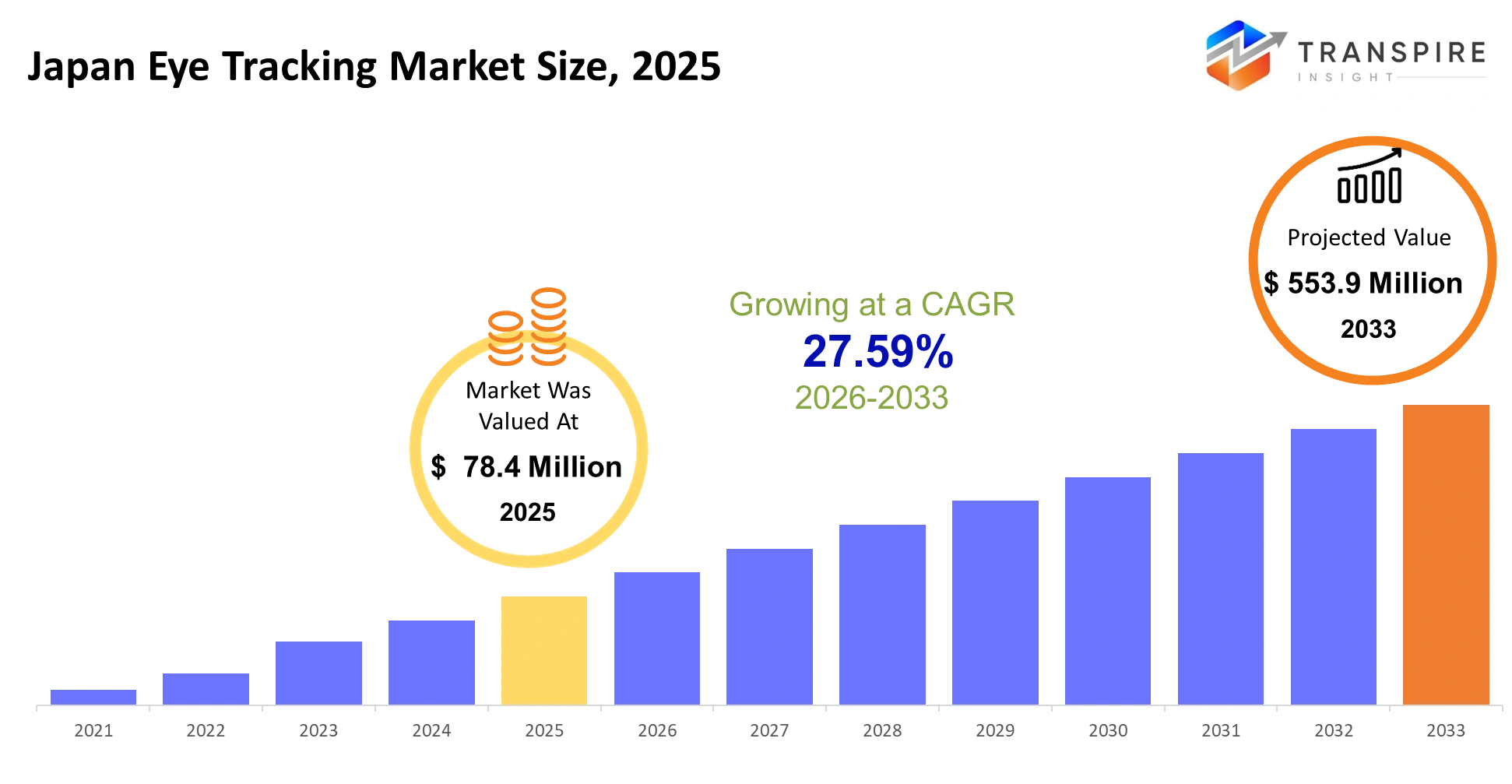
- Japan Eye Tracking Market Size 2025: USD 78.4 Million
- Japan Eye Tracking Market Size 2033: USD 553.9 Million
- Japan Eye Tracking Market CAGR: 27.59%
- Japan Eye Tracking Market Segments: By Type (Remote, Wearable, Mobile, Desktop), By Application (Healthcare, Gaming, Research, Marketing), By End-User (Hospitals, Research Institutes, Enterprises, Gaming Companies)
To learn more about this report,  Download Free Sample Report
Japan Eye Tracking Market Summary:
The Japan Eye Tracking Market size is estimated at USD 78.4 Million in 2025 and is anticipated to reach USD 553.9 Million by 2033, growing at a CAGR of 27.59% from 2026 to 2033. The Japan eye tracking market experiences strong growth because of advanced artificial intelligence (AI) technology and augmented reality (AR) and virtual reality (VR) systems development. The need for better human-computer interaction and user experience analysis drives businesses to adopt eye tracking technology in consumer electronics, healthcare, automotive, and research fields. Eye tracking technology serves as a fundamental component for multiple applications which include driver monitoring systems and assistive communication devices and gaming and behavioral research methods.
The Japanese electronics industry benefits from its established status and ongoing research and development investments which drive market growth. The rising demand for eye tracking technology in medical diagnostics and retail analytics and smart devices drives market growth. Companies develop systems which combine eye tracking technology with wearable devices and AR/VR headsets to create interactive experiences. The market will experience strong growth because of technological progress and rising adoption in various industrial sectors.
Key Market Trends & Insights:
- The Japanese market shows a major trend of combining eye tracking technology with augmented reality (AR) and virtual reality (VR) systems. Companies improve their gaming and training and simulation products through their ability to provide real-time gaze tracking and better user control systems.
- The market for eye tracking technology in healthcare continues to grow because medical professionals use it for neurological assessments and vision diagnostics and assistive communication device testing. The research institutions and hospitals in Japan use this technology to enhance patient results while assisting people who have physical or intellectual disabilities.
- Japanese automotive companies are now using eye tracking systems to develop advanced driver monitoring systems and safety technologies. The systems monitor driver fatigue and distraction and attention levels which supports Japan's mission to develop self-driving vehicles and establish better road safety regulations.
- Retail and marketing research organizations are increasingly using eye tracking solutions because of their rising need to study consumer behavior patterns. Companies analyze gaze tracking information to determine customer preferences which helps them decide product placement and advertising methods that will boost customer interaction and sales results.
- Technological progress and sensor miniaturization have created compact eye tracking devices which now offer lower costs and can be embedded in smartphones and wearables and laptops. The wider application of this technology drives broader adoption throughout the commercial and consumer markets in Japan
Japan Eye Tracking Market Segmentation
By Type
- Remote: The remote eye tracking systems use both cameras and sensors to track users from a distance without requiring any physical touch. The research labs and retail analytics and usability testing fields widely utilize these monitoring systems because they do not disturb users while they track actual user movements.
- Wearable: The use of smart glasses as wearable eye tracking devices has increased because they provide benefits for real-world situations. The system enables users to move freely which makes it suitable for healthcare and sports training and field research because it tracks eye movements throughout active situations.
- Mobile: The introduction of mobile eye tracking technology allows users to track their eye movements through their smartphone and tablet devices. The technology is now used more often for three purposes user engagement analysis and accessibility features and app optimization because most people use mobile devices and front-facing camera technology has advanced.
- Desktop: The controlled environments of laboratories and offices typically use desktop eye tracking systems for their operations. The system provides accurate tracking which makes it suitable for use in gaming and software testing and cognitive research because those fields demand precise tracking and stable testing environments.
By Application
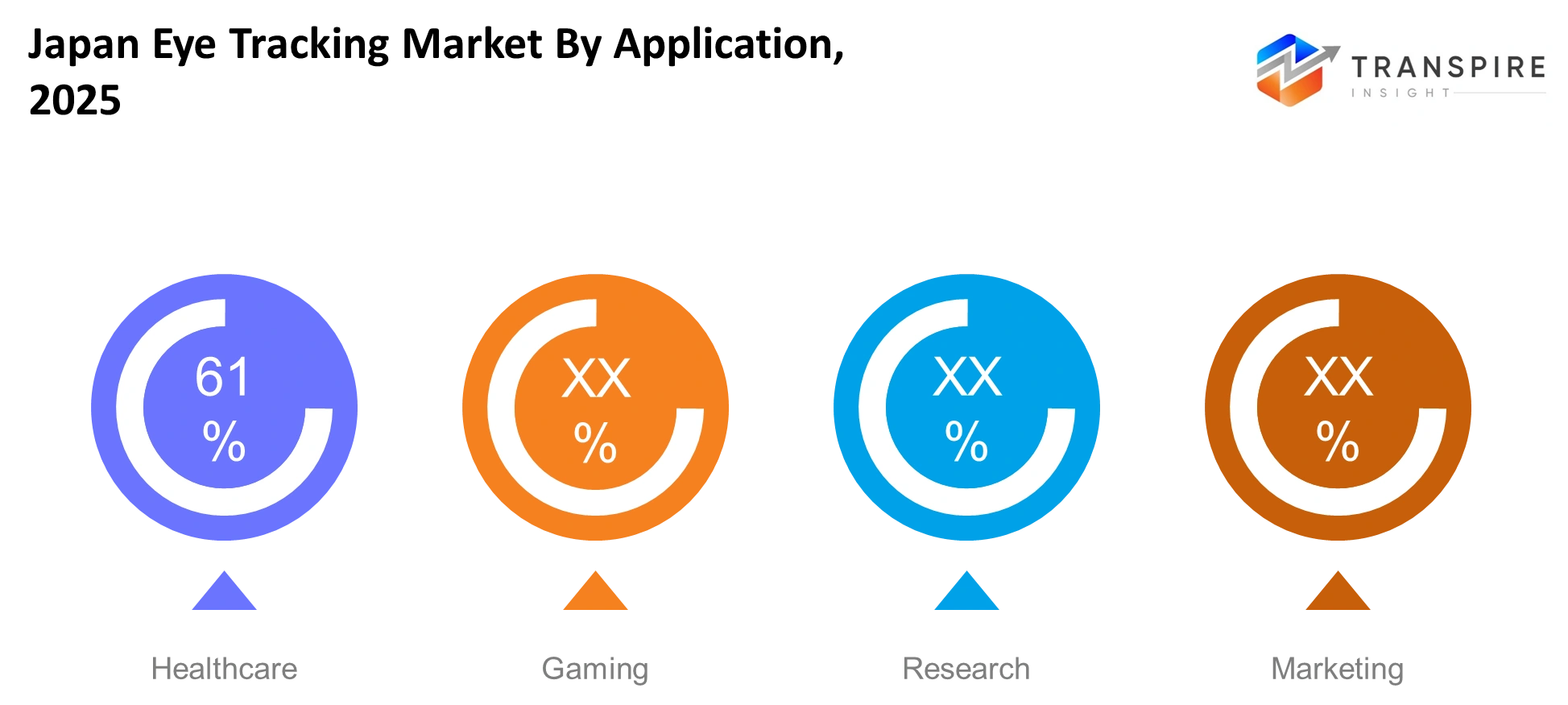
- Healthcare: Diagnostic procedures and rehabilitation programs and assistive communication systems use eye tracking technology for their operations. The technology functionsas a vital medical tool because it detects neurological disorders and tracks visual health and permits people with movement restrictions to communicate.
- Gaming: Eye tracking technology improves user experience in gaming by providing gaze-based control systems and creating authentic user interaction methods. The technology has become a standard part of virtual reality and augmented reality gaming platforms which allow players to experience interactive gameplay while developers track their gaming patterns and levels of engagement.
- Research: Research institutions use eye tracking to study human behavior and analyze cognitive processes and conduct research on how people interact with computer systems. The system provides researchers with accurate data about human attention patterns and their ability to concentrate and make choices which has research applications in psychology and neuroscience and usability testing.
- Marketing: Eye tracking technology serves a primary function in marketing because it allows marketers to study how consumers direct their attention and what products they choose. The technology allows businesses to enhance their advertising campaigns and product packaging and retail space design by tracking consumer attention patterns and their duration of focus on particular aspects.
To learn more about this report, Download Free Sample Report
By End-User
- Hospitals: Medical institutions apply eye tracking technology to perform clinical assessments and observe patients and develop assistive devices. The technology helps doctors evaluate brain function and enhance patient communication in both neurology and rehabilitation.
- Research Institutes: Research institutes are major users of eye tracking systems for academic and scientific studies. Organizations use accurate eye tracking data to study how people think and interact with each other and how their brains respond.
- Enterprises: Enterprises employ eye tracking technology to create new products and assess user experiences and conduct their staff development programs. The software enables companies to create better user interfaces and streamline their business operations and develop more effective customer interaction methods.
- Gaming Companies: Gaming companies use eye tracking technology to build games that offer players a fully immersive experience with interactive elements. The technology allows them to track how players behave while they play and to enhance game design and create new capabilities for AR and VR gaming systems.
Country Insights
The strong electronics manufacturing base of Japan together with its precision sensor and semiconductor expertise positions the country as a top eye tracking technology market within the Asia-Pacific region. The country advances its artificial intelligence (AI) research together with human-machine interface development and smart device innovation which leads to increased eye tracking usage in automotive and healthcare and consumer electronics sectors.
The increasing implementation of eye tracking technology in medical diagnostics and rehabilitation and assistive communication systems receives support from Japan's aging population together with its development of advanced healthcare facilities. The market benefits from government support which enables technological developments while companies increase their funding for AR/VR and smart wearable and automotive safety system technologies. Japan maintains its important position as a key region which drives the development of eye tracking technologies that will reach their full potential in the future.
Recent Development News
In 2026 Samsung Electronics launched its advanced 6K glasses-free 3D monitor which includes eye tracking technology that operates in real time. The new technology enables users to experience more realistic gaming and visual content which demonstrates that eye tracking technology has started to become standard in high-tech display systems and future gaming devices.
Japanese technology innovations are expanding globally as seen in AI-based tracking systems developed by Nippon Television Network being adopted internationally. The systems use advanced tracking and recognition technologies to provide customized viewing options which demonstrate Japan's expertise in real-time visual tracking and analytics systems.
|
Report Metrics |
Details |
|
Market size value in 2025 |
USD 78.4 Million |
|
Market size value in 2026 |
USd 100.6 Million |
|
Revenue forecast in 2033 |
USD 553.9 Million |
|
Growth rate |
CAGR of 27.59% from 2026 to 2033 |
|
Base year |
2025 |
|
Historical data |
2021 – 2024 |
|
Forecast period |
2026 – 2033 |
|
Report coverage |
Revenue forecast, competitive landscape, growth factors, and trends |
|
Country scope |
Japan |
|
Key company profiled |
Tobii, SR Research, EyeTech, Seeing Machines, Smart Eye, Gazepoint, Pupil Labs, SMI, Apple, Microsoft, Google, Meta, NVIDIA, HTC, Sony |
|
Customization scope |
Free report customization (country, regional & segment scope). Avail customized purchase options to meet your exact research needs. |
|
Report Segmentation |
By Type (Remote, Wearable, Mobile, Desktop), By Application (Healthcare, Gaming, Research, Marketing), By End-User (Hospitals, Research Institutes, Enterprises, Gaming Companies) |
Key Japan Eye Tracking Market Company Insights
The Japan eye tracking market is a highly competitive field which relies on continuous innovation because both established companies and new businesses develop AI gaze tracking systems and wearable devices and automotive safety solutions. The market is dominated by Tobii which provides advanced attention-computing solutions for research purposes and gaming and extended reality (XR) applications while its robust patent portfolio and international alliances support its business operations. The companies Seeing Machines and Smart Eye establish a presence in the Japanese automotive market through their driver monitoring systems which improve road safety and facilitate autonomous vehicle development.
The technology giants Apple Microsoft Google Meta and Sony are implementing eye tracking technology into their AR/VR headsets and smartphones and accessibility features to create new consumer applications. The research-focused companies SR Research Gazepoint Pupil Labs and EyeTech make major contributions to academic research and usability studies. NVIDIA and HTC promote ecosystem development by providing GPU technologies and VR platforms which help create a highly innovative market environment.
Company List
- Tobii
- SR Research
- EyeTech
- Seeing Machines
- Smart Eye
- Gazepoint
- Pupil Labs
- SMI
- Apple
- Microsoft
- Meta
- NVIDIA
- HTC
- Sony
Japan Eye Tracking Market Report Segmentation
By Type
- Remote
- Wearable
- Mobile
- Desktop
By Application
- Healthcare
- Gaming
- Research
- Marketing
By End-User
- Hospitals
- Research Institutes
- Enterprises
- Gaming Companies
Frequently Asked Questions
Find quick answers to common questions.
The approximate Japan Eye Tracking Market size for the market will be USD 553.9 Million in 2033.
Key segments for the Japan Eye Tracking Market are By Type (Remote, Wearable, Mobile, Desktop), By Application (Healthcare, Gaming, Research, Marketing), By End-User (Hospitals, Research Institutes, Enterprises, Gaming Companies).
Major Japan Eye Tracking Market players are Tobii, SR Research, EyeTech, Seeing Machines, Smart Eye, Gazepoint, Pupil Labs, SMI, Apple, Microsoft, Google, Meta, NVIDIA, HTC, Sony.
The Japan Eye Tracking Market size is USD 78.4 Million in 2025.
The Japan Eye Tracking Market CAGR is 27.59%.
- Tobii
- SR Research
- EyeTech
- Seeing Machines
- Smart Eye
- Gazepoint
- Pupil Labs
- SMI
- Apple
- Microsoft
- Meta
- NVIDIA
- HTC
- Sony
Recently Published Reports
-
Apr 2026
3D Optical Profiler Market
3D Optical Profiler Market Size, Share & Analysis Report By Type (Desktop 3D Optical Profiler, and Portable 3D Optical Profiler), By Technology (Confocal Technology, and White Light Interference), By End-Use Industry (Manufacturing, Research Institutions, Automotive, Aerospace and Defense, Medical Devices, and Other), and Geography (North America, Europe, Asia-Pacific, Middle East and Africa, South and Central America), 2021 - 2031
-
Apr 2026
Depth Sensor Market
Depth Sensor Market Size, Share & Analysis Report By Type (Infrared Depth Sensors, Time-of-Flight (ToF) Sensors, Stereo Vision Sensors, Structured Light Sensors, Ultrasonic Depth Sensors), By Application (Automotive, Robotics, Gaming, Consumer Electronics, Industrial Automation, Healthcare, Security & Surveillance, Others), By End Users (Automotive Manufacturers, Consumer Electronics Companies, Healthcare Providers, Industrial Companies, Security Agencies, Gaming Companies, Robotics Companies, Others), and Geography (North America, Europe, Asia-Pacific, Middle East and Africa, South and Central America), 2021 – 2031
-
Apr 2026
Digital Manufacturing Market
Digital Manufacturing Market Size, Share & Analysis Report By Component (Hardware, Software, and Services), By Technology (Robotics, 3D Printing, Internet of Things (IoT), and Others), By Application (Automotive and Transportation, Aerospace and Defense, Consumer Electronics, Industrial Machinery, and Others), By Process Type (Computer-Based Designing, Computer-Based Simulation, Computer 3D Visualization, Analytics, and Others), and Geography (North America, Europe, Asia-Pacific, Middle East and Africa, South and Central America), 2021 – 2031
-
Apr 2026
Digital Visa Services Market
Digital Visa Services Market Size, Share & Analysis Report By Type (Individual Travelers, Group Travelers), By Application (Tourism, Business Travel, Others), and Geography (North America, Europe, Asia-Pacific, Middle East and Africa, South and Central America), 2021 – 2031