

Japan Extreme Ultraviolet (EUV) Lithography Market Size & Forecast:
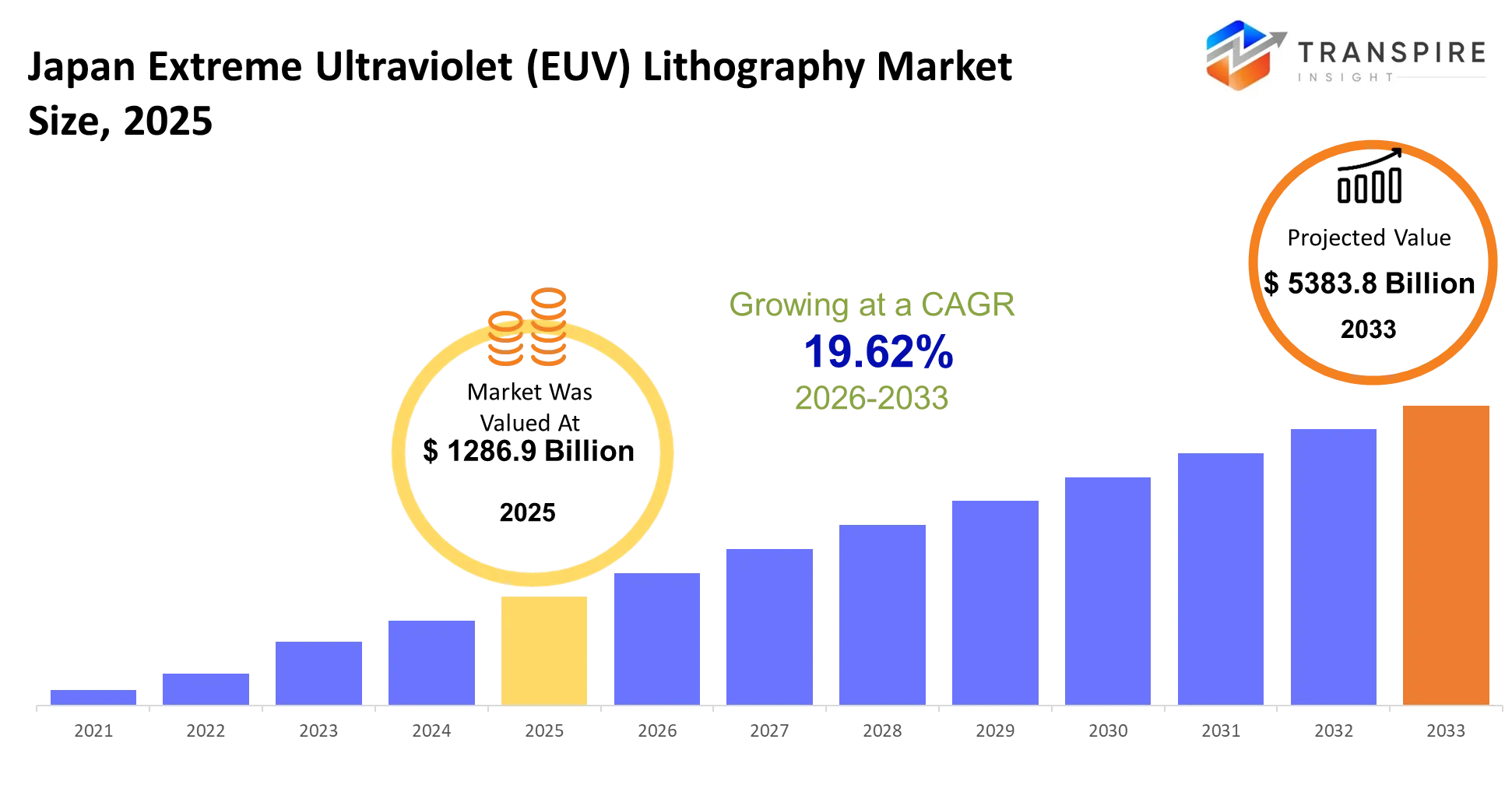
- Japan Extreme Ultraviolet (EUV) Lithography Market Size 2025: USD 1286.9 Million
- Japan Extreme Ultraviolet (EUV) Lithography Market Size 2033: USD 5383.8 Million
- Japan Extreme Ultraviolet (EUV) Lithography Market CAGR: 19.62%
- Japan Extreme Ultraviolet (EUV) Lithography Market Segments: By Type (EUV Light Sources, EUV Masks, EUV Resists, EUV Systems, Others); By Application (Semiconductor Manufacturing, IC Fabrication, Advanced Chips, Memory Devices, Logic Devices, Others); By End-User (Semiconductor Companies, Foundries, Electronics Firms, Research Institutes, Others); By Node (7nm, 5nm, 3nm, Below 3nm, Others)
To learn more about this report,  Download Free Sample Report
Japan Extreme Ultraviolet (EUV) Lithography Market Summary
The Japan Extreme Ultraviolet (EUV) Lithography Market was valued at USD 1286.9 Million in 2025. It is forecast to reach USD 5383.8 Million by 2033. That is a CAGR of 19.62% over the period.
Japan maintains its Extreme Ultraviolet lithography market as a fundamental element of semiconductor manufacturing which enables chipmakers to create extremely thin circuit designs required for their upcoming processors and memory systems and artificial intelligence acceleration hardware. The method enables manufacturers to produce increasingly advanced electronic devices through its ability to reduce transistor dimensions without sacrificing operational capabilities and power consumption and production accuracy.
The market has undergone complete transformation during the past three to five years as it transitioned from its dependence on deep ultraviolet processes toward implementing EUV technology for advanced semiconductor manufacturing nodes. The Japanese government increased its domestic semiconductor industry capabilities by establishing public and private funding programs together with manufacturing development incentives. The global semiconductor supply chain breakdown during the pandemic and its aftermath together with rising geopolitical tensions demonstrated critical weaknesses in chip distribution networks which led to this situation.
The advanced fabrication capacity expansion and ecosystem collaboration development process has experienced rapid development. The manufacturers who run cutting-edge processes use their EUV-related expenditures to establish better equipment systems and create local supply networks which will bring them ongoing income throughout all components of Japan's semiconductor industry.
Key Market Insights
- The Kanto region dominates the Japan Extreme Ultraviolet (EUV) Lithography Market because it has semiconductor fabrication centers that account for 48% of the market share in 2025.
- Kyushu is the fastest-growing region because it will develop until 2030 through its planned semiconductor manufacturing facilities and local supply chain development.
- The Kansai region establishes its presence through two main factors, which include its research and development semiconductor ecosystem development and its government-sponsored technology infrastructure growth.
- The EUV exposure systems market will reach about 42% market share in 2025 because there is a crucial need for advanced semiconductor patterning technology.
- The second largest market segment consists of mask inspection and metrology tools, which exist because manufacturers need to reduce defects that occur during advanced node production.
- The segment of EUV resist materials will see its most rapid growth until 2030 because process optimization enables production of 3nm and 2nm technology.
- Advanced lithography systems are necessary for AI processors and high-performance computing chips which create logic semiconductor fabrication that holds 46% market share.
- The memory chip manufacturing industry experiences its most rapid expansion because next-generation DRAM and NAND scaling requirements drive the market.
- Integrated device manufacturers control 54% of the market share in 2025 because they use their extensive capital investment to move forward with advanced node development.
- The end-user category of foundry service providers shows the most rapid growth during the forecast period because outsourcing continues to expand.
What are the Key Drivers, Restraints, and Opportunities in the Japan Extreme Ultraviolet (EUV) Lithography Market?
The Japan Extreme Ultraviolet EUV Lithography Market advances its most powerful growth through the renewed industrial semiconductor strategy which Japan developed to address international chip shortages and operational challenges which revealed the country depended on imported advanced-node manufacturing. The government-supported funding and private sector financing have both boosted investment levels into domestic manufacturing facilities which focus on developing sub-7nm technology.
The shift generates more financial prospects for EUV system vendors and component production businesses and process integration experts since advanced semiconductor manufacturing facilities need special lithography equipment to compete internationally. The market demand for smaller efficient chip designs keeps growing because AI processors and automotive semiconductors and high-performance computing systems continue to expand their commercial needs.
The market faces its biggest structural obstacle because EUV deployment requires extremely high capital expenses and complicated technological systems. EUV-compatible fabrication lines need more than multi-billion-dollar funding because they need both cleanroom systems and special engineering skills to construct them. The solution to this problem needs prolonged time because it requires both infrastructure development and the establishment of specialized training programs. The result produces longer times needed for factories to start operations which leads to postponed product launches that reduce immediate revenue generation across Japan's semiconductor industry
Japan currently presents its most significant growth opportunity through its developing 2nm semiconductor ecosystem which includes the advanced node project of Rapidus at its Hokkaido fabrication facility. The domestic foundries reach their operational peak while ecosystem partners establish deeper connections which will drive demand for EUV process optimization and metrology tools and resist innovation.
What Has the Impact of Artificial Intelligence Been on the Japan Extreme Ultraviolet (EUV) Lithography Market?
The EUV lithography system in Japan now uses AI to handle process control tasks while improving exposure precision and maintaining equipment stability throughout semiconductor manufacturing operations. AI control systems track wafer alignment and overlay accuracy and mask defects and power stability to enable fabs to adjust operations in real time which results in decreased patterning errors during their production processes.
To prevent production interruptions machine learning models now perform predictive maintenance through their analysis of vibration patterns and temperature variations and optical decline tracking. The predictive feature has boosted advanced manufacturing facilities equipment availability by 10 to 15 percent while decreasing unexpected maintenance expenses.
Digital twin technology enables performance optimization through early workflow simulation which allows fabs to reduce time spent on process qualification while achieving better production results. The systems operate tighter yield control standards which result in reduced defect-related wafer waste and increased cost savings for production processes below 5 nanometers.
AI platforms create major challenges for their application in existing manufacturing systems because of their complicated integration process. The EUV systems produce unique data sets while the limited historical data on system failures restricts model development because it makes autonomous optimization at early deployment stages impossible.
Key Market Trends
- The Japanese semiconductor industry began investing its resources into developing sub-5nm technology during 2022 after which they committed more than 30% to advanced-node projects through their major fabrication initiatives.
- The semiconductor industry received government-supported funding programs which began after 2023 to support manufacturers in building advanced domestic lithography systems instead of improving their existing production methods.
- Buyers increasingly prefer complete EUV process systems which has led ASML and Tokyo Electron to increase their partnerships for service and process support.
- The global semiconductor supply chain disruptions which began in 2021 forced Rapidus to develop new procurement patterns that focus on domestic advanced-node manufacturing capabilities.
- Manufacturers now focus their resources on building EUV-compatible facilities because AI processor demand has changed their production scheduling procedures.
- Japanese materials suppliers have intensified their research and development efforts for photoresist and mask blank technologies since 2024 because they need to meet stricter defect tolerance standards which have become necessary for producing 2nm technology.
- The implementation of advanced lithography systems in fabrication facilities has resulted in a 15 to 20 percent extension of equipment procurement periods because of stricter qualification requirements which facilities now follow.
- The industry competition now requires organizations to establish partnerships between their equipment divisions and background systems through which Nikon Canon and other international companies will work together to develop new products.
- Advanced fabrication environments now use AI-based predictive analytics systems which process engineers implement to enhance EUV tool operational time while decreasing unexpected maintenance events.
- The establishment of regional semiconductor hubs began in 2024 when Hokkaido and Kyushu became important locations for advancing Japan's next-generation lithography development.
Japan Extreme Ultraviolet (EUV) Lithography Market Segmentation
By Type:
The Japan Extreme Ultraviolet (EUV) Lithography Market by type includes EUV light sources, EUV masks, EUV resists, and EUV systems and additional products. EUV light sources hold a central position because high-energy light generation is necessary for creating smaller semiconductor patterns. The production quality in advanced fabrication environments throughout Japan experiences ongoing improvements because source efficiency and stability continue to progress.
EUV masks support precise circuit transfer during lithography processing, while EUV resists improve pattern accuracy on wafers. EUV systems represent the largest investment area due to equipment complexity and advanced engineering needs. Semiconductor manufacturers use supporting technologies, including inspection tools and metrology solutions, to enhance their production capabilities while meeting strict production requirements in competitive chip manufacturing.
By Application:
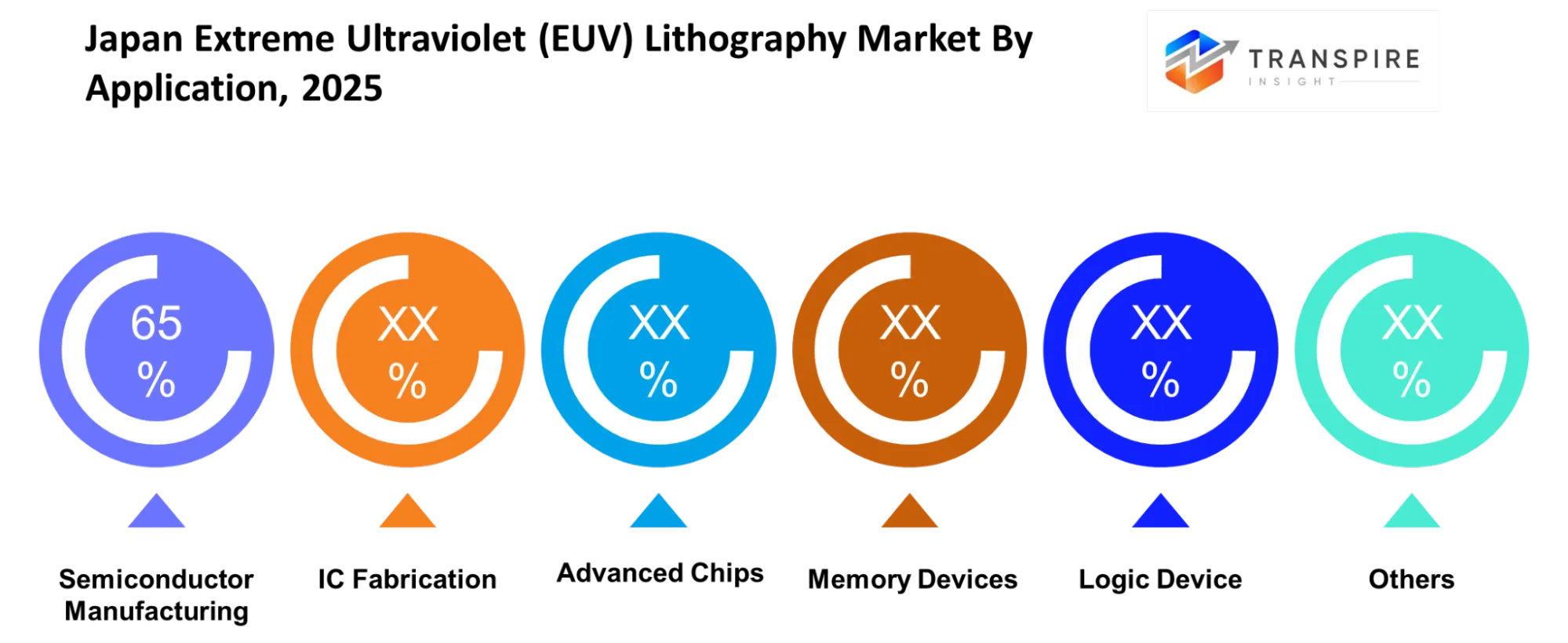
The Japan Extreme Ultraviolet (EUV) Lithography Market by application is divided into semiconductor manufacturing, IC fabrication, advanced chips, memory devices, logic devices, and others. Semiconductor manufacturing accounts for major demand because EUV technology supports the production of highly compact chips required for modern electronics. The manufacturing industry in Japan shows strong growth, which drives the adoption of advanced lithography technologies.
IC fabrication depends on EUV for creating detailed integrated circuit structures with greater precision. Advanced chip production benefits from reduced design limitations, which enable better processing performance and energy efficiency. Memory devices and logic devices also rely on this technology for improved density and faster operational capability. Research and industrial needs drive the development of new applications that require smaller a.
To learn more about this report, Download Free Sample Report
By End-User:
The Japan Extreme Ultraviolet (EUV) Lithography Market by end-user includes semiconductor companies, foundries, electronics firms, research institutes, and others. The semiconductor industry shows high system adoption because chip manufacturers need precise lithography systems for producing their next generation products. Investment in domestic semiconductor growth supports greater implementation of EUV technologies across large-scale manufacturing facilities.
Foundries use EUV lithography to meet demand for smaller process nodes from global clients. Electronics firms benefit through access to more efficient components for consumer and industrial devices. Research institutes perform testing on materials while they work on process reliability improvements. Other specialized technology organizations also participate by supporting innovation, helping strengthen Japan’s technical capabilities in advanced semiconductor production.
By Node:
The Japan Extreme Ultraviolet (EUV) Lithography Market by node includes 7nm, 5nm, 3nm, and below 3nm. The 7nm segment established early commercial use of EUV lithography and created a foundation for scaling smaller semiconductor structures. The current manufacturing demand for this node maintains its importance in producing performance-based products that need both operational efficiency and technical expertise.
The 5nm and 3nm segments show stronger momentum because high-performance computing, artificial intelligence, and mobile processors require greater transistor density. Below 3nm represents the most advanced stage of semiconductor innovation, driving substantial research and infrastructure development. Progress at these nodes reflects Japan’s focus on advanced manufacturing precision and long-term competitiveness in semiconductor technology advancement.
What are the Key Use Cases Driving the Japan Extreme Ultraviolet (EUV) Lithography Market?
Japan primarily uses EUV lithography technology for producing advanced logic chips which power AI processors and high-performance computing systems and premium consumer electronics. The application creates maximum demand because chipmakers require better patterning precision to achieve higher transistor density while they need to control power consumption and processing speed.
Various applications are entering new markets which include advanced memory manufacturing especially DRAM and next-generation NAND used in data centers and automotive electronics. EUV-enabled processes are being adopted by integrated device manufacturers to produce semiconductor components which enable autonomous driving systems and industrial automation platforms and edge computing infrastructure.
Quantum computing chips and specialized semiconductor architectures for generative AI accelerators are developing new use cases. Japan is increasing its domestic foundry development investments which will lead to future EUV deployment opportunities in custom semiconductor manufacturing for defense systems and next-generation telecommunications infrastructure and advanced robotics platforms.
|
Report Metrics |
Details |
|
Market size value in 2025 |
USD 1286.9 Million |
|
Market size value in 2026 |
USD 1536.6 Million |
|
Revenue forecast in 2033 |
USD 5383.8 Million |
|
Growth rate |
CAGR of 19.62% from 2026 to 2033 |
|
Base year |
2025 |
|
Historical data |
2021 - 2024 |
|
Forecast period |
2026 - 2033 |
|
Report coverage |
Revenue forecast, competitive landscape, growth factors, and trends |
|
Country scope |
Japan |
|
Key company profiled |
ASML, Nikon, Canon, Intel, TSMC, Samsung, Applied Materials, Lam Research, KLA, Tokyo Electron, Zeiss, JSR, Shin-Etsu, SUMCO, GlobalFoundries |
|
Customization scope |
Free report customization (country, regional & segment scope). Avail customized purchase options to meet your exact research needs. |
|
Report Segmentation |
By Type (EUV Light Sources, EUV Masks, EUV Resists, EUV Systems, Others); By Application (Semiconductor Manufacturing, IC Fabrication, Advanced Chips, Memory Devices, Logic Devices, Others); By End-User (Semiconductor Companies, Foundries, Electronics Firms, Research Institutes, Others); By Node (7nm, 5nm, 3nm, Below 3nm, Others) |
Which Regions are Driving the Japan Extreme Ultraviolet (EUV) Lithography Market Growth?
The Kanto region leads Japan's Extreme Ultraviolet lithography market because it combines national semiconductor policy support with the country's most advanced technology infrastructure. The government has supported semiconductor revitalization programs which resulted in research institutes receiving extensive funding for fabrication readiness and advanced manufacturing partnerships throughout the Tokyo metropolitan corridor. The presence of major semiconductor equipment suppliers together with precision materials manufacturers and leading research universities establishes an innovation ecosystem which drives faster process development. The presence of technical experts and nearby suppliers enables manufacturers to complete qualification processes faster while they maintain their dominance in advanced lithography technologies.
The Kansai region depends on industrial stability together with its existing electronics manufacturing capacity to build its economic strength while avoiding fast expansion. The region achieves operational stability through its established network of component suppliers together with specialty chemical producers and its history of semiconductor engineering expertise. The Kanto region leads innovation while the Kansai region enables market growth through its reliable production process and advanced-node migration support. The region serves as a dependable source of income because it develops materials innovation and process optimization technologies which support EUV implementation.
Recent semiconductor manufacturing investments together with Japan's domestic chip supply chain development program bring Kyushu the status of its fastest-growing area. The region established itself as an advanced-node growth corridor because new fabrication projects and infrastructure enhancements upgraded its existing semiconductor manufacturing facilities. The post-2023 period saw increased supply chain protective measures which manufacturers used to establish production sites in different regions. Kyushu provides investors and market newcomers with major growth possibilities that will last from 2026 to 2033 through its greenfield projects and supplier alliances and development of advanced manufacturing facilities.
Who are the Key Players in the Japan Extreme Ultraviolet (EUV) Lithography Market and How Do They Compete?
The Japanese Extreme Ultraviolet lithography market has reached a state of complete market consolidation because only equipment manufacturers with specialized expertise and local precision engineering firms are able to enter the market.The market remains stable because the EUV technology development process demands both extensive optical engineering knowledge and substantial financial resources and complete semiconductor manufacturing process expertise. The competition in the market depends mainly on three factors which include technological precision and system reliability and long-term process support. The existing companies are maintaining their market positions through stronger partnerships with Japanese semiconductor producers and direct involvement in the development of advanced-node manufacturing plans for Japan.
ASML competes through unmatched EUV system engineering and its exclusive ability to deliver high-volume EUV scanners. The company achieves product differentiation through its source power stability feature and advanced overlay control system and integrated software optimization which enhance wafer throughput performance. The company is expanding its position through tighter service partnerships with Japanese fabs and localized technical support infrastructure.
The company Tokyo Electron specializes in process integration technologies which support EUV systems through their deposition and cleaning technologies that manage defects. The company achieves its competitive edge through strong partnerships with Japanese semiconductor manufacturers and its ability to quickly adapt products to match the specific requirements of local manufacturing operations. Rapidus establishes market competition through its strategic partnerships with IBM and international ecosystem partners after it created domestic advanced-node manufacturing facilities. SCREEN Holdings expands its specialized market position through cutting-edge wafer cleaning technology which boosts EUV process yield.
Company List
- ASML
- Nikon
- Canon
- Intel
- TSMC
- Samsung
- Applied Materials
- Lam Research
- KLA
- Tokyo Electron
- Zeiss
- JSR
- Shin-Etsu
- SUMCO
- GlobalFoundries
Recent Development News
In September 2025, SCREEN Semiconductor Solutions entered a partnership with IBM to develop next-generation cleaning processes for High-NA EUV lithography. The collaboration advances critical process-enablement technologies for sub-2nm chip production and strengthens Japan’s position in the global EUV equipment and process technology market. Source https://newsroom.ibm.com/
In February 2026, Fujifilm completed a 5 billion yen investment in Rapidus Corporation. This strategic investment reinforces Japan’s domestic EUV semiconductor supply chain by supporting advanced photoresist materials and process integration capabilities critical for next-generation EUV lithography manufacturing. Source https://www.fujifilm.com/
What Strategic Insights Define the Future of the Japan Extreme Ultraviolet (EUV) Lithography Market?
The period from 2023 to 2030 will lead to Japan establishing advanced domestic chip production capabilities which will create self-sufficient operations instead of competing directly with international semiconductor manufacturers. The main reason for this situation stems from Japan pursuing strategic efforts to obtain reliable access for next-generation semiconductor production which supports artificial intelligence and automotive electronics and national technology security.
This approach will increase financial backing for semiconductor research and development facilities which combine manufacturing and materials science and engineering and research development activities. The industrial sector hides its hazards through common advanced manufacturing facilities which operate without public awareness. The primary research activities that rely on these main initiatives will halt because of execution problems and funding shortages and slower product development.
Hokkaido's advanced semiconductor corridor presents a new business opportunity through its development of next-generation resist materials and metrology innovation which will create dedicated growth solutions. Companies that want to succeed in their market should focus on establishing ecosystem partnerships through early investments instead of developing their products into separate entities. The companies that develop joint process systems with local technical support for domestic fabs will achieve greater market advantages during their operations.
Japan Extreme Ultraviolet (EUV) Lithography Market Report Segmentation
By Type
- EUV Light Sources
- EUV Masks
- EUV Resists
- EUV Systems
By Application
- Semiconductor Manufacturing
- IC Fabrication
- Advanced Chips
- Memory Devices
- Logic Devices
By End-User
- Semiconductor Companies
- Foundries
- Electronics Firms
- Research Institutes
By Node
- 7nm
- 5nm
- 3nm
- Below 3nm
Frequently Asked Questions
Find quick answers to common questions.
The Japan Extreme Ultraviolet (EUV) Lithography Market size is USD 5383.8 Million in 2033.
Key segments for the Japan Extreme Ultraviolet (EUV) Lithography Market are By Type (EUV Light Sources, EUV Masks, EUV Resists, EUV Systems, Others); By Application (Semiconductor Manufacturing, IC Fabrication, Advanced Chips, Memory Devices, Logic Devices, Others); By End-User (Semiconductor Companies, Foundries, Electronics Firms, Research Institutes, Others); By Node (7nm, 5nm, 3nm, Below 3nm, Others).
Major Japan Extreme Ultraviolet (EUV) Lithography Market players are ASML, Nikon, Canon, Intel, TSMC, Samsung, Applied Materials, Lam Research, KLA, Tokyo Electron, Zeiss, JSR, Shin-Etsu, SUMCO, GlobalFoundries.
The Japan Extreme Ultraviolet (EUV) Lithography Market size is USD 1286.9 Million in 2025.
The Japan Extreme Ultraviolet (EUV) Lithography Market CAGR is 19.62% from 2026 to 2033.
- ASML
- Nikon
- Canon
- Intel
- TSMC
- Samsung
- Applied Materials
- Lam Research
- KLA
- Tokyo Electron
- Zeiss
- JSR
- Shin-Etsu
- SUMCO
- GlobalFoundries
Recently Published Reports
-
Apr 2026
Fiber Optic Faceplates Market
Fiber Optic Faceplates Market Size, Share & Analysis Report By Type (< 300 mm2, 300-350 mm2, and > 350 mm2, By Application (Night Vision, Holographic Imaging, Medical, and Others), and Geography (North America, Europe, Asia-Pacific, Middle East and Africa, South and Central America), 2021 - 2031
-
Apr 2026
High Temperature Superconductors Market
High Temperature Superconductors Market Size, Share & Analysis Report By Type (1G HTS, and 2G HTS), By Application (Power Cable, Fault Current Limiter, and Transformer), and Geography (North America, Europe, Asia-Pacific, Middle East and Africa, South and Central America), 2021 - 2031
-
Apr 2026
Industrial Plugs and Socket Market
Industrial Plugs and Socket Market Size, Share & Analysis Report By Type (Industrial Plugs, Industrial Sockets), By Current (Up to 32 A, 32 to 125 A, Above 125 A), By Protection (Dustproof and Splash Proof, Waterproof, Explosion Proof), By End User (Heavy Industries, Oil and Gas, Chemicals and Pharmaceuticals, Power Generation, Others), and Geography (North America, Europe, Asia-Pacific, Middle East and Africa, South and Central America), 2021 - 2031
-
Apr 2026
InGaAs Avalanche Photodiodes Market
InGaAs Avalanche Photodiodes Market Size, Share & Analysis Report By Type (1100 - 1700 nm, and 1000 - 1600 nm), By Application (Missile Warning System, Muzzle Flash Detection, Wafer Defect Inspection, Laser Rangefinders, and Others), and Geography (North America, Europe, Asia-Pacific, Middle East and Africa, South and Central America), 2021 - 2031