
Japan Computer Room Air Handlers (CRAH) Data Center Construction Market Size & Forecast:
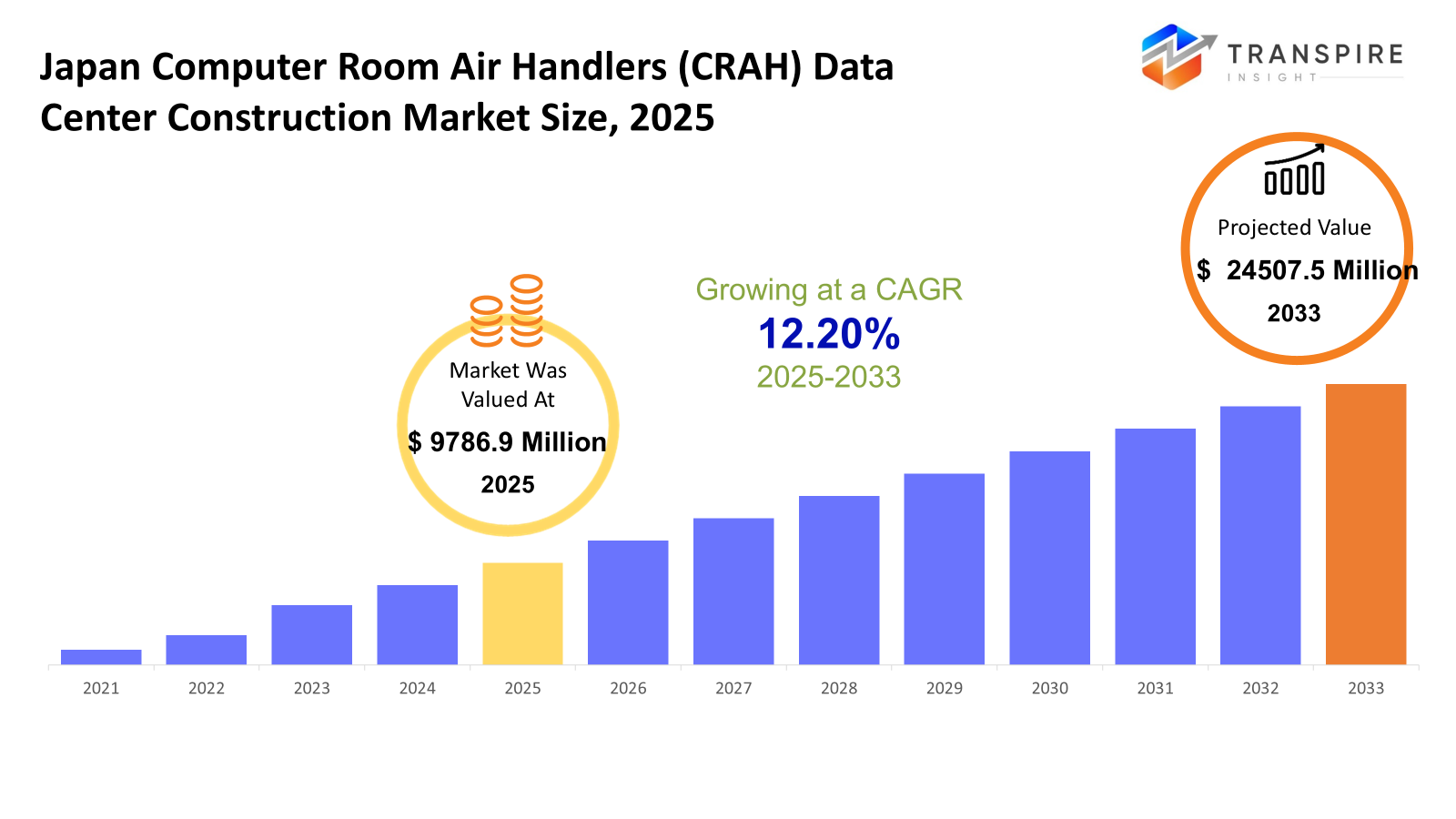
- Japan Computer Room Air Handlers (CRAH) Data Center Construction Market Size 2025: USD 9786.9 Million
- Japan Computer Room Air Handlers (CRAH) Data Center Construction Market Size 2033: USD 24507.5 Million
- Japan Computer Room Air Handlers (CRAH) Data Center Construction Market CAGR: 12.20%
- Japan Computer Room Air Handlers (CRAH) Data Center Construction Market Segments:By Component (Cooling Units, Control Systems, Sensors), By Data Center Type (Enterprise Data Centers, Colocation Data Centers, Hyperscale Data Centers), By End User (IT & Telecom, BFSI, Government).
To learn more about this report,  Download Free Sample Report
Japan Computer Room Air Handlers (CRAH) Data Center Construction Market Summary:
The Japan Computer Room Air Handlers (CRAH) Data Center Construction Market size is estimated at USD 9786.9 Million in 2025 and is anticipated to reach USD 24507.5 Million by 2033, growing at a CAGR of 12.20% from 2026 to 2033. The Computer Room Air Handlers Data Center Construction market in Japan experiences continuous growth as the nation develops its digital infrastructure. The requirement for cloud services and artificial intelligence operations and extensive data processing needs drives the construction of contemporary data Centers that use energy-saving technologies. CRAH systems maintain server performance through their essential function of controlling temperature and humidity at optimal levels. Japanese data center developers invest in efficient air-handling solutions because the country wants to achieve sustainability through advanced cooling technologies.
Key Market Trends & Insights:
- Japan currently experiences rapid growth in hyperscale data Center construction due to increasing adoption of cloud computing and digital services. The expanding operations of the business require the development of advanced CRAH systems which have the capability to operate under extreme thermal conditions.
- Operators are focusing their efforts on energy-efficient cooling systems because both energy costs and environmental problems are becoming more important. The modern systems with their advanced airflow and smart sensors enable power savings through their ability to deliver consistent cooling output.
- Data Center operators in Japan are increasingly using intelligent monitoring technologies. The technologies enable CRAH units to automatically modify their cooling capacity, which results in better performance and decreased chances of equipment failure.
- The development of edge data Centers is being driven by the increasing demand for 5G IoT and real-time data processing technologies. The facilities need compact CRAH systems which deliver high cooling performance to operate their equipment in restricted areas.
- Japan is using carbon reduction targets to shape its data Center construction methods. The developers are using eco-friendly cooling solutions with optimised CRAH systems to achieve sustainability goals while backing Japan's expanding digital market.
Japan Computer Room Air Handlers (CRAH) Data Center Construction Market Segmentation
By Component
- Cooling Units: CRAH systems depend on cooling units, which function as their main components to control data Center temperatures and preserve constant airflow through their facilities. The Japanese market shows increasing demand for high-efficiency cooling units because data Centers in the country experience both larger and denser growth. The modern units function to boost energy efficiency while delivering dependable performance for critical IT systems.
- Control Systems: Control systems enable operators to oversee CRAH equipment operations through their ability to track temperature, airflow and humidity measurements. Intelligent control platforms have become vital components of advanced data Center operations in Japan. The systems enable operators to achieve optimal cooling performance while decreasing energy use and sustaining stable environmental conditions necessary for server and network device operations.
- Sensors: Sensors provide data about temperature and humidity and airflow conditions in real time throughout data Center operations. Japanese operators are adopting advanced sensors at increasing rates to improve their monitoring precision. The devices enable automatic cooling system adjustments which allow CRAH systems to maintain their operating conditions while they respond to environmental shifts.
By Data Center Type
- Enterprise Data Centers: Organisations operate enterprise data Centers to handle their complete IT operations and internal data processing requirements. Japanese companies establish dedicated facilities that depend on effective CRAH cooling systems to operate continuously without interruption. The Centers focus on maintaining operational stability through effective airflow control and permanent cooling systems which safeguard essential digital systems.
- Colocation Data Centers: Colocation data Centers allow multiple businesses to rent space for servers and IT equipment within a shared facility. Japanese businesses increasingly demand colocation services because they provide flexible and economical infrastructure solutions. The site requires CRAH systems to maintain constant cooling throughout various customer locations which operate different types of equipment.
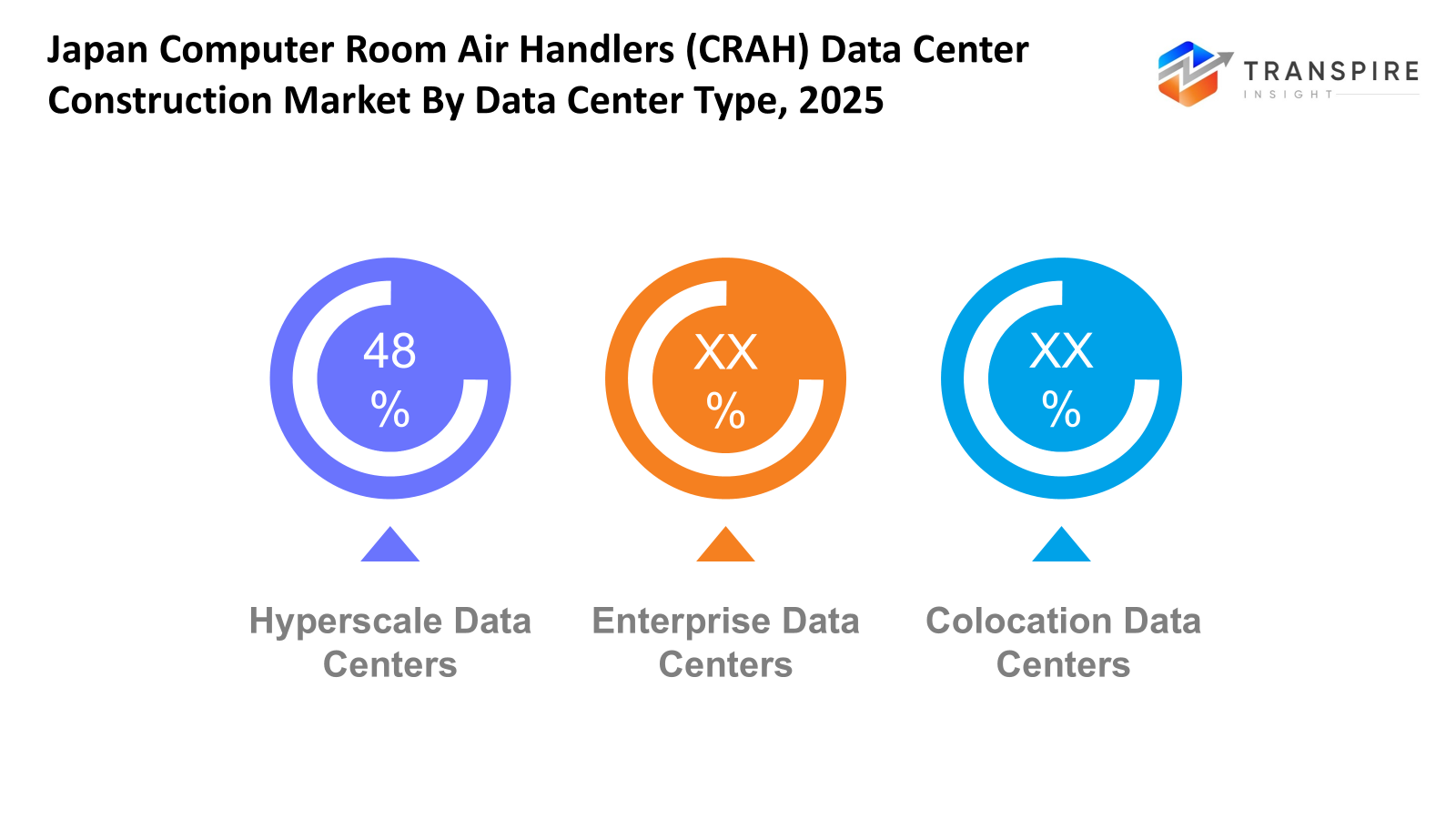
- Hyperscale Data Centers: Hyperscale data Centers operate as extensive facilities which enable large cloud platforms and high-demand digital services to function. The centers experience rapid growth in Japan because of increasing requirements for cloud computing and data storage solutions. The cooling systems for hyperscale environments must provide powerful, energy-efficient solutions which handle high heat loads.
To learn more about this report, Download Free Sample Report
By End User
- IT & Telecom: The IT and telecom sector is a major driver of CRAH demand in Japan's data Center construction market. The increasing data traffic together with cloud services and network expansion requires companies to establish dependable cooling systems. CRAH units help maintain stable server environments which enable continuous network access and effective digital service operations.
- BFSI: Banks and financial institutions, together with insurance companies, depend on secure data Centers which provide high-performance capabilities. The BFSI sector in Japan depends on CRAH systems to maintain proper operational conditions which protect vital financial data processing activities. The system receives stable cooling, which helps maintain operational reliability while safeguarding confidential data and enabling ongoing financial operations.
- Government: Japanese government bodies are dedicating funds to develop contemporary data Centers which will enable digital governance and public service delivery. The facilities need reliable cooling systems which will safeguard their extensive data and application assets. CRAH technology establishes consistent environmental conditions which enable the secure and continuous operation of government digital systems.
Country Insights
The Computer Room Air Handlers (CRAH) Data Center Construction market in Japan is experiencing growth because the country is becoming an important digital technology center for Asia. New data Centers are being built because more people are using cloud computing and artificial intelligence and big data applications. The growing data traffic requires effective cooling systems which have become essential for modern facilities that depend on CRAH solutions.
Japan's dedication to energy efficiency and sustainable infrastructure development is currently driving market trends. Data Center operators are making investments in advanced CRAH systems which establish exact temperature and humidity control while decreasing energy usage. The deployment of 5G networks together with digital transformation projects in various sectors drives the development of data Centers with superior performance capabilities. Japan maintains its status as an innovation and growth Center for the CRAH data Center construction market because of its combination of advanced technological skills and efficient infrastructure development.
Recent Development News
Japan Plans One of the World’s Largest Data Center Hubs in Toyama Prefecture.
Japan’s Power Demand Expected to Rise Due to Data Center and Chip Growth.
|
Report Metrics |
Details |
|
Market size value in 2025 |
USD 9786.9 Million |
|
Market size value in 2026 |
USD 10951.6 Million |
|
Revenue forecast in 2033 |
USD 24507.5 Million |
|
Growth rate |
CAGR of 12.20% from 2026 to 2033 |
|
Base year |
2025 |
|
Historical data |
2021 – 2024 |
|
Forecast period |
2026 – 2033 |
|
Report coverage |
Revenue forecast, competitive landscape, growth factors, and trends |
|
Country scope |
Japan |
|
Key company profiled |
Vertiv Group, Schneider Electric SE, Stulz GmbH, Airedale International, Mitsubishi Electric Corporation, Johnson Controls, Daikin Industries Ltd., Rittal GmbH & Co. KG, Trane Technologies, LG Electronics, Delta Electronics, Huawei Technologies, Hitachi Ltd., Fujitsu Limited, Toshiba Corporation. |
|
Customization scope |
Free report customization (country, regional & segment scope). Avail customized purchase options to meet your exact research needs. |
|
Report Segmentation |
By Component (Cooling Units, Control Systems, Sensors), By Data Center Type (Enterprise Data Centers, Colocation Data Centers, Hyperscale Data Centers), By End User (IT & Telecom, BFSI, Government). |
Key Japan Computer Room Air Handlers (CRAH) Data Center Construction Company Insights
The Japan Computer Room Air Handlers (CRAH) Data Center Construction market is shaped by companies that focus on advanced cooling technologies and energy-efficient infrastructure solutions. These companies are funding their research efforts to create new airflow control methods and intelligent monitoring technologies and eco-friendly cooling systems which will benefit contemporary data center facilities. As cloud computing and digital service usage increase, companies are enhancing their precision cooling capabilities together with their system integration abilities. The companies are working together with data center developers to develop tailored CRAH solutions which will maintain consistent temperatures and enhance energy efficiency and deliver dependable operations for high-density computing centers throughout Japan.
Company List
- Vertiv Group
- Schneider Electric SE
- Stulz GmbH
- Airedale International
- Mitsubishi Electric Corporation
- Johnson Controls
- Daikin Industries Ltd.
- Rittal GmbH & Co. KG
- Trane Technologies
- LG Electronics
- Delta Electronics
- Huawei Technologies
- Hitachi Ltd.
- Fujitsu Limited
- Toshiba Corporation.
Japan Computer Room Air Handlers (CRAH) Data Center Construction Market Report Segmentation
By Component
- Cooling Units
- Control Systems
- Sensors
By Data Center Type
- Enterprise Data Centers
- Colocation Data Centers
- Hyperscale Data Centers
By End User
- IT & Telecom
- BFSI
- Government
Frequently Asked Questions
Find quick answers to common questions.
The approximate Japan Computer Room Air Handlers (CRAH) Data Center Construction market size for the Market will be USD 24507.5 Million in 2033.
The key segments of the Japan Computer Room Air Handlers (CRAH) Data Center Construction Market are By Component (Cooling Units, Control Systems, Sensors), By Data Center Type (Enterprise Data Centers, Colocation Data Centers, Hyperscale Data Centers), and By End User (IT & Telecom, BFSI, Government).
Major players in the Japan Computer Room Air Handlers (CRAH) Data Center Construction Market are Vertiv Group, Schneider Electric SE, Stulz GmbH, Airedale International, Mitsubishi Electric Corporation, Johnson Controls, Daikin Industries Ltd., Rittal GmbH & Co. KG, Trane Technologies, LG Electronics, Delta Electronics, Huawei Technologies, Hitachi Ltd., Fujitsu Limited, and Toshiba Corporation.
The current market size of the Japan Computer Room Air Handlers (CRAH) Data Center Construction Market is USD 9786.9 Million in 2025.
The Japan Computer Room Air Handlers (CRAH) Data Center Construction Market CAGR is 12.20%.
- Vertiv Group
- Schneider Electric SE
- Stulz GmbH
- Airedale International
- Mitsubishi Electric Corporation
- Johnson Controls
- Daikin Industries Ltd.
- Rittal GmbH & Co. KG
- Trane Technologies
- LG Electronics
- Delta Electronics
- Huawei Technologies
- Hitachi Ltd.
- Fujitsu Limited
- Toshiba Corporation.
Recently Published Reports
-
Apr 2026
3D Optical Profiler Market
3D Optical Profiler Market Size, Share & Analysis Report By Type (Desktop 3D Optical Profiler, and Portable 3D Optical Profiler), By Technology (Confocal Technology, and White Light Interference), By End-Use Industry (Manufacturing, Research Institutions, Automotive, Aerospace and Defense, Medical Devices, and Other), and Geography (North America, Europe, Asia-Pacific, Middle East and Africa, South and Central America), 2021 - 2031
-
Apr 2026
Depth Sensor Market
Depth Sensor Market Size, Share & Analysis Report By Type (Infrared Depth Sensors, Time-of-Flight (ToF) Sensors, Stereo Vision Sensors, Structured Light Sensors, Ultrasonic Depth Sensors), By Application (Automotive, Robotics, Gaming, Consumer Electronics, Industrial Automation, Healthcare, Security & Surveillance, Others), By End Users (Automotive Manufacturers, Consumer Electronics Companies, Healthcare Providers, Industrial Companies, Security Agencies, Gaming Companies, Robotics Companies, Others), and Geography (North America, Europe, Asia-Pacific, Middle East and Africa, South and Central America), 2021 – 2031
-
Apr 2026
Digital Manufacturing Market
Digital Manufacturing Market Size, Share & Analysis Report By Component (Hardware, Software, and Services), By Technology (Robotics, 3D Printing, Internet of Things (IoT), and Others), By Application (Automotive and Transportation, Aerospace and Defense, Consumer Electronics, Industrial Machinery, and Others), By Process Type (Computer-Based Designing, Computer-Based Simulation, Computer 3D Visualization, Analytics, and Others), and Geography (North America, Europe, Asia-Pacific, Middle East and Africa, South and Central America), 2021 – 2031
-
Apr 2026
Digital Visa Services Market
Digital Visa Services Market Size, Share & Analysis Report By Type (Individual Travelers, Group Travelers), By Application (Tourism, Business Travel, Others), and Geography (North America, Europe, Asia-Pacific, Middle East and Africa, South and Central America), 2021 – 2031