

Japan Compressed Natural Gas (CNG) Market Size & Forecast:
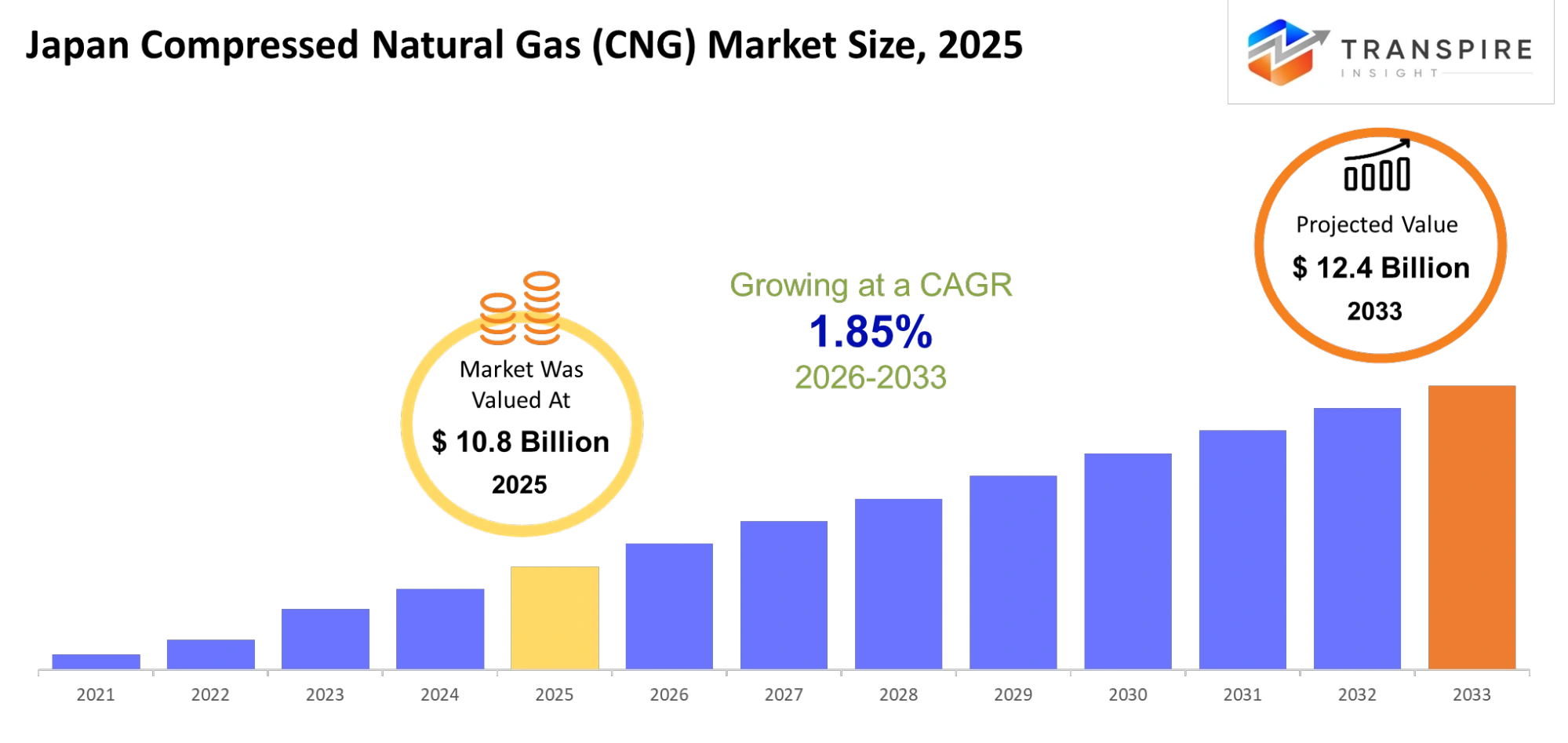
- Japan Compressed Natural Gas (CNG) Market Size 2025: USD 10.8 Billion
- Japan Compressed Natural Gas (CNG) Market Size 2033: USD 12.4 Billion
- Japan Compressed Natural Gas (CNG) Market CAGR: 1.85%
- Japan Compressed Natural Gas (CNG) Market Segments: By Application (Transportation, Power Generation, Industrial, Residential), By Storage (Cylinders, Pipelines, LNG Conversion, Tanks), By End-User (Automotive, Utilities, Industrial Users, Households)
To learn more about this report,  Download Free Sample Report
Japan Compressed Natural Gas (CNG) Market Summary:
The Japan Compressed Natural Gas (CNG) Market size is estimated at USD 10.8 Billion in 2025 and is anticipated to reach USD 12.4 Billion by 2033, growing at a CAGR of 1.85% from 2026 to 2033.
The compressed natural gas (CNG) market in Japan operates within the clean energy and alternative fuel sector which will experience ongoing development through changing fuel demands and urban transportation patterns. Natural gas will maintain its role as a transitional energy solution in Japan because the country possesses limited domestic fossil resources and is pursuing energy security. Fleet operators in logistics and public transport will seek dependable and affordable fuel solutions because compressed natural gas provides this requirement until electrification becomes fully operational. Consumers will gradually expect quieter vehicles that produce fewer emissions and maintain their current ownership costs.
The market will develop through continuous progress in both storage systems and refueling infrastructure development. Market expansion for cng vehicles will receive assistance from new lightweight cylinder technologies and safety standard improvements, while government policies will continue to support reduction activities in urban areas. Urban air quality regulations will become stricter, which will force businesses to switch their fuel methods. The electric mobility market will create an operational space where businesses need dependable systems and fast refueling, which will generate a competitive environment with controlled competition.
What Has the Impact of Artificial Intelligence Been on the Japan Compressed Natural Gas (CNG) Market?
The implementation of artificial intelligence technologies in Japan's compressed natural gas market enables companies to make better decisions through improved data assessment capabilities throughout their entire operational process. AI in Japan compressed natural gas (CNG) market applications strengthens market research capabilities through advanced data mining and predictive analytics which enable stakeholders to identify consumption patterns and regional demand shifts and emerging market trends with greater accuracy.
Machine learning models now serve as the primary tool for analyzing large datasets which originate from transportation industrial usage and energy sectors to enhance demand forecasting capabilities while enabling companies to synchronize their production and distribution operations with current market data.
The implementation of artificial intelligence technologies in Japan's compressed natural gas market operations delivers operational advantages through intelligent automation technologies and effective resource distribution methods. AI-powered systems streamline production operations while they decrease equipment downtime and they boost the efficiency of fuel compression and storage operations.
Machine learning enables predictive maintenance which helps companies maintain uninterrupted operations while decreasing their maintenance costs. AI drives fundamental changes in the Japan compressed natural gas market because it provides supply chain optimization through route optimization, inventory management, and intelligent logistics planning, which leads to decreased operational expenses.
The application of AI technology in the Japan compressed natural gas market enables companies to create innovative solutions that provide them with a competitive edge. Companies use AI-based information to create personalized energy solutions which enhance their service operations for commercial vehicle fleets and industrial customers. The Japan CNG market becomes more stable and effective as artificial intelligence creates new business possibilities during the ongoing digital transformation process.
Key Market Trends & Insights:
- The Kanto region controls the Japanese compressed natural gas market because it will reach a 35% market share in 2025 due to high demand for urban transportation.
- The Kansai region shows the highest growth rate because the region will grow at 6.5% annual rate from 2025 to 2030 through infrastructure development projects.
- The market for CNG fueling stations reaches 40% because urban refueling stations continue to develop their network.
- The second largest market segment operates through CNG cylinders because more vehicles are being retrofitted and safety technology makes progress.
- The Smart CNG systems segment is fastest-growing (2025–2030), fueled by AI integration and smart automation technologies.
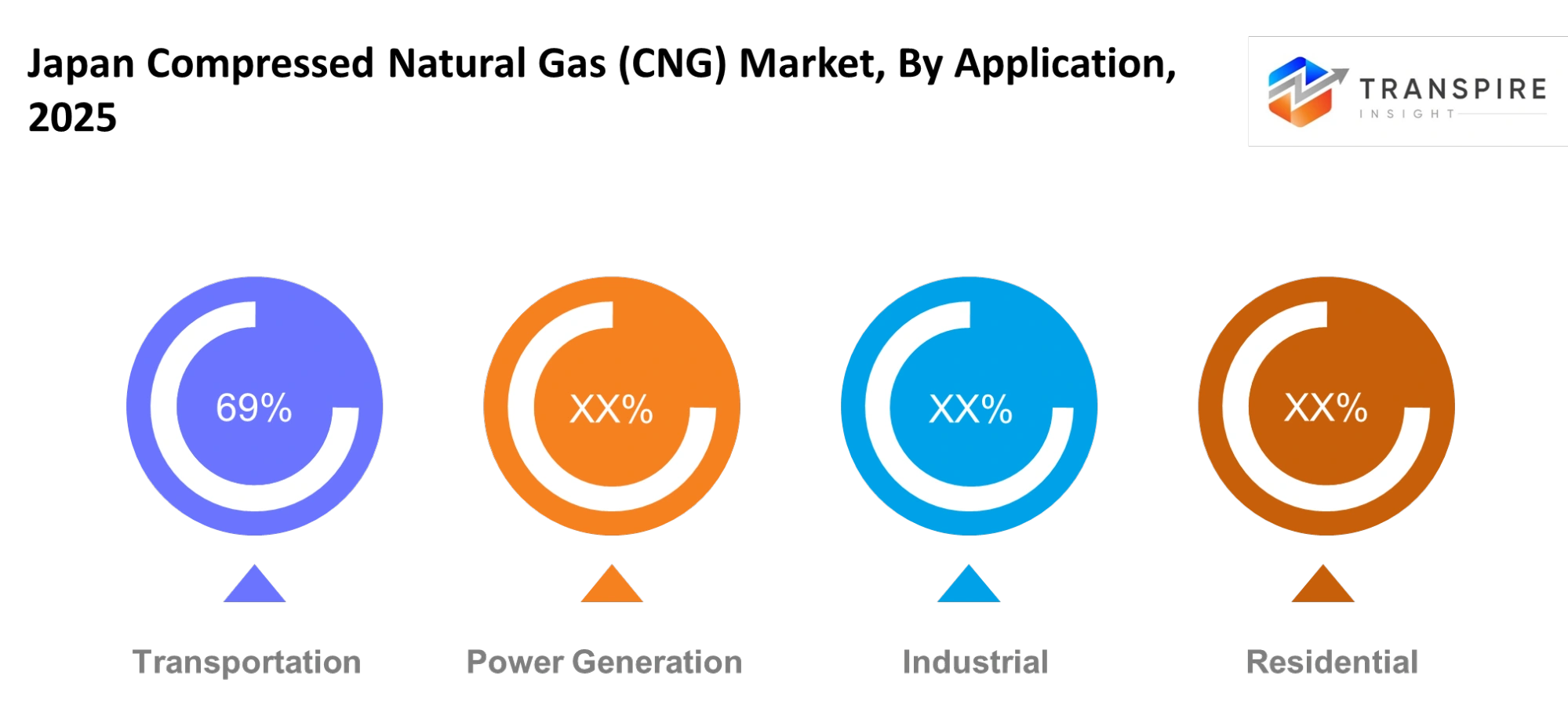
- The transportation sector holds the largest market share which exceeds 60% because public buses and taxis and logistics fleets have switched to using environmentally friendly fuel sources.
- The manufacturing sectors experience their fastest growth through industrial energy usage which helps companies achieve cost savings and reduce their greenhouse gas emissions.
- Automotive fleet operators represent the biggest market segment which accounts for approximately 55% of the market because they take advantage of cheaper fuel prices and government financial support.
- E-commerce growth and sustainability requirements drive the rapid expansion of the logistics and last-mile delivery market.
- The main companies in the market are Osaka Gas Co., Tokyo Gas Co., ENEOS Corporation, Nippon Steel Engineering, and Iwatani Corporation.
Japan Compressed Natural Gas (CNG) Market Segmentation
By Application :
The transportation segment achieves its critical status because vehicle fleets now transition to using environmentally friendly fuels. Public transport systems and delivery fleets along with taxis now use CNG because it helps them reduce emissions while cutting their fuel expenses. The government provides support through fuel pricing advantages which drive steady adoption of this equipment that decreases reliance on traditional fuels.
CNG functions as a backup energy source for power generation systems which require continuous and adaptable energy solutions. Industrial facilities use CNG to operate manufacturing equipment that needs stable thermal and power generation capabilities. People use residential gas systems to cook and heat their homes in areas with gas infrastructure although this usage remains smaller than other applications.
To learn more about this report, Download Free Sample Report
By Storage :
Cylinders maintain their popular status because people find them easy to handle while their design meets transportation requirements for both vehicles and small operations. Pipeline systems operate as essential infrastructure that enables large-scale distribution, which provides continuous supply to both industrial areas and urban centers. The dependable operation of pipeline networks enables organizations to achieve effective production processes while decreasing their operating expenses throughout the years.
LNG conversion occurs when liquefied natural gas undergoes transformation into compressed form which enables companies to utilize the material for specific purposes within their supply chains. Storage tanks function as containers to store and distribute bulk materials especially within industrial and utility environments. Different storage methods provide distinct operational support which helps maintain system stability while increasing overall efficiency.
By End-User :
The automotive industry defines the main market segment which exists because customers seek to cut fuel expenses and comply with emission restrictions. The public transportation systems and fleet operators achieve their operational advantages through constant cost assessments and decreased environmental effects. The development of refueling facilities strengthens this market segment while creating conditions for sustainable business expansion.
The energy sector uses CNG to provide power supply stability which becomes essential during times of high demand or when other energy resources face interruptions. The industrial sector relies on CNG to deliver stable energy resources which businesses need for their manufacturing processes. The gas distribution networks established in developed areas create a stable yet smaller market segment which delivers steady demand from households that use gas for their everyday requirements.
What are the Main Challenges for the Japan Compressed Natural Gas (CNG) Market Growth?
The japan compressed natural gas (CNG) market operates under multiple technical and operational obstacles which restrict its ability to grow and function with optimal performance. The primary obstacle to growth for the market emerges from CNG storage and transportation requirements which demand specialized containment systems and high-pressure compression methods. The system requires specialized components which increase the possibility of leaks and safety compliance problems and system failure.
The supply chain operates under two main constraints which include natural gas supply fluctuations and the need to rely on imported energy resources which create difficulties in maintaining constant service delivery. The technical barriers which exist in the japan compressed natural gas (CNG) market force operators to choose between existing high-performance solutions and alternative fuel options which provide greater operational flexibility.
The japan compressed natural gas (CNG) market faces two main obstacles which include high-cost infrastructure development requirements and multiple regulatory compliance demands that control manufacturing and commercialization processes. The CNG refueling station establishment process demands an extensive capital allocation together with engineering expertise and adherence to rigorous safety protocols which collectively extend project execution periods.
The financial obligations from advanced compression technology together with its required continuous maintenance have created stronger financial difficulties for operators. The current market conditions create obstacles which stop new businesses from entering the market while they also prevent commercial activities from developing in regions that lack proper funding and governmental support.
Adoption challenges persist because infrastructure development remains incomplete and consumers lack knowledge about the product. The Japan compressed natural gas (CNG) market needs to establish a bigger refueling network which enables drivers to access stations just like they do with regular fuels. A shortage of skilled professionals for installation and maintenance of CNG systems further adds to operational inefficiencies. The competition between electric vehicles and hydrogen fuel technologies creates future threats because clean energy policies will direct investments away from CNG which leads to greater market unpredictability.
Country Insights
The Japan Compressed Natural Gas (CNG) Market demonstrates continuous development through its combination of governmental regulations and dedicated efforts to promote sustainable fuel solutions. The government initiatives maintain their function of promoting decreased carbon emissions through their application in both transportation systems and industrial processes. The refueling infrastructure expansion throughout urban corridors establishes a foundation for fuel acceptance which benefits energy security through its support of multiple domestic fuel supply options.
The Japan Compressed Natural Gas (CNG) Market shows consistent industrial demand from its three main sectors which include logistics operations and public transport systems and small manufacturing facilities. Fleet operators shift toward CNG vehicles due to cost balance and lower emissions when compared with conventional fuels. Urban transit systems adopt cleaner alternatives to meet strict environmental targets, creating consistent demand patterns across major metropolitan regions.
Technological advances drive market development within Japan's Compressed Natural Gas (CNG) Market because they enable better storage solutions and more efficient engine development. Energy companies and automotive manufacturers work together to create new technologies and improve existing infrastructure. The long-term forecast depends on how businesses implement their strategies for transitioning to low-emission energy systems while using CNG as a temporary solution which helps them achieve their environmental objectives.
Recent Development News
In March 2026, the Government of Japan announced the release of 80 million barrels of oil reserves amid supply disruptions. The move highlights increased energy security efforts, indirectly strengthening interest in alternative fuels such as CNG for transportation and industrial use.Source https://www.reuters.com/
In April 2026, a Japanese-registered LNG tanker successfully transited the Strait of Hormuz amid geopolitical tensions. The event underscores Japan’s continued reliance on gas-based energy supply chains, supporting infrastructure relevance for compressed natural gas distribution.Source https://www.reuters.com/
|
Report Metrics |
Details |
|
Market size value in 2025 |
USD 10.8 Billion |
|
Market size value in 2026 |
USD 10.91 Billion |
|
Revenue forecast in 2033 |
USD 12.4 Billion |
|
Growth rate |
CAGR of 1.85% from 2026 to 2033 |
|
Base year |
2025 |
|
Historical data |
2021 - 2024 |
|
Forecast period |
2026 - 2033 |
|
Report coverage |
Revenue forecast, competitive landscape, growth factors, and trends |
|
Country scope |
Japan |
|
Key company profiled |
Gazprom, ExxonMobil, Shell, BP, TotalEnergies, Chevron, Mitsubishi, Sumitomo, Osaka Gas, Tokyo Gas, ENEOS, Sinopec, PetroChina, Reliance, Woodside |
|
Customization scope |
Free report customization (country, regional & segment scope). Avail customized purchase options to meet your exact research needs. |
|
Report Segmentation |
By Application (Transportation, Power Generation, Industrial, Residential), By Storage (Cylinders, Pipelines, LNG Conversion, Tanks), By End-User (Automotive, Utilities, Industrial Users, Households) |
How Can New Companies Establish a Strong Foothold in the Japan Compressed Natural Gas (CNG) Market?
New market entry into the Japan compressed natural gas (CNG) sector will succeed when companies identify unexplored market segments and use their business strategy to match current energy transition developments. The company establishes its initial market presence by focusing on various high-demand sectors which include converting commercial vehicle fleets and operating urban public transportation and developing smart city transportation systems.
The market entry process relies on data-driven strategies which use demand forecasting together with regional consumption analysis to determine profitable market areas. New businesses entering the Japan compressed natural gas (CNG) market can establish themselves as strong competitors through their solutions which tackle fundamental industry challenges that include expensive fuel and environmentally-safe emissions practices while they participate in market expansion.
Innovation and technology differentiation are critical for success in the Japan compressed natural gas (cng) market. Companies which develop advanced compression systems together with lightweight storage cylinders and artificial intelligence-based monitoring systems will achieve better operational performance and increased safety standards. Market entry speed increases through strategic partnerships which companies establish with local utilities and automotive original equipment manufacturers and infrastructure development companies.
Emerging companies such as CleanFuel Japan (illustrative) develop modular CNG refueling systems while Nippon Green Energy Solutions (illustrative) uses predictive analytics to optimize its fuel distribution process. Innovation strategies allow new companies to achieve market differentiation in competitive business environments.
The Japan compressed natural gas market achieves sustainable development through two main factors which include collaboration-based market expansion and development of region-specific solutions. The companies need to follow government decarbonization rules while they should obtain financial backing and develop their staff skills to overcome difficulties in adopting new technologies. New businesses in the Japan compressed natural gas market can build an enduring and expandable business model through their use of strategic partnerships and technology-based market differentiation and focused market entry strategies.
Key Japan Compressed Natural Gas (CNG) Market Company Insights
The Japan Compressed Natural Gas (CNG) Market will experience continuous growth because more people are choosing to use cleaner fuels which produce less carbon emissions. The government policies which support alternative fuel sources together with the existence of consistent natural gas delivery systems will assist in increasing fuel usage. CNG will become the preferred choice for urban transport systems and commercial vehicle fleets because both cost savings and emission reduction capabilities remain essential for their operations.
The Japanese Compressed Natural Gas (CNG) Market will experience strong demand from public transportation systems and logistics fleets and municipal vehicles which require cost-effective operations. Fleet operators will switch to CNG because conventional fuel prices increasingly experience sudden changes. The industrial and commercial transportation sectors will adopt new technologies because of environmental regulations and emission reduction targets.
The development of refueling infrastructure will serve as a vital element for the expansion of the Japan Compressed Natural Gas CNG Market. Government funding for fueling stations together with pipeline system development will enhance public access to these facilities. The current low availability of fueling stations in particular areas will create operational difficulties but the market will develop through gradual station growth which will promote vehicle conversion efforts.
The competitive analysis demonstrates that established energy companies and automotive manufacturers exist within the market which focuses on developing fuel-efficient products that meet emission control standards. The distribution channels will become more efficient through strategic partnerships which gas suppliers establish with transport operators. The storage technologies and engine performance upgrades will create unique product offerings while the pricing methods and service consistency will determine how major companies establish their market presence.
Company List
- Gazprom
- ExxonMobil
- Shell
- BP
- TotalEnergies
- Chevron
- Mitsubishi
- Sumitomo
- Osaka Gas
- Tokyo Gas
- ENEOS
- Sinopec
- PetroChina
- Reliance
- Woodside
What are the Key Use-Cases Driving the Growth of Japan Compressed Natural Gas (CNG) Market?
The japan compressed natural gas (CNG) market shows growth because the transportation industry expands its use of CNG as a cheaper and cleaner fuel option compared to traditional fuels. CNG adoption is rising among public buses and taxis and commercial delivery fleets because these vehicles need to comply with strict emission rules while reducing their operating expenses. Urban mobility systems demonstrate this trend because fleet operators choose to use fuel-efficient vehicles which meet all regulatory requirements thus increasing demand for Japan CNG services.
Industrial applications which extend beyond transportation create important use cases that drive the growth of the Japan CNG market. CNG emerges as a cleaner energy option which manufacturing units use for their heating and processing operations to achieve both carbon footprint reduction and energy cost stability. Government initiatives that promote cleaner industrial practices enable small and medium enterprises to use CNG for improved energy management. CNG has emerged as a crucial element which supports the sustainable development of industrial operations.
The Japan compressed natural gas market receives new market influences through smart city infrastructure development and decentralized energy system implementation. CNG powers both distributed power generation systems and backup energy systems to produce dependable and environmentally friendly electricity. The invention of hybrid fuel systems together with AI-powered fuel management systems provides new business development options because these technologies improve operational growth and productivity. The various applications in this sector drive market growth which positions the Japan CNG market for sustainable expansion in the future.
Japan Compressed Natural Gas (CNG) Market Report Segmentation
By Application
- Transportation
- Power Generation
- Industrial
- Residential
By Storage
- Cylinders
- Pipelines
- LNG Conversion
- Tanks
By End-User
- Automotive
- Utilities
- Industrial Users
- Households
Frequently Asked Questions
Find quick answers to common questions.
The approximate Japan Compressed Natural Gas (CNG) Market size for the market will be USD 12.4 Billion in 2033.
Key segments for the Japan Compressed Natural Gas (CNG) Market are By Application (Transportation, Power Generation, Industrial, Residential), By Storage (Cylinders, Pipelines, LNG Conversion, Tanks), By End-User (Automotive, Utilities, Industrial Users, Households).
Major Japan Compressed Natural Gas (CNG) Market players are Gazprom, ExxonMobil, Shell, BP, TotalEnergies, Chevron, Mitsubishi, Sumitomo, Osaka Gas, Tokyo Gas, ENEOS, Sinopec, PetroChina, Reliance, Woodside.
The Japan Compressed Natural Gas (CNG) Market size is USD 10.8 Billion in 2025.
The Japan Compressed Natural Gas (CNG) Market CAGR is 1.85%.
- Gazprom
- ExxonMobil
- Shell
- BP
- TotalEnergies
- Chevron
- Mitsubishi
- Sumitomo
- Osaka Gas
- Tokyo Gas
- ENEOS
- Sinopec
- PetroChina
- Reliance
- Woodside
Recently Published Reports
-
Apr 2026
Active Power Filter Market
Active Power Filter Market Size, Share & Analysis Report By Type (Shunt Active Power Filters, Series Active Power Filter, Hybrid Active Power Filter), By Application (Harmonics Mitigation, Reactive Power Compensation, Voltage Regulation, Power Factor Correction), By Phase (Single Phase, Three Phase), By End-User Industry (Manufacturing, Healthcare, Commercial, Automotive, Oil and Gas, Others), and Geography (North America, Europe, Asia-Pacific, Middle East and Africa, South and Central America), 2021 - 2031
-
Apr 2026
Electrical Transformer Market
Electrical Transformer Market Size, Share & Analysis Report By Core (Closed, Shell, and Berry), By Insulation (Gas, Oil, Solid, Air, and Other), By Phase (Single, and Three), By Rating (100 MVA to 500 MVA, 501 MVA to 800 MVA, and 801 MVA to 1200 MVA), and Geography (North America, Europe, Asia-Pacific, Middle East and Africa, South and Central America), 2021 – 2031
-
Apr 2026
Hydraulic Piston Pumps Market
Hydraulic Piston Pumps Market Size, Share & Analysis Report By Type (Axial Piston Pumps, Radial Piston Pumps), By Operating Pressure (Low Pressure, Medium Pressure, High Pressure), By Application (Construction, Mining, Agriculture, Automotive, Oil & Gas, Industrial Machinery, Others), By End-User (OEMs, Aftermarket), and Geography (North America, Europe, Asia-Pacific, Middle East and Africa, South and Central America), 2021 – 2031
-
Apr 2026
Laboratory Gas Generators Market
Laboratory Gas Generators Market Size, Share & Analysis Report By Product (Nitrogen Gas Generator, Hydrogen Gas Generator, Zero Air Gas Generator, Purge Gas Generator, TOC Gas Generators, Others), By Application (Gas Chromatography, Liquid Chromatography-mass Spectrometry (LC-MS), Gas Analyzers, Others), By End-user (Life Science, Chemical & Petrochemical, Food & Beverage, Others), and Geography (North America, Europe, Asia-Pacific, Middle East and Africa, South and Central America), 2021 – 2031