

Japan Caprolactam Market Size & Forecast:
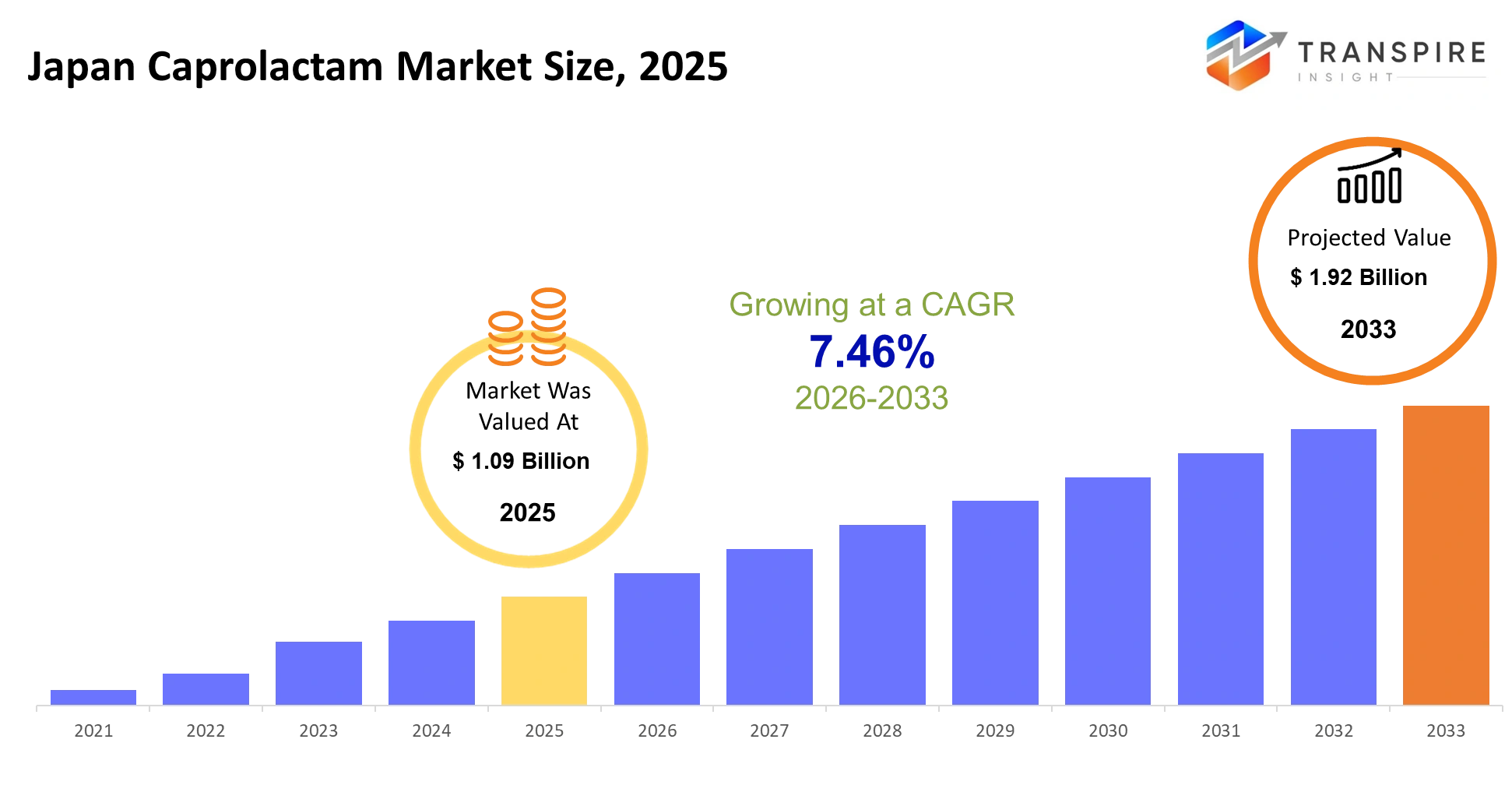
- Japan Caprolactam Market Size 2025: USD 1.09 Billion
- Japan Caprolactam Market Size 2033: USD 1.92 Billion
- Japan Caprolactam Market CAGR: 7.46%
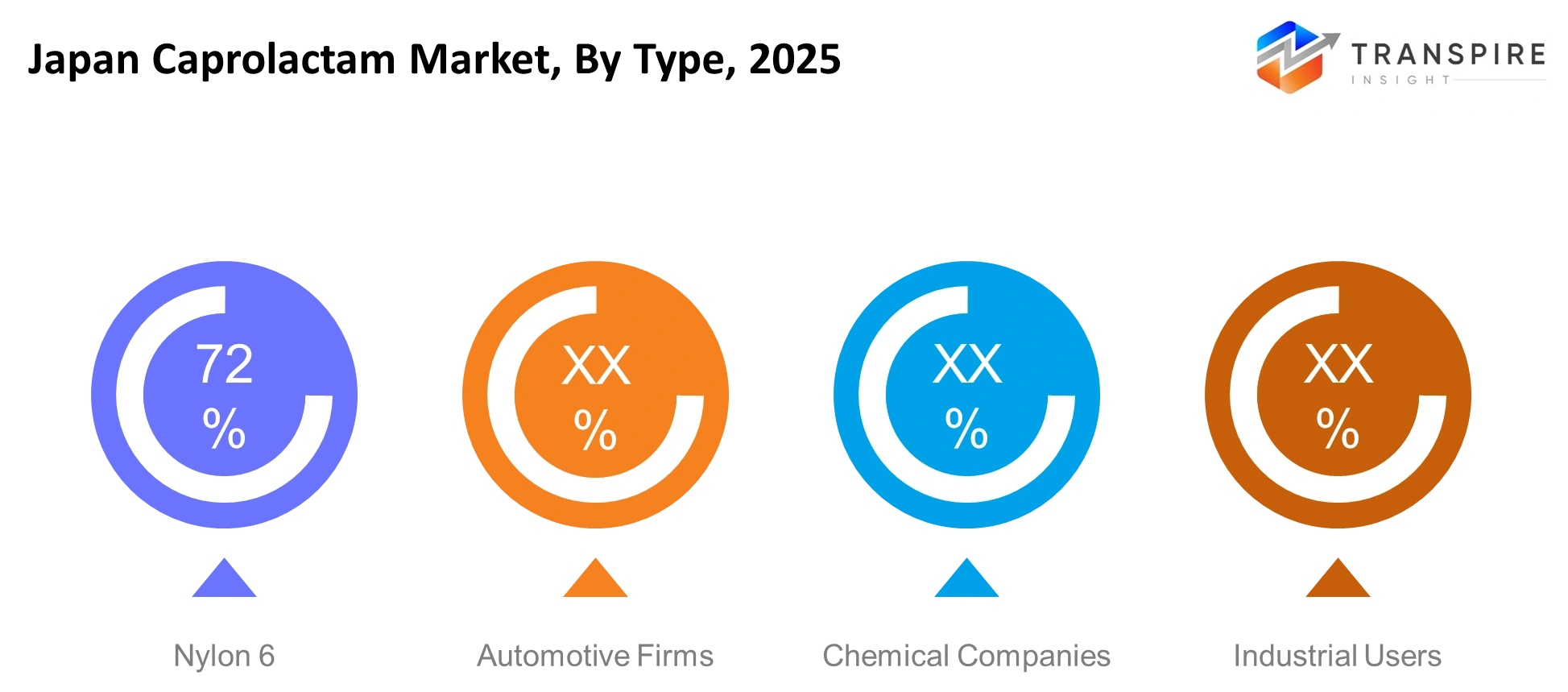
- Japan Caprolactam Market Segments: By Grade (Textile, Industrial, High Purity, Technical), By Application (Nylon 6, Automotive, Textiles, Industrial), By End-User (Textile Companies, Automotive Firms, Chemical Companies, Industrial Users)
To learn more about this report,  Download Free Sample Report
Japan Caprolactam Market Summary:
The Japan Caprolactam Market size is estimated at USD 1.09 Billion in 2025 and is anticipated to reach USD 1.92 Billion by 2033, growing at a CAGR of 7.46% from 2026 to 2033. The Japan caprolactam market functions as an essential part of the nation’s chemical and polymer sector because it maintains strong connections with nylon-6 manufacturing. Caprolactam serves as a key raw material for manufacturing nylon-6 fibers and resins which are used across textiles and automotive components and engineering plastics and electronics. The market benefits from Japan's advanced manufacturing ecosystem which includes automotive and high-performance materials production facilities that create lightweight durable heat-resistant polymers.
The market experiences growth because end-use industries including automotive and construction and electrical & electronics sectors and textile and industrial applications demand high-performance synthetic fibers. The market encounters difficulties because raw material prices change unpredictably and China imports have increased which negatively affects domestic production. The Japan caprolactam market will experience sustainable expansion because technological progress and sustainability projects and the rising use of recyclable nylon materials will drive market development.
Key Market Trends & Insights:
- Companies increasingly adopt sustainability practices which involve developing recyclable nylon-6 and creating sustainable caprolactam production methods. Japanese companies are implementing bio-based raw material usage and circular economy initiatives to meet the country's strict environmental standards and sustainability objectives.
- Domestic manufacturers encounter intense market rivalry because lower-priced products from Asian countries increase competition. Japanese producers now concentrate their efforts on developing high-value specialty caprolactam materials and advanced material solutions which allow them to maintain their profits while establishing a distinct market identity in a competitive business landscape.
- Japanese manufacturers use advanced catalysts together with energy-efficient production techniques to produce higher-quality products which help them compete against low-cost competitors from China and other Asian Pacific nations.
- Domestic producers face pricing difficulties because of increased competitive pressure from rising imports that originate primarily from China. To achieve profitability while protecting market share Japanese companies need to develop specialty grades which deliver high-value products through their strategic partnerships.
- The textile sector combined with the industrial fiber sector drives market growth through its increasing demand. Caprolactam-based nylon fibers show extensive application in apparel production, carpet manufacturing, tire cord creation, and industrial usage, while ongoing performance fabric and technical textile innovations create positive long-term development opportunities.
Japan Caprolactam Market Segmentation
By Grade
- Textile Grade: The textile-grade caprolactam serves as a primary material for manufacturing nylon-6 fibers which are used in producing clothing and carpets and home furnishings. The material exhibits dual capabilities which enable its use in manufacturing textiles at industrial scale and in producing fabrics for daily use by consumers.
- Industrial Grade: Industrial-grade caprolactam is used for manufacturing nylon-6 resins applied in heavy-duty components such as machine parts, films, and packaging materials. The material demonstrates exceptional mechanical strength together with wear resistance which makes it suitable for use in both industrial settings and engineering projects.
- High Purity Grade: High-purity caprolactam is designed for specialized applications requiring superior quality and minimal impurities. The material serves multiple purposes in advanced electronics and medical-grade materials and high-performance engineering plastics which require consistent and dependable and precise performance.
- Technical Grade: Technical-grade caprolactam functions in applications where performance remains vital but organizations do not require ultra-high purity products. The material serves as a common material for industrial fibers and molded plastics and intermediate products because it delivers both cost-effective and functional capabilities.
By Application
- Nylon 6: Japan uses caprolactam mainly for producing Nylon-6 which serves as the primary application of this chemical. The material serves multiple purposes in various applications because it combines strength with elastic properties and heat and chemical protection.
- Automotive Firms: Automotive companies use nylon-6 materials derived from caprolactam in their production of lightweight components and all applications found beneath vehicle hoods. The ongoing transition towards electric vehicles together with improved fuel efficiency standards leads to increased market demand for this particular segment.
- Chemical Companies: Chemical manufacturers use caprolactam as a raw material for producing nylon resins and other intermediate chemical products. These companies play a crucial role in the value chain by supplying materials to various downstream industries.
- Industrial Users: Industrial users include manufacturers of machinery products and packaging materials and construction materials. Caprolactam-based products provide them with necessary durability and strength and resistance properties which meet their demanding operational needs.
To learn more about this report, Download Free Sample Report
By End-User
- Textile Companies: Caprolactam serves as a primary material for textile manufacturers who require it to create nylon fibers which they use to make garments and carpets and industrial fabrics. The segment maintains steady demand because fashion and technical textiles continue to experience market growth.
- Automotive Firms: Automotive companies use caprolactam-based nylon to create components that need to be both lightweight and durable for their engine and interior applications. The industry is experiencing increased demand for these materials because electric vehicles and higher fuel efficiency solutions are becoming more popular.
- Chemical Companies: Chemical companies use caprolactam as a key raw material to produce nylon resins and other important compounds. The company operates as a fundamental supply chain component because it delivers vital materials which other sectors utilize throughout their operations.
- Industrial Users: Industrial users who manufacture machinery and packaging materials and construction materials rely on caprolactam-based products because these materials provide them with both strength and durability. The materials receive high value because they can maintain their performance capabilities in demanding and challenging environments.
Country Insights
Japan's caprolactam market receives support from its advanced chemical manufacturing facilities, which provide essential services to the automotive, electronics, and textile industries. UBE Corporation and Toray Industries and Sumitomo Chemical all gain advantages from their combined production operations and advanced technological capabilities.
These companies focus on producing high-quality, specialty-grade caprolactam for premium applications. Japan maintains its global leadership position in advanced materials research and development through its continuous material research and development efforts and its dedication to producing exact materials.
Domestic production experiences pressure from imports which are cheaper than local products especially those coming from other Asia-Pacific nations. Japanese manufacturers have decided to create value-added products which include both high-performance nylon-6 and sustainable alternatives. The government supports environmental sustainability through circular economy initiatives which drive the development of eco-friendly production methods and recyclable materials. Japan maintains its status as an important market because of its steady customer demand and advanced operational systems and dedication to premium product development.
Recent Development News
UBE Corporation increased its caprolactam production capacity in Japan by about 10% during September 2025 to satisfy growing demand from construction projects and reinforced nylon applications which include infrastructure development and high-performance engineering plastics.
Sumitomo Chemical launched AI-powered optimization technology for its caprolactam production process in November 2025 which helped the company to boost manufacturing efficiency and achieve a 15% increase in product yield that targeted electronics-grade nylon used in semiconductor and advanced applications.
|
Report Metrics |
Details |
|
Market size value in 2025 |
USD 1.09 Billion |
|
Market size value in 2026 |
USD 1.16 Billion |
|
Revenue forecast in 2033 |
USD 1.92 Billion |
|
Growth rate |
CAGR of 7.46% from 2026 to 2033 |
|
Base year |
2025 |
|
Historical data |
2021 – 2024 |
|
Forecast period |
2026 – 2033 |
|
Report coverage |
Revenue forecast, competitive landscape, growth factors, and trends |
|
Country scope |
Japan |
|
Key company profiled |
BASF, DSM, UBE, Sumitomo Chemical, Capro Corp, Fibrant, Sinopec, AdvanSix, LANXESS, Toray, Mitsubishi Chemical, Honeywell, Radici, DOMO Chemicals, Asahi Kasei |
|
Customization scope |
Free report customization (country, regional & segment scope). Avail customized purchase options to meet your exact research needs. |
|
Report Segmentation |
By Grade (Textile, Industrial, High Purity, Technical), By Application (Nylon 6, Automotive, Textiles, Industrial), By End-User (Textile Companies, Automotive Firms, Chemical Companies, Industrial Users). |
Key Japan Caprolactam Market Company Insights
The Japan caprolactam market features global chemical companies and domestic chemical producers who compete in a market that exhibits moderate consolidation. The companies BASF UBE Toray Sumitomo Chemical and Mitsubishi Chemical use their advanced production systems and complete value chains to produce top-quality caprolactam which they supply for nylon-6 fiber production and engineering plastic manufacturing. Japanese firms achieve business growth and innovation development through their extensive connections with automotive and electronics industries which create continuous demand for their products. The global market receives contributions from DSM Fibrant AdvanSix and Honeywell through their extensive production facilities and scientific expertise.
Sinopec LANXESS DOMO Chemicals Radici Capro Corp and Asahi Kasei form key players in the market who use capacity growth and partnership development and supply chain establishment to create new competitive forces. The majority of these companies work to boost their operational performance and environmental friendliness and production expenses through their technological advancements which they use to achieve their business objectives. The European market undergoes structural changes through plant shutdowns and production capacity modifications which enhance the role of Asia-Pacific markets particularly Japan and its neighboring areas as primary centers for caprolactam production and consumption.
Company List
- BASF
- DSM
- UBE
- Sumitomo Chemical
- Capro Corp
- Fibrant
- Sinopec
- AdvanSix
- LANXESS
- Toray
- Mitsubishi Chemical
- Honeywell
- Radici
- DOMO Chemicals
- Asahi Kasei
Japan Caprolactam Market Report Segmentation
By Grade
- Textile
- Industrial
- High Purity
- Technical
By Application
- Nylon 6
- Automotive
- Textiles
- Industrial
By End-User
- Textile Companies
- Automotive Firms
- Chemical Companies
- Industrial Users
Frequently Asked Questions
Find quick answers to common questions.
The Approximate Japan Caprolactam Market size for the Market will be USD 1.92 Billion in 2033.
Key Segments for the Japan Caprolactam Market are By Grade (Textile, Industrial, High Purity, Technical), By Application (Nylon 6, Automotive, Textiles, Industrial), By End-User (Textile Companies, Automotive Firms, Chemical Companies, Industrial Users).
Major Japan Caprolactam Market players are BASF, DSM, UBE, Sumitomo Chemical, Capro Corp, Fibrant, Sinopec, AdvanSix, LANXESS, Toray, Mitsubishi Chemical, Honeywell, Radici, DOMO Chemicals, Asahi Kasei.
The Current Japan Caprolactam Market size is USD 1.09 Billion in 2025.
The Japan Caprolactam Market CAGR is 7.46%.
- BASF
- DSM
- UBE
- Sumitomo Chemical
- Capro Corp
- Fibrant
- Sinopec
- AdvanSix
- LANXESS
- Toray
- Mitsubishi Chemical
- Honeywell
- Radici
- DOMO Chemicals
- Asahi Kasei
Recently Published Reports
-
May 2026
Healthcare Polymer Packaging Market
Healthcare Polymer Packaging Market Size, Share & Analysis Report By Packaging Type (Syringes, IV Bottles and Pouches, Clamshells, Blisters, Bottles & Jars, Containers, Tubes, IV Parental Packaging, Others), By Type (Regulated, Non-regulated), By Polymer Type (LDPE (Low-Density Polyethylene), HDPE (High-Density Polyethylene), Homo-polymer (Homo), Random Copolymer (Random), Block Copolymer (Block), PET, Polystyrene, Polyvinyl Chloride, Polyamide/EVOH, Others), and Geography (North America, Europe, Asia-Pacific, Middle East and Africa, South and Central America), 2021 - 2031
-
Apr 2026
Hydrophilic Tape (Waterstop) Market
Hydrophilic Tape (Waterstop) Market Size, Share & Analysis Report By Type (Bentonite-Based Hydrophilic Tape, Rubber-Based Hydrophilic Tape), By Application (Residential Buildings, Commercial Buildings, Infrastructure Projects), and Geography (North America, Europe, Asia-Pacific, Middle East and Africa, South and Central America), 2021 - 2031
-
Apr 2026
Metalens Market
Metalens Market Size, Share & Analysis Report By Type (Visible Light Metalens, and Infrared Metalens), By Application (Consumer Electronics, Automotive Electronics, Industrial, Medical, and Others), and Geography (North America, Europe, Asia-Pacific, Middle East and Africa, South and Central America), 2021 - 2031
-
Apr 2026
PBT Resin Market
PBT Resin Market Size, Share & Analysis Report By Type (Reinforced PBT Resin, Unreinforced PBT Resin), By Processing Method (Injection Molding, Extrusion, Blow Molding, Others), By End-User (Automotive, Electrical & Electronics, Consumer Appliances, Industrial Machinery, Medical Devices, Packaging, Others), and Geography (North America, Europe, Asia-Pacific, Middle East and Africa, South and Central America), 2021 - 2031