

Japan C-RAN Market Size & Forecast:
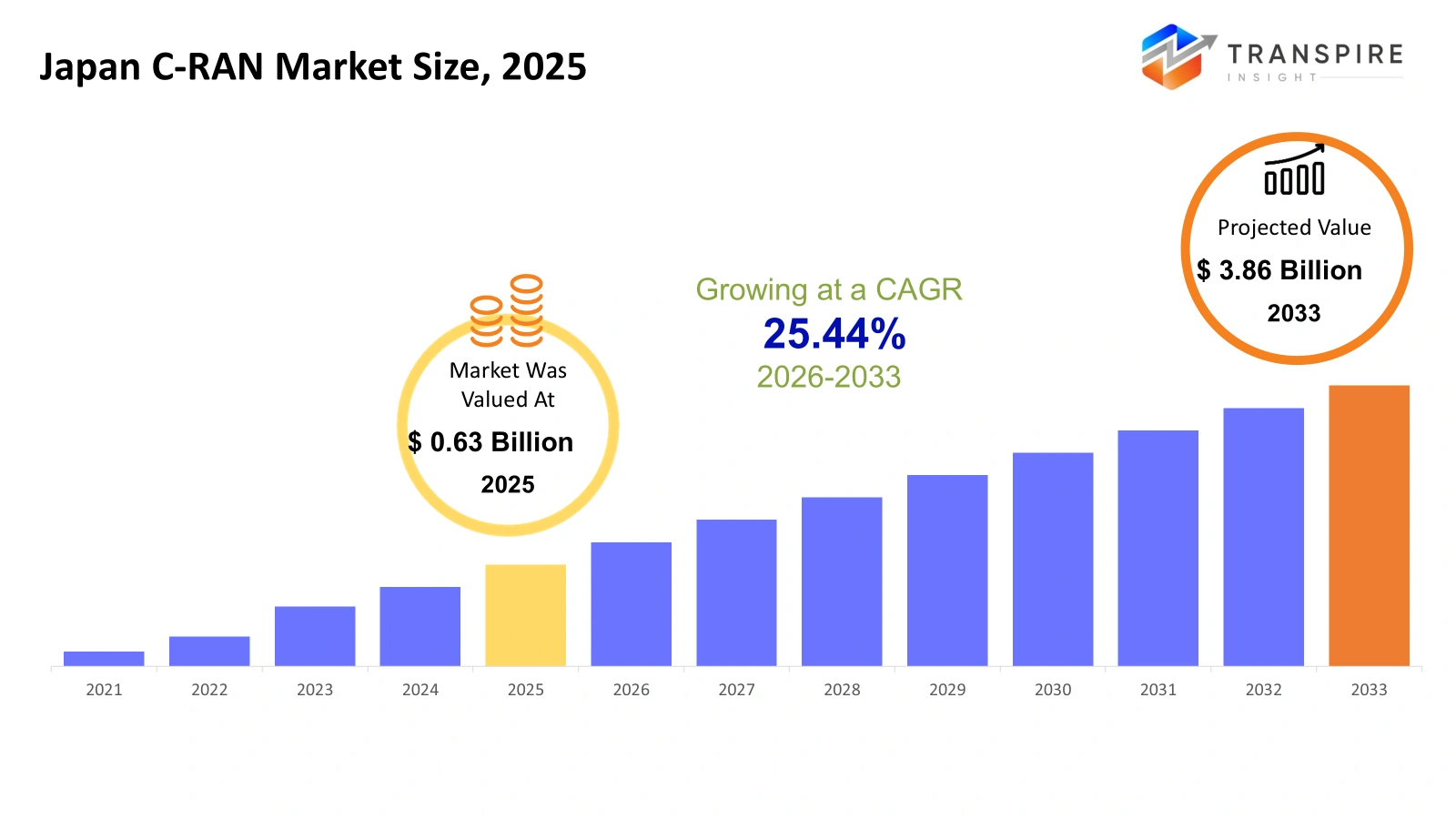
- Japan C-RAN Market Size 2025: USD 0.63 Billion
- Japan C-RAN Market Size 2033: USD 3.86 Billion
- Japan C-RAN Market CAGR: 25.44%
- Japan C-RAN Market Segments:By Component (Hardware, Software, Services), By Deployment (Centralized RAN, Virtualized RAN), By End User (Telecom Operators, Enterprises).
To learn more about this report,  Download Free Sample Report
Japan C-RAN Market Summary:
The Japan C-RAN market size is estimated at USD 0.63 Billion in 2025 and is anticipated to reach USD 3.86 Billion by 2033, growing at a CAGR of 25.44% from 2026 to 2033. The Japan C-RAN (Cloud Radio Access Network) market is experiencing fast expansion because telecom operators implement virtualisation and centralised network systems. The demand for high-speed connectivity, together with 5G deployment and economical network management solutions, has led companies to make substantial investments in C-RAN technology for performance improvement and cost reduction. The market operates through three main forces, which include technological advancements, increasing data traffic, and government programmes that support modern telecom network development. Japan's commitment to smart city development and Internet of Things implementation drives the C-RAN system market, which serves as an important area of business expansion.
Key Market Trends & Insights:
- Telecom companies are increasingly adopting virtualised RAN solutions to reduce CAPEX and OPEX. Virtualisation enables networks to scale resources with flexibility, while network management becomes easier.
- C-RAN decreases energy usage through its system that processes baseband signals. This system supports Japan's environmental sustainability targets while the telecom sector works towards sustainable network development.
- The expanding IoT network and smart city projects need networks that provide high performance with quick response times. C-RAN delivers both the required system growth capacity and performance to manage connected devices.
- Major telecom operators are partnering with technology vendors to develop advanced C-RAN solutions. These collaborations develop new technologies which enhance Japan's ability to compete in next-generation network development.
- Increasing smartphone use and urban population density are pushing operators to adopt C-RAN. The C-RAN system provides fast and dependable connectivity throughout urban centres and commercial districts.
Japan C-RAN Market Segmentation
By Component
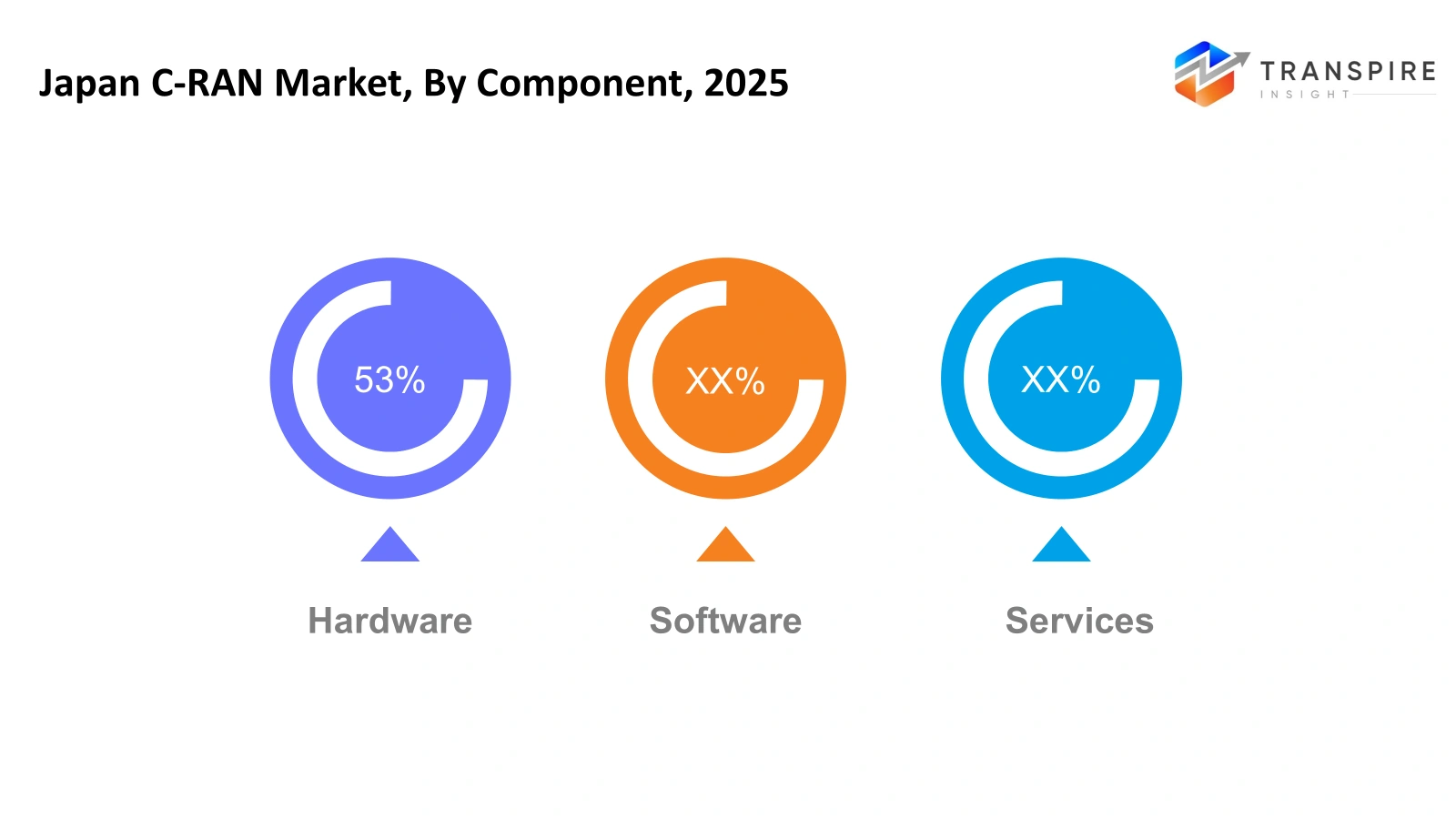
- Hardware: The core elements of C-RAN infrastructure depend on baseband units and remote radio heads and antennas, which function as essential components of its hardware foundation. Japanese telecom operators select advanced energy-efficient hardware systems because they need solutions which can handle increasing 5G network traffic while boosting their coverage capabilities and maintaining dependable service across all areas.
- Software: C-RAN networks depend on software to handle their operations while achieving network optimisation. Through its advanced network management system, virtualisation platforms, and AI-based analytics capabilities, the software enables operators to observe their system performance while managing their resources and decreasing their operational expenses, which makes it an essential component that drives the development of Japan's contemporary telecommunications system.
- Services: The C-RAN services encompass the following functions: installation and integration and maintenance and consulting. Japanese telecom operators depend more on specialised service providers because they need assistance in building expandable networks while maintaining operational efficiency and upgrading their systems to support 5G and Internet of Things applications.
To learn more about this report, Download Free Sample Report
By Deployment
- Centralized RAN (C-RAN): C-RAN technology unifies baseband processing operations in a single facility, which results in decreased infrastructure expenses and easier management tasks. The Japanese telecom industry implements C-RAN technology to enhance their service area coverage while meeting the needs of dense urban environments and achieving efficient city-wide 5G network implementation.
- Virtualized RAN (vRAN): Virtualized RAN enables users to separate their hardware components from software applications, which creates adaptable networking solutions that run on cloud infrastructure. The telecom companies in Japan use vRAN technology to expand their business operations while improving their network performance and achieving efficient handling of varying traffic levels through reduced capital investment.
By End User
- Telecom Operators: C-RAN technology has become the main choice for telecom operators who need cost-effective solutions to build high-performance networks which support their 5G network expansion. Japanese telecom companies use C-RAN technology to enhance their network coverage while decreasing latency and providing better service to their urban and rural customers.
- Enterprises: Businesses now implement private C-RAN networks to enable their IoT operations and smart factory processes and maintain secure communications. Japanese businesses in manufacturing and logistics and smart city development use tailored C-RAN solutions which provide dependable performance and minimal latency for their essential business functions.
Country Insights
The C-RAN market of Japan is becoming a crucial factor that will drive the development of new telecommunication systems throughout the country. The telecom industry is moving toward RAN solutions, which combine centralised operations with virtualised systems, because of the fast rollout of 5G networks and the increasing requirement for quick and dependable internet connections. The government drive to develop smart cities through IoT technology implementation and digital transformation initiatives has increased market demand for these services.
The Japanese population, which lives in cities and uses smartphones at high rates, requires network management solutions that C-RAN provides because it helps decrease operational expenses and enhances network efficiency. Telecommunications companies dedicate substantial resources to research and development activities while they create new hardware and software products and provide network coverage and reliability enhancements. Local service providers team up with technology companies to develop new solutions that provide networks which can scale efficiently and use energy sustainably.
The manufacturing and logistics and healthcare industries will require C-RAN systems which provide both flexibility and reliability because they will start using IoT devices and connected technology throughout their operations, which will make Japan a vital centre for cutting-edge telecom research and development.
Recent Development News
Rakuten Mobile achieves TM Forum Level 4 RAN autonomy validation: Rakuten Mobile received a prestigious global validation for autonomous energy optimization in its live Open RAN network, marking a significant milestone in intelligent RAN deployments.
NTT Docomo launches agentic AI system for mobile network maintenance: NTT Docomo has begun commercial deployment of an AI system designed to improve network service response and maintenance across complex multi‑vendor environments.
|
Report Metrics |
Details |
|
Market size value in 2025 |
USD 0.63 Billion |
|
Market size value in 2026 |
USD 0.79 Billion |
|
Revenue forecast in 2033 |
USD 3.86 Billion |
|
Growth rate |
CAGR of 25.44% from 2026 to 2033 |
|
Base year |
2025 |
|
Historical data |
2021 – 2024 |
|
Forecast period |
2026 – 2033 |
|
Report coverage |
Revenue forecast, competitive landscape, growth factors, and trends |
|
Country scope |
Japan |
|
Key company profiled |
Huawei Technologies Co. Ltd., Nokia Corporation, Ericsson AB, Samsung Electronics Co. Ltd., ZTE Corporation, NEC Corporation, Fujitsu Limited, Intel Corporation, Qualcomm Technologies Inc., Cisco Systems Inc., Mavenir Systems Inc., Juniper Networks Inc., Rakuten Symphony Inc., Parallel Wireless Inc., VMware Inc. |
|
Customization scope |
Free report customization (country, regional & segment scope). Avail customized purchase options to meet your exact research needs. |
|
Report Segmentation |
By Component (Hardware, Software, Services), By Deployment (Centralized RAN, Virtualized RAN), By End User (Telecom Operators, Enterprises). |
Key Japan C-RAN Company Insights
The major telecommunications companies of Japan are making investments in C-RAN technologies to improve their network performance and enable 5G network deployment. The companies use sophisticated hardware systems combined with intelligent software solutions and complete service packages to achieve their network optimisation goals while minimising expenses. The virtualised and centralised RAN systems receive innovative development through the partnerships between technology vendors and startup companies. The Japanese operators focus on developing energy-efficient systems which provide scalable performance to handle increasing urban connection needs. The strategies companies use to build their networks enable them to provide reliable high-speed connections with minimal delays, which establish Japan as a centre for upcoming telecommunications innovations.
Company List
- Huawei Technologies Co. Ltd.
- Nokia Corporation
- Ericsson AB
- Samsung Electronics Co. Ltd.
- ZTE Corporation
- NEC Corporation
- Fujitsu Limited
- Intel Corporation
- Qualcomm Technologies Inc.
- Cisco Systems Inc.
- Mavenir Systems Inc.
- Juniper Networks Inc.
- Rakuten Symphony Inc.
- Parallel Wireless Inc.
- VMware Inc.
Japan C-RAN Market Report Segmentation
By Component
- Hardware
- Software
- Services
By Deployment
- Centralized RAN
- Virtualized RAN
By End User
- Telecom Operators
- Enterprises
Frequently Asked Questions
Find quick answers to common questions.
The Approximate Japan C-RAN Market size will be USD 3.86 billion in 2033.
The key segments of the Japan C-RAN Market are By Component (Hardware, Software, Services), By Deployment (Centralized RAN, Virtualized RAN), By End User (Telecom Operators, Enterprises).
Major Players in the Japan C-RAN Market are Huawei Technologies Co. Ltd., Nokia Corporation, Ericsson AB, Samsung Electronics Co. Ltd., ZTE Corporation, NEC Corporation, Fujitsu Limited, Intel Corporation, Qualcomm Technologies Inc., Cisco Systems Inc., Mavenir Systems Inc., Juniper Networks Inc., Rakuten Symphony Inc., Parallel Wireless Inc., VMware Inc.
The Current Market size of the Japan C-RAN Market is USD 0.63 Billion in 2025.
The Japan C-RAN Market CAGR is 25.44%.
- Huawei Technologies Co. Ltd.
- Nokia Corporation
- Ericsson AB
- Samsung Electronics Co. Ltd.
- ZTE Corporation
- NEC Corporation
- Fujitsu Limited
- Intel Corporation
- Qualcomm Technologies Inc.
- Cisco Systems Inc.
- Mavenir Systems Inc.
- Juniper Networks Inc.
- Rakuten Symphony Inc.
- Parallel Wireless Inc.
- VMware Inc.
Recently Published Reports
-
Apr 2026
3D Optical Profiler Market
3D Optical Profiler Market Size, Share & Analysis Report By Type (Desktop 3D Optical Profiler, and Portable 3D Optical Profiler), By Technology (Confocal Technology, and White Light Interference), By End-Use Industry (Manufacturing, Research Institutions, Automotive, Aerospace and Defense, Medical Devices, and Other), and Geography (North America, Europe, Asia-Pacific, Middle East and Africa, South and Central America), 2021 - 2031
-
Apr 2026
Depth Sensor Market
Depth Sensor Market Size, Share & Analysis Report By Type (Infrared Depth Sensors, Time-of-Flight (ToF) Sensors, Stereo Vision Sensors, Structured Light Sensors, Ultrasonic Depth Sensors), By Application (Automotive, Robotics, Gaming, Consumer Electronics, Industrial Automation, Healthcare, Security & Surveillance, Others), By End Users (Automotive Manufacturers, Consumer Electronics Companies, Healthcare Providers, Industrial Companies, Security Agencies, Gaming Companies, Robotics Companies, Others), and Geography (North America, Europe, Asia-Pacific, Middle East and Africa, South and Central America), 2021 – 2031
-
Apr 2026
Digital Manufacturing Market
Digital Manufacturing Market Size, Share & Analysis Report By Component (Hardware, Software, and Services), By Technology (Robotics, 3D Printing, Internet of Things (IoT), and Others), By Application (Automotive and Transportation, Aerospace and Defense, Consumer Electronics, Industrial Machinery, and Others), By Process Type (Computer-Based Designing, Computer-Based Simulation, Computer 3D Visualization, Analytics, and Others), and Geography (North America, Europe, Asia-Pacific, Middle East and Africa, South and Central America), 2021 – 2031
-
Apr 2026
Digital Visa Services Market
Digital Visa Services Market Size, Share & Analysis Report By Type (Individual Travelers, Group Travelers), By Application (Tourism, Business Travel, Others), and Geography (North America, Europe, Asia-Pacific, Middle East and Africa, South and Central America), 2021 – 2031