

Japan Biohacking Market Size & Forecast:
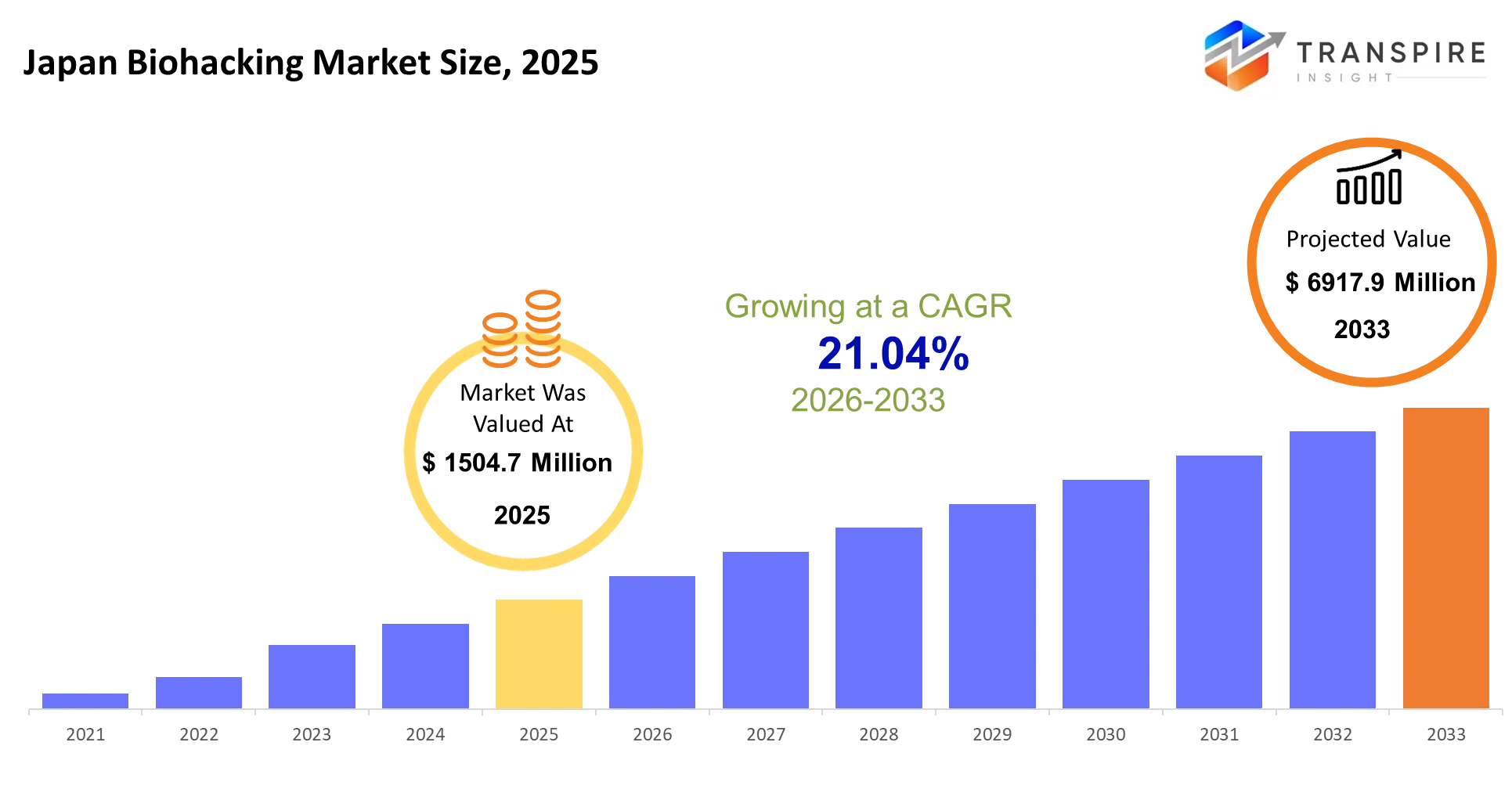
- Japan Biohacking Market Size 2025: USD 1504.7 Million
- Japan Biohacking Market Size 2033: USD 6917.9 Million
- Japan Biohacking Market CAGR: 21.04%
- Japan Biohacking Market Segments: By Type (Wearables, Implants, Supplements, Smart Drugs, Others); By Application (Health Monitoring, Cognitive Enhancement, Fitness Optimization, Longevity, Others); By End-User (Consumers, Athletes, Healthcare Enthusiasts, Biohackers, Others); By Distribution (Online Platforms, Retail Stores, Clinics, Others)
To learn more about this report,  Download Free Sample Report
Japan Biohacking Market Summary
The Japan Biohacking Market was valued at USD 1504.7 Million in 2025. It is forecast to reach USD 6917.9 Million by 2033. That is a CAGR of 21.04% over the period.
Japan's biohacking industry has transformed from a specialized wellness practice into a functioning system which improves physical abilities, mental strength, sleep performance and preventive healthcare through its data-based assessment methods. The system allows users and organizations to track their body indicators while they design their dietary plans and enhance their recovery times and protect their future health through wearable technology and artificial intelligence health solutions and dietary supplements and online assessment tools. This function has become increasingly relevant as Japan addresses workforce productivity pressures and an aging population that demands proactive health management.
The market has transformed during the past three to five years from its original consumer experimentation period to its current state which combines clinical knowledge with advanced technology solutions that healthcare organizations and corporate wellness systems provide. The COVID-19 pandemic acted as a major trigger which led to widespread adoption of remote health monitoring systems and established digital self-tracking as standard practice. Users changed their expectations to receive scientific data about their body functions instead of receiving basic fitness information. The development of precision health technologies and subscription-based platforms has provided companies with a new revenue stream which becomes more stable because both individual users and enterprise health management systems adopt those technologies.
Key Market Insights
- The Kanto region of Japan leads the country's biohacking market because it controls 42 percent of the market share which will exist in 2025, due to its extensive network of medical technology facilities.
- The Kansai region stands as the second most important area for business development because it has advanced research centers for biotechnology and health-related research facilities.
- The Kyushu region will experience its most rapid market growth until 2030 because it implements intelligent health monitoring systems through experimental programs and supports its digital health business development through startup acceleration initiatives.
- The Japan Biohacking Market derives its main revenue from wearable biomonitoring devices which will reach 38 percent of market size during 2025 because consumers widely use these products.
- Personalized nutrition and nootropic supplements capture significant market share because consumers demand solutions which will improve their cognitive performance abilities.
- The segment of AI-driven health analytics platforms which monitors health outcomes through predictive capabilities will experience its most rapid growth until the year 2030.
- The users who choose to track their biological performance over an extended period will make preventive health optimization their top choice, which will give this method a market share of almost 34% in 2025.
- The market for cognitive enhancement applications experiences its most rapid growth because of the increasing demand among professionals who need tools to improve their ability to concentrate and work efficiently.
- Individual consumers dominate the Japan Biohacking Market, which will generate more than 57% of its 2025 revenue through direct sales of wearable devices and supplements.
- The corporate wellness programs represent the most rapidly expanding end-user category, which will continue to grow throughout the forecast period, as businesses allocate resources to improve their staff's work performance.
What are the Key Drivers, Restraints, and Opportunities in the Japan Biohacking Market?
The main force driving growth in the Japan biohacking sector results from the combination of wearable biosensor technology and the country's ongoing digital healthcare developments. The COVID-19 pandemic brought about this change when it made remote health monitoring standard and people and healthcare organizations began using data-based wellness methods. The combination of better sensor accuracy and improved battery performance together with advanced AI health analytics systems led to easier access for people to track their biometrics throughout the day. The solution has expanded consumer adoption for those who want personalized performance data while businesses continue to invest in their employee health improvement programs. As health platforms that use subscription models begin to work with wearable technology companies will start making ongoing income instead of depending on single device transactions.
The main obstacle preventing market development in Japan comes from its strict healthcare regulations which control clinical verification processes and health declaration procedures and handle consumer information security matters. The approval process for biohacking products that target specific health conditions requires extensive evaluation procedures which assess the products' proven effectiveness. The problem exists because institutional regulations and public trust requirements create a permanent obstacle for organizations. The process of commercializing products takes more time because companies face difficulties in bringing their products to market and making money from their innovative products.
The strongest growth opportunity lies in enterprise biohacking solutions tailored for Japan’s aging workforce. Companies are increasingly piloting AI-driven fatigue monitoring and recovery optimization platforms. The combination of workplace biometric analytics with wearable devices will enable manufacturing and technology sectors to adopt their applications at a large scale which will create a scalable business-to-business growth channel.
What Has the Impact of Artificial Intelligence Been on the Japan Biohacking Market?
The biohacking ecosystem of Japan undergoes transformation through artificial intelligence and digital technology because they create health intelligence from raw biometric information. The AI-powered system provides ongoing monitoring through wearable devices which it uses to assess heart rate variability and sleep patterns and glucose levels and stress indicators in real time. The system enables automatic health assessment through its continuous tracking system, which provides tailored health advice without requiring ongoing medical supervision. The machine learning algorithms used by multiple digital health platforms in Japan create dynamic recovery plans and nutritional programs and cognitive performance strategies which adapt to daily changes in user body composition.
The sector achieves measurable value through the implementation of predictive analytics. The machine learning models enable organizations to forecast fatigue risk while identifying patterns of irregular recovery and discovering metabolic imbalance indicators which exist before symptoms arise. The system helps users remain committed while achieving better results because enterprise wellness programs show 10 to 15 percent productivity growth through effective fatigue control and recovery time management. AI-driven precision health solutions enable healthcare organizations to cut treatment expenses by shifting their primary focus to preventive care methods.
The process of adoption encounters a significant obstacle which consists of separated biometric databases. The health research field faces predictive accuracy issues because many algorithms depend on restricted population data which does not represent Japan's senior citizen demographic. The high costs associated with integrating wearable devices and healthcare systems and enterprise platforms create barriers which prevent mid-sized companies from implementing these solutions.
Key Market Trends
- Japanese consumers now prefer complete biometric systems which track their health through multiple health applications because they stopped using separate fitness trackers in 2022.
- Corporate wellness programs experienced faster growth after 2021 because major companies like Sony Group Corporation introduced biometric tracking systems to combat productivity declines caused by employee exhaustion.
- The period from 2023 to 2025 witnessed the rise of AI-based sleep improvement systems which replaced traditional health journaling methods after recovery tips became more precise through algorithm development.
- Biohacking supplement brands increasingly moved toward evidence-backed formulations after 2022, responding to tighter scrutiny around unsupported wellness claims.
- The digital healthcare regulations in Japan which started in 2020 require technology developers to validate their products through clinical testing rather than testing their products in consumer markets.
- The period after 2023 saw device makers and healthcare institutions establish strategic partnerships which led to increased trust in personalized biomarker analytics platforms.
- The health optimization platforms that operate on a subscription model replaced the previous practice of selling devices as their primary revenue source by 2024.
- The professional workforce aged 40 and above has become the main customer segment since 2022 which has led to product development that focuses on cognitive resilience and metabolic health tracking.
- Global competitors like Apple Inc. and WHOOP increased their market rivalry by adapting their analytics tools to meet the needs of Japan's preventive healthcare system.
Japan Biohacking Market Segmentation
By Type:
The Japanese biohacking market maintains its large wearable device market share because consumers increasingly want to use devices for tracking their physical activity and sleep patterns and their overall health status. People use smartwatches and fitness bands and sensor-based monitoring tools to find practical methods for improving their daily health routines. The devices combine with mobile applications through simple connections which enable users to monitor their health status without difficulty.
The market for body-integrated technology exists through implant technology which has started to expand since more people know about it . The market sustains its interest from specific users who want to track performance results and monitor biological data. The demand for supplements and smart drugs is growing because customers need products which help them with energy and focus and physical recovery. The other category consists of experimental products and personalized biological tracking tools which are starting to receive recognition as innovation develops in Japan.
By Application:
Health monitoring leads to application demand in Japan's biohacking market due to strong consumer attention toward preventive care and early health assessment. People are now using technologies and products which enable them to monitor their vital signs and identify health problems and receive health information. The public now understands personal wellness management better which leads to an increase in self-directed healthcare practices.
The demand for cognitive enhancement solutions has increased among students and working professionals who want to boost their focus abilities and work productivity and mental performance. People use biohacking tools for fitness optimization because they want to enhance their workout results and speed up their recovery process.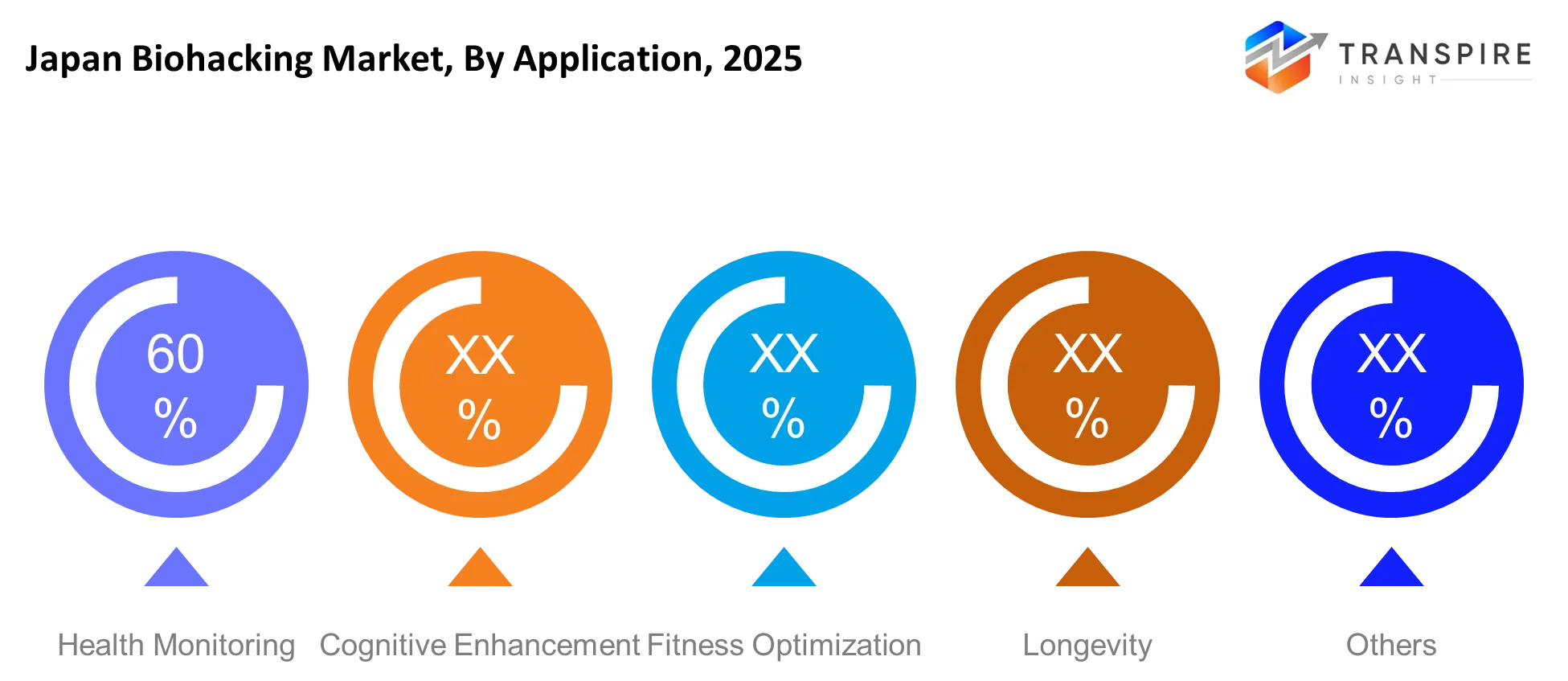
To learn more about this report, Download Free Sample Report
By End-User:
The biohacking market in Japan serves its largest customer base through health devices which become more accessible to consumers who want to monitor their health and use dietary supplements. Daily users are becoming more interested in practical technologies that help maintain wellness and improve routine habits and support physical performance. User-friendly products have created a simple adoption process which people from various age groups can use.
The athletic community needs performance tracking tools which help them monitor their training progress and optimize their recovery process. People who are passionate about healthcare investigate different wellness techniques which use biological data tracking as their base. Dedicated biohackers continue to drive experimentation with advanced tools and unconventional optimization methods. The others category includes professionals and specialized users who use biohacking products to enhance their work efficiency and track their health metrics.
By Distribution :
The Japanese biohacking market sees online platforms as its main distribution method because digital purchasing enables consumers to easily access various products while showing them detailed product comparisons and customer reviews. E-commerce channels enable customers to shop for wearables and supplements and related tools from their home environment. The channel benefits from growing digital literacy levels and high customer confidence in online shopping platforms.
Retail stores continue to maintain relevance because many buyers prefer direct product evaluation before purchase especially for devices that need technical understanding. The clinics function as essential distribution centers which provide specialized biohacking solutions that require professional guidance and customized recommendations. Wellness centers and niche specialty outlets serve as additional distribution channels which provide targeted biological optimization products for specific customer groups.
What are the Key Use Cases Driving the Japan Biohacking Market?
The Japanese biohacking market develops mainly through its primary application which enables ongoing biometric tracking to create steady market growth. The market mostly relies on wearable devices and health platforms that enable users to monitor their sleep patterns and recovery processes and stress levels and heart health in real time. The system creates high demand from professionals who want to achieve measurable productivity improvements while maintaining their health through extended periods of preventive health measures.
The corporate wellness sector and preventive healthcare sector are experiencing growth through the development of adjacent applications. The technology and manufacturing industries use performance tracking systems to help their employees manage fatigue and build stronger resilience. The premium wellness centers use biomarker analysis and customized nutrition plans to help middle-aged and older clients achieve better metabolic health.
The field currently develops AI-based cognitive enhancement solutions and digital twin health modeling techniques. Japan demonstrates strong potential for developing precise medical applications through its current research projects which are still in their initial stages. The research institutions and high-performance executive health programs will report increasing adoption of neurofeedback systems and predictive metabolic simulation technologies throughout the study period.
|
Report Metrics |
Details |
|
Market size value in 2025 |
USD 1504.7 Million |
|
Market size value in 2026 |
USD 1817.7 Million |
|
Revenue forecast in 2033 |
USD 6917.9 Million |
|
Growth rate |
CAGR of 21.04% from 2026 to 2033 |
|
Base year |
2025 |
|
Historical data |
2021 - 2024 |
|
Forecast period |
2026 - 2033 |
|
Report coverage |
Revenue forecast, competitive landscape, growth factors, and trends |
|
Country scope |
Japan |
|
Key company profiled |
Oura, Fitbit, WHOOP, Apple, Garmin, Muse, Thync, Neurohacker Collective, Bulletproof, HVMN, Viome, InsideTracker, Levels Health, Eight Sleep, Halo Neuroscience |
|
Customization scope |
Free report customization (country, regional & segment scope). Avail customized purchase options to meet your exact research needs. |
|
Report Segmentation |
By Type (Wearables, Implants, Supplements, Smart Drugs, Others); By Application (Health Monitoring, Cognitive Enhancement, Fitness Optimization, Longevity, Others); By End-User (Consumers, Athletes, Healthcare Enthusiasts, Biohackers, Others); By Distribution (Online Platforms, Retail Stores, Clinics, Others) |
Which Regions are Driving the Japan Biohacking Market Growth?
The Kanto region leads Japan's biohacking market because it combines the country's strongest digital health infrastructure together with numerous technology companies and research institutions and premium healthcare providers. Tokyo and Yokohama have become central hubs for companies that develop wearable devices and use AI for health analytics and create precision wellness startups. The region also receives advantages from corporate funding which supports employee productivity improvement across finance and technology and consulting sectors. The ecosystem generates a powerful feedback mechanism which connects new developments with clinical testing and quick product launch to the market.
The Kansai region uses its existing biomedical research infrastructure to create its own identity instead of depending on consumer usage of digital wellness technologies. Osaka and Kyoto support the market through pharmaceutical innovation, academic research partnerships and steady investment in preventive healthcare technologies. Kansai provides superior territory stability to Kanto because it uses permanent institutional relations for its business operations. The system provides dependable market income which especially benefits biohacking systems designed for clinical use.
Kyushu is experiencing its quickest growth because of digital healthcare modernization projects and increasing public-private investments in intelligent health system development. The regional governments have increased their assistance for health technology pilot programs which focus on managing aging populations and using remote biometric monitoring systems. The situation has created beneficial opportunities for startups which are developing precision health solutions in locations outside of Japan's main urban areas. The period from 2026 to 2033 presents Kyushu as a business opportunity because it has less market competition and provides investors with chances to establish their positions.
Who are the Key Players in the Japan Biohacking Market and How Do They Compete?
The Japanese biohacking market shows moderate fragmentation because global wearable technology companies compete against local electronics manufacturers and digital health startups and specialized wellness platform providers. The market is not defined by price competition alone. Companies are competing through ecosystem integration and AI-powered analytics and clinical validation and recurring subscription-based service models. Established technology firms are defending market share by expanding health monitoring capabilities while newer entrants are disrupting the landscape with highly specialized solutions focused on sleep optimization and metabolic intelligence and cognitive performance enhancement.
Apple Inc. competes through deep hardware-software integration which enables it to use its connected device ecosystem for providing seamless biometric monitoring and personalized health insights. Its strength comes from user retention across interconnected products which allows continuous software upgrades to extend functionality without requiring frequent hardware replacement. OMRON Corporation establishes its market position through clinically validated monitoring devices which deliver strong integration with Japan's regulated healthcare system to bridge customer wellness with medical-grade diagnostic tools.
The company expands its operations through two main strategies which involve developing new sensors and implementing artificial intelligence analytics systems. The company uses its miniature electronic capabilities to create advanced wearable devices for future markets. WHOOP operates as a subscription service which provides users with recovery intelligence while its advanced physiological coaching system attracts users who need high-performance training. Panasonic Holdings Corporation uses its corporate wellness partnerships to develop a business-to-business growth channel which protects its enterprise health optimization services.
Company List
- Oura
- Fitbit
- WHOOP
- Apple
- Garmin
- Muse
- Thync
- Neurohacker Collective
- Bulletproof
- HVMN
- Viome
- InsideTracker
- Levels Health
- Eight Sleep
- Halo Neuroscience
Recent Development News
In April 2026, OMRON Healthcare entered a partnership with Tricog Health to strengthen AI-powered cardiovascular screening solutions. The expanded collaboration introduced Tricog CardioCheck for faster ECG-based risk assessment, reinforcing Japan’s biohacking ecosystem through advanced preventive health monitoring and digital biomarker analytics.
Source https://healthcare.omron.com/
In April 2026, JTB Communication Design, Inc. announced the organization of BioJapan 2026 with integrated ‘healthTECH JAPAN’ and ‘Regenerative Medicine JAPAN’ exhibitions. This initiative strengthens partnerships and showcases advanced digital health and biotechnology solutions, supporting innovation in personalized health and biohacking-related technologies in Japan. Source https://www.bio-m.org/
What Strategic Insights Define the Future of the Japan Biohacking Market?
The Japan biohacking market will develop into clinically integrated precision health ecosystems which will replace consumer wellness products that exist as separate entities during the five to seven upcoming years. The underlying force driving this shift is the convergence of AI-powered biomarker analytics, aging population pressures, and Japan’s broader healthcare digitalization agenda. Market value will increasingly concentrate around platforms that combine wearable monitoring, predictive health modeling, and validated intervention protocols. The transition will benefit companies which can provide customers with easy access to products that meet medical standards for performance.
The hidden danger exists because algorithms rely on limited biometric data which restrict their ability to function. The current platforms require training on specific demographic groups which leads to lower predictive performance for Japan's older population while creating trust issues that delay institutional adoption. Emerging opportunities exist through regional enterprise health optimization programs which are developing in Kyushu and other secondary innovation hubs that use public-private digital health pilots for their development.
The market participants should focus their strategic efforts on establishing clinical partnerships and developing local data systems through early investment. The companies that prove their AI health insights through Japanese healthcare institutions will gain better chances to obtain enterprise contracts and handle regulatory inspections while creating sustainable market advantages.
Japan Biohacking Market Report Segmentation
By Type
- Wearables
- Implants
- Supplements
- Smart Drugs
By Application
- Health Monitoring
- Cognitive Enhancement
- Fitness Optimization
- Longevity
By End-User
- Consumers
- Athletes
- Healthcare Enthusiasts
- Biohackers
By Distribution
- Online Platforms
- Retail Stores
- Clinics
Frequently Asked Questions
Find quick answers to common questions.
The Japan Biohacking Market size is USD 6917.9 Million in 2033.
Key segments for the Japan Biohacking Market are By Type (Wearables, Implants, Supplements, Smart Drugs, Others); By Application (Health Monitoring, Cognitive Enhancement, Fitness Optimization, Longevity, Others); By End-User (Consumers, Athletes, Healthcare Enthusiasts, Biohackers, Others); By Distribution (Online Platforms, Retail Stores, Clinics, Others).
Major Japan Biohacking Market Players are Oura, Fitbit, WHOOP, Apple, Garmin, Muse, Thync, Neurohacker Collective, Bulletproof, HVMN, Viome, InsideTracker, Levels Health, Eight Sleep, Halo Neuroscience.
The Current Japan Biohacking Market size is USD 1504.7 Million in 2025.
The Japan Biohacking Market CAGR is 21.04% from 2026 to 2033.
- Oura
- Fitbit
- WHOOP
- Apple
- Garmin
- Muse
- Thync
- Neurohacker Collective
- Bulletproof
- HVMN
- Viome
- InsideTracker
- Levels Health
- Eight Sleep
- Halo Neuroscience
Recently Published Reports
-
Apr 2026
Bottled Water Market
Bottled Water Market Size, Share & Analysis Report By Product Type (Still Bottled Water, Carbonated Bottled Water, Functional Bottled Water, and Others), By Packaging (PET, Cans, and Others), By Sales Channel (Supermarkets/Hypermarkets, Convenience Stores/Drug Stores, Grocery Stores/Club Stores, Foodservice, and Others) and Geography (North America, Europe, Asia-Pacific, Middle East and Africa, South and Central America), 2021 - 2032
-
Apr 2026
Color Cosmetic Packaging Market
Color Cosmetic Packaging Market Size, Share & Analysis Report By Application (Mascara Packaging, Liquid Packaging, and Liquid Face), By Type (Tubes & Bottles, Pens & Markers, Compacts & Containers, and Droppers & Pumps), and Geography (North America, Europe, Asia-Pacific, Middle East and Africa, South and Central America), 2021 - 2031
-
Apr 2026
External Microphone For Camera Market
External Microphone For Camera Market Size, Share & Analysis Report By Type (Shotgun Microphone, Lavalier Microphone, and Others), By Application (Digital Camera, Professional Video Camera, and Others), and Geography (North America, Europe, Asia-Pacific, Middle East and Africa, South and Central America), 2021 - 2031
-
Apr 2026
Foot Orthotic Insoles Market
Foot Orthotic Insoles Market Size, Share & Analysis Report By Type (Pre-fabricated, and Custom-made), By Material (Thermoplastic, Composite Carbon Fiber, and Others), By Distribution Channel (Drug Stores, Hospitals & Clinics, and Others), and Geography (North America, Europe, Asia-Pacific, Middle East and Africa, South and Central America), 2021 - 2031