Japan Automotive Hud Market Size & Forecast:
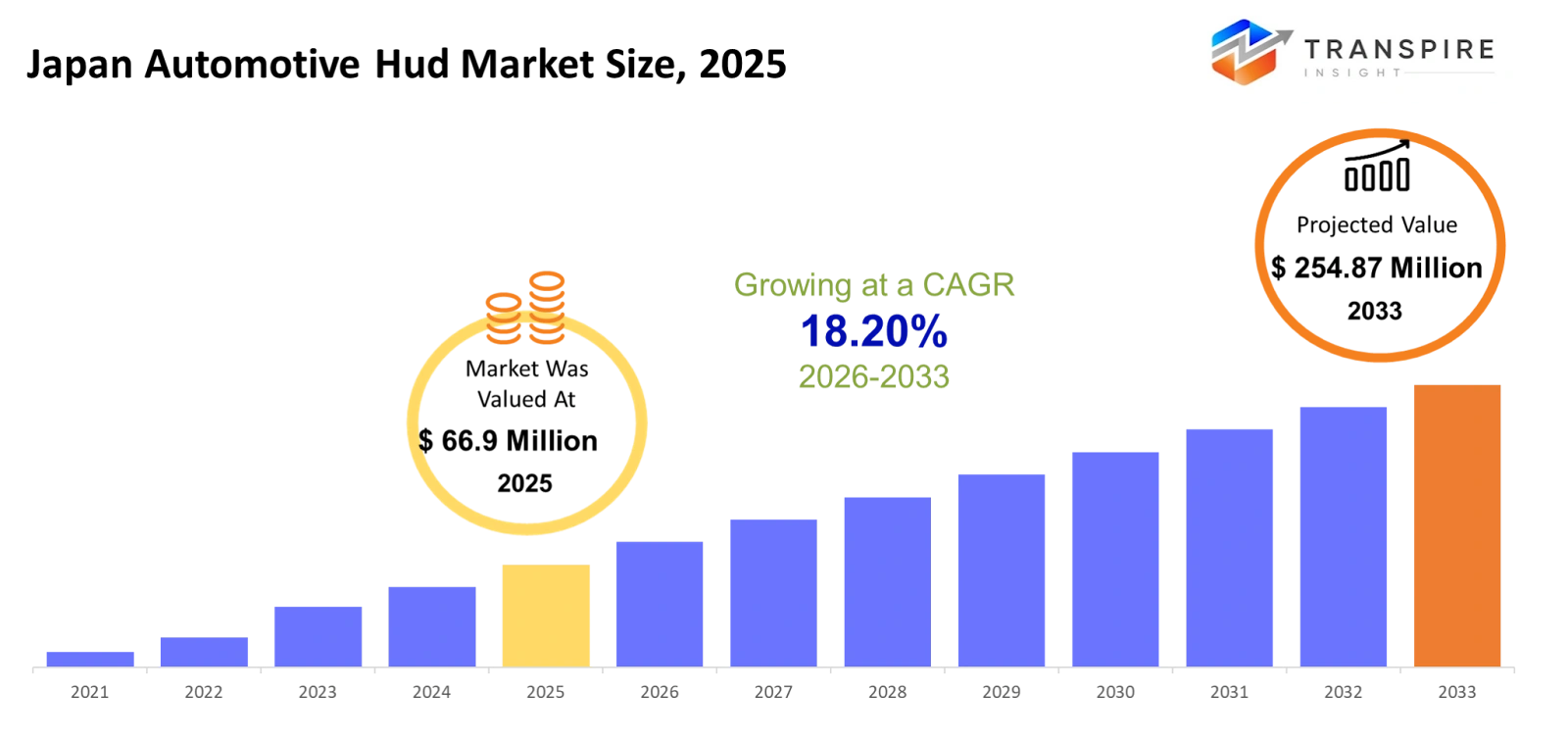
- Japan Automotive Hud Market Size 2025: USD 66.9 Million
- Japan Automotive Hud Market Size 2033: USD 254.87 Million
- Japan Automotive Hud Market CAGR: 18.20%
- Japan Automotive Hud Market Segments: By Type (Conventional HUD, AR HUD, Combiner HUD, Windshield HUD), By Application (Passenger Vehicles, Commercial Vehicles, EVs, Luxury Cars), By End-User (OEMs, Automotive Firms, Suppliers, Consumers)
To learn more about this report,  Download Free Sample Report
Japan Automotive Hud Market Summary:
The Japan Automotive Hud Market size is estimated at USD 66.9 Million in 2025 and is anticipated to reach USD 254.87 Million by 2033, growing at a CAGR of 18.20% from 2026 to 2033.The Japan automotive HUD market development relies on three main factors which include augmented reality AR technology integration and consumer demand for connected driving systems with immersive interfaces and manufacturers using advanced display technologies to create distinct product identities. The market growth shows different patterns because luxury and mid-range passenger cars lead the adoption of AR-HUD systems while 3D HUD variants emerge as the next-generation solution. The Japanese market expands because the country emphasizes smart mobility and its regulations support safety technology development. The shift of HUD systems from exclusive use in premium vehicles to their adoption in standard vehicles will create new business opportunities for both original equipment manufacturers OEMs and aftermarket users who want to upgrade their systems.
Key Market Trends & Insights:
- The use of Augmented Reality (AR) and digital heads-up display (HUD) systems is increasing because Japanese car manufacturers use advanced projection technology to project navigation details and speed measurements and driver information onto windshields which offers better visibility and less driver distraction while providing drivers with more advanced and user-friendly interface options.
- The presence of ADAS features and safety systems creates a strong connection which leads to increased HUD usage because users can access real-time warnings and situational data from driver assistance systems through HUD displays which help protect drivers while meeting safety regulations that require display technologies to reduce driving incidents.
- Mid-range and premium vehicles experience increasing demand because consumers now expect digital cockpit technologies which leads original equipment manufacturers to invest in heads-up display systems that will make their vehicles unique and valuable for customers who buy electric and connected vehicles in particular.
- Consumer understanding of heads-up display advantages has grown to include better concentration and quicker decision-making abilities and smooth access to real-time vehicle information, which has increased market demand for heads-up displays beyond their use in high-end vehicles to become common in everyday vehicles.
- The research and development and technological progress which continues through the micro-display imaging and augmented reality systems and digital projector development by industry players enables heads-up display systems to produce lighter and clearer displays which create adaptive display technologies that fulfill requirements for safety and comfort and create better experiences for drivers.
Japan Automotive Hud Market Segmentation
By Type
- Conventional HUD: The traditional HUD system displays essential vehicle data which includes speed and fuel status and navigation directions through a small see-through display. The system enhances driver protection because it enables drivers to concentrate on driving. The system remains popular among drivers of mid-range and entry-level vehicles.
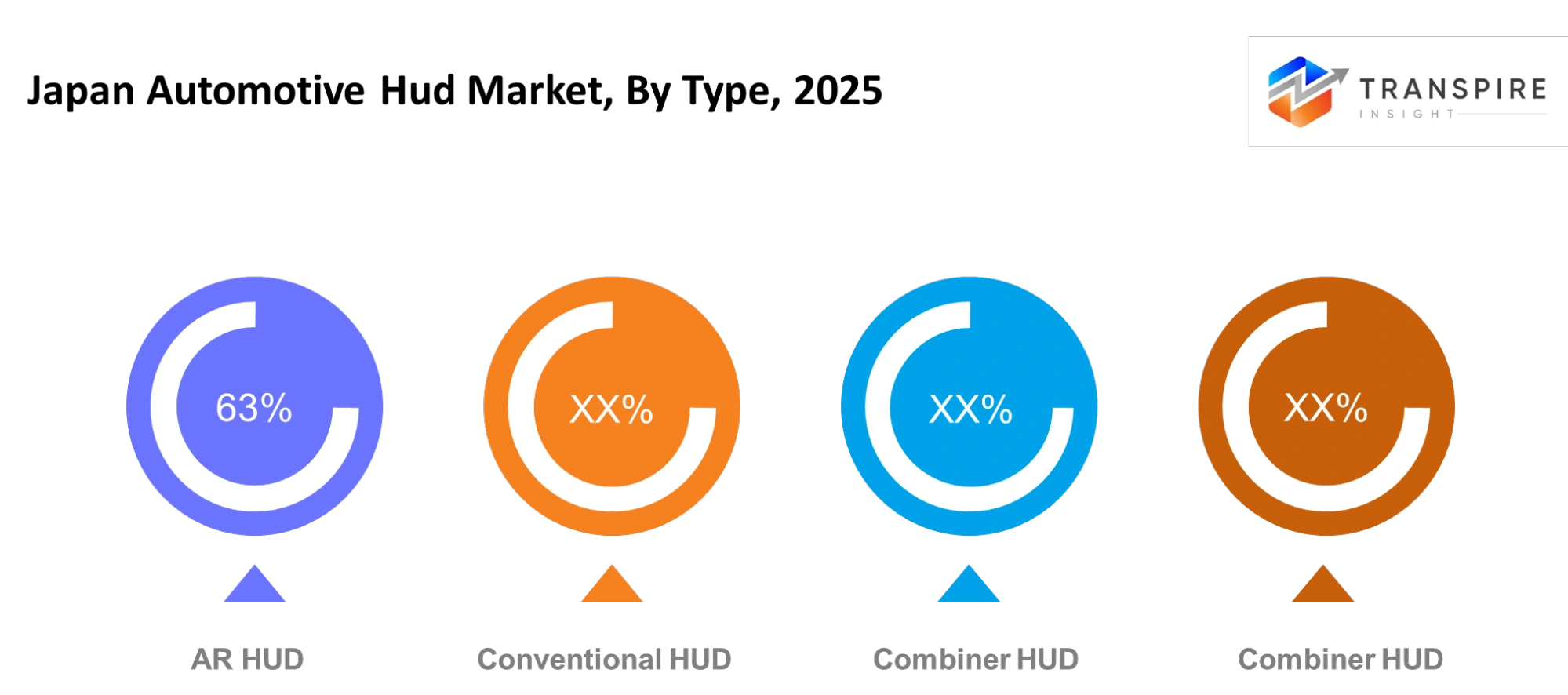
- AR HUD: The Augmented Reality HUD system projects real-time navigation data and hazard warning information and lane guidance details onto the windshield which drivers use to see the road. The system provides drivers with an interactive experience that uses augmented reality to improve their ability to assess their environment for safe driving.
- Combiner HUD: The driver can see vehicle information through Combiner HUDs which use special transparent screens to project data into his direct vision path. The system provides multiple installation choices which enable users to maintain clear sight while drivingand adapt to various automotive designs.
- Windshield HUD: Windshield HUDs project critical driving data directly onto the windshield glass, eliminating the need for additional screens. The product has become a preferred choice among premium vehicle markets and electric vehicle sectors because it offers seamless system integration and extensive visibility and advanced driver assistance system compatibility.
To learn more about this report, Download Free Sample Report
By Application
- Passenger Vehicles: The adoption of heads-up display technology in passenger vehicles is increasing because consumers want to access more secure and more convenient driving features. The systems provide essential driving details which help drivers maintain focus while they drive and experience greater comfort during city driving and extended travel distance situations.
- Commercial Vehicles: The three main advantages of heads-up display systems for commercial vehicles include enhanced route directions and continuous vehicle monitoring and driver warning systems which help reduce accidents while boosting work productivity especially in logistics and transportation and fleet management fields.
- EVs: Electric vehicles use heads-up displays to show battery information and driving range and power usage together with navigation data. Automakers are adopting augmented reality and windshield heads-up display systems as essential components of their advanced digital cockpit designs for electric vehicles.
- Luxury Cars: Luxury car manufacturers use sophisticated heads-up display technology to create unique products which combine augmented reality and three-dimensional visual displays and ultra-high-definition images to deliver exceptional driving experiences. The heads-up display systems improve security measures while creating a better brand image for the company.
By End-User
- OEMs: The main forces behind HUD system adoption include Original Equipment Manufacturers which integrate HUD technology into their new vehicle models while developing special features and safety improvements and complete ADAS and infotainment system connections.
- Automotive Firms: Automotive firms adopt HUDs to enhance product portfolios and collaborate with tech providers, ensuring advanced cockpit features meet evolving consumer expectations and regulatory safety standards.
- Suppliers: HUD component suppliers create display modules and projectors and AR systems through their research, which aims to develop lightweight products that offer better resolution at lower costs for use in various vehicle models and brands.
- Consumers: People increasingly demand aftermarket HUD systems because they want to install the technology which provides safety features and convenience functions and creates a high-end driving experience, especially in areas where people tend to use advanced technology and have extra money.
Country Insights
The Japanese automotive HUD market is experiencing continuous growth because of its robust domestic automotive production base and its adoption of advanced technologies and its consumer demand for safety-focused digital cockpit systems. Major automotive manufacturers, including Toyota Honda and Nissan are progressively incorporating augmented reality technology together with windshield head-up displays in their mid-range premium and electric vehicle products to improve driver satisfaction and market position.
Japan supports HUD implementation through its vehicle safety legislation and its development of smart transportation systems and its advancement of connected vehicle technology. The market is witnessing substantial research and development expenditure on augmented reality systems and micro-display technology and projection display systems. The growing demand for high-end electric vehicles together with existing facilities that support connected and autonomous vehicle operations is creating business prospects for both original equipment manufacturers and aftermarket service providers.
Recent Development News
The global automotive heads-up display market is experiencing rapid expansion because of digital cockpit advancements and enhanced safety features which will push both market value and unit sales to grow until the early 2030s.
Nippon Seiki Co Ltd, a major HUD and instrument‑cluster supplier in Japan, recently saw its stock face pressure amid a broader auto‑sector slowdown and softening demand for display components — a signal of short‑term volatility in Japanese auto supply chains.
|
Report Metrics |
Details |
|
Market size value in 2025 |
USD 66.9 Million |
|
Market size value in 2026 |
USD 79.08 Million |
|
Revenue forecast in 2033 |
USD 254.87 Million |
|
Growth rate |
CAGR of 18.20% from 2026 to 2033 |
|
Base year |
2025 |
|
Historical data |
2021 – 2024 |
|
Forecast period |
2026 – 2033 |
|
Report coverage |
Revenue forecast, competitive landscape, growth factors, and trends |
|
Country scope |
Japan |
|
Key company profiled |
Continental, Denso, Bosch, Visteon, Panasonic Automotive, Nippon Seiki, Yazaki, Valeo, Garmin, Pioneer, LG Electronics, Samsung, Harman, Mitsubishi Electric, Alpine |
|
Customization scope |
Free report customization (country, regional & segment scope). Avail customized purchase options to meet your exact research needs. |
|
Report Segmentation |
By Type (Conventional HUD, AR HUD, Combiner HUD, Windshield HUD), By Application (Passenger Vehicles, Commercial Vehicles, EVs, Luxury Cars), By End-User (OEMs, Automotive Firms, Suppliers, Consumers) |
Key Japan Automotive Hud Market Company Insights
The automotive HUD market depends on Japanese domestic companies together with international suppliers who develop advanced display systems. DENSO and Nippon Seiki stand out as Japanese innovators: DENSO, originally spun off from Toyota, leverages deep OEM relationships and broad mobility electronics expertise to supply high‑reliability HUD solutions worldwide, often tailored for mainstream and premium OEM applications. Nippon Seiki operates as one of the leading HUD and instrumentation companies because it delivers optical accuracy through its collaborations with major automotive manufacturers to implement windshield and AR‑enhanced HUD systems in passenger and premium and EV markets. Panasonic Automotive creates HUD systems linked to ADAS while developing digital cockpit solutions that improve both vehicle safety and user interaction through its extensive research and development and electronics system integration expertise.
Continental and Robert Bosch operate as international suppliers who provide Tier-1 experience in standard and AR HUD solutions through their presence in Japan and other countries while they develop HUD systems that work with safety features and ADAS systems across multiple vehicle types. Visteon Corporation combines cockpit electronics expertise with next‑gen HUD development, including partnerships for panoramic and AR systems aimed at future mobility platforms. Yazaki uses its main wiring and integration capabilities to provide fast HUD data transmission for the digital cockpit while Valeo provides a complete range of HUD products which include windshield and combiner and AR options that enhance safety and comfort in passenger vehicles. The companies work together to create new technologies which lead to standard products that become popular in the market for HUD systems used in both luxury and electric and mass-market products.
Company List
- Continental
- Denso
- Bosch
- Visteon
- Panasonic Automotive
- Nippon Seiki
- Yazaki
- Valeo
- Garmin
- Pioneer
- LG Electronics
- Samsung
- Harman
- Mitsubishi Electric
- Alpine
Japan Automotive Hud Market Report Segmentation
By Type
- Conventional HUD
- AR HUD
- Combiner HUD
- Windshield HUD
By Application
- Passenger Vehicles
- Commercial Vehicles
- EVs
- Luxury Cars
By End-User
- OEMs
- Automotive Firms
- Suppliers
- Consumers
Frequently Asked Questions
Find quick answers to common questions.
The approximate Japan Automotive Hud Market size for the market will be USD 254.87 Million in 2033.
Key segments for the Japan Automotive Hud Market are By Type (Conventional HUD, AR HUD, Combiner HUD, Windshield HUD), By Application (Passenger Vehicles, Commercial Vehicles, EVs, Luxury Cars), By End-User (OEMs, Automotive Firms, Suppliers, Consumers),
Major Japan Automotive Hud Market players are Continental, Denso, Bosch, Visteon, Panasonic Automotive, Nippon Seiki, Yazaki, Valeo, Garmin, Pioneer, LG Electronics, Samsung, Harman, Mitsubishi Electric, Alpine.
The Japan Automotive Hud Market size is USD 66.9 Million in 2025.
The Japan Automotive Hud Market CAGR is 18.20%.
- Continental
- Denso
- Bosch
- Visteon
- Panasonic Automotive
- Nippon Seiki
- Yazaki
- Valeo
- Garmin
- Pioneer
- LG Electronics
- Samsung
- Harman
- Mitsubishi Electric
- Alpine
Recently Published Reports
-
Apr 2026
ATV & UTV Market
ATV & UTV Market Size, Share & Analysis Report By Type (ATV, and UTV), By Variants (Less Than 400 CC, 400 CC To 800 CC, and More Than 800 CC), and Geography (North America, Europe, Asia-Pacific, Middle East and Africa, South and Central America), 2021 - 2031
-
Apr 2026
Automotive Central Gateway Module Market
Automotive Central Gateway Module Market Size, Share & Analysis Report By Type (Ethernet Central Gateway Module, CAN Central Gateway Module, LIN Central Gateway Module, and FlexRay), By Application (Powertrain Control, Body Control, Infotainment System, Advanced Driver Assistance Systems (ADAS), and Others), By End User (Passenger Vehicles, and Commercial Vehicles), and Geography (North America, Europe, Asia-Pacific, Middle East and Africa, South and Central America), 2021 - 2031
-
Apr 2026
Automotive Engine Oil Filter Market
Automotive Engine Oil Filter Market Size, Share & Analysis Report By Filter Type (Fuel Filter, Engine Oil Filter, Hydraulic Oil Filter, and Others), By Filter Media (Cellulose, Synthetic, and Micro), By Sales Channel (OEMs, and Aftermarket), By Vehicle Type (Passenger Cars, Light Commercial Vehicles, Heavy Duty Trucks, Buses and Coaches, and Off-road Vehicles), and Geography (North America, Europe, Asia-Pacific, Middle East and Africa, South and Central America), 2021 - 2031
-
Apr 2026
Automotive Parts Aluminium Die Casting Market
Automotive Parts Aluminium Die Casting Market Size, Share & Analysis Report By Production Process (Pressure Die Casting, Vacuum Die Casting, Squeeze Die Casting, Gravity Die Casting), By Application (Body Parts, Engine Parts, Transmission Parts, Battery And Related Components, Other Application Types), and Geography (North America, Europe, Asia-Pacific, Middle East and Africa, South and Central America), 2021 - 2031
Our Clients