

Japan AI In Microscopy Market Size & Forecast:
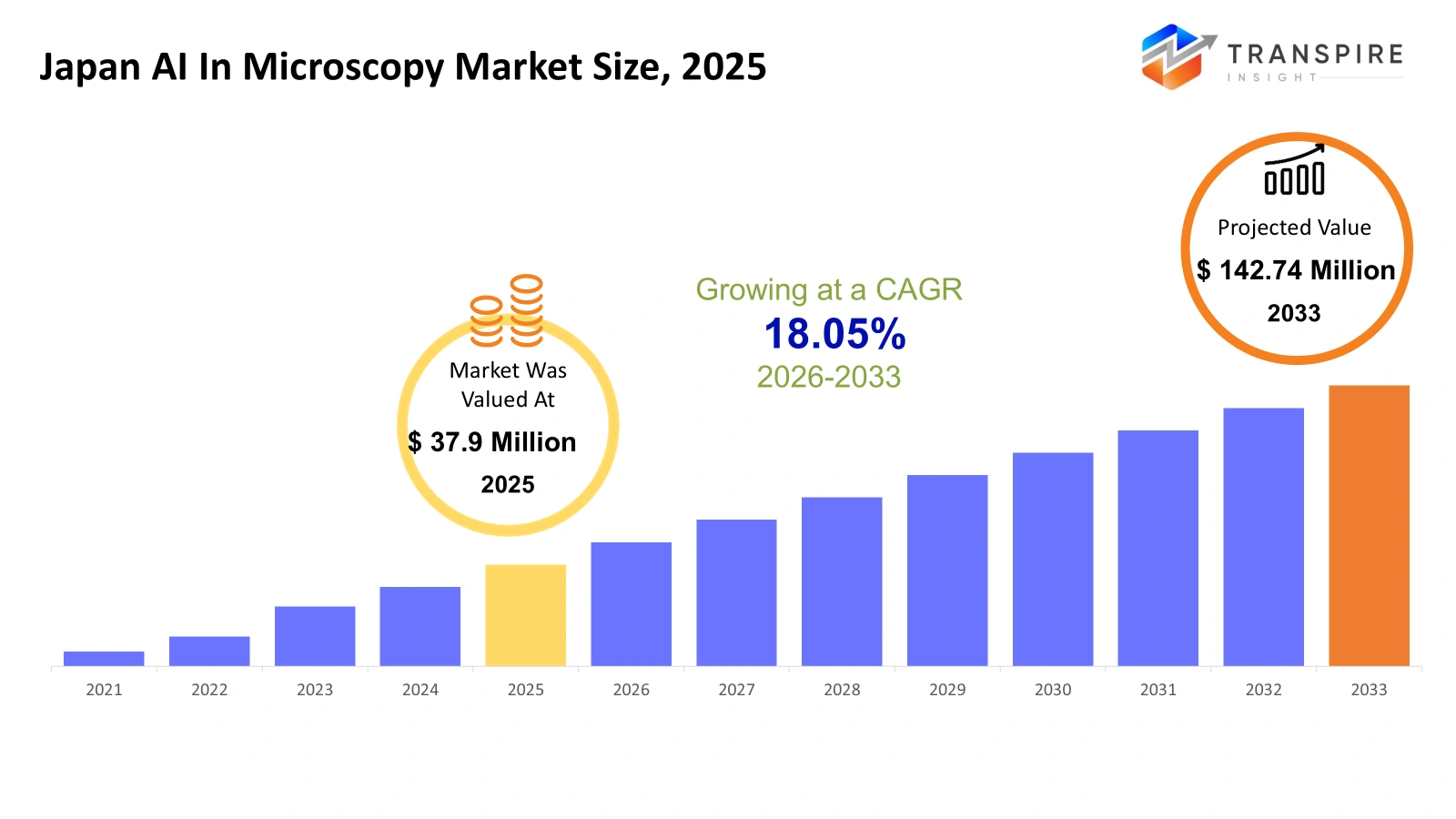
- Japan AI In Microscopy Market Size 2025: USD 37.9 Million
- Japan AI In Microscopy Market Size 2033: USD 142.74 Million
- Japan AI In Microscopy Market CAGR: 18.05%
- Japan AI In Microscopy Market Segments:By Component (Hardware, Software, Services), By Application (Life Sciences Research, Material Science, Nanotechnology), By End User (Research Institutes, Pharmaceutical Companies, Hospitals).
To learn more about this report,  Download Free Sample Report
Japan AI In Microscopy Market Summary:
The Japan AI In Microscopy Market size is estimated at USD 37.9 Million in 2025 and is anticipated to reach USD 142.74 Million by 2033, growing at a CAGR of 18.05% from 2026 to 2033. Japan's AI in the microscopy market now develops through its combination of modern imaging technologies and automated data assessment systems, which enable scientific research and medical diagnostics work. The scientists use automated systems to obtain immediate data while delivering accurate imaging results which reveal previously hidden details. The dual support from academic institutions and industrial partners enables scientific progress through life sciences and materials research investigations. The need for rapid results together with precise outcomes has made AI-powered microscopy a vital scientific tool which will determine Japan's research future.
Key Market Trends & Insights:
- Rising adoption of AI-powered imaging demonstrates the need for AI-based imaging systems. Researchers across Japan use AI technology to improve microscopy capabilities, which help them achieve better imaging results and faster analysis. The new approach enables laboratories to handle complicated data sets with improved processing capabilities and stable output.
- The life sciences sector and healthcare industry show increasing demand for AI-enabled microscopy. AI-enabled microscopy technology helps researchers study diseases, discover new drugs, and develop diagnostic tests. Scientists use this technology to find cellular changes which standard techniques cannot observe.
- Laboratories are moving toward automated microscopy systems that reduce manual intervention. The process accomplishes two objectives because it accelerates work progress while it decreases mistakes that people make during standard imaging work.
- The development of deep learning algorithms has reached its current stage because of research into new AI technologies that deliver improved pattern detection and image recognition capabilities. The latest technology advancement for microscopy instruments creates more intelligent and dependable systems.
- Academic institutions and business organisations in Japan maintain strong partnerships to create new microscope technologies. The partnership between these two groups enables faster scientific discovery and product development.
- Research in materials science has expanded its usage of AI microscopy technology beyond medical applications. AI microscopy technology helps researchers study semiconductor defects and nanotechnology to enhance product development.
- Researchers can now use cloud-based solutions because these technologies enable them to store microscopy data, share it with others and analyse it from different locations. The current trend improves both team member cooperation and organisational capacity to expand.
Japan AI In Microscopy Market Segmentation
By Component
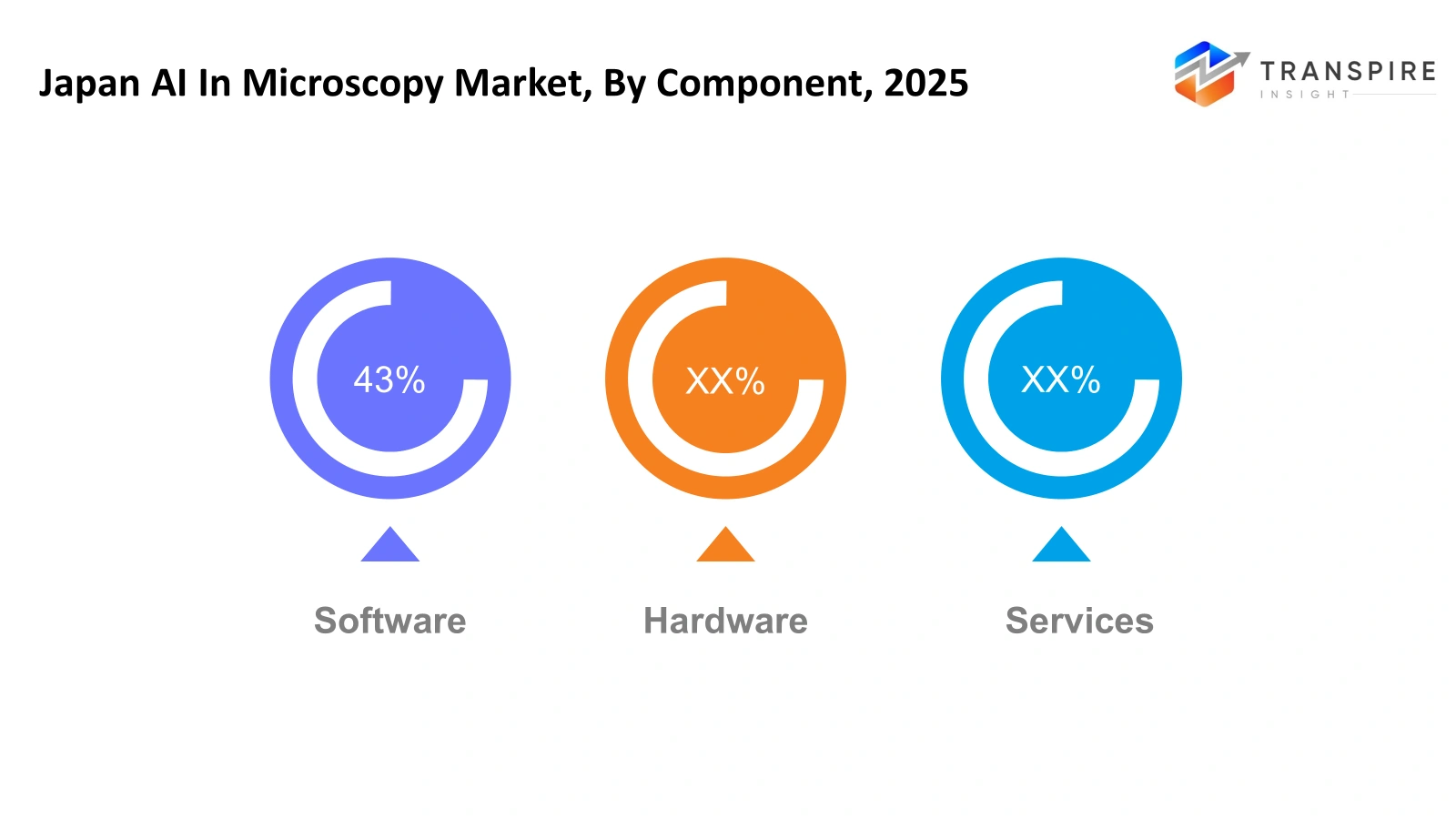
- Hardware: The fundamental component of AI microscopy systems is their advanced microscopes and sensor technologies and imaging equipment. Japanese researchers and industrial facilities require high-resolution automated instruments which function as complete AI tools to achieve faster data acquisition and better accuracy and stable imaging results.
- Software: The software functions as a vital component which enables image processing and pattern recognition together with data analysis capabilities through the implementation of AI algorithms. Japanese companies are developing user-friendly platforms which deliver real-time data to assist researchers in their image analysis process while making scientific and clinical decisions.
- Services: The services provide system integration services and maintenance work and training programmes together with consulting work, which has become essential for businesses. Japanese organisations depend on expert assistance to implement AI microscopy systems because it guarantees operational efficiency and performance enhancement through ongoing technological updates.
To learn more about this report, Download Free Sample Report
By Application
- Life Sciences Research: The research field of life sciences relies on artificial intelligence technology to utilise microscopy for performing in-depth studies of cellular and molecular structures. Researchers in Japan use this technology to expedite their work in cancer research, genetics and drug development because it provides better image processing capabilities and more precise biological pattern recognition systems.
- Material Science: AI-powered microscopy systems in material science enable scientists to conduct microscopic-level structural research with accurate results. The Japanese manufacturing and semiconductor industries gain advantages from these technologies because they help identify faults and enhance material standards and enable breakthroughs in new materials and production methods.
- Nanotechnology: Nanotechnology needs accurate imaging methods, which AI technology enhances through its advanced imaging capabilities. Japanese researchers use AI microscopy to investigate nanoscale structures, which helps them develop better manufacturing processes for electronics and healthcare and energy systems.
By End User
- Research Institutes: The research institutes in Japan serve as primary users of AI microscopy, which they utilise to advance scientific research. Research institutions gain advantages through automated analysis and high-throughput imaging, which enables researchers to spend more time on innovation while they manage extensive, complex data sets.
- Pharmaceutical Companies: Pharmaceutical companies in Japan use AI microscopy to enhance their drug discovery and development processes. The technology enables cellular response analysis, which results in better testing accuracy and faster product launch times while reducing research expenses and improving operational efficiency.
- Hospitals: Hospitals use AI microscopy as a diagnostic tool, which has become more popular within their facilities. The technology provides pathologists in Japan with superior imaging capabilities and expedited analysis processes, which enhance their ability to make accurate disease diagnoses and deliver effective patient treatment, especially for early disease detection.
Country Insights
The market for AI in microscopy research in Japan demonstrates the country's expertise in precision technology and scientific research. Japan has established itself as a leader in imaging and optics through its long history of innovation, which now enables the country to use artificial intelligence for microscopy operations. Academic institutions and research centers and businesses are developing AI solutions which improve their ability to analyse data and deliver results at a faster pace.
The country requires intelligent microscopy systems because of its commitment to advancing life sciences and healthcare and high-tech manufacturing capabilities. AI enables researchers in pharmaceuticals and materials science to obtain research discoveries and develop better products at a faster pace. The government supports technology development through its funding programmes, which make these technologies more accessible.
The rising demand for diagnostic instruments in Japan results from its aging population, which requires advanced technology for medical assessments that AI-based microscopy systems provide. The market develops through the combination of technological expertise with research partnerships and the increasing requirement for precise healthcare solutions.
Recent Development News
AI-Powered Microscope Launch Enhances Research Efficiency in Japan: Japan saw the launch of a next-generation AI-assisted microscope system that simplifies imaging workflows and improves user experience. It enables faster, high-quality image capture for researchers.
Epistra and Evident Collaborate on Smart Microscopy Solutions: A major collaboration introduced AI-driven software that automates microscope operations, reducing manual effort and improving accuracy in life science research.
|
Report Metrics |
Details |
|
Market size value in 2025 |
USD 37.9 Million |
|
Market size value in 2026 |
USD 44.69 Million |
|
Revenue forecast in 2033 |
USD 142.74 Million |
|
Growth rate |
CAGR of 18.05% from 2026 to 2033 |
|
Base year |
2025 |
|
Historical data |
2021 – 2024 |
|
Forecast period |
2026 – 2033 |
|
Report coverage |
Revenue forecast, competitive landscape, growth factors, and trends |
|
Country scope |
Japan |
|
Key company profiled |
Carl Zeiss AG, Olympus Corporation, Nikon Corporation, Leica Microsystems, Thermo Fisher Scientific Inc., Hitachi High-Tech Corporation, JEOL Ltd., Bruker Corporation, Keyence Corporation, Oxford Instruments PLC, TESCAN Group, Gatan Inc., Nanolive SA, Digital Surf, Danaher Corporation. |
|
Customization scope |
Free report customization (country, regional & segment scope). Avail customized purchase options to meet your exact research needs. |
|
Report Segmentation |
By Component (Hardware, Software, Services), By Application (Life Sciences Research, Material Science, Nanotechnology), By End User (Research Institutes, Pharmaceutical Companies, Hospitals). |
Key Japan AI In Microscopy Company Insights
The Japan AI in microscopy market exists through established technology leaders and emerging innovators who work to improve imaging intelligence. Companies are investing in advanced software solutions and automation systems and deep learning technologies to achieve faster analytical results with improved accuracy. Many firms are also prioritising user-friendly platforms that simplify complex data interpretation for researchers and clinicians. The companies maintain their market position through strategic partnerships and ongoing research and development activities and their dedication to producing high-quality products which meet the increasing demand for advanced microscopy technologies used in scientific research and medical applications.
Company List
- Carl Zeiss AG
- Olympus Corporation
- Nikon Corporation
- Leica Microsystems
- Thermo Fisher Scientific Inc.
- Hitachi High-Tech Corporation
- JEOL Ltd.
- Bruker Corporation
- Keyence Corporation
- Oxford Instruments PLC
- TESCAN Group
- Gatan Inc.
- Nanolive SA
- Digital Surf
- Danaher Corporation
Japan AI In Microscopy Market Report Segmentation
By Component
- Hardware
- Software
- Services
By Application
- Life Sciences Research
- Material Science
- Nanotechnology
By End User
- Research Institutes
- Pharmaceutical Companies
- Hospitals
Frequently Asked Questions
Find quick answers to common questions.
The Approximate Japan AI In Microscopy Market size for the Market will be USD 142.74 Million in 2033.
The key segments of the Japan AI In Microscopy Market are By Component (Hardware, Software, Services), By Application (Life Sciences Research, Material Science, Nanotechnology), By End User (Research Institutes, Pharmaceutical Companies, Hospitals).
Major Players in the Japan AI In Microscopy Market are Carl Zeiss AG, Olympus Corporation, Nikon Corporation, Leica Microsystems, Thermo Fisher Scientific Inc., Hitachi High-Tech Corporation, JEOL Ltd., Bruker Corporation, Keyence Corporation, Oxford Instruments PLC, TESCAN Group, Gatan Inc., Nanolive SA, Digital Surf, Danaher Corporation.
The Current Market size of the Japan AI In Microscopy Market is USD 37.9 Million in 2025.
The Japan AI In Microscopy Market CAGR is 18.05%.
- Carl Zeiss AG
- Olympus Corporation
- Nikon Corporation
- Leica Microsystems
- Thermo Fisher Scientific Inc.
- Hitachi High-Tech Corporation
- JEOL Ltd.
- Bruker Corporation
- Keyence Corporation
- Oxford Instruments PLC
- TESCAN Group
- Gatan Inc.
- Nanolive SA
- Digital Surf
- Danaher Corporation
Recently Published Reports
-
Apr 2026
3D Optical Profiler Market
3D Optical Profiler Market Size, Share & Analysis Report By Type (Desktop 3D Optical Profiler, and Portable 3D Optical Profiler), By Technology (Confocal Technology, and White Light Interference), By End-Use Industry (Manufacturing, Research Institutions, Automotive, Aerospace and Defense, Medical Devices, and Other), and Geography (North America, Europe, Asia-Pacific, Middle East and Africa, South and Central America), 2021 - 2031
-
Apr 2026
Depth Sensor Market
Depth Sensor Market Size, Share & Analysis Report By Type (Infrared Depth Sensors, Time-of-Flight (ToF) Sensors, Stereo Vision Sensors, Structured Light Sensors, Ultrasonic Depth Sensors), By Application (Automotive, Robotics, Gaming, Consumer Electronics, Industrial Automation, Healthcare, Security & Surveillance, Others), By End Users (Automotive Manufacturers, Consumer Electronics Companies, Healthcare Providers, Industrial Companies, Security Agencies, Gaming Companies, Robotics Companies, Others), and Geography (North America, Europe, Asia-Pacific, Middle East and Africa, South and Central America), 2021 – 2031
-
Apr 2026
Digital Manufacturing Market
Digital Manufacturing Market Size, Share & Analysis Report By Component (Hardware, Software, and Services), By Technology (Robotics, 3D Printing, Internet of Things (IoT), and Others), By Application (Automotive and Transportation, Aerospace and Defense, Consumer Electronics, Industrial Machinery, and Others), By Process Type (Computer-Based Designing, Computer-Based Simulation, Computer 3D Visualization, Analytics, and Others), and Geography (North America, Europe, Asia-Pacific, Middle East and Africa, South and Central America), 2021 – 2031
-
Apr 2026
Digital Visa Services Market
Digital Visa Services Market Size, Share & Analysis Report By Type (Individual Travelers, Group Travelers), By Application (Tourism, Business Travel, Others), and Geography (North America, Europe, Asia-Pacific, Middle East and Africa, South and Central America), 2021 – 2031