

Japan Acrylic Resin Market Summary
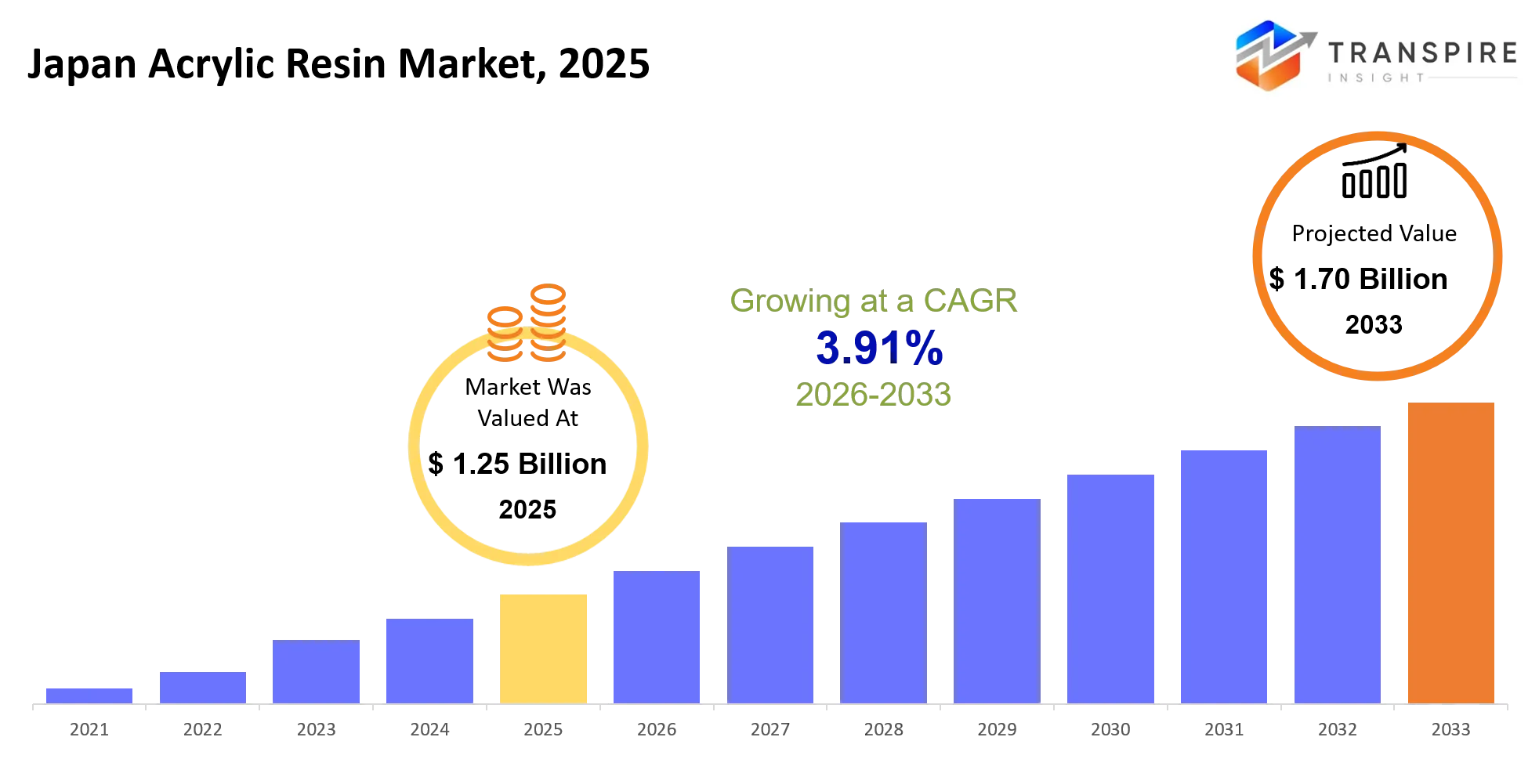
As per Transpire Insight Analysis theJapan Acrylic Resin Market size is estimated at USD 1.25 Billion in 2025 and is anticipated to reach USD 1.70 Billion by 2033, growing at a CAGR of 3.91% from 2026 to 2033.
In Japan, the Acrylic Resin Market kind of quietly plays a big part in getting durable, weather resistant and high performance materials to industries that actually need them, like coatings, adhesives, construction items, automotive parts, electronics, and also packaging. With these resins, products seem to last longer, the surface protection gets better , and it becomes easier to do lighter weight manufacturing, so yeah they’re sort of essential across Japan’s advanced industrial setup.
Over the last five years things have been shifting. More companies are moving toward water based and low VOC acrylic resin options , mostly because tougher environmental rules and carbon neutrality promises forced product development to change direction. After the COVID-19 pandemic there were supply chain hiccups too, and when petrochemical feedstock prices were all over the place, manufacturers leaned harder into localization and they invested more in production efficiency, not just the usual expansions.
To cope, many producers expanded their specialty resin portfolios, focusing on improved durability and recyclability, rather than only going for the commodity grade style. And as automotive electrification moves forward, semiconductor manufacturing keeps increasing, and infrastructure renovation projects gain momentum, premium acrylic resin use keeps climbing. That also helps suppliers capture more value, because they can build specialized formulations, instead of selling mostly standard materials.
Japan Acrylic Resin Market Size & Forecast:
- Japan Acrylic Resin Market Size 2025: USD 1.25 Billion
- Expected Market Value 2033: USD 1.70 Billion
- Forecast CAGR: 3.91%
- Leading region in 2025:
- Fastest Growing region:
- Key Profile: Mitsubishi Chemical Group, Arkema, BASF, Dow, LG Chem, Sumitomo Chemical, Nippon Shokubai, Evonik Industries, Covestro, Röhm GmbH, Kuraray, Mitsubishi Gas Chemical, Asahi Kasei, DIC Corporation, Toray Industries
Key Market Insights
- Japan Acrylic Resin Market, regional side of it, basically Kanto is taking the lead in 2025 with an estimated 38–40% market share, and it looks like the automotive, electronics, and chemical manufacturing hubs are doing most of the heavy lifting here.
- Meanwhile Kansai, is expected to grow the quickest through 2033, mainly because specialty chemicals, advanced coatings, and battery manufacturing investments are all stacking up in that area, a kind of steady momentum thing.
- If you zoom into segments, water-based acrylic resins are holding about 46% of the market in 2025, and a lot of that is pinned on tougher VOC regulations plus industrial coating uses, pretty common drivers.
- Solvent-based acrylic resins stay in the second slot, they’re largely used for automotive refinishing, heavy-duty protective coatings, and a variety of specialty industrial applications.
- UV-curable acrylic resins are projected to be the fastest grower through 2033, and the reason usually mentioned is electronics demand, printing needs, plus high-speed manufacturing setups.
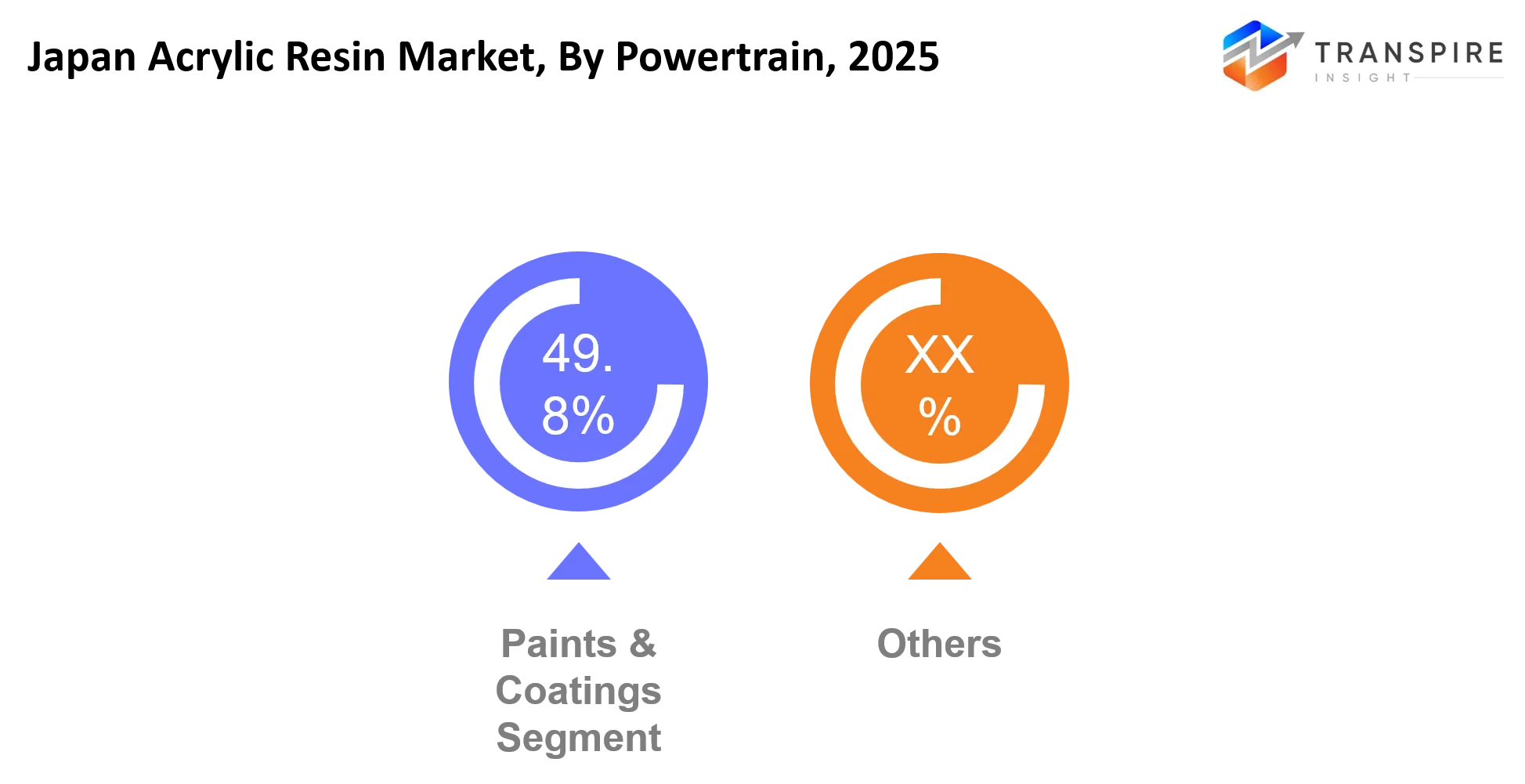
- For applications, paints and coatings make up nearly 52% of market revenue, which ties back to infrastructure maintenance and ongoing automotive production.
- Electronics adhesives, along with specialty encapsulation materials, are the ones seeing the fastest growth, and that’s mostly supported by semiconductor investments and more advanced electronic devices coming out.
- From an end-user perspective, automotive is still the top end-user, around 30% market share, while electronics manufacturing shows the quickest expansion across the forecast period, you can really see the shift there.
- On competition, Mitsubishi Chemical Group, Arkema, BASF, Dow, Sumitomo Chemical, and Röhm GmbH keep working on competitiveness via low-carbon resin technologies, bio-based materials, and capacity optimization, so the field stays pretty active.
- More companies are also moving toward digital manufacturing and collaborative R&D, plus they’re using recycled feedstocks, and launching specialty product lines, all to keep a stronger long-term stance in the Japan Acrylic Resin Market.
What are the Key Drivers, Restraints, and Opportunities in theJapan Acrylic Resin Market?
The most powerful growth driver is Japan moving toward low-emission industrial manufacturing, backed up by tighter volatile organic compound rules and corporate carbon neutrality promises that kind of stack on each other. In practice, automotive manufacturers , electronics makers, and infrastructure developers are specifying water-based along with high-performance acrylic systems more and more, so they meet environmental expectations without really sacrificing durability. That change has pushed resin producers to put on the market premium formulations with better weather resistance, improved bonding strength, and stronger chemical stability. When they sell these higher-value specialty products rather than typical commodity resins, the profit margins look steadier, and the revenue expansion keeps going.
Still, the biggest structural headache is the industry’s reliance on petrochemical feedstocks, like acrylic acid and other related monomers, where prices keep swinging with global crude oil movements and whatever supply chain conditions happen to be around. Setting up alternative feedstock capacity is not a quick thing, it takes major capital spending plus years of process qualification. These kinds of cost pressures can squeeze profitability, slow down purchasing decisions, and make broader adoption harder for price-sensitive manufacturers, especially when raw materials are getting more expensive.
At the same time, there’s a real opening in advanced acrylic resins for electric vehicles, semiconductor production, renewable energy equipment, and more sustainable construction materials. Japan’s battery production ecosystem is expanding, and semiconductor investment is increasing, so the demand for specialized coatings, encapsulation materials, and high-performance adhesives grows alongside it.
What Has the Impact of Artificial Intelligence Been on theJapan Acrylic Resin Market?
Artificial intelligence and more advanced digital manufacturing methods are kind of reshaping how acrylic resin gets made, mostly by pushing operational efficiency product steadiness, and also tighter predictive quality checks. In practice, many producers start using AI driven process analytics to keep an eye on polymerization temperature, reaction kinetics, viscosity trends, and catalyst behavior, all kind of in real time. Then machine learning models sift through the incoming plant data and try to foresee equipment issues before they actually stop the line, so that unplanned downtime gets cut down and plant utilization gets better. Digital twins even let manufacturers “try out” process tweaks inside a simulation first, before anyone touches the actual production, which helps shorten the whole product development timeline while reducing raw material waste.
Also, AI demand forecasting supports producers in picking inventory amounts and procurement moves more carefully, especially when feedstock prices swing around. Computer vision systems then do automatic inspection of resin quality, plus packaging integrity too, so manual checking takes less time while inspection accuracy tends to improve. Altogether these tools can mean lower manufacturing costs, better production yields, quicker order dispatch, and more dependable regulatory compliance, in a way that’s pretty measurable.
Still, even with all that, AI rollouts don’t happen overnight. The main constraints tend to be the expensive setup, and the fact that integrating new analytics platforms with legacy manufacturing equipment is complicated, because many established facilities are already running older systems. On top of that, older plants often lack standardized process data, so prediction quality during the early deployment stage can be weaker, which can slow the pace of digital transformation for some manufacturers, a bit longer than they would like.
Key Market Trends
- Water based acrylic formulations slowly sort of pushed out solvent based alternatives, after the tighter VOC regulations hit and kinda influenced industrial coating specs starting in 2021, across multiple plants.
- Automotive electrification then made the need for specialty acrylic adhesives, coatings, and battery compatible materials rise faster between 2022 and 2026, not just in one region.
- On the semiconductor side , manufacturing investments drove higher use of ultra pure acrylics aimed at electronic encapsulation, plus protective uses that demand strong consistency.
- To match Japan carbon neutrality targets for 2050, manufacturers broadened recycled acrylic resin and bio based development.
- At the same time , digital manufacturing platforms with AI process optimization improved output efficiency and trimmed material waste, even for some leading chemical companies.
- Supply chain disruptions after COVID-19 pushed firms toward more regional sourcing approaches and they also increased investment in domestic specialty chemical production capacity, rather noticeably.
- Mitsubishi Chemical Group, BASF, Arkema, and Dow raised funding for premium resin technologies, which helped them build stronger differentiation in the market.
- UV curable acrylic systems got wider industrial traction because they reduce curing time, and also lower manufacturing energy consumption , compared with older systems.
- Infrastructure modernization meanwhile boosted demand for weather resistant protective coatings, with more durability for public infrastructure and commercial assets.
- Finally, strategic partnerships between resin manufacturers and players in automotive, electronics, and coatings accelerated the commercialization of next generation high performance acrylic materials.
Japan Acrylic Resin Market Segmentation
By Resin Type
Thermoplastic acrylic resin still has a big role, because when it gets heated it can be reshaped, so flexible manufacturing becomes easier across automotive, packaging, and consumer items. Thermosetting acrylic resin meanwhile comes through with stronger heat resistance and better mechanical strength, so in practice its use makes sense for durable industrial coatings, and for electrical components as well, material selection gets tailored to those needs. Water-based acrylic resin keeps growing too, mainly because tighter environmental standards push low-VOC coating systems, for industrial jobs and architectural finishes. Solvent-based acrylic resin also stays steady in demand, when high durability, quick drying, and strong adhesion are all non negotiable for certain coating needs.
The others section is basically for specialty acrylic blends made for niche process steps, and also for advanced composites, or customized performance demands. There is an emphasis on new material development aimed at improved weather resistance, chemical stability, and even surface look across multiple manufacturing areas. Investment in production keeps moving forward, usually to boost processing efficiency while still backing more sustainable product development, and that part matters. Product differentiation will keep being a key topic as manufacturers roll out acrylic resin technologies meant for specific applications.
By Application
Paints and coatings are basically the biggest use case, because long-lasting surface protection , good weathering, and decorative appearances still matter a lot for most industrial and commercial jobs. Adhesives and sealants help keep dependable joining results in automotive assembly, electronics work , and construction tasks. Plastics get an advantage from better durability, clearer visibility, and stronger impact resistance, while textile uses can enhance fabric finishing,textiles plus more practical functional performance. Construction materials also lean on acrylic resin to strengthen protective coatings, waterproofing products, and exterior finishes even when environmental conditions keep shifting.
Automotive manufacturing keeps consuming advanced acrylic materials for vehicle coatings, interior parts, and lighter component production . The others segment covers printing inks, paper coatings, specialty chemicals, and several industrial processing applications too. Ongoing product development pushes broader performance characteristics for tough operating environments. Industrial customers will keep adopting advanced formulations that blend durability with efficient manufacturing performance .
By End User
Building and construction remains the leading end user, mostly because protective coatings, flooring materials, sealants , and architectural finishes need solid, reliable long term performance. Automotive manufacturing leans on acrylic materials for coatings, adhesives and even lightweight components that help durability and appearance. Packaging manufacturers rely on acrylic resin for protective films , labels and specialty coatings that keep product quality steady during distribution. Electronics production also benefits from acrylic based insulation materials, display components, plus protective coatings that back dependable device performance.
In the consumer goods space, acrylic materials get applied across furniture, appliances, household items, and decorative pieces, to stretch product life and keep the visual quality looking right. The others category covers healthcare, industrial equipment, aerospace, and specialty manufacturing needs. Continued investment in advanced manufacturing technologies still supports the development of more specialized material types. Industrial diversification will open additional pathways across several high value production sectors.
By Form
Liquid acrylic resin basically wins in commercial use because it’s easy to apply, gives fairly uniform coating results, and also supports fast, efficient processing across a whole bunch of industrial manufacturing operations. Powder formulations they offer strong shelf stability and help with environmentally friendlier coating approaches, typically with less solvent usage overall . Pellet forms on the other hand make shipping simpler, make automated feeding smoother, and assist large scale polymer processing inside plastic manufacturing facilities. Picking the right material really comes down to the way production is run, what the coating needs to do, and the finished product’s exact specifications across different industries.
The others category covers specialty forms that are made for tailored manufacturing steps and even research oriented work. Manufacturers keep tweaking product consistency too, so it better matches advanced processing technologies, while also pushing higher production efficiency. Improved handling qualities can also lower operational complexity during manufacturing. With ongoing material innovation , the whole thing should widen application flexibility across new and emerging industrial sectors.
By Distribution Channel
Direct sales end up taking a substantial share because bigger industrial buyers tend to want those long-run supply contracts, plus technical consultation, and a more tailored product support directly from the manufacturers themselves. In the meantime, distributors help widen product access across regional markets, while also handling inventory management and pushing out faster deliveries for small and medium-sized manufacturers. And online procurement keeps getting more accepted , since digital buying platforms make it easier to compare options, place orders, and manage the supply chain flow. Overall purchasing flexibility helps firms make quicker sourcing decisions across several industrial sectors at once.
The others category covers specialized chemical suppliers, trading companies, and procurement channels that are tied to specific projects, sort of for niche industrial requirements. Meanwhile, digital transformation keeps lifting procurement transparency and helps with more accurate inventory planning. Supply chain optimization, in turn, supports steady product availability even when raw material supply starts to fluctuate. Distribution networks will keep changing, to match shifting purchasing preferences across industrial manufacturing.
What are the Key Use Cases Driving theJapan Acrylic Resin Market?
Protective industrial coatings are still sort of the biggest use case, mainly because long service life and strong corrosion resistance, plus weather protection, are pretty much needed everywhere in automotive manufacturing, commercial buildings and public infrastructure. Also the higher performance coating systems help lower how often maintenance is needed and boost the durability of the assets which then keeps material consumption pretty consistent.
Adhesive technologies for electronics assembly, and for lightweight automotive components, keep on growing too, especially as semiconductor production ramps up and electric vehicle manufacturing spreads across Japan. On the packaging side, manufacturers are leaning more toward advanced acrylic materials to enhance label performance, protective films, and overall product appearance, while not really messing with production efficiency.
New openings are showing up for acrylic materials used in battery systems, renewable energy equipment, and even in advanced semiconductor manufacturing. Specialty formulations aimed at high-performance optical components and next generation electronic devices should also drive extra commercial opportunities as advanced manufacturing investment continues through the forecast period.
|
Report Metrics |
Details |
|
Market size value in 2025 |
USD 1.25 Billion |
|
Market size value in 2026 |
USD 1.30 Billion |
|
Revenue forecast in 2033 |
USD 1.70 Billion |
|
Growth rate |
CAGR of 3.91% from 2026 to 2033 |
|
Base year |
2025 |
|
Historical data |
2021 - 2024 |
|
Forecast period |
2026 - 2033 |
|
Report coverage |
Revenue forecast, competitive landscape, growth factors, and trends |
|
Regional scope |
Japan |
|
Key company profiled |
Mitsubishi Chemical Group, Arkema, BASF, Dow, LG Chem, Sumitomo Chemical, Nippon Shokubai, Evonik Industries, Covestro, Röhm GmbH, Kuraray, Mitsubishi Gas Chemical, Asahi Kasei, DIC Corporation, Toray Industries |
|
Customization scope |
Free report customization (country, regional & segment scope). Avail customized purchase options to meet your exact research needs. |
|
Report Segmentation |
By Resin Type (Thermoplastic Acrylic Resin, Thermosetting Acrylic Resin, Water-Based Acrylic Resin, Solvent-Based Acrylic Resin, Others); By Application (Paints & Coatings, Adhesives & Sealants, Plastics, Textiles, Construction, Automotive, Others); By End User (Building & Construction, Automotive, Packaging, Electronics, Consumer Goods, Others); By Form (Liquid, Powder, Pellets, Others); By Distribution Channel (Direct Sales, Distributors, Online Procurement, Others) |
Which Regions are Driving theJapan Acrylic Resin Market Growth?
The Kanto region keeps the biggest part of the Japan acrylic resin market because it kind of gathers the nation strongest cluster of automotive, electronics, and chemical manufacturing. There’s also government support for more advanced manufacturing, along with strict environmental compliance, and it comes with well established industrial infrastructure, so companies keep putting money into high performance resin production . Big ports like Yokohama and Tokyo help with distribution inside Japan, and they also boost international exports, while at the same time letting raw material movement stay efficient . Plus, the whole thing is supported by this dense network of research centers, specialty chemical producers, and downstream manufacturers, it feels almost like a connected ecosystem that backs up product innovation and stable commercial demand.
Then you have Kansai , which acts as the second largest contributor, though it’s more due to a balanced industrial structure rather than pure production scale only . Osaka, Kobe, and Kyoto are home to specialty chemicals, pharmaceuticals, and advanced materials industries that quietly drive steady consumption of higher value acrylic resins. Long-term investment in industrial modernization, and process efficiency, gives continuous purchasing momentum even when the economy looks shaky. Collaboration between manufacturers and research institutions matters too, because it keeps pushing continuous development of specialty formulations for electronics, healthcare and industrial applications.
For Chubu, it’s expected to grow the quickest through 2033, mainly because automotive electrification, semiconductor investments, and advanced manufacturing projects are spreading across central Japan. More recently, investment in battery supply chains and next generation production facilities has lifted demand for specialty coatings, adhesives, and engineering materials that rely on advanced acrylic resin technologies.
Who are the Key Players in theJapan Acrylic Resin Market and How Do They Compete?
Competition is still moderately consolidated. The established chemical manufacturers keep competing by leaning on technology innovation, specialty product development, and long-term industrial partnerships, not just price. Since the technical requirements are high, and product qualification is strict, new entrants find it hard to get in. Plus there is continuous research investment, so the barrier stays pretty strong. In practice, market participants tend to focus on application specific formulations, better production efficiency, sustainability targets, and technical support, all of which helps them keep customer relationships strong across automotive, electronics, construction and industrial coating.
Mitsubishi Chemical Group highlights advanced functional materials and specialty acrylic technologies, especially those that fit automotive, electronics, and more sustainable industrial use cases. They keep investing in research, low-carbon manufacturing, and customized material solutions. That lets the company differentiate with product performance rather than chasing production volume. Arkema concentrates on water based acrylic technologies and specialty coatings. Their competitiveness is strengthened through sustainable material innovation, and partnerships that widen industrial applications over time. BASF works on high-performance acrylic raw materials. They also put weight on circular economy initiatives, so customers can comply with tighter environmental standards while still maintaining coating durability.
Nippon Shokubai builds its edge through acrylic acid and specialty monomer expertise. This supports reliable upstream integration and steady product quality. DIC Corporation, meanwhile differentiates through customized coating resins, printing technologies, and close collaboration with downstream manufacturers, to speed up commercial product development. These companies keep expanding through cap
Company List
- Mitsubishi Chemical Group
• Arkema
• BASF
• Dow
• LG Chem
• Sumitomo Chemical
• Nippon Shokubai
• Evonik Industries
• Covestro
• Röhm GmbH
• Kuraray
• Mitsubishi Gas Chemical
• Asahi Kasei
• DIC Corporation
• Toray Industries
Recent Development News
In February 2026, BASF announced the expansion of its dispersions production capacity at the Mangalore site in India. The investment strengthens regional supply of high-performance dispersions used in architectural coatings, construction chemicals, and related acrylic resin applications.
What Strategic Insights Define the Future of theJapan Acrylic Resin Market?
The Japan acrylic resin market is slowly moving toward higher-value specialty materials that are made for electric vehicles, semiconductor manufacturing, advanced electronics, and even sustainable building, not so much the volume-driven commodity kind of production. This overall shift seems backed by industrial modernization, stricter environmental rules and also a broader need for application specific material behavior.
There is also a quieter risk, kind of a less obvious one, tied to the fact that production still depends a lot on petrochemical feedstocks, so if raw material prices stay jumpy for a long time, it could cut into investment returns and squeeze manufacturing margins even if end users demand stays steady. On the brighter side, an emerging opening is bio based acrylic technology together with recycled raw material integration, especially as auto and electronics manufacturers keep strengthening circular economy promises.
Firms that start early with digital manufacturing, specialized resin research and shared product development with downstream industrial buyers, should end up stronger long term. That also helps them grab premium applications before wider commercialization speeds up.
Japan Acrylic Resin Market Report Segmentation
By Resin Type
• Thermoplastic Acrylic Resin
• Thermosetting Acrylic Resin
• Water-Based Acrylic Resin
• Solvent-Based Acrylic Resin
• Others
By Application
• Paints & Coatings
• Adhesives & Sealants
• Plastics
• Textiles
• Construction
• Automotive
• Others
By End User
• Building & Construction
• Automotive
• Packaging
• Electronics
• Consumer Goods
• Others
By Form
• Liquid
• Powder
• Pellets
• Others
By Distribution Channel
• Direct Sales
• Distributors
• Online Procurement
• Others
Frequently Asked Questions
Find quick answers to common questions.
The expected Japan Acrylic Resin Market size for the market will be USD 1.70 Billion in 2033
Key segments for the Japan Acrylic Resin Market are By Resin Type (Thermoplastic Acrylic Resin, Thermosetting Acrylic Resin, Water-Based Acrylic Resin, Solvent-Based Acrylic Resin, Others); By Application (Paints & Coatings, Adhesives & Sealants, Plastics, Textiles, Construction, Automotive, Others); By End User (Building & Construction, Automotive, Packaging, Electronics, Consumer Goods, Others); By Form (Liquid, Powder, Pellets, Others); By Distribution Channel (Direct Sales, Distributors, Online Procurement, Others)
Major Japan Acrylic Resin Market players are Mitsubishi Chemical Group, Arkema, BASF, Dow, LG Chem, Sumitomo Chemical, Nippon Shokubai, Evonik Industries, Covestro, Röhm GmbH, Kuraray, Mitsubishi Gas Chemical, Asahi Kasei, DIC Corporation, Toray Industries
The Japan Acrylic Resin Market size is USD 1.25 Billion in 2025.
The Japan Acrylic Resin Market CAGR is 3.91% from 2026 to 2033.
- Mitsubishi Chemical Group
• Arkema
• BASF
• Dow
• LG Chem
• Sumitomo Chemical
• Nippon Shokubai
• Evonik Industries
• Covestro
• Röhm GmbH
• Kuraray
• Mitsubishi Gas Chemical
• Asahi Kasei
• DIC Corporation
• Toray Industries
About the Authors

Pankaj Ghogare Patil
I am Pankaj Ghogare Patil, a Senior Research Analyst at Transpire Insight, specializing in the Pharmaceutical, Chemicals & Materials, Healthcare IT, and Biotechnology industry. My expertise lies in conducting comprehensive market research, analyzing industry trends, evaluating competitive landscapes, and translating complex data into actionable insights. At Transpire Insight, I closely follow emerging technologies, regulatory developments, and market innovations to create accurate, well-researched, and informative content that helps businesses and professionals make informed decisions. I am committed to producing credible, evidence-based articles that reflect industry best practices while making technical topics accessible and valuable for a broad audience.

Chakradhar Khansole
Chakradhar serves as the Research Director at Transpire Insight, bringing over 8 years of experience in technology, innovation, and strategic market intelligence. He specializes in transforming complex market data into actionable business insights that enable organizations to make informed, growth-oriented decisions. Recognized for his strategic vision and analytical expertise, Chakradhar leads high-impact research initiatives, delivering comprehensive market assessments, competitive intelligence, and forward-looking industry analysis.
Recently Published Reports
-
May 2026
Healthcare Polymer Packaging Market
Healthcare Polymer Packaging Market Size, Share & Analysis Report By Packaging Type (Syringes, IV Bottles and Pouches, Clamshells, Blisters, Bottles & Jars, Containers, Tubes, IV Parental Packaging, Others), By Type (Regulated, Non-regulated), By Polymer Type (LDPE (Low-Density Polyethylene), HDPE (High-Density Polyethylene), Homo-polymer (Homo), Random Copolymer (Random), Block Copolymer (Block), PET, Polystyrene, Polyvinyl Chloride, Polyamide/EVOH, Others), and Geography (North America, Europe, Asia-Pacific, Middle East and Africa, South and Central America), 2021 - 2031
-
Apr 2026
Hydrophilic Tape (Waterstop) Market
Hydrophilic Tape (Waterstop) Market Size, Share & Analysis Report By Type (Bentonite-Based Hydrophilic Tape, Rubber-Based Hydrophilic Tape), By Application (Residential Buildings, Commercial Buildings, Infrastructure Projects), and Geography (North America, Europe, Asia-Pacific, Middle East and Africa, South and Central America), 2021 - 2031
-
Apr 2026
Metalens Market
Metalens Market Size, Share & Analysis Report By Type (Visible Light Metalens, and Infrared Metalens), By Application (Consumer Electronics, Automotive Electronics, Industrial, Medical, and Others), and Geography (North America, Europe, Asia-Pacific, Middle East and Africa, South and Central America), 2021 - 2031
-
Apr 2026
PBT Resin Market
PBT Resin Market Size, Share & Analysis Report By Type (Reinforced PBT Resin, Unreinforced PBT Resin), By Processing Method (Injection Molding, Extrusion, Blow Molding, Others), By End-User (Automotive, Electrical & Electronics, Consumer Appliances, Industrial Machinery, Medical Devices, Packaging, Others), and Geography (North America, Europe, Asia-Pacific, Middle East and Africa, South and Central America), 2021 - 2031