
Israel Geospatial Solutions Market Size & Forecast:
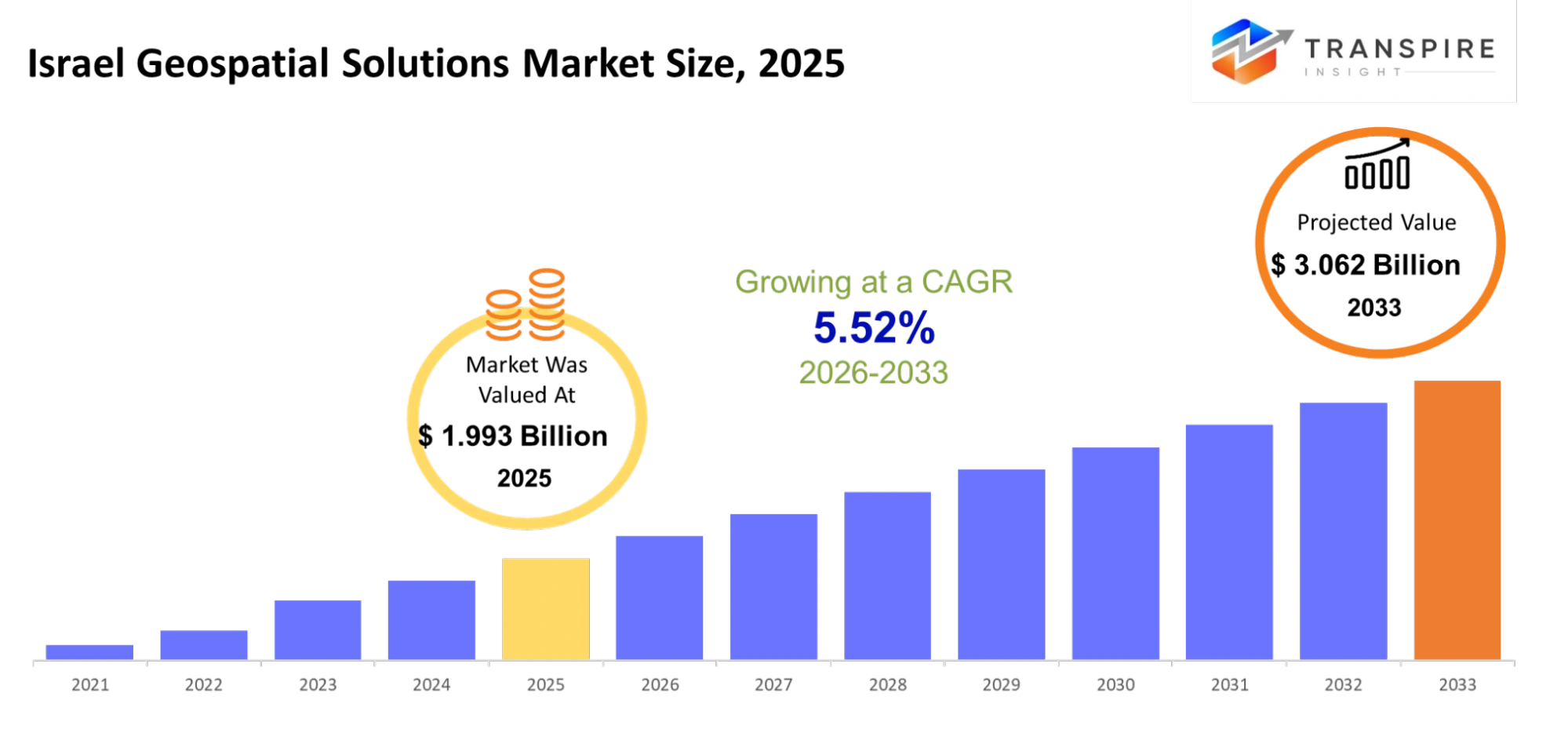
- Israel Geospatial Solutions Market Size 2025: USD 1.993 Billion
- Israel Geospatial Solutions Market Size 2033: USD 3.062 Billion
- Israel Geospatial Solutions Market CAGR: 5.52%
- Israel Geospatial Solutions Market Segments: By Component (Hardware, Software, Services), By Technology (GIS, Remote Sensing, GNSS), By End-User (Defense & Security, Agriculture, Construction, Transportation)
To learn more about this report,  Download Free Sample Report
Israel Geospatial Solutions Market Summary:
The Israel Geospatial Solutions Market size is estimated at USD 1.993 Billion in 2025 and is anticipated to reach USD 3.062 Billion by 2033, growing at a CAGR of 5.52% from 2026 to 2033.
The Israel geospatial solutions market, a subset of the advanced mapping and location intelligence industry, is set to continue to influence the way in which spatial data is collected, analyzed, and utilized in the realms of defense, urban planning, and environmental analysis. There is a need for more precise and real-time insights, as the need for satellite imaging, artificial intelligence, and drone surveying continues to increase in the Israeli market, where consumers need quicker and more mobile-friendly solutions that can be integrated into the current decision-making platforms. There is a need to strengthen the rules and regulations regarding data privacy and national security, and the market is set to continue into the realm of smart city planning, where the emphasis is on predictive mapping, where the data not only describes the terrain but predicts the changes.
Key Market Trends & Insights:
The need for high-resolution spatial intelligence will grow because government agencies and private organizations need to establish real-time situational awareness capabilities. The combination of satellite constellations and drone mapping will enable organizations to achieve more rapid data refresh intervals. Users will prefer platforms that combine visualization with predictive capabilities, which will lead them to select online geospatial systems that provide real-time mapping throughout Israel.
The field of artificial intelligence will shape new methods for handling and understanding location data. The system will use automated methods to extract features from data, find unusual patterns, and identify regular trends which will decrease the amount of work that needs to be done manually. AI-enabled tools will become essential for businesses because they provide quick insights which are vital for defense and agriculture and infrastructure monitoring, where timely geospatial interpretation directly affects operational efficiency and decision-making accuracy.
Smart city frameworks will become more integrated with municipal digital infrastructure investments. Geospatial platforms will serve as essential tools for urban planners who need to optimize traffic systems and analyze land use patterns and track environmental changes. The public demands environmentally friendly urban services, which will lead authorities to implement systems that provide immediate insights and predictive urban development systems, which will guide city planning.
The security requirements for the geospatial data will increase as the data becomes sensitive. The regulatory bodies will enforce guidelines for the storage, sharing, and access of the data. Organizations will establish secure cloud infrastructures together with compliance-based systems to protect their national and business information while developing new features for customer confidence.
Israel Geospatial Solutions Market Segmentation
By Component
Hardware-Hardware components will consist of advanced sensors, satellite receivers drones and surveying equipment which enable precise spatial data acquisition. The demand for hardware components that are portable power-efficient and able to provide continuous data flows throughout multiple operating environments will grow.
Software-Software solutions will achieve greater sophistication through their ability to deliver real-time analytics and visualization while connecting with enterprise software systems. Users will expect software solutions to provide user-friendly interfaces and artificial intelligence features which enable them to swiftly understand complex geospatial data.
Services-The GIS sector will develop more comprehensive service offerings which include consulting system integration and system maintenance. Organizations will rely on third-party services to develop customized GIS solutions and control data operations and maintain GIS solution efficiency.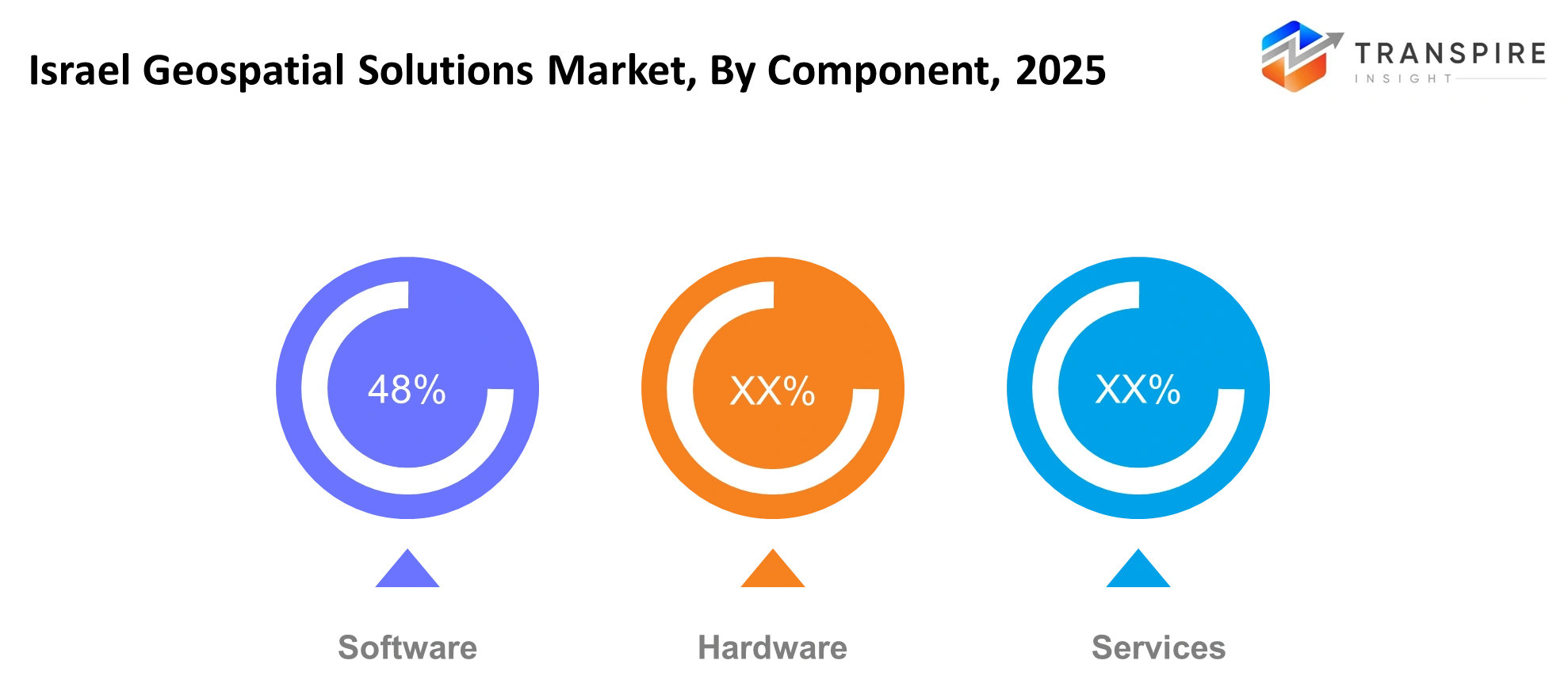
To learn more about this report, Download Free Sample Report
By Technology
GIS- The GIS system will provide organizations with two main advantages through its ability to conduct spatial analysis which enables them to plan operations and manage assets and make decisions. Organizations will increase their adoption of unified platforms which provide mapping features along with analytics and reporting capabilities in a single operational system.
Remote Sensing- The field of remote sensing will use both satellite and aerial imaging to track changes in land use and weather patterns and environmental conditions. The technology will find increasing applications in agriculture and military operations and disaster response efforts because it delivers critical information without needing personnel to be present at the site.
GNSS- The GNSS system delivers precise positioning and navigation data which transportation and construction and logistics industries require to operate effectively. The advancement of signal reliability together with improved accuracy will enable autonomous systems to operate within multiple industries while providing real-time tracking capabilities.
By End-User
Defense & Security- The defense and security sectors will utilize geospatial intelligence to conduct surveillance operations and monitor borders and develop their mission plans. The advanced mapping tools will enable decision-makers to make real-time choices which will result in better operational readiness and increased situational awareness during complex military situations.
Agriculture- Farmers will use geospatial technology to create accurate agricultural farming systems which include crop tracking and soil testing. Farmers will utilize location-based data to maximize their resource usage while achieving higher crop production and maintaining rapid responses to environmental shifts that impact their farming operations.
Construction- Construction companies will implement geospatial technology to assist them with site selection and surveying tasks and project tracking activities. The use of precise spatial information will help to decrease inconsistencies while enhancing resource distribution and improving coordination efforts during extensive infrastructure projects.
Transportation- Geospatial technologies will provide advantages to transportation systems through their application in route optimization and fleet tracking and infrastructure development. The use of real-time location information will enhance operational efficiency while minimizing operational interruptions and enabling secure transportation of goods and passengers.
Country Insights
The country of Israel will develop into a technology-driven center which uses geospatial technology to achieve its national objectives. The innovation programs which the government supports will create opportunities for startups to build their advanced mapping technologies. Defense organizations will work together with private companies to develop solutions which use spatial intelligence for security operations, infrastructure development, and environmental assessment.
The city of Tel Aviv will implement geospatial systems which help them control their high population density and intricate transportation networks. Authorities will use location information to manage traffic patterns and determine zoning regulations and provide public services. The public will demand digital services that respond quickly to their needs which leads municipalities to implement real-time mapping systems that improve their daily operations and urban planning activities.
Farmers in agricultural areas will increasingly depend on geospatial data to solve problems related to water shortage and land usage. Farmers will implement precision farming methods which use satellite technology and sensors for their irrigation and crop management practices. Farmers will utilize these new farming methods to sustain their farm output while they deal with climate changes and environmental restrictions which affect different regions of Israel.
The process of regulatory monitoring will determine the methods which organizations use to acquire, manage, and distribute geospatial information. Government organizations will establish precise standards for handling security and privacy which organizations must follow when handling sensitive mapping data. Organizations will need to establish secure systems together with data handling protocols which comply with regulations to maintain their innovative activities while safeguarding national security and preserving user confidence in digital geospatial technologies.
Recent Development News
Recent Developments in Satellite Expansion and Imaging Capabilities- Israel has established stronger geospatial capabilities through its recent satellite technology advancements and satellite deployments. The Ofek 19 radar satellite launch which took place in 2025 brought new imaging capabilities and intelligence collection abilities that allowed for continuous monitoring during all environmental conditions. This development will enhance national surveillance capabilities while increasing the accuracy of real-time geospatial information.
The space ecosystem of Israel is experiencing growth because of its commercial applications. Recent industry reports show that satellite usage has shifted from military purposes to providing civilian data services. The industry shift will create new business possibilities through mapping and analytics development while enabling public infrastructure development.
Strategic Contracts and Data Access Regulations- ImageSat International achieved its first commercial success when it signed a $42 million contract to deliver satellite-based geospatial services. The agreement demonstrates increasing worldwide interest in obtaining precise satellite images together with analytical capabilities. These contracts will establish Israel as a leading supplier of sophisticated geospatial intelligence solutions which international defense organizations use for their security needs.
The way geospatial data gets shared nowadays exists under the influence of existing global tensions. The major satellite companies which operate in 2026 decided to limit satellite access to sensitive conflict zone imagery which involves Israel in order to prevent misuse of that information. The actions taken by these organizations will create stricter data management rules while demonstrating that controlled access has become essential in the field of geospatial intelligence.
|
Report Metrics |
Details |
|
Market size value in 2025 |
USD 1.993 Billion |
|
Market size value in 2026 |
USD 2.102 Billion |
|
Revenue forecast in 2033 |
USD 3.062 Billion |
|
Growth rate |
CAGR of 5.52% from 2026 to 2033 |
|
Base year |
2025 |
|
Historical data |
2021 – 2024 |
|
Forecast period |
2026 – 2033 |
|
Report coverage |
Revenue forecast, competitive landscape, growth factors, and trends |
|
Country scope |
Israel |
|
Key company profiled |
Esri Inc., Hexagon AB, Trimble Inc., Autodesk Inc., Bentley Systems Inc., Maxar Technologies Inc., HERE Technologies, TomTom N.V., SuperMap Software Co. Ltd., Google LLC, Oracle Corporation, IBM Corporation, SAP SE, L3Harris Technologies Inc., Topcon Corporation. |
|
Customization scope |
Free report customization (country, regional & segment scope). Avail customized purchase options to meet your exact research needs. |
|
Report Segmentation |
By Component (Hardware, Software, Services), By Technology (GIS, Remote Sensing, GNSS), By End-User (Defense & Security, Agriculture, Construction, Transportation). |
Key Israel Geospatial Solutions Market Company Insights
Key companies operating in the Israel geospatial solutions market will include established defense-linked firms and agile startups specializing in satellite analytics, drone mapping, and AI-based spatial intelligence. Organizations such as Israel Aerospace Industries and ImageSat International will expand commercial offerings, while emerging ventures will focus on scalable platforms, real-time data services, and industry-specific geospatial applications.
Company List
- Esri Inc.
- Hexagon AB
- Trimble Inc.
- Autodesk Inc.
- Bentley Systems Inc.
- Maxar Technologies Inc.
- HERE Technologies
- TomTom N.V.
- SuperMap Software Co. Ltd.
- Google LLC
- Oracle Corporation
- IBM Corporation
- SAP SE
- L3Harris Technologies Inc.
- Topcon Corporation
Israel Geospatial Solutions Market Report Segmentation
By Component
- Hardware
- Software
- Services
By Technology
- GIS
- Remote Sensing
- GNSS
By End-User
- Defense & Security
- Agriculture
- Construction
- Transportation
Frequently Asked Questions
Find quick answers to common questions.
The Approximate Israel Geospatial Solutions Market size for the Market will be USD 3.062 Billion in 2033.
Key Segments for the Israel Geospatial Solutions Market By Component (Hardware, Software, Services), By Technology (GIS, Remote Sensing, GNSS), By End-User (Defense & Security, Agriculture, Construction, Transportation).
Major Players in the Israel Geospatial Solutions Market are Esri Inc., Hexagon AB, Trimble Inc., Autodesk Inc., Bentley Systems Inc., Maxar Technologies Inc., HERE Technologies, TomTom N.V., SuperMap Software Co. Ltd., Google LLC, Oracle Corporation, IBM Corporation, SAP SE, L3Harris Technologies Inc., Topcon Corporation.
The Current Israel Geospatial Solutions Market size is USD 1.993 Billion in 2025.
The Israel Geospatial Solutions Market CAGR is 5.52%.
- Esri Inc.
- Hexagon AB
- Trimble Inc.
- Autodesk Inc.
- Bentley Systems Inc.
- Maxar Technologies Inc.
- HERE Technologies
- TomTom N.V.
- SuperMap Software Co. Ltd.
- Google LLC
- Oracle Corporation
- IBM Corporation
- SAP SE
- L3Harris Technologies Inc.
- Topcon Corporation
Recently Published Reports
-
Apr 2026
3D Optical Profiler Market
3D Optical Profiler Market Size, Share & Analysis Report By Type (Desktop 3D Optical Profiler, and Portable 3D Optical Profiler), By Technology (Confocal Technology, and White Light Interference), By End-Use Industry (Manufacturing, Research Institutions, Automotive, Aerospace and Defense, Medical Devices, and Other), and Geography (North America, Europe, Asia-Pacific, Middle East and Africa, South and Central America), 2021 - 2031
-
Apr 2026
Depth Sensor Market
Depth Sensor Market Size, Share & Analysis Report By Type (Infrared Depth Sensors, Time-of-Flight (ToF) Sensors, Stereo Vision Sensors, Structured Light Sensors, Ultrasonic Depth Sensors), By Application (Automotive, Robotics, Gaming, Consumer Electronics, Industrial Automation, Healthcare, Security & Surveillance, Others), By End Users (Automotive Manufacturers, Consumer Electronics Companies, Healthcare Providers, Industrial Companies, Security Agencies, Gaming Companies, Robotics Companies, Others), and Geography (North America, Europe, Asia-Pacific, Middle East and Africa, South and Central America), 2021 – 2031
-
Apr 2026
Digital Manufacturing Market
Digital Manufacturing Market Size, Share & Analysis Report By Component (Hardware, Software, and Services), By Technology (Robotics, 3D Printing, Internet of Things (IoT), and Others), By Application (Automotive and Transportation, Aerospace and Defense, Consumer Electronics, Industrial Machinery, and Others), By Process Type (Computer-Based Designing, Computer-Based Simulation, Computer 3D Visualization, Analytics, and Others), and Geography (North America, Europe, Asia-Pacific, Middle East and Africa, South and Central America), 2021 – 2031
-
Apr 2026
Digital Visa Services Market
Digital Visa Services Market Size, Share & Analysis Report By Type (Individual Travelers, Group Travelers), By Application (Tourism, Business Travel, Others), and Geography (North America, Europe, Asia-Pacific, Middle East and Africa, South and Central America), 2021 – 2031