Israel Automated Fare Collection Market Size & Forecast:
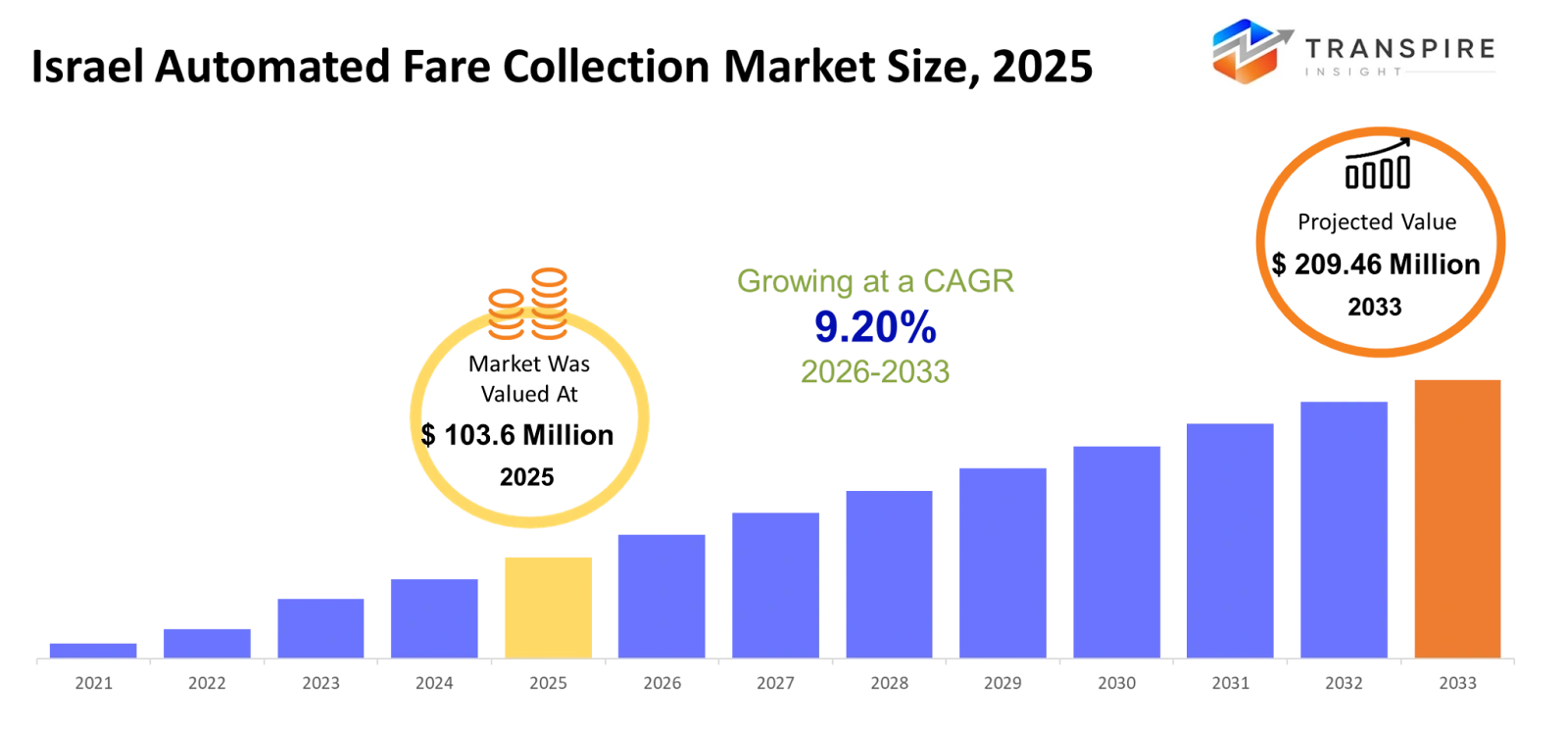
- Israel Automated Fare Collection Market Size 2025: USD 103.6 Million
- Israel Automated Fare Collection Market Size 2033: USD 209.46 Million
- Israel Automated Fare Collection Market CAGR: 9.20%
- Israel Automated Fare Collection Market Segments: By Component (Hardware, Software, Services), By Technology (Smart Cards, Mobile Ticketing, NFC, QR Codes), By Transportation Mode (Bus, Rail, Metro, Parking).
To learn more about this report,  Download Free Sample Report
Israel Automated Fare Collection Market Summary:
The Israel Automated Fare Collection Market size is estimated at USD 103.6 Million in 2025 and is anticipated to reach USD 209.46 Million by 2033, growing at a CAGR of 9.20% from 2026 to 2033.
The Israeli market in the public transport technology space would mirror a system in which digital payment modes increasingly replace traditional cash-based payment modes in buses, rail, and light rail networks. Passengers would increasingly prefer faster and touchless travel experiences, which would encourage transport operators to increasingly opt for digital payment modes such as mobile wallets, smart cards, and QR-based payment modes. The regulatory framework would encourage data security standards to increasingly align with the growing usage of digital payment modes. The market would increasingly witness the adoption of artificial intelligence-based analytics by technology providers. The market would increasingly witness the emergence of integrated mobility platforms.
Key Market Trends & Insights:
Urban commuters in Israel are increasingly using app-based tickets to commute. They want instant validation and ease in their day-to-day commute. This would further push the development of app-based platforms. The platforms would move towards bundling tickets with route planning. This would bring about a more integrated experience in tune with the digital-savvy commuter.
Contactless payment would move towards wearables and would incorporate biometric authentication. There would also be tests for frictionless entry systems. Passengers would be able to move without any validation points. This would push the development of highly secure payment systems.
Data-driven decision-making will continue to gain more significance as transport operators start to collect insights from passengers in real-time. Predictive analytics will be utilized to determine prices, control peak-hour services, and optimize route efficiency. Vendors will concentrate more on developing cloud infrastructure to help authorities interpret large amounts of data in a way that is completely compliant with national privacy regulations.
Integration of multiple transport modes will be another major trend as Israel moves closer to integrated transport ecosystems. Rail, bus, and shared transport modes would also be facilitated through integrated payment systems. There would also be increased cooperation between fintech companies and transport authorities to ensure smooth transfer between urban and inter-city transport networks.
Israel Automated Fare Collection Market Segmentation
By Component
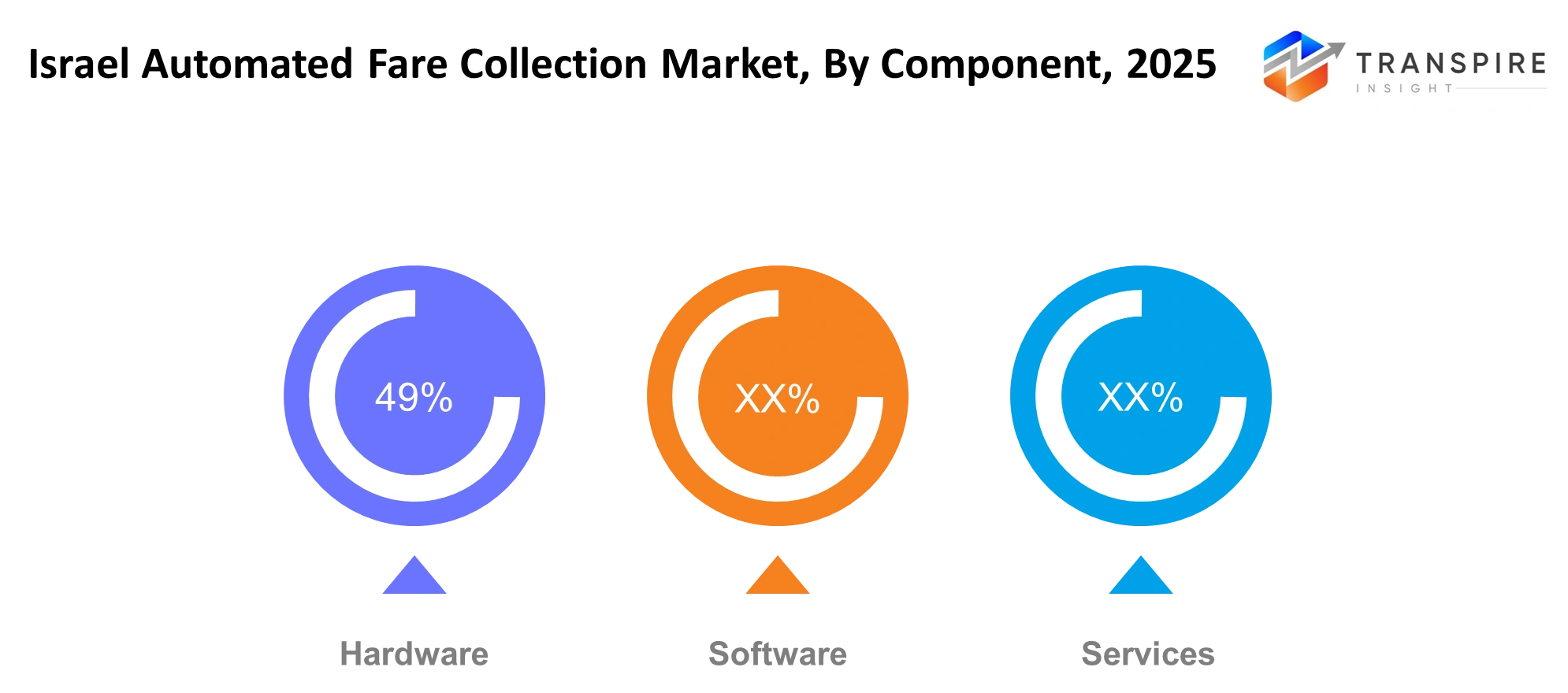
Hardware- The hardware components shall include validators, ticketing kiosks, card readers, and other onboard devices that are capable of supporting quick transactions while being durable enough to ensure connectivity in real-time and compatibility with different forms of payment systems.
Software- The software components shall include fare management systems, account-based ticketing systems, integration systems, and user interface systems, which shall provide transport operators with an opportunity to monitor transactions while offering users seamless digital experiences in interconnected transportation systems.
Services- The services shall include installation, maintenance, consulting, and upgrade services to transport operators, which shall provide them with an opportunity to ensure the installation and operation of secure systems while continuously striving to meet increasing passenger demands with evolving technologies.
To learn more about this report, Download Free Sample Report
By Technology
Smart Cards- Smart cards will continue to be used with their value-added attributes of storing value and smart tap functionality, which will provide commuters with reliable access without the need for internet connectivity, thus promoting integration with the broader digital payments landscape and loyalty rewards.
Mobile Ticketing- Mobile ticketing will become more popular as people increasingly depend on their mobile phones for buying, storing, and checking their tickets, thus prompting transport operators to create a more efficient app for their customers.
NFC- Near Field Communication will provide a facility for efficient communication between different devices, thus reducing transaction time, which will enhance passenger flow, as well as providing authentication options with cards, phones, and wearable payments.
QR Codes- QR code systems will provide a cost-effective solution for transport operators, thus enabling occasional users to access transport services as well as provide a facility for rapid deployment of transport systems.
By Transportation Mode
Bus- The bus network will use an automated fare system, which will help in reducing delay in boarding, thus allowing the movement of passengers and better schedule compliance.
Rail- The rail system will focus on high-capacity validation, which will be able to manage a high volume of passengers in minimal waiting time, also allowing the calculation of long-distance fares and integration with national ticketing systems.
Metro- The metro system will use automated entry/exit gates in combination with digital payments, which will help in managing peak hours, also allowing dynamic pricing and control systems.
Parking- The parking system will use an integrated system of automated payment and access control, which will allow parking, payment, and exiting without the need for physical checks, also allowing the collection of space usage information.
Country Insights
The public transportation system in Israel will undergo significant changes because of digital ticketing systems which the government supports to promote cashless transportation. Tel Aviv will become the main testing ground because commuters there will demand integrated payment systems which enable them to move between buses and trains and shared transportation services without interruption.
The existing regulatory frameworks will persist in their support of interoperability which allows passengers to use one payment method for different transit systems. The authorities will establish fair transparency requirements and data protection standards to foster public trust. The policies will drive vendors to create systems that meet national standards while providing capabilities for future growth.
Younger, technology-focused consumers will drive changes in consumer behavior, as they demand payment systems that offer instant processing and multiple payment methods. Tourists and occasional users will also drive demand for simplified ticketing solutions which include QR-based access and multilingual mobile applications, because these solutions make travel easier for people who lack deep knowledge about local transport systems.
Infrastructure investments will support modernization of legacy systems which will particularly benefit the expansion of metro and rail systems. Local organizations will work with technology providers to implement advanced validation systems and backend platforms which allow real-time monitoring and efficient revenue management while ensuring smooth passenger movement across high-density transit corridors.
Recent Development News
Digital Fare Platforms Gain Momentum- The Israeli transit system made significant progress with a new mobile application which a major bus company released to provide users with real-time navigation and fare information and in-app ticket validation. The development demonstrated a clear movement towards application-based fare systems which help passengers to travel more easily while decreasing their need for physical ticketing systems.
Government Push Through Fare Reform Policies- The recent transportation justice reform policies brought about new changes which modified fare systems across all public transit services. The new pricing system which launched in 2025 established standardized rates to improve consumer access to services. The authorities dedicated substantial funding resources to develop public awareness campaigns which demonstrated their commitment to updating modern fare collection systems and their current operational methods.
Ongoing Debate Around Fare Adjustments and Stability- Fare increase discussions continued throughout 2026 while officials proposed price hikes which would link to both inflation rates and infrastructure development expenses. Officials showed two possible outcomes which would influence fare stabilization efforts because they would depend on budget decisions while trying to maintain affordable ticket prices and develop advanced ticketing technology.
|
Report Metrics |
Details |
|
Market size value in 2025 |
USD 103.6 Million |
|
Market size value in 2026 |
USD 113.13 Million |
|
Revenue forecast in 2033 |
USD 209.46 Million |
|
Growth rate |
CAGR of 9.20% from 2026 to 2033 |
|
Base year |
2025 |
|
Historical data |
2021 – 2024 |
|
Forecast period |
2026 – 2033 |
|
Report coverage |
Revenue forecast, competitive landscape, growth factors, and trends |
|
Country scope |
Israel |
|
Key company profiled |
Cubic Corporation, Thales Group, Conduent Inc., Indra Sistemas S.A., Scheidt & Bachmann GmbH, Samsung SDS Co. Ltd., LG CNS Co. Ltd., NEC Corporation, Omron Corporation, NXP Semiconductors N.V., Vix Technology Group Ltd., INIT Innovation in Traffic Systems SE, Xerox Corporation, Hitachi Ltd., Toshiba Corporation. |
|
Customization scope |
Free report customization (country, regional & segment scope). Avail customized purchase options to meet your exact research needs. |
|
Report Segmentation |
By Component (Hardware, Software, Services), By Technology (Smart Cards, Mobile Ticketing, NFC, QR Codes), By Transportation Mode (Bus, Rail, Metro, Parking). |
Key Israel Automated Fare Collection Market Company Insights
The key players in the Israeli automated fare collection system market would include global technology companies and regional integrators working in close collaboration with transport authorities. The companies would focus on account-based tickets, cloud computing, and safe payment gateways. Partnerships with financial technology companies would also help these companies to expand their services. Upgrades in validation systems would also help these companies to stay ahead in the competition.
Company List
- Cubic Corporation
- Thales Group
- Conduent Inc.
- Indra Sistemas S.A.
- Scheidt & Bachmann GmbH
- Samsung SDS Co. Ltd.
- LG CNS Co. Ltd.
- NEC Corporation
- Omron Corporation
- NXP Semiconductors N.V.
- Vix Technology Group Ltd.
- INIT Innovation in Traffic Systems SE
- Xerox Corporation
- Hitachi Ltd.
- Toshiba Corporation
Israel Automated Fare Collection Market Report Segmentation
By Component
- Hardware
- Software
- Services
By Technology
- Smart Cards
- Mobile Ticketing
- NFC
- QR Codes
By Transportation Mode
- Bus
- Rail
- Metro
- Parking
Frequently Asked Questions
Find quick answers to common questions.
The approximate Israel Automated Fare Collection Market size will be USD 209.46 Million in 2033.
Key segments for the Israel Automated Fare Collection Market By Component (Hardware, Software, Services), By Technology (Smart Cards, Mobile Ticketing, NFC, QR Codes), By Transportation Mode (Bus, Rail, Metro, Parking).
Major players in the Israel Automated Fare Collection Market are Cubic Corporation, Thales Group, Conduent Inc., Indra Sistemas S.A., Scheidt & Bachmann GmbH, Samsung SDS Co. Ltd., LG CNS Co. Ltd., NEC Corporation, Omron Corporation, NXP Semiconductors N.V., Vix Technology Group Ltd., INIT Innovation in Traffic Systems SE, Xerox Corporation, Hitachi Ltd., Toshiba Corporation.
The Israel Automated Fare Collection Market size is USD 103.6 Million in 2025.
The Israel Automated Fare Collection Market CAGR is 9.20%.
- Cubic Corporation
- Thales Group
- Conduent Inc.
- Indra Sistemas S.A.
- Scheidt & Bachmann GmbH
- Samsung SDS Co. Ltd.
- LG CNS Co. Ltd.
- NEC Corporation
- Omron Corporation
- NXP Semiconductors N.V.
- Vix Technology Group Ltd.
- INIT Innovation in Traffic Systems SE
- Xerox Corporation
- Hitachi Ltd.
- Toshiba Corporation
Recently Published Reports
-
Apr 2026
ATV & UTV Market
ATV & UTV Market Size, Share & Analysis Report By Type (ATV, and UTV), By Variants (Less Than 400 CC, 400 CC To 800 CC, and More Than 800 CC), and Geography (North America, Europe, Asia-Pacific, Middle East and Africa, South and Central America), 2021 - 2031
-
Apr 2026
Automotive Central Gateway Module Market
Automotive Central Gateway Module Market Size, Share & Analysis Report By Type (Ethernet Central Gateway Module, CAN Central Gateway Module, LIN Central Gateway Module, and FlexRay), By Application (Powertrain Control, Body Control, Infotainment System, Advanced Driver Assistance Systems (ADAS), and Others), By End User (Passenger Vehicles, and Commercial Vehicles), and Geography (North America, Europe, Asia-Pacific, Middle East and Africa, South and Central America), 2021 - 2031
-
Apr 2026
Automotive Engine Oil Filter Market
Automotive Engine Oil Filter Market Size, Share & Analysis Report By Filter Type (Fuel Filter, Engine Oil Filter, Hydraulic Oil Filter, and Others), By Filter Media (Cellulose, Synthetic, and Micro), By Sales Channel (OEMs, and Aftermarket), By Vehicle Type (Passenger Cars, Light Commercial Vehicles, Heavy Duty Trucks, Buses and Coaches, and Off-road Vehicles), and Geography (North America, Europe, Asia-Pacific, Middle East and Africa, South and Central America), 2021 - 2031
-
Apr 2026
Automotive Parts Aluminium Die Casting Market
Automotive Parts Aluminium Die Casting Market Size, Share & Analysis Report By Production Process (Pressure Die Casting, Vacuum Die Casting, Squeeze Die Casting, Gravity Die Casting), By Application (Body Parts, Engine Parts, Transmission Parts, Battery And Related Components, Other Application Types), and Geography (North America, Europe, Asia-Pacific, Middle East and Africa, South and Central America), 2021 - 2031
Our Clients