
Market Summary
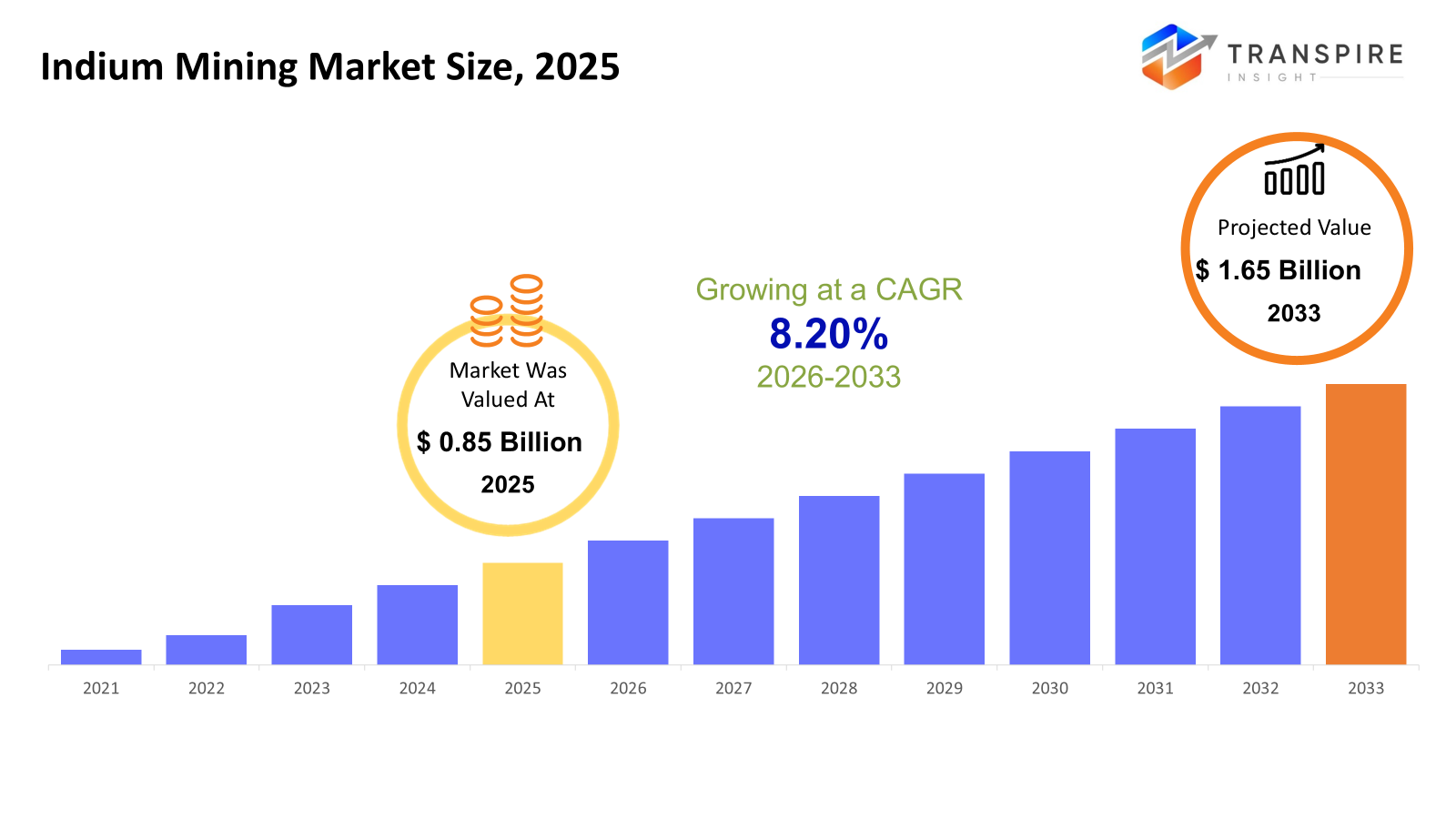
The global Indium Mining market size was valued at USD 0.85 billion in 2025 and is projected to reach USD 1.65 billion by 2033, growing at a CAGR of 8.20% from 2026 to 2033. The indium mining market is witnessing steady growth as consumer electronics, semiconductors, and innovative display technologies are prominently driving the demand for indium as it plays an active role in the fabrication of conductive materials. Growth in thin-film solar infrastructure, renewable energy, and an uptick in EV manufacture, coupled with favorable government policies to secure the indium mineral supply chain through recycling, are driving steady growth.
Market Size & Forecast
- 2025 Market Size: USD 0.85 Billion
- 2033 Projected Market Size: USD 1.65 Billion
- CAGR (2026-2033): 8.20%
- North America: Largest Market in 2026
- Asia Pacific: Fastest Growing Market
To learn more about this report,  Download Free Sample Report
Key Market Trends Analysis
- North America exhibits steady growth, driven by strong semiconductor manufacturing, renewable energy and EV markets tied to increasing investments in securing supply chains for critical minerals and bolstering refining and recycling capabilities for these materials within North America, such as indium.
- Notably, the United States continues to be an essential demand center for electronics, display screen production as well as defense-related technologies, depending on clean quality Indium, while federal support of critical minerals bolsters long-term suppleness in supply as well as competitive excellence.
- The region of Asia Pacific possesses dominance in the global industry, considering that China, Japan, and South Korea are at the top for industries such as electronic production, photovoltaic production and EV manufacturing. This gives them an advantage for both consumption and processing of Indium.
- Indium Ingots remain at the top of the type category due to its high level of purity and ease of handling which determines its extensive use for the manufacturing and production of high degrees of electronics and alloys across the globe.
- The most preferred extraction technique that hydrometallurgical processing offers over the others is that it presents the most purified form of Indium metal while allowing for higher efficiency in the extraction.
- In addition, electronics stands for the primary application category that is being driven by the increasing rate of smartphones, tablets, high-definition displays, and semiconductor devices, thus generating sales for indium-based conductive and consumer optics.
- Consumer electronics segment accounts for the majority of the end-use segment of the industry, driven by periodic upgrade of the product scope, increased emphasis on digitalization, and the adoption of cutting-edge technologies to improve displays. This thus emphasizes the significant role of indium in the industry and the end-use segment.
So, The indium mining market, as an evolving entity, presents itself as a thriving and growing entity. This rapid growth and development are mainly due to increasing demand for this product. Indium is usually found as a by-product during the excavation of Zinc. This element helps in manufacturing technologies used for touchscreen devices, LCD displays, semiconductors and solar panels. The indium market is divided among traditional direct excavations and secondary recovery and recycling activities because of increased focus and concern for sustainable practice. In this context indium element is showing an increasing demand for many technologies. In market growth prospects, market expansion can be attributed to the innovations that encompass the extraction and refining processes. Such processes include hydrometallurgical processes and the corresponding developments that include a combination of bio-hydrometallurgical processes. The use of indium materials in emerging renewable energy practices and electric vehicle technology ensures a high-level market growth trajectory. Moreover, the overall increased effort by governments is positively affecting market growth penetration. Areas include the Asia Pacific region and the United States. As a strategic value metal within high-end industries, the use case ensures a high-level market growth trajectory
Indium Mining Market Segmentation
By Type
- Indium Ingot
Ingots are most commonly used for industrial purposes because of their purity and manageable form. Ingots are generally used for large-scale manufacturing of electrical devices and metal alloys. This helps during their integration.
- Indium Powder
Powdered indium has the potential for niche uses and can be a versatile compound for its specialized uses. These include the manufacturing of catalysts, coatings, and for additive manufacturing. These uses require chemical control for which the particle size can be carefully managed. These uses will keep the demand for the compound
- Indium Oxide
Indium oxide plays an significant role in the formation of thin films, particularly on electronic devices and solar panels. Due to the surge in demand for solar panels, indium oxide has become an essential material playing an significant role in the development of sustainable technologies.
- Others
Other Grades/Forms Specialty grades of paperaddress the needs of specialized industries, for example, the space industry, the semiconductor industry and the scientific/research industry.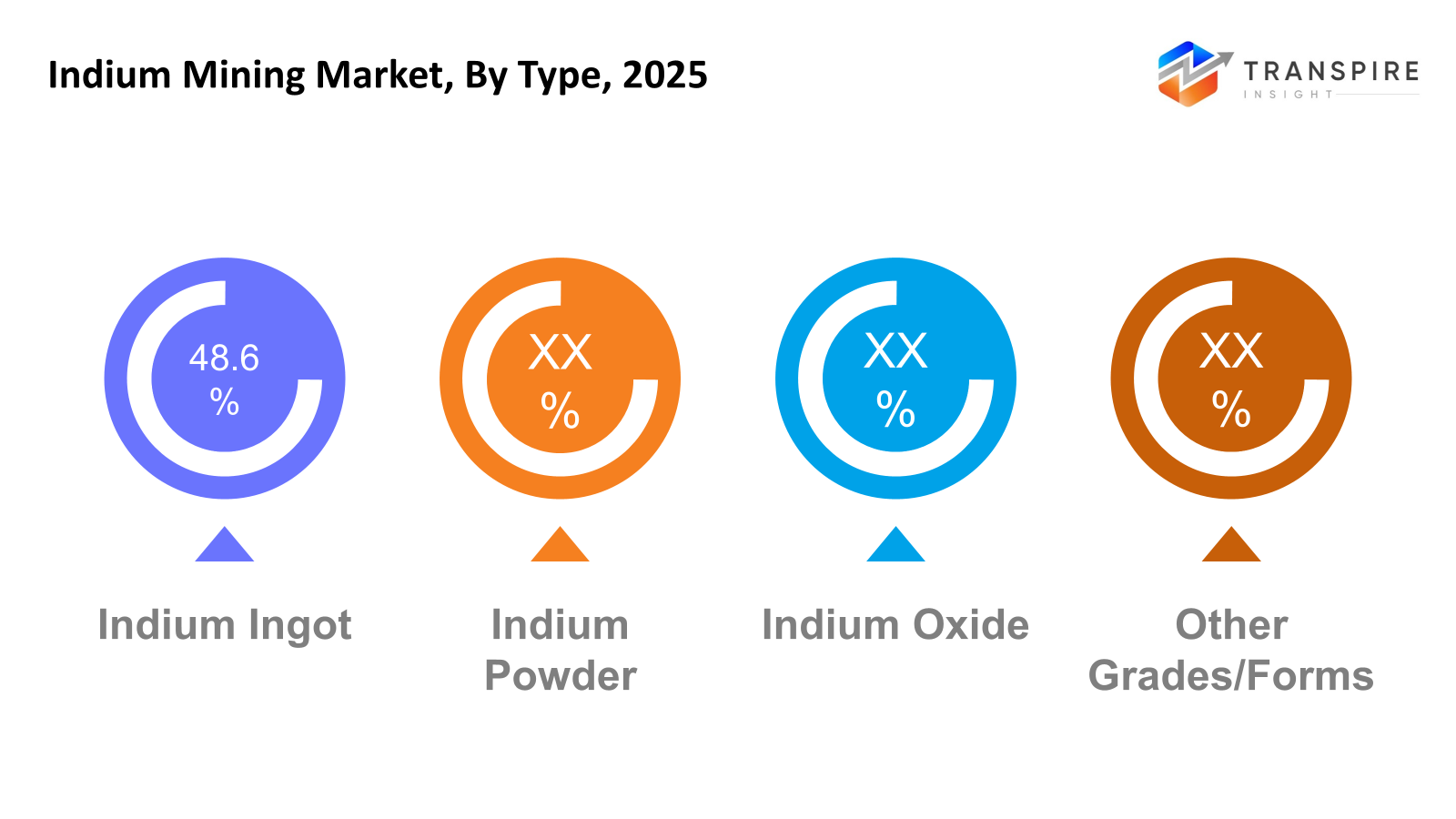
To learn more about this report, Download Free Sample Report
By Extraction Method
- Flotation
Flotation still remains a viable and cost-effective way for the separation of indium from zinc ones. It makes uniform efficiency, which suits traditional mining practices and does not disturb the environment.
- Hydrometallurgical Processing
The hydrometallurgy method also offers better purity levels in electronic-grade indium. Using chemical leaching in hydrometallurgy, accuracy levels are ensured, and it has become popular in modern settings.
- Pyrometallurgical Processing
Pyrometallurgical processing is appropriate for large-scale operations, particularly for alloy integration. High-temperature processing for extracting In efficiently, although such processes are quite costly.
- Bio‑hydrometallurgical extraction
The new eco-friendly bioreduction path is represented by bio-hydrometallurgy which uses microorganisms to recover indium. Still in their experimental phases they promise chemical use reduction and sustainability benefits so far attracting research and pilot projects.
- Recycling & Recovery Technologies
Electronic waste recycling has become prominent due to indium scarcity. Recovery technologies can reclaim valuable indium from end of life products reducing dependency on primary mining and supporting circular economy initiatives.
By Application
- Electronics
Indium is highly conductive, and this quality makes this element essential where touch screen technology, semiconductors, and soldering are concerned. Electronics technology is expanding very quickly, and this is generating demand, especially where technology is highly advanced, such as regions with increasing need for consumer
- Photovoltaics
Indium is used in thin film solar panel technology for improving efficiency. With the increased adoption rates for renewable energy sources, the demand for indium used in CIGS solar panel technology will create growth opportunities for the industry, considering its stability in relation to the energy targets set globally.
- LED Lighting & Optoelectronics
Indium-based compounds have the capacity to boost the efficiency and pigmentation accuracy of Light Emitting Diodes. The demand for smart lighting systems and display technology alone guarantees a consistent demand.
- Automotive
The contemporary vehicles also comprise an increased level of indium in display screens, sensors, as well as sophisticated luminous systems. The trend that targets electric as well as smart vehicles also enhances its importance, especially in the North America and Asia Pacific segments.
- Industrial and Chemical Usage
Applications of indium alloys, coatings, and catalysts improve industrial performance. These have limited application, which is however crucial for industrial sectors that require corrosion resistance, thermal stability, or specific chemical behaviors.
- Others
Research and the development and application of new technologies require indium, for example, through experimental devices, medical technology, and aerospace components. While not extensive, this plays a role in the market with long-term innovation-driven economic growth.
By End User
- Consumer Electronics
Consumer electronics make up the largest demand segment. For smartphones, tablets, and laptops, indium oxide layers are necessary for the screens. As a result, there would be continuous demand.
- Renewable Energy
The use of photovoltaic solar panels and other forms of renewable energy applications creates demand for indium. The growing interest and adoption of green energy, together with policy support and green energy strategies, increase its significance.
- Automotive & Transportation
Automotive & Transportation Electric and self-driven vehicles make significant use of the metal in displays, sensors, and light sources. Market trends correspond to indicators for vehicle uptake in different regions. In addition, there is a correlation with improvements in technology for the manufacture of automobiles.
- Electrical & Electronics Manufacturing
Indium is an excellent support for semiconductors, circuit board use, and soldering. The demand for high-quality conducting materials from industries will always be stable.
- Healthcare & Medical Devices
The segment that utilizes Indium for precision in the performance of imaging tools, sensors, and other equipment is a niche segment that appreciates the importance of quality. It thus provides a stable demand trend.
- Industrial Manufacturing
Indium alloys and coatings can help boost efficiency in machinery and manufacturing processes. Industries that may need or benefit from various properties like corrosion resistance, heat management, or other specific material needs will help drive indium’s niche market potential.
- Others
Others R&D, aerospace, and specialty chemistry require indium for experimental uses. While currently limited, there are potential innovations for growth.
Regional Insights
North America, with the likes of the U.S. and Canada, accounts for maximum consumption due to innovative technology, electronic manufacturing, and green initiative programs. Countries like Mexico help to drive the demand moderately with their intervention in industrial and secondary recycling efforts. In Europe, countries like Germany, the U.K., and France drive the usage of the element in industrial application, whereas other countries like Spain, Italy, etc., encourage photovoltaic technology and green electronic usage. The Asia Pacific is growing at an unprecedented rate. China, Japan, and South Korea lead in both production and consumption activities owing to their massive production industries like electronic gadgets, EV, solar panels, etc. India and various other APAC nations are gradually entering as emerging markets. South America, mainly comprising Brazil and Argentina, revolves around average growth. It is mainly utilizing its mining capabilities along with renewable energizing. The Middle East & Africa, led by Saudi Arabia, UAE, and South Africa, is clearly manifesting its growth rate with an incremental growth rate. Other regional nations are contributing moderately to its growth.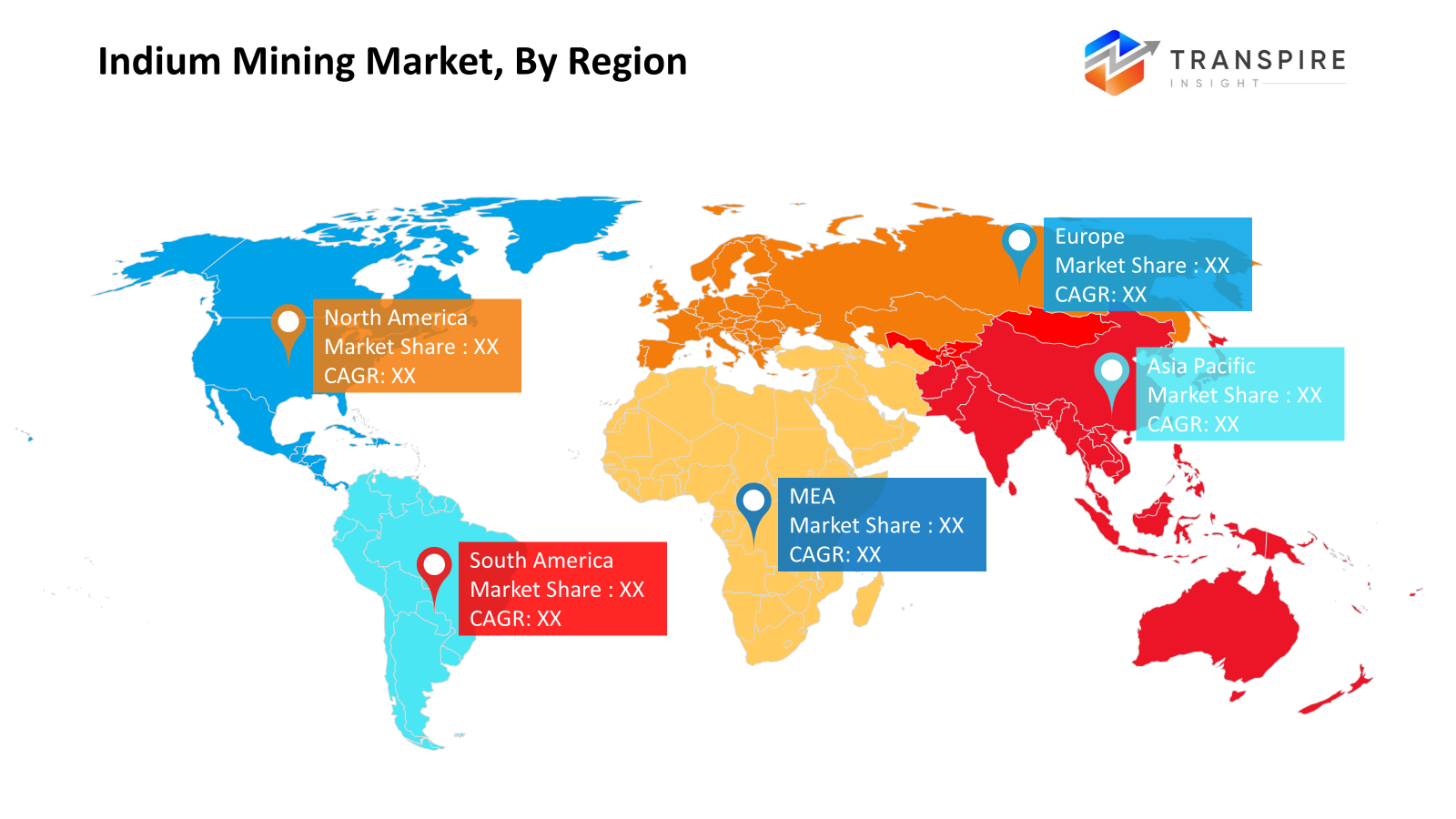
To learn more about this report, Download Free Sample Report
Recent Development News
- December 2025, the U.S. government had supported the funding of a vital processing plant for critical minerals with the company, Korea Zinc, in Tennessee, which could help reduce U.S. dependence on China, processing potentially large volumes of critical metals such as gallium, germanium, and indium.
(Source:https://www.ft.com/content/d885ab55-b4f8-4c8f-a213-94f2778863ac)
- In November 2025, Trafigura's subsidiary, Nyrstar, has initiated casting of antimony in Port Pirie, South Australia, under a system of critical minerals, with potential scope to produce critical materials such as indium, as part of strategic maneuvers from Australia, as well as its allies, to develop new supply chains.
(Source:https://www.supplychaindive.com/news/ups-rfid-tag-smart-package-initiative-expands-2023/642338/)
|
Report Metrics |
Details |
|
Market size value in 2025 |
USD 0.85 Billion |
|
Market size value in 2026 |
USD 0.95 Billion |
|
Revenue forecast in 2033 |
USD 1.65 Billion |
|
Growth rate |
CAGR of 8.20% from 2026 to 2033 |
|
Base year |
2025 |
|
Historical data |
2021 – 2024 |
|
Forecast period |
2026 – 2033 |
|
Report coverage |
Revenue forecast, competitive landscape, growth factors, and trends |
|
Regional scope |
North America; Europe; Asia Pacific; Latin America; Middle East & Africa |
|
Country scope |
United States; Canada; Mexico; United Kingdom; Germany; France; Italy; Spain; Denmark; Sweden; Norway; China; Japan; India; Australia; South Korea; Thailand; Brazil; Argentina; South Africa; Saudi Arabia; United Arab Emirates |
|
Key company profiled |
Korea Zinc Co., Ltd., Dowa Holdings Co., Ltd., Indium Corporation, Umicore N.V., Teck Resources Limited, Nyrstar NV, YoungPoong Corporation, PPM Pure Metals GmbH, China Germanium Co., Ltd., Guangxi Debang Technology Co., Ltd., Zhuzhou Smelter Group Co., Ltd., China Tin Group Co., Ltd., Mitsui Mining & Smelting Co., Ltd., Asahi Holdings, Inc., American Elements Inc. |
|
Customization scope |
Free report customization (country, regional & segment scope). Avail customized purchase options to meet your exact research needs. |
|
Report Segmentation |
By Type (Indium Ingot, Indium Powder, Indium Oxide, Other Grades/Forms), By Extraction Method (Flotation, Hydrometallurgical Processing, Pyrometallurgical Processing, Bio‑hydrometallurgical Extraction (emerging/experimental), Recycling & Recovery Technologies), By Application (Electronics, Photovoltaics, LED Lighting & Optoelectronics, Automotive, Industrial & Chemical Uses, Others) and By End User (Consumer Electronics, Renewable Energy, Automotive & Transportation, Electrical & Electronics Manufacturing, Healthcare & Medical Devices, Industrial Manufacturing, Others) |
Key Indium Mining Company Insights
Korea Zinc Co., Ltd. is one notably successful company in the refined indium market due to its unmatched scale and efficiency, which are the hallmarks of the successful operations and production at its plant. Moreover, Korea Zinc has its Onsan plant situated in South Korea, which has ideal infrastructure for the refined production and recovery of indium along with its refined production and recovery of zinc, making it one of the top players in the global refined indium market. Some strategic investments made by Korea Zinc have made it the top supplier in the global market by securing its sizable share. Korea Zinc has always been concerned about sustainability.
Key Indium Mining Companies:
- Korea Zinc Co., Ltd.
- Dowa Holdings Co., Ltd.
- Indium Corporation
- Umicore N.V.
- Teck Resources Limited
- Nyrstar NV
- YoungPoong Corporation
- PPM Pure Metals GmbH
- China Germanium Co., Ltd.
- Guangxi Debang Technology Co., Ltd.
- Zhuzhou Smelter Group Co., Ltd.
- China Tin Group Co., Ltd.
- Mitsui Mining & Smelting Co., Ltd.
- Asahi Holdings, Inc.
- American Elements Inc.
Global Indium Mining Market Report Segmentation
By Type
- Indium Ingot
- Indium Powder
- Indium Oxide
- Other Grades/Forms
By Extraction Method
- Flotation
- Hydrometallurgical Processing
- Pyrometallurgical Processing
- Bio‑hydrometallurgical Extraction (emerging/experimental)
- Recycling & Recovery Technologies
By Application
- Electronics
- Photovoltaics
- LED Lighting & Optoelectronics
- Automotive
- Industrial & Chemical Uses
- Others
By End User
- Hospitals and Clinics
- Bio-Pharmaceutical Companies
- Manufacturing Facilities
- Others
Regional Outlook
- North America
- United States
- Canada
- Mexico
- Europe
- Germany
- United Kingdom
- France
- Spain
- Italy
- Rest of Europe
- Asia Pacific
- Japan
- China
- Australia & New Zealand
- South Korea
- India
- Rest of Asia Pacific
- South America
- Brazil
- Argentina
- Rest of South America
- Middle East & Africa
- Saudi Arabia
- United Arab Emirates
- South Africa
- Rest of the Middle East & Africa
Frequently Asked Questions
Find quick answers to common questions.
The approximate Indium Mining Market size for the market will be USD 1.65 billion in 2033.
Key segments for the Indium Mining Market are By Type (Indium Ingot, Indium Powder, Indium Oxide, Other Grades/Forms), By Extraction Method (Flotation, Hydrometallurgical Processing, Pyrometallurgical Processing, Bio‑hydrometallurgical Extraction (emerging/experimental), Recycling & Recovery Technologies), By Application (Electronics, Photovoltaics, LED Lighting & Optoelectronics, Automotive, Industrial & Chemical Uses, Others) and By End User (Consumer Electronics, Renewable Energy, Automotive & Transportation, Electrical & Electronics Manufacturing, Healthcare & Medical Devices, Industrial Manufacturing, Others).
Major Indium Mining Market players are Korea Zinc Co., Ltd., Dowa Holdings Co., Ltd., Indium Corporation, Umicore N.V., Teck Resources Limited.
The North America region is leading the Indium Mining Market.
The CAGR of the Indium Mining Market is 8.20%.
- Korea Zinc Co., Ltd.
- Dowa Holdings Co., Ltd.
- Indium Corporation
- Umicore N.V.
- Teck Resources Limited
- Nyrstar NV
- YoungPoong Corporation
- PPM Pure Metals GmbH
- China Germanium Co., Ltd.
- Guangxi Debang Technology Co., Ltd.
- Zhuzhou Smelter Group Co., Ltd.
- China Tin Group Co., Ltd.
- Mitsui Mining & Smelting Co., Ltd.
- Asahi Holdings, Inc.
- American Elements Inc.
Recently Published Reports
-
Dec 2024
Healthcare Polymer Packaging Market
Healthcare Polymer Packaging Market Size, Share & Analysis Report By Packaging Type (Syringes, IV Bottles and Pouches, Clamshells, Blisters, Bottles & Jars, Containers, Tubes, IV Parental Packaging, Others), By Type (Regulated, Non-regulated), By Polymer Type (LDPE (Low-Density Polyethylene), HDPE (High-Density Polyethylene), Homo-polymer (Homo), Random Copolymer (Random), Block Copolymer (Block), PET, Polystyrene, Polyvinyl Chloride, Polyamide/EVOH, Others), and Geography (North America, Europe, Asia-Pacific, Middle East and Africa, South and Central America), 2021 - 2031
-
Jan 2025
Hydrophilic Tape (Waterstop) Market
Hydrophilic Tape (Waterstop) Market Size, Share & Analysis Report By Type (Bentonite-Based Hydrophilic Tape, Rubber-Based Hydrophilic Tape), By Application (Residential Buildings, Commercial Buildings, Infrastructure Projects), and Geography (North America, Europe, Asia-Pacific, Middle East and Africa, South and Central America), 2021 - 2031
-
Jan 2025
Metalens Market
Metalens Market Size, Share & Analysis Report By Type (Visible Light Metalens, and Infrared Metalens), By Application (Consumer Electronics, Automotive Electronics, Industrial, Medical, and Others), and Geography (North America, Europe, Asia-Pacific, Middle East and Africa, South and Central America), 2021 - 2031
-
Jan 2025
PBT Resin Market
PBT Resin Market Size, Share & Analysis Report By Type (Reinforced PBT Resin, Unreinforced PBT Resin), By Processing Method (Injection Molding, Extrusion, Blow Molding, Others), By End-User (Automotive, Electrical & Electronics, Consumer Appliances, Industrial Machinery, Medical Devices, Packaging, Others), and Geography (North America, Europe, Asia-Pacific, Middle East and Africa, South and Central America), 2021 - 2031