

Market Summary
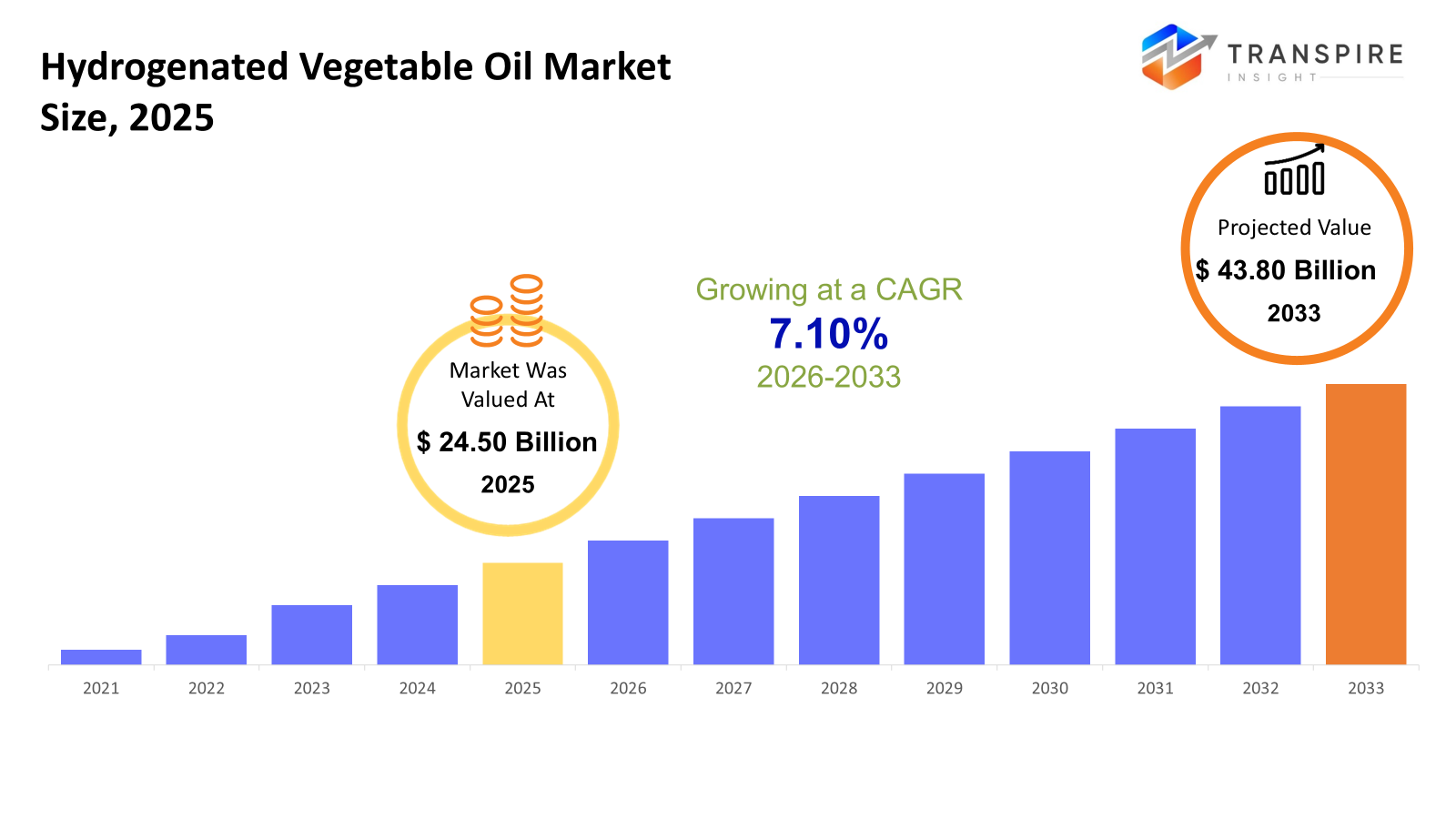
The global Hydrogenated Vegetable Oil market size was valued at USD 24.50 billion in 2025 and is projected to reach USD 43.80 billion by 2033, growing at a CAGR of 7.10% from 2026 to 2033. The market for Hydrogenated Vegetable Oil is registering a constant CAGR owing to the increasing demands for shelf-stable food ingredients, a rise in the consumption of processed foods, and its increasing uses in personal care and industrial formulations. Advancements in technology for fully hydrogenated forms suitable for trans fats also contribute to its amplified growth in the market.
Market Size & Forecast
- 2025 Market Size: USD 24.50 Billion
- 2033 Projected Market Size: USD 43.80 Billion
- CAGR (2026-2033): 7.10%
- North America: Largest Market in 2026
- Asia Pacific: Fastest Growing Market
To learn more about this report,  Download Free Sample Report
Key Market Trends Analysis
- North America also continues to demonstrate stable growth as food manufacturers increasingly adopt fully hydrogenated vegetable oils to comply with regulations regarding trans fats. Mature personal care and industrial applications continue to offer stable demand with fully integrated processing infrastructure.
- The United States leads regional dynamics due to large-scale bakery production, reformulation endeavors, high consumer preference for convenience food, and continued developments in sustainable oil processing technology to improve functionality while maintaining regulatory standards.
- The Asia Pacific industry is set to display the quickest growth pace on account of rapid urbanization trends in this geographical location accompanied by increasing spending on consumer goods. This is also accompanied by the growth of food processing units in countries such as China and India.
- Unfractionated hydrogenated vegetable oil continues to be the most preferred category, as the prime focus of the manufacturers relates to cost-effectiveness, stability, and most importantly, applications in food and non-food products.
- Food and Beverages is driving consumption as it is used in baked products, confectionery, and processed foods, where it provides key functionality such as texture and stability, thus being essential in mass production and distributions channels.
So, The Hydrogenated Vegetable Oil market refers to the group of vegetable oils which require the process of hydrogenation to increase their oxidative stability, texture, and shelf life, thereby finding their use in different applications in the fields of food, cosmetics, and industries. Hydrogenated oils are abundantly used in the production of baked goods, confectionery products, spreads, cosmetics, and specialty products in the industrial sector where consistency of performance is of utmost importance. The market demand is largely driven by processed food and convenient food sales, especially in the urban market. The companies use hydrogenated vegetable oils in order to attain homogeneity in their manufacturing and provide longer shelf life as well as large-scale manufacturing capabilities. The development of technologies in hydrogenation and fractionation has enabled companies to keep up with the regulations in this area without deteriorating functionality. Apart from being used as food ingredients, hydrogenated vegetable oils are being increasingly used as emollients and thickeners in personal care items, keeping in view the emerging trend of plant-based ingredients and naturals. Industrial uses such as bio-based lubricants and specialty chemicals are expected to provide other channels for expansion in this market as well.
Hydrogenated Vegetable Oil Market Segmentation
By Grade
- Unfractionated
Unfractionated hydrogenated vegetable oils continue to be the bedrock of the market in view of its multifaceted functionality and economical nature. The complete triglyceride spectrum of the unfractionated hydrogenated vegetable oils brings about complete oxidative stability, thus finding favor in basic-formulation requirements. Whether from the culinary or the consumer goods industry, the basic consistency of the product is preferred.
- Fractionated
Fractionated grades are on the rise due to their ability to create tailored melting profiles and structural specificity. This is very useful for confectionery coatings, high-quality fats, and cosmetic sticks. Improved performance attributes are also encouraging their use, especially within specialized products.
- Others
The “Others” categories consist of specialized mixtures formulated for unique product types like pharmaceutical excipients or co-processed cosmetic mixtures. Although smaller in volume, this sector is still vital for supporting new product development with high-priced specialized formulations.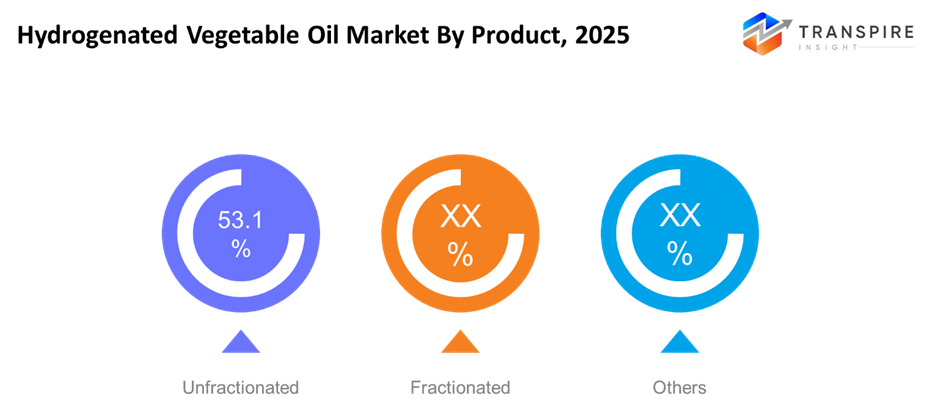
To learn more about this report, Download Free Sample Report
By End Use
- Food & Beverage
Hydrogenated vegetable oils are a backbone in the functional food industry and are used as functional enhancers for texture and shelf-life stability in products such as baked goods, snack foods, and spreads. The market has captured the largest market share due to a growing demand for convenience food products from consumers worldwide.
- Personal Care and Cosmetics
In personal care, hydrogenated oils are used as emollients and emulsifiers that enhance texture and skin feel in cream, balm, and stick formulations of personal care products. The trend in natural and plant-based beauty further increases the importance of this category.
- Industrial
This business segment utilizes hydrogenated vegetable oils as lubricants, bio-based products, or non-food production. Increasing demand for sustainable substitutes of petroleum products and biofuel materials is an added advantage.
- Others
This catch-all category includes pharmaceutical carriers, specialty coatings, and animal feeds. Although smaller in volume, the market in this category represents industry requirements for chemically inert, stable lipid compounds.
Regional Insights
The North America market, comprising the United States, Canada, and Mexico, is experiencing steady development because it is supported by a mature food processing industry, strong healthcare regulations, and a developed personal care and cosmetics industry that requires a stable source of lipid ingredients. The United States dominates consumption in the region, and strategic expansion is being driven by methods such as product formulation and renewable material conversion, and food processing in Canada and Mexico. The European region has important contributors such as Germany, the UK, France, Spain, and Italy, driven by innovation in food and cosmetic processing techniques, strict food quality norms, and strong renewable energy sources policies. The Rest of Europe also adds diversity, but smaller economies are increasingly focusing on prime locations. The Asia Pacific market, comprising Japan, China, Australia & New Zealand, South Korea, India, and Rest of Asia Pacific, stands out as the most rapidly growing market owing to industrialization, processed food consumption, and availability of raw materials. Growth is led by China and India, both in the domestic market and as export destinations.
South America, driven by leaders like Brazil and Argentina, has favorable agriculture resources, and evolving processed food markets. In Middle East & Africa, comprising countries like Saudi Arabia, UAE, and South Africa, increasing urbanization and emerging industries, including food, drive the incremental adoption rate, and logistics centers improve import and distribution capabilities within the region.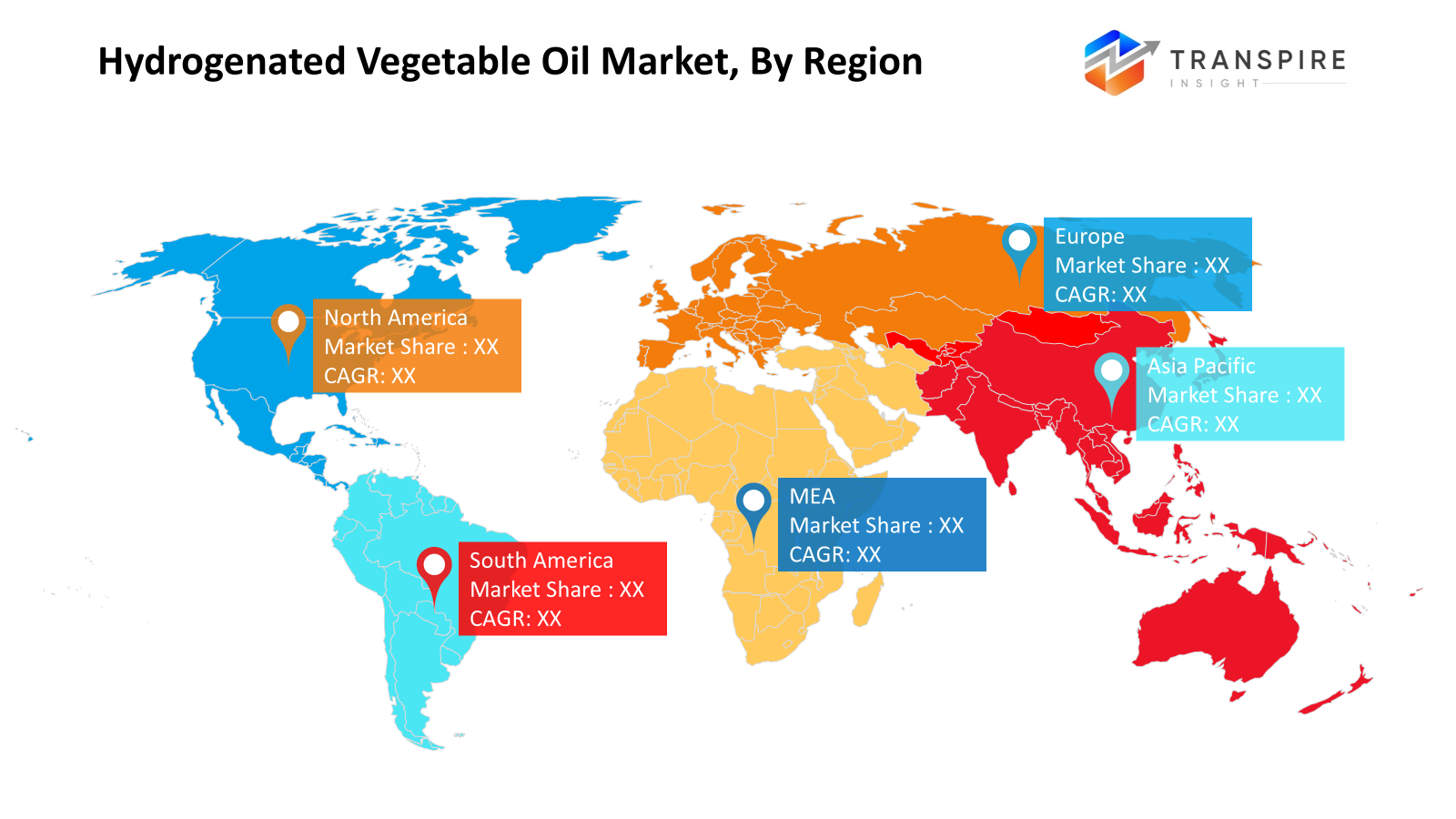
To learn more about this report, Download Free Sample Report
Recent Development News
- January 2026, The Indian government has also amended the Vegetable Oil Products, Production and Availability (Regulation) Order, 2025 (VOPPA Order), and manufacturers and traders are now forced to register and record their production and stock statements every month. There are already cases of enforcement actions such as inspections and show-cause notices to ensure compliance regarding vegetable and hydrogenated oils.
- In January 2025, a number of large energy companies including Galp (Portugal), LOKEN (Malaysia), and SAFCO Ventures chose to license Axens' Vegan technology to construct or expand Hydrogenated Vegetable Oil (HVO) and Sustainable Aviation Fuel (SAF) manufacturing plants in Portugal, Malaysia, or Pakistan. This increases the deployment of renewable fuels through the utilization of HVO feedstocks to lower carbon emissions and dependence on conventional fuels. Axens will provide technology, catalysts, and technical expertise to support these projects.
|
Report Metrics |
Details |
|
Market size value in 2025 |
USD 24.50 Billion |
|
Market size value in 2026 |
USD 27.00 Billion |
|
Revenue forecast in 2033 |
USD 43.80 Billion |
|
Growth rate |
CAGR of 7.10% from 2026 to 2033 |
|
Base year |
2025 |
|
Historical data |
2021 – 2024 |
|
Forecast period |
2026 – 2033 |
|
Report coverage |
Revenue forecast, competitive landscape, growth factors, and trends |
|
Regional scope |
North America; Europe; Asia Pacific; Latin America; Middle East & Africa |
|
Country scope |
United States; Canada; Mexico; United Kingdom; Germany; France; Italy; Spain; Denmark; Sweden; Norway; China; Japan; India; Australia; South Korea; Thailand; Brazil; Argentina; South Africa; Saudi Arabia; United Arab Emirates |
|
Key company profiled |
Cargill, Inc., Bunge Limited, Archer Daniels Midland Company, Wilmar International Limited, IOI Corporation Berhad, AAK AB, Louis Dreyfus Company B.V., BASF SE, Croda International Plc, Clariant International Ltd., Mewah International Inc., Olam International, Sime Darby Plantation Berhad, Golden Agri-Resources Ltd, Fuji Oil Holdings Inc. |
|
Customization scope |
Free report customization (country, regional & segment scope). Avail customized purchase options to meet your exact research needs. |
|
Report Segmentation |
By Grade (Unfractionated, Fractionated, Others), By End Use (Food & Beverage, Personal Care and Cosmetics, Industrial, Others) |
Key Hydrogenated Vegetable Oil Company Insights
Cargill, Inc. is the leading brand in the market for hydrogenated vegetable oils, translating the company’s strong global supply chain and oilseed processing enterprise into the production of trans-fat-free and specialty hydrogenated oils for the bakery, confectionery, margarine, and industrial sectors. The company’s strategy of investing in sustainable and safe food chain management adds strongly to its competitiveness, especially through its strong commitment to the development of advanced hydrogenation technology and the use of diverse feedstocks. The company’s presence in North America, Europe, and the Asia Pacific region is beneficial in supporting stable distribution and catering to region-specific regulations and consumer preferences regarding functional and stable fats.
Key Hydrogenated Vegetable Oil Companies:
- Cargill, Inc.
- Bunge Limited
- Archer Daniels Midland Company
- Wilmar International Limited
- IOI Corporation Berhad
- AAK AB
- Louis Dreyfus Company B.V.
- BASF SE
- Croda International Plc
- Clariant International Ltd.
- Mewah International Inc.
- Olam International
- Sime Darby Plantation Berhad
- Golden Agri-Resources Ltd
- Fuji Oil Holdings Inc.
Global Hydrogenated Vegetable Oil market Report Segmentation
By Grade
- Unfractionated
- Fractionated
- Others
By End Use
- Food & Beverage
- Personal Care and Cosmetics
- Industrial
- Others
Regional Outlook
- North America
- United States
- Canada
- Mexico
- Europe
- Germany
- United Kingdom
- France
- Spain
- Italy
- Rest of Europe
- Asia Pacific
- Japan
- China
- Australia & New Zealand
- South Korea
- India
- Rest of Asia Pacific
- South America
- Brazil
- Argentina
- Rest of South America
- Middle East & Africa
- Saudi Arabia
- United Arab Emirates
- South Africa
- Rest of the Middle East & Africa
Frequently Asked Questions
Find quick answers to common questions.
The approximate Hydrogenated Vegetable Oil Market size for the market will be USD 43.80 billion in 2033.
Key segments for the Hydrogenated Vegetable Oil Market are By Grade (Unfractionated, Fractionated, Others), By End Use (Food & Beverage, Personal Care and Cosmetics, Industrial, Others)
Major Hydrogenated Vegetable Oil Market players are Cargill, Inc., Archer Daniels Midland Company, Bunge Limited, Wilmar International Limited, AAK AB
The North America region is leading the Hydrogenated Vegetable Oil Market.
The CAGR of the Hydrogenated Vegetable Oil Market is 7.10%.
- Cargill, Inc.
- Bunge Limited
- Archer Daniels Midland Company
- Wilmar International Limited
- IOI Corporation Berhad
- AAK AB
- Louis Dreyfus Company B.V.
- BASF SE
- Croda International Plc
- Clariant International Ltd.
- Mewah International Inc.
- Olam International
- Sime Darby Plantation Berhad
- Golden Agri-Resources Ltd
- Fuji Oil Holdings Inc.
Recently Published Reports
-
Dec 2024
Baby Infant Formula Market
Baby Infant Formula Market Size, Share & Analysis Report By ype (Infant Milk, Follow On Milk, Specialty Baby Milk, Growing-Up Milk), By Ingredient (Carbohydrate, Fat, Protein, Minerals, Vitamins, and Others), By Product Form (Powder, Liquid, and Ready-to-feed), By Distribution Channels (Supermarket/Hypermarket, Specialty Store, Pharmacies, Online Retail, and Others), and Geography (North America, Europe, Asia-Pacific, Middle East and Africa, South and Central America), 2021 - 2031
-
Jan 2025
Edible Insects for Animal Feed Market
Edible Insects for Animal Feed Market Size, Share & Analysis Report By Type (Insect Powder, Insect Meal, Insect Bar, Insect Paste, Insect Oil, and Others), By Insect Type (Beetles, Cricket, Caterpillar, Hymenoptera, Orthoptera, Tree Bugs, and Others), By Application (Livestock, Pet Food, and Aquaculture), By Livestock Type (Poultry, Swine, and Others), and Geography (North America, Europe, Asia-Pacific, Middle East and Africa, South and Central America), 2021 - 2031
-
Jan 2025
Food Industry Disinfection and Bacterial Control Market
Food Industry Disinfection and Bacterial Control Market Size, Share & Analysis Report By Type (Chemical Disinfectants, Physical Disinfectants, and Biocides and Antimicrobials), By Application (Food Processing Equipment Surface Disinfection, Food Preparation Areas Surface Disinfection, Storage Areas Surface Disinfection, Anti-microbial Coatings Food Preservation, and Preservative Solutions Food Preservation), By End User (Meat and Poultry Processing, Dairy Processing, Seafood Processing, Bakery and Confectionery, Restaurants and Commercial Kitchens, and Food Service Providers), By Sales Channel (Online, Offline), and Geography (North America, Europe, Asia-Pacific, Middle East and Africa, South and Central America), 2021 - 2031
-
Jan 2025
Freeze Dried Food Market
Freeze Dried Food Market Size, Share & Analysis Report By Product Type (Fruits, Vegetables, Freeze-Dried Dairy Products, Freeze-Dried Meat and Seafood, Freeze-Dried Pet Food, and Prepared Meal), By Nature (Organic, and Conventional), By Form (Powdered, Granules, and Diced), By End Use (Breakfast Cereals, Dairy Products, Bakery & Confectionery, Nutritional Bars & Supplements, Powdered Beverages, Snacks, and Retail (Household)), and Geography (North America, Europe, Asia-Pacific, Middle East and Africa, South and Central America), 2021 - 2031