

Higher Education Learning Systems Market Summary:
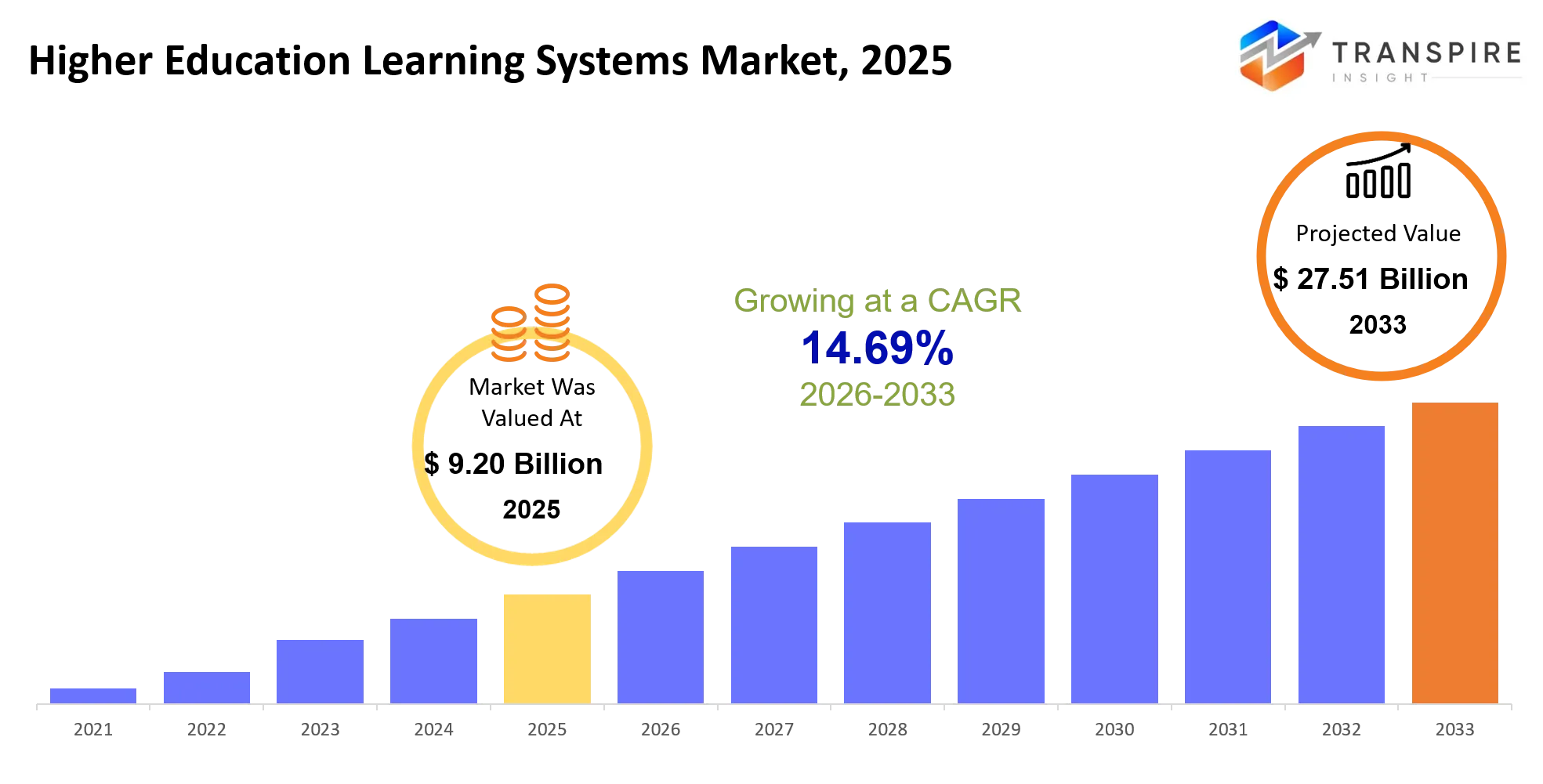
As per Transpire Insight Analysis, the Higher Education Learning Systems Market size is estimated at USD 9.20 billion in 2025 and is anticipated to reach USD 27.51 billion by 2033, growing at a CAGR of 14.69% from 2026 to 2033.
The higher education learning systems market supports universities, colleges and other academic institutions in managing coursework, student records, online classes, assessments and academic performance. In the past three to five years, institutions have gone beyond simple digital course delivery. They are now using platforms that bring teaching, administration and student support into one system. Cloud deployment, mobile access and AI-enabled learning tools are growing in importance. Universities are looking for ways to improve the student experience while also managing workloads. This shift was accelerated during the period when institutions had to move classes and assessments with very little preparation time. Many institutions have kept these systems and expanded them to support blended learning and flexible course delivery. Growth in this market is being driven by the need to handle large amounts of academic data, spot students who may need extra help and deliver consistent learning experiences across all campuses. Because of this, vendors that offer core systems along with analytics, accessibility features and technology that can adapt to changing needs are better positioned to meet what institutions require.
Higher Education Learning Systems Market Size & Forecast:
- Market Size 2025: USD 9.20 Billion
- Expected Market Value (2033): USD 27.51 Billion
- Forecast CAGR (2026–2033): 14.69%
- Leading Region in 2025: North America
- Fastest Growing Region: Asia Pacific
- Key Company Profiles: Blackboard, Instructure, D2L, Moodle, Anthology, Oracle, Microsoft, SAP, Ellucian, Canvas, Coursera, Pearson, Google, McGraw Hill, Infor
Key Market Insights:
The market is moving towards connecting course delivery with assessment administration and student performance monitoring. Learning management systems are the largest segment, while AI-driven learning systems are a growing trend.
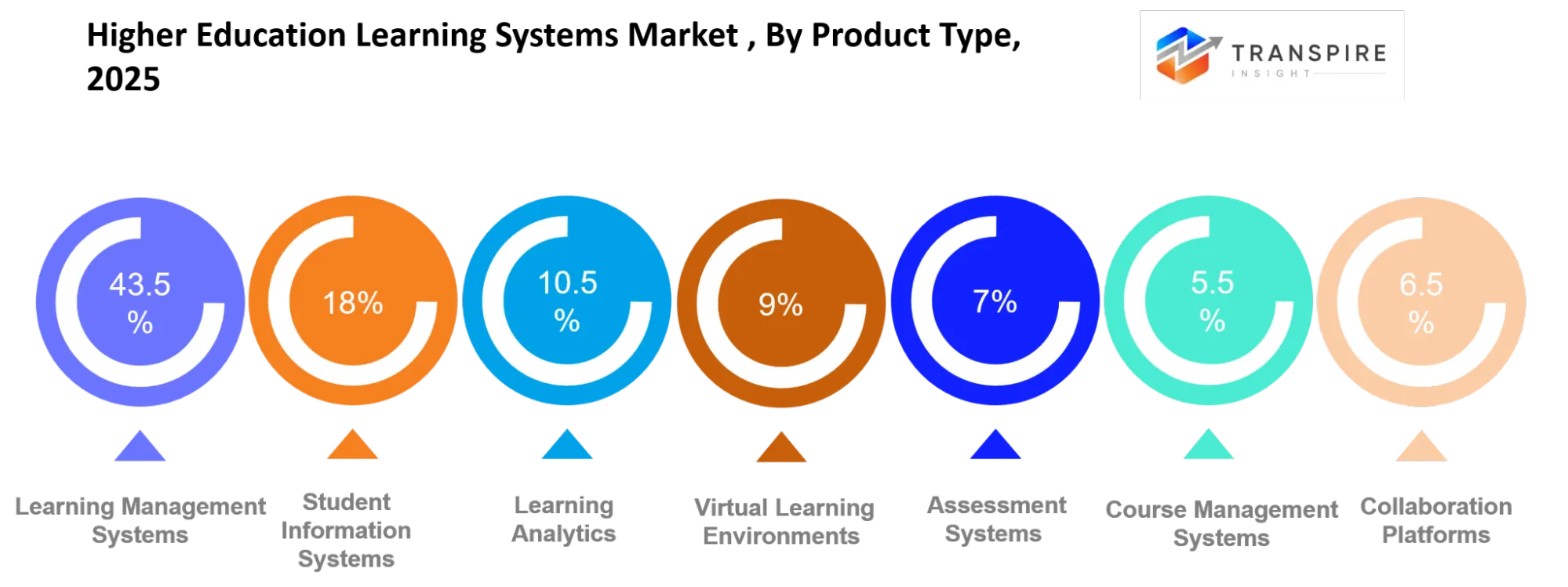
- Learning Management Systems constitute 43.5% of the market due to the importance of centralised platforms in distributing courses, class planning, and administration of student activity.
- Student Information Systems make up 18.0% of the market as they help in organising admission and enrollment,
- Learning Analytics makes up 10.5% of the market as performance data helps spot gaps in learning and make academic decisions based on it.
- Virtual Learning Environments constitute 9.0% of the market due to the growing use of online classrooms and learning environments together with regular classroom-based education.
- Assessment Systems hold 7.0% of the market as digital assessment and examination help teachers control exams and give feedback.
What are the Key Drivers, Restraints, and Opportunities in the Higher Education Learning Systems Market?
Drivers
Universities are implementing digital learning systems in order to cope with an expanding portfolio of courses, establish hybrid learning, and increase student retention. While the pandemic-induced large-scale pivot to online learning highlighted the flaws in the traditional in-person classroom process, it also prompted institutions to purchase platforms that were able to be used for teaching, testing and communicating remotely. Vendors have an opening here in the form of integrated software, implementation, analytics and ongoing technical support. Students who are struggling are also a potential sale for these vendors.
Restraints
The costly implementation process, the presence of legacy software and migrating data and training people can lead to delays in the adoption process, particularly in small colleges with less budget for technologies. The integration of the learning platform with student records, financials, identity management and other digital resources takes some time and requires certain knowledge. Student privacy, cybersecurity and accessibility, as well as the quality of data, influence the purchase decision as well.
Opportunities
AI-based tutoring, predictive analytics and cloud systems give vendors opportunities to offer more differentiated solutions. Thus, institutions can use the data from a learning management system and data on attendance and assessment to identify students who need academic assistance at the right moment. Increased spending on digital education in APAC provides opportunities for vendors of affordable and mobile-friendly platforms with local deployments. Providers of such solutions that can prove their benefits in terms of educational results, ethics of data handling and relatively low operating costs will be successful in bidding for institutions' contracts.
|
Driver |
Relative Impact on Growth (%) |
Geographic Relevance |
Impact Timeline |
Demand Strength |
Growth Mechanism (5–10 words) |
Key Beneficiaries (5–10 words) |
Major Constraint (5–10 words) |
|
Growing Adoption of Digital and Online Learning Platforms |
25% |
North America, Asia-Pacific, Europe |
Short-term (≤2 years) |
High |
Expands flexible learning through cloud-based digital education platforms. |
LMS providers, universities, cloud vendors, students, faculty. |
Limited budgets and inconsistent internet connectivity hinder adoption. |
|
Integration of Artificial Intelligence and Learning Analytics |
23% |
North America, Europe, Asia-Pacific |
Medium-term (2–4 years) |
High |
Personalizes instruction and improves performance tracking through analytics. |
AI developers, software vendors, educators, students, institutions. |
Data privacy concerns and AI integration costs restrict implementation. |
|
Government Initiatives and Institutional Digital Transformation Investments |
20% |
Asia-Pacific, North America, Europe |
Medium-term (2–4 years) |
High |
Funding accelerates digital infrastructure and institutional platform deployment. |
Public universities, edtech firms, technology integrators, learners. |
Funding uncertainty and lengthy procurement processes delay deployments. |
|
Rising Demand for Hybrid Learning and Flexible Degree Programs |
17% |
North America, Europe, Asia-Pacific |
Short-term (≤2 years) |
High |
Supports blended teaching, remote access, and lifelong learning. |
Universities, LMS vendors, online educators, working professionals. |
Faculty training gaps and resistance to pedagogical change. |
|
Increasing Need for Skills-Based Education and Learning Management Integration |
15% |
Asia-Pacific, North America, Europe |
Long-term (≥4 years) |
High |
Connects academic courses with employability and skills development. |
Universities, corporate training providers, employers, learners, vendors. |
Legacy systems and fragmented standards complicate platform integration. |
|
Total |
100% |
Global |
— |
— |
— |
— |
— |
What Has the Impact of Artificial Intelligence Been on the Higher Education Learning Systems Market?
The use of artificial intelligence has transformed the role played by higher education learning systems in supporting the needs of students, educators, and administration. Rather than merely acting as repositories for the learning materials for courses, the current focus is on designing learning platforms that offer personalised assistance, automate routine tasks, and convert learning information into insights. AI tools can aid in writing questions for quizzes, summarising learning material, answering routine queries from students, and recommending learning material depending on progress. Predictive analytics can help institutions discover patterns related to missed assignments, low test scores, or lower engagement. If used properly, these insights would enable academic advisors and faculty members to act before they have to wait for final exam results to realise that there is an issue. The process could also help to cut down the time spent organising content, answering routine questions, and writing some types of assessment feedback. The technology encourages vendors to incorporate AI assistants and analytics in existing learning management systems instead of developing new tools.The integration of AI has its limitations. The costs of integration, inaccurate responses, issues of privacy, and chances of student dependence on auto-generated answers limit
Instance
In March 2026, the Manipal Academy of Higher Education (MAHE) has come up with its MAGIC (MAHE Agentic Intelligent Console) platform to bring about AI-based systems in its academic and administrative processes. The platform incorporates AI agents for timetabling, attendance monitoring, exam scheduling, and analysis of student performance.
Key Market Trends:
The industry is moving from a stand-alone course management system to an integrated digital learning environment. Organizations are focusing on the outcomes of their students, implementation, and responsible use of AI as opposed to digitization.
- The Learning Management Systems (LMSs) have changed from being repositories of content to interconnected systems that link course activities with assessment, communication, and metrics.
- AI-based digital assistants are being introduced into academic processes to enable students to learn about their courses and to allow professors to automate some of the routine tasks.
- Universities are now paying attention to predictive analytics where the activities and assessment patterns of learners are analyzed in order to determine who needs help in academics.
- The cloud distribution model is becoming the new trend among institutions seeking scalability of access and independence from the local infrastructure, although this will depend on security and budgetary issues.
- Organizations are now giving importance to the interoperability of the learning platform, student information system, identity system, and other administrative systems.
Higher Education Learning Systems Market Segmentation
By System Type
Learning Management Systems lead the market, accounting for 43.5% of the segmentation, thanks to the fact that they handle the organisation of course content, assignments, assessment, and interaction between teachers and learners. Student Information Systems contribute 18.0%, whereas Learning Analytics account for 10.5% due to the growing need for visibility concerning academic success. Virtual Learning Environments make up for 9.0%, and Assessment Systems 7.0%, whereas Course Management Systems represent 5.5%, Collaboration Platforms 4.0%, and Others make up for 2.5%. All these system types serve different aspects of the educational process. The future development will probably focus on more integrated platforms with necessary AI features. According to the analysis provided in the supplied brief, AI-enabled learning systems demonstrate the highest CAGR – 18.4%.
By Deployment
The market comprises Cloud, On-Premise, Hybrid, SaaS, Private Cloud, Public Cloud, Hosted and Other. Cloud and SaaS delivery models can enable institutions to expand access, streamline software upgrades and offer distance learning. On-premise and private cloud deployment models may continue to be relevant where the institution has a greater need for infrastructure control, data security or configuration management. Hybrid delivery offers a compromise in a number of ways in the type of institution which is in a position to adopt an approach which aims to be the best of both worlds, but ultimately will have to align deployment architecture with budget, security constraints, integration requirements and technological capacity.
By Application
The market comprises Course Management, Student Assessment, Virtual Classrooms, Student Engagement, Academic Analytics, Content Management, Administration, and Other uses. Course management and content management comprise the base operations which make up the backbone of the entire business, whereas assessment tools assist the process of conducting tests and evaluations. Virtual class rooms give students the opportunity to study remotely, student engagement tools are needed for communication apart from scheduled class times, academic analytics provide the required data in decision making with respect to students' progress, courses' efficiency and retention, and administration software try to link digital learning with the conventional approach used by educational institutions. Future developments are expected to go in the direction of integrated tools.
By Institution Type
Market for Universities, Community Colleges, Colleges, Technical Institutes, Online Universities, Research Institutes, Vocational Institutes, Others. Big Universities can have complicated integration with various faculties, labs and research departments and can need a lot of student services to be offered. Small colleges will consider affordability and ease of implementation; community and vocational colleges will like flexible solutions which can adapt to practical training and different student working hours and vocational courses; online universities will need good quality and scalable online learning and service delivery solutions. Requirements of research institutions could be very different and will need some specific collaboration and learning support solutions along with their student administration systems.
By Learning Mode
Market categories include Online, Blended, Hybrid, In Person, Self-Paced, Instructor Led, Distance Learning, and Other. Online and distance-learning options depend on content, communication, testing, virtual classes, and access to content, with the blended and hybrid solutions building on these; however, the introduction of in-classroom teaching and learning requires the ability to support those requirements. Instructor-led schools need attendance, scheduling, and testing; self-paced teachers need delivery capabilities, goals, and tracking. The evolving bridge of physical and digital delivery in education will require flexible content, blended and hybrid capabilities, and both mobility and simplicity in platforms that accommodate each scenario without entirely replicating a building for every situation.
By end users
For students, the assistance required for easy storage of learning materials, grades, assignments, and academic communication, Faculty members need to prepare for assessment and ability to monitor students' progress, Administrators use to track daily tasks related to students and other academics with support of their administration, Academic advisors can access relevant data of students to help them conveniently, IT staff ensures that the solutions are integrated, secure, accessible, and scaled, management uses information for planning, andResearchers and other users may also access collaboration and document sharing features.
What are the Key Use Cases Driving the Higher Education Learning Systems Market?
The use case for learning management includes offering colleges and universities the ability to upload materials, organise assignments and exams, and communicate with students and teachers. This functionality enables organisations to organise the educational process among different faculties and to work with classroom and online programs. There are more and more use cases in the area: it is possible to have a virtual classroom, manage student information and analytics and conduct digital assessments. Educational institutions can link course attendance to student records for better reports, simplified workflows and a more transparent process for faculty members, as well as collaboration for working groups and communication between learners in different locations. The use cases to explore further include the development of AI-powered learning assistants, recommendations based on students’ progress, the early detection of learners who would need some extra care, and automatic answers to routine academic questions. Such functionalities can be used by online universities, technical institutes and vocational schools for flexible courses and learning assistance.
|
Report Metrics |
Details |
|
Market size value in 2025 |
USD 9.20 Billion |
|
Market size value in 2026 |
USD10.54 Billion |
|
Revenue forecast in 2033 |
USD 27.51 Billion |
|
Growth rate |
CAGR of 14.69% from 2026 to 2033 |
|
Base year |
2025 |
|
Historical data |
2021 - 2024 |
|
Forecast period |
2026 - 2033 |
|
Report coverage |
Revenue forecast, competitive landscape, growth factors, and trends |
|
Regional scope |
United States; Canada; Mexico; United Kingdom; Germany; France; Italy; Spain; Denmark; Sweden; Norway; China; Japan; India; Australia; South Korea; Thailand; Brazil; Argentina; South Africa; Saudi Arabia; United Arab Emirates |
|
Key company profiled |
Blackboard, Instructure, D2L, Moodle, Anthology, Oracle, Microsoft, SAP, Ellucian, Canvas, Coursera, Pearson, Google, McGraw Hill, Infor |
|
Customization scope |
Free report customization (country, regional & segment scope). Avail customized purchase options to meet your exact research needs. |
|
Report Segmentation |
System Type (Learning Management Systems, Student Information Systems, Learning Analytics, Virtual Learning Environments, Assessment Systems, Course Management Systems, Collaboration Platforms, Others)Deployment (Cloud, On-Premise, Hybrid, SaaS, Private Cloud, Public Cloud, Hosted, Others)Application (Course Management, Student Assessment, Virtual Classrooms, Student Engagement, Academic Analytics, Content Management, Administration, Others)Institution Type (Universities, Colleges, Community Colleges, Technical Institutes, Online Universities, Research Institutions, Vocational Institutions, Others)Learning Mode (Online, Blended, Hybrid, In-Person, Self-Paced, Instructor-Led, Distance Learning, Others)End User (Students, Faculty, Administrators, Researchers, IT Staff, Academic Advisors, Management, Others) |
Which Regions are Driving the Higher Education Learning Systems Market Growth?
North America
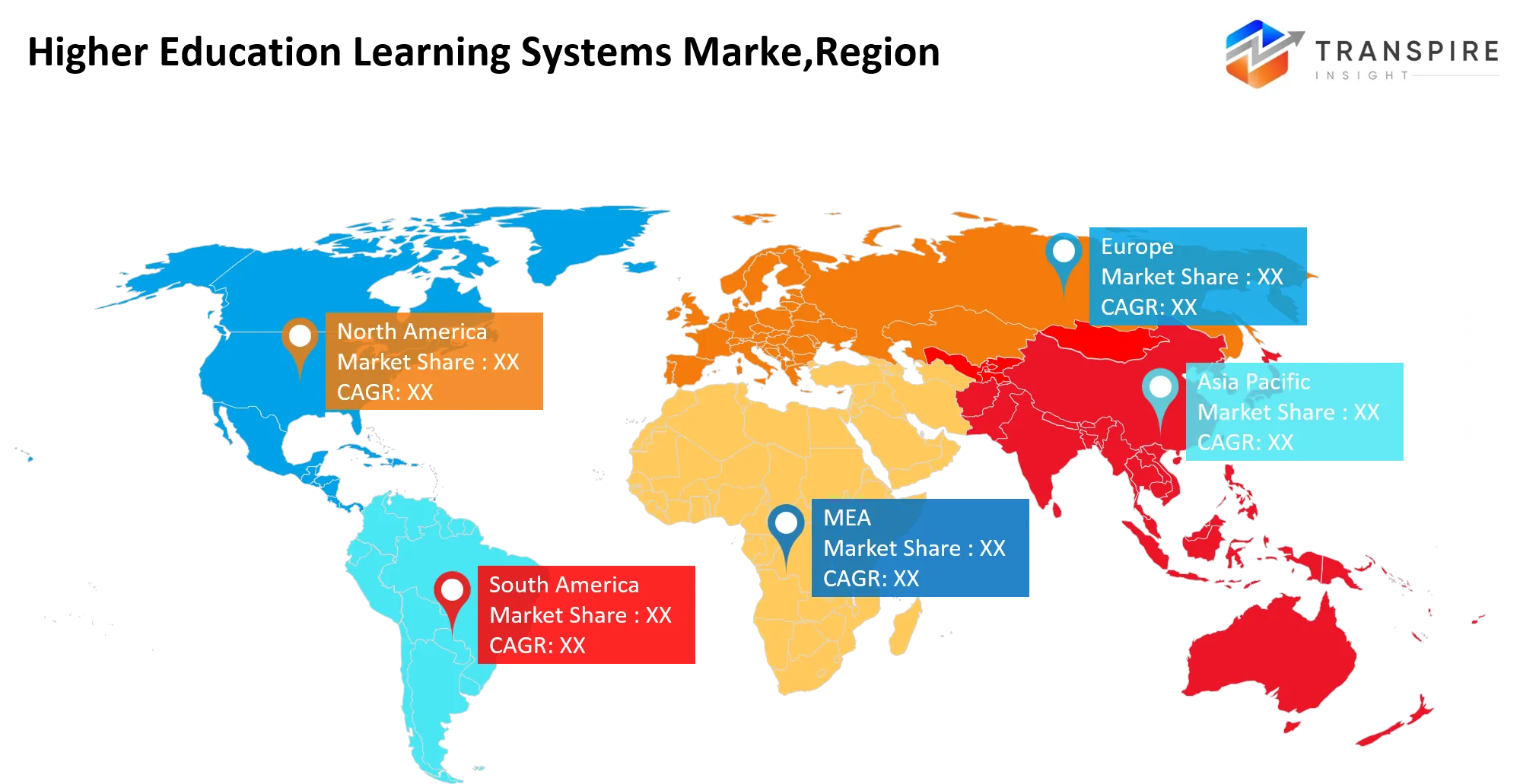
North America holds the lead position in the market share of 39.5%, aided by a mature digital education platform and extensive institutional experience with learning platforms. The universities and colleges in the region have adopted technologies for online courses, analytics, cloud services, and integrated student solutions. The presence of an established technology landscape and mature software vendors will aid the adoption and product development process in the region. Future investments in AI-enabled education and support will continue to make the region significant.
In May 2026, University of Maine System announced its plans to adopt ChatGPT Edu to serve the needs of the learners, faculty, and administrators starting from July 1, 2026. The purpose of this program is to facilitate learning, teaching, and research processes through AI technology as part of the growing need for an AI learning system in higher education.
Europe
Europe constitutes 27.0% of the market, owing to the presence of established higher education institutions, cross-border academic activities, and continued investment in digital learning infrastructure. The institutions in Europe are evaluating learning platforms that will be capable of handling multiple languages, accessibility needs, and data protection regulations. An existing campus infrastructure and the long procurement process in institutions will help sustain demand; however, integration and compliance will increase the implementation time. Vendors who offer reliable performance, flexible configuration, and data management will be able to compete in Europe.
In September 2025, University of Manchester implemented Canvas by Instructure in its learning environment, switching from the existing platform of Blackboard Learn to enhance its course delivery and improve the learning experience of its students.
Asia Pacific
Asia Pacific accounts for 24.0% .the fastest-growing region with a 16.2% CAGR. Increasing digital education infrastructure, increasing mobile learning adoption, and the requirement to cater to large, geographically dispersed student populations have opened up avenues for the platform providers. There is an increasing trend towards scalable cloud-based offerings, online courses, and academic services enabled through AI technology
In September 2026, the University of New South Wales announced its collaboration with D2L to adopt the Brightspace Learning Management System that will be used by more than 80,000 of its students.
Who are the Key Players in the Higher Education Learning Systems Market and how do they compete?
The market for higher education learning systems is highly competitive. Since a key consideration for purchasing decisions is platform functionality and ease of use, and the amount of support needed for implementation, competition is primarily between solution providers of commercial offerings, open source platforms, and specialist software vendors. Integrating AI and analytics capabilities can also provide differentiation, with other factors being integration costs and compatibility with existing systems. Instructure's competitive differentiation lies in its Canvas product, which encompasses course administration, educator satisfaction, and connections to third-party education systems. Its institutional growth approach is exemplified in its news that these firms battle it out along a variety of axes - from customisation and academic-specific features to the level of integrated enterprise services. The future growth of these companies will be increasingly influenced by results, quality of execution and the capacity to integrate learning into campus systems.
Higher Education Learning Systems Market companies
- Blackboard
- Instructure
- D2L
- Moodle
- Anthology
- Oracle
- Microsoft
- SAP
- Ellucian
- Canvas
- Coursera
- Pearson
- McGraw Hill
- Infor
|
Company |
Est. Revenue Share Range |
Key Offerings |
Strategic Positioning |
Geographic Strength |
Technology Focus |
|
Instructure |
Estimated 8–14% |
Canvas LMS, Canvas Studio, Canvas Catalog, learning analytics |
LMS leadership through scalable institutional adoption |
North America, Europe, Asia Pacific |
Cloud-native LMS, AI-assisted learning, open integrations |
|
Anthology |
Estimated 6–12% |
Blackboard Learn, Blackboard LMS tools, student success solutions, academic analytics |
Established institutional relationships through integrated learning solutions |
North America, Europe, Middle East |
AI-enabled learning, accessibility, learning analytics |
|
D2L Corporation |
Estimated 4–8% |
Brightspace LMS, Creator+, Performance+, learning analytics |
Personalized learning with strong institutional support |
North America, Europe, Asia Pacific |
Adaptive learning, AI capabilities, competency-based education |
|
Moodle |
Estimated 3–7% |
Moodle LMS, Moodle Workplace, MoodleCloud, plugins |
Open-source flexibility and extensive customization |
Europe, Asia Pacific, Latin America |
Modular architecture, open-source development, interoperability |
|
Ellucian |
Estimated 5–10% |
Banner, Colleague, Ellucian Student, Ellucian Experience |
Specialized higher education administration and student lifecycle management |
North America, Europe, Middle East |
SaaS platforms, AI-enabled services, data integration |
|
Oracle |
Estimated 3–7% |
Oracle Student Cloud, PeopleSoft Campus Solutions, Oracle Analytics |
Enterprise-scale student administration and institutional integration |
North America, Europe, Asia Pacific |
Enterprise cloud, analytics, workflow automation |
|
Microsoft |
Estimated 3–6% |
Teams for Education, Microsoft 365 Education, Azure, Power BI |
Ecosystem-driven education technology and cloud integration |
North America, Europe, Asia Pacific |
Cloud collaboration, AI assistants, learning analytics |
|
|
Estimated 2–5% |
Google Workspace for Education, Classroom, Google Meet, Gemini for Education |
Accessible collaboration tools for digital learning environments |
North America, Asia Pacific, Europe |
Generative AI, cloud collaboration, connected learning |
|
PowerSchool |
Estimated 2–5% |
Schoology Learning, assessment solutions, learning analytics |
Education platform expansion through established institutional relationships |
North America, Europe, selected international markets |
LMS integration, assessment analytics, data-driven instruction |
|
Pearson |
Estimated 2–5% |
MyLab, Mastering, Revel, digital learning platforms |
Digital courseware differentiation through content and assessment |
North America, Europe, Asia Pacific |
Adaptive courseware, digital assessment, personalized learning |
Recent Development News
In April 2026, Simple Higher Ed introduced Simple TA. The AI teaching assistant enables course content, syllabi, and learning management system material to serve as a work engine that helps students succeed in course-aligned ways. This marked the beginning of experimentation with AI tuition assistants as a seamless part of the student experience, rather than as stand-alone services.
In July 2025, Honour Education secured USD 38M in Series A funding. The investment was aimed at helping finance its learning platform and other solutions, including skills development, credentialed learning, and leadership development. Despite its focus on corporate learning, it is likely to have attracted investor support because of its links to structured learning and development.
https://www.honor.education/blog/series-a-funding?utm_source
What Strategic Insights Define the Future of the Higher Education Learning Systems Market?
The market is evolving toward integrated educational platforms with elements of course delivery, management, analysis, and AI support. The major challenge for providers is not to offer new features but to prove how they help academic processes and support students. Educational institutions are going to select software products that will be easy to integrate within the current process, keep students' data confidential and be accessible to all. The silent danger is that the absence of data and the poor integration of AI-enabled solutions can bring about unreliable suggestions, additional complexity, and the loss of trust. High costs of implementation can prevent colleges from receiving benefits from digitalisation. One of the promising directions for the future is to develop mobile applications for institutions of the Asia-Pacific region with high regional growth, based on the given data. Providers should concentrate on integration, responsible governance, professional development of faculty members, and results in order to create their products. Universities have to evaluate the total cost of ownership, confidentiality of information, accessibility and integration in order to sign contracts with vendors.
System Type
- Learning Management Systems
- Student Information Systems
- Learning Analytics
- Virtual Learning Environments
- Assessment Systems
- Course Management Systems
- Collaboration Platforms
- Others
Deployment
- Cloud
- On-Premise
- Hybrid
- SaaS
- Private Cloud
- Public Cloud
- Hosted
- Others
Application
- Course Management
- Student Assessment
- Virtual Classrooms
- Student Engagement
- Academic Analytics
- Content Management
- Administration
- Others
Institution Type
- Universities
- Colleges
- Community Colleges
- Technical Institutes
- Online Universities
- Research Institutions
- Vocational Institutions
- Others
Learning Mode
- Online
- Blended
- Hybrid
- In-Person
- Self-Paced
- Instructor-Led
- Distance Learning
- Others
End User
- Students
- Faculty
- Administrators
- Researchers
- IT Staff
- Academic Advisors
- Management
- Others
Frequently Asked Questions
Find quick answers to common questions.
The higher education learning systems market size was valued at USD 9.20 Billion in 2025 and is poised to reach USD 27.51 Billion by 2033, expanding at a 14.69% CAGR.
Key segments for the higher education learning systems market are System Type (Learning Management Systems, Student Information Systems, Learning Analytics, Virtual Learning Environments, Assessment Systems, Course Management Systems, Collaboration Platforms, Others)Deployment (Cloud, On-Premise, Hybrid, SaaS, Private Cloud, Public Cloud, Hosted, Others)Application (Course Management, Student Assessment, Virtual Classrooms, Student Engagement, Academic Analytics, Content Management, Administration, Others)Institution Type (Universities, Colleges, Community Colleges, Technical Institutes, Online Universities, Research Institutions, Vocational Institutions, Others)Learning Mode (Online, Blended, Hybrid, In-Person, Self-Paced, Instructor-Led, Distance Learning, Others)End User (Students, Faculty, Administrators, Researchers, IT Staff, Academic Advisors, Management, Others)
Growth is primarily driven by increasing adoption of digital education, rising demand for flexible and remote learning, integration of artificial intelligence in education, growing investments in cloud-based learning platforms, and the need for efficient student engagement, assessment, and academic management systems.
The market is led by major manufacturers including Blackboard, Instructure, D2L, Moodle, Anthology, Oracle, Microsoft, SAP, Ellucian, Canvas, Coursera, Pearson, Google, McGraw Hill, and Infor
North America accounts for 39.5% of the higher education learning systems market, owing to the sophisticated digital infrastructure, prevalence of e-learning platforms, substantial investment in educational technology, and the presence of leading technology vendors. The robust university system and rising demand for technology-enabled learning solutions add to North America’s market dominance.
The business opportunities in the higher education learning system market are the increasing use of learning platforms enabled by AI technology, the expansion of cloud-based learning management systems, rising demand for customized learning programs, virtual classrooms, and investment in digital education infrastructure in emerging economies.
- Blackboard
- Instructure
- D2L
- Moodle
- Anthology
- Oracle
- Microsoft
- SAP
- Ellucian
- Canvas
- Coursera
- Pearson
- McGraw Hill
- Infor
About the Authors

Mayur Shinde
I am Mayur Shinde, a Senior Research Analyst at Transpire Insight, specializing in the Automotive & Transportation and Information & Communication Technology (ICT) Industry. My work focuses on analyzing emerging market trends, technological advancements, competitive landscapes, and industry developments to deliver accurate, data-driven insights. I am passionate about transforming complex market information into clear, actionable content that helps businesses, professionals, and decision-makers stay informed and make confident strategic decisions.

Chakradhar Khansole
Chakradhar serves as the Research Director at Transpire Insight, bringing over 8 years of experience in technology, innovation, and strategic market intelligence. He specializes in transforming complex market data into actionable business insights that enable organizations to make informed, growth-oriented decisions. Recognized for his strategic vision and analytical expertise, Chakradhar leads high-impact research initiatives, delivering comprehensive market assessments, competitive intelligence, and forward-looking industry analysis.
Recently Published Reports
-
Apr 2026
3D Optical Profiler Market
3D Optical Profiler Market Size, Share & Analysis Report By Type (Desktop 3D Optical Profiler, and Portable 3D Optical Profiler), By Technology (Confocal Technology, and White Light Interference), By End-Use Industry (Manufacturing, Research Institutions, Automotive, Aerospace and Defense, Medical Devices, and Other), and Geography (North America, Europe, Asia-Pacific, Middle East and Africa, South and Central America), 2021 - 2031
-
Apr 2026
Depth Sensor Market
Depth Sensor Market Size, Share & Analysis Report By Type (Infrared Depth Sensors, Time-of-Flight (ToF) Sensors, Stereo Vision Sensors, Structured Light Sensors, Ultrasonic Depth Sensors), By Application (Automotive, Robotics, Gaming, Consumer Electronics, Industrial Automation, Healthcare, Security & Surveillance, Others), By End Users (Automotive Manufacturers, Consumer Electronics Companies, Healthcare Providers, Industrial Companies, Security Agencies, Gaming Companies, Robotics Companies, Others), and Geography (North America, Europe, Asia-Pacific, Middle East and Africa, South and Central America), 2021 – 2031
-
Apr 2026
Digital Manufacturing Market
Digital Manufacturing Market Size, Share & Analysis Report By Component (Hardware, Software, and Services), By Technology (Robotics, 3D Printing, Internet of Things (IoT), and Others), By Application (Automotive and Transportation, Aerospace and Defense, Consumer Electronics, Industrial Machinery, and Others), By Process Type (Computer-Based Designing, Computer-Based Simulation, Computer 3D Visualization, Analytics, and Others), and Geography (North America, Europe, Asia-Pacific, Middle East and Africa, South and Central America), 2021 – 2031
-
Apr 2026
Digital Visa Services Market
Digital Visa Services Market Size, Share & Analysis Report By Type (Individual Travelers, Group Travelers), By Application (Tourism, Business Travel, Others), and Geography (North America, Europe, Asia-Pacific, Middle East and Africa, South and Central America), 2021 – 2031