Global Radiology Structured Reporting Automation Market Summary:
As per Transpire Insight Analysis, the global radiology structured reporting automation market size is estimated at USD 1.08 Billion in 2025 and is anticipated to reach USD 2.55 Billion by 2033, growing at a CAGR of 11.37% from 2026 to 2033. Driven by rising imaging volumes and radiologist shortages, hospitals are adopting automation to speed reporting and improve consistency.
The space for Global Radiology Structured Reporting Automation is moving away from free-text dictated reports to reporting post-processing software that captures, structures, and auto-populates findings into clinical summary templates. Over the past 3-5 years, the market has matured from using rigid drop-down screen interfaces to smarter, more fluid workflows enabling faster and more consistent reporting. The structural foundation that has underpinned this transition has been the inflow of pressure for interoperability and 'standardised' clinical metrics that have brought reporting tools in line with reimbursement and compliance mandates. Concurrently, critical radiologist burnout has fuelled the operational imperative for faster, less repetitive reporting, promoting adoption by signalling that manual transcription is a bottleneck that hampers diagnosis, delays scan throughput and delays reimbursement. Healthcare software investment budgets are gradually shifting away from legacy imaging systems toward automated reporting solutions, whether for public or private care delivery.
Global Radiology Structured Reporting Automation Market Size & Forecast:
- Global Market Size 2025: USD 1.08 Billion
- Expected Market Value (2033): USD 2.55 Billion
- Forecast CAGR (2026–2033): 11.37%
- Leading Region in 2025: North America(42%)
- Fastest Growing Region: Asia Pacific(23% & CAGR 19.5%)
- Key Company Profiles: GE HealthCare, Siemens Healthineers, Philips Healthcare, Fujifilm Healthcare, Nuance Communications, Agfa HealthCare, Sectra, Intelerad, Bayer Radiology, Oracle Health, Aidoc, Rad AI, Merge Healthcare, Canon Medical Systems, IBM Watson Health.

Key Global Radiology Structured Reporting Automation Market Insights:
The world of dictation is moving from standalone, text-based dictation to comprehensive multimodal clinical data platforms. This behavioural evolution adds diagnostic intelligence to the workflow, with standardised, real-time diagnostics directly in the radiologist's reading environment.
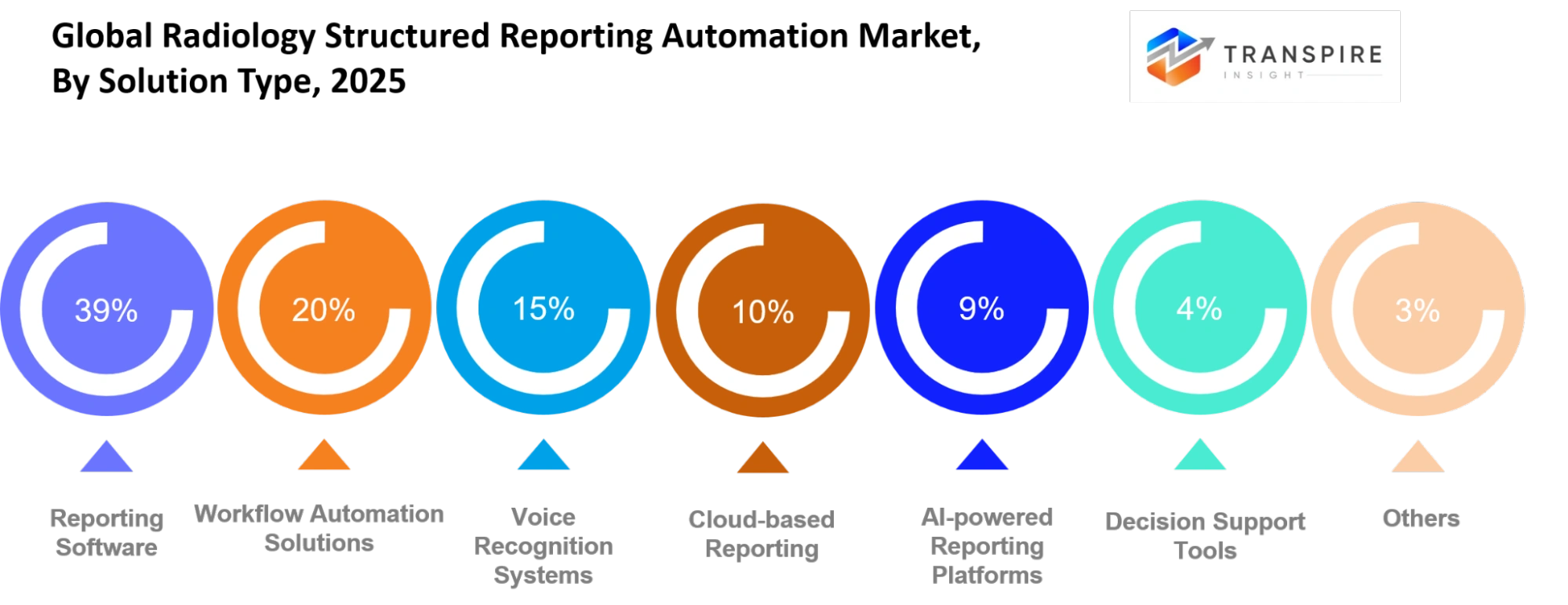
- Reporting Software (39%): GE HealthCare is making strides in this core business area with the introduction of adaptive macro templates, which automate the routine entry of anatomical data.
- Workflow Automation (20%): Siemens Healthineers' smart worklist prioritisation engines help to distribute complex scans dynamically depending on the clinical urgency in real-time.
- Voice Recognition (15%): Nuance Communications' ambient conversational AI automatically converts unstructured clinical speech to structured, compliant reports.
- Cloud-based Reporting (10%): Sectra's cloud strategy is based on moving enterprise radiology infrastructure to high-throughput, secure software-as-a-service (SaaS) environments.
- The impressive AI Platform Expansion (9%) generates customised impression statements from existing text automatically.
- Decision Support (4%): Philips Healthcare integrates real-time, evidence-based diagnostic guidelines into ongoing clinical interpretation and reporting processes.
- Other Solutions (3%): Vendors specialising in specific niche reports that are tailored to specific departments within complex multi-disciplinary clinical trials.
- Regional Dominance: North America holds a 42% share, with the providers moving towards end-to-end automated diagnostic reporting systems very quickly.
- European Penetration: European healthcare networks are prioritising strict regional data standardisation on enterprise hospital infrastructures, holding 28% market share.
What are the Key Drivers, Restraints, and Opportunities in the Global Radiology Structured Reporting Automation Market?
Driver:
The desire to reduce reporting variability and accelerate turnaround times as imaging volume jumps and radiologist shortages push workflow capacity. Driven by a dramatic rise in case volume and an extended wave of physician retirements, this gap has encouraged hospitals to implement structured reporting to protect throughput and revenue capture. Automated, protocol-guided report content minimises time-consuming editing, enhances report accuracy, and facilitates billing and compliance tasks, driving platform purchase decision frequency and recurring software license revenue.
In June 2026, Mosaic Clinical Technologies launched Mosaic Reporting, an AI-native radiology reporting platform built to construct standardized clinical reports in real time as radiologists interpret medical images.
Restraint:
The integration difficulty situation is exacerbated as radiology departments still work within compartmentalised PACS, RIS, and EHR systems, which delay and add cost to deployment. This problem is compounded in proprietary hospital systems, where the differentiation of legacy hospital systems enforces long customization lead times for standardising clinical data. This causes buyers to encounter ongoing technological frictions and slow adoption cycles.
Opportunity:
The biggest opportunity is in AI–integrated cloud reporting that uses multimodal models to assemble live imaging scans with prior imaging data to automatically populate a draft for fast, accurate, and consistent reporting. North American academic medical centres are currently at the forefront of this movement, using more comprehensive platforms than just basic templates that drive incremental enterprise value for the publisher with recurring subscription fees, deeper workflow lock-in, and penetration throughout hospital networks; it expands the addressable market by unbundling structured reporting into a scalable layer of clinical intelligence. In June 2026, Microsoft and Cortechs.ai partnered to integrate quantitative imaging platforms directly into the PowerScribe One ecosystem, embedding automated insights into daily workflows.
What Has the Impact of Artificial Intelligence Been on the Global Radiology Structured Reporting Automation Market?
Artificial intelligence (AI) is transforming radiology structured reporting, automating multiple manual steps and translating unstructured dictation and pixel-finding scans into normalised searchable fields critical to becoming a data-driven enterprise hospital. It interprets hard-to-understand or variable reports, converts stand-alone data into clinical context, automates report generation, and "learns" vocabularies to facilitate normalised, for-all-radiologists, for-all-sites, and for-all-care- settings standards. Supervised machine learning further closes reporting loops by automating audit correction, anticipating likely, unattended impressions; automatically levels prioritised abnormalities for rapid triage and short-circuits time-consuming editing across imaging disciplines. These features cut reporting editing cycles, accelerate report turnaround, and enable reporting metrics to be more easily searched, mined, and optimised enterprise-wide. AI has elevated structured reporting from a "comfort feature" to a core asset of radiology enterprise data Operations. Adoption remains limited by the expense of existing image management systems and technical accuracy deficiencies, which are more apparent in complex, reader, site, and modality-specific language.
Key Global Radiology Structured Reporting Automation Market Trends:
The industry is moving from a template-driven approach to populating the template to a more dynamic and ambient approach to clinical documentation that captures physician insights in context. This behavioural shift simplifies diagnostics and improves reporting efficiency.
- Ecosystem Consolidation: Radiologists are giving up on standalone dictation tools for multi-modal reporting ecosystems.
- Workflow Design: Rigid and manual menu selections are being replaced by automated and eye-tracking templates.
- Procurement Shift: Hospital procurement is moving from on-premises, capital-intensive licensing to flexible cloud SaaS licensing.
- Data Synthesis: Clinical data ingestion is moving beyond just image pixels to patient data profiles.
- Quality Assurance: The quality assurance process is shifting from a post-audit to real-time compliance validation.
- Reimbursement Compliance: From attaching billing codes to detailed value-based reporting for regulatory tracking.
- Workflow Concurrency: From sequential reading workflows to concurrent AI-assisted interpretation workflows.
- Change in Report Delivery: Reports are shifting from text-based to interactive multimedia diagnostic portals.
Global Radiology Structured Reporting Automation Market Segmentation
By Solution Type:
Reporting Software dominates with 39%, as it replaces free-text reporting using template creation for consistent data fields and EOIS analysis. Workflow Automation Solutions comprise 20%: camera worklist management, replacing manual inefficiencies at radiology facilities. Voice Recognition Systems comprise 15%, evolving towards ambient context extraction.
Cloud-based Reporting comprises 10%, bringing the low-capex model to new centres.
AI-based Reporting Platforms at 9% are the fastest growing, with 18.7% CAGR; now moving towards auto-generated drafts and workflow intelligence.
By Deployment:
Cloud-based, SaaS, and hybrid deployments are becoming appealing as they offer reduced IT expenditure, scalability, and mobility on multi-site radiology enterprise networks. On-premise solutions, though still in use in institutions with the highest data control and sovereignty requirements, are losing market share. Hybrid and enterprise architectures combine legacy storage with cloud computing, and increasingly, the 'AI-enabled' unified platforms are emerging as a combination of a specialist 'layer' for real-time clinical intelligence with accelerated workflow modernisation.
By End User:
Hospitals are the early volume adopters as they generate the highest volumes and require rapid turnaround, emergency throughput, and automated coding. Diagnostic imaging centres and speciality clinics are the next early adopters to enhance scan capacity utilisation and safeguard margins with quick software. Academic Medical Centres and research institutions use structured data for analytics and clinical trials, and accordingly, teleradiology services offering remote reads in a distributed network rely on structured data to support tight remote timing demands.
By Application:
Diagnostic radiology continues to dominate since it is largely used for routine, high-volume applications and standardised departmental triage. Oncology and cardiac imaging constitute major value segments as they derive most benefit through serial comparison, tumour evaluation, and treatment control. Neurology, orthopaedic, and emergency imaging have experienced increasing use through demand for quick, accurate measurements in time-critical treatment. Pediatric and other niche applications generally continue to flourish through customising reporting parameters for specific patient groups and clinical requirements.
By Technology:
Natural Language Processing (NLP) and speech recognition provide fundamental technologies to transform clinician dictation of clinical notes into structured data fields and more rapid management of documentation. Artificial intelligence and machine learning applications are currently growing at the fastest rate as they enable predictive pattern matching, segmentation, and self-generation of report drafts. Structured templates continue to support standardisation whilst clinical decision support overlays the text. All these technologies are trending towards a 'single stack' of automation.
What are the Key Use Cases Driving the Global Radiology Structured Reporting Automation Market?
High-volume hospital and diagnostic imaging centre report production is the primary use case where reporting software aided by AI platforms automatically pulls out measurements, attaches images for identifying features, and presents in standardised formats.
This remains the leading use case as faster turnarounds and more complete reports stretch billing and clinical resources. Oncology and cardiac imaging utilisation is increasing as well, with automated referencing of tumour size and frame data along with prior images, enabling longitudinal correlates and more reproducible end-user workflows.
More mature applications are beginning to appear in the emergency teleradiology space as decision support overlay techniques, such as intracranial event detection, can be used to optimize stroke workflows.
|
Report Metrics |
Details |
|
Market size value in 2025 |
USD 1.08 Billion |
|
Market size value in 2026 |
USD 1.20 Billion |
|
Revenue forecast in 2033 |
USD 2.55 Billion |
|
Growth rate |
CAGR of 11.37% from 2026 to 2033 |
|
Base year |
2025 |
|
Historical data |
2021 - 2024 |
|
Forecast period |
2026 - 2033 |
|
Report coverage |
Revenue forecast, competitive landscape, growth factors, and trends |
|
Regional scope |
United States; Canada; Mexico; United Kingdom; Germany; France; Italy; Spain; Denmark; Sweden; Norway; China; Japan; India; Australia; South Korea; Thailand; Brazil; Argentina; South Africa; Saudi Arabia; United Arab Emirates |
|
Key company profiled |
GE HealthCare, Siemens Healthineers, Philips Healthcare, Fujifilm Healthcare, Nuance Communications, Agfa HealthCare, Sectra, Intelerad, Bayer Radiology, Oracle Health, Aidoc, Rad AI, Merge Healthcare, Canon Medical Systems, IBM Watson Health. |
|
Customization scope |
Free report customisation (country, regional & segment scope). Avail customised purchase options to meet your exact research needs. |
|
Report Segmentation |
By Solution Type (Reporting Software, AI-powered Reporting Platforms, Voice Recognition Systems, Workflow Automation Solutions, Cloud-based Reporting, Template Management Software, Decision Support Tools, Others); By Deployment (Cloud-based, On-premise, Hybrid, SaaS Platforms, Enterprise Systems, AI-integrated Platforms, Others); By End User (Hospitals, Diagnostic Imaging Centers, Specialty Clinics, Academic Medical Centers, Research Institutes, Teleradiology Providers, Others); By Application (Diagnostic Radiology, Oncology Imaging, Cardiac Imaging, Neurology Imaging, Orthopedic Imaging, Emergency Imaging, Pediatric Imaging, Others); By Technology (Natural Language Processing, Artificial Intelligence, Speech Recognition, Machine Learning, Structured Templates, Clinical Decision Support, Others). |
Which Regions are Driving the Global Radiology Structured Reporting Automation Market Growth?
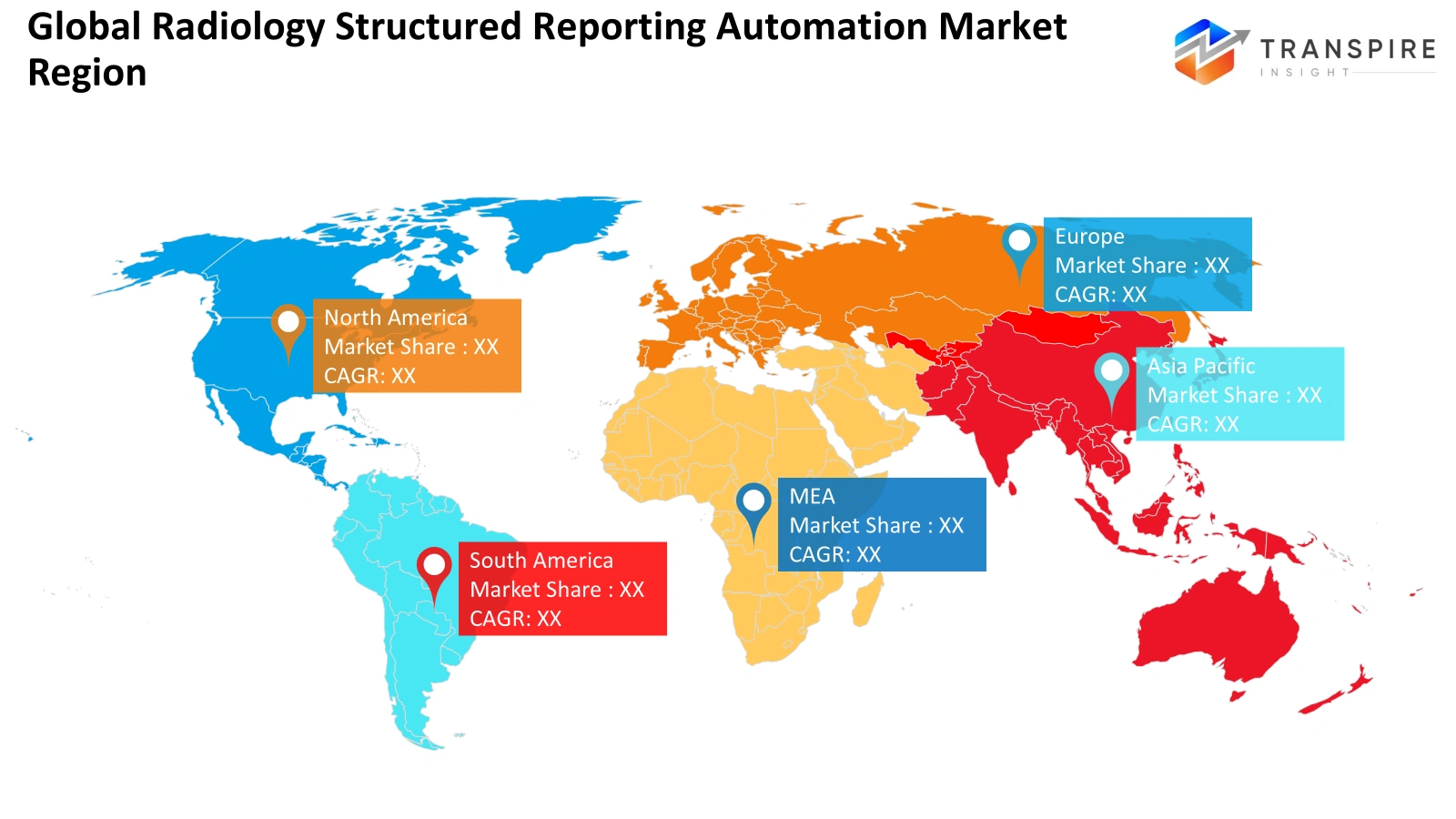
North America owns the market with a 42% share, driven by robust enterprise healthcare IT adoption, a mature PACS/RIS base, and high imaging levels. Prohibitive reporting mandates and stomach reimbursement incentives result in structured reporting becoming a compliance issue. Heavy radiologists in the US outnumber those around the globe; furthermore, this causes hospitals to lean on automated systems to preserve throughput and quality. All these amplify enterprise demand for reporting automation platforms and accelerate the replacement cycle across hospitals and imaging groups. In June 2026, Aidoc secured U.S. FDA Breakthrough Device Designation for its AI software that automatically generates preliminary, structured reports for chest radiographs, addressing radiologist throughput needs.
Europe has a 28% share of the market, with standards-driven legacy systems, continuity in digitalisation and proven interoperability standards. Unlike in North American regions, growth in Europe is led by institution-driven policies, regulated clinical pathways, and a sharp rise in public healthcare investments rather than tight software upgrades. This policy-based and regulatory framework guarantees short-term market stability, timely software procurement, and sustainable long-term growth for academia & healthcare organisations.
In May 2026, the European Innovation Council and SMEs Executive Agency (EISMEA) launched the UNITE digital health initiative, deploying €3,788,000 in regional and co-funded public investments to transition fragmented health data into scaled, interoperable clinical workflows across multiple EU territories.
Asia Pacific is the fastest-growing region with a 23% share, growing at a 19.5% CAGR. Growth is driven by new hospital builds operating digital reporting from inception, digital health investments, modern imaging networks, 'cloud-ready' workflow adoption, and a rapidly expanding teleradiology market. As enterprise imaging and AI documentation adoption is still in the early stages, the region has significant scope to scale faster. Latin America and ME&A are also emerging markets with private providers investing in modernising legacy imaging networks.
In March 2026, theEsaote Group launched a new cloud-native AI platform to boost regional efficiency. They introduce breakthroughs in ultrasound, MRI, and Enterprise Imaging.
Who are the Key Players in the Global Radiology Structured Reporting Automation Market, and how do they compete?
The global market encounters fierce competition amongst established imaging conglomerates, enterprise IT vendors, and nimble, specialised AI start-up firms. Mergers and acquisitions (M&A) are accelerating as major players acquire niche software developers that develop integrated software, aggregating diagnostic reporting within a comprehensive end-to-end system. Siemens Healthineers exemplifies the innovation playbook, yet through the presence of intelligence in native imaging software that simplifies complex reports, resulting in blazingly fast innovation, which manifests as no-click reporting. In contrast, Nuance Communications Inc, exemplifies the playbook of cost-leverage and scale, where the use of their ubiquitous speech-to-text cloud footprint built around allied ambient documentation features manifested in upselling to enormous hospital systems. Niche playbooks run commonly encountered by Sectra, where a focus on best-of-breed TCO-optimized enterprise imaging and Teleradiology platform, is differentiated through high-quality customer experience levels and occurs by deterring sales to multi-site public healthcare institutions for such premium quality only. Finally, Rad AI is disrupting the market via extremely specialised, browser-blind, generative text automations and is growing the fastest by directly integrating via API into legacy radiological settlement.
Key Players are:
- GE HealthCare
- Siemens Healthineers
- Philips Healthcare
- Fujifilm Healthcare
- Nuance Communications
- Agfa HealthCare
- Sectra
- Intelerad
- Bayer Radiology
- Oracle Health
- Aidoc
- Rad AI
- Merge Healthcare
- Canon Medical Systems
- IBM Watson Health
Recent Development News
In March 2026, RadNet announced a major €230 million acquisition of the prominent French radiology AI developer, Gleamer, to fold it into its digital health division. This strategic acquisition integrates Gleamer's extensive X-ray, musculoskeletal, and chest imaging automation algorithms directly with RadNet's clinical workflows to scale AI-driven, automated template draft generation across its high-volume diagnostic centres.
Source: https://theimagingwire.com
In June 2026, Rad AI and Yale New Haven Health System (YNHHS) finalized a comprehensive enterprise infrastructure partnership to overhaul legacy reporting systems. Under this strategic deployment, the health system will roll out Rad AI's generative software across its 5 hospital campuses and 16 outpatient facilities to automatically generate clinical impressions and structured draft layouts for over 700,000 annual imaging exams.
Source: https://www.radai.com
What Strategic Insights Define the Future of the Global Radiology Structured Reporting Automation Market?
The industry is trending toward fully automated, context-sensitive reporting, with the software producing initial diagnostic drafts before the clinicians even open the study. This trend presents a hidden risk: nuanced algorithmic bias is likely to miss unique anatomical findings, increasing diagnostic (and litigation) risk for institutions, even as an important playing field develops around oncology-specific, template-driven worklists that cross-check previous exams in real time. To benefit from this second trend, vendors should move beyond point product sales to scalable, vendor-neutral orchestration environments that bring together multiple AI models in a single operator interface. This approach minimises fragmentation, streamlines deployment, increases outreach to more customers, and offers a logical subscription-based revenue opportunity.
The dominant strategic position now is cloud-first, integration-ready systems that can optimize workflow today while establishing a path toward greater AI adoption down the line.
Key Segmentations are:
By Solution Type
- Reporting Software
- AI-powered Reporting Platforms
- Voice Recognition Systems
- Workflow Automation Solutions
- Cloud-based Reporting
- Template Management Software
- Decision Support Tools
- Others
By Deployment
- Cloud-based
- On-premise
- Hybrid
- SaaS Platforms
- Enterprise Systems
- AI-integrated Platforms
- Others
By End User
- Hospitals
- Diagnostic Imaging Centers
- Speciality Clinics
- Academic Medical Centres
- Research Institutes
- Teleradiology Providers
- Others
By Application
- Diagnostic Radiology
- Oncology Imaging
- Cardiac Imaging
- Neurology Imaging
- Orthopaedic Imaging
- Emergency Imaging
- Pediatric Imaging
- Others
By Technology
- Natural Language Processing
- Artificial Intelligence
- Speech Recognition
- Machine Learning
- Structured Templates
- Clinical Decision Support
- Others
Regional Outlook
North America
- United States
- Canada
- Mexico
Europe
- Germany
- United Kingdom
- France
- Spain
- Italy
- Rest of Europe
Asia Pacific
- Japan
- China
- Australia & New Zealand
- South Korea
- India
- Rest of Asia Pacific
South America
- Brazil
- Argentina
- Rest of South America
Middle East & Africa
- Saudi Arabia
- United Arab Emirates
- South Africa
- Rest of the Middle East & Africa
Frequently Asked Questions
Find quick answers to common questions.
The global radiology structured reporting automation market size was valued at USD 1.08 Billion in 2025 and is projected to reach USD 2.55 Billion by 2033, growing at a 11.37% CAGR.
Key segments for the global radiology structured reporting automation market are By Solution Type (Reporting Software, AI-powered Reporting Platforms, Voice Recognition Systems, Workflow Automation Solutions, Cloud-based Reporting, Template Management Software, Decision Support Tools, Others); By Deployment (Cloud-based, On-premise, Hybrid, SaaS Platforms, Enterprise Systems, AI-integrated Platforms, Others); By End User (Hospitals, Diagnostic Imaging Centers, Specialty Clinics, Academic Medical Centers, Research Institutes, Teleradiology Providers, Others); By Application (Diagnostic Radiology, Oncology Imaging, Cardiac Imaging, Neurology Imaging, Orthopedic Imaging, Emergency Imaging, Pediatric Imaging, Others); By Technology (Natural Language Processing, Artificial Intelligence, Speech Recognition, Machine Learning, Structured Templates, Clinical Decision Support, Others).
Growth is primarily driven by acute global radiologist shortages and surging imaging volumes, forcing healthcare facilities to adopt automated workflows to eliminate manual data-entry bottlenecks and reduce physician burnout.
The global radiology structured reporting automation market is led by major manufacturers, including GE HealthCare, Siemens Healthineers, Philips Healthcare, Fujifilm Healthcare, Nuance Communications, Agfa HealthCare, Sectra, Intelerad, Bayer Radiology, Oracle Health, Aidoc, Rad AI, Merge Healthcare, Canon Medical Systems, and IBM Watson Health.
North America influences the market by holding a dominant 42% share, leveraging its robust healthcare IT infrastructure, stringent regulatory compliance mandates, and favourable private insurance reimbursement policies to dictate global software standards.
Commercial opportunities exist in integrating multi-modal generative AI into cloud infrastructure to automatically pre-populate nuanced diagnostic drafts and in developing specialized multi-organ oncology tracking templates for long-term subscription growth.
- GE HealthCare
- Siemens Healthineers
- Philips Healthcare
- Fujifilm Healthcare
- Nuance Communications
- Agfa HealthCare
- Sectra
- Intelerad
- Bayer Radiology
- Oracle Health
- Aidoc
- Rad AI
- Merge Healthcare
- Canon Medical Systems
- IBM Watson Health
About the Authors

Pankaj Ghogare Patil
I am Pankaj Ghogare Patil, a Senior Research Analyst at Transpire Insight, specializing in the Pharmaceutical, Chemicals & Materials, Healthcare IT, and Biotechnology industry. My expertise lies in conducting comprehensive market research, analyzing industry trends, evaluating competitive landscapes, and translating complex data into actionable insights. At Transpire Insight, I closely follow emerging technologies, regulatory developments, and market innovations to create accurate, well-researched, and informative content that helps businesses and professionals make informed decisions. I am committed to producing credible, evidence-based articles that reflect industry best practices while making technical topics accessible and valuable for a broad audience.

Chakradhar Khansole
Chakradhar serves as the Research Director at Transpire Insight, bringing over 8 years of experience in technology, innovation, and strategic market intelligence. He specializes in transforming complex market data into actionable business insights that enable organizations to make informed, growth-oriented decisions. Recognized for his strategic vision and analytical expertise, Chakradhar leads high-impact research initiatives, delivering comprehensive market assessments, competitive intelligence, and forward-looking industry analysis.
Recently Published Reports
-
Apr 2026
AI in Diabetic Retinopathy Market
AI in Diabetic Retinopathy Market Size, Share & Analysis Report By Type (Screening AI Systems, Diagnostic AI Systems, and Predictive AI Models), By Application Segment (Hospitals, Ophthalmology Clinics, Diagnostic Centers, and Research and Development), and Geography (North America, Europe, Asia-Pacific, Middle East and Africa, South and Central America), 2021 - 2031
-
Apr 2026
Psychometric Tests Market
Psychometric Tests Market Size, Share & Analysis Report By Type (Personality Tests, Ability/Aptitude Tests, Skill/Knowledge Tests, and Others), By Application (Talent Acquisition and Talent Management), and Geography (North America, Europe, Asia-Pacific, Middle East and Africa, South and Central America), 2021 – 2031
-
Apr 2026
Rare Biological Sample Collection Market
Rare Biological Sample Collection Market Size, Share & Analysis Report By Type (Isolation Kits & Reagent, Blood Collection Tubes, and Others), By Application (Oncology, Transcriptomics, Pharmacogenomics, and Others), and Geography (North America, Europe, Asia-Pacific, Middle East and Africa, South and Central America), 2021 – 2031
-
Jul 2026
Diabetic Retinopathy Market
Diabetic Retinopathy Market Size, Share & Analysis Report By Type (Proliferative Diabetic Retinopathy, and Diabetic Macular Edema (DME)), By Treatment Type (Anti VEGF Drug, Steroid Implants, Laser Surgeries, and Vitrectomy), and Geography (North America, Europe, Asia-Pacific, Middle East and Africa, South and Central America), 2021 – 2031
Our Clients