

Global Magnetic Flow Meters Market Size & Forecast:
- Global Magnetic Flow Meters MarketSize 2025: USD 10.45 Billion
- Global Magnetic Flow Meters MarketSize 2033: USD 16.389 Billion
- Global Magnetic Flow Meters MarketCAGR: 5.80%
- Global Magnetic Flow Meters MarketSegments: By Type (Inline Magnetic Flow Meters, Insertion Magnetic Flow Meters, Battery-powered Magnetic Flow Meters, Smart Magnetic Flow Meters, High-pressure Magnetic Flow Meters, Sanitary Magnetic Flow Meters, Others); By Application (Water & Wastewater Management, Chemical Processing, Food & Beverage Processing, Oil & Gas, Pharmaceuticals, Others); By End-User (Industrial Plants, Municipal Utilities, Chemical Companies, Food Manufacturers, Others); By Technology (Digital Flow Meters, Analog Flow Meters, IoT-enabled Flow Meters, AI-assisted Flow Monitoring, Others).
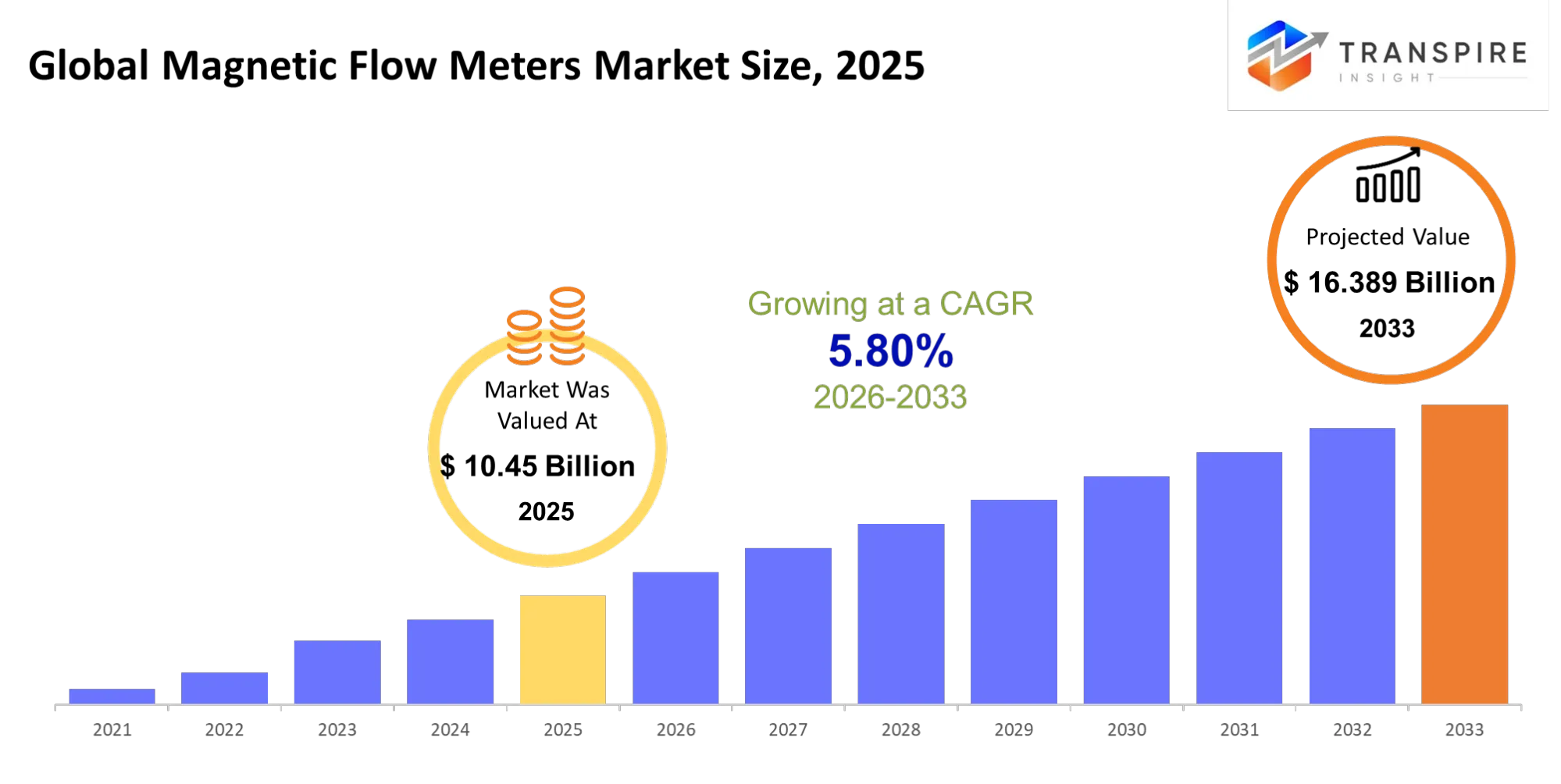
Global Magnetic Flow Meters Market Summary:
The Global Magnetic Flow Meters Market size is estimated at USD 10.45 billion in 2025 and is anticipated to reach USD 16.389 billion by 2033, growing at a CAGR of 5.80% from 2026 to 2033.
The Global Magnetic Flow Meters Market can be seen experiencing considerable growth due to the increasing need for accuracy and optimization in measurement, along with compliance considerations. There has been increasing usage of magnetic flow meters within applications ranging from pharmaceuticals, mining, pulp & paper and food manufacturing industries for measuring conductive liquids, which do not require maintenance. Within the past three to five years, the most important shift has been from analogue instruments to fully digital process-control ecosystems. This trend has pushed many users towards the replacement of old measurement technology with state-of-the-art flow meters that can facilitate the plant-wide centralization of management practices.
One important real-world trigger has been the increased regulations within industries on discharge control and environmental monitoring, especially those belonging to developed nations. This requirement has increased the demand for accurate flow measurement in production and purification processes.
Key Global Magnetic Flow Meters Market Insights:
Smart metering upgrades by ABB Ltd accounted for 53% of Water & Wastewater, which is a move towards real-time leakage detection in urban networks.
Chemical Processing holds 22% share, with Honeywell International Inc. developing more accurate hazardous fluid monitoring analytics to advance safety.
Food & Beverage represents 16% share, with KROHNE Group boosting hygienic sensor precision to meet more demanding contamination control requirements.
Other applications account for 9% share, demonstrating the beginning of small-scale industrial retrofitting projects that use low-cost magnetic meters.
The fastest growth is in IoT-enabled flow meters, with vendors pairing wireless communication modules with the flow meter for remote asset tracking and control, growing at 10.2% CAGR.
Increasingly, companies are building in self-diagnostic capabilities of devices to shorten manual inspection cycles and boost uptime efficiency in process industries.
Cloud-based monitoring platforms are gaining traction, allowing multiple locations of industrial operations to be monitored and visualised in a single place.
The integration with edge analytics is growing, and it is now possible to process flow data and make decisions on it at the point of the sensors.
The industrial users are moving towards a life cycle approach for procurement, which focuses on equipment performance rather than its initial price tag.
What are the Key Drivers, Restraints, and Opportunities in the Global Magnetic Flow Meters Market?
Drivers:
One of the key elements behind the Global Magnetic Flow Meters Market is the upgrading of the water and wastewater treatment systems. Smart water metering systems are adopted to conserve water, provide precise billing and comply with tough environmental laws, all being funded by governments and water utility companies. This development has become popular because of the need to measure water flow accurately, the shortage of water and ageing pipelines. The main advantage of magnetic flow meters is that they apply to conductive fluids and contain no moving components. The introduction of advanced monitoring systems at treatment facilities and distribution systems by utilities is driving growth in magnetic flow meter sales, which is a direct result of revenue gained in their recurring services. In January 2026, HPL Electric & Power Ltd. announced the launch of a new smart water metering solution called "Neeram Pulse". The company also inaugurated a new manufacturing facility to mass-produce multi-jet and ultrasonic water meters equipped with shielded magnetic coupling and AMR/AMI systems to support utilities.
Restraints:
One major constraint is the initial cost of installation, calibration and integration into the current industrial systems. Many facilities, especially small and medium-sized, will need to make changes to the piping configuration or control system to accept magnetic flow meters. This challenge is ongoing because many industries, including chemicals, food processing and municipal utilities, have areas of legacy infrastructure. Retrofitting projects are capital-intensive, which slows down replacement cycles and restricts the uptake of retrofitting in cost-sensitive markets.
Opportunities:
One of the significant opportunities is the connectivity of magnetic flow meters to Industrial Internet of Things (IIoT) platforms. Digital communication protocols and predictive diagnostics can give advanced devices real-time performance monitoring and asset management. The investments in Industry in the manufacturing hubs of Asia-Pacific are generating demand for connected flow measurement solutions that enable automation, predictive maintenance, and operational efficiency. Also, cloud-based analytics systems allow the operator to detect flow anomalies and improve the performance of the process from a distance, which minimises downtime and operational costs. The expansion of digital twins and smart factory ecosystems will also be expected to drive demand for intelligent magnetic flow meters with enhanced connectivity capabilities. In March 2026, Emerson announced an expansion of its Plantweb digital ecosystem in partnership with Aramco, utilizing AI-driven optimization and advanced IoT analytics to track resource use and flow processes.
What Has the Impact of Artificial Intelligence Been on the Global Magnetic Flow Meters Market?
Introduction of Artificial Intelligence (AI) technologies into the market of magnetic flow meters is revolutionising it because they allow to monitor flows intelligently, carry out automated process control, and analyse operational performance. Modern magnetic flow meters incorporate AI-based algorithms into their Industrial IoT solutions to be able to detect anomalies and optimise industrial processes automatically. As a result, companies involved in water treatment, production of chemical substances, medicines, and other products can increase the efficiency of their operations without the need for any human intervention.
Predictive maintenance is one of the most important features offered by AI technologies. By means of it, operators receive an opportunity to anticipate various disruptions, including the decline of the equipment or irregularities in flow. It is worth mentioning that the application of AI technologies improves operational performance by means of introducing adaptive calibration, automated diagnosis, and real-time decision-making into industrial processes. Nevertheless, one of the main limitations faced by industries is high integration costs, which arise when companies decide to combine their legacy solutions with AI-based systems.In April 2026, Wipro partnered with Kongsberg Digital to deploy AI-powered digital twin solutions for energy and utility operations. The partnership strengthened predictive monitoring, operational automation, and industrial asset optimisation capabilities.
Key Global Magnetic Flow Meters Market Trends:
- Magnetic flow meters are moving away from being standalone devices towards being connected assets integrated with the Industrial IoT and cloud monitoring platforms.
- Predictive maintenance features are proving to be a top priority for end users, surpassing the importance of reactive maintenance.
- Water companies are moving towards smart network management, with a focus on smart flow measurement system installations.
- Advanced diagnostics are being built into the system to minimise unplanned downtime and increase process reliability for manufacturers.
- Demand is shifting from flow measurement to flow application-specific solutions for the pharmaceutical, food processing and chemical sectors.
- Industries are adopting wireless communication technologies with a view to flexibility and cost reduction in deployment.
- Water flow analytics is being used more and more in the context of sustainability programs, aimed at optimising water use and resource efficiency.
- Concurrently, cybersecurity is emerging as a buying criterion for connected instrumentation applications as it gradually becomes ubiquitous across industrial facilities.
Global Magnetic Flow Meters Market Segmentation
By Type:
The Global Magnetic Flow Meters Market encompasses Inline, Insertion, Battery-powered, Smart, High-pressure, Sanitary, and other kinds of magnetic flow meters, which are used in various industrial flow conditions. The inline magnetic flow meter is the most dominant because of its high accuracy in continuous measurement and its use in the large pipeline system. Their growth is attributable to the increased demand for precise and low-maintenance measurement in the process industries, where downtime is expensive. Sanitary and smart types are becoming popular in regulated areas, and high-pressure models are used in heavy-duty applications. Future needs will look to modular and intelligent designs, which will minimize installation time and enhance operational efficiency.
By Applications:
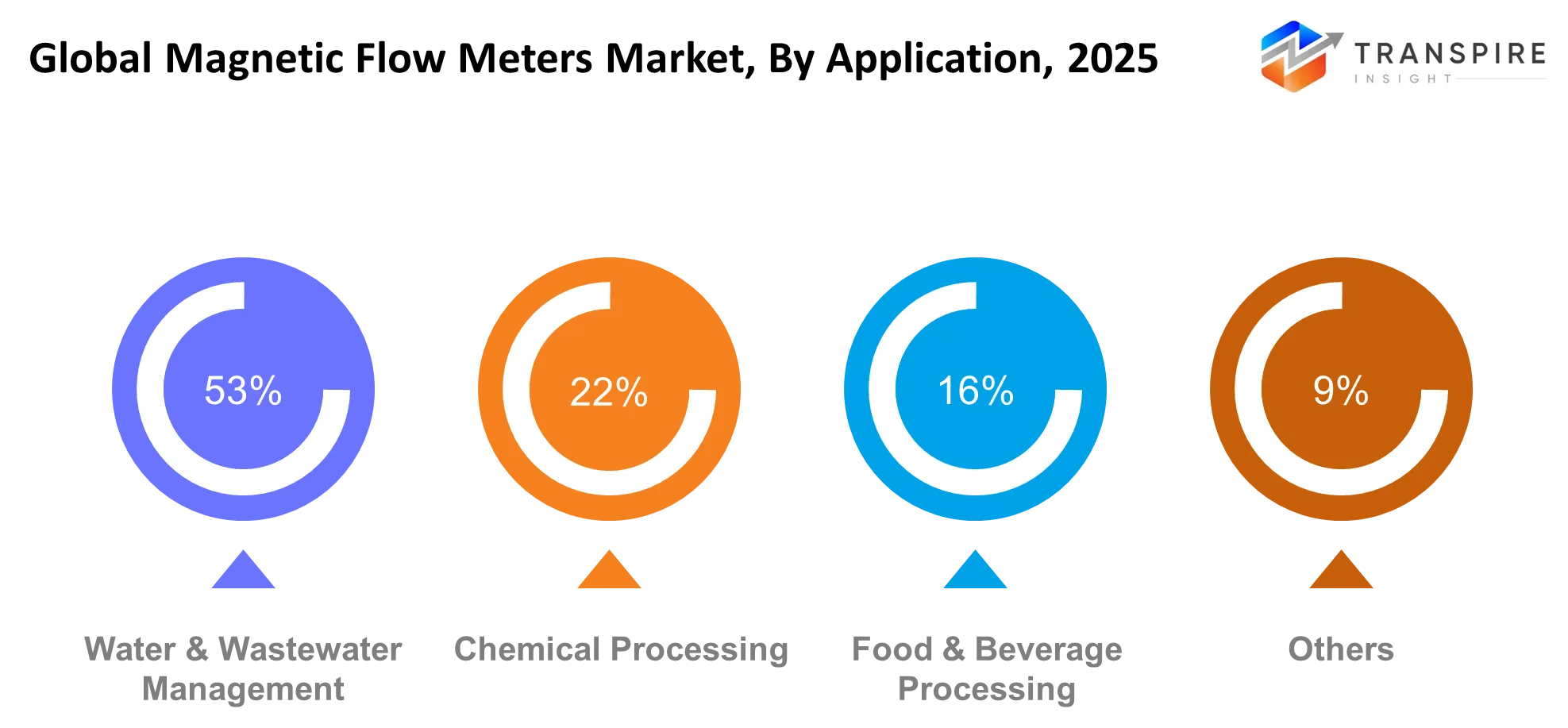
Water & Wastewater Management is the top market with 53% share, followed by Chemical Processing (22%), Food & Beverage (16%), and Others (9%). The need to control leakage, the need for urban infrastructure upgrades and the need for environmental compliance are all contributing to water dominance. The chemical and food industries rely on flow measurement for accuracy and hygiene to ensure safety and quality. They have noted growth associated with more stringent discharge monitoring regulations. Water reuse systems and investments in sustainability will be used to support future growth.
By End-User:
Industrial Plants and Municipal Utilities are the main contributors, as they have ongoing operations and the need to modernise their infrastructure. Chemical and food manufacturers follow, because of the accuracy requirements of processes. The increase in automation in industrial monitoring systems is supporting growth. Future demand will increase with the intelligent integration of the utility. Real-time monitoring systems are also getting more and more invested in, which is making decisions more efficient in big facilities.
By Technology:
The adoption of Industry is driving the fastest growth of IoT-enabled flow meters at 10.2% CAGR as digital flow meter systems replace analogue infrastructure. Real-time diagnostics and predictive maintenance are possible with AI-based monitoring. Future ecosystems will be completely cloud-connected and fully integrated. The integration of edge computing is also improving the speed of data processing directly at the device level, thereby decreasing latency during industrial operations.
What are the Key Use Cases Driving the Global Magnetic Flow Meters Market?
The magnetic flow monitoring in water and wastewater treatment applications forms the basic usage scenario behind the Global Magnetic Flow Meters Market. Water distribution utilities and waterworks facilities rely on magnetic flow meters to measure the flow rates of conductive liquids and provide accurate readings.
In addition, the growing list of applications includes chemical processing, the food & beverages industry, the pharmaceutical industry, pulp and paper, and power generation, among others. The magnetic flow meters help in managing processes and assuring quality in the above-mentioned industries.
Furthermore, the evolving list of scenarios can be attributed to advancements in smart infrastructure and digitalization in the industrial sector. Integration of magnetic flow meters into various digital platforms such as Industrial IoT, remote monitoring technologies, and predictive maintenance solutions is helping create new usage scenarios in the context of intelligent water infrastructure and sustainable industrial facilities.
|
Report Metrics |
Details |
|
Market size value in 2025 |
USD 10.45 Billion |
|
Market size value in 2026 |
USD 11.046 Billion |
|
Revenue forecast in 2033 |
USD 16.389 Billion |
|
Growth rate |
CAGR of 5.80% from 2026 to 2033 |
|
Base year |
2025 |
|
Historical data |
2021 - 2024 |
|
Forecast period |
2026 - 2033 |
|
Report coverage |
Revenue forecast, competitive landscape, growth factors, and trends |
|
Regional scope |
United States; Canada; Mexico; United Kingdom; Germany; France; Italy; Spain; Denmark; Sweden; Norway; China; Japan; India; Australia; South Korea; Thailand; Brazil; Argentina; South Africa; Saudi Arabia; United Arab Emirates |
|
Key company profiled |
Emerson Electric, ABB, Siemens, Yokogawa Electric, Endress+Hauser, KROHNE, Honeywell, Schneider Electric, Badger Meter, Azbil Corporation, OMEGA Engineering, Toshiba, Fuji Electric, McCrometer, Bürkert. |
|
Customization scope |
Free report customisation (country, regional & segment scope). Avail customised purchase options to meet your exact research needs. |
|
Report Segmentation |
By Type (Inline Magnetic Flow Meters, Insertion Magnetic Flow Meters, Battery-powered Magnetic Flow Meters, Smart Magnetic Flow Meters, High-pressure Magnetic Flow Meters, Sanitary Magnetic Flow Meters, Others); By Application (Water & Wastewater Management, Chemical Processing, Food & Beverage Processing, Oil & Gas, Pharmaceuticals, Others); By End-User (Industrial Plants, Municipal Utilities, Chemical Companies, Food Manufacturers, Others); By Technology (Digital Flow Meters, Analog Flow Meters, IoT-enabled Flow Meters, AI-assisted Flow Monitoring, Others). |
Which Regions are Driving the Global Magnetic Flow Meters Market Growth?
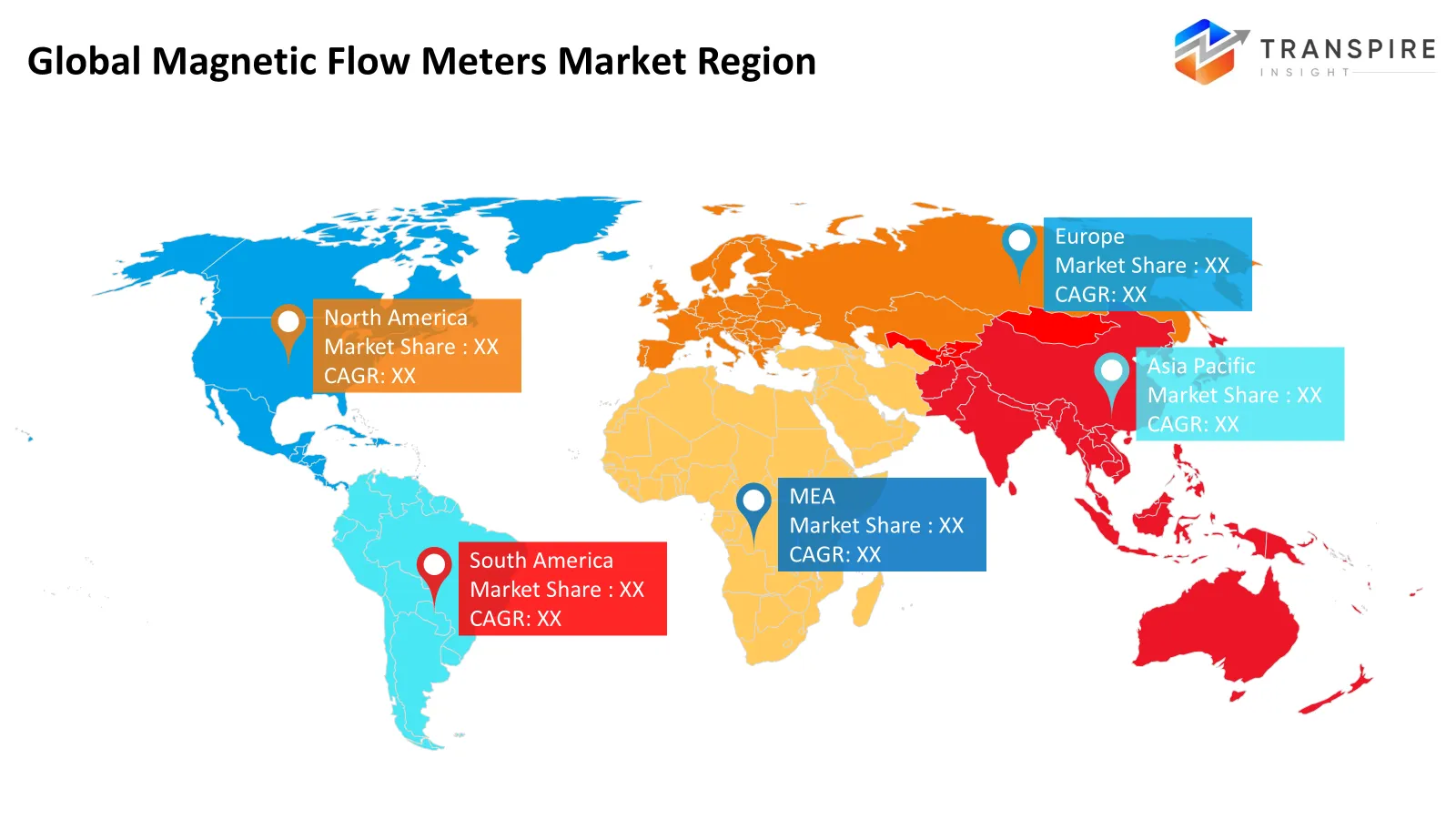
Asia Pacific is the largest shareholder in the Global Magnetic Flow Meters Market, with about 40% revenue share in the global market. The availability of many manufacturing plants, growing process industries and investments in industrial infrastructure in the region provide support for the leadership. China, Japan, South Korea and India are among those countries that are still upgrading production facilities for better operational efficiency and measurement accuracy. There is a positive ecosystem that supports a strong overall demand for goods from industry, growing utility networks, and government-sponsored industrial development programs. In January 2026, Yokogawa Electric Corporation expanded its electromagnetic flowmeter portfolio with enhanced IIoT-enabled diagnostic features. This improved real-time process visibility and strengthened adoption across Asian manufacturing plants.
Europe accounts for approximately 29% of the world trade share and is the second largest regional contributor. The growth rate in the Asia Pacific is more mature than in any other region and is moving towards modernisation instead of massive industrial expansion. The area has a high level of environmental controls, industry process automation protocols and advanced technology for process control. European countries have seen stable demand from the chemical, pharmaceutical, and food processing industries, which are important contributors to market growth.
North America is the largest market in the region, accounting for about 23% market share and the fastest growing region with a CAGR of 9.7% over the forecast period. New investments in industrial automation, energy infrastructure improvement and digitalisation programs in manufacturing plants have fueled recent growth. The need for high-performance flow measurement solutions has been accelerated by the introduction of advanced monitoring and data-driven operational strategies. In the future, the continued investment in smart manufacturing and upgrading of old industrial equipment will provide a large market opportunity for magnetic flow meter suppliers.
Who are the Key Players in the Global Magnetic Flow Meters Market and how do they Compete?
High competition exists in the Global Magnetic Flow Meters Market, with players using innovative techniques, cost efficiency, application know-how, and integration to distinguish themselves from competitors. The competition in this market is becoming more about innovative smart flow measuring, IoT integration, diagnostics, and industry-specific products. Service and regional production capabilities have also become important for increasing competitive advantage by building strong customer relations and growing markets.
For Emerson Electric, innovation is the primary competitive advantage, which the company achieves through its intelligent flow measuring technology. On the other hand, ABB has developed its own integrated automation systems and continues to grow through the use of industrial digitalisation strategies. Siemens has focused on innovative smart instrumentation and software capabilities, whereas Yokogawa Electric has opted for process optimisation solutions that utilise its regional partners. For Endress+Hauser, the major competitive advantage lies in application engineering expertise, while for KROHNE it is unique flow measuring technologies and targeted investment in growth industries.
Badger Meter has adopted a niche strategy in water management applications, whereas Azbil Corporation is involved in the precise control technology industry. OMEGA Engineering distinguishes itself through the widespread availability and affordability of its products. Toshiba and Fuji Electric have differentiated themselves by their focus on industrial instruments supported by aggressive Asia-Pacific expansion strategies. McCrometer has done so through its proficiency in water infrastructure.
Global Magnetic Flow Meters Market Companies:
- Emerson Electric
- ABB
- Siemens
- Yokogawa Electric
- Endress+Hauser
- KROHNE
- Honeywell
- Schneider Electric
- Badger Meter
- Azbil Corporation
- OMEGA Engineering
- Toshiba
- Fuji Electric
- McCrometer
- Bürkert
Recent Development News
- In March 2026, Endress+Hauser launched an OEM-configured Picomag electromagnetic flowmeter for data centre liquid-cooling applications. The product expanded the company’s presence in high-security industrial environments by offering wireless-disabled flow measurement solutions tailored to strict cybersecurity requirements.
Source: https://www.us.endress.com
- In March 2026, KROHNE pre-launched the FLEXMAG 6100 single-use electromagnetic flowmeter at INTERPHEX 2026. The launch strengthened KROHNE’s position in the biopharmaceutical sector through enhanced Ethernet/IP connectivity, advanced diagnostics, and improved automation integration capabilities.
Source: https://www.processingmagazine.com
- In March 2026, ITT Inc. completed its acquisition of SPX FLOW. The acquisition significantly expanded ITT’s flow technology portfolio, strengthened its industrial process business, and enhanced its global competitiveness across critical flow measurement and process automation markets.
Source: https://investors.itt.com
What Strategic Insights Define the Future of the Global Magnetic Flow Meters Market?
The Global Magnetic Flow Meters Market would be largely determined by the increasing trend towards industrial automation, intelligent water management, and digital process monitoring. The future growth of the market is increasingly going to rely on the incorporation of IIoT, predictive maintenance, and real-time analysis, rather than on traditional measuring features alone. There is a potential danger in the increasing security risks facing flow metering systems, which might impact the efficiency of industries' activities. On the other hand, the most promising opportunities for the market's future development are associated with the increased investments into smart water infrastructure and industrial projects aimed at sustainability goals in developing countries. Companies involved in the production of more sophisticated sensing technologies, cloud-based systems, and enhanced cybersecurity solutions would enjoy competitive advantages over their rivals in meeting future demands.
Global Magnetic Flow Meters Market Segmentations are:
By Type
- Inline Magnetic Flow Meters
- Insertion Magnetic Flow Meters
- Battery-powered Magnetic Flow Meters
- Smart Magnetic Flow Meters
- High-pressure Magnetic Flow Meters
- Sanitary Magnetic Flow Meters
- Others
By Application
- Water & Wastewater Management
- Chemical Processing
- Food & Beverage Processing
- Oil & Gas
- Pharmaceuticals
- Others
By End-User
- Industrial Plants
- Municipal Utilities
- Chemical Companies
- Food Manufacturers
- Others
By Technology
- Digital Flow Meters
- Analogue Flow Meters
- IoT-enabled Flow Meters
- AI-assisted Flow Monitoring
- Others
Regional Outlook
North America
- United States
- Canada
- Mexico
Europe
- Germany
- United Kingdom
- France
- Spain
- Italy
- Rest of Europe
Asia Pacific
- Japan
- China
- Australia & New Zealand
- South Korea
- India
- Rest of Asia Pacific
South America
- Brazil
- Argentina
- Rest of South America
Middle East & Africa
- Saudi Arabia
- United Arab Emirates
- South Africa
- Rest of the Middle East & Africa
Frequently Asked Questions
Find quick answers to common questions.
The global magnetic flow meter market size was valued at USD 10.45 billion in 2025 and is poised to reach USD 16.389 billion by 2033, expanding at a 5.80% CAGR.
Key segments for the magnetic flow meter market are By Type (Inline Magnetic Flow Meters, Insertion Magnetic Flow Meters, Battery-powered Magnetic Flow Meters, Smart Magnetic Flow Meters, High-pressure Magnetic Flow Meters, Sanitary Magnetic Flow Meters, Others); By Application (Water & Wastewater Management, Chemical Processing, Food & Beverage Processing, Oil & Gas, Pharmaceuticals, Others); By End-User (Industrial Plants, Municipal Utilities, Chemical Companies, Food Manufacturers, Others); By Technology (Digital Flow Meters, Analog Flow Meters, IoT-enabled Flow Meters, AI-assisted Flow Monitoring, Others).
Growth is primarily driven by modernisation of the water and wastewater infrastructure, increasing use of smart water meters for improved billing and conservation processes, and stringent environmental norms. Other factors contributing to the growth of the market include an increase in the need for accurate and maintenance-free flow measurement in conductive fluids.
The global magnetic flow meter market is led by major manufacturers, including Emerson Electric, ABB, Siemens, Yokogawa Electric, Endress+Hauser, KROHNE, Honeywell, Schneider Electric, Badger Meter, Azbil Corporation, OMEGA Engineering, Toshiba, Fuji Electric, McCrometer, and Bürkert.
Asia Pacific, with around 40% of the global magnetic flow meter market, dominates due to rapid industrialisation, expanding water and wastewater infrastructure, increasing automation adoption, supportive government initiatives, and strong manufacturing capabilities.
Commercial opportunities for the sector also lie in being able to integrate itself into IIoT-enabled smart factories, the use of cloud computing for predictive analysis and maintenance, and the increasing demand from industrializing countries for automated and integrated flow meters.
- Emerson Electric
- ABB
- Siemens
- Yokogawa Electric
- Endress+Hauser
- KROHNE
- Honeywell
- Schneider Electric
- Badger Meter
- Azbil Corporation
- OMEGA Engineering
- Toshiba
- Fuji Electric
- McCrometer
- Bürkert
About the Authors

Avinash Kumar
I’m Avinash Kumar, a Senior Research Analyst at Transpire Insight, with expertise in the Electronics and Semiconductor and Energy & Power industry. My work focuses on analyzing emerging technologies, market trends, industry developments, and innovation across these sectors. I specialize in transforming complex technical and market insights into clear, research-backed content that helps professionals, businesses, and decision-makers stay informed. Through continuous industry research and data-driven analysis, I strive to deliver accurate, reliable, and practical perspectives on the latest advancements shaping the semiconductor and energy landscape.

Chakradhar Khansole
Chakradhar serves as the Research Director at Transpire Insight, bringing over 8 years of experience in technology, innovation, and strategic market intelligence. He specializes in transforming complex market data into actionable business insights that enable organizations to make informed, growth-oriented decisions. Recognized for his strategic vision and analytical expertise, Chakradhar leads high-impact research initiatives, delivering comprehensive market assessments, competitive intelligence, and forward-looking industry analysis.
Recently Published Reports
-
Apr 2026
Fiber Optic Faceplates Market
Fiber Optic Faceplates Market Size, Share & Analysis Report By Type (< 300 mm2, 300-350 mm2, and > 350 mm2, By Application (Night Vision, Holographic Imaging, Medical, and Others), and Geography (North America, Europe, Asia-Pacific, Middle East and Africa, South and Central America), 2021 - 2031
-
Apr 2026
High Temperature Superconductors Market
High Temperature Superconductors Market Size, Share & Analysis Report By Type (1G HTS, and 2G HTS), By Application (Power Cable, Fault Current Limiter, and Transformer), and Geography (North America, Europe, Asia-Pacific, Middle East and Africa, South and Central America), 2021 - 2031
-
Apr 2026
Industrial Plugs and Socket Market
Industrial Plugs and Socket Market Size, Share & Analysis Report By Type (Industrial Plugs, Industrial Sockets), By Current (Up to 32 A, 32 to 125 A, Above 125 A), By Protection (Dustproof and Splash Proof, Waterproof, Explosion Proof), By End User (Heavy Industries, Oil and Gas, Chemicals and Pharmaceuticals, Power Generation, Others), and Geography (North America, Europe, Asia-Pacific, Middle East and Africa, South and Central America), 2021 - 2031
-
Apr 2026
InGaAs Avalanche Photodiodes Market
InGaAs Avalanche Photodiodes Market Size, Share & Analysis Report By Type (1100 - 1700 nm, and 1000 - 1600 nm), By Application (Missile Warning System, Muzzle Flash Detection, Wafer Defect Inspection, Laser Rangefinders, and Others), and Geography (North America, Europe, Asia-Pacific, Middle East and Africa, South and Central America), 2021 - 2031