Global Interferometric Synthetic Aperture Radar Market Size & Forecast:
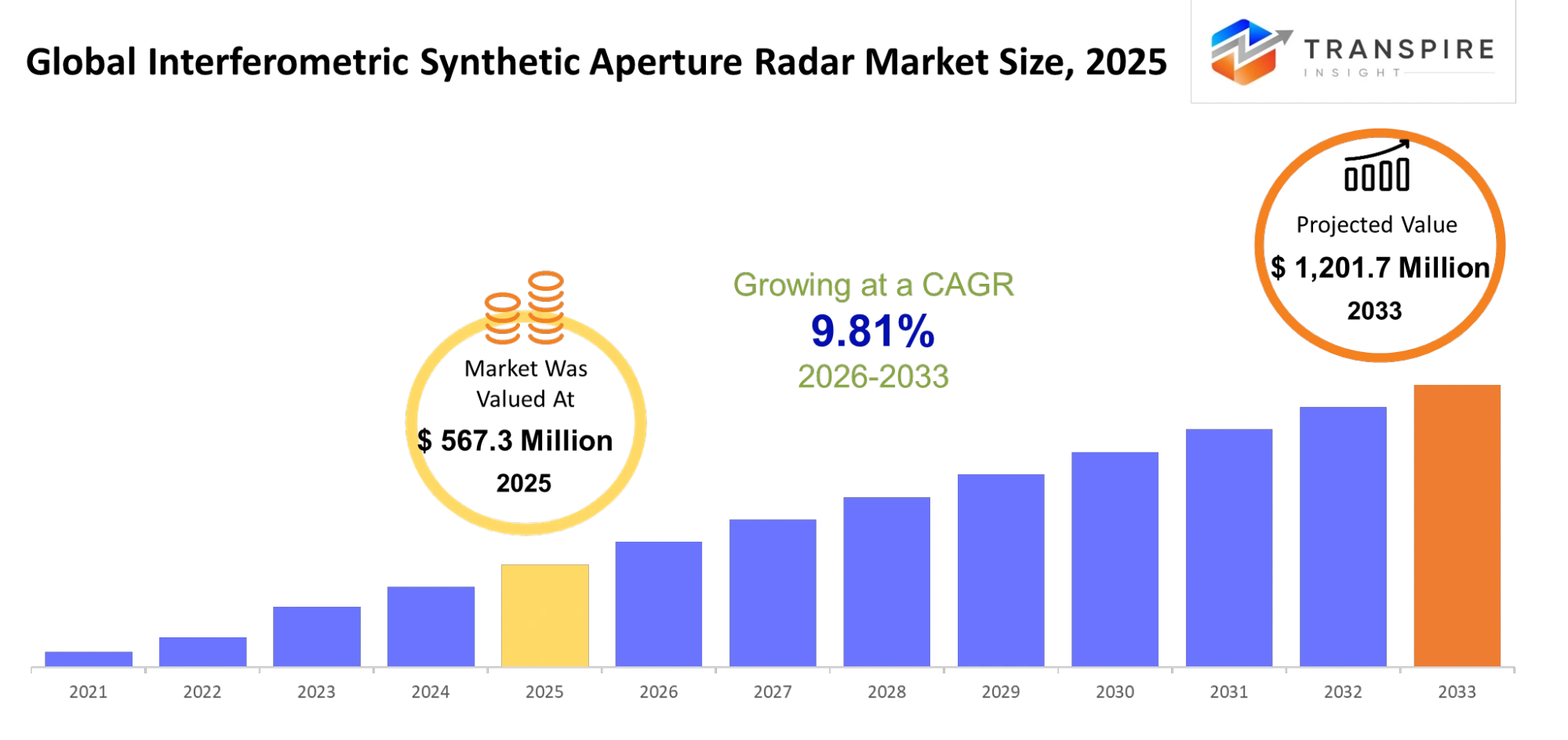
Global Interferometric Synthetic Aperture Radar Market Size 2025: USD 567.3 Million
Global Interferometric Synthetic Aperture Radar Market Size 2033: USD 1,201.7 Million
Global Interferometric Synthetic Aperture Radar Market CAGR: 9.81%
Global Interferometric Synthetic Aperture Radar Market Segments: By Platform (Airborne InSAR, Spaceborne InSAR), By Application (Earth Observation, Disaster Monitoring, Infrastructure Monitoring, Environmental Monitoring), By End-User (Government & Defense, Research Institutions, Commercial).
To learn more about this report,  Download Free Sample Report
Global Interferometric Synthetic Aperture Radar Market Summary:
The Global Interferometric Synthetic Aperture Radar Market was valued at USD 567.3 million in 2025 and is forecast to reach USD 1,201.7 million by 2033, at a CAGR of 9.81% from 2026 to 2033. Interferometric synthetic aperture radar - called InSAR in this report - is a radar-based remote sensing technique that produces very accurate surface deformation measurements by comparing the phase difference between two or more SAR images of the same area taken at different times or from slightly different angles. The method really can detect millimeter-scale ground displacement over quite large areas all on its own - irrespective of cloud cover and daylight conditions - making it capable of some tasks that optical imaging really cannot do very well: monitoring the slow settling of infrastructure, mapping volcanic deformation, tracking changes in permafrost, and finding landslide precursor movements even before we see any visible surface failure.
A spaceborne SAR satellite operating in almost a polar orbit can take an image of the same ground location at a repeat cycle of days to weeks, all depending on the satellite's orbital parameters and whether you're tasking one satellite or a whole group. That regular revisit schedule really is what makes InSAR's deformation detection ability practically useful: a single image pair might detect a displacement event, but a time series built from dozens or hundreds of acquisitions over months or years can tell us about very slow deformation at sub-centimeter accuracy and help us distinguish different deformation signals from one another.
Commercial SAR satellite operators are now competing in the market, changing both the cost structure and how accessible spaceborne InSAR data is. ICEYE and Capella Space operate small satellite constellations that give much higher revisit frequencies and much more flexible tasking than traditional government SAR programs. Their commercial data offerings have really stretched out InSAR capability to infrastructure operators, insurance companies, and urban planning agencies that wouldn't normally have had the budget or procurement path to access government satellite data right away.
Airborne InSAR still holds a pretty big share of the market for applications that need rather flexible scheduling, very high spatial resolution, or coverage over very small areas that wouldn't be worth the expense of satellite tasking. Airborne platforms can be deployed quickly, repositioned easily between missions, and fitted with sensors that are best for very specific frequency bands or resolution requirements that no satellite sensor really covers. They're the tool of choice for corridor mapping surveys, very rapid disaster assessments, and research campaigns where the spatial resolution requirements really go beyond what most operational SAR satellites are capable of providing.
Key Market Trends & Insights:
- Growing development in commercial SAR satellite constellations is being driven by operators increasing repeat-cycle coverage - and lowering the price threshold for data on infrastructure and environmental monitoring applications.
- Commercial operators like ICEYE and Capella Space are speeding up our transition away from relying so heavily on government-operated SAR systems, opening InSAR data access to many more paying customers who can use their usual procurement methods instead of going through government data licensing agreements all over again.
- Infrastructure monitoring - looking at things like bridge movement, dam deformation, pipeline corridor stability, and urban subsidence - has really grown into a new source of income as civil engineers and asset owners start to understand how InSAR time series can detect very small (millimeter-scale) settlement years even before any noticeable structural distress really shows up visually.
- Machine learning-based processing pipelines have greatly decreased the amount of time and analyst expertise needed to get deformation products out of really large InSAR datasets, making the whole process much more practical for operational monitoring programs that need results much closer to real-time rather than waiting weeks or months after doing some extensive post-processing workovers themselves.
- Government and defense are still the biggest category by far in terms of how much money they're spending, yet the commercial sector is actually growing at a much faster rate as InSAR data and processing services become more widely available through easy-to-use subscriptions and API-based procurement methods - rather than going through those super customized government contracts.
Global Interferometric Synthetic Aperture Radar Market Segmentation
By Platform
- Airborne InSAR: Airborne InSAR systems have synthetic aperture radar sensors fitted to fixed-wing aircraft, helicopters, or unmanned aerial vehicles to get SAR images from altitudes ranging from a few hundred meters to many kilometres. The spatial resolution you can achieve from an airborne platform, quite especially at low altitude, can be very much finer than what current operational spaceborne SAR systems give us at similar wavelengths, and the sensor can be set up for special frequency bands, polarizations, or interferometric baselines that not a single satellite has. Airborne InSAR is used for topographic mapping, corridor surveys for pipelines and transmission line routes, emergency response after earthquakes or landslides, and research investigations that need controlled acquisition geometry. The platform's flexibility comes at an operational price tag: aircraft deployment, crew, and logistics cost a lot more compared to buying a satellite data product - which is expensive itself - so airborne InSAR can only be used for applications where the required spatial resolution or scheduling flexibility justify the higher cost over satellite-based options.
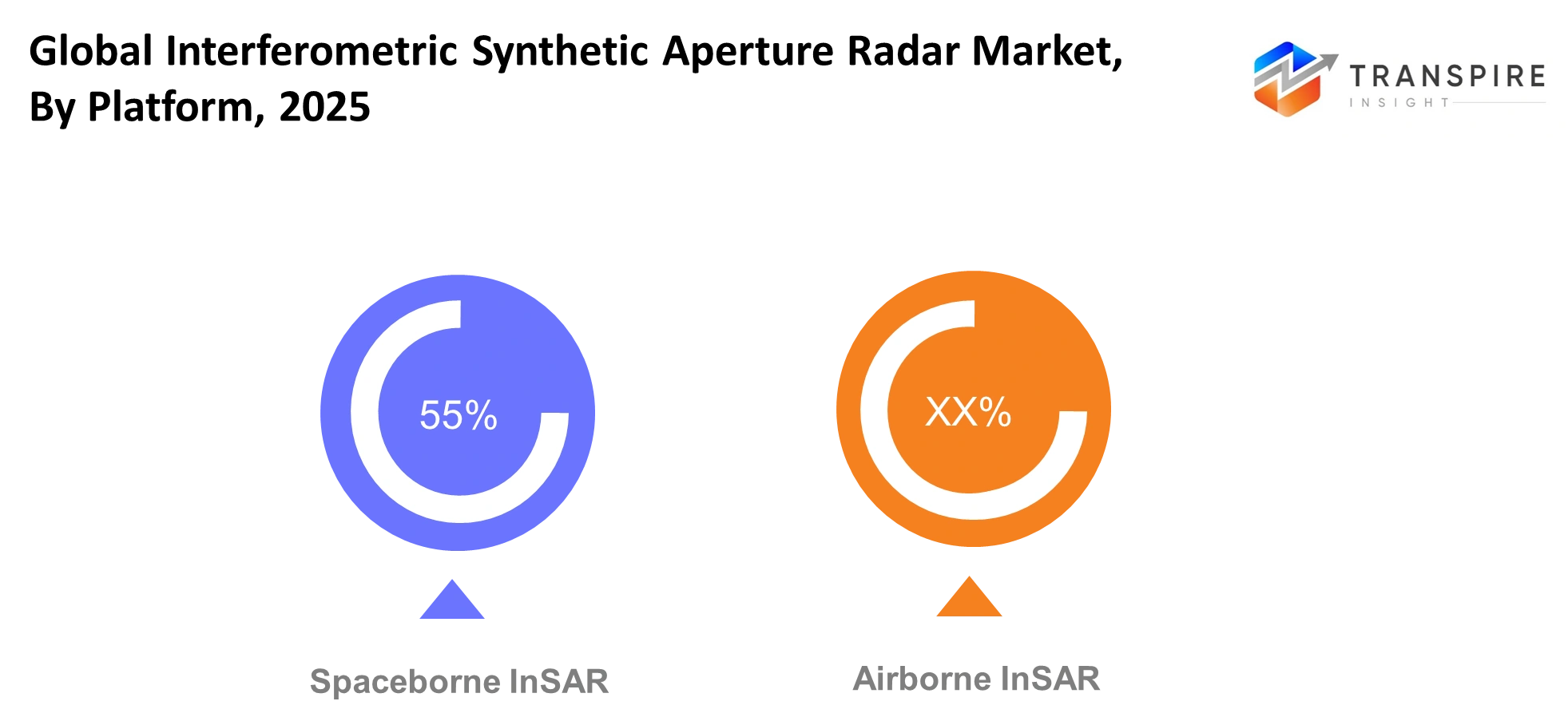
- Spaceborne InSAR: Spaceborne InSAR uses radar sensors on satellites to get repeat-pass images of the Earth's surface, with the phase comparison between acquisitions showing surface displacement at very small scales, about millimeters to centimetres. This segment covers around 55% of the Global Interferometric Synthetic Aperture Radar Market. The main operational SAR satellite programs that supply spaceborne InSAR data comprise the European Space Agency's Sentinel-1 constellation, the Italian COSMO-SkyMed system, the German TerraSAR-X and TanDEM-X pair, the Canadian RADARSAT Constellation Mission, and commercial systems run by ICEYE, Capella Space, and Synspective. Each system runs at a different frequency band, spatial resolution, and revisit interval - meaning that your choice of satellite data source really depends on the specific deformation rate, spatial scale, and time resolution your application needs. Persistent scatterer interferometry and distributed scatterer methods, which recover deformation signals from very dense time series of SAR acquisitions, are now the common processing methods used for infrastructure and urban monitoring applications.
To learn more about this report, Download Free Sample Report
By Application
- Earth Observation: Earth observation offers the largest variety of InSAR applications - including topographic mapping, identifying changes in land cover, the dynamics of ice sheets, estimating ocean surface currents with along-track interferometry, and constantly monitoring global or continental deformation. The Shuttle Radar Topography Mission, performed in 2000 with a single-pass interferometric SAR system on the Space Shuttle, created the very first nearly worldwide digital elevation model at 30-meter resolution - really demonstrating the power of InSAR for very large-scale topographic mapping. Present-day earth observation InSAR research involves processing Sentinel-1 time series for land motion monitoring all over Europe and making use of L-band SAR data to study deformation in permafrost and peatlands in the Arctic and sub-Arctic. This application sector is quite full of government programs and academic research - but commercial earth observation data suppliers are providing more and more of the fundamental SAR imagery every year.
- Disaster Monitoring: Disaster monitoring uses InSAR to map ground deformation caused by earthquakes, volcanic eruptions, landslides, and subsidence events - both right after an event occurs and as a pre-event monitoring capability for areas that have known hazards. After a big earthquake, InSAR coseismic deformation maps produced from before and after satellite acquisitions give us a very detailed view of ground displacement patterns that's almost impossible to achieve by just taking field measurements - and can be used to calculate fault rupture models within hours to days of the event itself. Volcanic deformation monitoring using InSAR is now quite common in the routine practices of volcano observatories for volcanoes covered by regular SAR acquisitions - since InSAR can detect inflation events related to magma intrusion that may happen months before any eruptive activity, which might not be apparent just from seismic data. Landslide monitoring using InSAR time series is able to find areas of precursor slope movement that often precede catastrophic failure, yet the vegetation cover and quick deformation rates typical of very active landslides pose some technical challenges for phase coherence.
- Infrastructure Monitoring: Infrastructure monitoring is the fastest-growing application segment in the global interferometric synthetic aperture radar market. Time-series InSAR applications applied to cities and surrounding areas will measure differential settlement of buildings, bridges, dams, embankments, and underground tunnel structures at millimeter precision over monthly to yearly scales. The really practical value is our ability to detect anomalous deformation in a structure long before it shows visible signs of distress - allowing asset owners and operators even more time to investigate and take action. Persistent scatterer InSAR - which isolates deformation signals from relatively steady radar reflectors like corner reflectors, building facades, and metal equipment components - is the main technique for watching over urban and built infrastructure in real time. Several national and regional government programs in Europe, Japan, and China have actually commissioned regular InSAR surveillance of major infrastructure properties using operational SAR satellite data. The commercial section has really grown as infrastructure asset owners, insurers, and risk analysts have widely adopted InSAR monitoring as a necessary component of their asset management programs.
- Environmental Monitoring: Environmental monitoring applications using InSAR involve tracking water surface size and flood inundation using backscatter and coherence change techniques, observing the changes in peatland and wetland dynamics, measuring subsidence in agricultural regions affected by groundwater extraction, and mapping permafrost thaw and active layer dynamics in very cold environments. The combination of SAR's continuous, weather-independent operation and InSAR's deformation sensitivity really makes it suitable for monitoring ongoing environmental changes that aren't easily accessible through episodic field surveys. Groundwater extraction-related subsidence is an especially important application in arid and semi-arid agricultural regions where aquifer depletion has actually led to quite noticeable ground settlement: InSAR time series from Sentinel-1 and other operational SAR systems have indeed documented subsidence rates of over 10 centimeters per year in parts of California's Central Valley, the North China Plain, and similar very irrigated regions.
By End-User
- Government & Defense: Government and defense is the largest end-user category in the Global Interferometric Synthetic Aperture Radar Market - holding a significant majority of our total spending. National mapping agencies, geological surveys, disaster management authorities, and military intelligence organizations are the main institutional buyers of InSAR systems and data products. Defense applications include change detection for facility monitoring, border and coastal surveillance, ground deformation mapping for underground facility detection, and all-weather, day-night reconnaissance. National space agencies such as ESA, NASA, JAXA, and ASI run or fund most of the major government SAR satellite programs - providing the base data for much of the world's InSAR processing. Government buyers are also the primary customers for custom airborne InSAR survey campaigns and for the development of operational processing pipelines that produce standardized deformation products from satellite time series data.
- Research Institutions: Research institutions - like universities, national laboratories, and geoscience research centers - have really pushed forward much of the methodological development, making InSAR a very practical operational tool indeed. Persistent scatterer interferometry was invented in the late 1990s by a research group at Politecnico di Milano; the distributed scatterer techniques that followed really emerged from both academic research and operational program development at European and US institutions. Research users process SAR data from public satellite programs - particularly Sentinel-1 - to study tectonic, volcanic, and glaciological processes at quite small spatial and temporal scales. Their demand for InSAR data and processing tools has really helped develop both commercial software providers and open-source processing platforms, with tools such as SNAP, StaMPS, MintPy, and ISCE2 very popularly used in the research community. Research institution budgets are somewhat smaller than those of government and defense - but their impact on developing new processing methods and application standards really defines where InSAR capability is going next.
- Commercial:The commercial end-user segment of the Global Interferometric Synthetic Aperture Radar Market is growing faster than government or research, driven by infrastructure asset owners, insurance and reinsurance companies, oil and gas operators, urban planning authorities, and risk intelligence providers that have identified InSAR monitoring as a cost-effective tool for asset risk management. An infrastructure operator monitoring a portfolio of bridges or dam facilities using periodic InSAR time series analysis can identify deformation anomalies that would require expensive physical inspection campaigns to detect by other means. Insurance companies use InSAR data to assess subsidence risk at property portfolio level and to validate claims following subsidence damage events. Oil and gas operators use InSAR to monitor surface deformation over producing fields for compaction and subsidence, and over storage facilities for ground stability. The commercial segment's growth is supported by the availability of processed InSAR deformation products through commercial data platforms, which allows buyers to access results without needing in-house SAR processing expertise.
Regional Insights
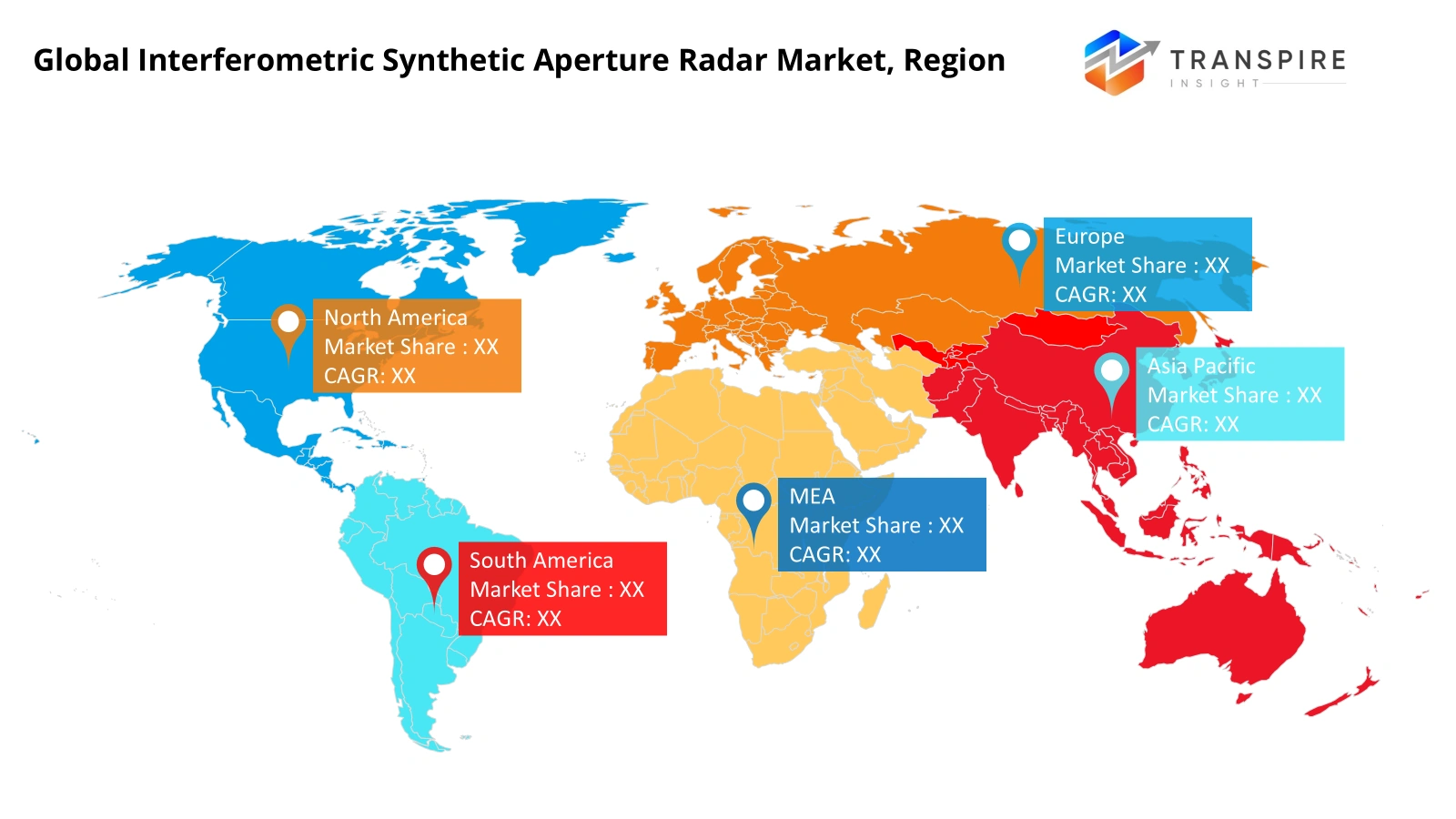
Europe constitutes quite a strong market in the global interferometric synthetic aperture radar market - backed by the European Space Agency's Sentinel-1 program, offering complimentary and open-access C-band SAR data using a six-day repeat cycle over Europe and a twelve-day cycle worldwide. The free data policy has greatly reduced the hurdle to InSAR adoption across all user segments in Europe, really making it possible to set up systematic monitoring programs at both national and regional levels - something that wouldn't have been financially feasible with commercial data pricing. Germany, Italy, France, and the UK house numerous active InSAR research programs, system manufacturers, and commercial service providers. Italy holds particularly extensive capabilities, with the COSMO-SkyMed program, the Politecnico di Milano group that developed persistent scatterer methods, and several commercial service companies that export InSAR monitoring services globally.
The United States is the biggest national market by defense and intelligence investment in SAR systems. Lockheed Martin, Northrop Grumman, Raytheon, and L3Harris all develop and provide SAR systems for defense purposes - and many of these companies have InSAR-capable products in their portfolios. The commercial SAR satellite industry is also quite active in the US, with Capella Space and other operators having received investment and government data purchasing agreements that have greatly increased their constellation development efforts. NASA's NISAR mission, developed in cooperation with ISRO, is predicted to really boost the availability of L-band SAR data all over the world once operational.
Japan has quite a developed InSAR program via JAXA's ALOS series, with ALOS-2 offering L-band SAR data - really suitable for vegetation-covered areas because C-band coherence degrades there. The country's ongoing exposure to earthquakes, volcanic eruptions, and landslides really pushes government investment into operational InSAR monitoring. Synspective is a Japanese commercial SAR operator that has been setting up a small satellite constellation aiming at infrastructure and disaster monitoring applications all across the Asia-Pacific region.
China has put a lot of effort into developing its own SAR satellites domestically, with the Gaofen-3 series providing real-time C-band SAR data for all sorts of government purposes. Chinese researchers have published extensively on InSAR methodologies - as well as their application to subsidence monitoring in major cities, where super-fast urban growth and groundwater extraction really resulted in noticeable settlement which needs very close tracking. Canada's RADARSAT Constellation Mission offers C-band SAR data for Arctic monitoring, naval surveillance, and land applications, with an InSAR capability integrated right into its everyday products.
To learn more about this report, Download Free Sample Report
Recent Development News
Several commercial operators in the Global Interferometric Synthetic Aperture Radar Market have been expanding their SAR satellite constellations to increase revisit frequency and reduce the time between data acquisitions for active monitoring programs. Higher revisit frequency matters for InSAR because it reduces the temporal baseline between image pairs, which generally improves phase coherence and reduces the decorrelation noise that limits deformation detection sensitivity, particularly in vegetated or agriculturally active areas.
There has been activity around InSAR processing-as-a-service platforms that allow customers to define an area of interest and receive processed deformation products on a subscription basis without handling raw SAR data themselves. These platforms abstract the significant computational and methodological complexity of producing reliable InSAR results from satellite time series into a managed service, which has lowered the technical barrier for infrastructure operators and other commercial buyers who lack in-house remote sensing expertise.
Report Metrics
|
Report Metrics |
Details |
|
Market size value in 2025 |
USD 567.3 Million |
|
Market size value in 2026 |
USD 624.1 Million |
|
Revenue forecast in 2033 |
USD 1,201.7 Million |
|
Growth rate |
CAGR of 9.81% from 2026 to 2033 |
|
Base year |
2025 |
|
Historical data |
2021 - 2024 |
|
Forecast period |
2026 - 2033 |
|
Report coverage |
Revenue forecast, competitive landscape, growth factors, and trends |
|
Country scope |
Global |
|
Key company profiled |
Airbus Defence and Space, Thales Alenia Space, Lockheed Martin Corporation, Northrop Grumman Corporation, Boeing Company, Maxar Technologies Inc., ICEYE Oy, Capella Space Corp., MDA Corporation, Raytheon Technologies Corporation, Israel Aerospace Industries Ltd., L3Harris Technologies Inc., OHB SE, Saab AB, Synspective Inc. |
|
Customization scope |
Free report customization (country, regional & segment scope). Avail customized purchase options to meet your exact research needs. |
|
Report Segmentation |
By Platform (Airborne InSAR, Spaceborne InSAR), By Application (Earth Observation, Disaster Monitoring, Infrastructure Monitoring, Environmental Monitoring), By End-User (Government & Defense, Research Institutions, Commercial). |
Key Global Interferometric Synthetic Aperture Radar Company Insights
The Global Interferometric Synthetic Aperture Radar Market has a structural division between large prime contractors supplying defense and government space systems and smaller commercial operators building SAR satellite constellations for data service businesses. Airbus Defence and Space, Thales Alenia Space, Lockheed Martin, Northrop Grumman, Raytheon, L3Harris, and Israel Aerospace Industries compete primarily in the government and defense segment, where program contracts are large, qualification requirements are stringent, and relationships with national space and defense agencies determine access to programs. These companies build and integrate SAR sensors and satellite platforms for customers that include national space agencies, military intelligence organizations, and government mapping programs.
ICEYE, Capella Space, and Synspective represent a different competitive model: building and operating SAR satellite constellations and selling data and analytics as a commercial service. Their competitive advantage is revisit frequency, tasking flexibility, and a procurement model that infrastructure operators, insurers, and commercial analysts can engage with directly without navigating government procurement processes. MDA Corporation sits across both segments, with heritage in government SAR programs including the RADARSAT series and growing commercial data and analytics offerings. Maxar has a broader earth observation portfolio that includes SAR data partnerships alongside its optical satellite operations.
Company List
- Airbus Defence and Space
- Thales Alenia Space
- Lockheed Martin Corporation
- Northrop Grumman Corporation
- Boeing Company
- Maxar Technologies Inc.
- ICEYE Oy
- Capella Space Corp.
- MDA Corporation
- Raytheon Technologies Corporation
- Israel Aerospace Industries Ltd.
- L3Harris Technologies Inc.
- OHB SE
- Saab AB
- Synspective Inc.
Global Interferometric Synthetic Aperture Radar Market Report Segmentation
By Platform
- Airborne InSAR
- Spaceborne InSAR
By Application
- Earth Observation
- Disaster Monitoring
- Infrastructure Monitoring
- Environmental Monitoring
By End-User
- Government & Defense
- Research Institutions
- Commercial
Frequently Asked Questions
Find quick answers to common questions.
The Global Interferometric Synthetic Aperture Radar Market is expected to reach approximately USD 1,201.7 million by 2033.
Key segments include Platform (Airborne InSAR, Spaceborne InSAR), Application (Earth Observation, Disaster Monitoring, Infrastructure Monitoring, Environmental Monitoring), and End-User (Government & Defense, Research Institutions, Commercial).
Major players include Airbus Defence and Space, Thales Alenia Space, Lockheed Martin Corporation, Northrop Grumman Corporation, Boeing Company, Maxar Technologies Inc., ICEYE Oy, Capella Space Corp., MDA Corporation, Raytheon Technologies Corporation, Israel Aerospace Industries Ltd., L3Harris Technologies Inc., OHB SE, Saab AB, and Synspective Inc.
The Global Interferometric Synthetic Aperture Radar Market size is approximately USD 567.3 million in 2025.
The Global Interferometric Synthetic Aperture Radar Market is expected to grow at a CAGR of 9.81% from 2026 to 2033.
- Airbus Defence and Space
- Thales Alenia Space
- Lockheed Martin Corporation
- Northrop Grumman Corporation
- Boeing Company
- Maxar Technologies Inc.
- ICEYE Oy
- Capella Space Corp.
- MDA Corporation
- Raytheon Technologies Corporation
- Israel Aerospace Industries Ltd.
- L3Harris Technologies Inc.
- OHB SE
- Saab AB
- Synspective Inc.
Recently Published Reports
-
Apr 2026
Aerospace Fluoropolymers Market
Aerospace Fluoropolymers Market Size, Share & Analysis Report By Type (PTFE, FEP, PFA, ETFE, and Others), By Application (Electrical Insulation, Seals & Gaskets, Coatings, and Others), By End User (Commercial Aviation, Military Aviation, General Aviation, and Others), and Geography (North America, Europe, Asia-Pacific, Middle East and Africa, South and Central America), 2021 - 2031
-
Apr 2026
Airborne SATCOM System Market
Airborne SATCOM System Market Size, Share & Analysis Report By Type (SATCOM Terminals, Transceivers, Airborne Radio, Modems and Routers, SATCOM Radomes, and Other), By Application (Government and Defense and Commercial), and Geography (North America, Europe, Asia-Pacific, Middle East and Africa, South and Central America), 2021 – 2031
-
Apr 2026
Ship Leasing Market
Ship Leasing Market Size, Share & Analysis Report By Vessel Type (Container Ships, Bulk Carriers, Tankers, and Specialized Vessels), By Lease Duration (Short-Term Lease (Less than 1 year), Medium-Term Lease (1-5 years), and Long-Term Lease (More than 5 years)), By Lease Type (Bareboat Charter, Time Charter, Financial Lease, and Others), By End-User Industry (Oil and Gas, Manufacturing and Industrial, Automotive, Agriculture and Food, Retail and Consumer Goods, and Others), and Geography (North America, Europe, Asia-Pacific, Middle East and Africa, South and Central America), 2021 – 2031
-
Apr 2026
Thread Rolling Dies Market
Thread Rolling Dies Market Size, Share & Analysis Report By Type (Flat Thread Rolling Dies, Circular (Cylindrical) Dies, Tangential Thread Rolling Dies, Planetary Thread Rolling Dies, and Other Types), By Material Type (High-Speed Steel (HSS), Carbide, Tool Steel, Alloy Steel, and Other Specialized Alloys), By Distribution Channel (Direct Sales, Distributors and Dealers, and Online Platforms), By Application (Automotive Industry, Aerospace and Defense, Construction and Infrastructure, Industrial Machinery, Electronics and Electrical Components, Medical Devices, and Fastener Production), and Geography (North America, Europe, Asia-Pacific, Middle East and Africa, South and Central America), 2021 – 2031
Our Clients