

Global Industrial Pasteurizers Market Size & Forecast:
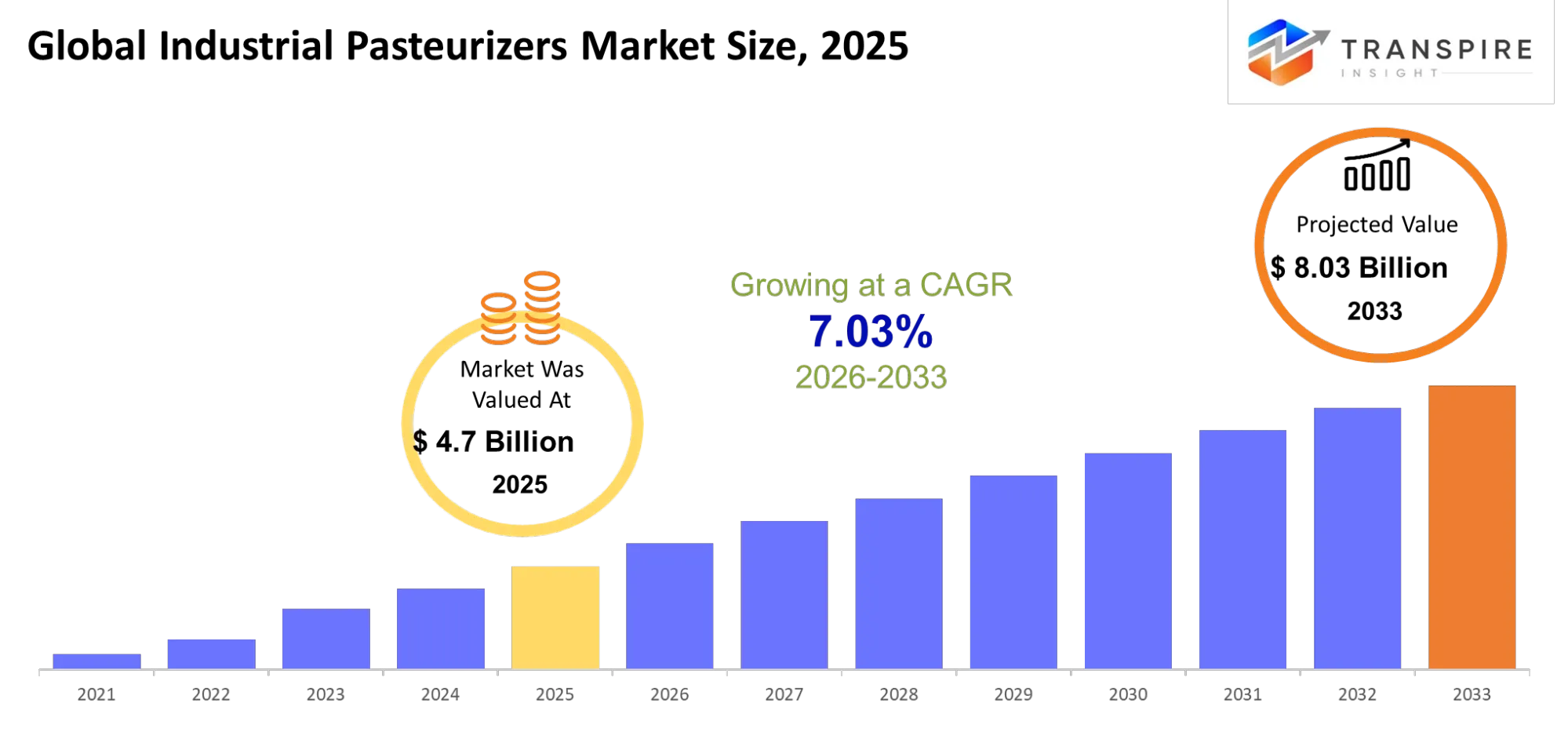
Global Industrial Pasteurizers Market Size 2025: USD 4.7 Billion
Global Industrial Pasteurizers Market Size 2033: USD 8.03 Billion
Global Industrial Pasteurizers Market CAGR: 7.03%
Global Industrial Pasteurizers Market Segments: By Type (Batch Pasteurizers, Continuous Pasteurizers), By Application (Dairy Products, Beverages, Food Processing), By End-User (Food & Beverage Manufacturers, Dairy Processing Plants)
To learn more about this report,  Download Free Sample Report
Global Industrial Pasteurizers Market Summary:
The global industrial pasteurizers market was valued at USD 4.7 billion in 2025. It will reach USD 8.03 billion by 2033. The CAGR over this period is 7.03%.
Industrial pasteurization actually dates back to the 1860s. Louis Pasteur's work with heat treatment really changed our approach to food safety. The process remains one of the best ways we have to preserve food - its basic principle hasn't changed much over 150 years or so.
The market is really growing steadily. Even tighter food safety regulations are driving this growth the most. Dairy manufacturers, juice producers, and packaged food manufacturers all rely on pasteurization to pass inspections and meet export markets' needs. That dependence isn't going away anytime soon.
Continuous pasteurizers are gaining a lot of ground over batch systems. Big-scale operations need equipment that runs constantly without interruptions. HTST systems give you much higher throughput and also lower energy costs per unit. Several medium-sized food companies are upgrading from older batch equipment just for these reasons.
Emerging markets are creating a lot of new demand. Rising incomes in Southeast Asia, Latin America, and Sub-Saharan Africa are pushing consumption of packaged dairy products and beverages even more. Local processors are investing in equipment to serve growing populations - India, Brazil, and Indonesia are seeing the most new plant construction happening right now.
The global industrial pasteurizers market really benefits from relatively stable and quite predictable demand cycles. Food and beverage production doesn't have the very volatile investment patterns you see with capital goods sometimes. Equipment replacement schedules are quite long but consistent. Aftermarket services and spare parts really provide a steady source of income along with equipment sales itself.
What Has the Impact of Artificial Intelligence Been on the Global Industrial Pasteurizers Market?
Artificial intelligence is transforming our daily operations across the entire global industrial pasteurizers market. Machine learning is being deeply embedded in process control systems at top manufacturers nowadays. These tools keep an eye on temperature profiles in real time - and warn us when there's a deviation, so our product batches pass the necessary compliance checks. We've seen a notable decrease in unplanned downtime wherever these systems are installed.
AI-driven demand forecasting is helping us plan our production a lot more efficiently. Historical sales data, signals from the supply chain, and seasonal patterns all feed into prediction models. Our production schedules get tweaked to reflect actual demand instead of rough estimates. As a result, we waste less energy and go through fewer unnecessary equipment cycles across the entire global industrial pasteurizers market.
Supply chain tools have also really improved. After some recent worldwide disruptions, equipment manufacturers and their customers invested in AI platforms that monitor component availability and warn us about potential shortages early on. The companies that adopted these tools recovered much faster. They were able to maintain their service levels while others were still dealing with backlogs.
Key Market Trends & Insights:
- North America holds the largest regional share at approximately 35% in 2024, supported by strict FDA and USDA compliance mandates and a large, mature dairy processing infrastructure across the US and Canada.
- Asia-Pacific is the fastest-growing region, expected to expand at a CAGR above 9% through 2033, driven by new dairy plant construction and rising packaged beverage consumption in India, China, and Vietnam.
- Continuous pasteurizers dominate with approximately 54% of global industrial pasteurizers market share in 2024, favored for high throughput and lower per-unit operating costs in large-scale food and beverage facilities.
- Dairy products lead application demand with over 45% share, driven by mandatory pasteurization requirements for fluid milk, cream, and cheese across virtually all regulated markets globally.
- Beverages are the fastest-growing application, with juice, plant-based drinks, and ready-to-drink tea manufacturers investing heavily in continuous HTST pasteurization lines to meet ambient shelf-stability requirements.
- Food and beverage manufacturers account for the largest end-user share at over 55%, supported by ongoing capacity expansions and new product line additions across processing facilities in North America, Europe, and Asia.
- Tetra Pak, GEA Group, and Alfa Laval collectively held around 35% of the global industrial pasteurizers market share in 2025, with Tetra Pak leading at over 7% individual share, per Global Market Insights data.
- GEA Group unveiled an AI-driven “Thermal Health” system for its heavy-duty pasteurization units, capable of measuring microbial inactivation rates in real time using smart sensors and integrated heat exchanger diagnostics.
- High-pressure processing (HPP) and pulsed electric field (PEF) technologies are gaining traction in premium food segments, creating longer-term competitive pressure on traditional thermal pasteurization equipment manufacturers.
- Regional expansion into Latin America and Sub-Saharan Africa is a growing priority for established players, as new dairy processing infrastructure creates first-install equipment demand that translates into long-term service relationships.
- Strategic partnerships between equipment suppliers and dairy cooperatives in Europe and Asia are expanding market reach, securing multi-year service contracts that deliver recurring revenue well beyond the initial equipment sale.
Global Industrial Pasteurizers Market Segmentation
By Type:
Batch pasteurizers process fixed amounts at set times. This method really works well for smaller facilities and specialty producers who highly value flexibility more than throughput. Craft dairy operations and artisan beverage makers use batch units for their lower initial cost and much simpler operation. The real catch is the output: batch systems stop and start again between cycles - which severely limits daily processing volumes.
Continuous pasteurizers handle product continuously in an unbroken flow. HTST and UHT methods fall right into this category and dominate big-scale operations. Manufacturers prefer these systems because they keep consistent output without stopping and starting all the time. Every little bit of a decrease in per-unit energy costs really widens the economic case for continuous systems over batch alternatives.
The move toward continuous systems really shows how food manufacturing is evolving. Plants designed for very high throughput need equipment that integrates into fully automated production lines. Batch changeover cycles really disrupt line efficiency and increase labor requirements quite a bit. Continuous pasteurizers solve both problems at once, which is why the segment really holds a 54% share of the global industrial pasteurizers market.

To learn more about this report, Download Free Sample Report
By Application:
Dairy products drive application demand - over 45% of the market share is theirs. Fluid milk, cream, yogurt, and liquid cheese ingredients - all have to be pasteurized before they're distributed. Regulatory requirements in almost all markets mean this isn't optional. That necessary compliance produces consistent, recurring equipment demand - even when wider food processing investment decreases somewhat.
Beverages represent the second major application area. Juice manufacturers use pasteurization to get their products to last at room temperature without needing a fridge. The rise of oat milk, almond milk, and protein drinks is pulling more demand into the global industrial pasteurizers market. Each new product format entering the ambient category adds even more equipment demand.
Food processing beyond dairy and beverages includes liquid eggs, sauces, soups, and condiments. Growth in meal kit delivery and institutional food services really increased these operations quite a bit. As packaged food consumption goes up all over the world, the number of products requiring pasteurization at some point goes up along with it. That broad application base supports the market's steady long-term demand trajectory.
By End-User:
Food and drink manufacturers really drive the bulk of equipment purchases. These companies run several production lines and continuously upgrade their capacity. Their massive procurement volumes give them lots of bargaining power when it comes to pricing and service terms. Multi-site operators quite often standardize on just one equipment supplier to make maintenance contracts and spare parts management much easier.
Dairy processing plants represent a very distinct and considerable end-user group. They have to operate under extremely strict hygienic standards and face regular regulatory audits all the time. In established markets such as the US and Germany, many plants are actually replacing outdated pasteurizer units so as to meet the latest compliance regulations. In emerging markets, new plant construction really creates demand for brand new first-install equipment across the whole industrial pasteurizers market.
Contract food processors really complete the end-user mix. They manufacture products for brands that do not own their own production facilities themselves. This requires quite versatile pasteurization equipment that can handle various different products across rather short production runs. Flexibility and ease of cleaning matter even more than maximum throughput, creating a very distinct product niche within the broader market itself.
What Are the Main Challenges for the Global Industrial Pasteurizers Market Growth?
Technical and operational constraints really exist. Heat treatment has to find a balance between microbial kill rates and preserving product quality itself. Newer beverage categories with intricate ingredient profiles present some engineering difficulties indeed. Equipment developed for standard dairy products very often requires quite a bit of customization for plant-based formulations - this adds extra cost and lengthens commissioning timelines even more.
Capital costs form a huge barrier in price-sensitive markets. High-quality pasteurization equipment holds a rather expensive upfront price tag. Smaller food processors in emerging markets quite often lack access to equipment financing themselves. Import tariffs on processing machinery actually increase the total cost of ownership further. These factors really push adoption timelines back - especially for new facilities in cost-constrained regions even more so.
Adoption challenges are actually the sharpest in places with inconsistent regulatory enforcement. Where food safety oversight is somewhat weak, the economic case for certified pasteurization equipment weakens even more with it. Some producers use lower-cost alternatives that don't quite meet international standards. This really limits the addressable market for established global industrial pasteurizers market suppliers trying to expand in those areas themselves.
Competition from alternative preservation technologies puts longer-term pressure indeed. HPP and PEF technologies are actually gaining more acceptance in the premium food segment. These cold-process methods really preserve nutritional attributes that heat pasteurization can break down. Cost and scale are still big barriers for these alternatives, but continued investment in them actually increases competitive pressure on traditional thermal equipment manufacturers even more.
Regional Insights
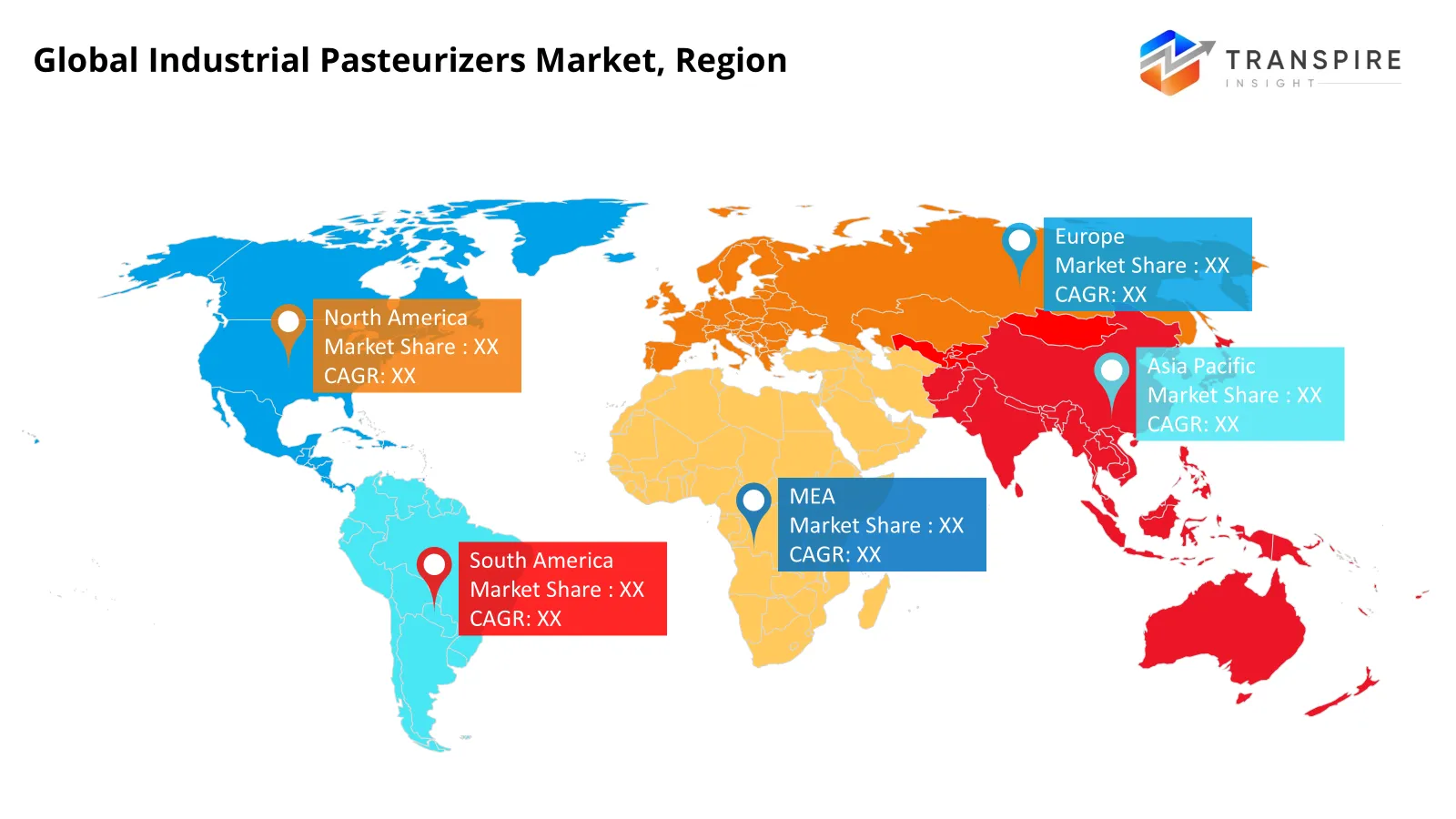
North America and Europe represent the largest - and quite developed part of the world's industrial pasteurizers market altogether. The USA really sets the pace nationally, thanks to very strict FDA and USDA pasteurization requirements for any commercially distributed dairy products. The US pasteurizers and sterilizers market actually reached $3. 8 billion in 2023, growing at a 3. 2% CAGR by 2032, according to Global Market Insights. Germany kind of drives European demand, hosting GEA Group and Krones AG - both major players in global food processing equipment. The UK's SmartParc manufacturing model - using GEA heating and cooling technology - shows just how energy efficiency is changing pasteurization plant economics across the whole region really. France and the Netherlands contribute consistent procurement volume thanks to their massive dairy export industries.
Asia-Pacific is definitely the most dynamic growth market in the global industrial pasteurizers market. The region held roughly $3. 97 billion in dairy processing equipment value in 2024, forecast to grow at a CAGR of 6. 85% by 2029. China processes huge volumes of dairy and fruit juices right at home, and local equipment manufacturers have developed quite competitive continuous pasteurizer lines at lower price points than Western alternatives ever were. India is expanding fast: organized dairy processing is scaling up super quick, with brands like Amul and Heritage Foods adding capacity all over Tier 2 and Tier 3 cities. Government schemes supporting food processing investment in India are greatly reducing capital barriers for setting up new plants. Vietnam, Thailand, and Indonesia are adding more demand as packaged beverage consumption rises with middle-class incomes all over the place.
Latin America is actually an active growth market itself. Brazil really leads the region, with a massive dairy sector that's super modernizing right now and a beverage industry investing in pasteurization capacity as juice and ready-to-drink categories grow. Argentina adds additional demand from its already developed dairy export sector. A Dairy Pasteurizer Market global forecast report published back in April 2026 confirmed continued expansion in the region, with a market CAGR of 7. 18% projected by 2032. Trade relationships with European and North American equipment suppliers are very well established indeed. Government infrastructure investment is opening processing markets in regions way beyond the industrial south of Brazil itself.
The Middle East and Africa represent a somewhat smaller but developing portion of the global industrial pasteurizers market. Saudi Arabia and the UAE are investing in domestic food processing to reduce their import reliance pretty much. South Africa holds the most developed dairy processing infrastructure on the entire African continent. As refrigerated cold chain networks really expand into smaller African cities, demand for pasteurization equipment grows with them even more.
To learn more about this report, Download Free Sample Report
Recent Development News
In November 2025, Tetra Pak launched its Integrated Heat Pump system for pasteurizers, targeting up to 77% energy savings for large-scale dairy operations. The system recovers waste heat from pasteurization and reuses it for both heating and cooling, eliminating reliance on fossil fuel-fired boilers. For a typical dairy line processing 60,000 litres per hour, Tetra Pak estimates annual operating savings of up to US$250,000 and CO₂ reductions of up to 650 tonnes per year. Source: www.foodtechbiz.com
In April 2026, ResearchAndMarkets published its Dairy Pasteurizer Market global forecast report confirming the sub-market grew from USD 1.40 billion in 2025 to USD 1.50 billion in 2026, with a projected CAGR of 7.18% through 2032. The report identifies GEA Group, SPX FLOW, Tetra Pak, Alfa Laval, and IDMC as leading players, and highlights system scalability, modularity, and digital integration readiness as critical differentiators shaping procurement decisions globally. Source: www.globenewswire.com
Report Metrics
|
Report Metrics |
Details |
|
Market size value in 2025 |
USD 4.7 Billion |
|
Market size value in 2026 |
USD 4.99 Billion |
|
Revenue forecast in 2033 |
USD 8.03 Billion |
|
Growth rate |
CAGR of 7.03% from 2026 to 2033 |
|
Base year |
2025 |
|
Historical data |
2021 – 2024 |
|
Forecast period |
2026 – 2033 |
|
Report coverage |
Revenue forecast, competitive landscape, growth factors, and trends |
|
Regional scope |
United States; Canada; Mexico; United Kingdom; Germany; France; Italy; Spain; Denmark; Sweden; Norway; China; Japan; India; Australia; South Korea; Thailand; Brazil; Argentina; South Africa; Saudi Arabia; United Arab Emirates |
|
Key company profiled |
Tetra Pak International S.A., GEA Group AG, SPX FLOW Inc., Alfa Laval AB, Krones AG, JBT Corporation, IDMC Limited, Feldmeier Equipment Inc., Paul Mueller Company, KHS GmbH, MicroThermics Inc., Iwai Kikai Kogyo Co. Ltd., Scherjon Dairy Equipment Holland B.V., Triowin Intelligent Machinery Co. Ltd., Neologic Engineers Pvt. Ltd. |
|
Customization scope |
Free report customization (country, regional & segment scope). Avail customized purchase options to meet your exact research needs. |
|
Report Segmentation |
By Type (Batch Pasteurizers, Continuous Pasteurizers), By Application (Dairy Products, Beverages, Food Processing), By End-User (Food & Beverage Manufacturers, Dairy Processing Plants) |
How Can New Companies Establish a Strong Foothold in the Global Industrial Pasteurizers Market?
Competing head-on against Tetra Pak or GEA in their core product lines is not really a viable entry plan. New players actually do better by targeting processing categories that larger suppliers consider secondary. Specialty dairy ingredients, plant-based drinks, and small-batch high-end food products all require pasteurization quite often. They don't necessarily get equipment designed very specifically to meet their needs most of the time.
Modular pasteurizer designs are quite attractive. Equipment that ships and installs faster than traditional systems appeals to food startups expanding their capacity extremely quickly. Companies solving issues related to ease of cleaning, less water consumption, and a more compact footprint really are addressing actual pain points. Several smaller equipment makers have gained some traction precisely by solving problems that established suppliers kind of deprioritize.
Partnerships speed up entry significantly without requiring us to start manufacturing everything ourselves from day one. Collaborating with food processing consultancies or local dairy co-operatives really builds credibility much faster than just cold outreach. Distribution agreements with established industrial equipment dealers give us a much wider reach into markets that would take years to develop independently. The entire global industrial pasteurizers market actually rewards relationship-based selling very much.
After-sales service is truly where building a long-lasting market position happens. Processors won't go back to a supplier that just disappears after the sale. New players who invest early in regional service infrastructure and have more spare parts available really create some real switching costs. That approach builds ongoing revenue and the essential customer relationships needed to grow sustainably in this market.
Key Global Industrial Pasteurizers Market Company Insights
The highly competitive global industrial pasteurizers market breaks down into a top tier consisting of a few very large, integrated food processing equipment companies, as well as a much larger group of smaller, regional specialists. Tetra Pak, GEA Group, Krones AG, SPX FLOW, and Alfa Laval collectively commanded about 35% of the market share in 2025. This high level of concentration really leaves a lot of room for regional and niche players to compete based on service, speed, and specialty.
Tetra Pak currently has the strongest individual position with more than 7% share. Its model really combines the supply of equipment with packaging systems and long-term processing agreements. Producers of dairy and beverages who use Tetra Pak packaging quite often standardize on Tetra Pak processing equipment itself - creating a very deep customer base that is difficult to displace. The November 2025 introduction of its Integrated Heat Pump system demonstrates active investment in maintaining that leadership position itself.
GEA Group competes across a rather wider set of food processing categories altogether. Its pasteurizer business benefits greatly from cross-selling with a very wide product portfolio itself. GEA's AI-driven Thermal Health system - which monitors microbial inactivation in real time itself - adds quite a bit of service revenue well beyond the cost of the initial equipment sale. The company really operates across over 62 countries - with a particularly strong position in Europe and a growing presence across Asia itself.
Alfa Laval focuses even more so on heat transfer technology itself. Its plate heat exchangers are key components in many continuous pasteurization systems. Alfa Laval competes both on standalone heat exchanger components and complete pasteurization skids itself. Its agreement to acquire the cryogenics business from Fives Group for roughly EUR 800 million reflects an active acquisition strategy that really strengthens its thermal processing capabilities itself.
SPX FLOW and JBT Corporation really serve North America with particular depth. Both have established relationships with US dairy cooperatives and beverage manufacturers. Their domestic service capabilities and regulatory expertise give them a very clear advantage in a market where FDA compliance adds complexity to equipment selection itself. These factors really make them the preferred suppliers for cautious procurement teams at very large dairy and food processing companies itself.
Regional players like Triowin in China and Neologic Engineers in India compete on price and local service responsiveness. They serve markets where international brands face cost barriers. As food safety standards tighten in their home markets, these manufacturers are being pushed to upgrade their equipment designs to match international performance benchmarks. That process is creating new investment cycles within regional equipment sectors.
Company List
- Tetra Pak International S.A.
- GEA Group AG
- SPX FLOW Inc.
- Alfa Laval AB
- Krones AG
- JBT Corporation
- IDMC Limited
- Feldmeier Equipment Inc.
- Paul Mueller Company
- KHS GmbH
- MicroThermics Inc.
- Iwai Kikai Kogyo Co. Ltd.
- Scherjon Dairy Equipment Holland B.V.
- Triowin Intelligent Machinery Co. Ltd.
- Neologic Engineers Pvt. Ltd.
What Are the Key Use-Cases Driving the Growth of the Global Industrial Pasteurizers Market?
Fluid milk processing is the foundational use-case. Virtually all commercially distributed milk in regulated markets must be pasteurized before sale. That requirement creates a demand baseline that holds even when other food processing investment cycles slow. The US dairy sector is among the largest in the world, and federal regulations make pasteurization non-negotiable for interstate commerce.
Juice and ready-to-drink beverages are a growing driver. Pasteurization allows juice producers to distribute shelf-stable products without refrigeration. Plant-based milks including oat and almond drinks all require heat treatment for ambient shelf stability. Each new product format entering the ambient category adds another layer of demand to the global industrial pasteurizers market.
Beer and craft beverage production is a smaller but expanding use-case. Flash pasteurization lets breweries extend shelf life and distribute across wider geographies. As craft breweries scale from taproom sales to retail and export channels, they invest in pasteurization equipment. This shift from self-distribution to commercial channels has driven steady demand from a segment that previously relied on refrigerated distribution.
Liquid egg and prepared food processing add further demand volume. Food service suppliers and ingredient companies use pasteurization to ensure safety and extend usable shelf life. Growth in meal kit delivery and institutional food service has expanded the scale of these operations. That expansion is pulling additional pasteurization equipment into supply chains that previously operated well below commercial scale.
Global Industrial Pasteurizers Market Report Segmentation
By Type
- Batch Pasteurizers
- Continuous Pasteurizers
By Application
- Dairy Products
- Beverages
- Food Processing
By End-User
- Food & Beverage Manufacturers
- Dairy Processing Plants
By Regional Outlook
North America
- U.S.
- Canada
- Mexico
Europe
- UK
- Germany
- France
- Italy
- Spain
- Denmark
- Sweden
- Norway
Asia Pacific
- Japan
- China
- India
- Australia
- South Korea
- Thailand
Latin America
- Brazil
- Argentina
Middle East & Africa
- South Africa
- Saudi Arabia
- UAE
- Kuwait
Frequently Asked Questions
Find quick answers to common questions.
The Global Industrial Pasteurizers Market is expected to reach approximately USD 8.03 billion by 2033.
Key segments include Type (Batch Pasteurizers, Continuous Pasteurizers), Application (Dairy Products, Beverages, Food Processing), and End-User (Food & Beverage Manufacturers, Dairy Processing Plants).
Major players include Tetra Pak International S.A., GEA Group AG, SPX FLOW Inc., Alfa Laval AB, Krones AG, JBT Corporation, IDMC Limited, Feldmeier Equipment Inc., Paul Mueller Company, KHS GmbH, MicroThermics Inc., Iwai Kikai Kogyo Co. Ltd., Scherjon Dairy Equipment Holland B.V., Triowin Intelligent Machinery Co. Ltd., and Neologic Engineers Pvt. Ltd.
The Global Industrial Pasteurizers Market size is approximately USD 4.7 billion in 2025.
The Global Industrial Pasteurizers Market is expected to grow at a CAGR of 7.03% from 2026 to 2033.
- Tetra Pak International S.A.
- GEA Group AG
- SPX FLOW Inc.
- Alfa Laval AB
- Krones AG
- JBT Corporation
- IDMC Limited
- Feldmeier Equipment Inc.
- Paul Mueller Company
- KHS GmbH
- MicroThermics Inc.
- Iwai Kikai Kogyo Co. Ltd.
- Scherjon Dairy Equipment Holland B.V.
- Triowin Intelligent Machinery Co. Ltd.
- Neologic Engineers Pvt. Ltd.
Recently Published Reports
-
Apr 2026
Baby Infant Formula Market
Baby Infant Formula Market Size, Share & Analysis Report By ype (Infant Milk, Follow On Milk, Specialty Baby Milk, Growing-Up Milk), By Ingredient (Carbohydrate, Fat, Protein, Minerals, Vitamins, and Others), By Product Form (Powder, Liquid, and Ready-to-feed), By Distribution Channels (Supermarket/Hypermarket, Specialty Store, Pharmacies, Online Retail, and Others), and Geography (North America, Europe, Asia-Pacific, Middle East and Africa, South and Central America), 2021 - 2031
-
Apr 2026
Edible Insects for Animal Feed Market
Edible Insects for Animal Feed Market Size, Share & Analysis Report By Type (Insect Powder, Insect Meal, Insect Bar, Insect Paste, Insect Oil, and Others), By Insect Type (Beetles, Cricket, Caterpillar, Hymenoptera, Orthoptera, Tree Bugs, and Others), By Application (Livestock, Pet Food, and Aquaculture), By Livestock Type (Poultry, Swine, and Others), and Geography (North America, Europe, Asia-Pacific, Middle East and Africa, South and Central America), 2021 - 2031
-
Apr 2026
Food Industry Disinfection and Bacterial Control Market
Food Industry Disinfection and Bacterial Control Market Size, Share & Analysis Report By Type (Chemical Disinfectants, Physical Disinfectants, and Biocides and Antimicrobials), By Application (Food Processing Equipment Surface Disinfection, Food Preparation Areas Surface Disinfection, Storage Areas Surface Disinfection, Anti-microbial Coatings Food Preservation, and Preservative Solutions Food Preservation), By End User (Meat and Poultry Processing, Dairy Processing, Seafood Processing, Bakery and Confectionery, Restaurants and Commercial Kitchens, and Food Service Providers), By Sales Channel (Online, Offline), and Geography (North America, Europe, Asia-Pacific, Middle East and Africa, South and Central America), 2021 - 2031
-
Apr 2026
Freeze Dried Food Market
Freeze Dried Food Market Size, Share & Analysis Report By Product Type (Fruits, Vegetables, Freeze-Dried Dairy Products, Freeze-Dried Meat and Seafood, Freeze-Dried Pet Food, and Prepared Meal), By Nature (Organic, and Conventional), By Form (Powdered, Granules, and Diced), By End Use (Breakfast Cereals, Dairy Products, Bakery & Confectionery, Nutritional Bars & Supplements, Powdered Beverages, Snacks, and Retail (Household)), and Geography (North America, Europe, Asia-Pacific, Middle East and Africa, South and Central America), 2021 - 2031