

Global Fluorosurfactants Market Size & Forecast:
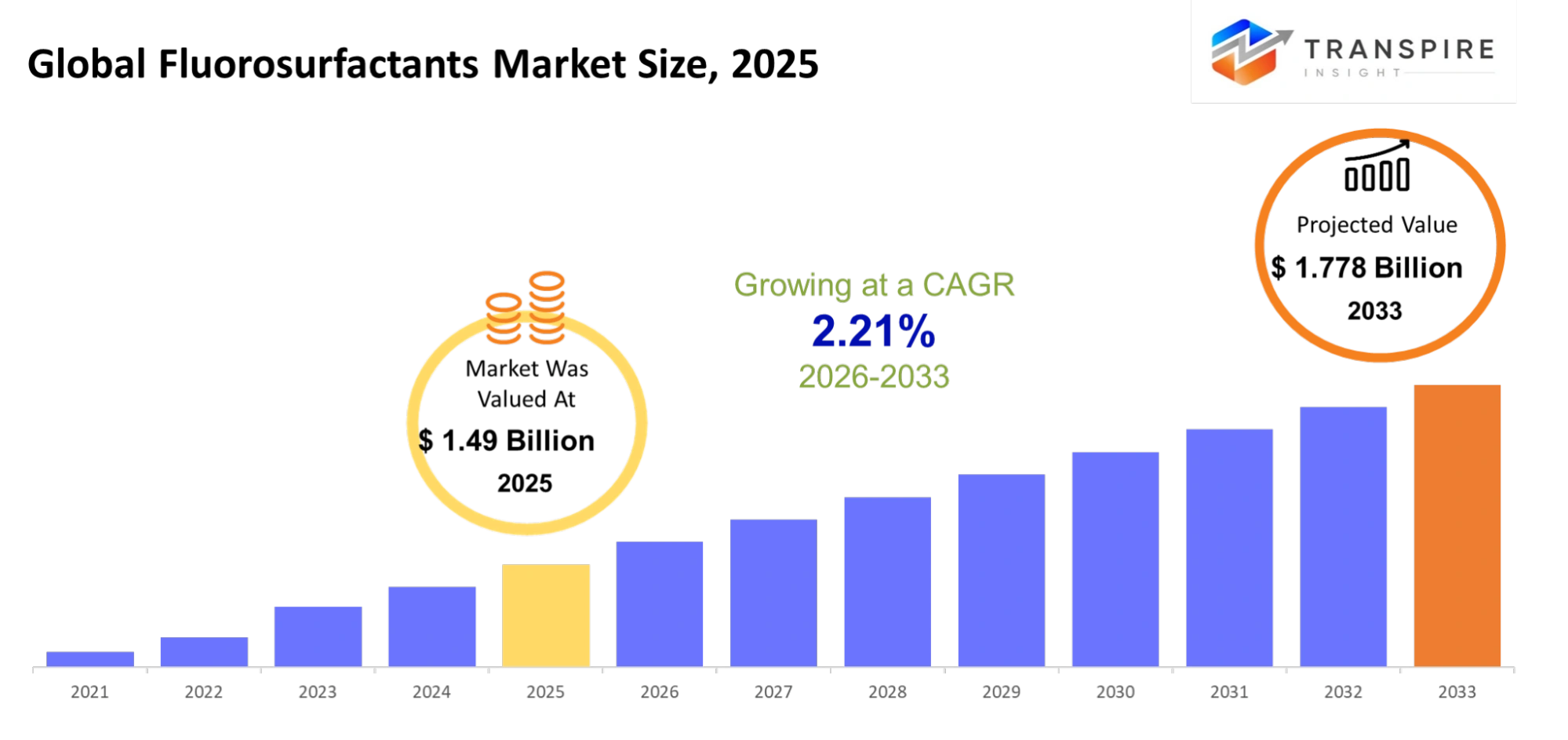
Global Fluorosurfactants Market Size 2025: USD 1.49 Billion
Global Fluorosurfactants Market Size 2033: USD 1.778 Billion
Global Fluorosurfactants Market CAGR: 2.21%
Global Fluorosurfactants Market Segments: By Type (Anionic Fluorosurfactants, Cationic Fluorosurfactants, Non-ionic Fluorosurfactants, Amphoteric Fluorosurfactants), By Application (Paints & Coatings, Firefighting Foams, Oilfield Chemicals, Electronics Cleaning), By End-User Industry (Construction, Oil & Gas, Electronics, Automotive).
To learn more about this report,  Download Free Sample Report
Global Fluorosurfactants Market Summary:
The Global Fluorosurfactants Market was valued at USD 1.49 billion in 2025. It is forecast to reach USD 1.778 billion by 2033. The CAGR over that period is 2.21%.
Fluorosurfactants are truly surface-active compounds. They feature a fluorinated carbon chain. This chain repels both water and oil - a very special property indeed. Their dual repellency is the reason why they outperform hydrocarbon surfactants in highly demanding applications. In fact, no hydrocarbon alternative even compares with their surface tension reduction at similar dose rates.
Regulatory pressures form the dominant force controlling this market. Long-chain PFAS compounds - particularly PFOS and PFOA - have been heavily restricted or phased out over most developed markets. Even the US EPA, the European Chemicals Agency, and Australian regulators have taken action. Manufacturers have responded in two different ways. Some switched to shorter-chain fluorosurfactant chemistries. Others developed fluorine-free solutions for applications where performance compromises were acceptable. Neither path was quite easy. Short-chain compounds cost quite a bit more to manufacture. Fluorine-free options often couldn't quite match the surface tension performance of the products they replaced.
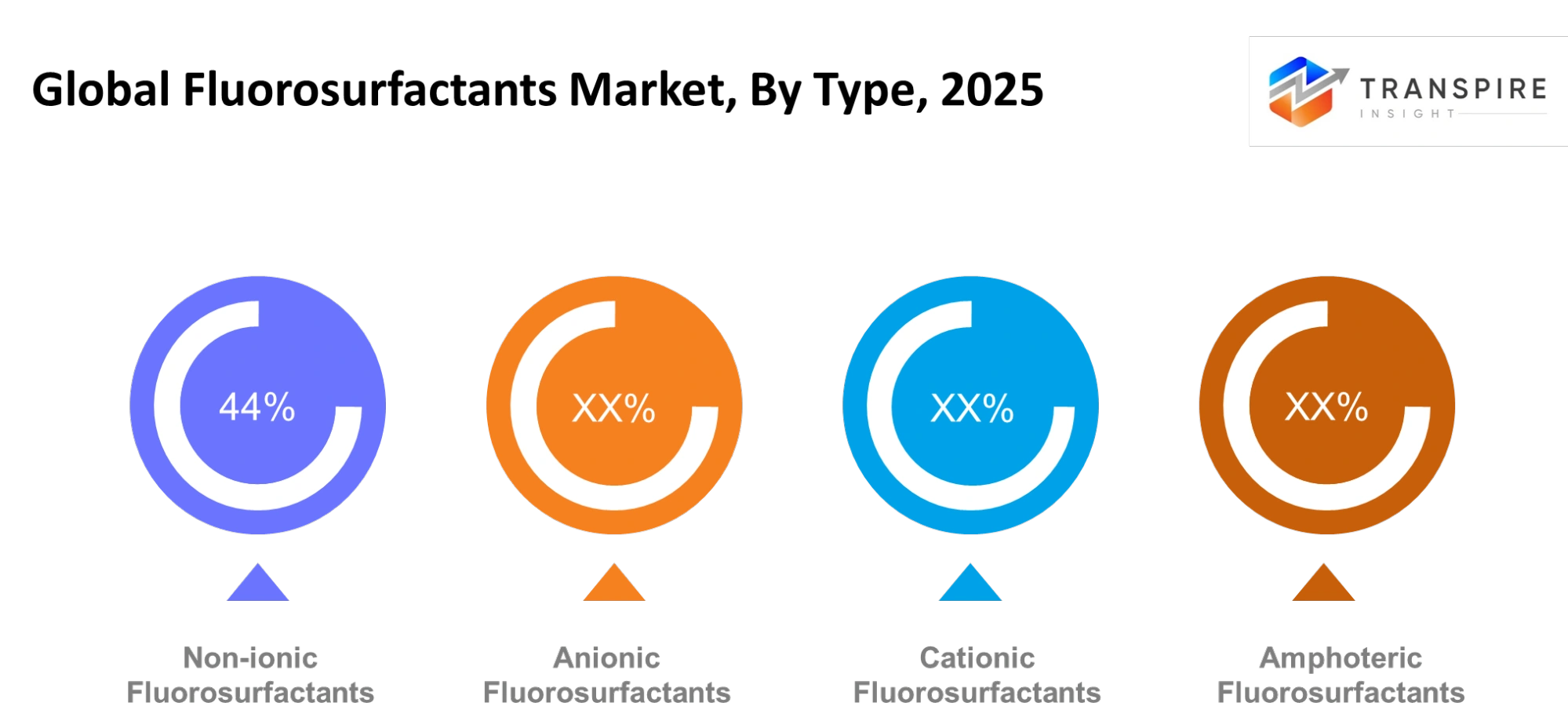
Non-ionic fluorosurfactants take up the largest type portion at 44%. They are very chemically stable across a very broad pH range. They also mix well with other types of surfactants. These properties really made them the go-to choice in paints and coatings - where compatibility with formulation chemistry is just as important as surface performance itself.
Growth is quite modest at a 2. 21% compound annual growth rate (CAGR). That reflects a fairly mature market subject to a lot of regulatory constraint. Even volume growth in electronics and oilfield applications partially balances out volume losses in firefighting foams, where PFAS-free mandates are really speeding along the phase-out of AFFF products.
Key Market Trends & Insights:
- Regulation of PFAS has really created a two-tiered market. Long-chain products that have been restricted are actually decreasing. On the other hand, short-chain and fluorine-free alternatives are really growing. The profit margins between these products really differ significantly.
- Cleaning electronics is kind of a bright spot. The need for miniaturization means much better flux removal is required. Cleaners based on fluorosurfactants handle this job much better than most alternatives indeed.
- Demand for oilfield chemicals is quite resilient. Formulations used for enhanced oil recovery contain fluorosurfactants - they help to decrease interfacial tension. With higher oil prices, they actually justify themselves economically even more.
- China's domestic fluorochemical industry has really taken off. Companies like Dongyue Group and Shandong Dongyue are now competing all over the world based on price. This actually puts pressure on the profit margins of Western manufacturers in very sensitive price markets.
- Replacing aqueous film-forming foam is a compliance deadline issue right now, rather than a matter of personal preference. Defense and airport operators in both the US and EU are facing very specific deadlines to get away from PFAS-based AFFF altogether.
Global Fluorosurfactants Market Segmentation
By Type
- Anionic Fluorosurfactants: Anionic fluorosurfactants bear a negative charge at the head group. They are very good wetting agents. They perform quite well in alkaline cleaning formulations. Firefighting foam concentrates have traditionally made use of anionic fluorosurfactants because of their remarkable film-forming properties. PFOS-based anionic products have essentially been recalled from sale in regulated markets. Short-chain anionic alternatives do exist but cost more to manufacture. Demand has actually decreased in foam applications. However, it remains rather steady in industrial cleaning and certain textile treatments.
- Cationic Fluorosurfactants: Cationic fluorosurfactants carry a positive charge. They strongly adhere onto negatively charged surfaces. This really makes them quite effective as leveling agents in electroplating baths. They are also used in fabric treatments and paper sizing. The cationic part is relatively small of the four types. It provides a specialty application where the electrical attraction with the substrate is specifically needed. Very high levels of regulatory scrutiny apply to cationic PFAS compounds just like their anionic counterparts, though the volume in regulated categories is smaller.
- Non-ionic Fluorosurfactants: Non-ionic fluorosurfactants constitute the largest sector of the Global Fluorosurfactants Market at about 44% of revenue. They don't carry any kind of ionic charge. This fact really makes them compatible with anionic, cationic, or even amphoteric surfactants in mixed formulations. They remain relatively stable in both acidic and alkaline environments. Paints and coatings formulators greatly prefer them because of this reason. They reduce the surface tension of liquids and significantly enhance the wetting power of a liquid on a substrate – all this without causing problems to other components of a formulation. They're also applied in electronics cleaning where ionic contamination from charged surfactants would be completely unacceptable on circuit boards. Short-chain non-ionic fluorosurfactants were initially the major beneficiaries of long-chain PFAS recalls, since they actually represent the most practically accessible replacement option in many coating applications.
- Amphoteric Fluorosurfactants: Amphoteric fluorosurfactants have both positive and negative functional groups. Their charge is dependent upon the pH of the solution itself. In acidic conditions, they act like cationics. Under alkaline conditions, they act like anionics. This adaptability is really useful in formulations operating over a wide range of conditions. They are employed in specialized cleaning, personal care products, and certain oilfield applications. The amphoteric component is actually smaller than non-ionic and anionic types. Its part of the global fluorosurfactant market shows its niche positioning quite clearly - not a very broad commodity usage.
To learn more about this report, Download Free Sample Report
By Application
- Paints & Coatings: Paints and coatings represent the biggest market share in the Global Fluorosurfactants Market. Fluorosurfactants function as flow and leveling additives. They decrease surface tension in both waterborne and solvent-borne systems. This stops crawling, cratering, and pinholes during application and film formation. We only need quite small amounts. Common usage levels are around 0. 01% to 0. 1% of the formula. Non-ionic fluorosurfactants really dominate this application area. They work well with most resin and pigment systems. Waterborne coating growth has led to increased demand, as water has higher surface tension than solvents - and thus needs a more aggressive reduction to wet substrates properly.
- Firefighting Foams: Firefighting foams were historically one of the largest applications for fluorosurfactants. Aqueous film-forming foam concentrates previously contained PFOS and PFOA-based products due to their ability to create a film on hydrocarbon fuel surfaces and suppress vapor emission. However, these products are largely restricted or banned in most regulated markets. This application is currently shrinking rapidly. Defense bases, airports, and industrial fire protection teams are mandated to switch to PFAS-free foam concentrates. The transition schedule varies depending on the location. Some markets still permit the use of existing stockpiles. New AFFF with long-chain PFAS is no longer available for purchase in the United States or the European Union. Revenue loss in this application really holds back the entire market.
- Oilfield Chemicals: Oilfield chemicals are a rather stable yet technically demanding field. Fluorosurfactants are utilized in enhanced oil recovery formulations, well stimulation fluids, and drilling additives. Their job is to lower interfacial tension between the injected liquid and the reservoir fluids. This increases sweep efficiency and recovery yields. They also act as wettability modifiers on reservoir rock surfaces. The oilfield environment is extremely corrosive. You'll find high temperatures, high pressures, and a lot of contact with crude oil, brine, and acid. Fluorosurfactants handle themselves much better under these conditions compared to most hydrocarbon alternatives.
- Electronics Cleaning: Electronics cleaning employs fluorosurfactant-based solutions for removing flux residues from printed circuit boards after soldering. Flux residues are quite acidic. They may cause corrosion and dendritic growth if they remain on the board. Cleaning efficiency really relies on how well the solution can wet and penetrate under low-clearance components. Fluorosurfactants perform better than hydrocarbon surfactants since they reduce surface tension to levels that enable penetration under tiny spaces. Because components have continued to shrink in size, gap heights have gotten smaller. This has actually made fluorosurfactant-based cleaners even more relevant, despite the wide regulation of PFAS.
By End-User Industry
- Construction: Construction makes extensive use of fluorosurfactants primarily through paints, coatings, and sealants. Exterior coatings on commercial and residential buildings employ them as leveling aids. Concrete release agents and form coatings use them to reduce adhesion. Demand in construction closely follows building activity cycles. It is not a technically demanding end-user by fluorosurfactant standards. Most construction applications employ non-ionic short-chain products at low dose rates. Regulatory transitions in this segment have been quite manageable because the performance requirements don't demand the extremely low surface tension reductions that foam or oilfield applications need.
- Oil & Gas: Oil and gas is an extremely technically driven end-user. It consumes fluorosurfactants in EOR, well stimulation, and pipeline drag-reduction formulations. The performance requirements are very strict indeed. Thermal stability at reservoir temperatures can go over 150°C. Chemical resistance to H2S, CO2, and brine is necessary. These conditions pretty much eliminate all hydrocarbon surfactant alternatives. Fluorosurfactants really do justify their high price tag when they deliver recovery rates that no other chemistry can match. Demand from this sector is relatively stable compared to construction since it is closely tied to well economics rather than construction cycles itself. It is less exposed to PFAS regulation than firefighting foam, since most oilfield fluorosurfactant uses involve non-PFOS, non-PFOA chemistries that have not yet been specifically restricted.
- Electronics: Electronics has become a significant growth area in the Global Fluorosurfactants Market. The trend towards smaller component sizes and higher component density on circuit boards makes the removal of flux significantly harder. It also raises the stakes of inadequate cleaning. Ionic contamination failures in automotive electronics, for example, can even trigger serious safety recalls. This really raises the worth of effective cleaning chemistry. Fluorosurfactant-based precision cleaning fluids precisely address this need. The electronics end-user also includes semiconductor fabrication, where fluorosurfactants appear in photoresist strippers and wet cleaning steps. Both sectors greatly benefit from the ongoing expansion of semiconductor manufacturing capacity in the US, EU, Japan, and South Korea.
- Automotive: Automotive utilizes fluorosurfactants in two very distinct ways. The first is via coatings that are applied to vehicle bodies, interiors, and components. The second is through electronics cleaning for the circuit boards and modules that modern vehicles increasingly contain. On the coatings side, fluorosurfactants are present in clearcoat formulations and in the waterborne basecoats that replaced solvent-borne systems due to VOC regulations. On the electronics side, the same factors that affect the broader electronics cleaning segment really apply: more electronics per vehicle, smaller components, and much stricter reliability requirements.
Country Insights
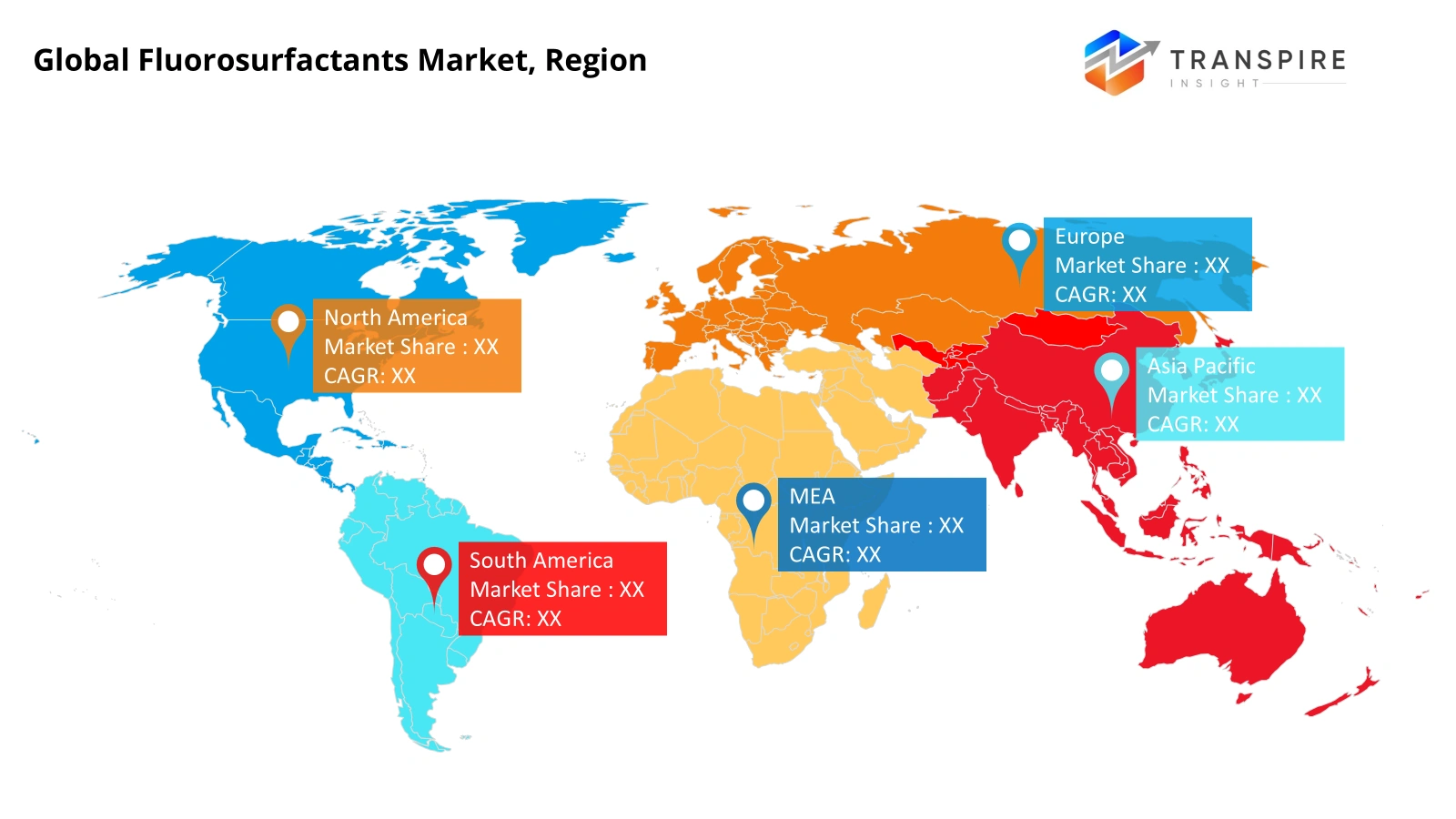
North America is the most heavily regulated regional market. The U. S. EPA has really taken the broadest action on PFAS compounds - that's any single regulator. This has significantly accelerated the withdrawal of long-chain fluorosurfactants from a number of applications. It has also created one of the most dynamic markets for short-chain and fluorine-free alternatives. Demand in paints, coatings, and electronics cleaning remains relatively solid. Firefighting foam is actually decreasing. Chemours and 3M have both greatly revised their fluorosurfactant portfolios because of US regulatory pressure.
Europe pretty much follows a similar path. REACH restrictions and the larger PFAS universal restriction plan under development by several EU countries have really pushed formulators to reformulate before actual deadlines even arrive. Germany, France, and the Netherlands are quite active markets for short-chain non-ionic products in industrial coatings. The EU's restriction schedule is actually more condensed than in the US in certain categories, which has further increased reformulation investment by European paint and coating manufacturers.
Asia-Pacific is actually the largest regional market by volume. China dominates production and consumption. Chinese producers such as Dongyue Group, Shandong Dongyue Chemical, and Hubei Everflon have developed a very large amount of capacity in fluoropolymer and fluorosurfactant chemistry. Their cost situation lets them compete very competitively in global markets. Japan is a major consumer through its electronics industry. South Korea and Taiwan also consume fluorosurfactants in semiconductor fabrication and electronics manufacturing. Regulatory pressure on PFAS in Asia-Pacific is quite real but less advanced than in North America or Europe - which means some long-chain products are still in use in applications where they've been withdrawn elsewhere.
The Middle East is a secondary market. Its importance lies mainly in oil and gas. Gulf state NOCs and international companies operating Enhanced Oil Recovery (EOR) programs in the region use special oilfield-grade fluorosurfactants. This demand is related to our investments in the upstream area more so than construction or electronics activity.
To learn more about this report, Download Free Sample Report
Recent Development News
In April 2023, updated short-chain fluorosurfactant application guides for coatings and inks. Included dosage optimization, compatibility tables, and substitution pathways for PFOA-based legacy products.
In December 2022 – March 2023, During its PFAS phase-out announcement, 3M issued transition support documentation for customers replacing legacy fluorosurfactants.
Report Metrics
|
Report Metrics |
Details |
|
Market size value in 2025 |
USD 1.49 Billion |
|
Market size value in 2026 |
USD 1.526 Billion |
|
Revenue forecast in 2033 |
USD 1.778 Billion |
|
Growth rate |
CAGR of 2.21% from 2026 to 2033 |
|
Base year |
2025 |
|
Historical data |
2021 - 2024 |
|
Forecast period |
2026 - 2033 |
|
Report coverage |
Revenue forecast, competitive landscape, growth factors, and trends |
|
Country scope |
Global |
|
Key company profiled |
Chemours Company, 3M Company, Solvay S.A., Arkema S.A., AGC Inc., Daikin Industries Ltd., DIC Corporation, Dynax Corporation, Pilot Chemical Company, Merck KGaA, Shin-Etsu Chemical Co. Ltd., Dongyue Group Ltd., Hunan Nonferrous Chenzhou Fluoride Chemical Co. Ltd., Hubei Everflon Polymer Co. Ltd., Shandong Dongyue Chemical Co. Ltd. |
|
Customization scope |
Free report customization (country, regional & segment scope). Avail customized purchase options to meet your exact research needs. |
|
Report Segmentation |
By Type (Anionic Fluorosurfactants, Cationic Fluorosurfactants, Non-ionic Fluorosurfactants, Amphoteric Fluorosurfactants), By Application (Paints & Coatings, Firefighting Foams, Oilfield Chemicals, Electronics Cleaning), By End-User Industry (Construction, Oil & Gas, Electronics, Automotive). |
Key Global Fluorosurfactants Company Insights
Chemours and 3M have really been at the heart of global fluorosurfactant supply for years. Both companies have refocused their portfolios quite a bit under PFAS regulatory pressure. 3M stated that it plans to exit PFAS manufacturing altogether. Chemours has maintained its fluorosurfactant business by concentrating on short-chain Capstone products. These replace older long-chain chemistries - yet remain well within present regulatory guidelines.
Solvay and Arkema do compete in both the European and global markets. Both have invested in alternatives with shorter chains. Daikin and AGC are a big deal in the Asian marketplaces.
They offer both fluoropolymer and fluorosurfactant chemistries from rather integrated production facilities. Chinese producers, especially Dongyue Group and all its subsidiaries, have built some very competitive cost positions through sheer size. They're quite active in commodity-grade fluorosurfactants. Premium specialty grades for electronics and the oil industry still really favor established Western and Japanese manufacturers - who can give the necessary technical support and consistenly document these applications more so.
Company List
- Chemours Company
- 3M Company
- Solvay S.A.
- Arkema S.A.
- AGC Inc.
- Daikin Industries Ltd.
- DIC Corporation
- Dynax Corporation
- Pilot Chemical Company
- Merck KGaA
- Shin-Etsu Chemical Co. Ltd.
- Dongyue Group Ltd.
- Hunan Nonferrous Chenzhou Fluoride Chemical Co. Ltd.
- Hubei Everflon Polymer Co. Ltd.
- Shandong Dongyue Chemical Co. Ltd.
Global Fluorosurfactants Market Report Segmentation
By Type
- Anionic Fluorosurfactants
- Cationic Fluorosurfactants
- Non-ionic Fluorosurfactants
- Amphoteric Fluorosurfactants
By Application
- Paints & Coatings
- Firefighting Foams
- Oilfield Chemicals
- Electronics Cleaning
By End-User Industry
- Construction
- Oil & Gas
- Electronics
- Automotive
Frequently Asked Questions
Find quick answers to common questions.
The Global Fluorosurfactants Market is expected to reach approximately USD 1.778 billion by 2033.
Key segments include Type (Anionic, Cationic, Non-ionic, Amphoteric Fluorosurfactants), Application (Paints & Coatings, Firefighting Foams, Oilfield Chemicals, Electronics Cleaning), and End-User Industry (Construction, Oil & Gas, Electronics, Automotive).
Major players include Chemours Company, 3M Company, Solvay S.A., Arkema S.A., AGC Inc., Daikin Industries Ltd., DIC Corporation, Dynax Corporation, Pilot Chemical Company, Merck KGaA, Shin-Etsu Chemical Co. Ltd., Dongyue Group Ltd., Hunan Nonferrous Chenzhou Fluoride Chemical Co. Ltd., Hubei Everflon Polymer Co. Ltd., and Shandong Dongyue Chemical Co. Ltd.
The Global Fluorosurfactants Market size is approximately USD 1.49 billion in 2025.
The Global Fluorosurfactants Market is expected to grow at a CAGR of 2.21% from 2026 to 2033.
- Chemours Company
- 3M Company
- Solvay S.A.
- Arkema S.A.
- AGC Inc.
- Daikin Industries Ltd.
- DIC Corporation
- Dynax Corporation
- Pilot Chemical Company
- Merck KGaA
- Shin-Etsu Chemical Co. Ltd.
- Dongyue Group Ltd.
- Hunan Nonferrous Chenzhou Fluoride Chemical Co. Ltd.
- Hubei Everflon Polymer Co. Ltd.
- Shandong Dongyue Chemical Co. Ltd.
Recently Published Reports
-
May 2026
Healthcare Polymer Packaging Market
Healthcare Polymer Packaging Market Size, Share & Analysis Report By Packaging Type (Syringes, IV Bottles and Pouches, Clamshells, Blisters, Bottles & Jars, Containers, Tubes, IV Parental Packaging, Others), By Type (Regulated, Non-regulated), By Polymer Type (LDPE (Low-Density Polyethylene), HDPE (High-Density Polyethylene), Homo-polymer (Homo), Random Copolymer (Random), Block Copolymer (Block), PET, Polystyrene, Polyvinyl Chloride, Polyamide/EVOH, Others), and Geography (North America, Europe, Asia-Pacific, Middle East and Africa, South and Central America), 2021 - 2031
-
Apr 2026
Hydrophilic Tape (Waterstop) Market
Hydrophilic Tape (Waterstop) Market Size, Share & Analysis Report By Type (Bentonite-Based Hydrophilic Tape, Rubber-Based Hydrophilic Tape), By Application (Residential Buildings, Commercial Buildings, Infrastructure Projects), and Geography (North America, Europe, Asia-Pacific, Middle East and Africa, South and Central America), 2021 - 2031
-
Apr 2026
Metalens Market
Metalens Market Size, Share & Analysis Report By Type (Visible Light Metalens, and Infrared Metalens), By Application (Consumer Electronics, Automotive Electronics, Industrial, Medical, and Others), and Geography (North America, Europe, Asia-Pacific, Middle East and Africa, South and Central America), 2021 - 2031
-
Apr 2026
PBT Resin Market
PBT Resin Market Size, Share & Analysis Report By Type (Reinforced PBT Resin, Unreinforced PBT Resin), By Processing Method (Injection Molding, Extrusion, Blow Molding, Others), By End-User (Automotive, Electrical & Electronics, Consumer Appliances, Industrial Machinery, Medical Devices, Packaging, Others), and Geography (North America, Europe, Asia-Pacific, Middle East and Africa, South and Central America), 2021 - 2031