
Global Fencing Market Size & Forecast:
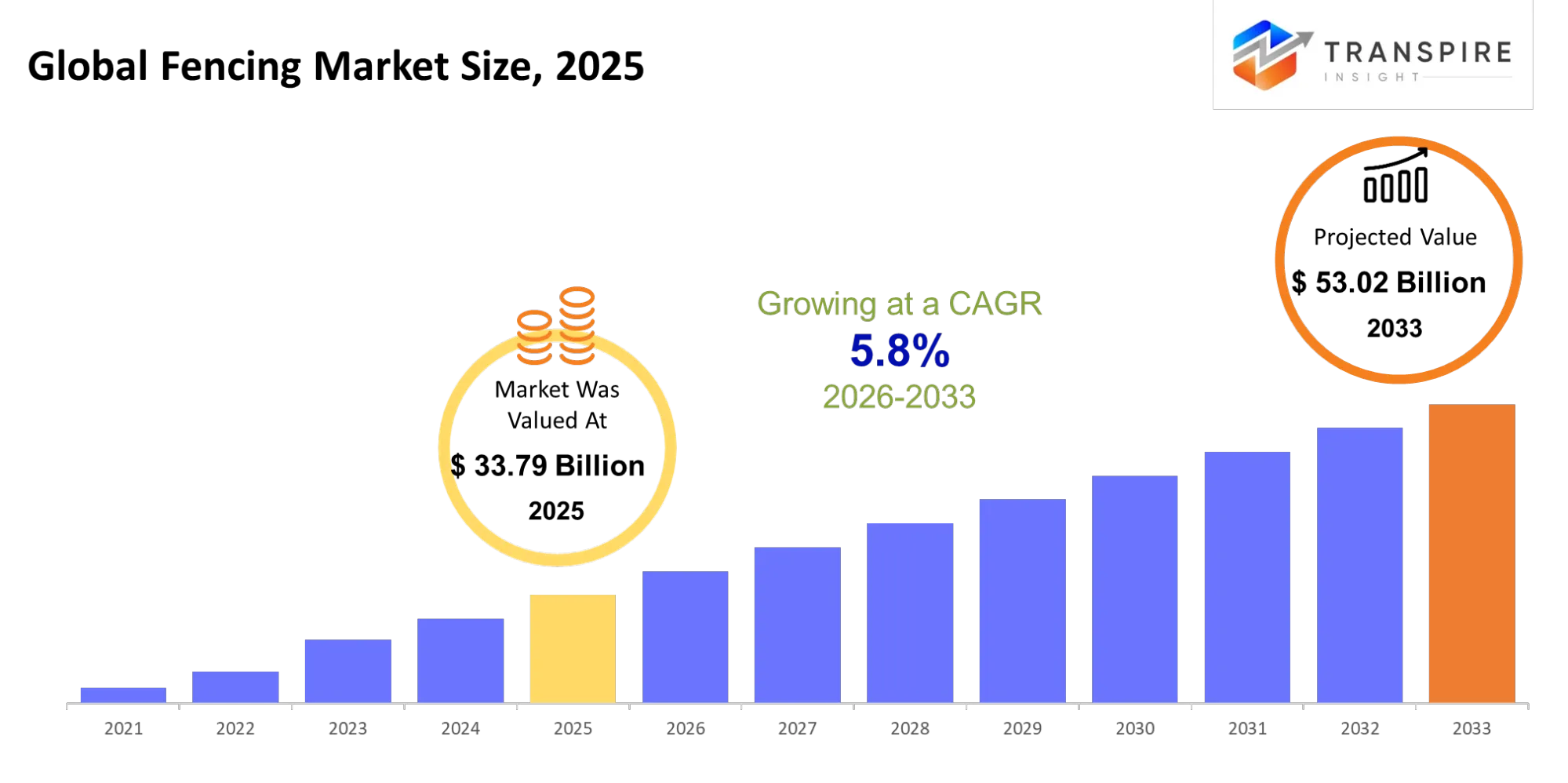
- Global Fencing Market Size 2025: USD 33.79 Billion
- Global Fencing Market Size 2033: USD 53.02 Billion
- Global Fencing Market CAGR: 5.8%
- Global Fencing Market Segments: by type (Chain-link Fencing, Wooden Fencing, Vinyl Fencing, Metal Fencing, Electric Fencing, Composite Fencing, Others); By Application (Residential Security, Commercial Security, Agricultural Fencing, Industrial Perimeter Protection, Sports Facilities, Others); By End-User (Homeowners, Construction Companies, Farms, Government Facilities, Others); By Installation (Permanent Fencing, Temporary Fencing, Smart Fencing Systems, Automated Gates, Others)By Form (Pellets, Granules, Molded Components, Others)
To learn more about this report,  Download Free Sample Report
Global Fencing Market Summary:
The Global Fencing Market size is estimated at USD 33.79 Billion in 2025 and is anticipated to reach USD 53.02 Billion by 2033, growing at a CAGR of 5.8% from 2026 to 2033.
The fencing industry is not about putting up a simple fence around a place anymore. It is now a business that includes security and taking care of properties. In the past few years, people who buy fences have wanted them to be strong, not need a lot of work to keep them good and have new technology. This has made the companies that make fences think about making more than the usual kinds of fences.
One big change is that more and more people are using fences that can watch what is going on and open and close automatically. This is happening because people are getting more worried about security at their homes, offices and farms. People who own property want to protect what they have and control who comes in and out. So they are spending money on fences. The fencing industry is growing because people need security, new products are being made, and fences are being used in more places. The fencing industry is going to keep growing for a time. The fencing industry is getting bigger because of these things. It is good for the fencing industry.
Key Market Insights:
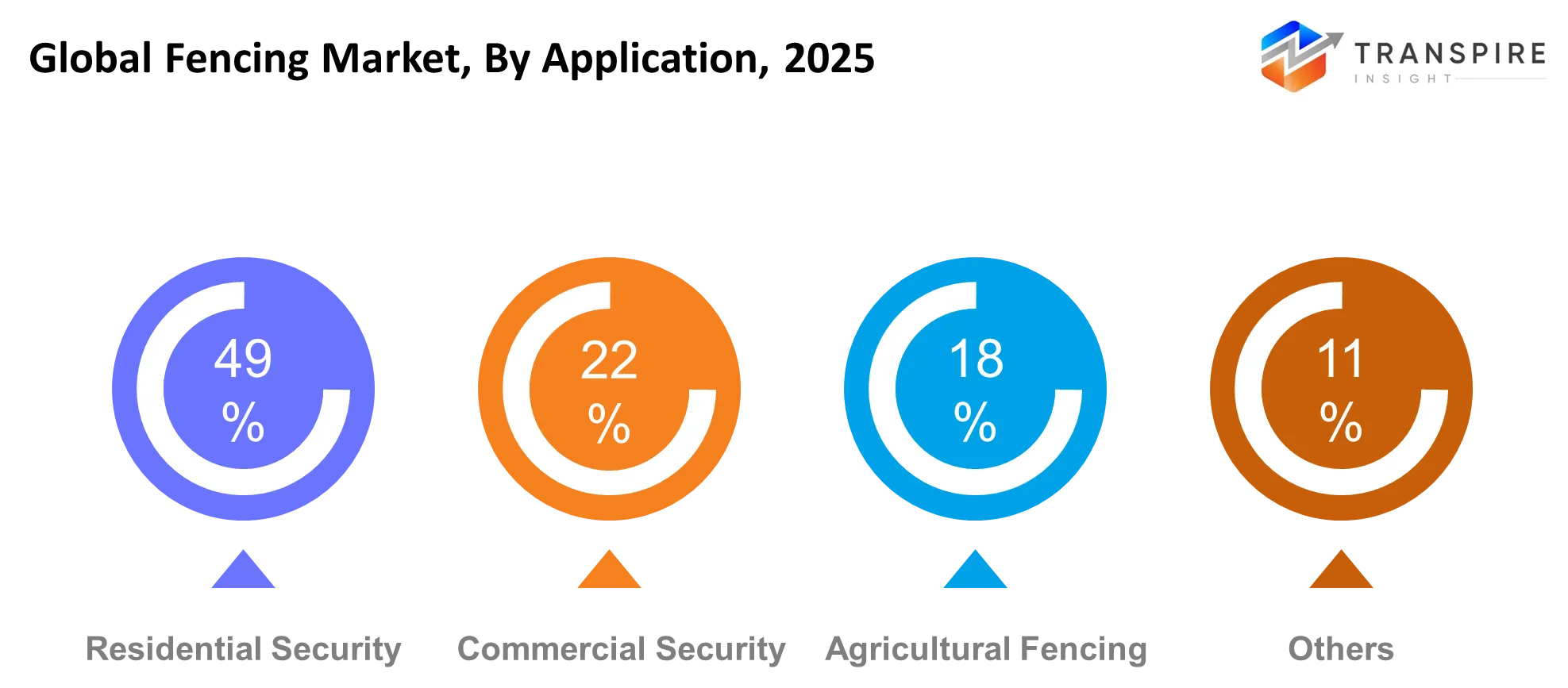
- Residential Security comprises 49% of demand driven by consumers investing in securing their homes. Commercial Security installations make up 22% as companies enhance their perimeter management strategies.
- Agricultural Fencing constitutes 18% and includes investments in protecting livestock and farmland. Other segments make up 11% of demand, catering to unique requirements.
- Residential Security leads the industry, making up 49% of demand due to continuous improvements in home security. Smart Fencing Systems are growing the fastest at a CAGR of 10.5%.
- Firms are integrating automation features like monitoring and access control into products. Firms are increasingly focusing on developing more durable materials with low maintenance costs.
- Surveillance systems are driving purchases of fencing products across various end-user industries.
What are the Key Drivers, Restraints, and Opportunities in the Global Fencing Market?
Drivers
Increased awareness of asset and property safety is one of the key drivers fueling the Global Fencing Market. Property owners are making investments in the installation of fence systems in order to secure their properties and also gain access control to their premises. With increased awareness about security issues, property owners are giving more emphasis to the safety of their assets and equipment, leading to the growth of this market segment. Moreover, construction activities across various regions have led to an increase in demand for fence installations. The fencing industry has been experiencing growth owing to the adoption of smart fences, which not only serve as barriers but also provide other functionalities.
Restraints
High cost involved in the installation, maintenance, and upgrade of fencing systems could prove to be a restraining factor. The majority of the customers still opt for the conventional systems, owing to the fact that upgrading or replacing the existing system could involve a lot of capital expenditure. Such a hindrance could be the major reason behind slower adoption rates, as well as limited penetration of premium products.
Opportunities
Emerging technologies such as smart fencing and automated gates could prove to be an important opportunity for the vendors in the market. Installation of fencing systems along with connected monitoring systems is expected to generate extra income for manufacturers. In addition, continuous developments in technology-based fencing systems would enable the companies to benefit from the opportunities in the market.
What Has the Impact of Artificial Intelligence Been on the Global Fencing Market?
The impact of artificial intelligence on the fencing industry is becoming more obvious with the use of intelligent perimeter management and improved surveillance technologies. Artificial intelligence is able to analyse data obtained from the fence sensors and cameras, allowing fence owners to detect any abnormal activity faster.
The first obvious benefit that should be mentioned in this regard is automation. The intelligent fencing system is capable of providing automation of alert generation, access control, and monitoring without the need for manual supervision. Additionally, the prediction feature enables detection of any possible security risks ahead of time.
Improving the efficiency of operational activities is another benefit provided by intelligent fences. The introduction of such systems helps cut down the number of unnecessary checks, improve monitoring operations, and provide effective assistance in managing large perimeters. Such solutions are especially useful for commercial, industrial, and large agricultural sites. At this stage of development, such systems face certain difficulties in terms of implementation because of high costs and technical limitations related to the fact that current fences cannot easily accommodate these features.
Instance
In March 2024, one of the most renowned providers of perimeter security solutions launched a new smart fencing system driven by AI, which is capable of analysing video and sensor data, identifying anomalies, and sending instant notifications.
Key Market Trends:
- Smart fencing solutions are gaining popularity among consumers who seek greater control, monitoring capabilities, and visibility over their property boundaries.
- Automated gate systems are increasingly being incorporated into new fencing installations, driven by demand for convenience, access control, and enhanced security.
- The market is witnessing a shift toward low-maintenance fencing materials that offer durability, weather resistance, and reduced long-term upkeep costs.
- Security considerations continue to play a major role in consumer purchasing decisions, driving demand for advanced fencing and perimeter protection solutions.
- Digital surveillance technologies are becoming more widely adopted in commercial applications, enhancing perimeter monitoring and threat detection capabilities.
- Farmers are increasingly investing in advanced perimeter management solutions to improve property security, livestock protection, and operational efficiency.
- Residential customers are showing strong preference for fencing products that combine aesthetic appeal with robust security functionality.
- Strategic partnerships between fencing manufacturers and technology companies are accelerating innovation, enabling the integration of smart monitoring, automation, and connected security features into modern fencing systems.
Global Fencing Market Segmentation
By Type
The chain-link fences lead in the segment based on their cost-effectiveness, durability, and use by many people and businesses. The wooden fence will continue to gain popularity in residences because of its attractive appearance, while the vinyl fence has advantages because of lower maintenance costs. The metal fence still plays an important role for highly secured areas, the electric fence helps fulfill requirements in agriculture, and the composite fence is gaining importance because of durability and attractiveness. The leading role of the chain-link fence is reinforced by the capability of providing good security at reasonable costs, which is important for the end users. In the future, increasing infrastructure projects and demand for cost-effective products can help strengthen the segment’s market position.
By Application
The leading application segment includes residential security fencing, which holds 49% market share. Commercial security constitutes 22% share, whereas Agricultural fencing holds 18% share. Other applications include industrial perimeter security fencing, sports facility security, and other applications, which together hold 11% share in the market. The leading share of the residential security segment is attributed to growing concerns amongst homeowners regarding privacy and safety of their properties. With increasing residential building activities and home improvement, the residential security fencing segment is set to lead the way.
To learn more about this report, Download Free Sample Report
By End-User
Homeowners account for the largest share of end-users because there is a high demand for fencing products from the security aspect and improving properties. The construction sector creates a high demand for fences through the development of infrastructure and buildings. Fencing products create a high demand from farms as they need them for the safety of their cattle and security of land. In addition, government institutions create a high demand for fencing products due to their need for security.
By Installations
The segment of installations that contributes the most to the industry includes permanent fences, owing to their robustness and the security advantage offered through their prolonged use. The use of temporary fences is still prevalent in building sites and for managing events, whereas automated gates find greater usage for controlling access points. The fastest-growing type of fence installation today is smart fences, and it is forecasted to grow at a CAGR of 10.5%, thanks to advanced monitoring and automation technology. There are plenty of growth opportunities available within the area of installing intelligent fences.
What are the Key Use Cases Driving the Global Fencing Market?
Home security will remain the most prominent area of application for fencing, driven by the needs of homeowners for property security, privacy, and controlled access. Home security is currently the most dominant in terms of industry activity and will remain the main driver of installations. Other promising application areas include business and farm fencing. Businesses require fences to protect their assets and control access to the site, while farms utilise fences to protect land, machines, and livestock. New applications for fencing technology are becoming more popular with the development of smart fences that monitor, control, and manage access along their perimeters.
|
Report Metrics |
Details |
|
Market size value in 2025 |
USD 33.79 Billion |
|
Market size value in 2026 |
USD 35.72 Billion |
|
Revenue forecast in 2033 |
USD 53.02 Billion |
|
Growth rate |
CAGR of 5.8% from 2026 to 2033 |
|
Base year |
2025 |
|
Historical data |
2021 - 2024 |
|
Forecast period |
2026 - 2033 |
|
Report coverage |
Revenue forecast, competitive landscape, growth factors, and trends |
|
Regional scope |
United States; Canada; Mexico; United Kingdom; Germany; France; Italy; Spain; Denmark; Sweden; Norway; China; Japan; India; Australia; South Korea; Thailand; Brazil; Argentina; South Africa; Saudi Arabia; United Arab Emirates |
|
Key company profiled |
Betafence, Ameristar Fence Products, Bekaert, Jerith Manufacturing, Gregory Industries, CertainTeed, Ply Gem, Long Fence, Allied Tube & Conduit, Poly Vinyl Creations, Master Halco, Jacksons Fencing, ActiveYards, Fortress Building Products, Associated Materials |
|
Customization scope |
Free report customization (country, regional & segment scope). Avail customized purchase options to meet your exact research needs. |
|
Report Segmentation |
By Type (Chain-link Fencing, Wooden Fencing, Vinyl Fencing, Metal Fencing, Electric Fencing, Composite Fencing, Others); By Application (Residential Security, Commercial Security, Agricultural Fencing, Industrial Perimeter Protection, Sports Facilities, Others); By End-User (Homeowners, Construction Companies, Farms, Government Facilities, Others); By Installation (Permanent Fencing, Temporary Fencing, Smart Fencing Systems, Automated Gates, Others) |
Which Regions are Driving the Global Fencing Market Growth?
North America
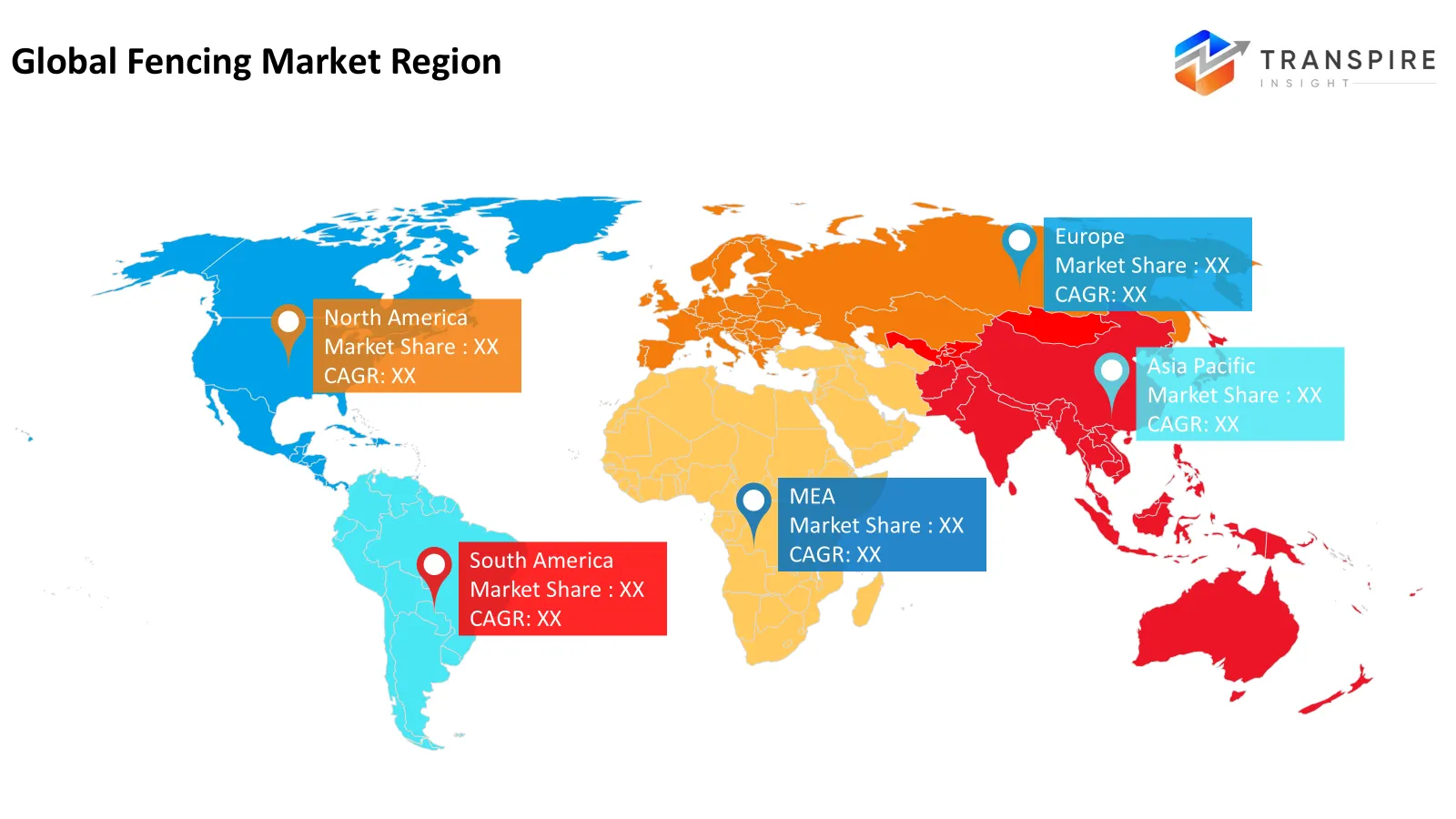
North America dominates the world market, accounting for 39% of its total volume. The advantages possessed by this area include high awareness of safety issues, well-developed infrastructure, and investments in property security solutions. Perimeter security remains highly popular among end-users, which ensures stable demand for fencing solutions. Innovation and efficient installation practices contribute to the leading position of North America. In March 2024, several important organisations within the U.S. enhanced their installation of fencing technology with artificial intelligence capability, video analytics, and intrusion-detection sensors as a result of the regional emphasis on innovative fencing technology.
Europe
Europe occupies second place on the market, comprising 27% of total sales volume. The stability of performance is ensured by ongoing infrastructure improvement and replacement activities. Unlike North America, market growth in Europe is facilitated not only by new constructions but also by modernisation programs. High standards of quality stimulate use of advanced materials for fencing installations. Diversity of customers in terms of residential, commercial, and agricultural applications provides an additional boost to the market performance in this region.In September 2025, increasing usage of smart fencing systems including sensors, alarms, and remote monitoring facilities for residences and commercial buildings was noted due to upgrades in infrastructure, as well as security reasons.
Asia-Pacific
Asia-Pacific ranks third in terms of fencing solutions market share, being responsible for 25%. It is also the most rapidly growing area, registering a CAGR of 11.4%. Fast urbanisation processes combined with increased construction activities lead to rising demand in fencing solutions. Growing property security concerns are contributing to market growth. Further infrastructure development presents good opportunities for future expansion. In June 2025, the fast pace of urbanisation and initiatives for building smart cities in China, India, and Southeast Asian countries resulted in high demand for advanced panel and security fencing technology, making the region a leader in the global Global Fencing Market
To learn more about this report, Download Free Sample Report
Who are the Key Players in the Global Fencing Market and how do they Compete?
Product quality, innovations, pricing policy, and geographic expansion constitute competitive factors in the Global Fencing Market. Competitiveness in the Global Fencing Market revolves around the provision of products that satisfy different needs in terms of security.
Betafence, Ameristar Fence Products, Bekaert, and Jerith Manufacturing compete by enhancing their portfolios through innovative materials and superior performance in terms of security. Their competitive edge involves durability, a high level of expertise in engineering, and versatility in usage. On the other hand, Gregory Industries, CertainTeed, Ply Gem, Long Fence, Allied Tube & Conduit, and Poly Vinyl Creations are competitive owing to their specialised and targeted solutions, including their efforts to expand their reach geographically through product diversification.
Master Halco, Jacksons Fencing, ActiveYards, Fortress Building Products, and Associated Materials compete with their innovations, expanded customer reach, and installation assistance services.
Global Fencing Market Companies
- Betafence
- Ameristar Fence Products
- Bekaert
- Jerith Manufacturing
- Gregory Industries
- CertainTeed
- Ply Gem
- Long Fence
- Allied Tube & Conduit
- Poly Vinyl Creations
- Master Halco
- Jacksons Fencing
- ActiveYards
- Fortress Building Products
- Associated Materials
Recent Development News
In September 2025, Harkness Capital Partners made an institutional equity investment in Premier Fence, LLC. The collaboration between the two entities is expected to enable Premier Fence to expand its geographic reach in New England and develop more sophisticated gate installation services.
https://www.harknesscapital.com
In January 2026, Perimeter Solutions Group, LLC purchased California-based commercial fence installer Econo Fence. This acquisition increases the company’s geographic reach and local manufacturing capacity in the key California market of perimeter protection for municipalities and industries.
https://www.bertramcapital.com
What Strategic Insights Define the Future of the Global Fencing Market?
Fencing technology would continue progressing towards intelligent perimeter management involving the integration of physical and digital components for security. The key requirement for future success would be the capability of the fencing industry to integrate advanced technology in an affordable way for customers.
The problem that has been overlooked is that of integrating advanced technology into existing structures. There exists considerable potential in smart fences along with other types of automated access control equipment. Manufacturers that adapt their products to changing trends in security would be more successful in the future. The recommended course of action would be to develop innovative, robust, and easily-integrable technologies while at the same time keeping costs low enough for traditional clients.
Global Fencing Market Segmentation
By Type
- Chain-link Fencing
- Wooden Fencing
- Vinyl Fencing
- Metal Fencing
- Electric Fencing
- Composite Fencing
By Application
- Residential Security
- Commercial Security
- Agricultural Fencing
- Industrial Perimeter Protection
- Sports Facilities
By End-User
- Homeowners
- Construction Companies
- Farms
- Government Facilities
By Installation
- Permanent Fencing
- Temporary Fencing
- Smart Fencing Systems
- Automated Gates
Regional Outlook
North America
- United States
- Canada
- Mexico
Europe
- Germany
- United Kingdom
- France
- Spain
- Italy
- Rest of Europe
Asia Pacific
- Japan
- China
- Australia & New Zealand
- South Korea
- India
- Rest of Asia Pacific
South America
- Brazil
- Argentina
- Rest of South America
Middle East & Africa
- Saudi Arabia
- United Arab Emirates
- South Africa
- Rest of the Middle East & Africa
Frequently Asked Questions
Find quick answers to common questions.
The global Fencing Market size was valued at USD 33.79 Billion in 2025 and is poised to reach USD 53.02 Billion by 2033, expanding at a 5.8% CAGR.
Key segments for the Global Fencing Market are By Type (Chain-link Fencing, Wooden Fencing, Vinyl Fencing, Metal Fencing, Electric Fencing, Composite Fencing, Others); By Application (Residential Security, Commercial Security, Agricultural Fencing, Industrial Perimeter Protection, Sports Facilities, Others); By End-User (Homeowners, Construction Companies, Farms, Government Facilities, Others); By Installation (Permanent Fencing, Temporary Fencing, Smart Fencing Systems, Automated Gates, Others)
Growth is primarily driven by the global Global Fencing Market is primarily driven by increasing concerns about property safety and security, rising investments in access control systems, growing construction activities, and the adoption of smart fencing solutions with advanced security features.
The global Global Fencing Market is led by major manufacturers including (Beta Fence, Ameristar Fence Products, Bekaert, Jerith Manufacturing, Gregory Industries, CertainTeed, Ply Gem, Long Fence, Allied Tube & Conduit, Poly Vinyl Creations, Master Halco, Jacksons Fencing, Active Yards, Fortress Building Products, Associated Materials.
North America influences global Global Fencing Market dynamics by accounting for 39% of the global market share. Its market dominance is supported by high security awareness, strong infrastructure development, significant investments in property protection, widespread adoption of perimeter security solutions, and ongoing advancements in fencing technologies.
The Global Fencing Market has ample scope due to the implementation of intelligent fences, automation in gates, and other security features. Manufacturers can earn more money by offering products such as fencing along with security devices, including monitoring and surveillance technology. Increasing investment in infrastructure, smart city development, and security at important locations opens up new avenues in the market.
- Betafence
- Ameristar Fence Products
- Bekaert
- Jerith Manufacturing
- Gregory Industries
- CertainTeed
- Ply Gem
- Long Fence
- Allied Tube & Conduit
- Poly Vinyl Creations
- Master Halco
- Jacksons Fencing
- ActiveYards
- Fortress Building Products
- Associated Materials
About the Authors

Chetan Dhatrak
I’m Chetan Dhatrak, a Senior Research Analyst at Transpire Insight, specializing in the Consumer Goods, Foods and Beverages industry. I focus on analyzing market trends, consumer behavior, competitive landscapes, and industry developments to deliver accurate, data-driven insights. My research at Transpire Insight is built on credible sources and in-depth analysis, helping businesses and readers better understand market dynamics, emerging opportunities, and evolving consumer preferences. I’m committed to creating reliable, well-researched content that supports informed decision-making and reflects the latest developments in the consumer goods and food & beverage sectors.

Chakradhar Khansole
Chakradhar serves as the Research Director at Transpire Insight, bringing over 8 years of experience in technology, innovation, and strategic market intelligence. He specializes in transforming complex market data into actionable business insights that enable organizations to make informed, growth-oriented decisions. Recognized for his strategic vision and analytical expertise, Chakradhar leads high-impact research initiatives, delivering comprehensive market assessments, competitive intelligence, and forward-looking industry analysis.
Recently Published Reports
-
Apr 2026
Bottled Water Market
Bottled Water Market Size, Share & Analysis Report By Product Type (Still Bottled Water, Carbonated Bottled Water, Functional Bottled Water, and Others), By Packaging (PET, Cans, and Others), By Sales Channel (Supermarkets/Hypermarkets, Convenience Stores/Drug Stores, Grocery Stores/Club Stores, Foodservice, and Others) and Geography (North America, Europe, Asia-Pacific, Middle East and Africa, South and Central America), 2021 - 2032
-
Apr 2026
Color Cosmetic Packaging Market
Color Cosmetic Packaging Market Size, Share & Analysis Report By Application (Mascara Packaging, Liquid Packaging, and Liquid Face), By Type (Tubes & Bottles, Pens & Markers, Compacts & Containers, and Droppers & Pumps), and Geography (North America, Europe, Asia-Pacific, Middle East and Africa, South and Central America), 2021 - 2031
-
Apr 2026
External Microphone For Camera Market
External Microphone For Camera Market Size, Share & Analysis Report By Type (Shotgun Microphone, Lavalier Microphone, and Others), By Application (Digital Camera, Professional Video Camera, and Others), and Geography (North America, Europe, Asia-Pacific, Middle East and Africa, South and Central America), 2021 - 2031
-
Apr 2026
Foot Orthotic Insoles Market
Foot Orthotic Insoles Market Size, Share & Analysis Report By Type (Pre-fabricated, and Custom-made), By Material (Thermoplastic, Composite Carbon Fiber, and Others), By Distribution Channel (Drug Stores, Hospitals & Clinics, and Others), and Geography (North America, Europe, Asia-Pacific, Middle East and Africa, South and Central America), 2021 - 2031