
Germany Steel Market Size & Forecast:
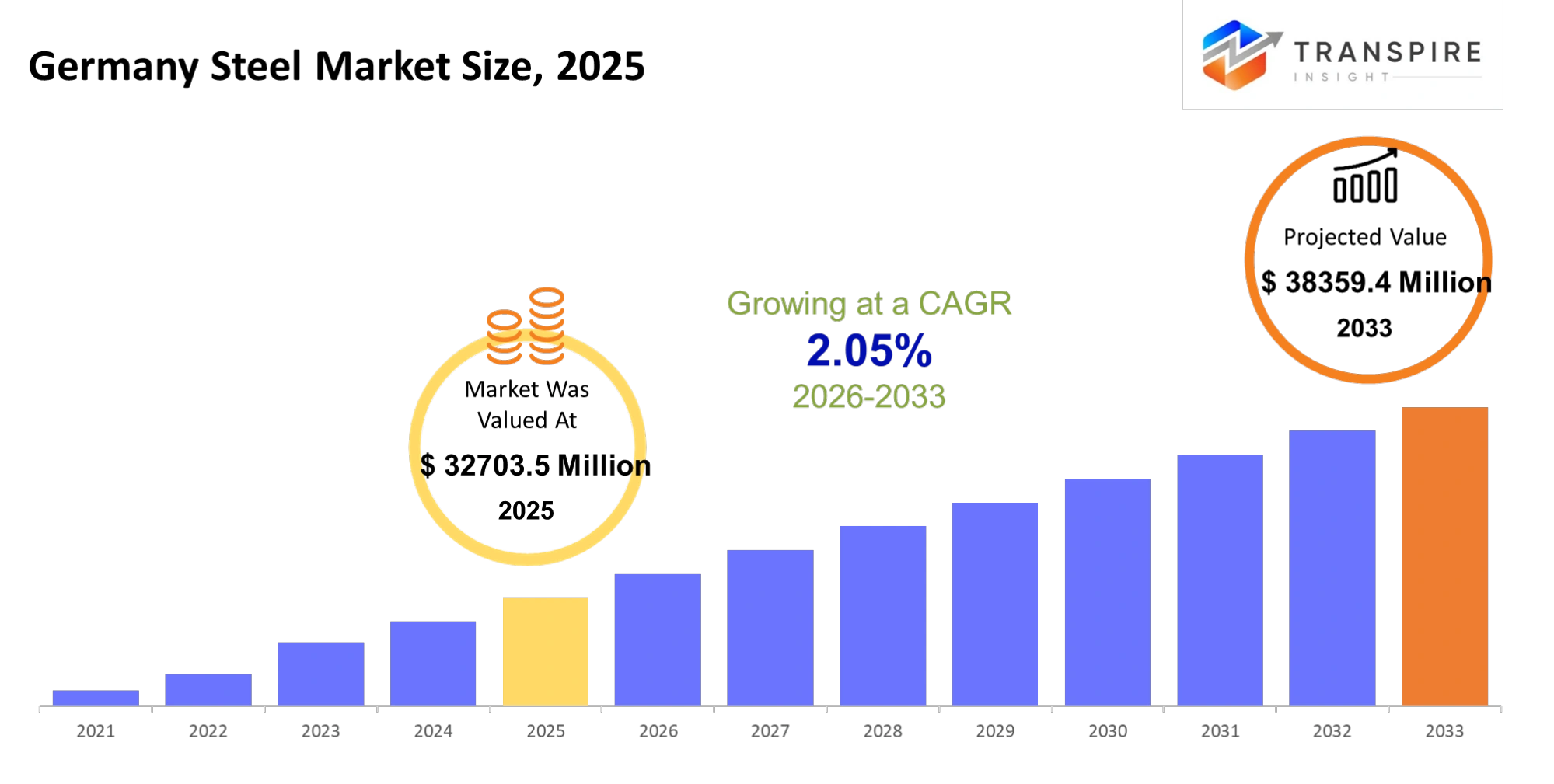
- Germany Steel Market Size 2025: USD 32703.5 Million
- Germany Steel Market Size 2033: USD 38359.4 Million
- Germany Steel Market CAGR: 2.05%
- Germany Steel Market Segments: By Product Type (Flat Steel, Long Steel), By Application (Construction, Automotive, Machinery, Energy).
To learn more about this report,  Download Free Sample Report
Germany Steel Market Summary:
The Germany Steel Market size was estimated at USD 32703.5 Million in 2025 and is anticipated to reach USD 38359.4 Million by 2033, growing at a CAGR of 2.05% from 2026 to 2033. The German steel market will establish its framework through historical industrial development and its present requirement to adapt to new market conditions. The market will maintain a stable price range, which analysts predict will increase from approximately USD 31 billion to almost USD 35 billion by the year 2030. The production process will show signs of pressure due to decreased domestic demand and increased operational expenses, leading to reduced output. Producers will need to create cleaner, more efficient steel products because buyer expectations for automotive and construction materials have set new requirements. The production process will undergo a technological transformation which will result in electric arc furnace production methods and hydrogen-based technologies that promote emissions reduction and operational efficiency improvements. The European Union will implement stricter import controls while promoting domestic manufacturing, which will create an impact on market prices and supply distribution. The steelmaking process will undergo transformation because industries increase their use of recycled scrap materials together with digital production systems.
Key Market Trends & Insights:
- The automotive, construction and machinery sectors show increasing demand for high-strength steel products and specialized steel products. Manufacturers use advanced production methods and quality control systems to achieve industrial production standards. The Germany steel Market will grow because more industries will adopt energy-efficient steel products, which offer long-lasting performance and durability.
- Environmental regulations influence production methods because steel manufacturers now use low-carbon steel materials and recycling systems. The steel industry uses cleaner production methods to cut emissions without compromising product quality. The German steel market will experience sustainable growth because businesses will continue to comply with European Union regulations, which serve as essential market drivers. European Union regulations drive sustainable growth which determines the future development of the German steel market.
- Steelmaking technology now uses automated systems, digital monitoring tools, and process improvement methods to achieve better production results and lower material waste. Research investment and modern equipment acquisition enable manufacturers to produce steel products that meet customer requirements through consistent high-quality outputs. The adoption of technology will improve the ability of businesses to compete in the German steel market.
- The steel market in Germany experiences its main trend through global trade activity together with import and export patterns, which determine steel market prices and product availability. Domestic production methods change as raw material prices and global market demand fluctuate. The German steel market will achieve stability through strong industrial partnerships and effective management of supply networks.
- The main trend of the German steel market shows that construction activities together with automotive production and industrial machine manufacturing drive constant steel usage. Urban development and infrastructure projects require reliable and durable steel products. The increasing demand from different industries will boost the German steel market while driving investments in production facilities and research development activities.
Germany Steel Market Segmentation
By Product Type
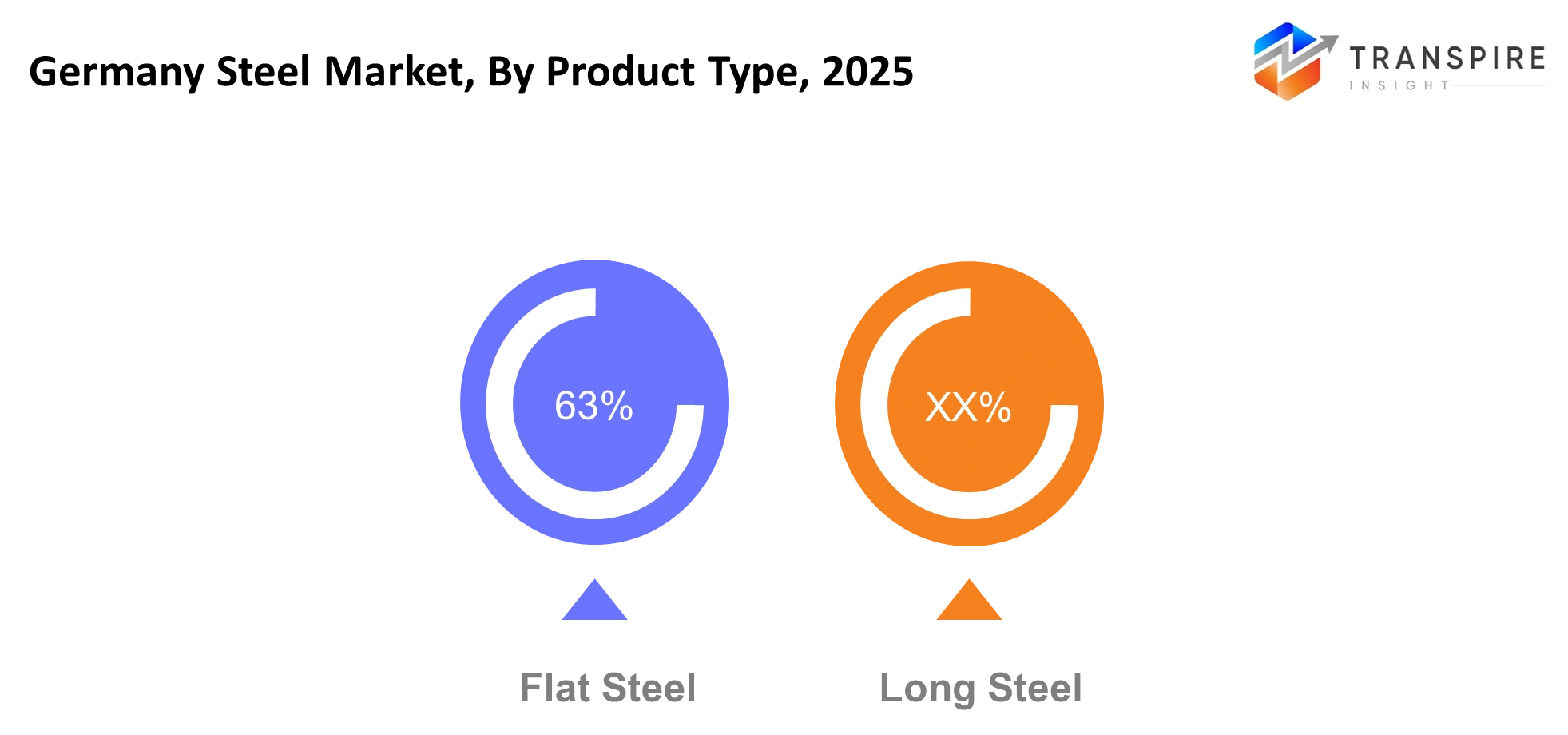
Flat Steel: The Germany steel market displays strong demand for flat steel because the material has multiple applications in automotive and industrial production processes. The term flat steel refers to sheets and plates and coils which manufacturers will use to manufacture their products. The automotive industry will use flat steel to create body structures while the appliance and equipment industries will maintain their regular flat steel usage throughout Germany.
Long Steel: The Germany steel market shows that long steel products have stable demand because they are needed for infrastructure projects and structural building work. The term long steel encompasses bars and rods and sections which construction companies will use to establish their building foundations. Long steel serves as an essential component for both construction and maintenance work required to build bridges and rail systems and residential properties.
To learn more about this report, Download Free Sample Report
By Application
Construction: The Germany steel market shows construction as a key application area with continuous demand from residential and commercial projects. Steel will be used in reinforcement, structural frames, and roofing systems. The construction industry will experience consistent growth because urban development projects and infrastructure improvements will lead to increased demand from both public and private construction projects.
Automotive: The Germany steel market shows automotive applications as its main use because there are strong manufacturing operations in the country. Steel will be used in vehicle frames and safety components and body panels. The production of vehicles will create ongoing demand because manufacturers need to produce durable vehicles while keeping costs down and electric vehicle production will need high-grade steel components.
Machinery: The Germany steel market shows machinery sector demand, which originates from industrial equipment manufacturing activities. Steel will be used in machine parts, tools and heavy equipment structures. The manufacturing units will use steel materials, which offer durability to make sure their equipment functions properly and lasts a long time therefore creating continuous demand from both engineering and industrial fields.
Energy: The Germany steel market shows increasing steel demand for energy projects which include both renewable and conventional energy systems. Steel will be used in wind turbines and pipelines and power plants. The expansion of renewable energy systems will boost steel demand while the maintenance of current energy facilities will create consistent steel demand.
Country Insights
Germany maintains a strong position in global steel production because its industrial infrastructure and manufacturing standards are both advanced and of high quality. The production process develops specialized steel materials which different sectors, including automotive, construction and machinery, require. Germany steel Market needs technology and modernization investments to achieve stable production levels and operational efficiency.
The German steel industry experiences production changes due to environmental regulations and sustainability programs the country implements. The industry is adopting recycling methods and energy-efficient solutions to decrease carbon emissions while producing high-quality products. The German steel market will experience production method advancements and competitive growth through industrial producers and research institutions joining together in collaborative efforts.
Recent Development News
German steel producers continue investment in low-carbon production methods to reduce emissions and improve energy efficiency. Transition toward hydrogen-based steelmaking and electric arc furnace technology will support sustainable production goals. Industrial upgrades and modernization efforts across manufacturing facilities will strengthen long-term growth within the Germany steel Market.
Expansion of green steel initiatives continues as major companies increase focus on climate-friendly production. thyssenkrupp AG announced progress in hydrogen-based steel production projects aimed at reducing carbon emissions from traditional processes. This development supports Germany’s transition toward sustainable industrial operations.
|
Report Metrics |
Details |
|
Market size value in 2025 |
USD 32703.5 Million |
|
Market size value in 2026 |
USD 33290.8 Million |
|
Revenue forecast in 2033 |
USD 38359.4 Million |
|
Growth rate |
CAGR of 2.05% from 2026 to 2033 |
|
Base year |
2025 |
|
Historical data |
2021 – 2024 |
|
Forecast period |
2026 – 2033 |
|
Report coverage |
Revenue forecast, competitive landscape, growth factors, and trends |
|
Country scope |
Germany |
|
Key company profiled |
Thyssenkrupp AG, ArcelorMittal, Salzgitter AG, Tata Steel Europe, Dillinger Group, Saarstahl AG, Voestalpine AG, Liberty Steel Group, Outokumpu Oyj, SSAB AB, JFE Steel Corporation, Nippon Steel Corporation, POSCO Holdings, Nucor Corporation, Hyundai Steel. |
|
Customization scope |
Free report customization (country, regional & segment scope). Avail customized purchase options to meet your exact research needs. |
|
Report Segmentation |
By Product Type (Flat Steel, Long Steel), By Application (Construction, Automotive, Machinery, Energy). |
Key Germany Steel Market Company Insights
The steel producers who operate in Germany use advanced technologies to boost their production efficiency which enables them to meet the demands of both their domestic market and their export operations. The companies use new blast furnaces and electric arc furnaces together with digital monitoring systems to enhance their production process while minimizing energy use. The development of high-strength and specialty steel products enables German steel manufacturers to maintain their market competitiveness.
The collaboration between manufacturers and research institutions develops sustainable steel solutions which include recycled steel and low-carbon production methods. The companies develop new products for the automotive construction and machinery industries while they continue to meet environmental regulations. The German steel market will experience sustained development because of its strong industrial networks and technological expertise which enable companies to maintain their market leadership position.
Company List
- Thyssenkrupp AG
- ArcelorMittal
- Salzgitter AG
- Tata Steel Europe
- Dillinger Group
- Saarstahl AG
- Voestalpine AG
- Liberty Steel Group
- Outokumpu Oyj
- SSAB AB
- JFE Steel Corporation
- Nippon Steel Corporation
- POSCO Holdings
- Nucor Corporation
- Hyundai Steel.
Germany Steel Market Report Segmentation
By Product Type
- Flat Steel
- Long Steel
By Application
- Construction
- Automotive
- Machinery
- Energy
Frequently Asked Questions
Find quick answers to common questions.
The approximate Germany Steel Market size for the market will be USD 38359.4 Million in 2033.
The key segments of the Germany Steel Market are By Product Type (Flat Steel, Long Steel), By Application (Construction, Automotive, Machinery, Energy).
Major players in the Germany Steel Market are Thyssenkrupp AG, ArcelorMittal, Salzgitter AG, Tata Steel Europe, Dillinger Group, Saarstahl AG, Voestalpine AG, Liberty Steel Group, Outokumpu Oyj, SSAB AB, JFE Steel Corporation, Nippon Steel Corporation, POSCO Holdings, Nucor Corporation, Hyundai Steel.
The current market size of the Germany Steel Market is USD 32703.5 Million by 2025.
The Germany Steel Market CAGR is 2.05%.
- Thyssenkrupp AG
- ArcelorMittal
- Salzgitter AG
- Tata Steel Europe
- Dillinger Group
- Saarstahl AG
- Voestalpine AG
- Liberty Steel Group
- Outokumpu Oyj
- SSAB AB
- JFE Steel Corporation
- Nippon Steel Corporation
- POSCO Holdings
- Nucor Corporation
- Hyundai Steel.
Recently Published Reports
-
Apr 2026
Healthcare Polymer Packaging Market
Healthcare Polymer Packaging Market Size, Share & Analysis Report By Packaging Type (Syringes, IV Bottles and Pouches, Clamshells, Blisters, Bottles & Jars, Containers, Tubes, IV Parental Packaging, Others), By Type (Regulated, Non-regulated), By Polymer Type (LDPE (Low-Density Polyethylene), HDPE (High-Density Polyethylene), Homo-polymer (Homo), Random Copolymer (Random), Block Copolymer (Block), PET, Polystyrene, Polyvinyl Chloride, Polyamide/EVOH, Others), and Geography (North America, Europe, Asia-Pacific, Middle East and Africa, South and Central America), 2021 - 2031
-
Apr 2026
Hydrophilic Tape (Waterstop) Market
Hydrophilic Tape (Waterstop) Market Size, Share & Analysis Report By Type (Bentonite-Based Hydrophilic Tape, Rubber-Based Hydrophilic Tape), By Application (Residential Buildings, Commercial Buildings, Infrastructure Projects), and Geography (North America, Europe, Asia-Pacific, Middle East and Africa, South and Central America), 2021 - 2031
-
Apr 2026
Metalens Market
Metalens Market Size, Share & Analysis Report By Type (Visible Light Metalens, and Infrared Metalens), By Application (Consumer Electronics, Automotive Electronics, Industrial, Medical, and Others), and Geography (North America, Europe, Asia-Pacific, Middle East and Africa, South and Central America), 2021 - 2031
-
Apr 2026
PBT Resin Market
PBT Resin Market Size, Share & Analysis Report By Type (Reinforced PBT Resin, Unreinforced PBT Resin), By Processing Method (Injection Molding, Extrusion, Blow Molding, Others), By End-User (Automotive, Electrical & Electronics, Consumer Appliances, Industrial Machinery, Medical Devices, Packaging, Others), and Geography (North America, Europe, Asia-Pacific, Middle East and Africa, South and Central America), 2021 - 2031