
Germany Radio Frequency Identification Technology Market Size & Forecast:
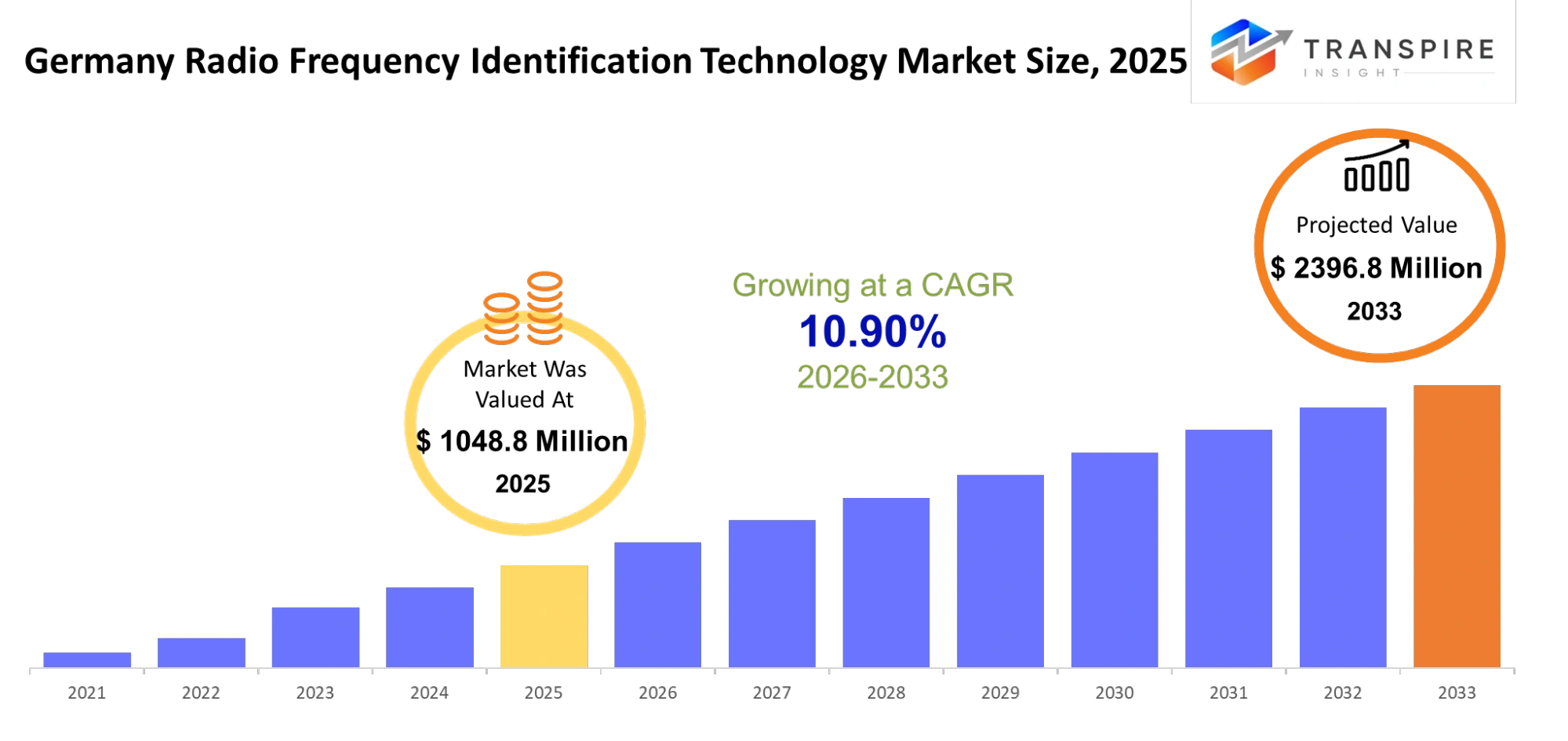
- Germany Radio Frequency Identification Technology Market Size 2025: USD 1048.8 Million
- Germany Radio Frequency Identification Technology Market Size 2033: USD 2396.8 Million
- Germany Radio Frequency Identification Technology Market CAGR: 10.90%
- Germany Radio Frequency Identification Technology Market Segments: By Component (Tags, Readers, Software), By Frequency Type (Low Frequency, High Frequency, Ultra-High Frequency), By Application (Retail, Healthcare, Logistics, Manufacturing).
To learn more about this report,  Download Free Sample Report
Germany Radio Frequency Identification Technology Market Summary:
The Germany Radio Frequency Identification Technology Market size is estimated at USD 1048.8 Million in 2025 and is anticipated to reach USD 2396.8 Million by 2033, growing at a CAGR of 10.90% from 2026 to 2033. The Germany Radio Frequency Identification Technology Market within the broader industrial automation and digital tracking industry will continue to shape how goods, assets, and information move across supply chains. It will reflect a shift toward precision, where German manufacturers and retailers will demand faster, contactless identification systems that reduce friction in logistics. Consumer expectations for transparency in product origin and availability will push companies to adopt smarter tagging and scanning solutions. At the same time, stricter European data protection standards will influence system design, encouraging secure and compliant deployments. Advancements in sensor integration and IoT connectivity will further strengthen its role in modern infrastructure.
Key Market Trends & Insights:
- The high demand for real-time location tracking would be the major driver for the adoption of RFID technology in the German market. Businesses would look to capitalize on the technology for faster inventory turnover, as it would provide the much-needed solution for the gaps that exist in the present scenario.
- Technological advancements in the quality of chips and antenna would also be the driver for the RFID technology industry in the German market, as it would provide the much-needed solution for the harsh environments in the industrial sector, as the technology would be more compact and would provide the much-needed durability.
- Changes in consumer behavior would also be the driver for the RFID technology industry in the German retail sector, as the technology would provide the much-needed solution for the accurate billing of products, as consumers would look to capitalize on the technology for faster checkout services.
- The regulatory guidelines set in Germany and the EU will be the key factors in implementing the system. Data protection policies will also play a role in the way data is shared, and it is expected that the data will be shared in a way that ensures data security. It is expected that vendors will be selected based on their compliance with data protection policies, particularly those related to data safety and security.
- The development of IoT environments is expected to improve the capabilities of the system, as data will be collected through IoT devices. The data collected by the tags will be used for data analytics, thus enabling better forecasting capabilities.
Germany Radio Frequency Identification Technology Market Segmentation
By Component
- Tags: Tags will form the basis of identification systems, allowing tracking at the individual item level in various sectors, including retail and manufacturing industries. The improvement in durability and size of tags will facilitate their application in various environments, including industrial settings, where reliability is expected to remain key in the future.
- Readers: The 'readers' will act as the data reception point, allowing for smooth communication between tags and digital interfaces. The improvement in data collection efficiency, especially in the 'read range' and 'speed' of the tags, is expected to facilitate the smooth operation of various business processes, including warehouse management and checkout counters.
- Software: The 'software' is expected to act as the data interpretation center, allowing businesses to make effective decisions through the provision of clear insights. Businesses are expected to rely on software platforms to connect identification data to their current operations, facilitating effective operations across various business departments.
By Frequency Type
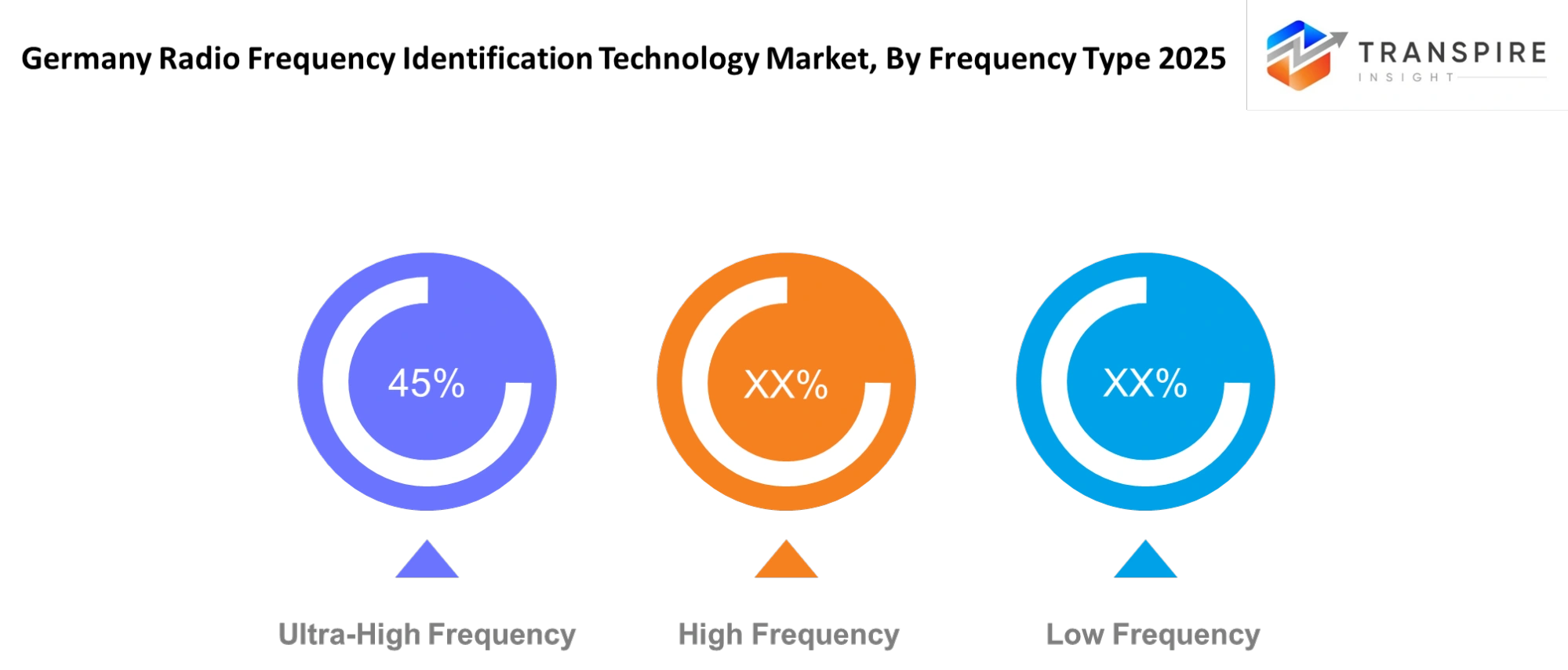
- Low Frequency: The low frequency systems will be able to facilitate short-range communication with reliable performance in situations that may be prone to interference. The use is set to remain significant in access control, animal tracking, and secure identification procedures, where reliability is more significant than communication speed.
- High Frequency: High-frequency systems can facilitate moderate-range reading with faster communication speeds than low-frequency systems. The use is expected to remain significant in procedures that require quick interaction, such as contactless transactions, ticketing, and library procedures.
- Ultra-High Frequency: Ultra-high frequency systems can facilitate long-range reading, making them applicable in situations that require quick scanning, such as logistics procedures. Businesses will rely on this type of system to facilitate effective inventory management.
To learn more about this report, Download Free Sample Report
By Application
- Retail: The retail industry is expected to utilize the identification system in their retail operations, which will help them improve the accuracy of their inventory management as well as the overall customer experience by reducing the time taken at the checkout counters.
- Healthcare: The healthcare industry is expected to utilize the identification system in their operations, which will help them improve the accuracy of their operations, thereby reducing the risk of errors that may occur during the fast-paced operations of the healthcare industry.
- Logistics: The logistics industry is expected to utilize the identification system in their operations, which will help them improve the efficiency of their operations by reducing the time taken at the distribution centers.
- Manufacturing: The manufacturing industry is expected to utilize the identification system in their operations, which will help them improve the efficiency of their operations by reducing the time taken during the operations of the manufacturing units.
Country Insights
The northern region of the country is likely to witness increased maritime trade activities, and the identification technology would be utilized in these areas as well. As the trade activities are high in these areas, the identification technology would be in high demand to maintain efficiency in the trade activities.
The southern region of the country would be focusing on the manufacturing industry, and the identification technology would be implemented in these areas as well. As the region is already industrialized, the identification technology would be in high demand in the region.
The western region of the country would be having an equal contribution from the retail, healthcare, and logistics sectors. As the region is already urbanized, the identification technology would be in high demand in the region, especially in the retail and healthcare sectors, as the region would be focusing on the efficiency of the operations in these sectors.
Recent Development News
Enterprise RFID demand is strong: European investors have recognized that RFID system adoption within the enterprise segment is stronger than anticipated. The stock market performance of companies reflects the optimism that RFID tags and systems will continue to gain traction. The emerging interest in RFID systems indicates that industrial sectors, such as German manufacturing and logistics industries, continue to rely on RFID technology.
Impinj stock performance: Impinj Inc is one of the leading global RFID technology companies. The company's stock performance has been stable and reflects positive expectations for Q1 2026. The emerging trends and stock performance of the company indicate that RFID system adoption is strong even in the face of profitability challenges. The company's strong stock performance reflects emerging trends and continued RFID system adoption within the enterprise segment. The enterprise segment includes markets where German partners and customers operate.
RFID applications: The emerging trends in radio frequency identification have recognized the growing interest in RFID systems within the smart packaging and sustainability segment of the supply chain.
|
Report Metrics |
Details |
|
Market size value in 2025 |
USD 1048.8 Million |
|
Market size value in 2026 |
USD 1162.1 Million |
|
Revenue forecast in 2033 |
USD 2396.8 Million |
|
Growth rate |
CAGR of 10.90% from 2026 to 2033 |
|
Base year |
2025 |
|
Historical data |
2021 – 2024 |
|
Forecast period |
2026 – 2033 |
|
Report coverage |
Revenue forecast, competitive landscape, growth factors, and trends |
|
Country scope |
Germany |
|
Key company profiled |
NXP Semiconductors, Zebra Technologies, Honeywell International, Impinj Inc., Avery Dennison, Alien Technology, Checkpoint Systems, GAO RFID, Invengo Technology, HID Global, Smartrac Technology, Motorola Solutions, Datalogic SpA, Toshiba TEC, Siemens AG. |
|
Customization scope |
Free report customization (country, regional & segment scope). Avail customized purchase options to meet your exact research needs. |
|
Report Segmentation |
By Component (Tags, Readers, Software), By Frequency Type (Low Frequency, High Frequency, Ultra-High Frequency), By Application (Retail, Healthcare, Logistics, Manufacturing). |
Germany Radio Frequency Identification Technology Market Company Insights
The leading companies in this industry will drive market growth through innovation and practical application across manufacturing, retail, and logistics. SICK AG and Pepperl+Fuchs SE will focus on improving automation in industries. Avery Dennison will improve smart labeling solutions, thereby enhancing supply chain visibility and sustainability. Impinj will improve real-time data capture through advanced platforms, while Zebra Technologies will provide integrated solutions that include hardware and software capabilities to track assets and manage workflows. The focus will remain on reliability, integration, and adherence to European standards.
Company List
- NXP Semiconductors
- Zebra Technologies
- Honeywell International
- Impinj Inc
- Avery Dennison
- Alien Technology
- Checkpoint Systems
- GAO RFID
- Invengo Technology
- HID Global
- Smartrac Technology
- Motorola Solutions
- Datalogic SpA
- Toshiba TEC
- Siemens AG.
Germany Radio Frequency Identification Technology Market Report Segmentation
By Component
- Tags
- Readers
- Software
By Frequency Type
- Low Frequency
- High Frequency
- Ultra-High Frequency
By Application
- Retail
- Healthcare
- Logistics
- Manufacturing
Frequently Asked Questions
Find quick answers to common questions.
The approximate Germany Radio Frequency Identification Technology Market size for the market will be USD 2396.8 Million in 2033.
Key segments for the Germany Radio Frequency Identification Technology Market By Component (Tags, Readers, Software), Frequency Type (Low Frequency, High Frequency, Ultra-High Frequency), Application (Retail, Healthcare, Logistics, Manufacturing).
Major Germany Radio Frequency Identification Technology Market NXP Semiconductors, Zebra Technologies, Honeywell International, Impinj Inc., Avery Dennison, Alien Technology, Checkpoint Systems, GAO RFID, Invengo Technology, HID Global, Smartrac Technology, Motorola Solutions, Datalogic SpA, Toshiba TEC, Siemens AG.
The Germany Radio Frequency Identification Technology Market size is USD 1048.8 Million in 2025.
The Germany Radio Frequency Identification Technology Market CAGR is 10.90%.
- NXP Semiconductors
- Zebra Technologies
- Honeywell International
- Impinj Inc
- Avery Dennison
- Alien Technology
- Checkpoint Systems
- GAO RFID
- Invengo Technology
- HID Global
- Smartrac Technology
- Motorola Solutions
- Datalogic SpA
- Toshiba TEC
- Siemens AG.
Recently Published Reports
-
Apr 2026
3D Optical Profiler Market
3D Optical Profiler Market Size, Share & Analysis Report By Type (Desktop 3D Optical Profiler, and Portable 3D Optical Profiler), By Technology (Confocal Technology, and White Light Interference), By End-Use Industry (Manufacturing, Research Institutions, Automotive, Aerospace and Defense, Medical Devices, and Other), and Geography (North America, Europe, Asia-Pacific, Middle East and Africa, South and Central America), 2021 - 2031
-
Apr 2026
Depth Sensor Market
Depth Sensor Market Size, Share & Analysis Report By Type (Infrared Depth Sensors, Time-of-Flight (ToF) Sensors, Stereo Vision Sensors, Structured Light Sensors, Ultrasonic Depth Sensors), By Application (Automotive, Robotics, Gaming, Consumer Electronics, Industrial Automation, Healthcare, Security & Surveillance, Others), By End Users (Automotive Manufacturers, Consumer Electronics Companies, Healthcare Providers, Industrial Companies, Security Agencies, Gaming Companies, Robotics Companies, Others), and Geography (North America, Europe, Asia-Pacific, Middle East and Africa, South and Central America), 2021 – 2031
-
Apr 2026
Digital Manufacturing Market
Digital Manufacturing Market Size, Share & Analysis Report By Component (Hardware, Software, and Services), By Technology (Robotics, 3D Printing, Internet of Things (IoT), and Others), By Application (Automotive and Transportation, Aerospace and Defense, Consumer Electronics, Industrial Machinery, and Others), By Process Type (Computer-Based Designing, Computer-Based Simulation, Computer 3D Visualization, Analytics, and Others), and Geography (North America, Europe, Asia-Pacific, Middle East and Africa, South and Central America), 2021 – 2031
-
Apr 2026
Digital Visa Services Market
Digital Visa Services Market Size, Share & Analysis Report By Type (Individual Travelers, Group Travelers), By Application (Tourism, Business Travel, Others), and Geography (North America, Europe, Asia-Pacific, Middle East and Africa, South and Central America), 2021 – 2031