

Germany Breakfast Cereal Market Size & Forecast:
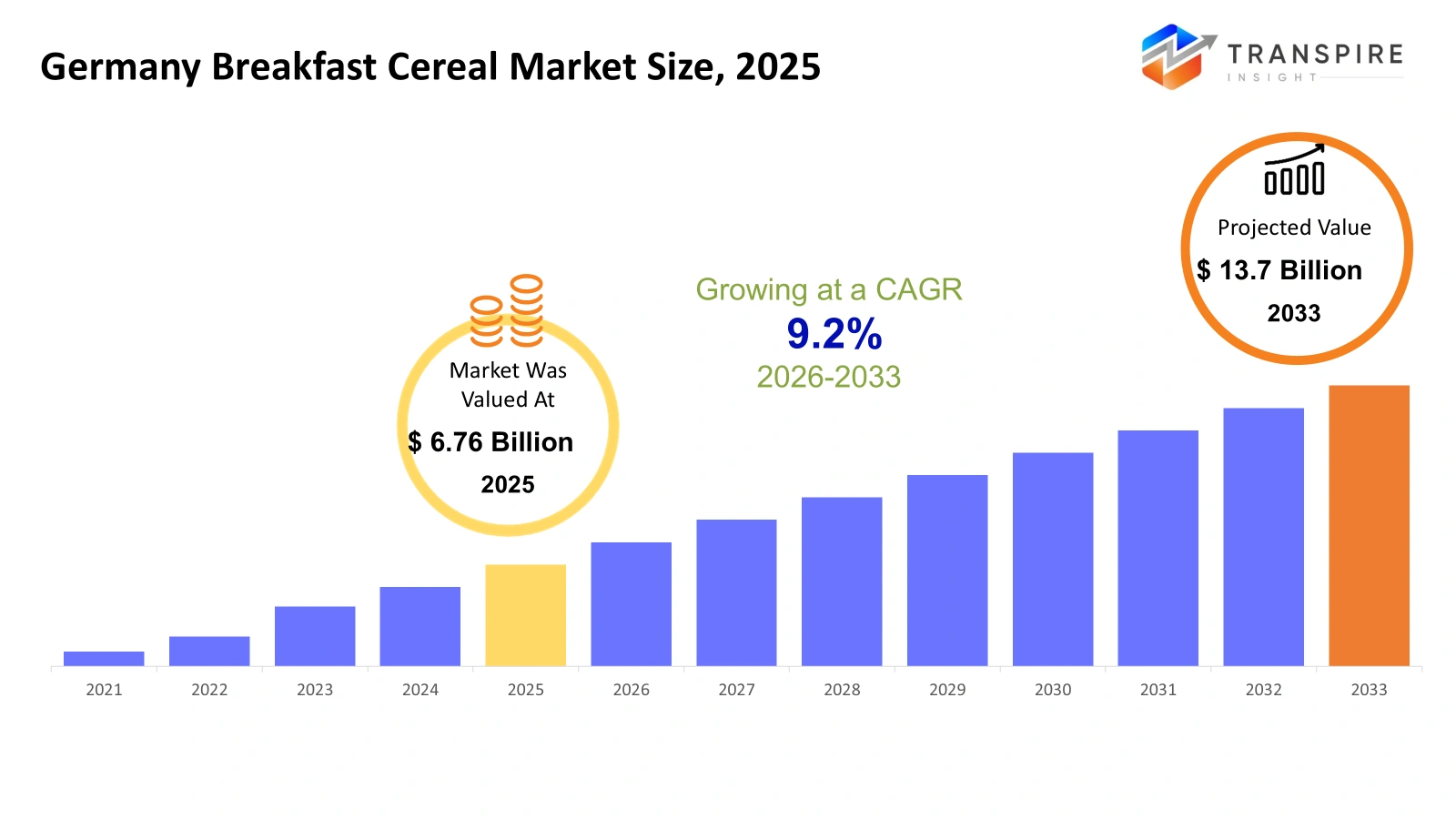
- Germany Breakfast Cereal Market Size 2025: USD 6.76 Billion
- Germany Breakfast Cereal Market Size 2033: USD 13.7 Billion
- Germany Breakfast Cereal Market CAGR: 9.2%
- Germany Breakfast Cereal Market Segments: By Product Type (Ready-to-Eat Cereals, Hot Cereals), By Source (Corn, Wheat, Oat), By Packaging (Boxes, Pouches), By Distribution Channel (Supermarkets/Hypermarkets, Online Retail)
To learn more about this report,  Download Free Sample Report
Germany Breakfast Cereal Market Summary:
The Germany Breakfast Cereal Market size is estimated at USD 6.76 Billion in 2025 and is anticipated to reach USD 13.7 Billion by 2033, growing at a CAGR of 9.2% from 2026 to 2033. The Germany Breakfast Cereal Market functions as a component of the nation's packaged food sector, which will reflect changing breakfast patterns from urban communities to rural areas. The two groups of customers will choose between two breakfast options because busy people need quick, whole-grain bowls with seeds and protein or because older customers prefer mild sugary flavors with stomach relief. Retailers will use digital shelf analytics to make product selection decisions, which will result in supermarkets receiving niche granola products and low-sugar flake items at an accelerated pace. The upcoming ten years will see manufacturers who want to connect with daily breakfast trends use nutrition labeling regulations and sustainability packaging targets to reshape their recipes and select their ingredients.
Key Market Trends & Insights:
Morning routine changes within Germany will create higher demand for breakfast foods which combine fast preparation with healthy nutrient content. Shoppers will increasingly choose cereals with whole grains, oats, nuts, and seeds. Manufacturers will respond by developing healthier product combinations which contain reduced sugar content and packaging will focus on fiber content, protein value, and clean ingredient labels to establish consumer trust.
Digital retail expansion will reshape how breakfast cereals reach households across Germany. Online grocery platforms will showcase niche cereal products which include organic muesli and functional granola mixes. Retailers will utilize data-driven merchandising to determine shelf placement which enables emerging brands and private labels to reach health-conscious customers.
German consumers will direct cereal production and packaging methods through their sustainability expectations. Brands will gradually adopt recyclable paper-based boxes, responsibly sourced grains, and transparent supply chains. Environmental labeling and sustainability certifications will become stronger marketing tools as shoppers increasingly evaluate products based on ecological responsibility and ingredient origin.
Product innovation will shift toward functional nutrition and dietary diversity. Producers will develop plant-based protein cereals, gluten-free grains, and fortified blends which provide energy and immunity and digestion support. As people understand the benefits of balanced diets better, cereal companies will market breakfast products as easy-to-use items which provide essential nutrients for everyday use.
Germany Breakfast Cereal Market Segmentation
By Product Type
Ready-to-Eat Cereals- The dominance of ready-to-eat cereals is a common phenomenon in breakfast meals because they ensure convenience and quick preparation. Generally, breakfast cereals are prepared using processed cereals such as corn, wheat, or oats, which are enriched with vitamins and minerals.
Hot Cereals- Hot cereals are those that should be cooked or mixed with hot water or milk before consumption. Hot cereals include oatmeal or porridge, which are widely consumed because of their soothing texture, natural composition, and nutritional value.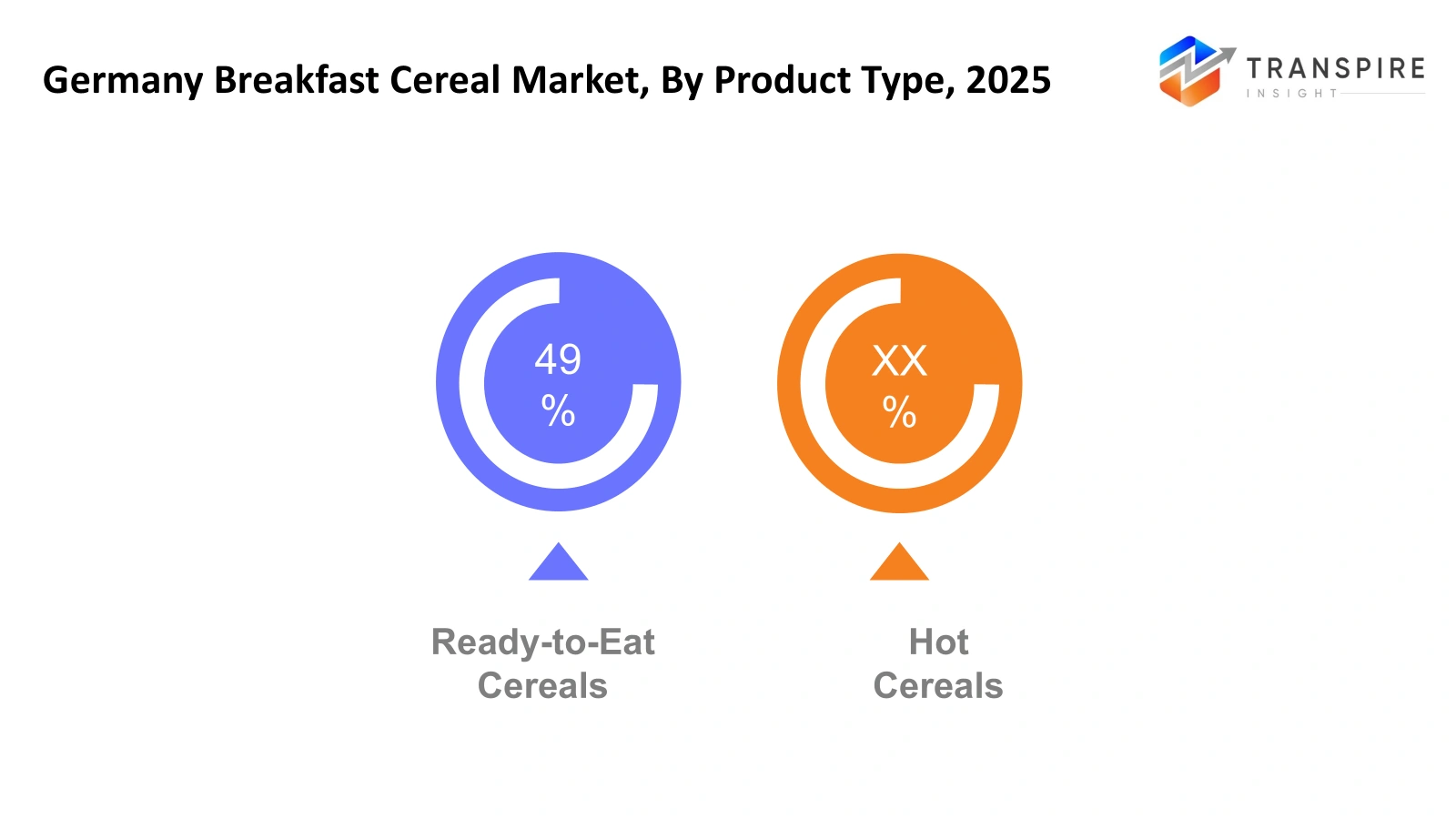
To learn more about this report, Download Free Sample Report
By Source
Corn- Corn-based cereals are popular breakfast meals because they are easily prepared, less costly, and possess a soft texture with a mild taste. Corn flakes are one type of breakfast cereal that is widely consumed by families and children because they ensure a crunchy breakfast meal that is enriched with essential nutrients.
Wheat- Wheat-based cereals are rich in nutritional value as they possess a balanced composition of carbohydrates, fiber, and protein. Wheat-based cereals include shredded wheat or wheat flakes, which are consumed by individuals because they ensure a filling breakfast meal.
Oat- Oat-based cereals are closely linked with health-conscious consumers. Oats are known to provide health benefits as they are rich in beta-glucan fiber. Oat-based cereals, such as oatmeal or oat-based granola mixes, are popular breakfast cereals due to their natural taste.
By Packaging
Boxes- Box packaging is the most common type of packaging used by breakfast cereals, as it has better shelf presence as well as product protection.
Pouches- Pouch packaging is increasingly being used by breakfast cereals as it is lightweight, flexible, and has less packaging material. It is more appealing to new-age consumers as it is easier to store.
By Distribution Channel
Supermarkets/Hypermarkets- The main sales channel identified is that of supermarkets/ hypermarkets, through which breakfast cereals are sold. These stores offer a wide range of products at promotional prices, thereby facilitating consumer purchasing.
Online Retail- The sales channels involving internet retailers are growing significantly, given that more and more people are adopting internet-based grocery shopping. These sales channels enable brands to reach more customers by offering a wide range of products, thereby facilitating consumer purchasing.
Country Insights
High consumer awareness of nutritional benefits and convenience has helped sustain cereal demand, particularly for fortified cereal blends and low sugar content, which are popular with busy families and health-conscious urban professionals across the country throughout the year.
The premiumization trend for cereals has been seen in whole grain, organic, and oat-based formulations, with parents preferring cereals that are popular with children, while millennials prefer cereals with high fiber content, proteins, and sustainable packaging, driven by ethical concerns.
To cater to the demand, retailers have maintained a wide range of cereals in supermarkets, along with online subscriptions, promotions, private label offerings, and convenient single-serve packaging, while regional distributors cover small towns and cater to demand spikes in festivals.
Regulatory pressure on labeling and nutrient content has driven reformulation activities in the industry, with companies investing in innovation in clean label, alternative grains, and processing technology for longer shelf life, taste, and low sugar content, in line with regulatory requirements.
Recent Development News
Market Growth and Consumption Trends- The German breakfast cereal industry has an expanding market, with the trend in consumption indicating an increased interest in ready-to-eat and healthy cereal products. The growth in the industry has been consistent, with an emphasis on whole grains and low-sugar content.
Regulatory & Ingredient Focus- Industry reports in Europe have indicated that there are concerns over the amount of chemicals found in cereal products, and as such, some manufacturers are focusing on clean ingredient lists as a way of dealing with the findings of health advocacy groups.
|
Report Metrics |
Details |
|
Market size value in 2025 |
USD 6.76 Billion |
|
Market size value in 2026 |
USD 7.4 Billion |
|
Revenue forecast in 2033 |
USD 13.7 Billion |
|
Growth rate |
CAGR of 9.2% from 2026 to 2033 |
|
Base year |
2025 |
|
Historical data |
2021 – 2024 |
|
Forecast period |
2026 – 2033 |
|
Report coverage |
Revenue forecast, competitive landscape, growth factors, and trends |
|
Country scope |
Germany |
|
Key company profiled |
Kellogg’s, Nestlé, General Mills, Post Holdings, Quaker (PepsiCo), Weetabix (ABF), Dr. Oetker, Hero Group, Nature’s Path Foods, Kellanova, B&G Foods, RITTER SPORT, Private Label Brands, PepsiCo Europe. |
|
Customization scope |
Free report customization (country, regional & segment scope). Avail customized purchase options to meet your exact research needs. |
|
Report Segmentation |
By Product Type (Ready-to-Eat Cereals, Hot Cereals), By Source (Corn, Wheat, Oat), By Packaging (Boxes, Pouches), By Distribution Channel (Supermarkets/Hypermarkets, Online Retail) |
Key Germany Breakfast Cereal Market Insights
The Germany breakfast cereals market is witnessing a growth trend, primarily fueled by the high rate of consumer demand for healthy, convenient, and nutritious breakfast cereals. Ready-to-eat cereals lead the way in sales, and supermarkets and online channels are seeing increased distribution. Consumer demand for breakfast cereals is driven by wellness trends, promotions, and purchase behavior, and premium and healthy options are gaining popularity as consumer dietary habits change.
Company List
- Kellogg’s
- Nestlé
- General Mills
- Post Holdings
- Quaker (PepsiCo)
- Weetabix (ABF)
- Dr. Oetker
- Hero Group
- Nature’s Path Foods
- Kellanova
- B&G Foods
- RITTER SPORT
- Private Label Brands
- PepsiCo Europe.
Germany Breakfast Cereal Market Report Segmentation
By Product Type
- Ready-to-Eat Cereals
- Hot Cereals
By Source
- Corn
- Wheat
- Oat
By Packaging
- Boxes
- Pouches
By Distribution Channel
- Supermarkets/Hypermarkets
- Online Retail
Frequently Asked Questions
Find quick answers to common questions.
The Approximate Germany Breakfast Cereal Market size for the Market will be USD 6.76 Billion in 2033.
Key Segments for the Germany Breakfast Cereal Market By Product Type (Ready-to-Eat Cereals, Hot Cereals), By Source (Corn, Wheat, Oat), By Packaging (Boxes, Pouches), By Distribution Channel (Supermarkets/Hypermarkets, Online Retail).
Major Players in the Germany Breakfast Cereal Market are Kellogg’s, Nestlé, General Mills, Post Holdings, Quaker (PepsiCo), Weetabix (ABF), Dr. Oetker, Hero Group, Nature’s Path Foods, Kellanova, B&G Foods, RITTER SPORT, Private Label Brands, PepsiCo Europe.
The Current Germany Breakfast Cereal Market size is USD 6.76 Billion in 2025.
The Germany Breakfast Cereal Market CAGR is 9.2%.
- Kellogg’s
- Nestlé
- General Mills
- Post Holdings
- Quaker (PepsiCo)
- Weetabix (ABF)
- Dr. Oetker
- Hero Group
- Nature’s Path Foods
- Kellanova
- B&G Foods
- RITTER SPORT
- Private Label Brands
- PepsiCo Europe.
Recently Published Reports
-
Apr 2026
Baby Infant Formula Market
Baby Infant Formula Market Size, Share & Analysis Report By ype (Infant Milk, Follow On Milk, Specialty Baby Milk, Growing-Up Milk), By Ingredient (Carbohydrate, Fat, Protein, Minerals, Vitamins, and Others), By Product Form (Powder, Liquid, and Ready-to-feed), By Distribution Channels (Supermarket/Hypermarket, Specialty Store, Pharmacies, Online Retail, and Others), and Geography (North America, Europe, Asia-Pacific, Middle East and Africa, South and Central America), 2021 - 2031
-
Apr 2026
Edible Insects for Animal Feed Market
Edible Insects for Animal Feed Market Size, Share & Analysis Report By Type (Insect Powder, Insect Meal, Insect Bar, Insect Paste, Insect Oil, and Others), By Insect Type (Beetles, Cricket, Caterpillar, Hymenoptera, Orthoptera, Tree Bugs, and Others), By Application (Livestock, Pet Food, and Aquaculture), By Livestock Type (Poultry, Swine, and Others), and Geography (North America, Europe, Asia-Pacific, Middle East and Africa, South and Central America), 2021 - 2031
-
Apr 2026
Food Industry Disinfection and Bacterial Control Market
Food Industry Disinfection and Bacterial Control Market Size, Share & Analysis Report By Type (Chemical Disinfectants, Physical Disinfectants, and Biocides and Antimicrobials), By Application (Food Processing Equipment Surface Disinfection, Food Preparation Areas Surface Disinfection, Storage Areas Surface Disinfection, Anti-microbial Coatings Food Preservation, and Preservative Solutions Food Preservation), By End User (Meat and Poultry Processing, Dairy Processing, Seafood Processing, Bakery and Confectionery, Restaurants and Commercial Kitchens, and Food Service Providers), By Sales Channel (Online, Offline), and Geography (North America, Europe, Asia-Pacific, Middle East and Africa, South and Central America), 2021 - 2031
-
Apr 2026
Freeze Dried Food Market
Freeze Dried Food Market Size, Share & Analysis Report By Product Type (Fruits, Vegetables, Freeze-Dried Dairy Products, Freeze-Dried Meat and Seafood, Freeze-Dried Pet Food, and Prepared Meal), By Nature (Organic, and Conventional), By Form (Powdered, Granules, and Diced), By End Use (Breakfast Cereals, Dairy Products, Bakery & Confectionery, Nutritional Bars & Supplements, Powdered Beverages, Snacks, and Retail (Household)), and Geography (North America, Europe, Asia-Pacific, Middle East and Africa, South and Central America), 2021 - 2031