
Germany Advanced Elastomers Market Summary
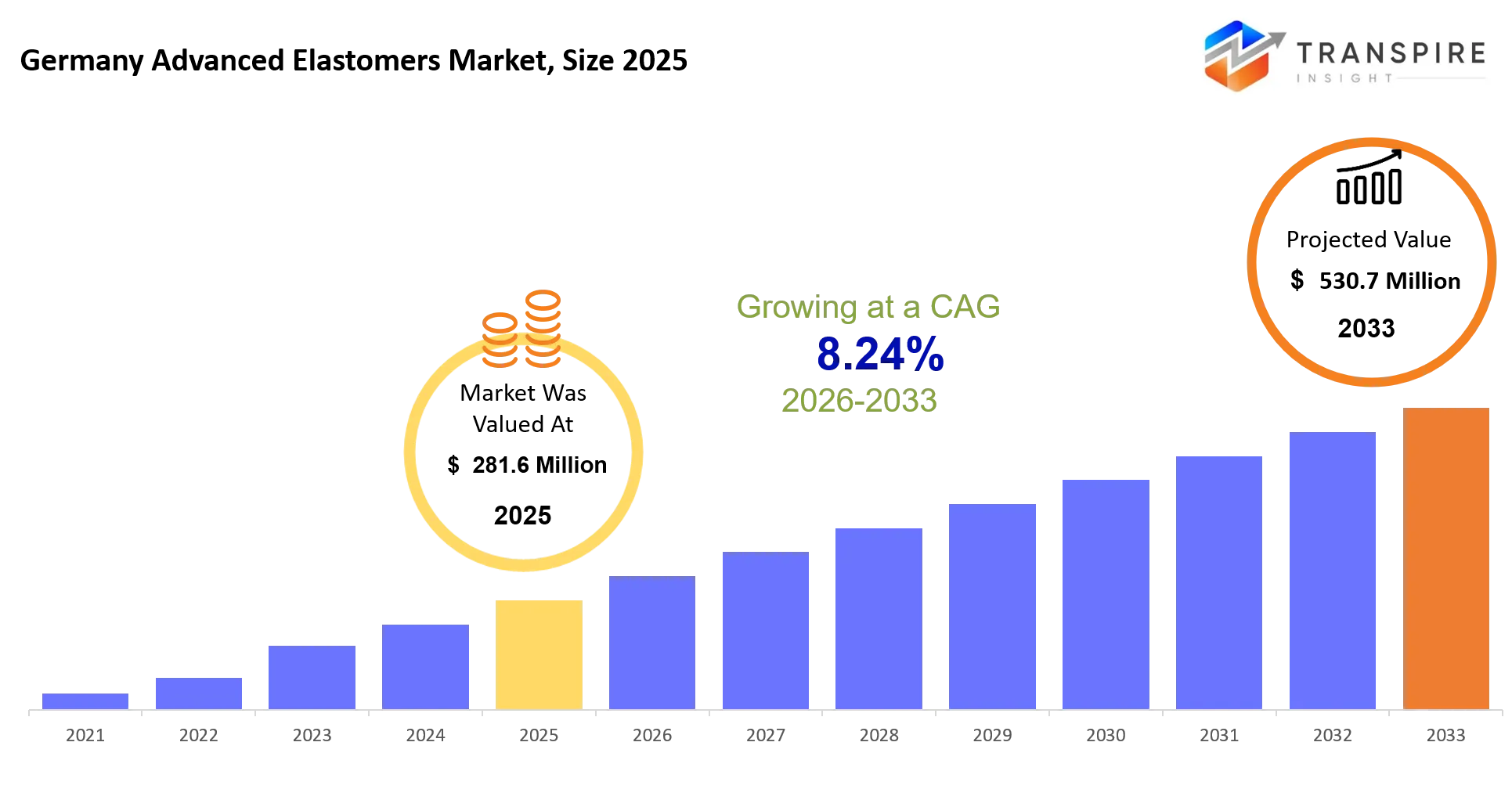
As per Transpire Insight Analysis, the Germany Advanced Elastomers Market size is estimated at USD 281.6 Million in 2025 and is anticipated to reach USD 530.7 Million by 2033, growing at a CAGR of 8.24% from 2026 to 2033.
The Germany Advanced Elastomers Market kind of plays a critical role in enabling durable, light-weight and high performance components across automotive, industrial machinery, medical devices, electrical systems, and renewable energy equipment. These specialty elastomers help manufacturers improve product longevity, endure even extreme temperatures and also curb maintenance expenses while still backing lightweight engineering goals. Over the last five years the whole market has moved away from more conventional rubber compounds toward high performance thermoplastic elastomers, and fluoroelastomers that are designed to satisfy tougher environmental requirements plus stricter performance standards.
There was also a disruption in global raw material supply chains after the Russia-Ukraine conflict, and that exposed sourcing risks, encouraged German manufacturers to strengthen regional production, and diversify their suppliers. That shift has accelerated investment in advanced material technologies which can deliver longer service life, and better efficiency. So as manufacturers push electrification, automation, and sustainable production practices, advanced elastomers are slowly turning into core engineering materials. It kind of translates directly into broader product uptake, and higher market revenue across multiple industrial segments.
Germany Advanced Elastomers Market Size & Forecast:
- Germany Advanced Elastomers Market Size 2025: USD 281.6 Million
- Expected Market Value 2033: USD 530.7 Million
- Forecast CAGR: 8.24%
- Leading region in 2025:Southern Germany
- Fastest Growing region:Eastern Germany
- Key Profile: Hughes Network Systems, Viasat, Gilat Satellite Networks, SES, Eutelsat OneWeb, Intelsat, ST Engineering iDirect, Cobham Satcom, Comtech Telecommunications, Kymeta, Honeywell, Thales, Orbit Communications, NSSLGlobal, ND SatCom
Key Market Insights
- Southern Germany kind of dominates the Germany Advanced Elastomers market, pulling in about 41% market share in 2025 ,and that’s mainly because Bavaria and Baden-Württemberg have strong automotive and industrial manufacturing clusters.
- Meanwhile Eastern Germany is expected to grow the quickest through 2033, with semiconductor investments, battery manufacturing, and a broader push for industrial modernization all working in the background.
- If you look at the product side, Thermoplastic Elastomers TPEs take up roughly 38% of the market, supported by the need for lightweight automotive parts and recyclable material requirements.
- On the flip side, the fastest-growing product looks like Fluoroelastomers, which are projected to post the strongest growth through 2033, driven by electric vehicle thermal management and chemical processing use cases.
- From applications, automotive is still the big contributor, around 36% of market revenue. And renewable energy equipment is showing up as the fastest-growing application segment across the forecast period.
- For end users, automotive manufacturers are still the biggest group, hovering near 35% market share. Meanwhile the electronics and semiconductor industries are the ones that are expanding the fastest, specifically when you look at customer demand.
- On the competitive side, the biggest players—ARKEMA, Dow, BASF, LANXESS, DuPont, and Covestro—continue pouring resources into specialty elastomer formulations and ongoing sustainable materials innovation.
- Plus, partnerships between materials suppliers and automotive OEMs have basically sped up the creation of lightweight, heat-resistant elastomers meant for next generation electric mobility platforms.
- More manufacturers keep adding recycled feedstocks and bio based raw materials too, so they can comply with European sustainability regulations. And they’re also trying to strengthen supply chain resilience , at the same time—not only one of those things, but kind of both.
What are the Key Drivers, Restraints, and Opportunities in the Germany Advanced Elastomers Market?
The strongest driver for the Germany Advanced Elastomers Market is the fast expansion of electric vehicle production, and industrial automation kind of at the same time. Electric vehicles need elastomer parts that can handle higher temperatures, plus electrical insulation requirements, and they also face tough chemical exposure inside battery setups. In parallel, Germany’s Industry 4.0 push has encouraged producers to swap usual rubber materials for specialty elastomers, which help extend equipment operating life and also cut back maintenance intervals. Because of these technical needs, the advanced elastomer content per made product tends to be higher, and that supports stronger revenue across automotive, electronics and industrial sectors.
Advanced elastomers really rely on fluorinated chemicals, specialty monomers , and various engineered additives, at least that’s how it works in practice. But once you use those materials, the manufacturing steps get more complicated, and the supply chains end up spread across several regions, kind of far and wide. Meanwhile capacity limits , geopolitical shocks , and tougher environmental regulations keep pushing pricing uncertainty, and firms can’t always damp it down quickly. So cost pressure makes purchasing decisions slower , it pinches profit margins tighter, and it can also slow down adoption among smaller and medium sized industrial users, even if the performance improvements are obvious .
On the other hand, there’s a real growth chance too , linked to hydrogen infrastructure and renewable energy equipment . Germany keeps putting money into hydrogen production, fuel cell technologies, and offshore wind projects that demand sealing solutions able to survive under high pressure and in corrosive surroundings. Advanced elastomers that are specifically designed for hydrogen compatibility, plus long-term durability are becoming more and more valuable.
What Has the Impact of Artificial Intelligence Been on the Germany Advanced Elastomers Market?
Artificial intelligence is quietly reshaping the Germany Advanced Elastomers Market, not just in a straightforward way, but in how material development and manufacturing efficiency get pushed forward at the same time. Companies are starting to use AI driven analytics more often to tune polymer formulations, which cuts down on the usual laboratory testing cycles and speeds up product development for automotive, electronics, and medical use. Instead of waiting around for results, machine learning models review production settings like temperature , pressure, viscosity, and curing conditions to make process behavior steadier and to bring down manufacturing defects .
At the operational level, predictive maintenance systems keep an eye on extrusion lines, molding equipment, and mixing machinery continuously. That helps maintenance teams spot likely component failures ahead of any real production stoppage , so interruptions happen less frequently. In practical terms this usually boosts equipment uptime, reduces material waste, and lowers manufacturing costs, while still keeping quality standards tightly under control.
On top of that, newer digital technologies support supply chain coordination in a more targeted manner. AI tools forecast raw material availability, surface procurement hazards early, and improve inventory planning especially when the market gets jumpy or volatile. There are also AI powered simulation tools that let engineers estimate long term elastomer performance when thermal, mechanical, and chemical stress are involved. This can reduce product validation time and, at least in many cases, help teams commercialize faster.
Still, the big question is that broader AI adoption moves slower than expected. High implementation costs, plus the challenge of connecting older manufacturing systems with newer digital platforms, limits progress. In addition, some specialized elastomer manufacturers don’t have deep historical production records. That means predictive algorithms can be less accurate during the early rollout phase, and the full set of operational benefits takes longer to actually appear.
Key Market Trends
- Automotive makers ramped up their thermoplastic elastomer use by almost 18% since 2021, swapping heavier conventional rubber bits in EV platforms, kinda like that.
- Specialty elastomer firms started pouring more into recyclable formulations after the EU Green Deal, which, yeah, helped thicken up sustainable product suites for multiple industrial uses.
- BASF, LANXESS, and Dow meanwhile expanded digital material development platforms and cut formulation development timelines by around 20% between 2022 and 2025.
- After the Russia-Ukraine conflict, supply chain diversification really picked up, with German manufacturers pushing more regional sourcing to lower raw material reliance, and logistics headaches.
- Fluoroelastomer demand also got stronger across hydrogen infrastructure and semiconductor production, because higher thermal plus chemical endurance is becoming more critical every year.
- In industrial automation, projects nudged companies toward longer-wearing sealing materials, so downtime drops and maintenance frequency is not as frequent.
- Electronics manufacturers shifted to higher purity elastomer materials to satisfy tighter semiconductor production rules, and cleanroom manufacturing requirements too.
- With joint innovation, automotive OEMs and specialty chemical companies sped up the creation of lighter elastomer solutions for next generation mobility.
- Bio-based feedstocks became more commercially workable after 2023, backing lower-carbon specialty elastomer output without sacrificing mechanical performance, not fully anyway.
- AI-assisted manufacturing along with predictive quality control improved efficiency while reducing material waste, and that helped keep Germany’s advanced materials industry more competitive.
Germany Advanced Elastomers Market Segmentation
By Component
VSAT Terminals kinda sit at the operational heart of satellite communication systems, because they let data move back and forth between faraway places and network hubs in a dependable way. They show up a lot across enterprise sites, energy facilities , and government operations too, and that keeps demand fairly steady since uninterrupted communication is still essential for everyday business. For antennas , the point is to keep signal reception stable even when weather is doing weird things, and satellite modems then take the digital info and turn it into signals that the satellite can actually use for smoother transmission. Then gateways connect the whole satellite side with terrestrial infrastructure so communication can flow across multiple locations without too much friction.
Network Management Software is how operators keep an eye on network performance, handle bandwidth allocation, and fix technical issues before service quality starts to slip. It typically comes with installation, maintenance, technical support, plus managed connectivity, so customers can keep operations running even if their internal resources are limited. Other component categories include specialized hardware and supporting equipment that are built for specific communication needs across different industrial applications. Ongoing improvements in software automation and terminal efficiency also help expand deployment, both in commercial settings and in government environments.
By Band Type
Ku-Band stays kind of the go-to frequency, mostly because it offers balanced performance, pretty broad coverage, and it’s cost efficient enough that deployment becomes realistic for enterprise communication and remote connectivity, all those projects. Meanwhile Ka-Band is still moving up because it delivers higher bandwidth and quicker data transmission, so it works well when the network needs more capacity than usual. C-Band is useful in places hit by heavy rainfall, since the signal holds up better and that helps keep operations running without too much interruption. X-Band, on the other hand, shows up a lot in defense or government communication, where secure plus dependable connectivity is, honestly, the main requirement.
Hybrid Band solutions usually mix several frequency bands, kind of to lift network availability and keep communication alive even when environmental conditions keep shifting around. Having multi-band capability means operators can tune how bandwidth is allocated, based on what’s happening operationally and which services matter most. There are also other frequency bands that fit specialized communication needs across research activities, industrial monitoring, and remote infrastructure projects. And overall, ongoing investment in satellite technology keeps improving bandwidth utilization and network flexibility, no matter which kind of deployment environment is involved.
By Application
Enterprise connectivity is, basically, the biggest application area because most organizations need secure communication running between headquarters, branch offices, manufacturing sites, and those remote operational areas. In banking networks , satellite communication still matters a lot for keeping financial transactions going without interruptions and for maintaining secure connectivity especially where local terrestrial infrastructure is thin or just not there. For Oil & Gas communications , dependable satellite networks are used for offshore platforms, drilling activity, and pipeline monitoring , and the continuous link really does support operational safety. Maritime connectivity meanwhile backs up commercial vessels, passenger ships, plus offshore work, using stable internet access and day to day operational communication.
Remote office connectivity helps organizations keep functioning across isolated industrial locations, using steady data exchange and voice communication. Disaster recovery applications kick in for emergency communication when storms, earthquakes, or infrastructure failures disrupt regular network services. Other use cases cover mining, defense, healthcare, education, and research programs , all of which depend on reliable communication in tough operating environments. And with digital operations expanding, adoption of satellite communication continues to grow across multiple industries, even when conditions are… not ideal.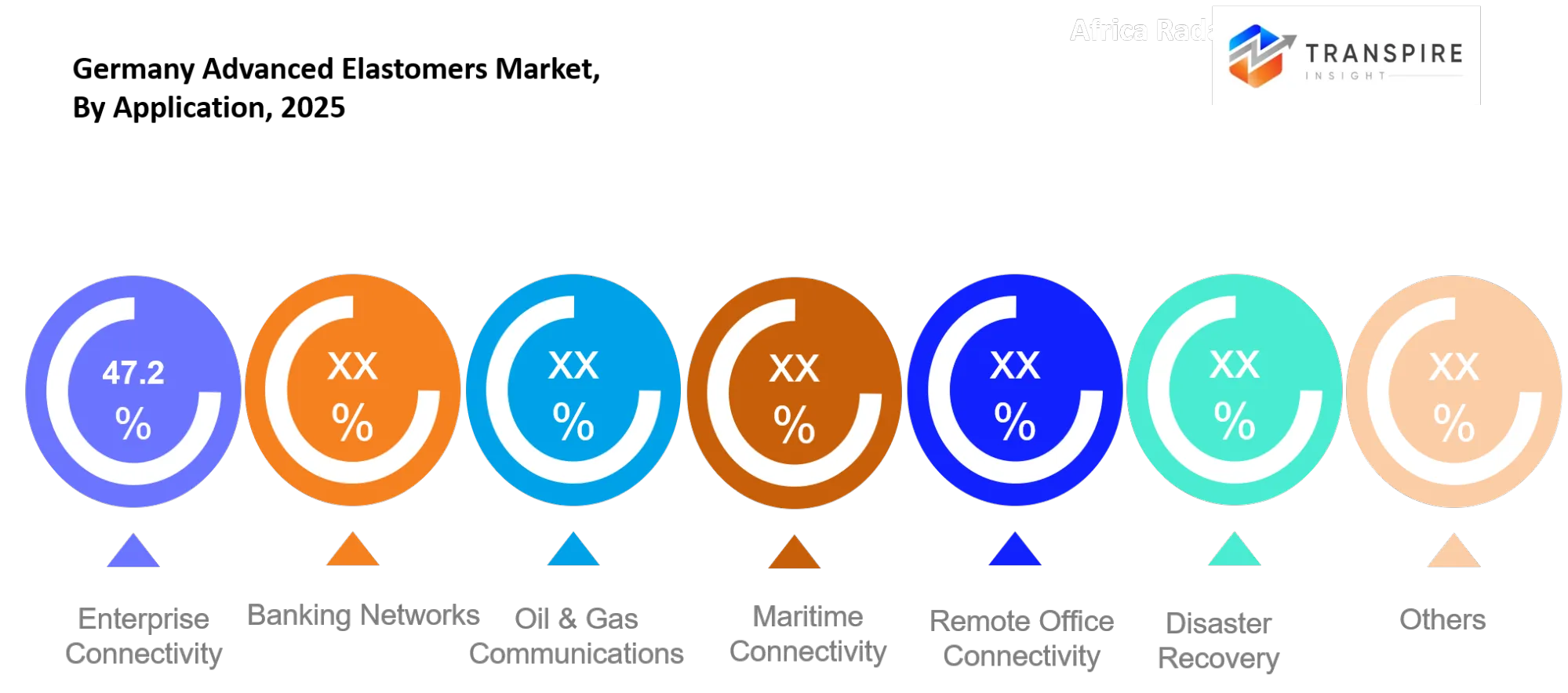
By End User
Telecom operators are a major customer group, because satellite communication helps spread network coverage into rural and underserved areas, even where there is not much ground infrastructure around. Also, government organizations often lean on satellite networks for defense communication, emergency response, border security, and public administration, since steady connectivity keeps national operations moving. BFSI institutions usually need dependable, safeguarded satellite links so banking services stay available across branches that are spread far apart. In a similar way, Energy and Utilities organizations depend on satellite systems to track distant assets and keep operational control, pretty much without interruption.
Maritime companies need dependable communication for fleet operations, navigation help, crew well-being, and cargo handling throughout long-distance voyages. Meanwhile, businesses from manufacturing , logistics, healthcare, and retail are using satellite connectivity more and more, not just for growth but to improve business continuity and overall operational toughness. There are also other users like educational institutions, humanitarian organizations, research centers, and transportation providers who work in remote settings. Overall, the broad industry adoption shows a growing need for reliable communications that does not rely on terrestrial network limits as a main constraint.
By Deployment
Fixed VSAT installations take up a noticeable portion of the market since the permanent links, help keep industrial plants , branch offices, government buildings, and energy infrastructure consistently connected. Mobile VSAT systems, on the other hand, support communication for moving assets that operate while locations shift, and this helps operational flexibility for transportation needs as well as emergency response actions. Portable VSAT solutions are used for fast setup during disaster recovery situations, temporary work sites, and field operations where immediate connectivity is needed right away. Vehicle-Mounted VSAT supports emergency vehicles, military logistics, and mobile command centers, basically by keeping network access steady while they are on the move.
With deployment flexibility, organizations can choose the communication style based on real operational needs, how much mobility they actually require, and what local infrastructure can support. Field operations are growing in construction, utilities, defense, and public safety so that naturally drives more adoption of mobile and portable communication platforms. Other deployment choices include customized satellite configurations, created for niche industrial uses where the installation layout has to be adjusted in its own way. Ongoing improvements in satellite equipment design also make installation faster, and can increase communication reliability.
What are the Key Use Cases Driving the Germany Advanced Elastomers Market?
Industrial manufacturing is still the leading use case, simply because those improved elastomers end up doing more than people expect—they help sealing performance quite a bit, smooth out vibration control, and generally make everything last longer in automotive production, machinery, and factory automation. Electric vehicle production is where the pressure gets really high, in the sense that battery systems, thermal management parts, and high-voltage applications all push hard on material needs, so the elastomers must tolerate harsh operating conditions for longer periods.
Medical equipment and electronics manufacturing also keep growing their material adoption, not just casually, but because precision components tend to demand chemical resistance, a bit of pliability, and a long service life, even with repeated use. Renewable energy installations, such as wind turbines and hydrogen processing equipment, raise consumption too, since energy operators are actively looking for dependable materials that can handle continuous mechanical plus environmental stress.
Looking ahead, emerging applications show up in hydrogen storage systems, semiconductor manufacturing equipment, and newer aerospace components. If investment stays on track for lightweight engineering, advanced mobility technologies, and high-performance industrial systems, more opportunities should appear for specialty elastomer materials across the forecast period.
|
Report Metrics |
Details |
|
Market size value in 2025 |
USD 281.6 Million |
|
Market size value in 2026 |
USD 304.8 Million |
|
Revenue forecast in 2033 |
USD 530.7 Million |
|
Growth rate |
CAGR of 8.24% from 2026 to 2033 |
|
Base year |
2025 |
|
Historical data |
2021 - 2024 |
|
Forecast period |
2026 - 2033 |
|
Report coverage |
Revenue forecast, competitive landscape, growth factors, and trends |
|
Regional scope |
Germany |
|
Key company profiled |
Hughes Network Systems, Viasat, Gilat Satellite Networks, SES, Eutelsat OneWeb, Intelsat, ST Engineering iDirect, Cobham Satcom, Comtech Telecommunications, Kymeta, Honeywell, Thales, Orbit Communications, NSSLGlobal, ND SatCom |
|
Customization scope |
Free report customization (country, regional & segment scope). Avail customized purchase options to meet your exact research needs. |
|
Report Segmentation |
By Component (VSAT Terminals, Antennas, Satellite Modems, Gateways, Network Management Software, Services, Others); By Band Type (Ku-Band, Ka-Band, C-Band, X-Band, Hybrid Band, Others); By Application (Enterprise Connectivity, Banking Networks, Oil & Gas Communications, Maritime Connectivity, Remote Office Connectivity, Disaster Recovery, Others); By End User (Telecom Operators, Government, BFSI, Energy & Utilities, Maritime Companies, Enterprises, Others); By Deployment (Fixed VSAT, Mobile VSAT, Portable VSAT, Vehicle-Mounted VSAT, Others) |
Which Regions are Driving the Germany Advanced Elastomers Market Growth?
Southern Germany kind of holds the biggest slice of the market, and it’s driven mostly by Bavaria, and Baden-Württemberg where automotive manufacturing, industrial machinery production, plus advanced chemical processing are all packed pretty tightly. Then the whole thing gets reinforced by strong environmental regulations and very firm product quality standards , which basically nudges manufacturers toward high-performance elastomers that help with durability, and also energy efficiency. There’s also this dense little network of automotive OEMs, specialty chemical producers, research institutes and engineering suppliers that keeps pushing material innovation, and speeds up commercialization. Add long term investment in electric vehicle production, and industrial automation and you end up with this region staying right in the center of both product development and commercial demand.
Western Germany sits in the second spot in terms of regional contribution, mainly because chemical manufacturing, aerospace production, and industrial equipment industries generate pretty constant demand for advanced elastomer materials. Compared with Southern Germany, the growth story here relies less on automotive production and more on how steady diversified industrial activity is across North Rhine-Westphalia, and even into nearby states. The region also benefits from established production sites, dependable logistics infrastructure, and long-running collaboration between manufacturers and material suppliers so it feels more resilient during supply chain disruptions. On top of that, continuous investment in process modernization, plus advanced manufacturing technologies keeps revenue generation steady across multiple industrial sectors, even when things get a little tricky.
Eastern Germany is expected to expand the fastest during the forecast period, as semiconductor manufacturing, battery production, and clean energy investments start accelerating around Saxony and Brandenburg.
Who are the Key Players in the Germany Advanced Elastomers Market and How Do They Compete?
Competition stays kind of moderately consolidated , since only a handful of global material producers really have the research mindshare, manufacturing muscle, and practical application know-how required for advanced elastomer work. The competitive edge usually comes more from formulation technology, overall product behavior, sustainability credibility, and the ability to back customers with application engineering , not just race on price. Most companies keep putting money into specialty grades , mainly those geared toward electric vehicles, industrial automation, renewable energy, and also medical manufacturing.
BASF stands out via a wide set of thermoplastic polyurethane plus specialty elastomer offerings , backed by solid research strength and very tight collaboration with automotive makers. Ongoing investment in lower-carbon material options, alongside circular production methods, is what keeps the long-term competitiveness more secure. LANXESS leans hard into high-performance synthetic rubber for tough automotive and industrial scenarios, while simultaneously broadening sustainable manufacturing and pushing specialty product development forward. Covestro, meanwhile, puts emphasis on polyurethane elastomer innovation , mixing digital material development with advanced processing technologies that give customers more design leeway and better production efficiency.
Dow plays a different card through silicone-based elastomer technologies that serve healthcare, electronics, and industrial sealing use cases where thermal stability and chemical resistance are non‑negotiable. Dow also builds momentum using product innovation and material solutions tailored to the specific customer. Arkema tries to strengthen its market position by working on recyclable thermoplastic elastomers, plus bio-based material efforts that fit with European sustainability targets.
Company List
• Hughes Network Systems
• Viasat
• Gilat Satellite Networks
• SES
• Eutelsat OneWeb
• Intelsat
• ST Engineering iDirect
• Cobham Satcom
• Comtech Telecommunications
• Kymeta
• Honeywell
• Thales
• Orbit Communications
• NSSLGlobal
• ND SatCom
Recent Development News
In February 2026, Covestro announced the start of its strategic partnership with XRG following completion of the transaction. The partnership provides additional investment resources to accelerate innovation, digital transformation, and sustainable material development, including advanced elastomer technologies.https://annualreport.covestro.com
What Strategic Insights Define the Future of the Germany Advanced Elastomers Market?
The market is kind of moving toward high-value specialty materials made for electric mobility, semiconductor manufacturing hydrogen infrastructure and advanced industrial automation, not in a simple way either. Performance needs are getting more strict, so manufacturers are encouraged to invest in materials that mix durability, lightweight design, chemical resistance, and also lower carbon footprints.
There’s also a less visible danger, it’s the ongoing reliance on specialty raw materials and fluorinated feedstocks , where supply disruptions or stricter environmental rules could bump up production costs and slow commercialization.
At the same time there’s an emerging opening : better elastomer formulations for hydrogen storage systems and for next generation battery manufacturing. In that space material reliability will matter a lot, like, it becomes a competitive edge rather than just an accessory.
Firms that grow regional production capacity, strengthen recycling know-how, and put money into cooperative research with automotive, energy, and electronics manufacturers will likely be more ready to lock in long-term growth and cut back exposure to future supply chain instability.
Germany Advanced Elastomers Market Report Segmentation
By Component
• VSAT Terminals
• Antennas
• Satellite Modems
• Gateways
• Network Management Software
• Services
• Others
By Band Type
• Ku-Band
• Ka-Band
• C-Band
• X-Band
• Hybrid Band
• Others
By Application
• Enterprise Connectivity
• Banking Networks
• Oil & Gas Communications
• Maritime Connectivity
• Remote Office Connectivity
• Disaster Recovery
• Others
By End User
• Telecom Operators
• Government
• BFSI
• Energy & Utilities
• Maritime Companies
• Enterprises
• Others
By Deployment
• Fixed VSAT
• Mobile VSAT
• Portable VSAT
• Vehicle-Mounted VSAT
• Others
Frequently Asked Questions
Find quick answers to common questions.
The Expected Germany Advanced Elastomers Market size for the Market will be USD 530.7 Million in 2033.
Key segments for the Germany Advanced Elastomers Market are By Component (VSAT Terminals, Antennas, Satellite Modems, Gateways, Network Management Software, Services, Others); By Band Type (Ku-Band, Ka-Band, C-Band, X-Band, Hybrid Band, Others); By Application (Enterprise Connectivity, Banking Networks, Oil & Gas Communications, Maritime Connectivity, Remote Office Connectivity, Disaster Recovery, Others); By End User (Telecom Operators, Government, BFSI, Energy & Utilities, Maritime Companies, Enterprises, Others); By Deployment (Fixed VSAT, Mobile VSAT, Portable VSAT, Vehicle-Mounted VSAT, Others).
Major Germany Advanced Elastomers Market players are Hughes Network Systems, Viasat, Gilat Satellite Networks, SES, Eutelsat OneWeb, Intelsat, ST Engineering iDirect, Cobham Satcom, Comtech Telecommunications, Kymeta, Honeywell, Thales, Orbit Communications, NSSLGlobal, ND SatCom.
The Germany Advanced Elastomers Market size is USD 281.6 Million in 2025.
The Germany Advanced Elastomers Market CAGR is 8.24% from 2026 to 2033.
• Hughes Network Systems
• Viasat
• Gilat Satellite Networks
• SES
• Eutelsat OneWeb
• Intelsat
• ST Engineering iDirect
• Cobham Satcom
• Comtech Telecommunications
• Kymeta
• Honeywell
• Thales
• Orbit Communications
• NSSLGlobal
• ND SatCom
About the Authors

Mayur Shinde
I am Mayur Shinde, a Senior Research Analyst at Transpire Insight, specializing in the Automotive & Transportation and Information & Communication Technology (ICT) Industry. My work focuses on analyzing emerging market trends, technological advancements, competitive landscapes, and industry developments to deliver accurate, data-driven insights. I am passionate about transforming complex market information into clear, actionable content that helps businesses, professionals, and decision-makers stay informed and make confident strategic decisions.

Chakradhar Khansole
Chakradhar serves as the Research Director at Transpire Insight, bringing over 8 years of experience in technology, innovation, and strategic market intelligence. He specializes in transforming complex market data into actionable business insights that enable organizations to make informed, growth-oriented decisions. Recognized for his strategic vision and analytical expertise, Chakradhar leads high-impact research initiatives, delivering comprehensive market assessments, competitive intelligence, and forward-looking industry analysis.
Recently Published Reports
-
Apr 2026
3D Optical Profiler Market
3D Optical Profiler Market Size, Share & Analysis Report By Type (Desktop 3D Optical Profiler, and Portable 3D Optical Profiler), By Technology (Confocal Technology, and White Light Interference), By End-Use Industry (Manufacturing, Research Institutions, Automotive, Aerospace and Defense, Medical Devices, and Other), and Geography (North America, Europe, Asia-Pacific, Middle East and Africa, South and Central America), 2021 - 2031
-
Apr 2026
Depth Sensor Market
Depth Sensor Market Size, Share & Analysis Report By Type (Infrared Depth Sensors, Time-of-Flight (ToF) Sensors, Stereo Vision Sensors, Structured Light Sensors, Ultrasonic Depth Sensors), By Application (Automotive, Robotics, Gaming, Consumer Electronics, Industrial Automation, Healthcare, Security & Surveillance, Others), By End Users (Automotive Manufacturers, Consumer Electronics Companies, Healthcare Providers, Industrial Companies, Security Agencies, Gaming Companies, Robotics Companies, Others), and Geography (North America, Europe, Asia-Pacific, Middle East and Africa, South and Central America), 2021 – 2031
-
Apr 2026
Digital Manufacturing Market
Digital Manufacturing Market Size, Share & Analysis Report By Component (Hardware, Software, and Services), By Technology (Robotics, 3D Printing, Internet of Things (IoT), and Others), By Application (Automotive and Transportation, Aerospace and Defense, Consumer Electronics, Industrial Machinery, and Others), By Process Type (Computer-Based Designing, Computer-Based Simulation, Computer 3D Visualization, Analytics, and Others), and Geography (North America, Europe, Asia-Pacific, Middle East and Africa, South and Central America), 2021 – 2031
-
Apr 2026
Digital Visa Services Market
Digital Visa Services Market Size, Share & Analysis Report By Type (Individual Travelers, Group Travelers), By Application (Tourism, Business Travel, Others), and Geography (North America, Europe, Asia-Pacific, Middle East and Africa, South and Central America), 2021 – 2031